Calciosamarskite
A valid IMA mineral species - grandfathered
This page is currently not sponsored. Click here to sponsor this page.
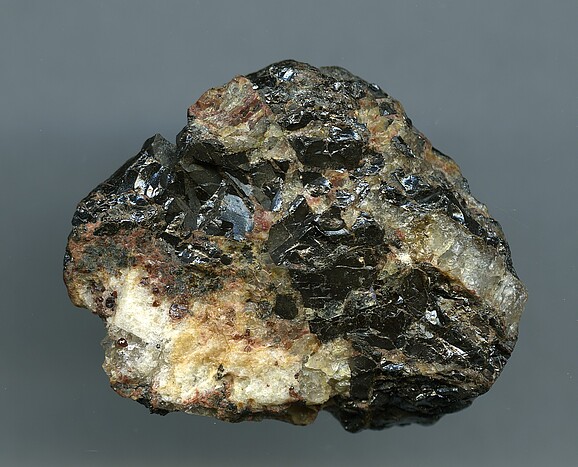

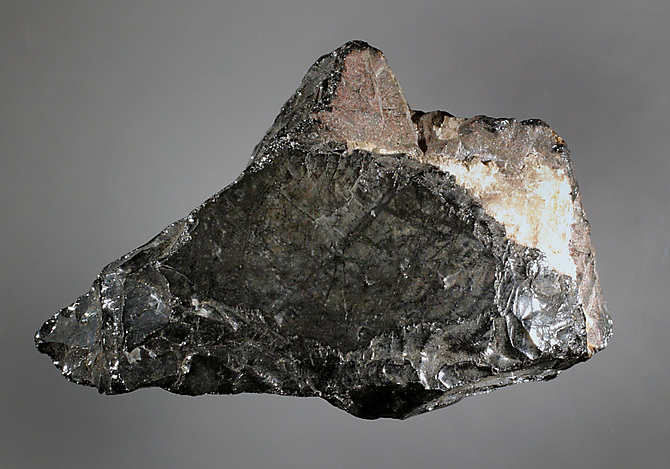

About Calciosamarskite
Formula:
(Ca,U4+)Fe3+(Nb,Ta,Ti)2O8
Colour:
Black
Lustre:
Vitreous
Hardness:
5 - 6
Specific Gravity:
4.48 - 4.74
Crystal System:
Orthorhombic
Member of:
Name:
Honors Colonel Vasilii Evgrafovich von Samarskii-Bykhovets (1803-1870), Chief of Staff of the Russian Corps of Mining Engineers. The prefix, calcio, indicates Ca is dominant in the A-site.
Samarskite Group.
The empirical formula based on Hanson et al. (1999) is (Ca0.31Y0.17Fe2+0.26U0.19Na0.08REE0.23)1.24(Nb0.79Ta0.07Ti0.04)0.90O4; all elements are required for charge balance, and iron is assumed to be ferrous, also to maintain charge balance. The ideal formula, as given above, cannot have any divalent cations in the A position in order to maintain charge neutrality.
The empirical formula based on Hanson et al. (1999) is (Ca0.31Y0.17Fe2+0.26U0.19Na0.08REE0.23)1.24(Nb0.79Ta0.07Ti0.04)0.90O4; all elements are required for charge balance, and iron is assumed to be ferrous, also to maintain charge balance. The ideal formula, as given above, cannot have any divalent cations in the A position in order to maintain charge neutrality.
Unique Identifiers
Mindat ID:
7962
Long-form identifier:
mindat:1:1:7962:0
IMA Classification of Calciosamarskite
Approved, 'Grandfathered' (first described prior to 1959)
IMA Formula:
(Ca,Fe,Y)(Nb,Ta,Ti)O4
Classification of Calciosamarskite
4.DB.25
4 : OXIDES (Hydroxides, V[5,6] vanadates, arsenites, antimonites, bismuthites, sulfites, selenites, tellurites, iodates)
D : Metal: Oxygen = 1:2 and similar
B : With medium-sized cations; chains of edge-sharing octahedra
4 : OXIDES (Hydroxides, V[5,6] vanadates, arsenites, antimonites, bismuthites, sulfites, selenites, tellurites, iodates)
D : Metal: Oxygen = 1:2 and similar
B : With medium-sized cations; chains of edge-sharing octahedra
Mineral Symbols
As of 2021 there are now IMA–CNMNC approved mineral symbols (abbreviations) for each mineral species, useful for tables and diagrams.
| Symbol | Source | Reference |
|---|---|---|
| Csmk | IMA–CNMNC | Warr, L.N. (2021). IMA–CNMNC approved mineral symbols. Mineralogical Magazine, 85(3), 291-320. doi:10.1180/mgm.2021.43 |
Pronunciation of Calciosamarskite
Pronunciation:
| Play | Recorded by | Country |
|---|---|---|
| Jolyon Ralph | United Kingdom |
Physical Properties of Calciosamarskite
Vitreous
Transparency:
Opaque
Colour:
Black
Streak:
Brown-grey
Hardness:
5 - 6 on Mohs scale
Tenacity:
Brittle
Cleavage:
None Observed
Fracture:
Conchoidal
Density:
4.48 - 4.74 g/cm3 (Measured)
Optical Data of Calciosamarskite
Type:
Isotropic
Comments:
n>2
Chemistry of Calciosamarskite
Mindat Formula:
(Ca,U4+)Fe3+(Nb,Ta,Ti)2O8
Element Weights:
Crystallography of Calciosamarskite
Crystal System:
Orthorhombic
Class (H-M):
mmm (2/m 2/m 2/m) - Dipyramidal
Cell Parameters:
a = 5.632 Å, b = 9.912 Å, c = 5.221 Å
Ratio:
a:b:c = 0.568 : 1 : 0.527
Unit Cell V:
291.46 ų (Calculated from Unit Cell)
Morphology:
Massive or in rough, square prisms (Parry Sound material)
Comment:
Space Group: n.d.; metamict
X-Ray Powder Diffraction
Powder Diffraction Data:
| d-spacing | Intensity |
|---|---|
| 2.952 Å | (100) |
| 3.079 Å | (90) |
| 2.599 Å | (35) |
| 3.867 Å | (30) |
| 2.824 Å | (30) |
| 3.614 Å | (25) |
| 1.839 Å | (20) |
Comments:
After heating at 1100°C for 12 hours
Geological Environment
Paragenetic Mode(s):
| Paragenetic Mode | Earliest Age (Ga) |
|---|---|
| Stage 4b: Highly evolved igneous rocks | >3.0 |
| 34 : Complex granite pegmatites |
Type Occurrence of Calciosamarskite
Co-Type Localities:
General Appearance of Type Material:
As anhedral masses.
Geological Setting of Type Material:
An accessory mineral in RE-rich granite pegmatites
Associated Minerals at Type Locality:
Other Language Names for Calciosamarskite
Relationship of Calciosamarskite to other Species
Member of:
Other Members of Samarskite Group:
| Ishikawaite | U4+Fe2+Nb2O8 | Mon. |
| Samarskite-(Y) | YFe3+Nb2O8 | Mon. 2/m : P2/b |
| Samarskite-(Yb) | YbFe3+(Nb,Ta)2O8 | Mon. 2/m : P2/b |
| Shakhdaraite-(Y) | ScYNb2O8 | Mon. 2/m : P2/b |
| Srilankite | ZrTi2O6 | Orth. mmm (2/m 2/m 2/m) : Pbcn |
| Yttrotantalite-(Y) | (Y,U,Fe2+)(Ta,Nb)(O,OH)4 | Orth. |
Common Associates
Associated Minerals Based on Photo Data:
| 1 photo of Calciosamarskite associated with Spessartine | Mn2+3Al2(SiO4)3 |
| 1 photo of Calciosamarskite associated with Albite | Na(AlSi3O8) |
| 1 photo of Calciosamarskite associated with Quartz | SiO2 |
| 1 photo of Calciosamarskite associated with Samarskite-(Y) | YFe3+Nb2O8 |
Related Minerals - Strunz-mindat Grouping
| 4.DB. | Nioboheftetjernite | ScNbO4 |
| 4.DB. | Nioboixiolite-(Mn2+) | (Nb0.67Mn2+0.33)O2 |
| 4.DB. | Shakhdaraite-(Y) | ScYNb2O8 |
| 4.DB.05 | Varlamoffite | Sn1-xFexO2-x(OH) |
| 4.DB.05 | Argutite | GeO2 |
| 4.DB.05 | Cassiterite | SnO2 |
| 4.DB.05 | Rutile | TiO2 |
| 4.DB.05 | Plattnerite | PbO2 |
| 4.DB.05 | Tripuhyite | Fe3+Sb5+O4 |
| 4.DB.05 | Tugarinovite | MoO2 |
| 4.DB.05 | Pyrolusite | Mn4+O2 |
| 4.DB.10 | Byströmite | MgSb2O6 |
| 4.DB.10 | Ordoñezite | ZnSb2O6 |
| 4.DB.10 | Tredouxite | NiSb2O6 |
| 4.DB.10 | Tapiolite-(Mn) | Mn2+Ta2O6 |
| 4.DB.10 | Tapiolite-(Fe) | Fe2+Ta2O6 |
| 4.DB.15a | Paramontroseite | V4+O2 |
| 4.DB.15a | Ramsdellite | Mn4+O2 |
| 4.DB.15b | Akhtenskite | ε-Mn4+O2 |
| 4.DB.15c | Nsutite | (Mn4+,Mn2+)(O,OH)2 |
| 4.DB.20 | Scrutinyite | α-PbO2 |
| 4.DB.20 | Nioboixiolite-([]) | (Nb0.8◻0.2)4+O2 |
| 4.DB.25 | Ishikawaite | U4+Fe2+Nb2O8 |
| 4.DB.25 | Yttrocolumbite-(Y) | Y(U4+,Fe2+)Nb2O8 |
| 4.DB.25 | Samarskite-(Yb) | YbFe3+(Nb,Ta)2O8 |
| 4.DB.25 | Ixiolite-(Fe2+) | (Ta0.67Fe2+0.33)O2 |
| 4.DB.25 | Ixiolite-(Mn2+) | (Ta0.67Mn2+0.33)O2 |
| 4.DB.25 | Srilankite | ZrTi2O6 |
| 4.DB.25 | Samarskite-(Y) | YFe3+Nb2O8 |
| 4.DB.25 | Nioboixiolite-(Fe3+) | (Nb0.5Fe3+0.5)O2 |
| 4.DB.30 va | Wolframite Group | |
| 4.DB.30 | Rossovskyite | (Fe3+,Ta)(Nb,Ti)O4 |
| 4.DB.30 | Huanzalaite | MgWO4 |
| 4.DB.30 | Heftetjernite | ScTaO4 |
| 4.DB.30 | Hübnerite | MnWO4 |
| 4.DB.30 | Sanmartinite | (Zn,Fe)WO4 |
| 4.DB.30 | Ferberite | FeWO4 |
| 4.DB.30 | Krasnoselskite | CoWO4 |
| 4.DB.35 | Qitianlingite | (Fe,Mn)2(Nb,Ta)2WO10 |
| 4.DB.35 | Tantalaeschynite-(Ce) | Ce(TiTa)O6 |
| 4.DB.35 | Tantalite-(Mg) | (Mg,Fe2+)(Ta,Nb)2O6 |
| 4.DB.35 | Columbite-(Mn) | Mn2+Nb2O6 |
| 4.DB.35 | Tantalite-(Mn) | Mn2+Ta2O6 |
| 4.DB.35 | Columbite-(Fe) | Fe2+Nb2O6 |
| 4.DB.35 | Columbite-(Mg) | (Mg,Fe,Mn)(Nb,Ta)2O6 |
| 4.DB.35 | Tantalite-(Fe) | Fe2+Ta2O6 |
| 4.DB.40 | Ferrotitanowodginite | Fe2+TiTa2O8 |
| 4.DB.40 | Wolframowodginite | Mn(Mn,Sn,Fe,Ta)(W,Ta,Nb)2O8 |
| 4.DB.40 | Lithiotantite | LiTa3O8 |
| 4.DB.40 | Lithiowodginite | LiTa3O8 |
| 4.DB.40 | Titanowodginite | Mn2+TiTa2O8 |
| 4.DB.40 | Tantalowodginite | (Mn2+0.5◻0.5)TaTa2O8 |
| 4.DB.40 | Wodginite | Mn2+Sn4+Ta2O8 |
| 4.DB.40 | Ferrowodginite | Fe2+Sn4+Ta2O8 |
| 4.DB.45 | Tivanite | V3+TiO3(OH) |
| 4.DB.50 | Carmichaelite | (Ti,Cr,Fe)[O2-x(OH)x] |
| 4.DB.55 | Alumotantite | AlTaO4 |
| 4.DB.60 | Biehlite | ((Sb,As)O)2[MoO4] |
Other Information
Health Risks:
No information on health risks for this material has been entered into the database. You should always treat mineral specimens with care.
Internet Links for Calciosamarskite
mindat.org URL:
https://www.mindat.org/min-7962.html
Please feel free to link to this page.
Please feel free to link to this page.
Search Engines:
External Links:
References for Calciosamarskite
Reference List:
Ellsworth, H. V. (1928) A mineral related to samarskite from the Woodcox mine, Hybla, Ontario. American Mineralogist, 13 (2) 63-65
Ellsworth, H. V. (1928) A mineral related to samarskite from Parry Sound, Ontario. American Mineralogist, 13 (2) 66-68
Localities for Calciosamarskite
 symbol to view information about a locality.
The
symbol to view information about a locality.
The Locality List
 - This locality has map coordinates listed.
- This locality has estimated coordinates.
ⓘ - Click for references and further information on this occurrence.
? - Indicates mineral may be doubtful at this locality.
- This locality has map coordinates listed.
- This locality has estimated coordinates.
ⓘ - Click for references and further information on this occurrence.
? - Indicates mineral may be doubtful at this locality.
 - Good crystals or important locality for species.
 - World class for species or very significant.
(TL) - Type Locality for a valid mineral species.
(FRL) - First Recorded Locality for everything else (eg varieties).
- World class for species or very significant.
(TL) - Type Locality for a valid mineral species.
(FRL) - First Recorded Locality for everything else (eg varieties).
All localities listed without proper references should be considered as questionable.
Australia | |
| Jacobson et al. (2007) +2 other references |
Canada (TL) | |
| Ellsworth (1928) +2 other references |
| www.geologyontario.mndm.gov.on.ca (n.d.) |
| Ellsworth (1928) +2 other references |
Czech Republic | |
| Pauliš P. et al. (Kutna Hora, issue 1) |
| Škoda et al. (2004) |
| Škoda +2 other references |
Poland | |
| PIECZKA et al. 2010: Nb-Ta minerals in ... |
| SZUSZKIEWICZ et al. (2013) | |
Russia | |
| Pavel M. Kartashov analytical data (2013) |
USA | |
| Eckel et al. (1997) |
| Hanson et al. (1999) |
Quick NavTopAbout CalciosamarskiteUnique IdentifiersIMA Classification Classification Mineral SymbolsPronunciation Physical Properties Optical Data Chemistry Crystallography X-Ray Powder DiffractionGeological EnvironmentType Occurrence Other LanguagesRelationshipsCommon AssociatesStrunz-MindatOther InformationInternet Links References Localities Locality List
Ilmen Nature Reserve, Chelyabinsk Oblast, Russia