Samarskite-(Yb)
A valid IMA mineral species
This page is currently not sponsored. Click here to sponsor this page.


About Samarskite-(Yb)
Formula:
YbFe3+(Nb,Ta)2O8
After the samarskite-(Y) redefinition (Britvin et al., 2019), with Fe as an essential and not substituting element, and considering data of Kjellman (2017), samarskite-(Yb) may either be a questionable species or a species stoichiometrically unrelated to samarskite-(Y).
Colour:
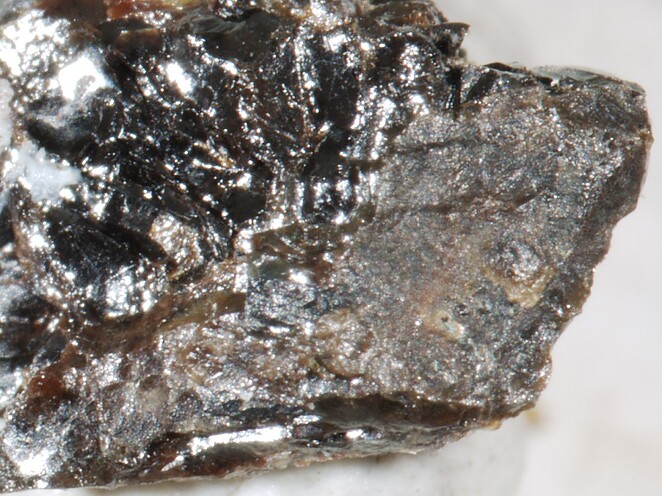
Black
Lustre:
Vitreous
Hardness:
5 - 6
Specific Gravity:
7.03
Crystal System:
Monoclinic
Member of:
Name:
Named for being the Yb analogue of samarskite-(Y).
Samarskite Group. The Yb analogue of Samarskite-(Y) (?). Unique combination of elements.
One of just a few known Yb-dominant minerals, the other being keiviite-(Yb), hingganite-(Yb), xenotime-(Yb), and 'hellandite-(Yb)'.
One of just a few known Yb-dominant minerals, the other being keiviite-(Yb), hingganite-(Yb), xenotime-(Yb), and 'hellandite-(Yb)'.
Unique Identifiers
Mindat ID:
27449
Long-form identifier:
mindat:1:1:27449:8
IMA Classification of Samarskite-(Yb)
Classification of Samarskite-(Yb)
4.DB.25
4 : OXIDES (Hydroxides, V[5,6] vanadates, arsenites, antimonites, bismuthites, sulfites, selenites, tellurites, iodates)
D : Metal: Oxygen = 1:2 and similar
B : With medium-sized cations; chains of edge-sharing octahedra
4 : OXIDES (Hydroxides, V[5,6] vanadates, arsenites, antimonites, bismuthites, sulfites, selenites, tellurites, iodates)
D : Metal: Oxygen = 1:2 and similar
B : With medium-sized cations; chains of edge-sharing octahedra
Mineral Symbols
As of 2021 there are now IMA–CNMNC approved mineral symbols (abbreviations) for each mineral species, useful for tables and diagrams.
| Symbol | Source | Reference |
|---|---|---|
| Smk-Yb | IMA–CNMNC | Warr, L.N. (2021). IMA–CNMNC approved mineral symbols. Mineralogical Magazine, 85(3), 291-320. doi:10.1180/mgm.2021.43 |
Physical Properties of Samarskite-(Yb)
Vitreous
Transparency:
Opaque
Colour:
Black
Comment:
Nearly opaque.
Streak:
Brown to black
Hardness:
5 - 6 on Mohs scale
Tenacity:
Brittle
Cleavage:
None Observed
Fracture:
Conchoidal
Density:
7.03(1) g/cm3 (Measured) 7.079 g/cm3 (Calculated)
Comment:
Measured density: unheated sample; calculated one: basing on the empirical formula.
Optical Data of Samarskite-(Yb)
Type:
Isotropic
RI values:
n = > 2.1
Birefringence:
Isotropic minerals have no birefringence
Surface Relief:
Moderate
Chemistry of Samarskite-(Yb)
Mindat Formula:
YbFe3+(Nb,Ta)2O8
After the samarskite-(Y) redefinition (Britvin et al., 2019), with Fe as an essential and not substituting element, and considering data of Kjellman (2017), samarskite-(Yb) may either be a questionable species or a species stoichiometrically unrelated to samarskite-(Y).
After the samarskite-(Y) redefinition (Britvin et al., 2019), with Fe as an essential and not substituting element, and considering data of Kjellman (2017), samarskite-(Yb) may either be a questionable species or a species stoichiometrically unrelated to samarskite-(Y).
Element Weights:
Common Impurities:
U,Th,Ca,Fe(II),Ta,Er,Y,Dy
Crystallography of Samarskite-(Yb)
Crystal System:
Monoclinic
Class (H-M):
2/m - Prismatic
Space Group:
P2/b
Setting:
P2/c
Cell Parameters:
a = 5.688(9) Å, b = 9.915(2) Å, c = 5.199(9) Å
β = 93.16(10)°
β = 93.16(10)°
Ratio:
a:b:c = 0.574 : 1 : 0.524
Unit Cell V:
292.76 ų
Z:
4
Twinning:
Not observed.
Comment:
Must have been heated to restore the structure; the above parameters are after heating to 1100oC for 12 hours.
X-Ray Powder Diffraction
Powder Diffraction Data:
| d-spacing | Intensity |
|---|---|
| 3.664 Å | (21) |
| 3.086 Å | (25) |
| 2.981 Å | (100) |
| 1.895 Å | (12) |
| 1.865 Å | (20) |
| 1.769 Å | (15) |
| 1.746 Å | (12) |
| 1.587 Å | (20) |
Locality:
Comments:
From type description (heated sample).
Geological Environment
Paragenetic Mode(s):
| Paragenetic Mode | Earliest Age (Ga) |
|---|---|
| Stage 4b: Highly evolved igneous rocks | >3.0 |
| 34 : Complex granite pegmatites |
Type Occurrence of Samarskite-(Yb)
General Appearance of Type Material:
Anhedral metamict masses, up to tens of centimeters in size, intergrown with columbite-(Fe) and zircon.
Place of Conservation of Type Material:
National Museum of Natural History (Smithsonian Institution_, Washington, D.C., USA, number NMNH 174442.
Geological Setting of Type Material:
Late-stage replacement units at the contact between core and margin of a pegmatite.
Associated Minerals at Type Locality:
Synonyms of Samarskite-(Yb)
Other Language Names for Samarskite-(Yb)
Relationship of Samarskite-(Yb) to other Species
Member of:
Other Members of Samarskite Group:
| Calciosamarskite | (Ca,U4+)Fe3+(Nb,Ta,Ti)2O8 | Orth. mmm (2/m 2/m 2/m) |
| Ishikawaite | U4+Fe2+Nb2O8 | Mon. |
| Samarskite-(Y) | YFe3+Nb2O8 | Mon. 2/m : P2/b |
| Shakhdaraite-(Y) | ScYNb2O8 | Mon. 2/m : P2/b |
| Srilankite | ZrTi2O6 | Orth. mmm (2/m 2/m 2/m) : Pbcn |
| Yttrotantalite-(Y) | (Y,U,Fe2+)(Ta,Nb)(O,OH)4 | Orth. |
Common Associates
Associated Minerals Based on Photo Data:
| 2 photos of Samarskite-(Yb) associated with Columbite-(Fe) | Fe2+Nb2O6 |
Related Minerals - Strunz-mindat Grouping
| 4.DB. | Nioboheftetjernite | ScNbO4 |
| 4.DB. | Nioboixiolite-(Mn2+) | (Nb0.67Mn2+0.33)O2 |
| 4.DB. | Shakhdaraite-(Y) | ScYNb2O8 |
| 4.DB.05 | Varlamoffite | Sn1-xFexO2-x(OH) |
| 4.DB.05 | Argutite | GeO2 |
| 4.DB.05 | Cassiterite | SnO2 |
| 4.DB.05 | Rutile | TiO2 |
| 4.DB.05 | Plattnerite | PbO2 |
| 4.DB.05 | Tripuhyite | Fe3+Sb5+O4 |
| 4.DB.05 | Tugarinovite | MoO2 |
| 4.DB.05 | Pyrolusite | Mn4+O2 |
| 4.DB.10 | Byströmite | MgSb2O6 |
| 4.DB.10 | Ordoñezite | ZnSb2O6 |
| 4.DB.10 | Tredouxite | NiSb2O6 |
| 4.DB.10 | Tapiolite-(Mn) | Mn2+Ta2O6 |
| 4.DB.10 | Tapiolite-(Fe) | Fe2+Ta2O6 |
| 4.DB.15a | Paramontroseite | V4+O2 |
| 4.DB.15a | Ramsdellite | Mn4+O2 |
| 4.DB.15b | Akhtenskite | ε-Mn4+O2 |
| 4.DB.15c | Nsutite | (Mn4+,Mn2+)(O,OH)2 |
| 4.DB.20 | Scrutinyite | α-PbO2 |
| 4.DB.20 | Nioboixiolite-([]) | (Nb0.8◻0.2)4+O2 |
| 4.DB.25 | Ishikawaite | U4+Fe2+Nb2O8 |
| 4.DB.25 | Yttrocolumbite-(Y) | Y(U4+,Fe2+)Nb2O8 |
| 4.DB.25 | Calciosamarskite | (Ca,U4+)Fe3+(Nb,Ta,Ti)2O8 |
| 4.DB.25 | Ixiolite-(Fe2+) | (Ta0.67Fe2+0.33)O2 |
| 4.DB.25 | Ixiolite-(Mn2+) | (Ta0.67Mn2+0.33)O2 |
| 4.DB.25 | Srilankite | ZrTi2O6 |
| 4.DB.25 | Samarskite-(Y) | YFe3+Nb2O8 |
| 4.DB.25 | Nioboixiolite-(Fe3+) | (Nb0.5Fe3+0.5)O2 |
| 4.DB.30 va | Wolframite Group | |
| 4.DB.30 | Rossovskyite | (Fe3+,Ta)(Nb,Ti)O4 |
| 4.DB.30 | Huanzalaite | MgWO4 |
| 4.DB.30 | Heftetjernite | ScTaO4 |
| 4.DB.30 | Hübnerite | MnWO4 |
| 4.DB.30 | Sanmartinite | (Zn,Fe)WO4 |
| 4.DB.30 | Ferberite | FeWO4 |
| 4.DB.30 | Krasnoselskite | CoWO4 |
| 4.DB.35 | Qitianlingite | (Fe,Mn)2(Nb,Ta)2WO10 |
| 4.DB.35 | Tantalaeschynite-(Ce) | Ce(TiTa)O6 |
| 4.DB.35 | Tantalite-(Mg) | (Mg,Fe2+)(Ta,Nb)2O6 |
| 4.DB.35 | Columbite-(Mn) | Mn2+Nb2O6 |
| 4.DB.35 | Tantalite-(Mn) | Mn2+Ta2O6 |
| 4.DB.35 | Columbite-(Fe) | Fe2+Nb2O6 |
| 4.DB.35 | Columbite-(Mg) | (Mg,Fe,Mn)(Nb,Ta)2O6 |
| 4.DB.35 | Tantalite-(Fe) | Fe2+Ta2O6 |
| 4.DB.40 | Ferrotitanowodginite | Fe2+TiTa2O8 |
| 4.DB.40 | Wolframowodginite | Mn(Mn,Sn,Fe,Ta)(W,Ta,Nb)2O8 |
| 4.DB.40 | Lithiotantite | LiTa3O8 |
| 4.DB.40 | Lithiowodginite | LiTa3O8 |
| 4.DB.40 | Titanowodginite | Mn2+TiTa2O8 |
| 4.DB.40 | Tantalowodginite | (Mn2+0.5◻0.5)TaTa2O8 |
| 4.DB.40 | Wodginite | Mn2+Sn4+Ta2O8 |
| 4.DB.40 | Ferrowodginite | Fe2+Sn4+Ta2O8 |
| 4.DB.45 | Tivanite | V3+TiO3(OH) |
| 4.DB.50 | Carmichaelite | (Ti,Cr,Fe)[O2-x(OH)x] |
| 4.DB.55 | Alumotantite | AlTaO4 |
| 4.DB.60 | Biehlite | ((Sb,As)O)2[MoO4] |
Fluorescence of Samarskite-(Yb)
Non-fluorescent
Other Information
Health Risks:
No information on health risks for this material has been entered into the database. You should always treat mineral specimens with care.
Internet Links for Samarskite-(Yb)
mindat.org URL:
https://www.mindat.org/min-27449.html
Please feel free to link to this page.
Please feel free to link to this page.
Search Engines:
External Links:
References for Samarskite-(Yb)
Reference List:
Britvin, Sergey N., Pekov, Igor V., Krzhizhanovskaya, Maria G., Agakhanov, Atali A., Ternes, Bernd, Schüller, Willi, Chukanov, Nikita V. (2019) Redefinition and crystal chemistry of samarskite-(Y), YFe3+Nb2O8: cation-ordered niobate structurally related to layered double tungstates. Physics and Chemistry of Minerals, 46 (7) 727-741 doi:10.1007/s00269-019-01034-0
Localities for Samarskite-(Yb)
 symbol to view information about a locality.
The
symbol to view information about a locality.
The Locality List
 - This locality has map coordinates listed.
- This locality has estimated coordinates.
ⓘ - Click for references and further information on this occurrence.
? - Indicates mineral may be doubtful at this locality.
- This locality has map coordinates listed.
- This locality has estimated coordinates.
ⓘ - Click for references and further information on this occurrence.
? - Indicates mineral may be doubtful at this locality.
 - Good crystals or important locality for species.
 - World class for species or very significant.
(TL) - Type Locality for a valid mineral species.
(FRL) - First Recorded Locality for everything else (eg varieties).
- World class for species or very significant.
(TL) - Type Locality for a valid mineral species.
(FRL) - First Recorded Locality for everything else (eg varieties).
All localities listed without proper references should be considered as questionable.
USA (TL) | |
| Eckel et al. (1997) +1 other reference |
| Anita Moore-Nall (personal communication January 2018) +1 other reference |
| Anita Moore-Nall (personal communication January 2018) +1 other reference |
Quick NavTopAbout Samarskite-(Yb)Unique IdentifiersIMA Classification Classification Mineral SymbolsPhysical Properties Optical Data Chemistry Crystallography X-Ray Powder DiffractionGeological EnvironmentType Occurrence SynonymsOther LanguagesRelationshipsCommon AssociatesStrunz-MindatFluorescence Other InformationInternet Links References Localities Locality List
Little Patsy pegmatite, South Platte Pegmatite Mining District, Jefferson County, Colorado, USA