Polymer OLEDs (PLED): introduction and market status
OLED is an emerging display and lighting technology that enables beautiful and efficient displays and lighting panels. Thin OLEDs are already being used in many mobile devices and TVs. Polymer-OLEDs (or PLEDs, also used to be called P-OLEDs) are OLED devices made from polymer (large-molecules) materials.

PLEDs vs SM-OLEDs
Basically you can make OLEDs from two kinds of materials: small-molecule (SM-OLED) or large-molecules, or polymers. Virtually all OLED displays on the market toady are using Small Molecules, and are produced using evaporation processes.
PLED (P-OLED) materials do not perform as good as SM-OLEDs in terms of lifetime and efficiency, but are easily soluble and so can be easily adapted for printing and other solution-based processes. In the past some believed that the soluble nature of PLEDs mean that these materials will be the future of OLED displays, but that has not been the case yet. There has been great progress in evaporation processes and materials - and also in soluble SM-OLEDs.
CDT / Sumitomo
UK-based Cambridge Display Technology (CDT) is the company that holds the basic patents for PLED technologies. The company licensed its technology to several companies, including Philips, Seiko Epson, Osram, Dupont and Delta Optoelectronics, but it does not seem as it anyone is pursuing PLEDs at the moment besides Sumitomo Chemicals (which owns CDT).
Sumitomo still develops PLED materials and panels. The materials were used by JOLED that used to mass produce OLEDs using inkjet printing - but the company is no longer in business).
Panasonic's 2013 56" OLED TV prototypes
In January 2013 Panasonic unveiled a 56" 4K (3840x2160) OLED TV panel prototype that was produced using an all-printing method and PLED materials. Panasonic says that all the organic materials were deposited using ink-jet printing. The panel's TFT substrate was supplied by Sony (and actually made by AUO. It's an Oxide-TFT panel) as part of the two companies collaboration. The lifetime and efficiency of this TV was not disclosed.


In December 2013 Sony and Panasonic announced that they are canceling the OLED TV JV. Panasonic is now producing OLED TVs - but these use WRGB OLED panels produced by LG Display.
P-OLED (PLED) vs pOLED
P-OLEDs, or PLEDs, are a class of OLED materials. Somewhat confusingly, LG Display is branding its mobile flexible AMOLED displays as pOLEDs (plastic OLEDs). For more information on LGD's pOLEDs, click here.
Further reading
Researchers develop a high-efficiency soluble polymer MR-TADF hyperfluorescence OLED emitter system
Researchers from Hanyang University, Gyeongsang National University, and Soongsil University have developed a high-efficiency soluble blue OLED emitter based on a hyperfluorescence architecture.

The new emitter platform uses a polymer/small-molecule hybrid emitting layer composed of a polymeric thermally TADF sensitizer and a narrowband MR-TADF emitter.


The end of the OLED process monoculture - what will it mean for supply chain companies?
For most of OLED's commercial history, the industry operated as a near-monolith: virtually every panel maker deposited RGB organic materials through a Fine Metal Mask (FMM) on 6th-generation glass (or polyimide substrates with a glass carrier), while LG Display stood as the sole practitioner of its WRGB architecture for large-area OLED production.

In recent years, we have seen the emergence of new OLED architectures, processes and materials that signal the end of this technological uniformity. In this article, we examine the different technologies, speculate how the industry is changing and where it is headed - and understand the implications for supply chain companies.
Researchers at the University of Oxford develop electrically-switch polarized OLED emitters
Researchers from the University of Oxford have developed a new OLED device that, by electrically switching, can change its light emission from left-handed circularly polarized light to a right-handed one.
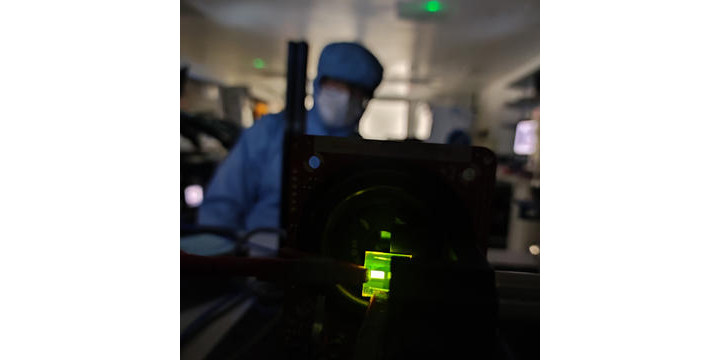
The researchers explain that usually to switch between the emission polarized direction, one would need to choose a different OLED emitter molecule - a mirror image of the other molecule. In this new breakthrough, the researchers designed new OLED emitters that react to the charge transport, and the light emission differs on whether whether the charge transport is balanced or unbalanced. The materials are polymer-OLEDs (PLED) materials, that self-assemble into a highly twisted structure.
Is current OLED architecture obsolete? An interview with the head of Germany's Max Planck Institute
Researchers from Germany's Max Planck Institute, led by Prof. Paul W.M. Blom, are looking into single-layer OLED devices (in which a single emitting layer is sandwiched between two electrodes), with an aim to match their efficiencies to those of common multilayer OLED stacks, like the ones used in commercial OLED displays.

Current OLED architectures utilize multilayer stacks of materials, in order to increase the performance and lifetime of OLED devices. But according to the latest findings by Prof. Blom, equal efficiencies can indeed be met with single-layer TADF OLED emitters - and there's no fundamental reason or major benefits that arise from multilayer OLEDs.
Researchers develop PLED-emitting temporary tatoos
Researchers from the UK's UCL and Italy's IIT developed OLED-based smart temporary tatoos. Similar to children's "sticker" type tatoos, these small devices can be transferred to the skin by being pressed and washed with water.

Such devices could in the future be used to short-term sensors (for example to detect when an athlete is dehydrated during an event) or in fruit packaging to signal when a product has passed its expiry date.
Sumitomo expects demand for PLED materials to increase, aims to ramp-up its OLED business
Sumitomo Chemical announced that the company expects demand for polymer OLED materials will increase as large-area OLED displays are entering into the market. Sumitomo hopes that its OLED materials will become the standard for large-area OLED production.
The address this next phase in its OLED business, Sumitomo has decided to integrate its PLED Business Planning office into its IT-related Chemicals Sector, which will enable it to ramp up its OLED materials business through integrated operations with its IT-related Chemicals Sector, which handles display-related materials.
Researchers develop highly efficient polarized light emitting polymer OLED devices
Researchers from the Imperial College London have devised a method to create strong chiral light emitting polymers OLEDs. These OLED devices emit efficient polarized light - which means that they could be used to create OLEDs without an anti-reflection polarizer filter and thus enable higher efficiency displays.

The researchers discovered that using thin films of aligned polymer LED devices shaped like fusili pasta it is possible to emit high chirality light.
SDC: our ultra-thin glass is more durable than polyimide for foldable OLEDs
Earlier this month Samsung announced the Galaxy Z Flip, its 2nd foldable smartphone - and the 6.7" 1080x2636 inward foldable HDR "Dynamic AMOLED" display uses a flexible glass cover, as opposed to SDC's previous foldable OLEDs that used a flexible polyimide cover.

Samsung now says that it is branding its ultra-thin-glass foldable OLEDs as Samsung UTG. I'm not sure what to say regarding Samsung's slogan "Tough, yet Tender" which seems to be taken out of a completely different industry.
Researchers develop PLED materials with circularly polarized luminescence
Researchers from the Imperial College London developed a new class of PLED materials that exhibit circularly polarized luminescence. Basically this means that the new materials emit polarized light which could make for more efficient Polymer-OLED devices as none of the light will be blocked by the external anti-glare circular polarizer added to the display.

In 2013 researchers from the ICL has reported they are researching the usage of Helicenes as emitter materials in PLED devices that also emit circularly polarized light - the researchers termed these devices CP-OLED (Circularly-Polarized OLED). Helicenes materials are thermally-stable polycyclic aromatics with helically-shaped molecules.
Sumitomo and Merck detail their latest soluble OLED material performance
At the OLED Korea conference, both Merck and Sumitomo detailed their latest OLED inkjet material performance.

Sumitomo is advancing with its R&D efforts, and the company says that its PLED materials will be adopted in mass production systems by 2020 (although JOLED already uses PLEDs in its displays).

