OLED TV: Introduction and Industry News
What is an OLED TV?
OLED TVs use a display panel technology called OLED (Organic Light Emitting Diodes). Compared to LCDs, OLEDs offer an improved image quality, and are brighter, more efficient, and thinner. Simply put, OLED TVs deliver the best picture quality ever!

OLED TV technology
Each pixel in an OLED TV emits light on its own (in fact each pixel is made from 3 different OLEDs, red, green and blue). OLEDs are truly emissive devices with a simple design which gives them many advantages over current LCD technology:
- High contrast: in OLEDs we have true blacks as when a pixel is off it does not emit any light. In LCDs, the backlighting is always on and so true blacks are impossible to achieve. Even when compared to the latest high-end mini-LED backlit LCDs, the contrast of OLEDs is superior.
- High refresh rates: OLEDs can switch on and off much faster than LCDs.
- Better power consumption: OLEDs only consume light on lit pixels - as opposed to LCDs who always need to use the backlighting. The power consumption of OLEDs depends on the image shown, but in most cases OLEDs will be more efficient than LCDs.
- Flexibility: the simple design of OLEDs enables next-generation flexible, bendable, foldable and even rollable displays.
Click here for a more in-depth comparison between LCDs and OLEDs.
OLED TVs on the market - what can you buy today?
The leading OLED TV panel producer is LG Display - making panels ranging from 42-inch to 97-inch. These OLEDs offer the best image quality of all TVs on the market today. LGD is offering its OLED panels to many companies, including LG Electronics, Sony, Vizio and Panasonic.

In 2022 Samsung joined LGD and started to produce its own OLED TV variant, called QD-OLED (which is based on blue OLED emitters and quantum dots color conversion technology). QD-OLED panels offers a superb image quality, but Samsung's production capacity is smaller than LG's.
Today close to 10 million OLED TVs ship every year, from many TV producers (including LG, Samsung, Sony, Panasonic, Philips and more), offering a wide range of OLED TV models. Click here for the latest OLED TVs on the market.
Reviews of OLED TVs are terrific, and most experts and consumers agree that these OLED TVs are the best TVs ever produced - with virtually perfect image quality and beautiful form factors.
Direct Emission vs WRGB / QD-OLED
The most straightforward OLED architecture uses 3 color OLED sub-pixels (Red, Green and Blue) to create each 'pixel'. This is referred to as a direct emission OLED, and is the design used in mobile OLED displays (for example those used in Apple's latest iPhones, iPads and Watches). But direct-emission OLEDs are not available in TV sizes (not yet, anyway).
For its OLED TVs, however, LG Display uses a different architecture, called WRGB (or WOLED-CF) which uses four white OLED subpixels (each created by using both blue and yellow OLED emitters) with color filters on top (RBG and W). The WRGB technology (developed by Kodak many years ago and now owned by LG Display) was found to be easier to scale-up for large-area OLED production, although it suffers from lower efficiency and more complicated design compared to direct-emission TVs .
As we stated, Samsung's OLED TV architecture is based on blue OLED emitters and quantum-dots color conversion layers. In terms of performance, this architecture seems to be rather similar to LGD's WRGB panels.
Further reading
- Introduction to OLEDs
- A list of all OLED TVs on the market
- OLED vs LED TVs
- Flexible OLEDs
- OLED-Info Pro: subscribe to access our premium content, OLED technology guide, analysis and insights, data resources
Samsung Display's QD-OLED panels received wide-viewing angle performance verification from UL Solutions
Samsung Display announced that its QD-OLED panels have received verification from UL Solutions for their viewing angle performance under the QuantumView standard.

QuantumView is a verification program that evaluates changes in luminance and color coordinates as the viewing angle shifts from the front in 10-degree increments up to 60 degrees. According to UL's assessment results, Samsung Display’s QD-OLED panels maintained above 60% of front-facing luminance even at a 60-degree angle, while color shift remained below 0.012, indicating minimal change.
Sony officially signs deal with TCL to spin-off its TV business, TCL to pay $473 million for a 51% stake
In January 2026, Sony announced a plan to spin-out its TV and home audio business to a separate entity, bringing TCL as a 51% stakeholder.

The two companies today announced that this deal is official, and the agreement has been signed. The new company will be called Bravia, Inc, and indeed TCL will own 51% while Sony will own 49%. Its TVs will still be branded as Sony Bravia TVs, and the headquarters will be located at Sony’s Tokso Osaki office. Bravia Inc. is expected to begin operations in April 2027 (so a year from today exactly).
LG launches its 2026 OLED TVs in Korea - with reduced prices
LG Electronics launched its 2026 OLED TV lineup in Korea, announcing its prices for the first time. Interestingly, some of the models are sold for lower cost from a year ago.

The entry-level OLED B6 for example, starts at 3.29 million Won (around $2,200 USD), while the high-end 83-inch OLED G6 costs 13 million Won ($8,600).
LGD's WOLED panels earn the industry's first 100% dimming consistency certification from UL Solutions
LG Display announced that its WOLED panels have been recognized for their “perfect dimming technology” – earning the industry’s first “100% dimming consistency” verification from UL Solutions. LGD says that this certification objectively demonstrates the superiority of OLED’s pixel-level dimming.

LGD explains that dimming consistency refers to a measurement method that evaluates how effectively a display reproduces content based on its brightness performance. A reference area is set in the center of the screen and is gradually reduced from 1/10 of the panel to 11/1000, 5/1000, and finally 2/1000. The results are expressed as a percentage: if the maximum and minimum brightness values remain the same throughout the process, dimming consistency is 100%. Conversely, as the value decreases, it means that there is light intensity variation within the same screen. In such cases, brightness differs depending on the position of the light source, even for the same color.
Omdia: Samsung Electronics sold around 2 million OLED TVs in 2025, up 38% from 2024
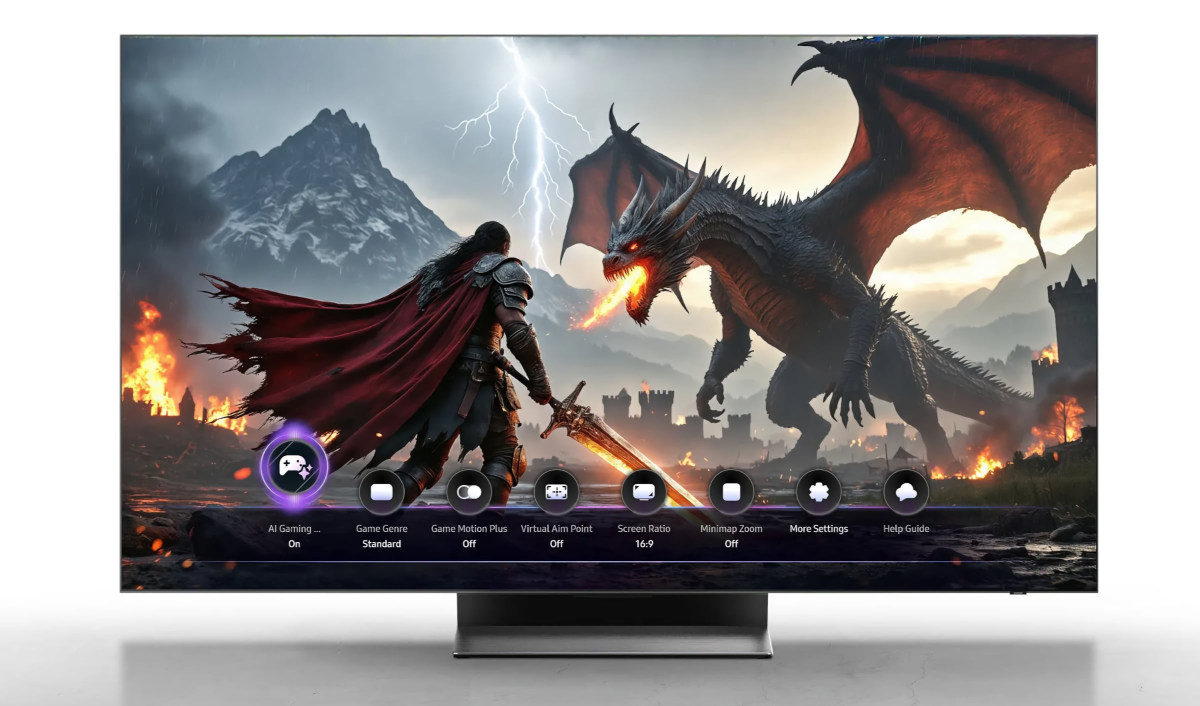
Omdia says that Samsung Electronics sold around 2 million OLED TVs in 2025, up 38.1% from 2024. This is a record year for Samsung Electronics in the OLED TV market. Omdia says that Samsung's anti-glare technology is popular with consumers, in addition to the strong gaming performance of Samsung's OLED TVs.
Omdia estimates that the total OLED TV market grew 6% in 2025, and reached 6.43 million units. This means that Samsung's market share is 31%, and is the world's second OLED TV producer after LG Electronics. Sony is the third largest producer, with sales of 560,000 TVs in 2025 (down 15.5% from 2024).
Panasonic announced a strategic partnership with Skyworth for TV production and sales
Panasonic announced a strategic partnership with Skyworth, in which the Chinese TV maker will produce, market and sell Panasonic branded TVs. Panasonic itself will provide expertise and quality assurance for these TVs.

The two companies will join forces to develop new high-end OLED TVs. Skyworth is estimated to be the third largest OLED TV producer (following LG Electronics and Sony), but was mostly focused on its domestic market in China. Now this partnership will enable it to grow globally, using Panasonic's well-trusted global TV brand.
Omdia: increased OLED depreciation will enable display makers to increase profitability
Omdia says that the rate of equipment depreciation at display fabs is accelerating, which means that production costs of OLED and LCD panels alike is on the decrease, enabling display makers to increase their profits.

Omdia says that depreciation will increase at a compound annual growth rate (CAGR) of 9.3% between 2021 and 2028, for LCD and OLED fab combined (see chart above), with the amount of fully depreciated global FPD manufacturing capacity nearly doubling over that period from approximately 160 million square meters to almost 300 million. This is the result of the slowness in FPD production fabs investment in recent years.
Sony to spin out its TV and audio unit, TCL to become the major shareholder
Sony announced today that it plans to spin-out its TV and home audio business to a separate entity. Sony has partnered with China-based TCL that will hold a 51% stake (Sony holds the rest of the company). The new company will continue to use the Sony and Bravia brands.
Sony said that the new JV will be a global company, and will handle the full process from product development and design to manufacturing, sales, logistics, and customer service for its TV and audio products.
Samsung announces its range of 2026 OLED TVs, based on both QD-OLED and WOLED panels
Samsung has announced its range of OLED TVs for 2026, utilizing both WOLED and QD-OLED panels. The company will release 4 different ranges, with sizes ranging from 42-inch to 83-inch. Samsung did not disclose many details about the TVs yet.
At the top of the line sits the S99H, Samsung flagship 2026 OLED TV. Available in sizes 55-, 65-, 77- and 83-inches, the 4K 165Hz TVs are based on Samsung's latest QD-OLED panels (except the 83-inch model, which uses LG's a WOLED panel). Interestingly, the TVs have a metal bezel and sports Samsung's Wireless One Connect box.
LG Display introduces its latest 4,500 nits WOLEDs, LG Electronics announce its range of 2026 OLED TVs
LG Display announced its latest WOLED TV panel, that reaches a brightness of 4,500 nits (similar to Samsung Display's latest QD-OLEDs).

The new OLED TV panel is branded as Primary RGB Tandem 2.0. In this panel, red, green and blue OLED emitters are stacked in independent layers. In this new version, LG has utilized an even more refined pixel structure and advanced algorithms, to maximize light efficiency. LGD says that the new RGB Tandem 2.0 panels also incorporate advanced light-absorption and diffusion technology to minimize reflections, delivering the lowest reflection rate among existing displays of just 0.3%.

