AMOLED - introduction and market status
OLED displays use organic materials that emit light when electricity is applied. OLEDs enable emissive, bright, thin, flexible and efficient displays - and so OLEDs are set to replace LCDs in all display applications - from small displays to large TV sets.
An AMOLED display is an OLED display that is driven by an active matrix backplane, it is a type of OLED display that can achieve high performance. Most OLED displays such as the ones used in TVs and smartphones are actually AMOLED displays.

What does AMOLED mean?
The term AMOLED means Active-Matrix OLED. The 'active-matrix' part refers to the driving electronics, or the TFT layer. When you display an image, you actually display it line by line (sequentially) as you can only change one line at a time. An AMOLED uses a TFT which contains a storage capacitor which maintains the line pixel states, and so enables large size (and large resolution) displays.
AMOLEDs today
AMOLED displays today are used in many applications - and are most common in smartphones. Most smartphones today use AMOLED displays (over 50% of smartphones use AMOLEDs rather than LCDs), including the latest Samsung phones, and all of Apple's latest iPhone models.

AMOLED displays are also used in OLED TVs, many wearables (including Apple's Watch), tablets, laptops, VR headsets, monitors, and more. There are also flexible, foldable (and soon rollable) AMOLED displays available today.
AMOLED vs PMOLED
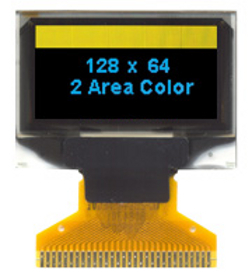
A PMOLED uses a simpler kind of driver electronics - without a storage capacitor. This means that each line is turned off when you move to the next line. So let's say you have 10 rows in your display - each row will only be on 1/10 of the time. The brightness of each row has to be 10 times the brightness you'd get in an AMOLED. So you use more voltage which shortens the lifetime of the OLED materials and also results in a less efficient display. So while PMOLEDs are cheaper to make than AMOLEDs they are limited in size and resolution (the largest PMOLED is only 5", and most of them are around 1" to 3"). Most PMOLEDs are used for character display, and not to show photos or videos.


Looking to buy AMOLED displays?
Are you looking to buy AMOLED display for your project? AMOLEDs on the market range from small 1-inch ones for smartwatches through large OLEDs used in tablets and laptops - to large TV panels, up to 97" in size. Visit our OLED Marketplace, the world's most comprehensive OLED catalog, where you can browse the available panels, and let us help you find the best AMOLED supplier for your needs!
Further reading
- Introduction to OLED displays
- OLED Technology explained
- PMOLED Displays
- Flexible OLEDs
- Transparent OLEDs
- The OLED Marketplace - buy your AMOLED here
- OLED-Info Pro: subscribe to access our premium content, OLED technology guide, analysis and insights, data resources
Will Samsung utilize AMOLEDs produced by BOE for its Galaxy S27 phone basic model?
A couple of months ago we reported that Samsung Electronics, aiming to reduce its cost structure, has ordered 15 million AMOLED panels from CSOT, that are adopted in the 2026 Galaxy A57 and S FE models smartphones.

According to a new report from Korea, Samsung is in talks with BOE to the supply of more advanced AMOLED displays that will be used in the basic model of the flagship Galaxy S27 smartphone.


BOE to start mass producing 14-inch laptop OLED panels at its 8.6-Gen OLED line in Chengdu by the end of the month
BOE is accelerating its B16 8.6-Gen IT AMOLED fab in Chengdu, and according to the latest updates from Korea, the company will begin mass production by the end of this month (May 2026).

BOE's first products out of this new line will be 14-inch laptop OLED panels, and it will supply the first batch to ASUS and Acer (this was already reported last year). It is likely that BOE will take time to fully ramp up the new production line, but the first commercial production is an important step. BOE originally planned to begin production towards the end of 2026, but it has managed to accelerate and begin production sooner.
TCL CSOT demonstrates a 1700PPI Real-RGB 2.24" AMOLED display for AR applications
TCL CSOT is showing a 2.24" 1700 PPI Real-RGB G-OLED display. This is the highest density such display that TCL has shown to date, improving on its previous 1,512 PPI AMOLED display showed in 2025.

The 1700 PPI 120Hz display (2.24" 2600x2784) is deposited on a glass substrate. Targeting XR applications, TCL's high-resolution AMOLEDs should offer a lower-cost solution compared to OLED microdisplays.
Samsung Display shows new display prototypes at SID Displayweek 2026, including its first PSF OLED panel
Samsung Display is showing its latest OLED displays, prototypes and technologies at SID Displayweek 2026.

First up we have Samsung's new Flex Chroma Pixel technology, that combines a PSF OLED emitter platform (this is the first time that Samsung Display shows a PSF OLED prototype), with a polarizer-free OLED architecture (Samsung LEAD) to enable high brightness and a wide color gamut: the new display achieves up to 3,000 nits brightness in HBM mode, while supporting the BT.2020-96 color space.
LG Display shows a wide range of new OLED displays and technologies at SID Displayweek 2026
LG Display is showcasing a wide range of OLED displays and prototypes at SID Displayweek 2026. In this article we detail the most interesting demonstrations and technologies.

First up, is LG's 3rd-Gen Tandem OLED, these are AMOLED displays, aimed towards the automotive market. LG says that it has introduced two new technologies into its tandem stack - a deep-blue dopant and optimized hole and electron movement. It isn't clear exactly what LG refers to, but it does say that these new technologies enable tandem OLEDs with improved power consumption (18%), brightness (1,200 nits), lifetime (over 15,000 hours) and color purity and reproduction.
BOE resumes production of iPhone 17 AMOLEDs after it regained approval from Apple
In early 2026 it was reported that BOE has been suffering from disruptions at its B11 AMOLED production line, which is where BOE produces smartphone AMOLED displays for Apple's iPhones. The production line started having quality issues at some of the processes, and BOE halted production already in November 2025. Apple had to increase its orders from Samsung Display.

According to the latest report from China, BOE finally managed to over come these issues, and has restarted production for Apple a couple of weeks ago, as the US company verified and approved BOE's latest AMOLEDs.
Reports suggest Apple and Samsung are developing a quad-edge-curved OLED for the iPhone 20
In 2027 Apple will release its 20th iPhone model, and it is reported that the company is working with Samsung to develop a special OLED display for the new device, which may be called the iPhone 20 - or the iPhone XX.

A Quad-curved iPhone (AI render)
The new display is said to offer a polarizer-free (COE) architecture, a "micro-curved" flexible AMOLED that will curve on all four sides, and under-the OLED Face-ID and camera.
The OLED Marketplace now lists military-grade 4" AMOLED displays
We are happy to update that the OLED Marketplace now lists a new military-grade AMOLED display, a 3.92" 1080x1240 panel.

This AMOLED offers a wide operating temperature range, long lifetime (over 40,000 hours), touch functionality including glove support, and customizable electromagnetic shielding.
Counterpoint: the OLED market to remain flat in 2026, as smartphone panel shipments will decline 3% due to high memory prices
Market research firm Counterpoint says that following the spike in memory prices, it revised down its forecast for the OLED industry in 2026, as it now sees smartphone OLED panel shipments declining 3% in 2026. We have heard this before from Omdia a couple of months ago.

Following a 3% increase in global OLED panel shipments in 2025, Coiunterpoint says that the market will remain flat in 2026, as automotive and IT OLED shipments will increase and offset the decline lin smartphone OLEDs.
HKC starts planning a 6-Gen OLED production line, approaches OLED equipment makers
Shenzhen-based HKC is reportedly progressing with its plans to build a 6-Gen OLED production line in Mianyang, Sichuan Province, and has started to approach OLED equipment vendors, seeking more information and quotes for production equipment.

According to the reports, HKC is looking to base this new fab on equipment it has acquired from Japan Display's Mobara OLED line, but increasing the capacity and adapting the technology by using new equipment to supplement the existing JDI systems.

