WritingWithColor (Posts tagged angry black woman)

1.5M ratings
277k ratings

See, that’s what the app is perfect for.

Sounds perfect Wahhhh, I don’t wanna

Black-Korean Woman using AAVE during Anger

I have a biracial (Black and Korean) protagonist who starts out withdrawn and insecure, but comes out of her shell and learns to assert herself. The family moved from the city to a small mostly-white town, and she is close to her mother. Her mother code switches a lot, and especially uses AAVE when she feels comfortable and secure.

At the start of the story, the protagonist’s love interest seems like the cool guy who has everything, but as they get closer and he helps her gain confidence, she recognizes that he comes from a shitty, toxic family and has his own vulnerabilities. Her character arc goes from being insecure, outside of her family, to secure enough to not only assert herself but stand up for others. I really want her to do this with a badass callout speech directed at her love interest’s shitty dad.

I also like the image of her channeling her Mom during this speech; not necessarily delivering it all in AAVE, but throwing in a few of her mother’s favorite phrases to get into a more self-assured headspace. But since this scene has her using AAVE while intimidating the crap out of a room full of white people, does it play too much into Scary Black Person tropes?

Has your Black Korean woman ever used AAVE before, and in other circumstances?

It is natural for Black people to switch into AAVE in situations where they feel strongly about something, but if she does not ever use it in other circumstances (e.g. calm, comfortable, balanced, and in a safe space) I would not have her using it now to express aggression towards someone. It just feels too convenient that she would only use AAVE now when she’s pissed off.

I’d recommend you incorporate other uses of her using her mother’s phrases and AAVE. Sprinkled here and there is enough, just to show it is a part of her. If AAVE if indeed a dialect she speaks, then her slipping into it during the callout is fine. Coming out only when she gets the courage to be assertive? Not so much.

~Mod Colette

Black Black woman Korean Korean woman Black Korean woman AAVE Angry Black Woman Language asks submission

friendlyneighborhoodnightow-blog asked:

(1/2) My WIP has Black (J) and white (A) foster sisters, alternating POVs, who can't stand each other. There are honest misunderstandings, but A also lashes out a lot from long-term abuse by the (white) foster dad (J is new there). J initially blames herself and takes it, but learns to stand up for herself. When she finds out A is being abused, she has a chance for revenge but helps A instead. She’s just being a good person, not still trying to change A, but A does apologize and change.

friendlyneighborhoodnightowl said:(2/2) They become friends and escape together. I’m worried about overstepping boundaries by writing an abused Black girl, although she’s less abused than A, and sending the wrong message about being able to change your oppressor. If it helps, even when A hates J, she secretly tries to make sure her abuser doesn’t hurt J, so it’s not completely one-sided. Also they’re both in foster care because of dead parents, not abuse or neglect.

Black and White Foster Sisters, Abuse, and Friendships

You’re playing out some very old tropes around abuse victims here, the chief of which being villainization of your abuse victim. There is some basis for this, for how volatile trauma makes an individual, but it gets really tiring to see this sort of thing happen over and over again. Reconciliation doesn’t necessarily make it any better, too: there’s the fact the trope was there in the first place, and there’s the fact there are a bunch of toxic tropes around reconciliation, as well.

Let’s get the obvious out of the way, first: yes, abuse makes you lash out, and half of all child abuse victims will develop PTSD. It would be factually incorrect to show A as not having some points that make her touchy. Another factual statement is it takes a lot of compassion to reach out and understand trauma lashing out, so it’s also normal to have animosity or hatred between a traumatized person and their, for lack of a better word, target. That isn’t the problem at hand. 

The problem with this lashing is it’s so common and very rarely explored in a way that’s sensitive. The fact you have dual PoVs will help your case in this regard; by being able to show a window into A’s life, you’ll give her much needed sympathy. If you show hints in J’s PoV that she can piece together it’s a trauma reaction, that will also help. (Just, please try to avoid the old bruised= abused narrative. Emotional abuse produces the same volatility in victims) But that doesn’t reconcile everything.

Overcoming a traumatized/target narrative internally in a friendship is exceptionally difficult. This is spoken from experience. Because there are so many pitfalls that look like reconciliation, but are actually a continuation of a toxic narrative. Namely, “you can fix people who are hurting you.” This is… basically impossible to do, and it has to be the traumatized person who takes responsibility, instead of the target trying to manage the traumatized person. You also need to avoid excusing her volatile behaviour with “she’s triggered, she can’t help it.” That is a genuine statement of fact, but it is not a get out of jail free card for your bad behaviour. You have to own up to what you do when triggered, because a triggered state is an explanation, not an excuse.

Black women are already prone to being painted as targets, and they’re also expected to fix everyone else. As a result, you’re in a bit of a double bind— show a Black girl with a bucketload of compassion, and you’re reinforcing the narrative Black girls can and should fix everyone; don’t show enough, however, and the friendship can never be attained because there’s nothing driving a person to look beyond the lashing. Giving her hurt and anger and breaks apart—plus more friends who help her explore a variety of emotions—will help keep her out of stereotype territory (namely Angry Black Woman and Strong Black Woman).

If you want a window into how a traumatized brain works, we strongly suggest The Body Keeps the Score by Bessel van der Kolk, who has been pioneering trauma study for decades. It will give you nuances for a traumatized PoV that will lend much needed realism, compassion, and possible bridges to reconcile. Namely, it will give a path for A to follow so she goes from a toxic traumatized person to one who can hold intimate friendships.

Further narrative suggestions:

  • Make her less volatile, and/or having a different target. Lashing out at others isn’t the only way to show a person is an abuse victim, and if that was kept to a minimum (with other symptoms), you have less of a victim-villain on your hands (a really good example of this is Adam Parrish from Raven Boys; he is hard to get close to, but his abuse is shown in a difficulty relating to others and dislike of charity, with only the occasional boiling over point)
  • Have A undergo a Heel Realization, where she takes responsibility for her actions and realizes she was in the wrong, and have her work to be less reactive and volatile in the future
  • Show signs of abuse in both PoVs, preferably emotional moments, fear reactions, freezes, or fights, so readers know exactly what is happening. Abuse in A’s PoV will be critical, but abuse in J’s PoV will help build up a natural compassion that doesn’t come from her Blackness and instead comes from realization it might be happening to A, too.

— WWC

friendlyneighborhoodnightowl black women abuse strong black woman angry black woman Abused Black Woman relationships friendship bwww abuse tw writer resources asks

fundamentallyf00lish asked:

Hi there! I’m rewriting a superhero from my youth. Recently, I’ve been trying to introduce more diversity, and my older characters were written mostly sans race [read: I was a white kid who said stuff like “race doesn’t matter”]. I’ve been considering making this hero black, but his superpowers initially revolve around anger and later around darkness. This carries with it a lot of unfortunate stereotypes. What should I do?

Black Character with Anger and Darkness Powers

You have to be mindful of what you change your previously “Raceless” characters into.

Choosing to make the hero into a Black person with anger and darkness-based powers feels stereotypical, especially in a non-Black writer’s hands. Anger can be complex. It’s not always something to be ashamed of having. There is righteous anger, anger that motivates one into action, and so on. Still, to write a Black character who has a lot of anger vs. an Angry Black Character, requires nuance. I’m personally wary of folks tackling this who are outside of my race.

Suggestions

  • Change the powers. 

You could choose another emotion with big impact, or still run with the darkness but develop it enough where darkness isn’t portrayed as all evil. 

Resource: Black and White Symbolism: A Look into the Trope 

  • Change the race of this character, one that isn’t anger-associated

If going this route, I suggest making the Black hero into someone else similarly significant to the story. I hate to suggest downgrading the role of a Character of Color, but if it’s stereotypical, it ultimately does more harm than good.

  • If you’re super committed to anger as a power, keep it, but give it to some other non-Black character.

Still, you’ll need to do your research as there may be associations that stick to other races, like the Spicy Latina, or the (Asian) Dragon Lady.

If you’re placing a person of color in the role of Anger powers, I suggest you thoroughly explain the source of the character’s anger, past or present. It shouldn’t be natural to them, as if it’s natural for X race to have anger issues. Showing characters of the same race without anger issues is essential too.

Summary: Trace your logic. I suggest you keep the hero Black and move the power away from your previous idea, particularly the anger. If darkness is to remain, though, it should be worked to avoid the same ole stereotypical dark as evil themes.

~Colette

660feet trace your logic black angry black woman angry black man stereotypes people of color character creation black and white symbolism Black stereotypes Black tropes asks

bogwitchlesbian asked:

Hi! So I'm writing a fantasy book and one of my main characters is a black girl, but I realised that the personality she had may be considered stereotypical. She's very into horticulture and is brilliant and maths and botany, but she's also not too good at showing her emotions and constantly has resting bitch face. My book is about introspection and she learns that just because people see her a certain way doesn't mean she has to act like it, and she starts to try and overcome a traumatic 1/2

Childhood by actually facing her emotions rather than suppressing them. She has issues with suppressing her anger sometimes and she is isolated by her colleagues, who are white. The country she lives in is mainly white so she’s somewhat of a noticeable face in the crowd but eventually, after a road trip she decides to travel and be better than she was told she could be I was wondering if her personality was horribly stereotypical despite her learning to open up and deal with her trauma? 2/2

Angry Black Woman /  Childhood Trauma

I’m concerned about the tragic aspects you’ve placed into her characterization. Not sure what her childhood trauma is related to, otherwise I could speak more specifically, but I advise treading carefully with such topics if not coming at it with your own experience. Even then, there’s nuance as a Black girl dealing with almost any trauma. The Abused Black Woman is a stereotype in itself and needs to be handled with respect and not be mishandled or exploitative. Otherwise, it’s just harmful and we don’t want it. We’ll write about our own traumas and prefer not to stumble across them when just trying to enjoy ourselves in a book.

Remember: balance is key. We need extended happy moments and brightness, and not just flickers of light.

As for the anger issues, we’ve written extensively enough about it and how to handle alleged stereotypical traits that there’s not much new to say. There’s much more to her than anger as she appears to have a varied personality and interests. The story being from her perspective should instantly dissolve assumptions that she’s only one thing: anger and “bitchiness.” At least from the reader’s perspective.

More reading:

~Mod Colette

thecryofthemorrigan Black Black woman stereotypes angry black woman representation abused black woman strong black woman tragedy exploitation Black stereotypes asks

woochew07 asked:

Hello. One of my characters is a 21 yr/o black autistic girl. I'm autistic so that parts easy. Lol. But I'm white. And I don't want to misrepresent her. Okay, okay to the point. The Character will obviously go through a lot. I want her to be very curt and borderline rude to people 1) because of her autism and 2) She's tired of people calling her names/infantilizing(autism)/sexualizing (look). How do I do this with out accidentally using the "angry black girl" trope? Thanks.

Black Autistic Woman, Avoiding “Angry BW” Stereotyping

Ooooohhohohohoh are you in for a treat xD 

  • As Black and Autistic, she will sometimes be thrown into the “angry Black woman” stereotype no matter what you do, by reader or character alike. 
  • What you can do as a writer to lower the chance a reader will see her that way, is to clearly show her motivation and intentions. 
  • Show her feelings about how people interpret her and how they react. If you clearly show that her actions aren’t born from anger, or that her anger is justified (because come on, some people REALLY know how to push the limits and then some), you should be as okay as you can be.

Good luck!

~ Mod Alice

woochew07 stereotypes Black Black women autism angry black woman characters asks Black stereotypes

vorpalgirl asked:

Mod Jess said in the 1st chronological post in the "Dragon Lady" tag: "I think when it comes to Asian ladies, they immediately fall into the Dragon Lady stereotype whenever they get angry, no matter what kind of angry it is." Been pondering that, b/c everywhere else lists it as a specific set of traits derived from racist pulp fiction portrayals (not just "angry"), but that sounds more like "Asian equivalent of Angry Black Woman". Makes me wonder. What're your current thoughts/feelings on this?

Anger in the Dragon Lady vs. Angry Black Woman Stereotype

It’s tempting to make superficial comparisons like this, because hearing about specific emotions that fall into multiple stereotypes leads you to think that the root of stereotyping is tied to individual emotions and how they present. Stereotypes are, instead, meant to reinforce a behaviour or belief set about an ethnicity, and as a result cannot be compared on traits.

As a result, our thoughts are that you’re drawing a false comparison without understanding the history and beliefs behind the stereotypes.

Asian women are taken as submissive, and Dragon Ladies are understated, cool anger… when Angry Black Woman is the polar opposite of this, as being loud, brash, and bold. Whiteness views them as extremely different people, and uses the tools to reinforce completely different behaviour sets.

While some stereotypes do indeed share root similarities— Magical Negro and Magical Native American both fall under “x ethnicity has special powers inherent to being x ethnicity"— most do not. Making comparisons like this without understanding the behaviours that are being perpetuated leads to only revealing more ignorance, instead of making you sound educated.
Stereotypes do not come from “x people express emotions in y way”; stereotypes come from “x people should behave in y way, which influences all emotional expressions allowed and imagined.” Of course stereotypes are going to cover the same emotions, because people only have so many emotions. They just express them in different ways, and different people will have different default sets of behaviour.

What racist stereotypes do is limit the set of default behaviours allowed down to a single note. Angry East Asian women are Dragon Ladies because white people assume all Asian women are submissive and restrained in their behaviour, and that falls in line with the Dragon Lady stereotype— clinically calculated, refined, seductive, and deadly. Angry Black Women are their own stereotype because all Black women are loud and hot-tempered— motivated by exploding at the smallest provocation from a chip on their shoulder.

Most racist stereotypes are reinforcing different sets of behaviour, founded in totally different beliefs from centuries of white people creating certain images for certain ethnicities. Dragon Ladies have their roots in the “dangerous Asian who will seduce then kill you” stereotype, while Angry Black Women come from “slaves complain about everything” stereotype. The two do not mix.

You need to have a much deeper understanding of stereotypes before you go throw around comparisons such as this. It is hurtful to try and flatten individual ethnicities’ experiences with “both of these stereotypes impact the same emotion, therefore you’re similar, right?” It’s the same logic that drives “Japan and China are close enough I can blend the two cultures easily, right?” or “Native Americans are all the same, right?”. Just because we have some tenants of shared oppression and limitations in our expression does not mean our experiences are the same. Individual stereotypes should be taken as individual stereotypes until proven otherwise.

— WWC

stereotypes tropes Dragon Lady Angry Black woman woc women of color racism vorpalgirl history black stereotypes asian stereotypes east asian stereotypes black tropes east asian tropes asian tropes asks

Black Names, M.I.A. Father, &“Angry Black Woman” Mother

@theincredibleibex asked: 

Angry Black Woman?

I’m writing a story that is sort of a paranormal mystery as seen through the eyes of several high school aged characters. The main character, Javion, is a young black kid with an interest in science and the paranormal that his mother very very subtly discourages. His father was a paranormal investigator who worked for the government on cases involving a wide range of things and he was very successful, with his books on debunking the usual pseudosciences people used for such things meeting wide acclaim. During an investigation in a remote part of Washington state, however, he vanished, the government refusing to give answers as to the exact circumstances to his family. 

As a result Javion is both determined to bring him back and devoted to being the kind of scientific mind his father was, the kind who helped people and exposed frauds. His mother desperately does not want him going into a field of study wherein eldritch abominations are a very real threat. Along the way in his investigation he runs into several people who either assume his father is around but a deadbeat or not around at all, something that tests his patience.This is where I’ve hit some snags. I don’t want to write his mother as an angry black woman. She’s just scared for her only child’s safety after losing her husband to the same field of study.

Absent Black Father?

I don’t want to play into the absent black father trope because it’s not like he’s absent willingly at all and there is the possibility, albeit slim, that he could be saved and brought back. 

‘Stereotypical’ Black Name?

And I really don’t want to have accidentally given Javion a stereotypical name - I picked his first name after a black professor I had with the same given name. Basically I just want to know if the plot is inherently racist and what to avoid to keep it from being so.

Is Javion a “Stereotypical” Black name?

This name doesn’t come off as “stereotypical” to me. I’ve never heard of the name, but I like the sound of Javion and I don’t see a problem with it either. Read Black Characters: On Stereotypical Names for what we have to say on stereotypical Black names. 

Basically, there’s more of a problem that what are seen as Black-associated names are demonized by society more so than people having the names themselves. 

Is it problematic that my Black boy’s father vanishes?

The father’s disappearance is clearly linked to his work, and is not a case of “deadbeat Black Father.” I really like the possibility of him coming back, though.

“Along the way in his investigation he runs into several people who either assume his father is around but a deadbeat or not around at all, something that tests his patience.”

Now, people’s assumptions about J’s father are prejudice micro-aggressions. I wouldn’t slather them on heavily if racism is not the focus of your work, but it’s realistic for Javion to face these sort of assumptions and the frustration that goes with it, so nice touch.

Is my concerned Black mother an Angry Black Woman?

From your description Javion’s mom comes across as a loving and concerned mother who doesn’t want to lose her son in the same way she lost her husband. Even if we are to see her frustration in her son for going deeper on a path that is clearly dangerous, i’m still not seeing where we are getting ABW from that. She’d have every right to be upset about this. Black women should be allowed to present emotion without being summed up to the typical Angry Black Woman so do not be afraid to show the range of emotions that this mother feels in this situation.

Another thing; with the father missing, she has been made a single Black mother which is another BW stereotype. Is she still shown as desirable? Is she dating, engaging or potentially to engage in a new relationship? Does she have close companionship besides her son with peers? Hell, does that “helpful” lovestruck neighbor try to put the moves on her ever since Javion’s father disappeared? Any number of these additions would help deter the stereotype and any potential desexualization.

~Mod Colette
Black black men black women angry black woman absent black father stereotypes names single black mother black names submission Black tropes Black stereotypes asks
chescaleigh
chescaleigh

3 Black Female Stereotypes that Need to Die | MTV Decoded

Every notice how black women in media tend to looped into a few basic stereotypes? Like get portrayed as the sassy friend who has an instant comeback for everything, or the over-sexualized woman who wants it all the time, or the helpful black maid. Well these stereotypes don’t come from nowhere. And on this episode of Decoded where they come from and explain why they need to be buried good and deep. 

black black women characters stereotypes mammy Jezebel angry black woman sassy black woman black best friend black history history american history hypersexualization desexualization rape rape mention tw videos Black stereotypes Black tropes misogynoir

skyfaeries-deactivated20170722 asked:

n my story i have a black girl who uses fire magic. she can be a bit hot-headed, but this isnt a main characteristic - her use of fire is more in ref to her recklessness rather than anger. is she still in danger of being an angry black woman? thanks!

Black Girl, Fire Powers, and Avoiding the “Angry Black Woman” Association

As long as you’re clearly (keyword: clearly) not correlating her power to anger, this should be fine. I would be mindful of her hotheadedness, though. What makes her hot headed? What sparks this, what frustrates her? Is it related to her upbringing? Is she sensitive? is it a defense mechanism? 

If she’s snapping all the time for no apparent reason besides it just being the way she is, that does translate to me as “Angry Black Woman.”

You’ve only shared that this character is hotheaded and reckless. Though i’m sure there’s much more to her, i’ll still remind you to expand upon her beyond these traits. I do feel exploring a Black character’s anger and the validity of it would be an interesting topic for addressing, though, particularly by someone in the community.

Regarding her fire powers as the potential association to anger, Najela has some good notes on avoiding lampshading which applies here. 

Check out Biracial with Elemental Powers and Negative Connotations.

~Mod Colette

skyfaeries black black women angry black woman stereotypes characters lampshading powers Black stereotypes asks
crimeshetyped
ebonyrise

image

Photo by Femi Matti

Because when I was five, my kindergarten classmate told me I couldn’t be the princess in the game we were playing because black girls couldn’t be princesses. Because I was in third grade the first time a teacher seemed shocked at how “well-spoken” I was. Because in fourth grade I was told my crush didn’t like black girls. Because in sixth grade a different crush told me I was pretty — for a black girl. Because in 7th grade my predominantly black suburban neighborhood was nicknamed “Spring Ghettos” instead of calling it its name (Spring Meadows). Because I was in 8th grade the first time I was called an Oreo and told that I “wasn’t really black” like it was a compliment.

Because in 9th grade when I switched schools a boy told me he knew I had to be mixed with something to be so pretty. Because in 10th grade my group of friends and I were called into an office and asked if we were a gang, or if we had father figures. Because in 11th grade my AP English teacher told me that I didn’t write like a college-bound student (though I later scored perfectly on the exam). Because when I volunteered in Costa Rica that summer, I was whistled at and called Negrita. Because when I asked my host father if that was like being called nigger, he said, no, it was a compliment because black women are perceived to be very good in bed. Because I was a kid. Because I watched from the bleachers while the school resource officer didn’t let my brother into a football game after mistaking him for another black boy who was banned. Because the school resource officer maced him for insisting he was wrong. Because I was suspended for telling the school resource officer he didn’t deserve respect. Because my senior year boyfriend said nigger.

Because I was one of two black girls in the freshman class at my college. Because at meetings to talk about how to attract more black students, someone suggested that the school attracted a certain demographic (sustainable living, farming, general hippiness) and that maybe black people “just weren’t interested in things like that.” Because my college boyfriend called me a “fiery negress” as a joke when he ordered for me at a restaurant. Because the boyfriend after that cut me off for saying he was privileged. Because I can’t return to my hometown without getting pulled over.

Because when I got married people assumed I was pregnant. Because people who know I’m married call my husband my “baby daddy.” Because my pregnancy with my son was plagued with videos of black lives being taken in cold blood. Because their murderers still walk the streets. Because the nation sent me a message that my son’s life didn’t matter. Because when Tamir Rice was murdered I curled up on the bed and sobbed, cupping my belly. Because my son heard me sobbing from the inside. Because they don’t care about us. Because when I was 7 months pregnant my neighbor asked me to help him move a dresser up a flight of stairs. Because I am not seen as a woman. Because I am not allowed to be fragile. Because the nurse that checked me in at the hospital to deliver wouldn’t look my husband in the eye. Because the vast majority of people won’t look my husband in the eye. Because when the doctors put my son in my arms and I saw that he was as dark as his father, I knew life would be even harder for him. Because he will be regarded the same way I was. Because he will be forced to grow up before he is grown. Because strangers at the store think it’s okay to reach into my son’s stroller and touch him without a word to me. Because we aren’t entitled to boundaries. Because they think we are here for their enjoyment. Because people don’t think we are people.

Because my nephew told me he couldn’t be Spider Man like he wants to because Spider Man is white. Because when he was four he said that he wants to be white so that he can go on a boat like the people on TV. Because I couldn’t save him from that. Because I can’t protect my son. Because I can’t protect myself. Because my stomach sinks whenever I see a police car. Because when my husband leaves the house at night I am afraid he’ll be killed for looking like somebody. Because I worry that if I went missing like the 64,000 other black women in this nation, the authorities wouldn’t try hard to find me. Because I am disposable. Because I am hated. Because we keep dying. Because they justify our deaths. Because no one is held accountable. Because I am gas lighted. Because I have been told that by speaking about being oppressed I am victimizing myself. Because our murders are filmed and still pardoned. Because I don’t know what it means to let loose. Because doing the things that my white peers do with ease could cost me my life — trespassing in abandoned buildings, smoking joints, wearing a hoodie, looking an officer in the eye, playing music loudly, existing. Because I am afraid to relax. Because I am traumatized.

Because there isn’t a place in the world White Supremacy hasn’t touched. Because I am trapped here. Because the playing field isn’t leveled. Because I love my skin. Because I love being a woman. Because not hating myself is considered radical. Because I’ve been called racist for defending myself. Because all the major protests are for cis black men. Because I’ve been told that talking about the women who’ve died is taking away from the real issue. Because I get no break from fighting. Because everything is a struggle. Because my anger isn’t validated. Because they don’t care about my pain. Because they don’t believe in my pain. Because they forgive themselves without atoning. Because I’m not free. Because the awareness of it permeates everything. Because it’s not ending. Because they teach the children that it’s already ended. Because someone will assert their supremacy over me today. Because they’ll do it tomorrow. Because I want more.

Because I deserve better.

crime-she-typed

Please read all of this it’s more than worth it

stereotypes social issues black black women injustice oppression articles angry black woman Black tropes Black stereotypes reblog

Magical Muslim-Monsters, Romani, Black Women and Latina Stereotypes

Anonymous asked: 

Okay so i am working on several stories with POC characters. I feel like a few of them may be tropes but i’ve checked and they don’t seem to match any? 

Magical Muslim and Monster Tropes

in one story there’s a trio of magical girls. one of them is a Muslim girl who was cursed into a spider creature. she is ashamed of this and views it negatively. would this relate to any monster Muslim stereotypes? she doesn’t drink blood. she rarely uses her magic, only if she absolutely has to.

Sassy Black Stereotypes in Children

in the second story there’s a trio of sisters. they are all Black and the daughters of the personification of heaven. the first sister is very young, only 7 or 8. she is very loud and sort of bold, i don’t want her to come across as a “sassy Black girl” stereotype, because later on she reveals she is only that way because her oldest sister doesn’t care for her as much as she should. the middle sister is a teenager, like 16, and spends a lot of time on her phone. she cares very much for her little sister. she doesn’t get along too well with the oldest sister either because she didn’t take care of their younger sister. she kind of fits the white girl starbucks stereotype but is shown to be caring and gentle on a regular basis. their oldest sister is disconnected and not really sure how to be a good sister after their mother left, but she tries her hardest. i think the second 2 characters are okay but im not sure about the first one.

Greedy Latina Stereotypes

in the last story (its fantasy) the entire main cast are POC. first off theres the main heroine. she is indigenous Guatemalan of Mayan descent. she lives in a village in England. She wears English style clothes and armor and speaks English, even though Spanish is her first language. she wants to fit in so people with see her as a hero, because being a hero is her goal in life. throughout the story she slowly starts reconnecting with her Guatemalan roots, like speaking Spanish more and wearing her mother’s huipils on occasions. at the very end of the story she has learned to preserve her parent’s culture while living in England. i don’t want her to come across a negative latina stereotype of liking money and being sort of greedy. (she is strong and kinda punk as well)

Romani Elf 

one of her friends is an elf and Romani with albinism. she isn’t an elf because shes albino or albino because she’s an elf, she’s just an albino elf. she can’t use magic as well as her brother can so i think that avoids “magical albino” but is there any issue with her being Romani? i couldnt find much in your tags on Romani in fantasy. what could i do to show her living a traditional Romani life without using stereotypes? (i know it may not make much sense for an elf to be Romani, but she is because of the way elves work in this world. i wont go into detail but basically elves are sort of seen as higher beings and since her parents chose to live with a group of Romani people, their children were born Romani.)

Saudi Arabian Djinn

2 of the side characters are a Tahitian mermaid (cookiecutter shark) who mostly acts a guide. at one point she tricks the first girl mentioned by leading her off and taking her valuables. im pretty sure that’s not a stereotype however. the other side character is a Saudi Arabian djinn who is not Muslim. she’s a traditional djinn, is there something wrong with her being Saudi and not Muslim? 

Motherly Black Queen and Angry Black Woman

And finally the 2 characters that i think are sort of problematic but i cant pinpoint why. The queen is a Black woman, she is very motherly towards her subjects but this is because she is the queen and she’s sort of the sad about it, like the subjects dont know how much empathy she has for them. she is very mysterious and magical. her counterpart is the villain, another Black woman who is connected to fire. she is the sun, basically, and shown to be abusive to the elf’s brother who had the stone her spirit was trapped in for a long time. she uses a lot of big, fancy words. she is so angry because she was trapped in the stone for so long, i dont want to play her as an angry Black woman stereotype though.

Answers below:

Keep reading

General Writing question submission romani albinism angry black woman sassy black woman tropes stereotypes muslim creatures magic muslim Black tropes Muslim tropes Black stereotypes Muslim stereotypes asks long post
yourfavoriteheathen
venus-in-virgo:
“ takeprideinyourheritage:
“ Same goes for Italians. Italian people talk loud and talk with their hands. Other people see it as cultural and them being passionate but when black people talk loud and use hand gestures we’re seen as...
takeprideinyourheritage

Same goes for Italians. Italian people talk loud and talk with their hands. Other people see it as cultural and them being passionate but when black people talk loud and use hand gestures we’re seen as ghetto and dramatic.

venus-in-virgo

This is so real!
I cannot count how many times I’ve been a tad animated and people act like I’m being confrontational.
…Because a black woman expressing her displeasure any other way than quietly or solemnly is her being an irrational, ghetto, angry black woman.

writingwithcolor

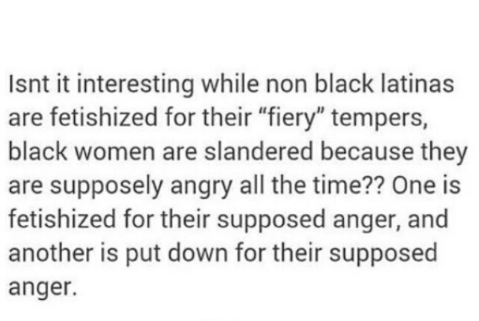
The original image above reads:

“Isn’t it interesting while non-Black Latinas are fetishized for their “fiery” tempers, Black women are slandered because they are supposedly angry all the time?? One is fetishized for their supposed anger, and another is put down for their supposed anger.”

angry black woman intersectional feminism stereotypes misogynoir black women latinx latina antiblackness reblog