WritingWithColor (Posts tagged creatures)

1.5M ratings
277k ratings

See, that’s what the app is perfect for.

Sounds perfect Wahhhh, I don’t wanna

No Longer Taking Questions Involving the Wendigo

I have made my stance on the Wendigo very clear: it is not your stock fantasy monsters to use. It can be used accurately if you ask the tribe in question how to use it, but if you’re looking for some “Native magic” to throw into the story, look elsewhere.

It is not a hybrid. Your character can’t be half-Wendigo or part-Wendigo or whatever. You are either possessed by the spirit, have become the whole spirit, or not involved with the Wendigo.

No, they can’t be “good” or anti-heros— they’re many cultures’ definition of evil.

No, they can’t be outside of their original Algonquin/Great Lakes peoples contexts. 

This also means they don’t belong interacting with witches, especially Christian witches.

If you want to be respectful to Native cultures, put the Wendigo in its full context (including the fact it is evil in our societies) with multiple Native characters involved in the plot, or don’t use it at all.

The obsession with having Native characters be tied to the Wendigo is honestly disturbing. As mentioned, the Wendigo is often a definition of evil. It is an insatiable hunger; it is pure greed. It’s wild and untamed. It’s every negative stereotype of Native Americans— cannibals, demonic, rabid, indiscriminate hunters, a threat to civilized society— wrapped up into one.

Racism against Native Americans founded in these principles is still alive and well. Trace your logic for why you want a greedy cannibal hunter to be tied to your Native character. 

We are not your monsters.

~ Mod Lesya

wendigo Native American Blog Things folklore mythology cultural appropriation creatures updates

Using Creatures From Native American Beliefs

I have been working on a fantasy series and my world has 9 nations of people, each with somewhat loose real-world influences. Each nation has its own kind of… guardian animal I guess (I formerly called them totem animals but have recently thought I should avoid that word since it specifically originated from Ojibwe culture) and while most of them are animals I have made up, a few of them are taken from real world mythologies and legends. One is the Wyvern, which doesn’t have any significant purpose in its origin so I think should be fine to use, but the others are the wakinyan (Lakota - thunderbird) and the amarok (Inuit) which were significantly more important to their originating cultures. 

The wakinyan is the guardian animal of the nation influenced by some Native American cultures, where the Amarok is similarly the guardian of the nation influenced by Inuit cultures. I hoped this would give representation to those cultures and their mythologies but have worried that in reality it might just be disrespectful. I was hoping you could give me some feedback on whether this use is problematic or appropriative. Thank you! (PS I love this blog, it has taught me a lot, so thank you!) 

I’d caution you to make sure that the “Native American” cultures you’re pulling from all use the Thunderbird, because it is specific to a few tribes. It would feel very off to have a culture that didn’t have the Thunderbird at all suddenly have it be incorporated. I’d prefer it if it was one specific tribe, but if you’re pulling from closely-knit nations who have a common history as allies then you’ll run into a lot less raised eyebrows for mixing a few together. I should note that a shared language family does not indicate a shared ally history; the Huron and Iroquois both shared a language family, but they’re traditionally enemies. They had periods of allyship, but that wasn’t the norm.

Other than that, this doesn’t look appropriative to me because you’re pulling from the entirety of the culture when selecting those animal protectors. The key to at least beginning to respect a culture’s religion (another caution is calling Native American religions “mythologies"— we’re still alive and practicing our traditions!) is to take the whole of it, not just the “cool” or pretty parts.

Of course, the usual cautions of sensitivity readers and making sure you’re not relying on the white versions of our beliefs apply. But as a general rule, if there’s the culture to go along with the creature, you have solid representation.

~ Mod Lesya

General submission Native American Culture cultural appropriation supernatural beings creatures beliefs asks

bombus-lapidarius-deactivated20 asked:

1/2 Hello! I'm writing a sort of fantasy story/series, and the (white) main character is Fae, which is a species of kinda ethereal non-humans. There's a subplot and a lot of little anecdotes about the prejudice she and her father face in mostly human London for being visibly fae. But of course, what my main character experiences may seem a lot like racism, but it isn't - especially because the Fae are literally not people, and feel compassion and emotions in entirely different ways, and are

simply not human, and a lot of the prejudice they encounter is based around that. How do I avoid drawing analogies which suggest that PoC are less human?Secondly, there are dwarves in this fantasy series. A family of dwarves who are quite prominent in the story are Black (originally Djerban, I think) and Jewish. I know that a lot of dwarf tropes in fantasy stem from stereotypes of Jewish people, and I’d like to know how to make sure I don’t stray into those tropes. Thank you for your help!

White-coded Fae + North African Jewish-coded Dwarves

I’d love for you to trace the thought process that led your imagination to come up with a plot where the “pretty” supernatural characters are coded white (and gentile) and the, well, less-pretty supernatural characters are coded as North African Jews.

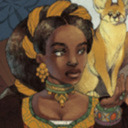
This is the heroine of The Rabbi’s Cat, a graphic novel starring Jewish Algerians and their weird cat.

image

The Rabbi’s Cat is by a Jewish author. I just wanted to put that image in your mind for a second.

“How do I avoid drawing analogies which suggest that PoC are less human?”

Human characters of color are the best way to establish that your Fae really are something else and not a metaphor for PoC. in my opinion.

>> A family of dwarves who are quite prominent in the story are Black (originally Djerban, I think) and Jewish. I know that a lot of dwarf tropes in fantasy stem from stereotypes of Jewish people, and I’d like to know how to make sure I don’t stray into those tropes.

Why are they Jewish in the first place, then? A piece without Jewish human characters doesn’t really need Jewish dwarves, especially if there aren’t gentile dwarves alongside them. Caveat that if you’re writing from inside the community I have less of a problem with it because this is our nonsense to reclaim if we want.

So, your options if you don’t want to have people go “….why….” are:

  • Add Jewish humans alongside the Jewish dwarves (or, alternatively, Jewish fae, we never get to be fae… we never get to be anything beautiful like mermaids or fairies or whatever. Dwarves. Lovely. *sobs into knitting project*)
  • Make the dwarves not Jewish – is there a plot reason they need to be Jewish?

The “dwarf=Jew” trope comes from these stereotypes:

  • short
  • hairy
  • clannish/unfriendly to outsiders without ever bothering to justify, oh, why a marginalized group might do that
  • avaricious/super into treasure and riches

And possibly a little harder to pick apart, but a weird smoothie of antisemitism/misogyny/transphobia in which our women are supposedly too hairy and too loud to be feminine (which is double bull because women can be as hairy as they want and still be feminine, and nothing’s wrong with being a masculine woman, either.)

So those are the specific tropes you’d want to avoid. But I’d say if you’re gentile, writing Jewish dwarves into a story that doesn’t have any non-dwarf Jews just seems like giving yourself a lot of extra work trying to stay out of the Sarlacc’s mouth. Ya know?

–Shira

creatures fantasy creatures supernatural beings Jewish Judaism Jumblr coding tropes dwarves fairies trace your logic stereotypes African North African antisemitism Jewish stereotypes Jewish tropes Asks Jewish coding religion coding

asdfghjbhvg asked:

I've been writing a story for a really long time, and the main antagonist in it (who happens to be one of exactly two white characters in the story) made herself into a shapeshifter through magic. So, I was researching shapeshifter myths and came across a Navajo legend called a skinwalker and the description comes disturbingly close to what I had in mind for the magic she performs. Is this cultural appropriation, and if so, is there anything specific I could change about it to make it better?

Navajo Skinwalker, Similar Concept and Avoiding Appropriation 

You’re dealing with a case of convergent evolution where the thing you so happened to evolve with is a marginalized religion. It’s not automatically cultural appropriation (which involves conscious theft) but it is something to be cautious about.

I can’t actually make this call— you’d have to ask the Navajo themselves what they think. It is possible for skinwalker legends to be done well (see Teen Wolf; they actually got Navajo feedback on their skinwalker arc and got it accurate), but in this situation you have to ask them what they believe.

~Mod Lesya

kittyskeleton Navajo Native American Skinwalker supernatural beings cultural appropriation creatures asks

Pregnant Jewish Teen kicked out, and Angels of Color = Cultural Erasure?

Hi! I have two questions to ask.

I’m writing a book in which two teenage girls live in a small fictional town in Alabama.  The main character is a white protestant queer girl. Her best friend is a conservative jewish girl (still figuring out her sexuality) named Dalia. Dalia and her parents are the only jewish people in the town, and they commute to their synagogue (its mentioned that they have more family in Birmingham). 

The book establishes that Dalia is essentially the best person in the whole town, meaning she is more patient, kind, less corrupt than anyone else.  She does have flaws of course, she fears being a burden and tends to be a little impulsive. Anyway, Dalia’s dad is Ashkenazi and i was thinking her mom is Sephardi from Turkey, and immigrated to America earlier in her life.  

Dalia does get pregnant at 17, and hides the pregnancy for a little while. She does know exactly who the father is (a teenage boy who isn’t in the story) and when it is revealed that she is pregnant her parents are very angry, and kick her out of the house (i also planned for one of her parents to hit her in the face, but i dont have to write that). Dalia does intend to go live with her relatives in Birmingham, who are aware of her pregnancy and are fine with it, but ends up not going because of plot events. 

There is also an Angel who takes a male form, but really has no concept of gender.  I know i dont want him to be white because of the white=pure=holy connotation of that. The problem is he’d be completely separate from any culture of the race he’d be presenting, because he’s an angel and is simply using a random corporeal form.  

So, is Dalia’s situation with her parents in anyway coming off as anti semitic/painting immigrants as being backwards and inherently sexist/abusive?

And, is someone adopting a form with an ethnicity but being totally disconnected from any connecting culture racist? 

Wait, you’re writing a story where a Jewish mom and dad kick out their teenage daughter for being pregnant? That strikes me as a little… “look over here at this marginalized culture! don’t they treat their young girls badly?” I mean, I’m sure getting kicked out for a teen pregnancy has happened to someone Jewish somewhere but I haven’t seen it, personally. 

Could they maybe be overprotective instead? Stop letting her go out with her friends, refuse to give her any freedom? That would do away with the “where did this author even GET this” in my head, although it would still paint us as More Backward. 

If you’re not Jewish yourself this becomes even more awkward.

Shira

>> is someone adopting a form with an ethnicity but being totally disconnected from any connecting culture racist? 

Well, these are non-human beings that just look like humans, right? I’d assume angels have their own culture of sorts and it’s not necessarily erasure when it’s a being that isn’t even from earth. We’ve talked extensively on disconnecting PoC from their cultures and the erasure that is, but having a non-human being that simply appears as a Person of Color so doesn’t have the associated culture(s) is alright with me personally and is not the same. 

Now, if they switched between races at leisure that would feel like dress-up and is a whole different story. Also, please assure they’re not being a certain race because they just think it’s cool or interesting (see: Androids, Black Culture & Appropriation).

But if pale and white angels don’t need a reason for existing, why do Black and brown angels need one? It helps to also have human PoC of the same coded race in Angels who do have (human) cultures, though.

Here’s a discussion Shira and I also happened to write on how to differentiate species from similar-looking human ones. See: Differentiating Black-skinned Species from Black people.

–Mod Colette

fantasy angels Jewish teen pregnancy creatures submission fantasy creatures supernatural beings asks

solitairespades asked:

This is a bit of a generalized question, but it's something I'd like to hear multiple opinions on: What do the mods here think about writing mythological creatures that have origins in different cultures and religions, but have since been assimilated into a public 'bestiary' of sorts? I'm talking things like golems, gnomes, kelpies, etc. Are there creatures that the mods here wish people would stop writing about? What about creatures that you'd like to see written differently?

Using Mythological Creatures Made Common

I can’t really think of many Indian or Hindu mythological creatures that have been assimilated into the public consciousness like you say, but one thing that happens that I wish wouldn’t is the occasional use of Hindu deities as villains.  

Kali and Shiva tend to get the worst of it in this regard, because they’re deities associated with destruction, and can be quite terrifying in some depictions.  Kali, for example, gets portrayed as a System Lord in Stargate, and is not a nice person, to say the least.  And while she never appears in Indiana Jones and the Temple of Doom, the heart-ripping bad guys are flagrantly depicted as a Kali cult.

As a philosophical skeptic who doesn’t believe in the factive reality of any gods, you might not think I would care about this, but the effect of this trope isn’t the vilification of deities but the othering of the people whose culture surrounds those deities, whether they actually believe in them or not.  With Abrahamic religions and Christianity in particular being so dominant in the west, such that even most atheists in America or Europe approach their non-belief from an ex-Christian perspective, Hindu iconography, cosmology and practice falls so outside this general sphere that we’re markedly other already.  Thus assimilating into Western society already comes with an immense pressure to abandon your cultural traditions, even the purely material ones, because said society contains a streak that seems so incompatible with your ancestral philosophies.  So when those weird four-armed, elephant-headed, funny-colored gods show up in mainstream media as evils to be defeated, it paints the culture around them as backward and superstitious at best and barbaric at worst.

You can still do things with Hindu deities in fiction, and some works I’ve read that do are actually very good and well-written even if the premise is somewhat uncomfortable at times (Zelazny’s Lord of Light comes to mind).  I mean, here, I even made a snarky post a couple of years ago about how you can assemble an entire Avengers team out of Hindu deities: http://science-of-noise.tumblr.com/post/56186438978/that-awesome-moment-when-you-realize-you-can-build

(I guess I’ll have to add guys for The Vision and Scarlet Witch now).

The thing about Hindu gods is that they can be very compelling characters.  Keep in mind that Hinduism is the last living continuant of the reconstructed Indo-European religion, which spawned the Norse gods, the Greek gods, and more.  Like those pantheons, the Hindu deities are super-human and extra-ordinary (note the hyphenation), and so in some Hindu stories they can be portrayed as fallible and even amoral, because their roots lie in a philosophical system that was primarily concerned with keeping the world turning, as opposed to the grace and salvation narrative of, say, Christianity.  Many times, the Hindu gods do not give humans any special status above other forms of life, which can be baffling to outsiders.  There are some very interesting and compelling narratives that can be built out of this, which is why seeing the deities devolved into villainy is disappointing and saddening.

We’ve got some badass demons and monsters who I haven’t seen much of in fiction at all: vetālas, bhūtas, and pishachas are quite nasty (pishachas particularly so), and they’re rarely portrayed as anything but evil and troublesome, so negative portrayals of those probably wouldn’t cause too much furor.  Asuras and rakshasas are generally evildoers but on a more human scale.  They are less often portrayed as outright monsters as humanoid races who have a propensity to go astray in various, often bloody ways.  The issue with that is that they are involved in so many obviously Hindu stories, and are not always evil (they may be virtuous but corrupted, scholarly, and worship various gods, and some are even heroic), and they form a large part of Hindu philosophical underpinnings usually as foils for righteousness.  It would be difficult and potentially offensive to use them out of context.

This is all just my personal opinion, and while I consider myself quite well-informed, I can’t speak for all Hindus.  Many would be annoyed and angry at depictions that I might have suggested are okay.  While I personally think those folks could stand to lighten up a notch or two, I can’t discount their opinions as invalid, so just be aware that what I have to say on the matter is likely going to err on the laissez-faire side of things.

Also, stay away, Dan Brown: http://articles.economictimes.indiatimes.com/2014-11-16/news/56137405_1_dan-brown-fiction-hinduism

-Mod Nikhil

For me, I believe some mythological creatures shouldn’t be in public consciousness. I’ve found Native beliefs in particular bastardized and appropriated left and right, especially in new age religious circles. White people have become the authority on Native spirituality in mainstream discourse, and that is so beyond twisted I shouldn’t even have to explain why.

If something is part of a living and marginalized religion, it shouldn’t be touched without bringing the whole religion into the work. There’s a difference between taking a long forgotten, dead, or peganism-revived religion and modifying it to suit your needs, taking a dominant religion to suit your needs, and taking a marginalized religion to suit your needs. The first two aren’t really directly hurting anyone, while the last one is deeply hurting someone.

It’s made worse how these creatures/deities are normally cast as monsters, which, as Nikhil said, others the cultures that hold these beliefs. It paints a one sided and very negative picture of the cultures in question. If you’re going to use these creatures, especially as villains, have positive aspects of the culture to counterbalance it.

This really isn’t needed for Christianity or even pagan based religions (in the West, at least), simply because the heroes usually end up being part of the culture they’re fighting against, either explicitly or implicitly. There’s already that cultural balance of good and evil within the work. However, when creatures come from religions that have a less well known spirituality, you end up with some pretty bad unfortunate implications in regards to what “good” and “evil” is.

So if you’re going to cast these parts of specific religions, make sure you’re pulling from both the good and evil side of the religion and taking it within its own contexts.

-Mod Lesya
solitairespades Mythological Creatures mythology culture religion cultural misappropriation cultural appropriation symbolism Hinduism Christianity Gods history Native Native American indigenous myth creatures asks books

treacherousgodswrites-blog asked:

Seeing as you already received an ask about Until Dawn, I wanted to ask you what your general opinion about the game and its use of the Wendigo is? I understand if the question has little to do with writing but I'd like your opinion before buying it in case it is offensive.

Until Dawn Game and Use of the Wendigo

From what I’ve gathered about the game, they didn’t have Algonquian people giving input to the story. While Wendigo legends have spread much farther West in modern times because of how much ecological destruction is happening, it’s spreading amongst Natives and is still staying mostly within Algonquin territory (the Cree are an Algonquin speaking people, and their nation is absolutely gigantic). 

While the game pays lip service to the original locations of the Cree, and it is remotely possible the Cree owned mountains, the thing about the bordering Cree nation is they are called Plains Cree for a reason. If you look at a map highlighting the Rockies, and you look at a map highlighting the territory of the Cree, the two barely overlap if they overlap at all.

Disclaimer: I am not Plains Cree— I am Mohawk, Mi'kmaq, and Wyandot— so I could be wrong. Plains Cree are more than welcome to correct me about ancestral lands.

However, the concepts taken from the game make me uneasy.

The Wendigo is not a random horror creature, as I have said before. It has been stolen and repurposed (before anyone comes at me saying that it’s part of their local mythology so it’s free for white people to use, allow me to explain that Native people were not free to practice their religions in Canada from 1884 and the ban lasted about a century; there was no room for there to be equal sharing of religions, because Natives had no ownership over their own). As soon as I see any Native ‘scary creature’ used, I am extremely wary. It is possible to use them respectfully, but more often than not, it’s just appropriation.

Even though the game pays lip service to keeping the Wendigo within the Cree, I cannot find a single piece of information that says the Cree were actually consulted for the game. And that’s a huge problem. The thing about the proper use of Native American mythology is it stays within our control, like the aforementioned Skinwalkers usage. It seems to me that they simply used the Wendigo for the old school horror tropes, which are inherently racist.
I can’t seem to find any Native-written pieces about the game, either, which I would love to link to (followers, if you provide opinions, make sure they are either linking to Native-written works or you yourself are Native). 

But from my own glance at it, I don’t like their use of the Wendigo and I don’t like how I can’t seem to find any Native voices anywhere around the project.

~Mod Lesya 

treacherousgodswrites native american indigenous representation creatures religion cultural appropriation cultural misappropriation skinwalkers mythology mythological creatures media asks wendigo

East Asian Shapeshifter Dragons

the-hungry-hungry-fannibal asked:

Part 1) I want to write a fantasy story about people who can turn into dragons. In my fantasy world the dragon people came from the East (fantasy lands inspired by China and Japan etc.) where they’re nobles into the west (fantasy Europe) hundreds of years ago. The Western people hunt them down because they think their dangerous. So the ones in the west go into hiding. When they are human the Eastern dragons have Asian features but with small clusters of scales around their eyes and are slightly taller etc. there are human people living in the East as well. Could this race be unintentionally offensive towards the Asian community?

Part 2) The appearance of the dragon people who traveled into the West evolved over time to help them adapt to their new surroundings. Their skin became paler as they live in caves and thick forests. Their eyes change to improve night vision and their human appearances are more dragon like than their Eastern counterparts so they can transform faster when they’re in danger. Their dragon bodies change too like the difference between European and East Asian dragons. Does this unintentionally make the Western dragons fall into ‘Beastly POC’ trope because of their heritage?

Part 3) By lightening their skin for biological reasons am I accidentally white washing my characters? Even though they’ll be different from the other dragons they’ll still be proud of their heritage 

1) I don’t think the inclusion of this race would be offensive toward East Asians on its face, but it all really depends on execution. You’ve mentioned there are East Asian humans, which is good, but at the same time, their treatment in the story, along with the dragon shapeshifters, is going to be a factor as to whether or not it’s offensive.

2) I think this trope could be averted with the inclusion of dragon people from the East, although I think you’re also running into a bit of a problem because technically the Western dragon people would be diaspora, and from my perspective as a diaspora Asian, you need to be careful not to perpetuate the dynamic of the Western transplant dragons being less “authentic” than the Eastern ones, or even disparaged because of their differences from the Eastern dragons because of adapting to their new environment.

3) Bear in mind that East Asians don’t necessarily have the same skin tone. There are pale-skinned East Asians (like myself) and dark-skinned East Asians. In any case, a lightening of skin tone doesn’t illustrate an immediate loss of culture.

–mod Jess

Writing advice Writing question east asian chinese japanese skin color culture creatures fantasy creatures dragons shape shifters asks submission

arrou-e asked:

I want to make a character who is a "jiangshi" (Chinese hopping vampire), but I'm not sure whether or not to make him Chinese. Would it be offensive? The whole story contains many kinds of living dead people.

Chinese-Origin Jiangshi  as Chinese

I don’t see why it would it be offensive to make your jiangshi Chinese, especially if you have many kinds of undead in your story. I’d raise an eyebrow if he wasn’t, for sure.

–mod Jess

chinese east asian asian writing advice mythology arrou-e creatures asks

behind-evil-thoughts asked:

So basically I'm writing a supernatural thriller. And the monster in the book is a folkloric being from Algonquian legend called the Wendigo. And while I did try my best to be faithful to the myth, I had to change a few things about the Wendigo lore so it would fit better into my story. So my question for you is: have I culturally appropriated native folklore by making some changes to the myth itself? I realize that it's just a fantasy creature but I'd rather be safe than sorry here.

Using Native American Folklore

The question shouldn’t be “is it appropriation if I change it?” but “is it appropriation if I use it outside of its original context?”

The answer is yes, it is appropriation to use it out of Algonquin context.

The Wendigo is not some supernatural creature to pick at random and include because it’s the latest horror fad. It is a part of a living, breathing religion that created the Wendigo for a very specific purpose. You cannot just go around picking monsters at random from other cultures because they sound cool or fit your plot the best.

If you were really wanting to use the Wendigo, make the story Algonquin-centric. Native protagonists who believe in this stuff and grew up with the legends. The appropriate setting in Algonquin territory. The entirety of the religion, not just one sensationalist part. The Wendigo means something to the Algonquin. It provides a key piece of their beliefs.

It’s not “just” a “fantasy creature”. One, there is no such thing as “just” when dealing with representation, because all forms of racism and appropriation are hurtful. Two, the Wendigo is not a “fantasy creature”. It is a part of a mythology and religion that still exists. Treat it with that respect.

Using it out of the original context is appropriation. Changing it to fit your own plot is selfishly putting your own story above the culture you’re hurting by misrepresenting them.

Don’t.

~Mod Lesya

cinema-cynic native american mythology cultural appropriation culture folklore wendigo creatures asks

Native American Magic and Worldbuilding

reyourspleen asked:

So I’m writing a contemporary fantasy story. In this world, there’s a parallel plane where most of the fae/magical people live. We’re running with the idea that the US was never colonised by Britain, and therefore the Native American fae/spirits still run the area that would be considered the US on Earth. As I’m a white writer, I’m kind of worried (…petrified) about potentially doing something wrong. 

Would it be a good guideline to use a map like this as a basic outline of where to draw the areas of what fae control what areas?

Other than reading through the appropriate tags on this blog, and doing research, research, research - are there any potential issues I’m going to run into by doing this?

It might also be worth noting that this won’t be a large part of the story, it’s largely background information, but I like to have solid worldbuilding before moving ahead with making any references (and therefore having to retcon at a later point).

I can’t speak to the Native American aspect of the story, but I can comment on the worldbuilding. I don’t see why having a map would a bad idea. Many books, especially fantasy, tend to have maps in them so I don’t see why this wouldn’t be a good idea. Though, I don’t necessarily understand how that ties into your issue of using Native American fae/spirits in your story.

I think the main issue would be your world building and having a map doesn’t really solve the issue. I don’t think you can have Native American spirits and fae and not have Native American people in your story, so keep that in mind. You don’t want to fall into the Magical Indian trope by having all your Native American characters be the only ones with magic. You would need to research the different nations and their locations, their mythologies and legends, and then really do some deep thinking about what the United States would be like if it was never colonized by Britain. Was it never colonized at all or was it colonized by another group of people?  If you change a major part of history, you need to think of all the implications it could have on your current story. It might not be a huge part of your story, but it has to make logical sense in terms of your world. You might need to answer these questions first or just write some drafts as you go along and discover more of your world. Here’s the world building tag if you want more info. 

~Mod Najela

As Najela pointed out, Native Americans don’t have “fae”. There are spirits, yes, but they take on a much different form than what the Europeans think of as “fae”. If you want to respectfully do this, you should start by learning about Native American spirituality in specific detail and erase the Eurocentric ideals of what fae are.

The map doesn’t solve your issue for another reason. Native American spirituality cannot be broken down into strokes that broad. If you look at the creation myths of neighbouring tribes in one area you’ve selected— Ojibway and Huron, around the Great Lakes region— both call North America “turtle island” but have very different ways of how it got there. In the Ojibway, Muskrat is the animal that brought the earth up to create the world. In the Huron, Toad is the animal that brought up that earth. Both of these tribes would be in the “Eastern Woodlands” part of the map, but they would have different revered animals because of their creation story. Therefore you can’t say either spirit is the dominant spirit in the area. Turtle might be a possible “overreaching spirit”, but still, that’s dicey considering the star of the story (as I understand it) is the animal that brought up the earth.

Another thing that bothers me is how you’re equating modern borders where they don’t exist; many tribes were actually split up as colonialism happened (the Huron come to mind, seeing as there is a major US branch and a major Canadian branch, but there are dozens if not hundreds of others). Instead of thinking about “this is a US tribe”, think of the general geographic region and determine how it was pre-contact.

On the “changing parts of history” thing, Native populations aren’t static— the pre-contact regions could be much different. Now, this is not an excuse to go and merge everything together, but you should probably think at least a little for how borders and alliances have shifted. For example, the Huron and Iroquois alternated between being enemies and trading allies, just like alliances in Europe changed over history. Just because something used to be that way doesn’t mean it always will be.

Overall, this seems like there’s potential there, but you need to learn enough about specific indigenous peoples to get out of the Western approach to how the world works. You’re looking to apply certain concepts that don’t fit, and you need to treat Native spirituality on its own terms instead of finding the parallels to Europe in order to do this respectfully.

When in doubt, ask Natives.

~Mod Lesya

asks zhenyuanlongsuni world building Magic Native american creatures fae fantasy fantasy creatures submission

Magical Muslim-Monsters, Romani, Black Women and Latina Stereotypes

Anonymous asked: 

Okay so i am working on several stories with POC characters. I feel like a few of them may be tropes but i’ve checked and they don’t seem to match any? 

Magical Muslim and Monster Tropes

in one story there’s a trio of magical girls. one of them is a Muslim girl who was cursed into a spider creature. she is ashamed of this and views it negatively. would this relate to any monster Muslim stereotypes? she doesn’t drink blood. she rarely uses her magic, only if she absolutely has to.

Sassy Black Stereotypes in Children

in the second story there’s a trio of sisters. they are all Black and the daughters of the personification of heaven. the first sister is very young, only 7 or 8. she is very loud and sort of bold, i don’t want her to come across as a “sassy Black girl” stereotype, because later on she reveals she is only that way because her oldest sister doesn’t care for her as much as she should. the middle sister is a teenager, like 16, and spends a lot of time on her phone. she cares very much for her little sister. she doesn’t get along too well with the oldest sister either because she didn’t take care of their younger sister. she kind of fits the white girl starbucks stereotype but is shown to be caring and gentle on a regular basis. their oldest sister is disconnected and not really sure how to be a good sister after their mother left, but she tries her hardest. i think the second 2 characters are okay but im not sure about the first one.

Greedy Latina Stereotypes

in the last story (its fantasy) the entire main cast are POC. first off theres the main heroine. she is indigenous Guatemalan of Mayan descent. she lives in a village in England. She wears English style clothes and armor and speaks English, even though Spanish is her first language. she wants to fit in so people with see her as a hero, because being a hero is her goal in life. throughout the story she slowly starts reconnecting with her Guatemalan roots, like speaking Spanish more and wearing her mother’s huipils on occasions. at the very end of the story she has learned to preserve her parent’s culture while living in England. i don’t want her to come across a negative latina stereotype of liking money and being sort of greedy. (she is strong and kinda punk as well)

Romani Elf 

one of her friends is an elf and Romani with albinism. she isn’t an elf because shes albino or albino because she’s an elf, she’s just an albino elf. she can’t use magic as well as her brother can so i think that avoids “magical albino” but is there any issue with her being Romani? i couldnt find much in your tags on Romani in fantasy. what could i do to show her living a traditional Romani life without using stereotypes? (i know it may not make much sense for an elf to be Romani, but she is because of the way elves work in this world. i wont go into detail but basically elves are sort of seen as higher beings and since her parents chose to live with a group of Romani people, their children were born Romani.)

Saudi Arabian Djinn

2 of the side characters are a Tahitian mermaid (cookiecutter shark) who mostly acts a guide. at one point she tricks the first girl mentioned by leading her off and taking her valuables. im pretty sure that’s not a stereotype however. the other side character is a Saudi Arabian djinn who is not Muslim. she’s a traditional djinn, is there something wrong with her being Saudi and not Muslim? 

Motherly Black Queen and Angry Black Woman

And finally the 2 characters that i think are sort of problematic but i cant pinpoint why. The queen is a Black woman, she is very motherly towards her subjects but this is because she is the queen and she’s sort of the sad about it, like the subjects dont know how much empathy she has for them. she is very mysterious and magical. her counterpart is the villain, another Black woman who is connected to fire. she is the sun, basically, and shown to be abusive to the elf’s brother who had the stone her spirit was trapped in for a long time. she uses a lot of big, fancy words. she is so angry because she was trapped in the stone for so long, i dont want to play her as an angry Black woman stereotype though.

Answers below:

Keep reading

General Writing question submission romani albinism angry black woman sassy black woman tropes stereotypes muslim creatures magic muslim Black tropes Muslim tropes Black stereotypes Muslim stereotypes asks long post