QD-OLED displays
OLED displays are made from organic emitter materials - and are gaining in popularity as these next-generation displays offer excellent image quality and novel form factors.

Quantum Dots are tiny particles that have excellent photonic emission properties - and are used widely today in many LCD displays as the QD photoluminescence features enable the conversion of blue LED light to red and green light to create full-color displays that are better than white-backlit LCDs. QD particles can also be used to create emissive displays, in which the QDs themselves emit the light - read more about QD displays here.
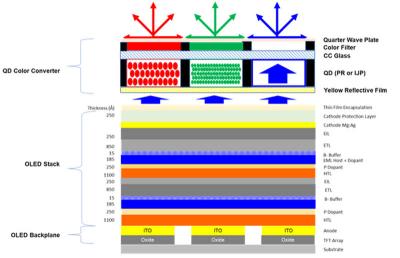
QD-OLED displays are hybrid displays that use a combination of OLED emitters with QD color conversion layers and/or QD emitters. The basic idea is that the display uses only blue OLED emitters, and the QD layers converts some of the pixels to red and green, thus creating a full color display. Read our latest QD-OLED analysis article here.
Samsung QD-OLED
Samsung is the only company that have commercialized QD-OLED displays (at least until now). Samsung's QD Displays use blue OLED emitters and quantum-dots that convert the blue light to red and green light. In 2019 Samsung Display announced its decision to invest $10.85 billion in QD-OLED TV R&D and production lines. A few years later, SDC started to produce panels in its first fab, mass producing TV and monitor QD-OLEDs.
Samsung attracted several customers (Sony and Samsung Electronics for TV panels, and several companies for its monitors), and these displays have been very well received by the market. Samsung is currently producing around a million QD-OLED panels per year. The future roadmap of Samsung's QD-OLED displays is not clear.
TCL H-QLED
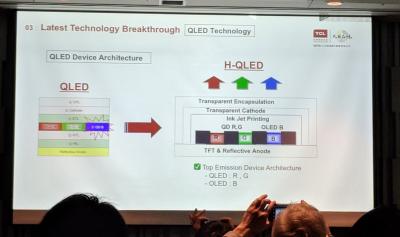
In 2019 it was unveiled that China-based display maker TCL is developing a new hybrid display technology that uses a blue OLED emitter coupled with red and green QD emitters. All three emitter materials will be combined and printed using ink-jet printing technology.
TCL called this technology H-QLED and said that this could prove to be the technology of choice for TCL's future high-end emissive TV displays. For more information on TCL's H-QLED, click here. The company, however, did not update on its H-QLED technology since 2019.
Further reading
Samsung Display reports its financial results for Q1 2026, with a decline in its small/medium OLED business and stable QD-OLED sales
Samsung Display reported its financial results for the first quarter of 2026, with revenue of $4.5 billion, and a profit of $280 million.

Samsung reported a decline in its small/medium display business, saying this is due to seasonal effects and the impact of higher memory prices. Samsung's large-area display business maintained stable sales on robust demand for OLED gaming monitors.


Samsung Display's QD-OLED panels received wide-viewing angle performance verification from UL Solutions
Samsung Display announced that its QD-OLED panels have received verification from UL Solutions for their viewing angle performance under the QuantumView standard.

QuantumView is a verification program that evaluates changes in luminance and color coordinates as the viewing angle shifts from the front in 10-degree increments up to 60 degrees. According to UL's assessment results, Samsung Display’s QD-OLED panels maintained above 60% of front-facing luminance even at a 60-degree angle, while color shift remained below 0.012, indicating minimal change.
Samsung Display announced it has shipped over 5 million QD-OLED monitor panels
Samsung Display announced today that it has shipped over 5 million QD-OLED monitor panels last month, about 4 years after the company commenced the mass production of QD-OLED monitor panels.

SDC further says that from 2021 to 2025, it average an annual growth rate of over 320%. It has passed the 1 million unit market in May 2024, and in less than two years it has shipped over 4 million more units.
LG Electronics reportedly in talks with Samsung Display for the supply of QD-OLED monitor panels
According to reports in Korea, LG Electronics is considering using Samsung's QD-OLED panels in its future monitor lineup, and is in talks with SDC regarding a supply agreement.

It is said that LG is specifically interested in Samsung's 27-inch 4K 240Hz QD-OLED panel. The reports haven't been verified yet.
The end of the OLED process monoculture - what will it mean for supply chain companies?
Apple is reportedly looking to adopt QD-OLED or WOLED panels for its 2029/2030 iMac monitors
According to reports from Korea, Apple is looking into OLED displays for its 2029 or 2030 iMac monitors, and has reached out to both Samsung Display and LG Display.

Apple, unsurprisingly, is interested in a high-end display, that will sport a high resolution and high brightness, and both SDC and LGD are developing their next-gen panels in order to satisfy Apple's demand.
Samsung Display launches a new low-reflection high-durability film for QD-OLED monitors
Samsung Display announced that it has developed a low-reflection high-durability film for QD-OLED monitors. Branded as QuantumBlack, the film reduces light reflection by 20% compared to the company's previous film and increases panel hardness to 3H (up from 2H) - indicating a high level of strength that resists scratches even when contacted by a fingernail.

Samsung says that this new film will be fully applied to all new QD-OLED monitor products launched this year. The company says it has always applied low-reflection films to its QD-OLED panels, and continues to improve this vital component.
Will Samsung start producing 24-inch QD-OLED monitor panels in 2027?
According to a leaked product roadmap, Samsung Display is developing two new QD-OLED monitor panels, sized 39-inch and 24-inch. Samsung Electronics will release monitors based on this panel in early 2027.

Samsung's 2025 monitor range, that does not include a 24-inch QD-OLED
This is very interesting news. Up until now, all consumer OLED monitors have been offered with sizes of 27-inch and higher, and consumer that want to use smaller monitors (me included) were left with no choice.
Samsung resumes QNED development, will that mean the end of QD-OLEDs?
A report from Korea suggests that Samsung Display has decided to resume its QD Nanorod Diode (QNED) technology development, that it has paused a few years ago, following a technology breakthrough related to the QD nanorod arrangement and placement technology.

Samsung's QNED technology is based on blue emitting nanorods (somewhat similar to microLEDs), coated with QDs for color conversion. Samsung's nanorod and QD deposition are both based on inkjet printing. The company originally hoped to achieve pilot production in 2021, but it faced several technical challenges, and eventually decided to abandon R&D - until this resumed last year.
Semes finished the development of a 8-Gen QD inkjet printing system
South Korea's Semes has finished the development of a 8-Gen (2500x2200 mm) QD inkjet printing system, and has begun to mass produced systems, aiming to ship these to Samsung Display.

The 8.5-Gen Vincent QD inkjet printing system utilizes over 100 print heads, and achieves a resolution of over 220 PPI. Semes says that it has improved the PPI by 30% compare to its previous systems.

