OLED Tablets - Introduction and Latest Industry News
What is an OLED display?
OLED is short for Organic Light Emitting Diode, a device composed of thin carbon-based films placed between two electrodes that creates light with the application of electricity. Unlike other screen technologies, (like LCDs), which require backlighting, OLED displays are emissive devices - they emit light rather than manipulate transmitted external light.

OLEDs provide brighter, crisper colors and contrast on electronic devices and use less power than conventional light-emitting diodes (LEDs) or liquid crystal displays (LCDs) used today. This revolutionary technology is fit for various types of screens, like computer screens, mobile phones, tablets, TVs and more. OLED screens are light, thin, high-resolution and contain individually-lit pixels that make for true blacks and superior color contrast.
The current OLED tablet market
OLED displays are already very common on mobile phones (in fact it is the dominant technology, with a market share of over 50%), as Apple, Samsung, Vivo, Xiaomi and others adopt OLED displays in their smartphones.
OLEDs are also used in tablets, and this is a growing market. Samsung, Microsoft, Huawei and others are already shipping OLED-powered tablets. In 2024 Apple launched its first OLED tablets, the 2024 iPad Pro devices. It is likely that Apple's move will cause an increased adoption of OLEDs in tablets from other companies.
Click here for a list of the latest OLED tablets on the market. Subscribe to OLED-Info Pro to access our complete list of OLED Tablets , with full information on the display types, producers, features and more.
LG Display shows a wide range of new OLED displays and technologies at SID Displayweek 2026
LG Display is showcasing a wide range of OLED displays and prototypes at SID Displayweek 2026. In this article we detail the most interesting demonstrations and technologies.

First up, is LG's 3rd-Gen Tandem OLED, these are AMOLED displays, aimed towards the automotive market. LG says that it has introduced two new technologies into its tandem stack - a deep-blue dopant and optimized hole and electron movement. It isn't clear exactly what LG refers to, but it does say that these new technologies enable tandem OLEDs with improved power consumption (18%), brightness (1,200 nits), lifetime (over 15,000 hours) and color purity and reproduction.
Counterpoint: the OLED market to remain flat in 2026, as smartphone panel shipments will decline 3% due to high memory prices
Market research firm Counterpoint says that following the spike in memory prices, it revised down its forecast for the OLED industry in 2026, as it now sees smartphone OLED panel shipments declining 3% in 2026. We have heard this before from Omdia a couple of months ago.

Following a 3% increase in global OLED panel shipments in 2025, Coiunterpoint says that the market will remain flat in 2026, as automotive and IT OLED shipments will increase and offset the decline lin smartphone OLEDs.
LG Display advances with its plans to adopt eLEAP for IT OLED production, will make a final decision by end of 2026
Last year, we reported that LG Display is looking into adopting Japan Display's eLEAP technology at its OLED TV production lines in Paju, perhaps seeking to produce RGB AMOLED displays for IT applications at these fabs that are currently under utilized.

Today we hear that LG Display is now progressing with this plan, and is checking an investment plan to apply eLEAP into its large-area OLED production lines.
Samsung Display reportedly achieve 80% yields at its A6 8.6-Gen production line, on track for mass production in June
A few weeks ago we reported that Samsung Display may be delaying the A6 8.6-Gen ramp up, following some technical challenges - and demand concerns. Today it is reported that say that this it not the case - SDC actually managed to achieve yields of over 80%, and is on track to start full mass production by June 2026.

According to what we know, the first products out of the new line will be laptop AMOLED panels that will go to Apple - that signed an exclusive supply agreement with Samsung Display to produce touch AMOLED displays for its upcoming 2026 MacBook Pro laptops (both 14-inch and 16-inch models).
BOE shipped 150 million OLED panels in 2025, the company provides details on its OLED roadmap, demand for IT panels, and OLED profitability
BOE's Chairman Chen Yanshun provided some interesting information in a recent investor communication event, providing an update and outlook for the company's OLED business.
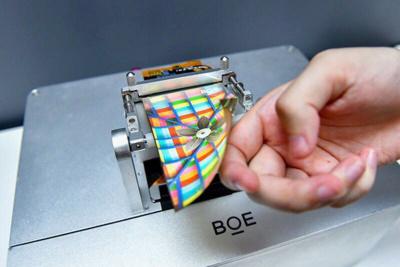
BOE updates that it shipped around 150 million AMOLED display in 2025, a growth of 8% over 2024. This is below BOE's original expectations, and the company gives three reasons for the lower shipments in 2025: patent disputes in the AMOLED field, limited coverage of national subsidies (most Chinese phone subsidies cover only budget smartphones), and the need for improvement in internal lean management.
UBI: the medium and large OLED display market will generate $11.5 billion in revenues in 2026, will grow to $20 billion by 2030
UBI Research says that medium and large OLED display panel revenue will reach $11.5 billion in 2026, and will grow to $20 billion by 2030, a CAGR of 14.8%. These displays are utilized in tablets, monitors, laptops and automotive applications, mostly (this category for UBI does not include TV panels).

UBI says that the main driver for increased sales will be the monitor market, where OLED panels will grab a market share of 26% of the total medium and large OLED market (not the total monitor display market).
Is Samsung Display slowing down its 8.6-Gen IT AMOLED line ramp up? Reports suggest technical challenges combined with low demand as reasons
Two days ago we reported that Samsung Display has began trial production of laptop AMOLED displays at its A6 site, and has already achieved yields of over 70%, and is close to achieve over 80% yields soon. That report was optimistic, saying that SDC is on track to begin full scale mass production by May 2026.
There are reports from Korea today, that Samsung may be delaying the A6 ramp up, citing some interesting information about technical issues, but also market concerns. We detail it below.
Bloomberg: Apple is developing a 18-inch foldable tablet, but will take years to launch, if ever
Bloomberg is claiming that Apple is developing a large foldable iPad, one that features a 18-inch display when fully open. While this is an exciting project, Bloomberg's report says that there are many technical challenges, and the plan is to release it in 2029 - and the project will likely to be cancelled soon.

There are also other reports that Apple is developing a smaller folding tablet, that may replace the iPad mini. But there are not many details there, yet.
8.6-Gen AMOLED production lines - current snapshot and future industry outlook
The OLED's industry main new target, for the past several years, has been the IT display sector, mainly tablets, laptops and monitors. While we have seen OLED displays penetrate this market many years ago, the current 6-Gen AMOLED production lines are optimized for smartphone and wearable display production.

A few years ago display makers realized that OLED production lines with larger substrates will enable lower cost production, and will enable to increase the adoption of OLEDs in such devices. When this converged with technology readiness , several companies initiated new projects, all of which use 8.6-Gen (2250 x 2600 mm) substrates. In this article, we detail all four 8.6-Gen OLED production lines that are currently being built - by Samsung Display, BOE, TCL CSOT and Visionox. We also other display makers and how likely they are of launching large-scale 8.6-Gen lines as well. Finally, we see how these new lines will effect the entire OLED industry, whether it is likely we'll see new lines (do we actually need all that added capacity?) and what we expect to happen next.
Samsung Display to initiate mass production at its 8.6-Gen IT AMOLED line in May 2026
Samsung Display will reportedly initiate mass production at its new 8.6-Gen IT production line in Asan in May 2026 - a few months ahead of schedule. Last month we reported that SDC has verified mass production at the fab, and has shipped the samples to potential customers (laptop makers).
According to what we know, the first products out of the new line will be laptop AMOLED panels that will go to Apple - that signed an exclusive supply agreement with Samsung Display to produce touch AMOLED displays for its upcoming 2026 MacBook Pro laptops (both 14-inch and 16-inch models).

