OLED Encapsulation: introduction and market status
OLED (Organic Light Emitting Diodes) is a flat light emitting technology, made by placing a series of organic thin films (usually carbon based) between two conductors - and these films light up when electrical current is applied. OLEDs are used to make display and lighting panels. OLED displays an offer excellent image quality, are thinner, more efficient than LCD displays, and they can be flexible.

One of the major problems with those organic materials is that they are very sensitive to oxygen and moisture. This means that OLEDs need to be protected - as even a single water or oxygen molecule can harm the OLEDs.
Thin Film Encapsulation (TFE)
With regular (rigid) OLED panels, one can use a glass sheet. Glass is a great barrier, and it is widely used in the display industry and so easy to handle.
For flexible panel, rigid glass is not a a good option, and in such panels producers use different techniques, collectively referred to as Thin Film Encapsulation, or TFE. TFE is a multi-layer film, made from alternating organic and inorganic layers.
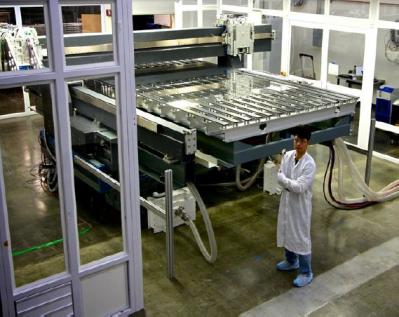
Most organic layer TFEs use an inkjet printing process. Inkjet printing is used to deposit the organic TFE materials. Kateeva launched an encapsulation inkjet printer system towards the end of 2014, and in 2016 the company announced that it secured the "vast majority" of available TFE orders. Since then it is believed that most, if not all, AMOLED displays are protected by inkjet printed TFEs (the organic layers).


The inorganic TFE material deposition can be done in different methods, including Plasma-enhanced chemical vapor deposition (PECVD) and Atomic Layer Deposition (ALD), that enables thinner and more uniform films.
Further reading
TCL CSOT develops inkjet printing materials for polarizer-free OLED color filter deposition
TCL CSOT has developed a novel inkjet printing material for color filter deposition, that can be used in polarizer-free OLEDs that adopt a color-filter on encapsulation (COE) architecture.

Samsung's COE OLED structure (source: DSCC)
CSOT has already produced functional testing samples on 326 PPI OLED displays, meeting the industry's technical standard of a 30% power consumption reduction compared to polarizer OLEDs, and a reflectance of 6.41%. CSOT says that its IJP-COE process will simplify the manufacturing, increase material utilization and cuts costs.
BOE lights up its 8.6-Gen AMOLED line in Chengdu ahead of schedule
BOE officially announced that it has lit up its 8.6-Gen AMOLED production line in Chengdu, five months ahead of schedule. The company aims to be the first in the world to mass produce OLED IT panels in a 8.6-Gen line.

Back in October, we reported that BOE is accelerating the building of its 8.6-Gen line. The company's original plan was to start mass production in Q4 2026, but now it hopes to begin production in Q3 2026, a month or two earlier than Samsung Display (that also hopes to begin mass production in Q3 2026).
Everdisplay reports its financial results for the first half of 2025
China-based AMOLED producer Everdisplay reported its financial results for the first half of 2025, with an income of 2.67 billion Yuan ($372 million USD), up 11.5% from 2024, and a net loss of 893 million Yuan (almost $125 million USD), down from 1.3 billion in 2024.

Everdisplay says that its improved results are the result of its new strategy to focus on fast-growing market segments, such as displays for tablets and laptops. Everdisplay continues to expand its R&D to increase its competitiveness.
HKC decides on two strategies for OLED production: equipment acquisition followed by an eLEAP on IGZO production line
China-based LCD maker HKC aims to become an AMOLED producer, and we now have more details on its strategic plans. In 2023, HKC started a collaboration with JDI to build an eLEAP AMOLED production line in China. These plans were canceled towards the end of 2023, but the company continued to develop its AMOLED technologies, and in early 2025 it acquired Royole's AMOLED production line equipment.

Earlier this month HKC produced its first AMOLED display sample - a smartphone type panel, produced on an advanced Oxide-TFT (IGZO) backplane.
Will OLED inkjet printing finally take off in 2025? We explore the past, present and future of OLED inkjet technology
Inkjet printing of OLED displays has been in development for many years, driven by the potential of this deposition technology to reduce the cost of OLED display manufacturing.
Currently, the vast majority of AMOLED, WOLED, and QD-OLED production relies on evaporation methods to deposit OLED layers. In these processes, OLED molecules are evaporated and then deposited onto the required substrates. For AMOLED displays, precise subpixel patterning is necessary, which requires the use of a fine metal mask (FMM). While subpixel patterning is less complex for WOLED and QD-OLED production, these technologies still depend on material evaporation.
Evaporation-based OLED deposition has enabled the large-scale production of high-quality, affordable OLED displays found in wearables, smartphones, tablets, laptops, monitors, and TVs. This approach forms the foundation of today’s OLED industry, which exceeds $40 billion in value. This article will examine the alternative approach of OLED inkjet printing, review its history and current status, and consider its future prospects.
Table of contents for this article
- Introduction to OLED deposition processes
- Soluble OLED materials and processes
- OLED inkjet printing – history and technology progress
- Inkjet printing of OLED TFE and QD-OLEDs
- TCL CSoT – the last inkjet printing champion?
Researchers developed an ultra-small flexible OLED neural probe
Researchers from Korea's Advanced Institute of Science and Technology (KAIST), in collaborations with a team at the University of Incheon, have developed a flexible OLED-integrated optogenetics neural probe. Optogenetics uses light stimuli of specific wavelength to regulate neuronal activity.

The main advance in this research was the development of an ultra-thin flexible encapsulation layer, made of aluminum oxide and parylene-C, which enabled the fabrication of an ulta-thin bio-compatible flexible probe, that can sustain its operation in a biological environment rich in moisture and oxygen while minimizing tissue damage upon implantation.
Samsung Display introduces its UT One IT OLED panels, to enter production in 2026
Samsung Display is introducing a new IT AMOLED display type, branded as UT One OLED. UT One displays feature an ultra-thin structure and a variable refresh rate (VRR) of down to 1Hz. Samsung says that UT One OLEDs offer a reduced power consumption by 30% compared to 'conventional panels'.

UT One OLEDs are produced on a glass substrate, but offer a TFE encapsulation, to reduce thickness (by 30%) and weight (also 30%). Samsung says that compared to a standard rigid OLED protected by two glass panels, this can reduce weight by about 50 gram in a laptop display.
Samsung Display readies new automotive OLED display technologies
According to a report from Korea, Samsung Display has decided to adopt a tandem OLED stack architecture in its future automotive OLED panels. Up until now, most of its automotive displays used a single stack. This change will enable the company to offer highly efficient and longer lasting panels.
In addition to the tandem stack architecture, Samsung Display has also finished the development of automotive flexible OLED panels, produced on a polyimide substrate, and encapsulated via TFE. The company is also developing rigid TFE OLEDs produced on glass. The company has developed these new panels as per customer requests.
Toray Research Center to share an open webinar to discuss OLED materials analysis and technologies
Toray Research Center (TRC) is sharing a new open online webinar recording focused on OLED materials analysis and evaluation. TRC, who supplies technical analysis and support for R&D and manufacturing, invites you to attend the online lectures at no cost, to get a deeper understanding on OLED technologies and analysis of OLED devices. The webinar recordings will be available until April 5th.

The first lecture, titled 'current analytical techniques for displays', will introduce TC's technologies, services, expertise and equipment. TRC will detail the company's latest analytical technologies installed in the past year and will explain the most appropriate techniques for different types of displays and analysis goals.
The second lecture will discuss the analysis of OLED materials impurities. The OLED industry still faces challenges with durability and lifetime improvements, and impurities in organic materials and deposition equipment are considered to be one of the causes of decreased device lifetime. Identifying the materials impurities is extremely important to improve OLED performance and for the quality control of OLED panels. In this lecture, TRC will show how it investigates the impurities in an OLED material using mass spectrometry, and will show how it has successfully identified materials impurities that affect the decrease in device lifetime.
LG Display to retrofit its iPad AMOLED line to produce iPhone OLEDs as Apple reduces its tablet display orders
In late 2024 we reported several times that demand for Apple's iPad Pro devices is lower than expected, and the company reduced its OLED panel orders from both Samsung and LG.

According to a new report from Korea, LG may decide to start using its IT AMOLED production line to produce smartphone displays. The company looks to supply 70 million iPhone AMOLED displays to Apple in 2025, up from around 65 million in 2024 (and 52 million in 2023). Converting the IT AMOLED line to smartphone panel production will enable LGD to increase capacity without a large investment in new equipment.

