Visiting Perth Museum – some thoughts, including the Stone of Destiny and Mary Queen of Scots last letter displays

Today my husband and I visited Perth Museum for the first time. We’d been meaning to go for years, to see the Stone of Destiny and more. The temporary exhibition of the last letter of Mary Queen of Scots finally drew us there.

I was using my wheelchair, and parking nearby in Perth’s one way and pedestrianised centre is tricky. But we were very lucky to find a disabled space in the next street – I have a Blue Badge. The museum is good for wheelchair accessibility, with ramp access, lots of room inside, and generously proportioned lifts and disabled toilets.

The Stone of Destiny exhibition on the ground floor was impressive, with clever use of audio and visuals, to cover the history, especially the 1950 theft of the Stone, and the 1249 coronation of Alexander III, the earliest coronation historians are sure used the stone. Nicely done, and thoroughly recommended. I also appreciated that there were seats in the rooms for people attending, so it wasn’t just the wheelchair user who got to sit down for the duration!

The last letter of Mary Queen of Scots is on the upper floor, in a special area, based around two rooms, the first providing wider context, the second showing the letter, and more information boards, including about her local connections. I’ve been fascinated by Mary since I was a young child, and even back then, over 40 years ago, I had a facsimile copy of this letter. It is really helpful to see the letter physically in person, to appreciate its scale, be able to examine the paper, and the handwriting, and appreciate it more directly.

Another area of the museum that interested me, again on the first floor, was the extensive section about Georgian Perth. My Dundee University PhD examined Scottish cultural and social history in this period, so this section of the museum was of particular appeal. Both my husband and I were wowed by the natural history display nearby – he is a birder, and appreciated the stuffed birds flying high above! The ground floor pre history exhibition, including Pictish art, was good too. As a Hammer horror films fan I was also delighted to find a prop sarcophagus from their 1959 film The Mummy.

In between the two big headline items and browsing the rest of the museum we stopped for lunch in the museum cafe. It was extremely busy, and we were relieved to get a table, before browsing the menu and deciding what to order. Both were impressed by the range of food. I ordered a haggis and cheese baked potato and my husband ordered sandwiches, with cajun fries. The food was of a high standard, and the service excellent. The food and drinks arrived quickly after ordering. We found the cafe a calm place to pause in between museum browsing.

The shop layout in the museum is a little confusing. At the back of the museum on the ground floor there is a shop with gifts and especially things that children might enjoy. I bought a RSPB peregrine falcon stuffed toy! I also picked up the museum’s facsimile copy + English translation of Mary’s last letter. But they didn’t have other books, which we found later near the front desk. This split is a little unintuitive for visitors.

We very much enjoyed our time in Perth Museum and would recommend it to visitors without question. But maybe allow a good amount of time to browse the sections of interest to you, at least two hours. Also check in advance if going by car about the parking and street system, which can be confusing for those not familiar with Perth and its roads. But otherwise, a great day.

The image below shows part of the interior of the museum, and comes from the museum website.

Part of the museum upper floor, showing wide passageways around the edge with exhibits beside them, and below the opening down to the ground floor below. In the picture can be seen a variety of exhibits, including paintings, and especially natural history items, including birds flying, suspended from the high ceiling. The room is light and airy, with a tall curving roof with fine plasterwork and large skylights.

Graduation musings

Last week saw graduation ceremonies at Dundee University. This week sees them at St Andrews University. Two of my three universities (the other is the Open University). And it’s bringing up thoughts.

I graduated in absentia from both my history degrees (taught MPhil and PhD) at Dundee. I was far too ill and disabled by then to manage the ceremony. Even if they’d let me use my wheelchair, my extremely severe bladder incontinence would make it impractical for me to sit through the ceremony. So I haven’t witnessed Dundee’s graduation ceremonies in person. A friend graduated with a history PhD last week. It was interesting to watch in the online live stream. PhD graduates at Dundee, unlike lower degrees, carry their hoods onto the stage, where they are hooded, and bopped by the Chancellor, now standing. My friend was the very last person to cross the stage in her ceremony last week.

My husband Martin (then fiancé) remembers carrying a hood on stage at our St Andrews BSc(Hons) ceremony in 1994, though I thought we were already hooded. We definitely got bopped by not-John-Knox’s-breeches. We should have received a digital video copy of our 1994 ceremony last year. But the St Andrews university alumni people can’t find footage for our ceremony. So we remain unsure what happened. Martin graduated in absentia with his later St Andrews CS PhD.

St Andrews Computer Science are hosting a reception for CS graduates this year. I don’t remember that happening in 1994. Then there were just 3 BSc(Hons) CS students graduating, after the catastrophic plunge in numbers going into honours for our year. We didn’t even have a class photo, though the large years before and after did. My classmate joked we could have had one in a photo booth. I definitely envy this year’s St Andrews CS bunch getting fudge doughnuts at the reception. I do have fond memories of a reception for history students at Dundee (we MPhil students were very few in number, alongside more numerous other degrees).

Photo from 1994 from North Street, St Andrews, outside the Younger Hall. From left to right my gowned future husband, my mum in a red dress and black hat beside him, then Martin's mum in a blue and white dress with white jacket, and to the right me begowned.

Dealing with an invisible and fluctuating neurological illness

I wanted to blog a bit about what my life has been like since 1994, and the struggles I cope with that people can’t see. There’s still very much a perception among the public and medical staff that you can judge someone’s health by looking at them, or in a short interview. This is the core basis of many things, including benefit assessments, medical consultations etc. But for fluctuating largely invisible illnesses it’s hugely flawed.

I fell ill with what would turn out to be cerebral vasculitis in 1994, aged just 22. This is a literally 1 in a million diagnosis (no I’m not making that incidence up!) and it can be very difficult to diagnose. I was misdiagnosed with ME at first, and only diagnosed properly in 1997 after brain scans and then many more tests. My form was initially similar to ME but then changed to be closer to multiple sclerosis, in a somewhat relapsing-remitting form, but also rather progressive. I’m not going to recount the whole medical history, which is summarised online. But it’s a struggle to stay alive, and it’s amazing I’m still here 21 years after that delayed eventual correct diagnosis. Chemotherapy, steroids and immunosuppression drugs (many lifelong) keep me alive, and slow down further brain damage.

What I wanted to focus on in this post is the invisible and fluctuating nature of my illness. Since not long after 1994 I’ve used a stick permanently, and more recently two. And since the late 1990s I’ve had my own manual wheelchair for occasional use. Yes those are visible signs of disability, and people do, thankfully, usually notice them, and take them into account. But other than this I can look very well. Chunky from steroids, but otherwise looking well. If I had a pound for every time someone said “You look well!” I’d be rich. Each time I want to cry – it’s not how I am. But what can you say. I get particularly exasperated when a medic says it.

What someone looking at me can’t see are the hidden symptoms. They can’t see how I struggle to control my bladder, and have to wear incontinence pads permanently, since I was in my early 20s. They can’t see inside my brain, to understand how as a conversation goes on I get more and more brain tired, have more trouble hearing, speaking without slurring, and just thinking full stop. All things that worsen as I’m more tired, that you won’t see, until it gets extremely noticeable, and by then it’s probably far too late for me, and I should have gone back to bed to rest long before then.

You’ll see me for just a short time when I get out, but won’t see how much I’ve had to rest – sleep solidly! – the day before any appointment or meet up, so I’m well enough to manage that outing. And equally how I will be knocked out and sleeping solidly both after I get home and the day after, because of what the effort to get out takes out of me. I make this effort because I want to have fun, and do things, but it always takes a lot out of me. Yes I may be smiling and happy when you see me for a short time, but I’m exhausted before and after, and it’s not easy.

Also I may use a wheelchair one day, and other days not. Or get out of my wheelchair part way through and walk with sticks after. That doesn’t mean that the wheelchair wasn’t needed, and that I’m fine. It just means that it’s done its job helping me to do what I need to do. And yes, I will still crash badly afterwards.

Nor do you see how much I need to sleep. As my disease has gone on over the years I’ve found that I need to sleep more and more. The amount increases during a relapse or flare, and can go as high as 18 hours total a day, every day, day after day, for weeks or even months. As the inflammation in my brain reduces the amount of sleep needed per day usually drops too, but it’s never anywhere remotely near normal. Often it’s as though I’ve been given a horse tranquilliser, and I’m very sedated and confused. I can’t fight it – if I do I risk at best making myself vomit uncontrollably as my body fights back, or at worst more serious brain damage happening, if I push myself too far. I’ve learned the hard way that I need to go along with my body, and that this increased sleeping is my brain’s way of protecting itself, especially during increased periods of disease activity. But it’s still difficult. And other people usually haven’t the remotest clue. They’ll think I have the normal amounts of time that others have per day to do things, whereas in reality I’m snatching odd hours here and there, as I can, sometimes weeks or even months apart. My first history PhD supervisor used to say he marvelled at how productive I would be in such a short time, which I found a really insightful and understanding comment.

One of the most infamous medical interviews I had was with a neurologist, who because I’d completed a PhD was convinced I couldn’t have significant brain problems. But I did that PhD in the most difficult circumstances. Part-time yes, but way more part-time than that sounds. For much of the time, including writing my thesis, I was working on the PhD in one hour chunks, spread throughout the week, for no more than five hours total a week. After each hour, for example writing more of my thesis, I would be so brain tired that it would take me up to a couple of days to recover before I could have another hour’s go. All because of my brain disease. But nope, I looked fine clearly, and this neurologist had no understanding. Luckily I didn’t rely on him for treatment,

I’m tired now, so will wrap this up. But I hope it’s given an insight into what living with an invisible and fluctuating disease can be like. If you have a friend or family member with something like this, please think twice before saying “You are looking well!” It may not be the most supportive way you can help them. And don’t prejudge strangers you encounter, including with Blue Badges.

Visit to Edinburgh Book Festival in August 2018

My husband and I visit the Edinburgh Book Festival every other year or so, and were back again last week. We’d booked to go and see a talk by Brian May and photographic historian Roger Taylor. But I was also keen to see the bookshops again, which I always find excellent.

This is the first year that I’ve found the crowds a particular problem. I have to use my wheelchair when I’m there, with my husband pushing, and this year getting past other visitors, who’d often stop to chat in the walkways, was a significant problem. I don’t know if there were higher numbers of people attending this year, or what, but it seemed more of an issue than usual. Note we were there on Wednesday 15th August, in the late afternoon and early evening.

I was also struck by how difficult it can be to get the wheelchair into the tents, bookshops, talk venues etc. There’s always quite a slope to go up, and a ridge to get past or bump over. I could never wheel myself in. Even my husband, who’s been pushing my wheelchair for years, struggled, again not helped by people milling around.

On the plus the bookshops were a delight. I always find things there that are real gems for me, that I wouldn’t know of otherwise. My particular highlights this year included a book of 100 Gaelic WW1 poems, most of them written during or shortly after the war, with dual language Gaelic and English translations facing each other in the book. My other main highlight was finding a book of essays by Philip Pullman about storytelling in its many forms. I was reluctant to buy such a chunky book – I have too many books already, and wondered where I’d shelve it! But it drew me back, and I was very pleased to take it away and delighted when I started reading it. Something else I’d have bought before had I known it existed.

Books bought include Philip Pullman essays, George Washington Wilson stereoscopic history, Gaelic WW1 poems and compact dictionary, and a free signed bookplate to go in the Wilson book

Book haul from Edinburgh Book Festival

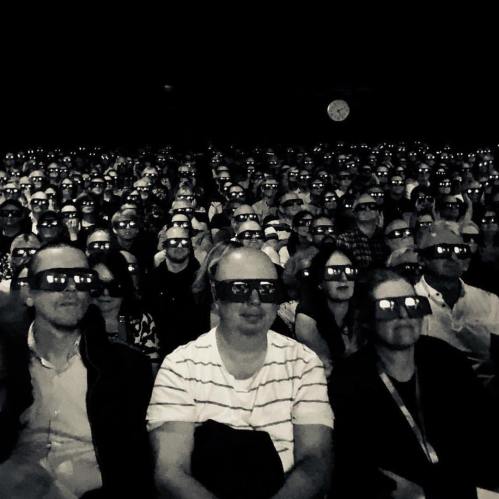
The talk by Brian May and Roger Taylor was fantastic. They were speaking about Scottish Victorian stereoscopic photographer George Washington Wilson, and launching Roger’s book about him. The audience were all given 3D glasses to wear, which worked from a vast range of seating positions, and enabled us to enjoy the original stereoscopic photos. Quite magical, and enormous fun. Sadly Brian and Roger couldn’t do a signing afterwards, having to dash off to a BBC interview, but we were all offered signed bookplates to go in the book.

Audience of scary looking people all wearing 3D glasses and looking intently at the stage

Audience at Brian May and Roger Taylor talk (photo by Nicole Ettinger and from Brian May on Instagram)

So a fun trip, but some disability niggles. We’ll be back in future, but definitely with my wheelchair, albeit anticipating problems.

Problems as a disabled academic attending conferences

Inspired by a very thorough piece in the Guardian newspaper today by Kate Sang I wanted to reflect a bit on my own problems attending academic conferences.

Decades ago I was a young and healthy academic, about to start a computer science PhD. I could attend conferences in their full form: going to all sessions, all days, including meals and socialising.

Shortly after that I fell ill, at just age 22, with a neurological illness very similar to multiple sclerosis. It took some years for me to be diagnosed with cerebral vasculitis, but by then I’d had to drop out of that science PhD. Fortunately I retrained part-time as a historian, picking up three more degrees, including PhD. My disease is incurable, progressive in my case, and is treated lifelong with chemotherapy drugs and steroids to reduce brain inflammation and slow damage.

I can’t work in a paid form due to my illness. It is severely disabling. I sleep for much of the time, sometimes up to 18 hours a day, every day, due to the brain damage and inflammation. And even when awake I am often very confused and can only work for short periods. Near the end of my history PhD I could only work for five hours total a week, in one hour chunks maximum, spread over many days. But I finished the PhD. And I am now active as an academic. I publish academic journal papers, undertake new research projects, and speak at conferences and attend as an audience member. I have an honorary research fellowship from my university, though costs of attending events etc. are paid by myself.

Whereas 25 years ago I could attend a conference in its entirety, now I have to pick at most one or two days, with a day of rest in between. I will also usually have to be modest in my expectations re the number of panels to attend.

Firstly there are the practical issues of getting to the conference. I’m typically travelling with a wheelchair, which usually makes connections by train etc. difficult. Normally if I am flying to a venue it is far easier to get a taxi – albeit costly – from the airport to the hotel. But this only works if it’s within reasonable and affordable travelling distance. A few years ago I was invited to speak at a book history conference in Germany, which would have been very good for my research interests and academic networking. But the venue was far away from the airport I’d be using, and a taxi trip would be quite impractical in journey time and cost terms. Nor could I rely on being able to access trains. So reluctantly I declined the invitation. Fortunately I was asked years later if I would like to contribute a piece to the conference’s collection of essays. I submitted my piece, and the book is due to be published in a month.

Even on the spot physical accessibility is a major concern. I normally now use two sticks, but when at a lengthy academic event I need to use my manual wheelchair – with husband along to help push – to manage to last the day. And getting into and around academic venues can be highly problematic.

One thing I should praise is I’ve found conference organisers usually very helpful in helping my husband attend as my carer. He shouldn’t have to pay, since he is just there to push me around and help me navigate obstacles like doors etc. He is also an academic, but in a very different field from me. So he’s not there to listen to the talks. Most conferences allow him to attend for free. That is enormously helpful, and not something I expected. We still have double travelling costs, but not paying double conference fees does ease the cost for us to a certain extent.

Though against that positive experience very few academic conferences offer daily registration fees. At least in my field – humanities – you typically have to pay for the full conference or nothing. And with me often only attending half or even a third of the conference this makes them particularly costly for the time and benefit that I’m going to get in return from the event. Sometimes I do get a reduced attendance fee though. I am particularly grateful to a recent conference organiser, who given how little I was going to be there, let me attend for free. And my husband as well of course. Thank you Drew!

Once there, if a venue has stairs to reach talks I cannot possibly attend. Sometimes organisers move rooms, which I am very grateful for when it happens. But it’s not just about the room where the talks take place, but also about getting into a toilet, and getting to meals. I have severe bladder incontinence from my brain damage, which in particular causes huge problems with urgency and frequency. I need to go to the toilet a *lot*. Having a wheelchair toilet beside the room is good, but if I have to go constantly during the talks – as has happened – it can be very awkward.

One conference that I regularly attend relocated to a ground floor room, with a toilet beside it, which is good. But the meals including lunch were elsewhere in the building, and I would not be able to get there, without major difficulty. It was far easier for me to stay trapped in the room during the lengthy lunch break, while my husband fetched food for me. This cut down the vital networking with fellow academics I could do, though thankfully some historian contacts specifically sought me out at these times, and had lengthy chats with me in the room on my own. Likewise the book stands of academic books to buy at this conference were upstairs. No way could I get there. So again husband was dispatched, with iPad, to take photos for me to browse, and also to bring any specific titles of interest down to me to look at. In this instance the Brill publishing rep actually came downstairs to take the order from me directly. He was keen to help, but it was still frustrating for me not to be able to browse through all the books in person.

Sometimes I attend conferences with multiple streams of talks on at once, in many rooms, even a dozen and more in one case. For these conferences I will always try to let the organisers know in advance which specific panels I want to attend, to make sure I can reach them ok on the day, and rooms can be swapped in advance if need be. But that only works if the messages are passed on correctly at the other end. At the SHARP 2016 book history conference in Paris, at the Bibliotheque Nationale, I’d checked all the talks in advance, and was assured by the organisers that I would be able to reach them. When I got there on the day I found a panel I very much wanted to go to was up many stairs, in a building without a lift …

But perhaps the worst aspect for conferences for me as a disabled academic is how intensive they are, and how crammed the days are. Often they start at 9am or even 8am, and continue until 6pm or 7pm, with a packed set of talks running throughout those periods. Very tiring in brain concentration terms, and much stamina needed to get through. I understand organisers are trying to fit as much in as possible for attendees. But it is exhausting, even for fit and healthy academics, who can find it wearing. For me it’s impossible to attend even a full day of this. So sometimes I’ll have to choose morning or afternoon, or if I am lucky afternoon and evening. Or I need to try to factor in some sort of rest time, which is difficult in a venue that I don’t know well, crammed with conference goers. I remember at an Ada Lovelace event in Oxford a few years ago that I went back into the main lecture theatre – then deserted – during lunch, to have a bit of a rest, and quiet time to myself, while everyone else socialised out in the lunch area. That quiet time refreshed me enough mentally to allow me to stay for some more talks in the afternoon.

I know that it’s unusual for someone to be as bad as me health-wise and still want to attend academic conferences. But the problems that I have described aren’t unique to me, and some of them – especially issues of fatigue and mobility issues – will be shared by other academics. Not all of these academics will be so obviously disabled. I remember that when one conference I mentioned above was moved to a ground floor venue this turned out to benefit quite a few other attendees, who would not have said anything before. So more accessible venues can benefit a wider academic population.

In practical terms I’m not sure how much longer I can keep attending academic conferences. And if I do it will have to always be done in a modest way, within my limitations. With travel costs, and logistical challenges, there is a trade off between costs and benefit. I will have to continue to decide if it is worth it for me. But for now it is. I just hope not to run into too many practical challenges in future conferences …