Looking back at a year of reading 2025 edition

Nearing the end of another year, and time for my annual recap of the books I’ve read in the last year, including general patterns, favourites etc. I enjoy looking back each year, and hope that the books mentioned may help some others.

To be blunt I’m also still delighted that I’m reading masses, albeit in increasingly difficult circumstances. I’ve lived with a progressive neurological disease now for 31 years, and although we’ve been able, with strong ongoing treatment, to slow the progression down a lot, it does mean that I am now extremely disabled and restricted. Including in what I can read.

Fortunately ebooks with gargantuan size fonts came to the rescue for me, and help me continue reading. I also still read graphic novels, though I am less likely to read traditional print. I have been an enthusiastic reader throughout all my life, and it’s very important to me that I can keep reading. I also have a PhD in historic reading habits … So yes, invested!

Looking back at the year I finished 58 books this year, the same number as in 2024, compared with 60 in 2023, and 75 in 2022. I don’t generally read short books, and my 58 books this year represent over 16,000 pages of reading. An average of over 300 pages a week. Almost always read on my Kindle, late at night, or during the day fitting around my extended sleeping and bedbound periods. I am usually reading lying down …

The picture below shows a glimpse of some of the books I was reading.

Screenshot showing a variety of book covers, including "Insomniacs After School" manga, "Forgotten Churches", a Peter Capaldi 12th Doctor graphic novel, "Some of Us Just Fall" by Polly Atkin, and many more. Very varied designs.

Two thirds of the books I read this year were fiction, and one third were non fiction. I tend to prefer reading novels, but also enjoy reading short stories. And my non fiction reading is quite varied and wide ranging. I tend not to read poetry, though I enjoy it, but occasionally read plays, including this year Born With Teeth by Liz Duffy Adams, the fictional retelling of the relationship between William Shakespeare and Christopher Marlowe, recently staged in London with Edward Bluemel and Ncuti Gatwa playing those roles. I enjoyed reading this play script a lot, rating it 5/5 on Goodreads and StoryGraph.

I had a number of other 5-star reads this year, including the 1988 painting book The Silvery Tay: Paintings and sketches from a Scottish river by Keith Brockie. Obviously of great interest to me living in Dundee. Similarly Luke Sherlock’s mix of architecture, history and place Forgotten Churches: Exploring England’s Hidden Treasures was a total delight.

My favourite genre for reading by a very long way is fantasy – not scifi, even though I’m a big fan of TV scifi series like Doctor Who, Babylon 5 and Star Trek. This year, for the first time, I read a Robin Hobb book, Assassin’s Apprentice, and was wowed. Though devastated in places while reading too! I expect to read more of her books. Better late than never. Other genres that I regularly enjoy reading include history, horror (though horror is very carefully selected to avoid some things that are too triggering for me) and manga.

I continued to slowly read Robert Jordan’s The Wheel of Time series of books. I’ve been reading them, widely spread out alongside other books, slowly since October 2021. This year I read books 9 and 10 – the latter a particularly disappointing book, though I had been forewarned. Things should pick up after that point, and I expect to read books 11 and 12 in 2026, and hopefully 13 and 14 in 2027. To take me to the end of the series. I am still enjoying this series, though am taking an extremely strategic approach to get me to the end.

As usual I reread a few books. Every October, I read A Night in the Lonesome October by Roger Zelazny, the gothic horror tale of a mysterious game taking place in the Victorian English countryside around Halloween. I am one of many many people around the world who reread this book every year at this time.

At the start of the year I reread my favourite Charles Dickens book, Our Mutual Friend. A palette cleanser after a rather torrid read of something else! And I am continuing to slowly work my way through a reread of Arthur Conan Doyle’s original Sherlock Holmes short stories. Which I am enjoying immensely as always, and writing little capsule reviews/thoughts on each one on my Dreamwidth blog.

Another book that I reread this year, for the first time in 30 years or so, was George Mackay Brown’s award-winning and Booker-shortlisted Beside the Ocean of Time. Told through the dreams and imaginings of a young Orcadian boy, this is a lyrical and powerful telling of Orkney history through time. An absolute highlight for me this year, and thoroughly recommended.

I also reread Terry Pratchett’s The Wee Free Men, continuing my slow reread of his “Witches” books in his Discworld fantasy series, following a slow reread some years ago of *all* of his Discworld books. This book is the very first book he wrote about young witch Tiffany Aching, and is a joy, and assumes no prior knowledge of the Discworld series. I was so happy to read it again, and have the rest of Tiffany’s books to reread in coming years too.

Continuing my love of fantasy books, I read a number of newly published fantasy books this year. Two 4-star reads for me were V.E. Schwab’s Bury Our Bones in the Midnight Soil, and R.F. Kuang’s Katabasis. The former a tale of vampires, over many centuries, the latter a journey into the Underworld by two students of magic at Cambridge University in England, trying to save their academic supervisor, so they can complete their PhDs. Both were enjoyable, but not quite hitting the top spot for me. But I’m very glad that I read them.

The V.E. Schwab book was a book club read for me this year. Other book club reads for me included The King of Elfland’s Daughter by Lord Dunsany (liked it, but glacially slow, and more descriptive than either plot-driven or character-driven) and Carmilla by Sheridan Le Fanu (I greatly disliked the very convoluted writing style, which I could barely read). I don’t read all of my book club monthly reading choices, but cherry pick the ones of most interest to me.

I’d like to mention a couple of other books that I particularly enjoyed. Firstly D.V. Bishop’s City of Vengeance, the first in his series of 16th century set Florence thrillers. Gripping! I will definitely read more. Notebook by Tom Cox was a 5-star read for me, a delightful set of varied scribblings and musings, often funny. Tom has had a torrid time with his former publisher Unbound, who treated him and other authors appallingly, as well as pre-order customers like me. If you want to read this or any of his other books, make sure that you get the new edition from his new publisher Swift Books, who are publishing his new books and rereleasing his old ones. Unscrupulous resellers are reselling copies of his former Unbound-published book, but Tom doesn’t get any revenue from those sales. The same applies to other ex Unbound authors, whose books are being resold similarly.

I’ve written a lot, so I think I should wrap things up now. Hopefully some of this was of interest to others. I’m delighted to report another good year for reading for me, despite everything. Hopefully next year will also bring fun reads, new book and new author discoveries, and the delights of rediscovering old favourites.

Looking back at a year of reading 2024 edition

It’s Hogmanay 2024, so time for another year’s reading retrospective from me! I adore reading, but read with great difficulty now due to my progressive neurological disease. I really envied the historic readers I was studying for my history PhD on Scottish reading habits … Thankfully my Kindle lets me read with an utterly gargantuan font, so I’m still gobbling up books, even as my disease continues to progress. But print books are rarely feasible for me now. Though I still read and enjoy graphic novels.

This year I finished 58 books, almost 17,000 pages read, and an average of 325 pages a week. Of these most of the books were fiction, with just 17 non fiction. I also read a couple of plays, and some works of poetry. The picture below shows a glimpse of some of the books I was reading over the months.

Various covers, including in the centre "Why We Love Middle-Earth" showing a warm Prancing Pony scene, and around the edge covers for some other books, including non fiction, manga and fantasy.

20 of this year’s books were fantasy, my favourite genre by far. This included a number of rereads, such as Tolkien’s The Fellowship of the Ring and Susan Cooper’s The Dark is Rising. I also did my usual pre-Halloween reread of Roger Zelazny’s A Night in the Lonesome October. Great new fantasy discoveries for me this year included V.E. Schwab’s A Darker Shade of Magic and Diana Wynne Jones’s Howl’s Moving Castle – yes I’m a bit behind the game with these ones!

I also read 10 graphic novels or manga books. Particularly manga books, and especially the Insomniacs After School series, which I found a delightful mix of slice of life, growing up, insomnia, astronomy and light romance. Quite a mix. I was also constantly amused because the main male character looks like a young version of my husband of 30 years!

16 reads were non fiction. I always have multiple non fiction books on the go. Highlights included Marchese and Sisto’s Why We Love Middle-earth: An Enthusiast’s Book about Tolkien, Middle-earth, and the LotR Fandom; Travis Nelson’s Sigrid Rides: The Story of an Extraordinary Friendship and An Adventure on Two Wheels; Michael Finkel’s The Art Thief (like a slow motion car crash, but unputdownable); Oliver Darkshire’s Once Upon a Tome: The Misadventures of a Rare Bookseller; and Aaron A. Reed’s 50 Years of Text Games: From Oregon Trail to A.I. Dungeon, which was a stunning achievement.

In my Goodreads record I rated 19 of this year’s reads 5 star, including 4 of the 5 books I reread this year. My average Goodreads rating was 3.8, but I did abandon some books that weren’t working for me, and didn’t record a score for them. And others are set to the side to be resumed later.

Looking ahead to 2025 I want to continue my very slow read of The Wheel of Time series by Robert Jordan. I think I am up to book 9 now. I’d also like to read more history books, and continue rereading some Shakespeare plays. Above all though I want to read and have fun, and look forward to discovering new gems as well as rediscovering old favourites.

Attending the Edinburgh Book Festival online rather than in person

This year I’ve been an online attendee of the Edinburgh Book Festival. I thought it might be helpful to blog some thoughts about this, and in particular how it compared for me to being there in person in the past.

I’ve been going to the Edinburgh Book Festival many times since the late 1990s. In the early visits I would travel down by train. More recently, as my neurological disease progressed, my husband and I had to switch to driving down with my wheelchair and staying a couple of nights in a hotel. Much more costly and time consuming, but giving me much valued experiences and memories.

This year the festival is being held in a new venue, and is offering a hybrid in-person/online attendance option. It would not have been safe for me to go there in person this time, being immunosuppressed during a Covid pandemic. The vaccine has fortunately given me antibodies – yay! – but at an extremely low level. So I am still at great risk, and being ultra cautious. But the availability of online tickets for most of the book festival’s events this year allowed me to attend in a different way.

The highlight of the festival for me has always been the author talks. I’ve written here before about attending some of these in person, e.g. in 2013, 2015 and 2018. Usually because I have to travel from a distance I can only see one or at the very most two author talks, depending on the timing options, and what I can get tickets for. But online attendance allows me to potentially attend more events more events spread over more days, even at a distance.

This year I bought online tickets for three events: Helena Attlee talking about the tale of a violin through time (I am a long lapsed violin player), James Robertson talking about his new ghostly novel set in the Angus glens (I live in Angus), and Denise Mina talking about her new novella retelling of the Rizzio murder. I watched the first and third of these live, and the second on catchup in the middle of a neurologically disturbed night. All were watched from bed in my pyjamas, on my iPad with Bluetooth headphones. Definitely a form of access I haven’t enjoyed attending the festival before!

With each event I was able to watch video footage of the author talks, with good camera shots of the authors, interviewers and audience in the room (a very spaced out and masked up audience). The audio was clear, and the experience of watching reassuringly close to being there in person.

In addition to the live video stream online attendees have access to online text chat rooms, where we can share comments, and ask questions to be posed to the speakers. I didn’t ask a question myself, but participated actively in the chats. I was pleased to see the online questions asked by the interviewers on behalf of the online audience members. This was integrated well alongside questions from the audience in the room in Edinburgh.

So yes, positive impressions from watching author talks online. On the downside online participants do miss out on face to face signing events, though some of the author talks had prebookable (days in advance) online signing options. I was more concerned though at how online members could miss out on the festival bookshop. Visiting the festival bookshops – adult and children’s – was always a major highlight for me of attending in person. With a huge range of books on offer, including from publishers I would never normally encounter, I would always come away with unexpected gems.

Yet the bookshop is not promoted effectively in the festival website. Yes on individual events pages there is a link to order book(s) associated with the event. And clicking on that takes you to the bookshop website. But otherwise the online bookshop is not linked as far as I can see from the festival website. Even if you know it exists it can be very hard to find. Google is often the best option! Which is ridiculous. Because when you get there it is possible to browse the shelves well, and find gems. Ok not the same as physically in person, but worth some minutes of your time for many online attendees.

So yes some downsides, but overall I’m really happy I could attend in person. Very grateful in fact. Looking ahead it may be safer for me to attend in future years, but my neurological disease is progressing, and that might simply not be practical. But I’m encouraged that the festival organisers have said that they value the online attendance, and intend to continue to make it part of the festivals in future years. So hopefully I can attend in that way in future years. And maybe the bookshop be better linked too?

Visit to Edinburgh Book Festival in August 2018

My husband and I visit the Edinburgh Book Festival every other year or so, and were back again last week. We’d booked to go and see a talk by Brian May and photographic historian Roger Taylor. But I was also keen to see the bookshops again, which I always find excellent.

This is the first year that I’ve found the crowds a particular problem. I have to use my wheelchair when I’m there, with my husband pushing, and this year getting past other visitors, who’d often stop to chat in the walkways, was a significant problem. I don’t know if there were higher numbers of people attending this year, or what, but it seemed more of an issue than usual. Note we were there on Wednesday 15th August, in the late afternoon and early evening.

I was also struck by how difficult it can be to get the wheelchair into the tents, bookshops, talk venues etc. There’s always quite a slope to go up, and a ridge to get past or bump over. I could never wheel myself in. Even my husband, who’s been pushing my wheelchair for years, struggled, again not helped by people milling around.

On the plus the bookshops were a delight. I always find things there that are real gems for me, that I wouldn’t know of otherwise. My particular highlights this year included a book of 100 Gaelic WW1 poems, most of them written during or shortly after the war, with dual language Gaelic and English translations facing each other in the book. My other main highlight was finding a book of essays by Philip Pullman about storytelling in its many forms. I was reluctant to buy such a chunky book – I have too many books already, and wondered where I’d shelve it! But it drew me back, and I was very pleased to take it away and delighted when I started reading it. Something else I’d have bought before had I known it existed.

Books bought include Philip Pullman essays, George Washington Wilson stereoscopic history, Gaelic WW1 poems and compact dictionary, and a free signed bookplate to go in the Wilson book

Book haul from Edinburgh Book Festival

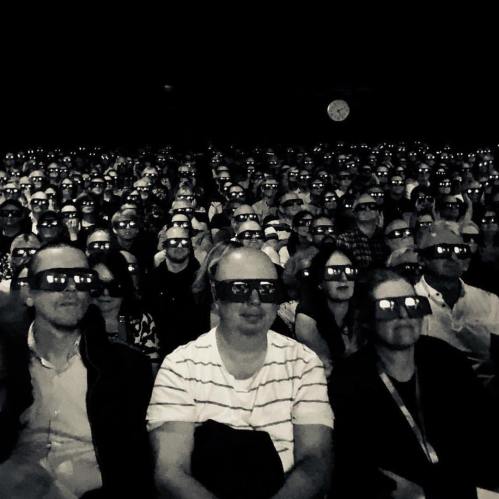
The talk by Brian May and Roger Taylor was fantastic. They were speaking about Scottish Victorian stereoscopic photographer George Washington Wilson, and launching Roger’s book about him. The audience were all given 3D glasses to wear, which worked from a vast range of seating positions, and enabled us to enjoy the original stereoscopic photos. Quite magical, and enormous fun. Sadly Brian and Roger couldn’t do a signing afterwards, having to dash off to a BBC interview, but we were all offered signed bookplates to go in the book.

Audience of scary looking people all wearing 3D glasses and looking intently at the stage

Audience at Brian May and Roger Taylor talk (photo by Nicole Ettinger and from Brian May on Instagram)

So a fun trip, but some disability niggles. We’ll be back in future, but definitely with my wheelchair, albeit anticipating problems.

At the Edinburgh Book Festival to see Ian Rankin talk

Every few years I head to the Edinburgh Book Festival for a fun flying visit. Last time in 2013 was to see Neil Gaiman talk, and also the Iain Banks memorial event. This time I was there to see Ian Rankin talk about the return of Rebus, with a new novel, and a recent short story collection. Because of my MS-like illness, which means I need to use my wheelchair while in Edinburgh, it is easiest to drive down from Dundee. And because I need to rest after and before travelling it makes sense to stay in a hotel the night before and after. Which is costly, but we think is worth it for the treat. We make a real break of it.

So last night after Afternoon Tea at Edinburgh’s famous Balmoral Hotel on Princes Street we got a taxi to Charlotte Square, arriving at about 6.50pm. The site was packed, with people there to attend author talks, browse in the bookshops, and soak up the friendly atmosphere. Our first stop was to go to the two bookshops, where I bought a few books: one a Gaelic children’s book (I’m learning the language, slowly), and also two other books I’d been wanting to get for a while, on astronomy and the history of Edinburgh.

By 7.45pm we were waiting in the queue for people with reserved seats (mainly disabled people like me) and were in in good time before the event started at 8.15pm. As usual we had good front row seats, and a good view of the speakers: Ian Rankin, and Phill Jupitus who would be chatting to him for the hour.

Ian opened the event by reading an extract from his latest soon to be published Rebus novel Even Dogs in the Wild. This was interesting, and quite gripping, and made me want to read the book when it comes out. Indeed the whole event made me want to read more of the Rebus novels – I’ve read a lot of them, but not all – and also read (and reread where necessary) the short stories. I particularly liked the discussion after this opening read through about Rebus’s relationship with the gangster ‘Big Ger’ Cafferty, which Ian likened to Holmes and Moriarty. Coincidentally I’m currently reading Anthony Horowitz’s Moriarty.

After this opening section there was a more general discussion. Indeed I was relieved that they didn’t just talk about the new novel, but covered a much wider range of subjects, including as the book festival entry for the event had indicated the recent short story collection The Beat Goes On: The Complete Rebus Stories. As a big fan of short stories – partly for the form, partly because they are often easier for me to read due to memory and reading problems from my neurological disease – I was particularly interested in what Ian said about the joy of writing them, and seeing a new artefact as the end product in a pretty quick time, as opposed to the marathon many months writing that each new novel requires.

One of the most interesting sections of the talk for me was where Ian reflected on his breaks from Rebus, both more recently and in the past. His recent break was prompted by deaths in recent years of a number of friends, all at fairly young ages. So he didn’t sign a new contract for a new novel then, but took the chance to do fun things, including other types of writing – like scifi – that he normally doesn’t do, but likes to. This was picked up on to an extent in one of the questions at the end. It was a bit sad that even a very successful writer like Ian Rankin feels the pressure to write what will sell, and doesn’t have the time to write other perhaps more experimental works. But the benefits of his break were apparent.

I also liked his discussion of the writing process, both in terms of how many hours he works on the first draft of a novel, and also how he discovers plot and character through his writing. He spoke of an example where he had advance plotted a novel to great detail, and his agent loved the concept, but Ian felt no desire to write it after sorting out everything so much in advance! I don’t write fiction, but in my academic writing I often find that I am feeling my way through the writing process, coming up with new thoughts and ideas by writing, and it’s a process that I enjoy too. I could also relate to his reflections on the importance of getting away from modern pressures to write. He goes to Cromarty (“no wifi”) and finds that in a secluded environment the writing process can flow extremely effectively. He also knows of other writers who play white noise in their ears to chill out the sound of the modern world while writing.

Quite a large chunk of the talk was about Ian’s love of music, including his experiences being in a band. For quite a while there I thought Phill was going to try to coerce him to sing, but Ian dodged that, though he did share some of his lyrics with us – very dark and gloomy, and quite in keeping with much of his later writing as a crime novelist! He also shared some entertaining reflections on touring life from his brief experiences of that. And he mused on how he had been so tempted to buy a record shop …

Returning to the writing craft one interesting observation Ian made fairly late on in the talk was that he doesn’t like to over research books, to the extent of filling them with “look what I found out!” stuff in the say way that some other writers do, including in the crime genre. Though having said that, a constant running joke throughout the event was his struggle to keep up with the changing police situation e.g. current retirement age for police officers, location of CID units, even the terminology used. Phill joked that it was almost as if the Scottish police were deliberately trying to foil Ian’s writing.

There were only limited questions at the end, in the last ten minutes, but they were interesting, and all sparked off lengthy responses from Ian. Indeed during the talk Phill was a fairly gentle interviewer, typically providing a short starting point that Ian could use to explore an issue in more depth.

We skipped the signing at the end, though I’d brought a paperback copy of the recent short story collection just in case I decided to stay and get it signed. But we had a great time. And, as I said, I am very much looking forward to reading more Rebus on my Kindle (the main way I have to read now due to the brain damage and reading problems it causes). Though I think I’ll start with the short stories, because those are so approachable for me. Many I have read before, but a lot I haven’t, and should enjoy them all.

So thanks Ian! And Phill!