Watching the Cymera festival online – again!

As last year I treated myself to a digital weekend pass for this year’s Cymera festival of fantasy, scifi and horror writing. This 3-day festival had taken place in Edinburgh in late May and early June this year. And obviously the focus for many participants was attending in person. But digital tickets were also available, including a digital weekend pass, which I picked up for a reduced early bird price of £45. This gave me access to dozens of online streaming events, both live on the day, and available for catchup for some weeks after.

Catchup online viewing was available to me and paid ticket holders from early June until late last night. So quite a lot of weeks. And with my digital pass I could choose to watch masses of things. Here are the talks I watched this time around, covering a huge range of themes, topics, and of course authors and books:

  • From Dr. Who to Star Trek: New Stories with Esmie Jikiemi-Pearson and Una McCormack
  • The Power of Books with Gareth Brown and Mark Lawrence
  • Eldritch Gods and Other Uninvited Guests with Mark Stay and Charles Stross
  • There’s Been A Murder with Amy Goldsmith, T.L. Huchu and Frances White
  • Arctic Horrors with C.J. Cooke, Tim Lebbon and Ally Wilkes
  • In Search of a New Eden with Oliver Langmead, Ken MacLeod and Adrian Tchaikovsky
  • Time Travels with Poppy Kuroki & Nigel Planer
  • Cassandra Clare in conversation with V.E. Schwab
  • The Pleasures of Reading
  • The Secret to a Successful Partnership with Megan Bannen and Gabby Hutchinson Crouch
  • Many Shades of Darkness with Elle Nash, Kaaron Warren and Johanna Van Veen
  • Creating Legends with Kate Heartfield and Sophie Keetch
  • Past, Present, Future with Esmie Jikiemi-Pearson, William Letford and EJ Swift
  • Dark Encounters with Em Reed and Lorraine Wilson
  • Writing the Future with Rachelle Atalla, Dan Coxon and Una McCormack
  • Thrilling Futures with Lauren Beukes, Nikhil Singh and Maud Woolf
  • Retellings with Joanne Harris, Lucy Holland and Shona Kinsella
  • Unleashing Chaos with Jane Flett and Kelly Link

Some of the events had jumped out of the programme for me, such as the Doctor Who one. But others were more of a gamble. And often the ones that I enjoyed the most were not those I was anticipating at all. It was particularly nice to see panels where the authors chatting had an impromptu discussion among themselves, often picking up on each other’s points. And sometimes people clearly just gelled more than on other occasions.

Watching 18 online hour-long streaming events over even 5/6 weeks took some sticking power. I have very little productive awake time now due to my progressive neurological disease. But I would often watch a bit more late at night, before final bed time. It often took a few days to get through a panel. I wouldn’t watch every night. But over time I watched a lot. And this was an absolutely unmissable opportunity for me, given my extremely disabling circumstances.

From watching many of the events I was inspired to read the books by the authors speaking. Or something else that they might mention in the discussion. I generally read ebooks now for disability reasons. So my ebook TBR list has grown a lot, as well as some purchases already.

I want to thank the Cymera festival organisers for again offering online streaming. Which I certainly made the most of! I intend to be back watching next year, remotely. I highly recommend this to anyone else at a distance. You can buy individual event tickets – online or in person – or like me pick up a weekend pass – again online or in person. It is well worth it.

Watching the Cymera writing festival on catchup

Logo for the Cymera festival with big bold CYMERA word, in a mix of sort of scifi, horror and fantasy letter design. Below it are the word's (in capitals) Scotland's festival of science fiction, fantasy & horror writing.

This passed me by in previous years, but this year I was lucky to find out in time about the Cymera festival of fantasy, scifi and horror writing. It takes place in Edinburgh, but in recent years due to Covid has been online too. It took place in early June and I bought a digital weekend pass. This let me watch events streamed live, but more importantly let me also watch after on catchup. I had until today, 3rd July, to watch them, and have been putting in the time in recent weeks to get through as many as I could. Today I watched my last talk, my 22nd. This is a quite incredible tally for seriously ill me to have managed. And as someone with a very restricting neurological illness (I am mostly bedbound now, and asleep most of the time) it was a marvellous opportunity to watch and enjoy things from home at my own convenience that in the past you would have to be there in person to see.

I watched a huge list of panels and author chats, as listed below. Initially looking through the programme before the event I spotted 3-5 events that immediately jumped out to me. Events taking place live in Edinburgh that were streaming too, or Zoom chats that would be available to watch either live or on catchup for digital ticket holders later. However because I bought a digital weekend pass (£50, though available earlier at £40) I could watch *everything* recorded live and on catchup. And in practice I ended up watching way, way more than even I could hope. Not all the talks aired, but a huge number of them.

  • Folkways with JJA Harwood and Kit Whitfield
  • Cityscapes with Adrian Tchaikovsky, E.C. Hibbs and J.L. Worrad
  • Expanding Universes with Aliette De Bodard and Ann Leckie
  • Dead Weird with Gemma Amor, John McGlade and Heather Parry
  • Unlikely Friendships with Travis Baldree and Heather Fawcett
  • Haunted and Hunted with Fiona Barnett, Anya Bergman and Catriona Ward
  • Catching Up With Helen Sedgwick
  • War Stories with Gareth Hanrahan, Anna Smith Spark and Ian Whates
  • The Epic’s New Clothes with Sharon Emmerichs, Juliet McKenna and Claire North
  • It’s Grim up Norse with Thilde Kold Holdt, Shauna Lawless and Suzie Wilde
  • N.K. Jemisin in conversation with Tasha Suri
  • Daring Deeds with Justin Lee Anderson and Sebastien de Castell
  • Adventures in Time and Space with A.G. Riddle and Gareth Worthington
  • Catching Up With Silvia Moreno-Garcia
  • Connection, Interrupted with Nina Allan, Cory Doctorow and Ian McDonald
  • Catching Up With Brent Weeks
  • Yesterday’s Tomorrow with Nicholas Binge and Christopher Priest
  • New Scottish Stories with Paul Tonner, Letty Wilson and Ell J Walker
  • Of Gods and Dragons with Amie Kaufman and L.R. Lam
  • Dangerous Magics with Chelsea Abdullah and Hadeer Elsbai
  • Underworld with C.K. McDonnell, Sarah Painter and Adam Simcox
  • CyberJunk with M.R. Carey, Dave Cook and Ever Dundas

The order in which I watched the events above isn’t representative of what I was most intrigued by. I could flit from event to event, and saved some of the best to last. Many were two or three-author panels based around a theme with a chair person. Others were single author chats with a chair by Zoom.

The range of fantasy, scifi and horror writing covered was immense. There would rarely be a panel where I wouldn’t be adding titles to my book watch list, or even buying something immediately. Some authors I knew already, but I discovered many authors new to me, whose works I now want to read. And despite watching so many of author events I was impressed by how little overlap there was in terms of content. Every panel or chat would give me new insights and experiences into the writing process, as well as touch on the specific themes of that panel and introduce me to the writers and their books.

I would like to thank the organisers for allowing streamed access like this. It was so enabling for me, and as a reader and writer myself I am throughly inspired by having watched these. I would also like to thank the festival team for managing the technology and practicalities so well. This was a very smooth operation. I will definitely be back to watch next year. Though aiming to book my digital weekend earlier so I can benefit from the reduced early bird weekend pass price!

Attending the Edinburgh Book Festival online rather than in person

This year I’ve been an online attendee of the Edinburgh Book Festival. I thought it might be helpful to blog some thoughts about this, and in particular how it compared for me to being there in person in the past.

I’ve been going to the Edinburgh Book Festival many times since the late 1990s. In the early visits I would travel down by train. More recently, as my neurological disease progressed, my husband and I had to switch to driving down with my wheelchair and staying a couple of nights in a hotel. Much more costly and time consuming, but giving me much valued experiences and memories.

This year the festival is being held in a new venue, and is offering a hybrid in-person/online attendance option. It would not have been safe for me to go there in person this time, being immunosuppressed during a Covid pandemic. The vaccine has fortunately given me antibodies – yay! – but at an extremely low level. So I am still at great risk, and being ultra cautious. But the availability of online tickets for most of the book festival’s events this year allowed me to attend in a different way.

The highlight of the festival for me has always been the author talks. I’ve written here before about attending some of these in person, e.g. in 2013, 2015 and 2018. Usually because I have to travel from a distance I can only see one or at the very most two author talks, depending on the timing options, and what I can get tickets for. But online attendance allows me to potentially attend more events more events spread over more days, even at a distance.

This year I bought online tickets for three events: Helena Attlee talking about the tale of a violin through time (I am a long lapsed violin player), James Robertson talking about his new ghostly novel set in the Angus glens (I live in Angus), and Denise Mina talking about her new novella retelling of the Rizzio murder. I watched the first and third of these live, and the second on catchup in the middle of a neurologically disturbed night. All were watched from bed in my pyjamas, on my iPad with Bluetooth headphones. Definitely a form of access I haven’t enjoyed attending the festival before!

With each event I was able to watch video footage of the author talks, with good camera shots of the authors, interviewers and audience in the room (a very spaced out and masked up audience). The audio was clear, and the experience of watching reassuringly close to being there in person.

In addition to the live video stream online attendees have access to online text chat rooms, where we can share comments, and ask questions to be posed to the speakers. I didn’t ask a question myself, but participated actively in the chats. I was pleased to see the online questions asked by the interviewers on behalf of the online audience members. This was integrated well alongside questions from the audience in the room in Edinburgh.

So yes, positive impressions from watching author talks online. On the downside online participants do miss out on face to face signing events, though some of the author talks had prebookable (days in advance) online signing options. I was more concerned though at how online members could miss out on the festival bookshop. Visiting the festival bookshops – adult and children’s – was always a major highlight for me of attending in person. With a huge range of books on offer, including from publishers I would never normally encounter, I would always come away with unexpected gems.

Yet the bookshop is not promoted effectively in the festival website. Yes on individual events pages there is a link to order book(s) associated with the event. And clicking on that takes you to the bookshop website. But otherwise the online bookshop is not linked as far as I can see from the festival website. Even if you know it exists it can be very hard to find. Google is often the best option! Which is ridiculous. Because when you get there it is possible to browse the shelves well, and find gems. Ok not the same as physically in person, but worth some minutes of your time for many online attendees.

So yes some downsides, but overall I’m really happy I could attend in person. Very grateful in fact. Looking ahead it may be safer for me to attend in future years, but my neurological disease is progressing, and that might simply not be practical. But I’m encouraged that the festival organisers have said that they value the online attendance, and intend to continue to make it part of the festivals in future years. So hopefully I can attend in that way in future years. And maybe the bookshop be better linked too?

Visit to Edinburgh Book Festival in August 2018

My husband and I visit the Edinburgh Book Festival every other year or so, and were back again last week. We’d booked to go and see a talk by Brian May and photographic historian Roger Taylor. But I was also keen to see the bookshops again, which I always find excellent.

This is the first year that I’ve found the crowds a particular problem. I have to use my wheelchair when I’m there, with my husband pushing, and this year getting past other visitors, who’d often stop to chat in the walkways, was a significant problem. I don’t know if there were higher numbers of people attending this year, or what, but it seemed more of an issue than usual. Note we were there on Wednesday 15th August, in the late afternoon and early evening.

I was also struck by how difficult it can be to get the wheelchair into the tents, bookshops, talk venues etc. There’s always quite a slope to go up, and a ridge to get past or bump over. I could never wheel myself in. Even my husband, who’s been pushing my wheelchair for years, struggled, again not helped by people milling around.

On the plus the bookshops were a delight. I always find things there that are real gems for me, that I wouldn’t know of otherwise. My particular highlights this year included a book of 100 Gaelic WW1 poems, most of them written during or shortly after the war, with dual language Gaelic and English translations facing each other in the book. My other main highlight was finding a book of essays by Philip Pullman about storytelling in its many forms. I was reluctant to buy such a chunky book – I have too many books already, and wondered where I’d shelve it! But it drew me back, and I was very pleased to take it away and delighted when I started reading it. Something else I’d have bought before had I known it existed.

Books bought include Philip Pullman essays, George Washington Wilson stereoscopic history, Gaelic WW1 poems and compact dictionary, and a free signed bookplate to go in the Wilson book

Book haul from Edinburgh Book Festival

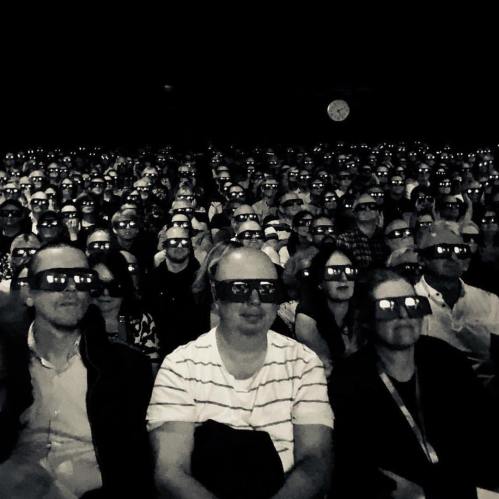
The talk by Brian May and Roger Taylor was fantastic. They were speaking about Scottish Victorian stereoscopic photographer George Washington Wilson, and launching Roger’s book about him. The audience were all given 3D glasses to wear, which worked from a vast range of seating positions, and enabled us to enjoy the original stereoscopic photos. Quite magical, and enormous fun. Sadly Brian and Roger couldn’t do a signing afterwards, having to dash off to a BBC interview, but we were all offered signed bookplates to go in the book.

Audience of scary looking people all wearing 3D glasses and looking intently at the stage

Audience at Brian May and Roger Taylor talk (photo by Nicole Ettinger and from Brian May on Instagram)

So a fun trip, but some disability niggles. We’ll be back in future, but definitely with my wheelchair, albeit anticipating problems.

At the Edinburgh Book Festival to see Ian Rankin talk

Every few years I head to the Edinburgh Book Festival for a fun flying visit. Last time in 2013 was to see Neil Gaiman talk, and also the Iain Banks memorial event. This time I was there to see Ian Rankin talk about the return of Rebus, with a new novel, and a recent short story collection. Because of my MS-like illness, which means I need to use my wheelchair while in Edinburgh, it is easiest to drive down from Dundee. And because I need to rest after and before travelling it makes sense to stay in a hotel the night before and after. Which is costly, but we think is worth it for the treat. We make a real break of it.

So last night after Afternoon Tea at Edinburgh’s famous Balmoral Hotel on Princes Street we got a taxi to Charlotte Square, arriving at about 6.50pm. The site was packed, with people there to attend author talks, browse in the bookshops, and soak up the friendly atmosphere. Our first stop was to go to the two bookshops, where I bought a few books: one a Gaelic children’s book (I’m learning the language, slowly), and also two other books I’d been wanting to get for a while, on astronomy and the history of Edinburgh.

By 7.45pm we were waiting in the queue for people with reserved seats (mainly disabled people like me) and were in in good time before the event started at 8.15pm. As usual we had good front row seats, and a good view of the speakers: Ian Rankin, and Phill Jupitus who would be chatting to him for the hour.

Ian opened the event by reading an extract from his latest soon to be published Rebus novel Even Dogs in the Wild. This was interesting, and quite gripping, and made me want to read the book when it comes out. Indeed the whole event made me want to read more of the Rebus novels – I’ve read a lot of them, but not all – and also read (and reread where necessary) the short stories. I particularly liked the discussion after this opening read through about Rebus’s relationship with the gangster ‘Big Ger’ Cafferty, which Ian likened to Holmes and Moriarty. Coincidentally I’m currently reading Anthony Horowitz’s Moriarty.

After this opening section there was a more general discussion. Indeed I was relieved that they didn’t just talk about the new novel, but covered a much wider range of subjects, including as the book festival entry for the event had indicated the recent short story collection The Beat Goes On: The Complete Rebus Stories. As a big fan of short stories – partly for the form, partly because they are often easier for me to read due to memory and reading problems from my neurological disease – I was particularly interested in what Ian said about the joy of writing them, and seeing a new artefact as the end product in a pretty quick time, as opposed to the marathon many months writing that each new novel requires.

One of the most interesting sections of the talk for me was where Ian reflected on his breaks from Rebus, both more recently and in the past. His recent break was prompted by deaths in recent years of a number of friends, all at fairly young ages. So he didn’t sign a new contract for a new novel then, but took the chance to do fun things, including other types of writing – like scifi – that he normally doesn’t do, but likes to. This was picked up on to an extent in one of the questions at the end. It was a bit sad that even a very successful writer like Ian Rankin feels the pressure to write what will sell, and doesn’t have the time to write other perhaps more experimental works. But the benefits of his break were apparent.

I also liked his discussion of the writing process, both in terms of how many hours he works on the first draft of a novel, and also how he discovers plot and character through his writing. He spoke of an example where he had advance plotted a novel to great detail, and his agent loved the concept, but Ian felt no desire to write it after sorting out everything so much in advance! I don’t write fiction, but in my academic writing I often find that I am feeling my way through the writing process, coming up with new thoughts and ideas by writing, and it’s a process that I enjoy too. I could also relate to his reflections on the importance of getting away from modern pressures to write. He goes to Cromarty (“no wifi”) and finds that in a secluded environment the writing process can flow extremely effectively. He also knows of other writers who play white noise in their ears to chill out the sound of the modern world while writing.

Quite a large chunk of the talk was about Ian’s love of music, including his experiences being in a band. For quite a while there I thought Phill was going to try to coerce him to sing, but Ian dodged that, though he did share some of his lyrics with us – very dark and gloomy, and quite in keeping with much of his later writing as a crime novelist! He also shared some entertaining reflections on touring life from his brief experiences of that. And he mused on how he had been so tempted to buy a record shop …

Returning to the writing craft one interesting observation Ian made fairly late on in the talk was that he doesn’t like to over research books, to the extent of filling them with “look what I found out!” stuff in the say way that some other writers do, including in the crime genre. Though having said that, a constant running joke throughout the event was his struggle to keep up with the changing police situation e.g. current retirement age for police officers, location of CID units, even the terminology used. Phill joked that it was almost as if the Scottish police were deliberately trying to foil Ian’s writing.

There were only limited questions at the end, in the last ten minutes, but they were interesting, and all sparked off lengthy responses from Ian. Indeed during the talk Phill was a fairly gentle interviewer, typically providing a short starting point that Ian could use to explore an issue in more depth.

We skipped the signing at the end, though I’d brought a paperback copy of the recent short story collection just in case I decided to stay and get it signed. But we had a great time. And, as I said, I am very much looking forward to reading more Rebus on my Kindle (the main way I have to read now due to the brain damage and reading problems it causes). Though I think I’ll start with the short stories, because those are so approachable for me. Many I have read before, but a lot I haven’t, and should enjoy them all.

So thanks Ian! And Phill!