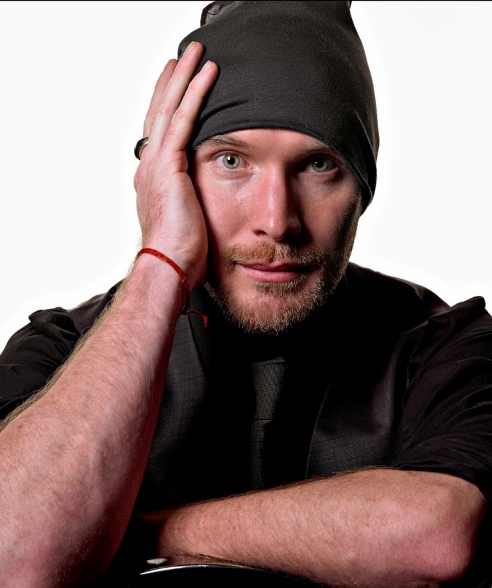
(1) SCI-FI LONDON PROOF OF LIFE. Jonathan Cowie sent along a photo taken with his fellow Northumberland Heath Science Fiction Society members at Sci-Fi London.
The Facebook photo shows Jonathan, Louis Savey (Director of the event), and siblings Stephen and Julie Perry.

(2) IS THE FORCE STRONG ENOUGH? In the latest “Week in Geek” newsletter Ben Childs wonders whether Star Wars is now an “impossible franchise” on the big screen: “The Mandalorian and Grogu shows Star Wars is a cursed franchise – on the big screen at least” in the Guardian.
When Disney bought Lucasfilm for roughly $4bn in 2012, it must have felt like an obvious piece of business: who wouldn’t throw wads of cash at a saga boasting an entire galaxy in a box? For a while, it seemed too good to be true. The Force Awakens made more than $2bn worldwide. Rogue One did more than $1bn. The Last Jedi conjured up more than $1.3bn, even while triggering a culture war so radioactive it could power the Death Star. Most of the fandom hated The Rise of Skywalker, but that most execrable of movies still earned Disney more than $1bn.
Then came Disney+, the perfect delivery system. No more waiting years between films: just hang around for a few months and something else would pop up on the conveyor belt. Andor, The Book of Boba Fett, Obi-Wan Kenobi, Ahsoka, The Mandalorian. Plot holes were filled, animated side characters got their magnum opus, and we all learned far more about the middle-management structure of galactic fascism than we had ever imagined possible. So why are we, almost 14 years on from that monumental shift in the Star Wars power structure, reading yet another slew of critical notices declaring that the saga has run its course? The Mandalorian and Grogu, at time of writing, has a rating of 61% on Rotten Tomatoes, pushing it just into the “fresh” category. The positives, broadly speaking, are that it is charming, brisk, visually polished and has Baby Yoda, a character precision-engineered for adorability. On the negative side, critics have complained the film feels thin, formulaic and weirdly televisual, less a grand restoration of Star Wars on the big screen than three Disney+ episodes….
(3) SNAIL MAIL CALL In his “Personal Interlude: ‘The Postcard Liberation Front’”, Paul Riddell of The Annals of St. Remedius Medical College offers to share his funky postcard collection with the world. See the link for full instructions. Here’s an excerpt —

…Among other things, this was the opportunity to consolidate decades of weird postcards, bumper stickers, letterhead, and stationery into one box for eventual disposition. Official US Post Office cards and envelopes of the James Gurney-painted dinosaur stamp series from 1997 were a big one, as well as a set of letterhead given to me by my maternal grandmother shortly before she died in 2002. Various postcard books gathered and occasionally used since 1984. (You think Harlan Ellison’s untold story of how he ended up with Donny Osmond Fan Club letterhead is one of the great mysteries of the universe? I’m still trying to figure out how I ended up with a Star Trek III postcard book.) The biggest haul, though, were postcards, purchased at places I’d visited or lived in, sent by friends either deceased or disappeared, and sometimes gathered because of plans that fell through. Museum postcards, postcards from state and national parks (US and Canadian), postcards bought solely for the art and postcards promoting long-ago art showings, lots and lots and LOTS of paleontology and natural history-related postcards, and piles of cards promoting long-dead businesses and projects intended to be passed on to others three decades ago or more. Some were so fresh that I remembered the exact circumstances under which I purchased them, and others still make me ask “And exactly why the hell did I hang onto these? I know I wasn’t drunk.” As of a count a few hours ago, 391 postcards in a cardboard box. I didn’t know exactly what I’d do with them, but I’d been to so many estate sales during the Texas Triffid Ranch years and seen so many boxes piled up with unknown and unknowable postcards that had been hoarded for a rainy day that I knew these eventually had to get out to the world in general. When, though, was the question….
…So here’s the new project, dedicated to those who still love dead physical media, who want a more solid connection than an email or a text, and who didn’t know how much they missed getting things in their mailbox. The rules:
Number One: Absolutely no purchase necessary. The Postcard Liberation Front will continue until all cards are sent, but quantities are limited.
Number Two: To receive a postcard, I need a mailing address. This can be sent via email or via the St. Remedius Contact Form. Note that the mailing address doesn’t have to be YOUR mailing address: I have no problems sending it to someone or somewhere else….
(4) FYI. Federal tax returns filed by nonprofit organizations are public records. ProPublica has made available a reconstruction of the 2024 Form 990 filed by the Locus Science Fiction Foundation.
The return shows total revenue increased year-to-year from $617K to $1055K, mostly due to “Contributions and grants” increasing from $334K to $754K.
You can’t really infer very much from these raw numbers, however, they may still be of interest.
(5) MEMORY LANE.
[Written by Cat Eldridge.]
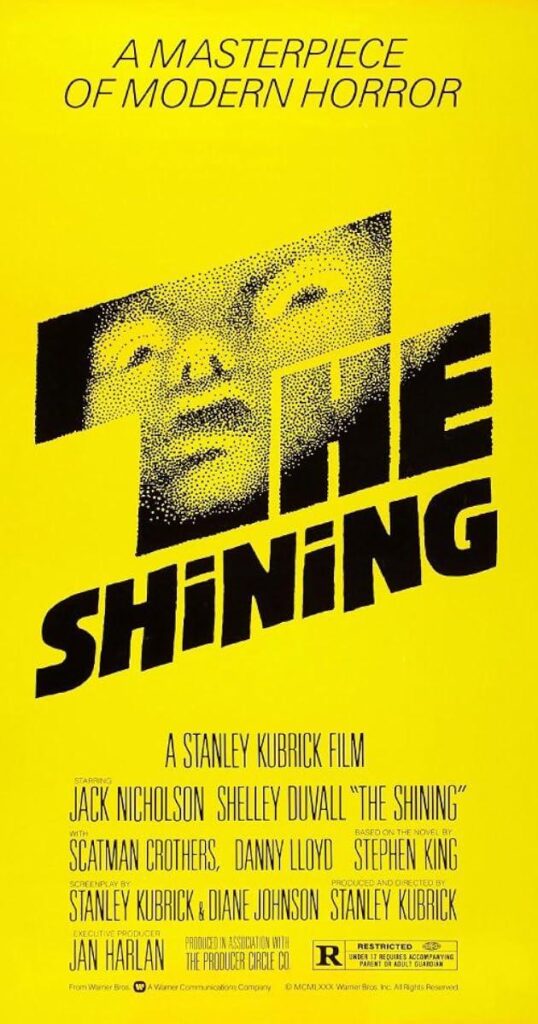
The Shining (1980)
Forty-six years ago, the most perfect Stephen King film imaginable from my viewpoint came out in the form of The Shining as directed by Stanley Kubrick from a screenplay by him and Diane Johnson, it was also produced by him. This was true of 2001, wasn’t it? The screenplay and production I mean (co-written with Clarke, not Johnson).
It had an absolutely wonderful lead cast of Jack Nicholson, Shelley Duvall. Danny Torrance, Scatman Crothers and Danny Lloyd. Jack Nicholson in particular was amazing in his role as was Shelley Duvall in hers. And the setting of the Overlook Hotel is a character in and itself — moody, dangerous and quite alive.
Kubrick’s script is significantly different from the novel which is not unusual to filmmaking. However Stephen King was extremely unhappy with the film due to Kubrick’s changes from his novel.
If you saw it upon the first release, you saw a print that was a half hour longer than later prints. Yes, Kubrick released multiple prints, all different from each other. Some prints made minor changes, some made major changes. I assume that first release exists as a director’s cut or whatever they care to call as the lust after lucre never ends.
It cost twenty million to make and made around fifty million. Now according to some sources it cost much more than forty million, but this being studio accounting, that will never be known. What is known is that it lost the studio money, or so they claim.
So how was it received by the critics? Well it got a mixed reception.
Gene Siskel in his Chicago Tribune review stated he thought it was a “crashing disappointment. The biggest surprise is that it contains virtually no thrills. Given Kubrick’s world-class reputation, one’s immediate reaction is that maybe he was after something other than thrills in the film. If so, it’s hard to figure out what.” No thrills? Huh.
Peter Bradshaw of The Guardian was much more positive: “The Shining doesn’t look like a genre film. It looks like a Kubrick film, bearing the same relationship to horror as Eyes Wide Shut does to eroticism. The elevator-of-blood sequence, which seems to ‘happen’ only in premonitions, visions and dreams, was a logistical marvel. Deeply scary and strange.”
Let’s give Roger Ebert the last word: “Stanley Kubrick’s cold and frightening ‘The Shining’ challenges us to decide: Who is the reliable observer? Whose idea of events can we trust?”
Audience reviewers at Rotten Tomatoes currently give it an excellent ninety-three percent rating.
(6) COMICS SECTION.
- Brevity revisits a character’s lack of education.
- Frank and Ernest suggest a way to make a sporting event more efficient.
- Saturday Morning Breakfast Cereal demonstrates that one thing is safe, but nothing else.
(7) BACK AT YOU. Space Daily says “The Soviet Lunokhod 1 rover went silent on the Moon in 1971, then scientists found its lost reflector in 2010 and got a signal bright enough to reopen a forgotten corner of lunar science”.
For nearly 40 years, Lunokhod 1 was not so much dead as misplaced.
The Soviet rover had stopped responding in 1971, after almost a year on the lunar surface. Its tracks were still there. Its body was still there. Its French-built laser reflector was still there too, bolted to the rover and facing whatever part of the sky it had last faced before the machine went silent.
The problem was that scientists no longer knew precisely where to aim.
That changed in 2010, when high-resolution images from NASA’s Lunar Reconnaissance Orbiter helped identify the rover’s location. Soon after, researchers using the Apache Point Observatory Lunar Laser-ranging Operation in New Mexico were able to acquire a signal from the long-lost reflector. In the abstract of their later paper, the team wrote that the reflector appeared to be in excellent condition and was returning a signal roughly four times stronger than the reflector on Lunokhod 2.
After decades of silence, the old Soviet rover had answered back.
A rover that outlived its mission by accident
Lunokhod 1 landed in the Sea of Rains on November 17, 1970, delivered by the Soviet Luna 17 mission. It was the first remote-controlled rover to operate on another world, a tub-like vehicle with eight wheels, a hinged solar lid, television cameras, scientific instruments, and a laser retroreflector built in France….
(8) REMINDS ME OF SOMETHING. [Item by Steven French.] Anyone else thinking about a spatio-temporal version of Ice Nine?! “Crystals of space and time: A structural phenomenon that may collapse into tiny black holes” at Phys.org.
A team from Vienna and Frankfurt has found a formula describing a strange phenomenon: Space and time can form a kind of “crystal” that may turn into a black hole. The results are described in Physical Review Letters.
Alongside the famous gigantic black holes, physics also allows for microscopic versions. They emerge from so-called critical states, when spacetime organizes itself into a regular, crystal-like structure during a process known as critical collapse. A team from Goethe University Frankfurt and TU Wien has now succeeded, for the first time, in describing this phenomenon with an exact mathematical formula using an unusual mathematical trick….
(9) THE SOLAR SYSTEM’S INTERSTELLAR ODYSSEY HAS BEEN FROZEN IN TIME. [Item by SF Concatenation’s Jonathan Cowie.] The Solar system’s travel through the local part of the Galaxy has been charted in Antarctic ice. Iron (Fe) comes in a number of isotopes with around 98% in the form of 54Fe and 56Fe (the latter being the most common making up nearly 92% of all iron). However, there are other minority isotopes including 60Fe which is radioactive and decays with a half-life of 2.6 million years. It is a form of iron that is created in supernova explosions and so is found in interstellar dust clouds.
The Antarctic is covered in ice and so can be considered to be a blank sheet. Consequently, 60Fe in Antarctic ice is considered to be a proxy for interstellar dust entering the atmosphere and this happens to a greater extent when the Solar system passes through an interstellar dust cloud.
The Earth and Solar system is currently passing through one such interstellar dust cloud that is tentatively thought to have been created around 130,000 years ago but within a cluster of clouds thought to have formed around a million years ago, and an even larger surrounding, encompassing bubble (called the Local Bubble) that was likely triggered by supernova-driven outflows from 14 – 20 supernovae in the Scorpius Centaurus Association starting around 10–15 million years ago.
Researchers, mainly based in Germany, have now drilled an Antarctic ice core. As snow falls on the Antarctic ice surface, so ice builds up over time. Therefore, by measuring 60Fe in Antarctic ice it is possible to estimate when the rate of such isotopic deposition was higher or lower. The researchers found that between 40,000 and 81,000 years ago there was less of an isotopic signature and this, the researchers conclude, is evidence of a changing interstellar medium surrounding the Solar system than experienced now and before then. Separate work on marine sediments, as well as future work added to current astronomical observations and modelling, should enable us eventually to understand the Solar system’s journey through the various encompassing bubbles over millions of years. (See the primary research Koll, D. et al (2026) Local Interstellar Cloud Structure Imprinted in Antarctic Ice by Supernova 60Fe. Physical Review Letters, vol. 136, 192701.)
(10) VIDEO OF THE DAY. “China’s real-life ‘transformer’ mech is a giant humanoid robot that can switch from bounding on 4 legs to walking on 2” reports Live Science.
Chinese engineers have built a mecha-style robot that can quickly transition from two legs to four while carrying people, resembling the power-loader exoskeletons from Aliens or the utility-style mobile suits from Japanese anime series Gundam SEED.
The robot’s developer, Unitree, says the large, humanoid robot is intended for civilian transport. In a promotional video, the robot — called GD01 — walks upright, smashes down a high wall of cinder blocks, and reconfigures itself to stand on four limbs to traverse more difficult terrain.
Unitree representatives say the machine weighs around 1,100 pounds (500 kilograms) with an operator on board and stands nearly 10 feet (3 meters) tall. People can even buy the robot, with prices starting at 3.9 million yuan ($572,000)….
[Thanks to Chris Barkley, Mark Roth-Whitworth, Kathy Sullivan, Steven French, Mike Kennedy, Andrew Porter, John King Tarpinian, Cat Eldridge, and SF Concatenation’s Jonathan Cowie for some of these stories. Title credit belongs to File 770 contributing editor of the day Andrew (not Werdna).]