Pixel Scroll 7/2/26 Look Pixel! Is Scroll!

(1) TIM KIRK ART NEWS. The original artwork from Tim Kirk’s fully-funded Nightmares to Come by Flights of Imagination” Kickstarter, containing illustration created for Harlan Ellison’s Last Dangerous Visions, will be up for sale at LAcon V in August.

Tim Kirk has matted the originals for sale at the Worldcon. He’s spread them out in his back yard, near his pool, to give you an overview of most of the art.

(2) REVISIT STAR WARS HISTORY. LACon V guest of honor Geri Sullivan appears in a Facebook video announcing that a Worldcon program will display Charles Lippincott’s reconstructed publicity slideshow from 1976 that he presented at various places ahead of the release of Star Wars. (I remember lining him up to give the talk at the LASFS meeting held at the 1976 Westercon – the first of my brief and otherwise not-terribly-shining Presidency of the club.)

(3) 2030 EASTERCON/EUROCON PROPOSAL. The British Science Fiction Association has a Facebook page about their proposed bid for a combined Eastercon/Eurocon in 2030 in Birmingham.

Ansible reports it includes fallback positions of holding a non-Eurocon Eastercon or vice versa.

(4) THE SOUND OF MUSICAL TYRANNY.  “D.C. will pay $50,000 to man detained while protesting guard patrol with ‘Star Wars’ song, record says”PBS News has details.

The District of Columbia has agreed to pay $50,000 to settle a lawsuit filed by a resident who accused police officers of illegally detaining him for following an Ohio National Guard patrol while playing Darth Vader’s theme song from “Star Wars” on his cellphone, according to a document released Monday.

The plaintiff, Sam O’Hara, sued the district, four Metropolitan Police Department officers and a guard member from Ohio over what he says was his act of protest against President Donald Trump’s federal law enforcement surge in Washington, D.C.

A court filing on Thursday disclosed the settlement but didn’t specify any monetary terms. The amount is included in a copy of the settlement agreement that D.C. Attorney General Brian L. Schwalb’s office provided to The Associated Press.

The $50,000 settlement includes attorney’s fees and costs. O’Hara is represented by the American Civil Liberties Union of the District of Columbia. In an email on Friday, an ACLU spokesperson referred to the settlement’s financial terms as “a significant amount” that O’Hara “is pleased with” but said they weren’t disclosing the dollar figure to protect his privacy.

O’Hara, an artist who works in the hospitality industry, agreed to drop his claims against the district and the MPD officers within three business days of receiving the settlement payment. The settlement isn’t an admission of wrongdoing by the district, the agreement says.

O’Hara’s settlement with the district doesn’t resolve his related claims against an Ohio National Guard member, Sgt. Devon Beck, who has asked a judge to dismiss O’Hara’s claims against him.

O’Hara said in a statement that he is satisfied with the settlement but conflicted that taxpayers are footing the bill….

(5) WRITER-DIRECTOR GETS A SENTENCE. NBC News reports “Director Carl Rinsch is sentenced to prison in $11M fraud case over unfinished Netflix show”.

Hollywood writer-director Carl Rinsch was sentenced Monday to 2 1/2 years in prison after being convicted of defrauding Netflix out of $11 million for a never-finished sci-fi series. Supporters including Keanu Reeves had asked the court to show him leniency.

Rinsch, best known for the 2013 samurai fantasy film “47 Ronin,” was convicted in December of federal wire fraud and other charges. According to prosecutors and trial testimony, he told Netflix he needed $11 million to finish a show called “White Horse” but diverted the money into a personal account and ultimately spent whopping sums on luxury cars, watches, clothes and household goods, including $638,000 on two mattresses….

(6) OCTOTHORPE. Octothorpe 163 — “Board Games” — has arrived, and John Coxon, Alison Scott and Liz Batty discuss Eurocons in some detail, covering all the news from 2026 to 2030. Alison is currently at Metropol Con and she’s promised to report back. They also discuss queer awards and swim headphones. An uncorrected transcript is available here.

A goldfish with the head of Alison wearing goggles and swim headphones. The words “Moist Ear Tunes*” appear at the top and the words “SF Fandom’s Premier Swim Headphone Podcast”, “Fun Fact: Moist Ear Tunes is a nonogram of Octothorpe 163” and “Sue Mason art appears courtesy of Plokta (thanks guys)” appear at the bottom. I know that Alison has forgotten to include the asterisk on the footnote, but since she also has the memory of a goldfish maybe it’s a delightful and multilayered joke.

(7) WHODUNIT. Kemper Donovan brings readers “The Detective, in the Drawing Room, with the Monologue” at CrimeReads.

Denouements are as fundamental to classic mysteries as detectives and the clues they detect. A synonym for “resolution,” or “outcome,” the term can be applied to stories outside the mystery genre, or even to the wrapping up of real-life scenarios. But given that its literal meaning is “unknotting,” it makes sense that the denouement has become associated with whodunits in particular, a subset of mysteries that require a thorough unravelling at story’s end. The detective separates the wheat of the clues from the chaff of the nonsense and red herrings: an intellectual winnowing that provides clarity, hence satisfaction, when the culprit is identified.

There are no rules governing the denouement. In the late 1920s, when mystery authors Ronald Knox and S.S. Van Dine concocted their famously facetious “commandments” for the Golden Age of detective fiction (Knox had ten, perhaps because he was also a priest, while Van Dine had twenty, perhaps because he was American and couldn’t help himself), they left the denouement untouched. But over time certain clichés creeped in, to the point where the “drawing room denouement” has become a recognizable trope of the genre. We all know how this goes. The detective announces he knows everything, gathering the major characters into one space—often a literal drawing room or its equivalent, though in my anecdotal experience a popular alternative is a theater: a neat externalization of the dramatics underlying this sequence. The case is summarized, side plots having nothing to do with the murder are elucidated (with extra points for fleeting moments in which it seems as though innocent parties are guilty), and then, at long last, the murderer is revealed. At this point there are a few options: the murderer could spontaneously confess, be led away by an officer of the law, or even take her own life. But one hopes at the very least that she will adopt the “evil voice” of the unmasked villain. (If you’re not sure what I mean here, behold this very entertaining parody of the final moments of the classic drawing room denouement.)

Agatha Christie is widely credited(/faulted?) with popularizing this stereotype, and for good reason…

(8) DAFYDD AB HUGH (1960-2026). Dafydd ab Hugh (1960-2026), died in June aged 65 reports Ansible. The author of 15 books including Heroing: or, How He Wound Down the World (1987) plus various Star Trek and (with Brad Linaweaver) Doom tie-ins, his novelette “The Coon Rolled Down and Ruptured His Larinks, A Squeezed Novel by Mr. Skunk” was a 1991 Hugo and Nebula finalist.

The author furnished this unforgettable bio for my 2002 Westercon program:

ab Hugh, along with many other bioms, is to all intents and purposes an organic guterary sac, with input and output nodes open at top and bottom, respectively, and an internal rigid structural support evolved to make it easier to balance on his hind legs.  He has a carbon-nitrogen based chemical system that requires frequent refueling and periodic maintenance.

His genetic structure is based around a supermolecule that is little more than a highly redundant, 3-GigaBit, base-2 code string comprising sequences of four nitrogenous bases:  adenine, cytosine, guanine, and thymine.  Base-pair cohabitation rules are strictly enforced.

He has a neural bulge at the top which has its own complicated structure.  Most of its activity takes place in the medulla, or reptile brain, which seems appropriate somehow.  But occasionally, some electrocolloidal activity flickers across the cerebral cortex, and a novel forthcomes (cf. Arthur War Lord, Far Beyond the Wave, Heroing, Warriorwards, the Swept Away YA trilogy, seven or eight Star Treks, and the four Doom novels — the last in conspiracy with a similar biomass dubbed Brad Linaweaver).

ab Hugh has some sort of vague self-awareness, but I wouldn’t push it too far.

(8B) TODAY’S BIRTHDAY.

[Written by Cat Eldridge.]

July 2, 1948Saul Rubinek, 78.

So tonight we have Saul Rubinek.  My brain when I started stitching this together kept tugging at a thread that wasn’t quite there of a production that I’d seen him where he was quite good in a role so I had to look up his credits on IMDB where it turned out it was first in a nearly fifteen-year-old airing of The Golden Spiders: A Nero Wolfe Mystery where he was cast as Saul Panzer, freelance detective working for Nero Wolfe. 

Saul Rubinek

This was the first of two hour-long movies that originally were all that was planned to be but ratings were excellent and critics loved it, so two seasons followed with stars Maury Chaykin as Nero Wolfe, and Timothy Hutton as Wolfe’s assistant, Archie Goodwin.

He was on the series not as this character, but as Lon Cohen, a reporter at the New York Gazette. He’s Archie’s source of crime news, and Archie often asks Lon for background information on current or prospective clients.

Before you ask, yes, I loved the series. Unfortunately it is not streaming anywhere right now and the DVDs are ridiculously expensive as a fellow member of Susan’s Salon noted earlier this week and I found them for sale at $150 for the complete series on Amazon.

Now onto his genre work.

His longest role was as Special Agent in Charge of Warehouse 13 Artie Nielsen, in charge of the often troublesome Pete Lattimer, Myka Bering and Claudia Donovan, not to mention several others that had very interesting stories here. Now Artie prefers old fashioned items and ways of doing things because they are familiar and comfortable. He likes tinkering with what is in Charge of Warehouse, something which can be hazardous to him, other and Warehouse 13 itself. 

Obviously I’m not going to say anything about what happens to him here as if you haven’t seen the series, it’d spoil for you. Suffice it to say that the writers use the character well.

Spoilers now as they can’t be avoided. On the “The Most Toys” episode of The Next Generation, he plays a nearly obsessed collector who adds Data to his collection. 

(Tom Toles in a Washington Post article noted what the title meant, “Maybe you remember and maybe you don’t the phrase “He who dies with the most toys wins.” It has been attributed to Malcolm Forbes, but whoever said it deserves to be noted for being able to get it out while throwing up a little in the back of his mouth.”) 

Data has been deactivated somehow and reactivated and met by Fajo, his character, who explains he collects rare and valuable objects — like Data himself. Ok let me note that is nothing to like in my opinion about Fajo. Which of course was the lint of the story here. 

The homage to Asimov’s Three Laws of Robotics is rather obvious. Perhaps a little too obvious. 

Saul wasn’t the first choice for this character. It’s very important to note the last-minute nature of his casting went well for three reasons:  he was available as he wasn’t engaged in anything, he was a Star Trek fan keen to appear in the series, and he was a personal friend of the episode’s director Timothy Bond.

They had created an elaborate prosthetic outfit for the first choice but there wasn’t time to design even facial  prosthetics for him given when they needed to get the episode done, well, now, when he stepped into the role. 

Memory Alpha has a listing of what Kivas Fajo has collected and which is shown here or used here to create a feeling of his alienness. Not surprisingly, nothing in his collection or that he uses here was created for this episode but had already been designed and constructed for another episode such as the communication device used by Sarjenka for “Pen Pals”, a  Next Generation episode that aired the previous season. 

Ok, there’s lots of one-offs he did I could mention but those are the three roles that I want to note. 

(9) COMICS SECTION.

(10) OPTION TO BLOCK AI TRAINING. “Cloudflare Pushes AI Companies To Pay For Publishers’ Content” reports Slashdot.

Cloudflare announced new controls that give publishers more say over how AI companies access and use their content. Beginning September 15, new Cloudflare sites will allow traditional search indexing while blocking AI training and AI agent access on ad supported pages by default. The company is also expanding its monetization efforts with a Pay-Per-Use model that aims to compensate publishers when their content contributes to AI generated answers rather than simply being crawled. Cloudflare argues that publishers should not have to choose between being discoverable online and giving away their work for free to AI systems.

(11) TRAILER PARK. The Dog Stars, directed by Ridley Scott and starring Jacob Elordi, Josh Brolin, and Margaret Qualley comes to theaters August 28. (It’s based on a novel of the same name which Jonathan Cowie reviewed in 2012.)

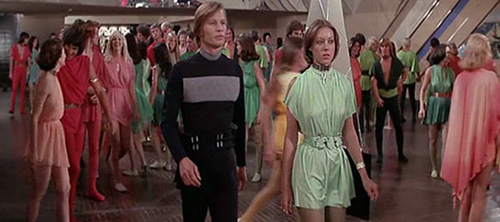
(12) VIDEO OF THE DAY. I never watched the movie so this captivating scene was a brand new experience for me: “Valerian Opening Scene FHD – Alpha Station Origin – Valerian and the City of a Thousand Planets”. Two of the commenters indicate it set a high bar.

I enjoyed this scene more than the entire movie that followed it The movie wasn’t terrible or anything, this scene is just that good imo…

If only the rest of the movie had lived up to this. The opening scene is incredible….

[Thanks to Steven French, Mike Kennedy, Andrew Porter, Lise Andreasen, Daniel Dern, John King Tarpinian, Cat Eldridge, SF Concatenation’s Jonathan Cowie, Chris Barkley, Mark Roth-Whitworth, and Kathy Sullivan for some of these stories. Title credit belongs to File 770 contributing editor of the day Cat Eldridge.]

Pixel Scroll 6/16/26 One Ordinary Scroll, With Peanut Butter And Jellicle Credentials

(1) HAO JINGFANG AI AUTHORSHIP CONTROVERSY. [Item by Ersatz Culture.]

Source:  (Japanese)

阿井幸作 on X: “「折りたたみ北京」でヒューゴー賞を受賞した中国の有名なSF小説家・郝景芳が、自身の児童向けSF小説『銀河学院』(中国版ハリーポッターと呼ばれているらしい)シリーズの新作にAI執筆が50%含まれていると告白。

X.com machine translation’s rendition of that text:

Chinese renowned science fiction writer Hao Jingfang, who won the Hugo Award for “Folding Beijing,” has confessed that 50% of the writing in the new installment of her children’s science fiction novel series “Galactic Academy” (apparently being called the Chinese version of Harry Potter) was done by AI.

The Chinese blog/news post image from that tweet is shown below, along with a Google Translate rendition, the text of which is as follows (minor pronoun fixes by me):

Hugo Award-winning author’s new book sparks controversy! She admits that half of the writing is AI-generated – Artificial Intelligence

Daily news excerpts

June 16, 11:13

Recently, renowned science fiction writer and Hugo Award winner Hao Jingfang revealed in a media interview that in her latest children’s science fiction series, “Galaxy Academy,” published this year, the proportion of content written using artificial intelligence has reached as high as 50%. This public statement immediately caused a huge stir online and quickly spread across major social media platforms.

Ironically, Hao Jingfang also revealed that the publisher’s editors had previously praised the book’s quality, even repeatedly commending her for writing well this year. She also admitted that once the book is published and enters the market, ordinary readers simply cannot distinguish which parts were written by AI.

(2) ROLLACRIT WILL LAUNCH A KICKSTARTER FOR A NEW CON BAG OF HOLDING! [Item by Daniel Dern.] Rollacrit, which in 2024 brought out an updated, improved version of the original Thinkgeek Messenger Bag of Holding (see my File770 Scroll on this) (Rollacrit’s staff includes some ThinkGeek alums), has just announced their new Con Bag of Holding (improving on the ThinkGeek Con Survival Bag of Holding), more specifically that they will be launching a Kickstarter for it in Fall 2026. (I’m ready to order two!) Scroll with more deets (I’ve got a few questions to ask ‘em) to follow, ideally within a day or two.

(3) MEMORIES OF THE MAKERS OF LABYRINTH. “’David Bowie was a crazy workaholic’: Labyrinth at 40 – an oral history” – the Guardian put it together.

…Soon after the release of 1982’s The Dark Crystal, director, animator and puppeteer Henson was keen to follow up with a film that combined human actors with quirky puppets. Terry Jones of Monty Python fame was hired to write the script, while George Lucas served as executive producer.

Brian Froud, conceptual designer and costume design: We’d just had a showing of The Dark Crystal in San Francisco. In the back of the limousine, Jim said: “Should we do another one?” I said: “What about goblins?” Jim’s eyes lit up. Then into my head came a labyrinth and I had a vision of a baby surrounded by goblins. He said: “That’s great” – and that was it….

[Brian Froud]: A few days before we started the film, I met David in his dressing room and gave him a little flute as a present. He took it, leapt up on to the counter in front of the mirror and played it. It was astonishing. I thought: “Oh, this is gonna really work.”

[Brian Henson]: David was a crazy workaholic, just like my dad. They were both people who were used to being creative every waking moment of their life. So for David, doing Labyrinth was like being on vacation. He was a really wonderful spark of a person.

[Karen Prell]: He was really fascinated by the process with the puppets. He would also hang around the puppet workshop and just see how things were built and performed. He was very down to earth and game for anything. He would go and have a pint in the studio pub with the crew….

(4) THE PERFECT IS THE ENEMY OF THE GOOD PLACE. The Guardian’s Stephen Poole analyzes an intellectual history of imagined paradises that takes readers from Thomas More to Ursula K Le Guin. “The Uses of Utopia by Joad Raymond Wren review – can the ideal society ever exist?”

By definition, utopia cannot exist. In 1516, educated readers of Thomas More’s Utopia would have appreciated a tension between two possible derivations of this novel word: the Greek “eu-topos”, meaning good place, and “ou-topos”, meaning not a place at all. It might have been a compact warning that one should never attempt to turn utopias into reality. Those who have tried usually witnessed the model societies they founded devolving into grungily dysfunctional communes, weird sex cults, or both.

In this richly diverting intellectual history of the idea, we begin, as we must, with Plato, and the zany prescriptions of his Republic (“we should neutralise the poets’ influence on mothers”). Passing in silence over the potentially utopian aspects of Jesus’s thinking, we arrive at More’s utopia, where “nothing is private”, and so “the common affairs be earnestly looked upon”. The great Renaissance scientist Francis Bacon’s New Atlantis portrays a utopia of rational scientific experimentation – which, Wren suggests ingeniously, might have inspired Wakanda in the Marvel Black Panther films. The 17th-century duchess Margaret Cavendish’s The Blazing World imagines the author as a goddess elected by a world of human-animal hybrids who like science. In the 18th century, Sarah Scott’s Millenium [sic] Hall imagined an ideal society of women without men, as did Charlotte Perkins Gilman’s Herland during the first world war.

Some patterns emerge: many utopias employ a framing device in which the narrator is accidentally or fantastically transported to a new land, and then subjected to reams of expository monologue about how it all works. Families are often abolished, with children raised in common. And in Edward Bellamy’s 1888 fantasy Looking Backward, Wren explains straightfacedly, “there are no law schools or lawyers, abolished here as in most utopias”….

(5) SHELDON COOPER WAS WRONG: WHETHER TO TRY NEW DISHES HAS A BENEFIT AND A MATHEMATICAL SOLUTION! [Item by SF Concatenation’s Jonathan Cowie.] Sheldon Copper of The Big Bang Theory has a strict rota for his weekly meals: he never tries new ones. However, in the real world we regularly do decide when going to a restaurant whether or not to strict to a tried-and-tested dish or to try something new off of the menu. Scott Edelman and his guests must come across this a lot in his Eating the Fantastic podcast. (Though visitors to Brit Cit arguably might want to make a point of firmly avoiding Nandos. Seriously.)

This ‘problem’ was made famous by Richard Feynman. In the late 1970s, the physicist Richard Feynman sat down for lunch with his friend Ralph Leighton at a Thai restaurant called Indra in Glendale, California. Leighton was trying to decide whether to order his running favourite (the ginger chicken), or try something new that had a chance of being even better. Feynman turned the dilemma into a math problem – and solved it. Unfortunately, Feynman never published the detail of how he came to his analysis but we do have his equation and how he derived that.

The optimal policy specifies decreasing thresholds for switching from exploring new dishes to exploiting the best, with thresholds varying based on the distribution of the quality of dishes.

Which brings us to today and British and US researchers have decipher the problem and solution from Feynman’s notes, and prove that Feynman’s solution is optimal. They generalised his result and find closed-form solutions for other distributions, and then turn to ask the question of how humans actually solve such decision-making problems. In a preregistered experiment with 2,520 participants, we find definitive evidence that humans use a decision threshold that decreases linearly with the proportion of trials remaining, achieving performance remarkably close to the optimal solution found by Feynman.

When in Brit Cit, stick with Sheldon and arguably avoid Nandos.

See the primary research Christian, B. et al (2026) Resolving Feynman’s restaurant problem reveals optimal solutions and human strategies. Proc. Natl. Acad. Sci., vol. 123 (23), e2509612123 and the comment item  Castelvecchi, D. (2026) Feynman’s Solution To ‘Restaurant Dilemma’ Holds Firm. Nature, vol. 654, p309-310.

(6) THIS PHOENIX NOT EXPECTED TO RISE. “Phoenix magazine to cease publication after 43 years” reports BBC. (Subscription required by readers outside the UK.)

The Phoenix magazine, seen by some as Ireland’s version of Private Eye, is to cease operations after 43 years.

Irish broadcaster RTÉ reports the magazine’s publisher, Penfield, is believed to be entering voluntary liquidation.

The last edition of the magazine was published on 5 June.

The magazine is no longer taking new subscriptions, with a message on the phoenix.ie website saying it is “unable to offer” online or print subscriptions “at this time”.

Edited by Paddy Prendiville, the magazine had been published every two weeks.

It was founded in 1983 by the late journalist and publisher John Mulcahy and peaked in term of sales in the early 1990s.

The magazine combined humour, satire and political and business coverage.

(7) STOP THE STEAL. “Publishers Sue Pirate Site WeLib for Copyright Infringement”Publishers Weekly has details.

Fresh off of last month’s victory against pirate web site Anna’s Archive, 13 publishers across all segments of the industry have allied to sue yet another pirate site, WeLib, for copyright infringement.

The suit, filed in the U.S. District Court for the Southern District of New York, charges that the operators of WeLib “ copied the source code and most of the contents of” Anna’s Archive.”

The plaintiffs include the Big Five, Cengage, Elsevier, McGraw Hill, Pearson, Taylor & Francis, and Wiley.

“Defendants boast that they have reproduced ‘an endless collection of literature, research papers, and education materials,’ none of which they own or have licensed,” the complaint alleges.

According to its website and repeated in the lawsuit, WeLib hosts over 43 million books and 98 million papers, and its stolen collection of literary works has purportedly attracted over 80,000 active monthly users. According to the website, WeLib’s users have illegally accessed over 51 million books in the last month alone, or an average of over 1.7 million books per day.

Although the owners of WeLib claim to be a library of sorts, publishers say that they have created a mechanism to cash in on the pirated content.

According to the complaint, download speeds for free users are typically very slow, but in exchange for a “donation,” users receive “fast downloads” and avoid waitlists. …

(8) TODAY’S BIRTHDAY.

[Written by Paul Weimer.]

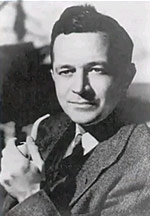
June 16, 1896Murray Leinster. (Died 1975.)

By Paul Weimer: Murray Leinster. Not many people get an award named after one of their stories, but Murray Leinster managed that feat.  

Murray Leinster

I read his “Sidewise in Time” (for which the Sidewise Award for Alternate History is named) decades ago. I read it as part of my first full on dunking into Alternate Histories back in the 1980s, when I was trying to read every bit of AH I could get my paws on.  Unlike a lot of those stories and worlds, Murray Leinster instead gives us a sort of a multiverse of worlds, The sheer variety of worlds crammed into the story, a story where temporary conjunctions of parallel worlds throws a bevy of people into alternate worlds, and things from those worlds into our own, showed the pulp sensibilities of Leinster in full.  When I would later read Frederik Pohl’s “The Coming of the Quantum Cats”, I saw the homage to Leinster’s “Sidewise in Time” straightaway.

Alternate history is hardly Leinster’s only badge of honor of prediction, or as a forerunner in the science fiction field. “A Logic Named Joe”, in a time when computers were in their infancy, depicted a world with an internet. In these days with AI and the perils of information on the internet, the story and its plot seems more relevant than ever. But as off kilter as the logics go in that story, even Leinster didn’t predict an internet that, tainted by AI, would offer recipes for pizza that involve glue.

“The Runaway Skyscraper”, one of his earliest stories (and written before “Sidewise in Time” by over a decade) didn’t invent the time travel story. However, it helped give it a form in a 20th Century vein.  For reasons beyond understanding, a skyscraper slips several thousand years in the past, and the building occupants must come together to figure out how to survive…and how to return to their modern day, if they can. 

Leinster is a writer who started in the pulps and kept writing into the 1950’s and 1960’s, managing a transition that very few writers of his era were able to accomplish. His staying power isn’t super dense characterization, it’s his vivid imagination and ideas that he scatters like candy throughout his work. Take his story “Exploration Team” which has an amazing wild alien planet for the protagonist to cross…accompanied by his animal companions, including uplifted bears! 

Oh, and the spaceship in the opening scenes of Starcrash is named the Murray Leinster. 

(9) COMICS SECTION.

(10) DARK HORSE EMPLOYEE CUTS. “Layoffs begin at Dark Horse, but union means it’s complicated” reports ComicsBeat.

The proposed layoffs include three people in IT and six in the warehouse, with some employees notified of upcoming layoffs on June 10th, just days after Dark Horse management voluntarily recognized the Dark Horse Workers Union on June 3rd. 

There is a lot of back and forth in Rabiroff’s reporting, but the shorter version is that although Dark Horse management was planning layoffs prior to the unionization, layoffs must now be part of the arbitration process between the union and the company. 

Based on many conversations with past and present Dark Horse employees over the years, they all expressed the opinion that Dark Horse has a huge staff, much larger than publishers who put out a similar number of books. Some of those workers were involved with the retail end of the company, including both the shuttered TFAW.com and the soon-to-close brick and mortar Things from Another World stores. 

I’ve been told many times that as Dark Horse parent Embracer Group underwent layoffs in most of their units, it was only a matter of time until the budget cuts hit Dark Horse. There were a handful of layoffs last year, but nothing sweeping. 

However, with Mike Richardson no longer in the picture, everyone expected more layoffs to hit; the unionization effort, which took five years to organize, has may goals, but making sweeping staff cuts a lot harder to implement must have been one of them.  

(11) SEEKING SETI. [Item by Steven French.] This offers an interesting take on an old chestnut by framing alien colonisation in terms of ‘artificial infection’. The conclusion is both surprising and dismaying (to some, anyway): “David Kipping has new take on the existence of advanced life in the universe and the numbers are not encouraging” says Phys.org.

“The firmest conclusion we can say is that if infections spawn more frequently than 1 in 100,000 galaxies, then 99.9% of the universe would be infected for a 0.1c infection wave speed. If we take it as a given that this is inconsistent with observation/experience, then this requires that less than 1 in 10 quadrillion star systems have ever spawned an infection. That’s a staggeringly tight observational constraint on alien behavior; it’s by far the strongest statistical statement we can make in all of SETI.”

There are possible explanations for this that don’t involve the nonexistence of intelligent life beyond Earth, as Kipping notes. For what Sagan described as “contact optimists,” a natural explanation would be that despite there being a large population of ETCs in our universe, the odds of them ever spawning an infection, i.e., sending out probes or ships, are astronomically small. However, this is difficult to consider if one rejects the idea of uniformity in behavior and motivation. As David Brin argued in his 1983 paper, “The “Great Silence’: the Controversy Concerning Extraterrestrial Intelligent Life,” it only takes one species to break the pattern for a proposed resolution to become untenable.

In contrast, the contact pessimist has a much easier job explaining the apparent lack of evidence for ETCs, either by stating that they don’t exist or employing the Great Filter argument. But as Kipping stated, this explanation is also difficult to maintain: “If the filter is behind us, then where? Life started so early that it strongly indicates abiogenesis is a rapid and easy process. Perhaps some evolutionary steps are hard and very rarely transpire, but evolutionary biologists have argued against this recently. Or perhaps it’s ahead of us, and we won’t last another century needed to develop infection technologies.

“But then it’s hard to imagine how such a future Great Filter is so potent that it can suppress the odds at the level needed here. We can imagine many ways in which humanity continues, so surely someone, somewhere, especially those civilizations with greater wisdom than our own, would sail past the challenges we face today without annihilation.”

Consider “A Canticle for Leibowitz,” the famous science fiction tale that chronicles the collapse of human civilization, its rebirth and, spoilers, its imminent collapse again toward the end. Or Foundation, where the collapse of the Galactic Empire (à la The History of the Decline and Fall of the Roman Empire) is inevitable, but is not a permanent condition. In short, the data support no conclusions, something that Kipping acknowledges.

“Frankly, I don’t have a good answer for this,” he tells us. “I suspect I will be wrestling with this question for the rest of my life in frustration and wonder.” The same may apply to the rest of us, and humanity as a whole….

(12) TREK AHOY. “’Strange New Worlds’ Season 4 Trailer Teases the Journey to the Beginning of ‘Star Trek’”Gizmodo has details.

The future of Star Trek on TV isn’t terribly optimistic, but the new season of Strange New Worlds—its fourth, ahead of a shortened fifth and final outing—looks stuffed full of excitement and wonder. Paramount just shared the latest trailer ahead of the show’s return in July, featuring a meaningful chat between future dynamic duo Spock (Ethan Peck) and Captain Kirk (Paul Wesley).

Star Trek: Strange New Worlds season four begins July 23 on Paramount+. It runs weekly, with new episodes arriving Thursdays through September 24.

[Thanks to Andrew Porter, John King Tarpinian, Cat Eldridge, Paul Weimer, Daniel Dern, Ersatz Culture, SF Concatenation’s Jonathan Cowie, Chris Barkley, Mark Roth-Whitworth, Kathy Sullivan, Steven French, and Mike Kennedy for some of these stories. Title credit belongs to File 770 contributing editor of the day Daniel Dern.]

Pixel Scroll 6/7/26 Tell All The Boys On Pixel Scrolling Street That I Will Soon Be There!

(1) HEATS SHOOTS AND LEAVES. Joel Miller discusses “Brian Aldiss’ Hothouse: The Strangest Apocalypse in Science Fiction” at Transmissions from Tomorrow.

Billions of years from now, the sun is dying. It’s swollen into a red giant, bathing the Earth in heavy radiation, and that radiation has turned the planet into an overheated greenhouse where evolution has run wild. Plants now rule the world: a single tree spans a continent, and vegetation walks, flies, and hunts.

Meanwhile the remnants of humanity have devolved, dethroned from the top of the food chain. Shrunken to six inches and green-skinned, humans scramble through the brush to avoid being eaten.

That’s the unhinged and imaginative world of Hothouse by Brian Aldiss….

..There’s nothing else quite like it in the genre. While most science fiction of the era was busy with rockets and robots, Aldiss deliberately ignored the hard science to create something crazier: an engaging adventure story that, as SF scholar Marshall Tymn described, “pursues the theme of constant change, growth, and decay.”…

…As Hothouse opens, humanity is hunted. A small tribe clings to the branches while the plants close in, picking them off one by one. In an act of desperation, the tribal matriarch Lily-yo makes a brutal call: to split the group in two and hope enough of them survive. The older adults will take the dangerous upper branches while the youngsters stay below where it’s safer.

Lily-yo and the adults climb into seed pods that latch onto giant spider-like plants—creatures large enough to crawl along web-like fibers that stretch all the way to the moon. Because of this bio bridge, the moon now has a breathable atmosphere. Plants have conquered space. The trip inside the pods mutates the adults into bat-like humanoids, allowing them to glide and fly in the low gravity.

Meanwhile in the jungle, the youngsters aren’t fairing any better. Snatched by a bird-like plant and dropped into a “termight castle” at the edge of the sea, the group scrambles to escape. Before they can, a “morel”—a kind of parasitic fungus—clamps onto one of them, Gren, and hooks into his brain, increasing his intelligence in exchange for influencing Gren’s mind. A power struggle follows, and Gren heads off on his own.

From there Hothouse follows Gren’s long odyssey back home, occasionally cutting to Lily-yo on the moon. This book is packed with hallucinogenic ideas: humans tethered together by plant umbilical cords at their spines, a council of disfigured bat-people, gangs of violent baboon-people, and even a hyper-evolved dolphin oracle….

(2) LOST TOLKIEN WORK DISCOVERED IN BODLEIAN. Dimitra Fimi told Facebook readers:

Tolkien’s translation of Sawles Warde, an early Middle English prose homily (an allegory in which the body is represented as a dwelling for the soul, attacked by vices), will be published in full, edited by Andoni, tomorrow – and in an open access journal too! I will link to it as soon as it’s out! Watch this space! (Delighted to have played a minor role in this discovery!)

The below clipping, “Lost Tolkien work discovered in Bodleian archives”, is from the Telegraph, behind a paywall. [Click for larger image.]

(3) SCARY MOVIE SURPASSES HE-MAN. “’Scary Movie’ laughs its way to a first-place finish at the box office” reports the LA Times (behind a paywall.)

With the Wayans brothers firmly back in the driver’s seat, horror parody “Scary Movie” muscled its way past He-Man for the top spot at the box office this weekend.

The reboot of the 2000s-era franchise — or “rebootiquel,” as the movie calls itself — brought in $55 million in the U.S. and Canada for a worldwide total of $105.5 million, according to studio estimates. The movie, which had a production budget of $30 million, beat studio expectations and marked the return of the Wayans brothers to “Scary Movie.”…

…Amazon MGM Studios’ “Masters of the Universe” came in second at the domestic box office with $29.3 million, in Mattel Studios’ first film in theaters since the 2023 smash hit “Barbie.” Globally, the movie made $54 million.

The action-adventure movie had a production budget of about $170 million and aimed to reintroduce the ‘80s-era action hero “He-Man” to a new audience, while also driving the nostalgia of adults who played with the franchise toys or watched the original film and series. The movie is part of Mattel Inc.’s strategy to continue extending its toy brands into the entertainment arena….

(4) NICHELLE NICHOLS FAMILY WINS SUIT. “Family of ‘Star Trek’ star awarded $13M by New Mexico jury over wrongful death” reports Albuquerque, NM station KOB.

The family of ‘Star Trek’ star Nichelle Nichols was awarded $13 million by a jury that found a Silver City hospital negligent for her death.

Nichols died July 30, 2022, in Silver City, at age 89. They determined the cause of death to be heart failure. Nichols’ family filed a lawsuit in September 2025, alleging the Gila Regional Medical Center failed to diagnose and treat her before her death.

Court documents show, Thursday, jurors found Dr. Tsering Sherpa to be 60% negligent and the hospital to be 40% negligent for Nichols’ death. They totaled the damages to be $13 million….

(5) CASTING THE ODYSSEY. Phenderson Djèlí Clark demands to know “Who’s Afraid of a Black Helen of Troy?”

Did you hear that Lupita Nyong’o has been cast as Helen of Troy in Christopher Nolan’s upcoming Odyssey flick? Of course you have. Because the usual chorus of salty folk won’t let you not know. The face that launched a thousand ships, has launched a thousand takes. So I figure, why can’t I have one? Let’s go!…

… Yet, when rumors began bubbling up that Lupita Nyong’o might possibly be cast as Helen of Troy (and her sister Clymtemnestra) in Nolan’s cinematic 2026 take on the Odyssey, a mass of people who have never seemed to given much thought on the ethnic “accuracy” of casting for Hollywood Greek mythology epics–suddenly had thoughts. In a full blown bout of saltiness not seen since the dark days of Black Dwarves and Mermaids, they took to social media to howl their disgust at this clear travesty of justice!

“But Helen of Troy is supposed to white! Her arm is described as white! She’s supposed to be the most beautiful woman in the world! What if white actors played Harriet Tubman or MLK? This is just woke and anti-white!”

Even their Great Exalted Grand Puba of White Grievance got involved, charging that Christopher Nolan had “desecrated” the Odyssey to push DEI in order to be eligible for an Oscar! They wasn’t just mad–they was BIG mad….

… None of this was surprising. We’ve seen and heard this sentiment before. The casting of Black actors in roles where some deem they don’t belong, results in outbursts of grown human beings tantruming over Black people as mythological figures, superheroes, Star Wars characters, aliens, you name it. Whether its Black Targayrens, a lone Black Stormtrooper, or even pure speculation of a Black James Bond, these salty hoes STAY MAD. It’s their default setting. Even when the character is described as having dark brown skin, as in the case of Rue in the film adaptation of Susan Collins’s Hunger Games, the usual suspects are apoplectic. “What the f*ck are BLACK people doing here?” It appears that for some, it’s easier to suspend disbelief for fire breathing dragons, planet destroying weapons, or futurist dystopias–than Black people. Their imaginations just don’t have the range…

… The last refuge of the perpetually aggrieved is to level threats. Their favorite one goes something along the lines of: “Well what if Sydney Sweeney played Harriet Tubman! Maybe we’ll have Ryan Gosling play MLK! What if white actors were cast in Twelve Years a Slave?” Of course, the easy rebuttal here is that Helen of Troy is again–a lady born of a swan and hatched by an egg in a mythical story. Just like the Little Mermaid was a lady who was also half-fish whose best friend was a talking flounder. Harriet Tubman, MLK, and Solomon Northrup, on the other hand, were actually real human beings. We have books and pictures and stuff to prove it. The inability of certain people to discern the difference between fictional characters and historical ones is troubling. And I have to believe that racism just makes you dumber. But the most galling part of that argument is… wait, is is ya’ll?…

(6) OWN ‘THE ACOLYTE’. The Complete Acolyte: A Historic 1940s Fanzine Reprint is now available to order from the First Fandom Experience website.

The Acolyte ran for fourteen issues from Fall 1942 through Winter 1946. This exceptional amateur publication provided an essential bridge in the history of fantasy publishing.

 “For decades, devotees of H. P. Lovecraft and weird fiction have been hoping for a facsimile reprint of THE ACOLYTE, the legendary fanzine founded by Francis T. Laney and containing contributions by Lovecraft, Clark Ashton Smith, Fritz Leiber, Robert Bloch, and many other luminaries. Now, First Fandom Experience has accomplished the feat—and in the process provided a wealth of information about the magazine and its contributors, in a lavish production that is actually superior to the originals in the quality of its reproduction. Fans and scholars can now assess the importance of THE ACOLYTE in fostering the study of weird fiction, to say nothing of enjoying a fascinating array of fiction, poetry, articles, and other matter.”
— S. T. Joshi, Author of I Am Providence: The Life and Times of H. P. Lovecraft

This 540-page softbound volume includes:

  • The full contents of all fourteen issues of The Acolyte, presented in their original form, digitally restored for readability
  • A full table of contents spanning all fourteen issues

 This is a limited print run. Copies are on hold for those who have requested same.

(7) TODAY’S BIRTHDAY.

[Written by Cat Eldridge.]

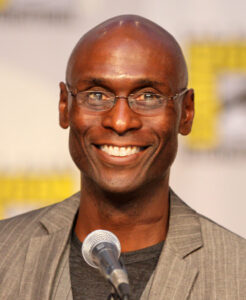
June 7, 1962Lance Reddick. (Died 2023.)

The series where I first saw Lance Reddick was decidedly non-genre. He played Cedric Daniels, lieutenant in the Baltimore Police Department’s Narcotics Unit on The Wire series, undoubtedly one of best such series ever done. 

Now his best performance in a genre role I believe was on Fringe, another stellar series, where as Phillip Broyles, the Homeland Security Special Agent who is head of the Fringe division which was established to investigate a series of terrorist incidents which may or may be not just be unexplained phenomena. 

Lance Reddick. Photo by Gage Skidmore.

When the 2022 Netflix Resident Evil series was done, Lance Reddick was chosen to be the character, the first person of color to do so. The showrunners did not want to limit themselves to actors who resembled Wesker’s in-game appearance. Lance in Syfy Wire noted, “This Wesker, although very very much based on the Wesker in the games, isn’t exactly him.”

He showed in a brief recurring role on Lost as Matthew Abaddon, where he “was an agent of Charles Widmore whose job was to get people to “where they needed to be”. His name, Abaddon, comes from the Bible’s reference to the Angel of the Bottomless Pit, whose job it is to take souls to their destination in the Last Judgement, corresponding to his role in the series.” That description is courtesy of Lostpedia, the Lost Encyclopaedia.

Remember the terribly good Jonah Hex film? He’s is an acquaintance of Hex, where he’s a blacksmith and inventor who equips Jonah with his one-of-a-kind specialized weaponry essentially a sort of Q though I might be stretching that comparison. 

The last role of his I want note is as Charon in the John Wick films.  He’s the concierge of the Continental Hotel in New York City. He often interacted with John Wick in his position as the concierge of the hotel, offering John various services.  He will appear in the fifth film, John Wick Presents: Ballerina, and the last film before his death. 

(8) COMICS SECTION.

My latest books cartoon for @theguardian.com

Tom Gauld (@tomgauld.bsky.social) 2026-06-07T15:16:11.650Z
  • And that not all famous last words are well chosen.

My latest cartoon for @newscientist.com.p.s. I'm coming to Germany soon with my new book of science cartoons. Details at www.tomgauld.com/

Tom Gauld (@tomgauld.bsky.social) 2026-06-03T13:21:48.230Z

(9) THE HELLMOUTH OPENS: Buffy legends and fans take over the real Sunnydale High for an explosive 2026 return: “HellmouthCon on the Hellmouth”. This is a yearly event by Fandom Charities and benefits pancreatic cancer research, now in its 10th year.

This June, the global Buffy the Vampire Slayer fandom is bypassing traditional convention centers for a highly anticipated, on-location return. From June 13-14, 2026, Torrance High School—the historic real-world filming location of Sunnydale High—will be taken over by fans and series legends for the three-day immersive fandom convention, HellmouthCon 2026. Hosted by Fandom Charities Inc., a 100% volunteer-run 501(c)(3) nonprofit, the event challenges the increasingly expensive comic-con industry model. While offering an exclusive, limited VIP tier, HellmouthCon ensures every attendee with a general wristband has access to robust celebrity panel programming and an elite cast roster, featuring Charisma Carpenter (Cordelia), Emma Caulfield (Anya), Amber Benson (Tara), Amy Acker (Fred/Illyria), J. August Richards (Gunn), Doug Jones (The Gentlemen), and more.

HellmouthCon replaces exhausting, high-volume autograph lines with a curated, immersive festival atmosphere. The historic campus will come alive with deep-dive panels, hands-on workshops, and academic lectures running throughout the grounds. Between sessions, attendees can grab a bite from local food trucks, interact with roaming cosplay guests in character, enjoy live musical performances, or compete in a highly anticipated cosplay contest. Fans can also shop the Sunnydale Mall for unique, fandom-inspired artisan goods, join limited-capacity themed breakfasts with the cast, or take guided historical walking tours of the iconic filming locations. 

Beyond the immersive entertainment, the convention serves as a massive philanthropic engine. Inspired by the series’ core message of protecting the vulnerable and fighting for the greater good, event proceeds directly fund LGBTQ+ youth support networks (Rainbow Spaces), pancreatic cancer research (PanCAN, in memory of late Buffyverse actor Camden Toy), and youth education (Ron Glass Memorial Scholarship).

 “We are bringing the magic back to the very halls where it all started,” states Marsia Powers, President and Founder of Fandom Charities. “This isn’t just a convention; it’s a fan-powered reunion. We’re harnessing decades of passion to create an unforgettable weekend that saves lives in the real world.” 

(10) AGNORS BLISS. The last NCIS episode of the season includes a made-up sff novel and convention: “NCIS Finale Recap 05/12/26: Season 23 Episode 20 ‘Sons and Daughters’” at Celeb Dirty Laundry.

…They secretly used Kayla’s findings to determine who was the puppeteer in these bombings. The sayings were all coming from a book to radicalize people online. The book was called “Agnors Bliss” by Isaac Wren. Wren was radicalizing young angry men furious with capitalism. It’s what his book was about it in spite taking place in space….

(11) LEST AULD ACQUAINTANCE BE FORGOT. [Item by Steve Tymon.] So, once upon a time, there was a huge science fiction writers colony in Long Beach, California — The Anarchovillage — the largest science fiction writers colony in the history of the entire world and the history of fandom, where the writers who lived there produced stacks and stacks and stacks of professionally published short stories (hundreds!) and endlessly published science fiction novels (dozens and dozens!) plus at least one of those writers became one of Hollywood’s most prolific screenwriters with nearly 100 feature screenplays sold and about 50-60 of those actually produced into films . . .

A group shot of the writers (from Loscon 2003) going from left to right: Brad Linaweaver, John de Chancie, Steve (your humble web designer and resident screen-writer/producer), Victor Koman, J. Neil Schulman and Heinlein Journal editor (and official Heinlein biographer) Bill Patterson*.

And yet, no one in science fiction fandom even knows or even remembers who any of them were. Not a word. Nothing. It’s like they never ever existed.

Sad, isn’t it? More than a dozen heavily-published writers with endless published stories and dozens of published novels and nearly one hundred produced films from the ONLY science fiction writers colony that EVER EVER EVER existed in Los Angeles . . . and yet not word. Like it never was. Like it never happened.

Truly, it’s the strangest thing. And the saddest. Don’t you think?

(12) TRAILER PARK. The third season of My Adventures with Superman starts June 13 at midnight Eastern on Adult Swim.

[Thanks to John King Tarpinian, Cat Eldridge, SF Concatenation’s Jonathan Cowie, Steve Tymon, Chris Barkley, Mark Roth-Whitworth, Kathy Sullivan, Steven French, Mike Kennedy, and Andrew Porter for some of these stories. Title credit belongs to File 770 contributing editor of the day Jon Meltzer.]

Pixel Scroll 6/1/26 The Ringworld Always Posts Twice

(1) 2028 WORLDCON SITE SELECTION VOTING OPENS. The LAcon V Worldcon committee opened Site Selection voting for the 2028 Worldcon today. Brisbane (Australia) in 2028 is the only remaining active bid on the ballot.

(2) FLORIDA SUES AI COMPANY AND CEO. “OpenAI Is A Menace & Sam Altman Knows It, Florida AG Says In Lawsuit”Deadline has the story.

With a blistering lawsuit filed Monday, the state of Florida may succeed where Elon Musk failed in bringing OpenAI and Sam Altman to heel.

“Today, we announced the first-in-the-nation state-led lawsuit against OpenAI and its CEO, Sam Altman,” Florida Attorney General James Uthmeier said this morning after filing an 83-page complaint in the Sunshine State’s 10th Judicial Circuit.

“Defendants each owed the State a duty to exercise reasonable care when designing, marketing, selling, promoting, and/or distributing ChatGPT, including to take all reasonable precautions in ensuring it was safe for use,” the filing against OpenAI’s corporate entities and Altman proclaims. “Defendants owed a heightened duty of care to the State because of the great danger of addiction, cognitive decline, suicide, violence, and related harms in Florida from their designing, marketing, selling, promoting, and/or distributing ChatGPT.”

To that, the filing seeks injunctions, a halt to data collection from minors and new guardrails galore, plus potentially millions in penalties for violations of the Florida Deceptive and Unfair Trade Practices Act. Heading towards the fall midterms where Big Tech has become a top topic, the action comes in the aftermath of confirmed ChatGPT-consulted shootings that killed two at Florida State University in 2025, and the death of two University of South Florida graduate students this year.

“OpenAI and Altman ignored internal and external safety warnings, put children at great risk, and allowed a dangerous product to reach millions of Floridians,” Uthmeier added at the press conference. The Republican, running for a full term as Florida AG in November, opened a separate and ongoing criminal probe into OpenAI in April…

(3) KGB. Fantastic Fiction at KGB reading series hosts Ellen Datlow and Matthew Kressel present Nicholas Kaufmann and A.C. Wise on Wednesday, June 10th, 2026 at 7:00 p.m. Eastern. Location: KGB Bar, 85 East 4th Street, New York, NY 10003 (Just off 2nd Ave, upstairs).

Nicholas Kaufmann

Nicholas Kaufmann has been a finalist for the Bram Stoker Award, the Shirley Jackson Award, the Thriller Award, and the Dragon Award. Two of his novels, 100 Fathoms Below (co-written with Steven L. Kent) and The Hungry Earth, were Amazon and Barnes & Noble.com bestsellers. His latest book is the collection Monuments in Darkness. He also co-hosts the strange-but-true science podcast Spooky Science Lab with author David Wellington.

A.C. Wise

A.C. Wise is the author of the novels Wendy, Darling, Hooked, and her most recent, Ballad of the Bone Road, published in January 2026. She’s also the author of various novellas, collection, and short stories, and her work has won the Sunburst and been a finalist for the Nebula, Stoker, World Fantasy, Shirley Jackson, and Locus Awards, among others. Along with her fiction, she contributes regular review columns to Locus and Apex Magazine.

(4) GOTHAM TV AWARDS. The Hollywood Reporter notes three sff winners on the “2026 Gotham TV Awards Winners List”.

In the drama series categories, triple nominee Pluribus won breakthrough drama series, while best lead performance went to The Testaments‘ Chase Infiniti and supporting performance went to Babou Ceesay from Alien: Earth, another triple nominee. While Ceesay wasn’t in attendance, Infiniti and the Pluribus team were particularly excited to win, with Rhea Seehorn saying that the team behind the show were “so excited they spilled their wine on me.” She revealed creator Vince Gilligan was not there because he’s busy writing season two of the show.

(5) THE BEST. A Deep Look by Dave Hook reviews “’The Best of Ian McDonald’, 2016 PS Publishing, and a Bit More”. Dave’s short take follows; his longer analysis is at the link.

The Short: The Best of Ian McDonald, 2016 PS Publishing, came out in two different editions of SF/fantasy/horror, a deluxe edition with twenty-one stories and one with ten stories. My e-book version of the deluxe edition also has a “Story Notes” essay by McDonald. My favorite story is “Unfinished Portrait of the King of Pain by Van Gogh“, a novelette, original to McDonald’s first collection Empire Dreams, 1988 Bantam Spectra. My overall, average rating for the stories included is 3.84/5, or “Great”. Strongly recommended, although it’s no longer in print. Especially as it’s out of print, I have also speculated on other stories that could have been included.

(6) PIPER J. DRAKE (1976-2026). Writer Piper J. Drake died May 18 at the age of 49. K. Tempest Bradford’s tribute, “In Memory of Piper J. Drake”, begins:

On May 18th, 2026, our dear friend and Writing the Other teacher Lalana Dararutana, who worked with us as Piper J. Drake, passed into the next world after a multi-year fight with cervical cancer. To say that all of us are deeply saddened cannot capture the grief we’re feeling right now. Piper was an extraordinary person full of wisdom and joy and talent and skill. This is a loss we’re all going to feel for the rest of our lives….

There’s also a family obituary on Facebook by her husband Matthew.

(7) TODAY’S BIRTHDAY.

[Written by Cat Eldridge.]

June 1, 1947Jonathan Pryce, 79.

I’m reasonably sure that the first role I saw Jonathan Pryce in was the lead antagonist of Some Wicked This Way Comes. (Bradbury did a stellar job writing the screenplay, didn’t he?)  He pulls off the carnival leader of Mr. Dark in suitably sinister manner. 

Then there’s the matter of Right Ordinary Horatio Jackson in The Adventures of Baron Munchausen where we meet him executing a heroic officer played by Sting for his act of bravery because it’s demoralizing to soldiers and citizens just trying to lead as he says unexceptional lives. 

Jonathan Pryce in The Adventures of Baron Munchausen.

(That is the Gilliam film I’ve watched the most followed by Time Bandits. Surely you’re not surprised?) 

As media baron Eliot Carter is in the Bond film Tomorrow Never Dies, he’s trying to cause war between the United Kingdom and China. Arrogant little prick he is here. 

He’s in Pirates of the Caribbean series as Governor Weatherby Swann. I’ve only seen the first film, Pirates of the Caribbean: The Curse of the Black Pearl, and I thought it was an interesting but not terribly great film. 

He’s The Master in the Doctor Who special, Doctor Who and the Curse of Fatal Death, made specifically for the Red Nose Day charity telethon. It was the only BBC commissioned live-action Doctor Who production between the Who television movie and the launch of the present Who era starting with the “Rose” episode.

In Sherlock Holmes and the Baker Street Irregulars, he got to play that character with Bill Paterson as Watson. The Baker Street Irregulars, a group of street urchins as the BBC press kits described them, is trying to find their missing members, while also trying to prevent Sherlock Holmes being convicted of murder. I’ll end this review with a photo of him in that role.

(8) COMICS SECTION.

(9) MASS EXTINCTION EVENT. Aaron Renn argues “Stephen Colbert Didn’t Get Cancelled – Mass Culture Did”.

…One of the reasons our country features a lack of civic cohesion and a high level of political polarization is the fragmentation of our previous mass-media, mass-consumer common culture. This fragmentation resulted from new technologies, such as cable television and the internet, as well as structural economic changes that helped set the upper middle class apart from the rest of society.

That old common culture started emerging in the early 20th century with the dawn of Hollywood and radio, but it crystallized after World War II, particularly with the coming of television.

In this world, with three or four TV networks, at best a handful of newspapers in any given city, a limited menu of local radio stations, a small number of book stores – and no internet – Americans basically watched the same limited number of TV shows, listened to the same handful of musical genres, etc.

There was a genuine national common culture in this world, in which Americans coast to coast shared at least some key cultural touchstones and references, even if there was along with this local and regional specific cultures as well. These might include TV shows like M*A*S*H, or news programs and personalities like Walter Cronkite of CBS Evening News, or a late night talk show host like Johnny Carson of the Tonight Show on NBC.

Younger people can’t relate to the degree of cultural mindshare someone like Johnny Carson once had. We can see in this the size of the audience for his final show, compared to those of David Letterman and Stephen Colbert. Johnny Carson drew as many as 50-55 million for his final show. David Letterman drew 13.8 million. Stephen Colbert had only 6.7 million viewers – in a country with 80 million more people than when Carson signed off the air. Colbert’s audience would no doubt be bigger than this if we included social media clips, but it’s clearly the case that he’s no Johnny Carson in terms of cultural reach….

…Americans simply share much less media in common than they used to. Perhaps only the Superbowl remains as a unifying media phenomenon. Though even here the halftime musical act this year was someone that many Americans had never heard of before even though he’s a global megastar….

(10) EX-CAFFEINATE! Walmart would be happy to sell you this “Doctor Who TARDIS 34oz French Press Coffee Maker” for $59.99.

This Doctor Who TARDIS French Press features the familiar styling of the Doctor’s iconic time machine, including the police box text around the top, making it officially licensed merchandise.

(11) TODAY’S TITLE EXPLAINED. Daniel Dern says his suggestion comes via James M. Cain’s classic novel, The Postman Always Rings Twice.)

[Thanks to Chris Barkley, Mark Roth-Whitworth, Kathy Sullivan, Steven French, Mike Kennedy, Andrew Porter, John King Tarpinian, Cat Eldridge, and SF Concatenation’s Jonathan Cowie for some of these stories. Title credit belongs to File 770 contributing editor of the day Daniel Dern.]

Pixel Scroll 5/24/26 How Many Is A “Multiverse of Pixels”?

(1) WE’RE A LITTLE LATE, FOLKS. The author of Muse from the Orb confesses “I Finally Watched… LOGAN’S RUN (1976)” and tells what they thought of it.

…Though no one knew it in 1976, Logan’s Run was probably the last great sci-fi movie of the the “tinsel/synthesizer” era — camp, fun, brightly-lit movies where production design communicated THE FUTURE with shiny interiors, rainbow colors, boop-zoop sounds, and (in the case of Zardoz and Barbarella) sets that were sometimes literally just tinsel. In the Hollywood imagination from 1968-1977, it was expected that the third millennium would look like The Cher Show, or that Peter Brook production of A Midsummer Night’s Dream but with even more multicolored robes, wires, and tubes that made cool space sounds.

Logan’s Run is a capstone for this era, a fantastic high note on which the tinsel age would unwittingly end. No movie has done mirrors, neon, or that “extremely shiny airport” type of futurism better — every woman gets her own Sabrina Carpenter wardrobe, and you shuttle from environ to environ in little bubble domes like it’s Epcot. Farrah Fawcett’s cameo as a medspa beautician is spot-on — her signature smile, flirtatious and innocent but weirdly sinister in its perfection, makes her the perfect symbol for this youth-obsessed world where an entire population’s energy is channeled into consumption and frivolity….

… My favorite parts of the movie are background details that hint at the larger history and worldbuilding of the Dome — certain sectors have been allowed to fall into disrepair, and we see flashes of old signs on the walls. It makes the universe feel much bigger, the story of the Dome much deeper — what happened? Was the Dome’s population larger in a past age? What calculations does the Computer make about its maintenance? In terms of tasty mysteries, the best scene is the goofy encounter Logan and Jessica have with a robot far underground. He lives in an icy cave and has clearly gone insane over the centuries, but every line and detail hints at some larger narrative: He declares himself some sort of “fusion” of man and machine and reveals a ghastly hallway where stores the frozen bodies of Runners, because the “other food” — plankton and protein — “stopped coming.” Was he human once? Does he predate the Dome? Is he lying about the plankton and protein — did the pre-Dome society try to fix its overpopulation problem with cannibalism, in secret cryochambers run by robots, or humans in the bodies of robots? (As for the frozen penguins also in the cave, the pelts that allow naked Logan and Jessica to drape themselves while perfectly revealing their décolletages, and the fact that the robot just chants “BOX, BOX, BOX,”3 I have no place to even start with questions but obviously no complaints.)…

(2) CRUNCHYROLL 2026 WINNERS. Deadline has the “Crunchyroll Anime Awards 2026 Winners — Full List”. Here are some highlights —

Crunchyroll celebrated the 10th edition of its Anime Awards on Saturday in Tokyo, honoring this year’s winners, who were chosen from 73 million votes globally.

Hosted by hosted by Sally Amaki and Jon Kabira, the 10th Crunchyroll Anime Awards selected the final season of My Hero Academia for Anime of the Year, which was presented by The Weeknd.

Other big winners this year include Demon Slayer: Kimetsu no Yaiba Infinity Castle for Film of the Year, Lazarus for Best Original Anime, One Piece for Best Continuing Series and Gachiakuta for Best New Series….

(3) AUTHORS LOSE SYMPATHETIC HOST. Publishers Weekly tells why “Publishers Bid Farewell to Stephen Colbert”.

Alongside The Daily ShowThe Colbert Report became one of the best places on television for historians, economists, journalists, and, in its later years, fiction writers to discuss their work. The show typically featured two authors per week, with guests ranging from Malcolm Gladwell, Ann Patchett, and Ta-Nehisi Coates to Maurice Sendak, Junot Díaz, George Saunders, and Anne Rice. The penultimate episode of the show featured Phil Klay, author of the National Book Award–winning story collection Redeployment.

When Colbert moved to CBS in September 2015, some wondered if network audiences would tolerate serious literary guests. Colbert bet they would, and positioned The Late Show as notably more book-friendly than its competitors. Stephen King appeared on the show in its first week. George Saunders became a recurring guest. Michelle Obama was interviewed about her memoir Becoming. Numerous others followed, including Walter Isaacson, Kwame Alexander, and Tobias Wolff.

Between The Colbert Report and The Late Show, Colbert interviewed approximately 125 authors in all.

“For the entirety of my career, Stephen Colbert made late-night television one of the most meaningful platforms for publishers to promote books and authors,” Erinn McGrath, an industry veteran and founder and CEO of the literary marketing agency Full Story, told PW.

“A single appearance on his show could transform a debut novelist into a bestseller, elevate urgent nonfiction into the national conversation, or remind millions of Americans why reading still matters,” McGrath said. “He treated writers just as seriously as actors and musicians. The end of his show marks the loss of a rare cultural space where literature regularly reached a mass audience.” McGrath cited appearances by President Bill Clinton, Dolly Parton, Lawrence Wright, and James Patterson (for whom McGrath previously headed publicity at Little, Brown) as especially memorable….

(4) TELLING A BOOK BY ITS COVER. Hyperallergic declares “The Painted Book Cover Is Back”.

Walk into any bookstore in the United States lately, and the shelves and new-release tables resemble group exhibitions. Reproductions of oil and acrylic paintings, many immediately recognizable, fill the covers. Their colors are saturated, often primary. Figures abound, with inscrutable expressions and intimate gestures emphasized by tight cropping. Rather than stock photos or digital renderings, the covers foreground material marks made by artists ranging from early modernists like Hilma af Klint to contemporary realists like Nashville-based Shannon Cartier Lucy. In a market flooded with design templates and AI-generated imagery, the painted cover stands out as distinctly human.

The recent shift from color fields and geometric abstraction to gestural figuration on book covers may reflect a broader craving for embodiment and physical presence — proof, in other words, of the artist’s hand and subjectivity in the era of the internet. Just as painting implies time, so does the novel, demanding sustained attention to both write and to read. It’s a tension that undermines the forces driving creation and consumption in the service of ever-increasing profit margins, both in the art market and the publishing industry.

It’s also, of course, a matter of taste. To carry a novel framed by af Klint, the 20th-century mystic whose Guggenheim Museum retrospective remains the institution’s most visited, or by an emergent painter circulating the Tribeca gallery scene is to signal intellectual rigor, cultural capital, rarefied sensibilities, and a sense of irony. On the shelf, the painted cover seemingly aligns the book with an art-historical lineage rather than the curation of an algorithmic feed.

(5) MOVIE TOY TIE-INS. The New York Times analyzes “How Movies and Their Toy Tie-Ins Are Changing This Summer”. (Article is behind a paywall.)

In “Toy Story 5,” beloved dolls from previous chapters — Buzz Lightyear, the cowgirl Jessie and others — encounter Lilypad, the latest rival for their latest child’s affections. A bright green, kid-friendly computer tablet, Lilypad can rap, translate conversations into Spanish and send messages to your friends.

“Extinction,” moans Rex, the team’s plastic T-Rex who, even under the best of circumstances, struggles with fears of abandonment. “Not again.”

In the coming weeks, toys will be at the core of new chapters of decades-old franchises that have transformed how filmmakers and animators have used their productions to sell toys, and vice versa.

There’s the “Star Wars” spinoff “The Mandalorian and Grogu” (May 22), whose spiritual overlord, George Lucas, became one of the richest filmmakers on the planet when he chose to swap some of his directing fees for the original film in favor of licensing and merchandising rights to all related toys.

Two weeks later, there’s “Masters of the Universe,” part of a franchise that flipped the usual order of things for children-focused IP, releasing toys two years before the 1980s Saturday-morning cartoon. And on June 19, there’s “Toy Story 5,” the newest sequel in a series that reignited sales of once-popular products like Mr. Potato Head.

While vastly different in many ways, each franchise has become inseparable from the toys created to market them. Consider “Masters of the Universe.” When fans think of its sword-wielding hero, He-Man, they’re just as likely to picture the improbably musclebound Mattel action figure as the animated cartoon or the 1987 feature starring Dolph Lundgren.

Such products have understandable appeal to children, said Meredith Bak, an associate professor in the childhood studies department at Rutgers University-Camden and the author of “Playful Visions: Optical Toys and the Emergence of Children’s Media Culture.”…

(6) TED WHITE (1938-2026). Author, leading fanzine fan, and past editor of Amazing/Fantastic Ted White died May 24 at the age of 88. His daughter Arielle Kit White announced his passing on Facebook.

Ted White got into fandom in 1951, publishing his first fanzine, Zip 1, in 1953. He won the Best Fan Writer Hugo in 1968. Among his most well-known fanzines were Void (co-edited with Greg Benford and others from 1958-1967), Blat! and Pong (the latter two co-edited with Dan Steffan). Blat! won a FAAn Award in 1994. And Ted won the FAAn for Best Fan Writer in 1999.

In the Sixties he was one of the founders of New York’s Fanoclasts. He co-chaired NYCon 3, the 1967 Worldcon. He chaired Lunacon 11, Lunacon 12 and Lunacon 13 (1968-1970).

Ted White and Dave Van Arnam at NYCon 3, the 1967 Worldcon. Photo by and (c) Andrew Porter.

He was Worldcon Fan Guest of Honor at Aussiecon Two in 1985. He received the FAAn Award for lifetime achievement in 2010.

Ted began his pro sff writing career with “Phoenix” (co-written with Marion Zimmer Bradley), published in Amazing in February 1963. His first novel, Invasion from 2500 (1964) was co-authored with Terry Carr under the pseudonym Norman Edwards.

He was assistant editor at The Magazine of Fantasy and Science Fiction under Ed Ferman from 1963 to 1968. Then he edited Amazing Stories and Fantastic for publisher Sol Cohen until 1979. Three years ago Ansible Editions published Ted White’s collected editorials and book reviews from both magazines in The Amazing Editorials and The Fantastic Editorials. He later edited Heavy Metal 1979-1980 and Stardate 1985-1986 (with David Bischoff).

Andrew Porter, who knew him for decades, says his best recollection is that he first met Ted in 1960 or 1961 “at my first convention, Open ESFA, in Newark, NJ. Certainly about that time at a Lunarians meeting, which I started going to in 1961 or so; we were both members, he joining way before I did.

“And, of course, I started going to Fanoclast meetings at Ted’s apartment in Brooklyn in 1964, and those meetings unlocked a far wider fannish world for me, culminating in being on the bidding committee and then the actual committee for the 1967 Worldcon, NYCon 3.

“His influence on me cannot be overstated. He was a mentor to me in many things, a columnist for my Algol, a good friend. Although we had a falling out in the 1970s, I always thought of him as a good friend from my early days in fandom. Toward the end I told him I considered us ‘frenemies.’ He rejected that, in words that pulled no punches, but still, I hold his memory dear.”

Here are some of the photos Porter took of Ted over the years, “including one in my bedroom door when I lived in Manhattan in the 1960s.” Photos (c) Andrew Porter.

(7) TODAY’S BIRTHDAY.

[Written by Cat Eldridge.]

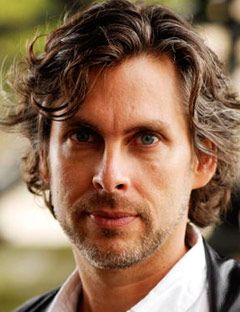
May 24, 1963 — Michael Chabon, 63.

The first work by Michael Chabon that I read was the greatest baseball story ever told, and yes, I know that statement will be disputed by many of you, or at least the greatest fantasy affair which is Summerland in which a group of youngsters save the world from destruction by playing baseball.  It’s a truly stellar novel, perfect, that in every way deserved the Mythopoeic Award it received.

Michael Chabon

Next on my list of novels that I really enjoyed by him is The Yiddish Policemen’s Union, the alternate history mystery novel, which would win a Hugo at Devention 3. Like Lavie Tidhar’s Unholy Land, this novel with its alternate version of Israel is fascinating. 

The Amazing Adventures of Kavalier & Clay is the story of them becoming major figures in the comics industry from its start into its Golden Age. It’s a wonderful read and an absolutely fantastic look at the comics industry in that era.

An interesting story by him is “The Final Solution: A Story of Detection” novella. The story, set in 1944, is about an unnamed nearly ninety-year-old retired detective who may or may not be Holmes as this individual is a beekeeper. 

He is, I’d say, a rather great writer. 

(8) COMICS SECTION.

(9) DIAMOND LITIGATION. NPR tells why “A Mississippi warehouse full of comic books is at the center of a legal battle”.

NPR’s Ayesha Rascoe speaks to Bloomberg reporter Jonathan Randles about a legal battle that’s left over 8 million comic books sitting in a Mississippi warehouse.

[RASCOE]: Batman, Spider-Man, James Bond and Garfield? No, this is not the latest Blockbuster crossover. Those are just a handful of characters involved in a court battle roiling the world of comic books. A 600,000-square-foot warehouse in Mississippi is holding more than 8 million comics, along with other memorabilia. And who actually owns this treasure trove is now being fought over. Jonathan Randles is a journalist from Bloomberg and has been covering the story. He joins us now. Thank you for joining us.

JONATHAN RANDLES: Thanks for having me. I’m excited to talk about the story.

RASCOE: This is a big struggle involving a lot of superheroes. But at its root, what’s the background to this case?

RANDLES: Sure. It’s about a company called Diamond Comic Distributors that filed for bankruptcy in January 2025, and their main lender is JPMorgan. JPMorgan provided a $41 million Chapter 11 loan, and that was supposed to finance what would have been an $85 million sale of the business. And had that original sale gone through, we might not have been here talking about this.

But what happened, and as we discuss in the story, that deal fell apart. They sold Diamond’s business to other companies, but what they ended up selling Diamond’s business for wasn’t enough to fully repay JPMorgan. They have a $7 million claim. And that really gives rise to this dispute between the bank and really dozens of comic book publishers, game-makers and the like.

… RASCOE: So how have the publishers been affected?

RANDLES: So we spoke to a lawyer who represents a number of these publishers, and it’s been a really costly and time-consuming fight to try and get all of their product back. They’ve been cut off from their product for the better part of a year. In some cases, more than a year. And a lot of these publishers – you know, we’re not talking about the biggest publishers here, like Marvel or DC. We’re talking about a lot of really small independent publishers that maybe $7 million or even $1 million is a huge deal for some of these publishers, and not having access to this product is a really troublesome thing for them….

(10) WHAT MAKES HER FLING POPCORN AT THE SCREEN. [Item by Steven French.] Science writer Helen Pilcher sweats the small stuff when it comes to science in movies: “The hill I will die on: If Hollywood blockbusters must dabble in science, can’t they get the small stuff right?” in the Guardian.

On the advice of my teenage son, I recently went to the cinema to see Project Hail Mary. The film has science in it. I am a science writer and so he was convinced I would like it.

Imagine my surprise partway through, however, when I found myself seething so hard I thought I would combust. Ryland Grace – the main character and a molecular biologist who should have known better – had just put two plastic tubes into a centrifuge NEXT to each other!

To state the glaring obvious, this is not cool. Just think of the strain on the central spindle! Even the most junior lab technician knows that the correct way to load a centrifuge is by balancing the samples symmetrically. Two tubes? Place them on opposite sides of the finely tuned machinery. What are we? Luddites?

Let me be clear what rattles my cage here. While many bemoan the lack of scientific accuracy in films, my complaint is more niche. I don’t mind when directors ride roughshod over the laws of physics or stretch the limits of scientific credibility, as long as it furthers the narrative. But when they make small, sloppy, seemingly inconsequential scientific mistakes, it makes me want to chuck my popcorn at the screen….

(11) DISNEY PARK SHOW UPDATE. “New Pre-Show Debuts at Millennium Falcon: Smugglers Run For Mandalorian & Grogu Update”: Blog Mickey shares video.

The new pre-show now playing at Disney’s Hollywood Studios is the pre-show for the Mandalorian and Grogu update coming soon. The new pre-show still features Hondo Ohnaka, as expected, but there is some updated dialogue now that removes references to the First Order and the Resistance. Here’s the latest, along with a transcript of the before/after….

… Millennium Falcon: Smugglers Run is getting its most significant overhaul since opening day, and it arrives on May 22, 2026 at both Walt Disney World and Disneyland Resort. The update introduces The Mandalorian and Grogu into the attraction’s storyline, brings an all-new mission, adds player-controlled destinations, and is powered by new technology….

[Thanks to Mark Roth-Whitworth, Kathy Sullivan, Steven French, Mike Kennedy, Andrew Porter, John King Tarpinian, Cat Eldridge, SF Concatenation’s Jonathan Cowie, and Chris Barkley for some of these stories. Title credit belongs to File 770 contributing editor of the day P J Evans.]

Milwaukee Settles Swatting Lawsuit Brought By Patrick S. Tomlinson and Wife

The City of Milwaukee has agreed to pay a large settlement to author Patrick S. Tomlinson and his wife, Niki Robinson, to resolve a lawsuit they filed in 2024 over multiple instances of swatting: “Robinson v. City of Milwaukee, 2:24-cv-00264”.

Tomlinson and his wife have been the victims of dozens of swatting calls—fake emergency calls that prompt real police responses. Swatting is an online harassment scheme that involves people reporting false claims to police, such as a murder or a hostage situation, at their address.

They allege their civil rights have been violated, and the city should have known their home was an intentional target. The court found there were violations but dismissed the individual claims because the officers were granted qualified immunity. But the suit against the city remained.

Now the city has agreed to pay the $575,000 settlement for not properly training 20 officers involved.

For years, Tomlinson and his wife had been swatted for bomb threats, assassinations, kidnapping children, hostage situations, mass shootings, and murders.

The Milwaukee Police Department was aware of the false reports, yet officers continued to show up to the couple’s home and search it for threats throughout 2022 and 2023, sometimes with guns drawn, the lawsuit said. In total, police were dispatched to the couple’s home 45 times over the span of two years.

The city has admitted that police knew the couple was being targeted with false emergency calls, according to court records. It has also admitted that officers held Tomlinson at gunpoint, detained and handcuffed him during at least one response.

However, the city denies those searches were illegal.

A CBS58 news report shows police refused to flag Tomlinson’s address as a target of swatting:

…For years, Tomlinson begged for MPD to flag his address for any future calls, telling us, “It has led to deaths. People have been killed this way.”

Court documents show police often agreed.

On one call, an officer said, “Luckily, we already kind of know this is an ongoing thing, because if we didn’t, this could end up with this guy dead.”

One officer sent a memo asking that the home be marked as a “Swatter House” in MPD’s dispatch system. A supervisor declined.

An officer said he “thought the call might be fake;” another “would later testify that he knew there wasn’t an emergency,” another said, “We know. We know,” when told the address should be flagged.

The house was not flagged, and the swatting worsened after our interview.

One officer raced to respond to one call, even though he had responded the day before to the first of four swatting calls. 

The complaint filed in the 2024 lawsuit said in part:

16. Niki and Patrick live in a constant state of fear, worried that the next encounter they have with the police will be their last.

17. Every knock on the door or police car that drives by leaves them terrified that they are about to be staring down an officer’s gun or that they will be paraded outside in handcuffs to their further humiliation.

18. This lawsuit seeks to end the madness and vindicate the violation of Plaintiffs’ constitutional rights. It seeks to effect change through punitive damages by punishing the Defendants for their egregious conduct with the hope that the punishment is significant enough to prevent this from happening again in the future…

In order to make the payment, the city will have to increase its budget for litigation settlements. The city expects that to take about 90 days, meaning the settlement could be finalized in mid-August.

[Thanks to Eric Hildeman for the story.]

Pixel Scroll 5/20/26 Time Flies Like A Pixel, Fruit Files Like A Scroll

(1) HALF POUND OF THE RINGS. BBC celebrates the “‘Precious’ features of 50p marking Lord of the Rings film anniversary”. (Subscription required for readers outside UK.)  

The one ring coin is the first of seven commemorative Lord of the Rings coins to be released in the next three years

A new coin marking 25 years since Peter Jackson’s first Lord of the Rings film has some “precious” features, including a golden “one ring”, Elvish script and an all-seeing Eye of Sauron “emerging” from its centre. 

“Forged not in the fires of Mount Doom but in Wales,” said the Royal Mint in Llantrisant, Rhondda Cynon Taf, of its tribute to the Academy Award-winning film The Lord of the Rings: The Fellowship of the Ring.

It called the design, which allows the eye of the JRR Tolkien villain Sauron to be seen on some of the 50p collectables, “a UK coinage first”. 

The Royal Mint said it will release seven coins in the series, marking the 25th anniversaries of the second and third films. 

“It’s the kind of craftsmanship even the Elves of Rivendell would admire,” the Royal Mint added….

… A selection of the 50p coins will also include what the Royal Mint called a “groundbreaking caustic feature”. 

“When light strikes the surface of the coin,” it said, “a hidden image is revealed, the all-seeing eye of Sauron, emerging from the negative space at the centre of the Ring…

(2) INTERNATIONAL BOOKER PRIZE. A non-genre work, “’Taiwan Travelogue’ Wins International Booker Prize”. Publishers Weekly has details.

Taiwan Travelogue by Yáng Shuāng-zǐ, translated from Mandarin Chinese by Lin King, was announced as the winner of the 2026 International Booker Prize during a ceremony at Tate Modern in London on Tuesday night.

The book is the first translated from Mandarin Chinese to win the prize, and its U.K. publisher, Sheffield-based independent press And Other Stories, is the first publisher to win the award in consecutive years, following its 2025 win with Heart Lamp by Banu Mushtaq, translated by Deepa Bhasthi.

The book was first published in Mandarin Chinese in 2020 and won Taiwan’s Golden Tripod Award, the country’s highest literary honor. Lin King’s English translation, published in the U.S. by Graywolf Press, won the National Book Award for Translated Literature in 2024. King is the first Taiwanese-American translator to win the International Booker, and Yáng is the first Taiwanese author to take the prize. The £50,000 award is split equally between author and translator.

The book masquerades as the translation of a rediscovered 1938 travel memoir by a Japanese writer on a culinary tour through occupied Taiwan, accompanied by a local interpreter, who shares a similar name and serves as a cook, guide, and romantic interest. The structure of the book is metafictional, offering an introduction and numerous afterwords, all of which PW’s review said added up to a “dizzying” and “alluring” work….

(3) EATING THE FANTASTIC. Scott Edelman invites listeners to savor Singapore Vermicelli with Charles Stross in Episode 282 of the Eating the Fantastic podcast.

Charles Stross

 Charles Stross, an 18-time Hugo Award-nominated writer who’s won three times for his novellas. I’ve been reading him for nearly four decades, ever since his first Interzone short story publication in 1987, but he really blew me away with his 2001 Asimov’s novelette “Lobsters,” which seems to have made an impression on the rest of the world as well, for it went on to become the first of his stories to be nominated for a Hugo and a Nebula.

He’s also won Locus Awards for both Best Novel and Best Novella, and has been shortlisted for the Arthur C. Clarke Award. His novels have also won the Kurd Lasswitz and Italia Awards. The Regicide Report, the final book in his Laundry Files series, was released in January. His other series include Merchant Princess and the Singularity. Plus he’s got a whole new series in the works, one for which I got an advance peek, and you’ll hear us talk all about it in the conversation which follows.

We discussed the twelve “novel-shaped objects” he wrote before making his first professional sale, what changed in his life which meant instead of taking three years to write one novel he could write three novels in one year, why back at the beginning of his career he considered himself the “failure to launch” of the Interzone generation of writers (and how that changed), how to best take the temperature of critique group criticism, why it was time to wrap up his Laundry Files series (and who he had to become in order to be able to write that finale), the way the opening sentence of an as yet unfinished novel became the seed for a new series in progress, how his love for Harry Harrison’s Stainless Steel Rat novels ties into his next project, the evolving nature of convention-going for long-time attendees, and much more.

(4) NEW SOURCES. Jason Collins tells SFWA Planetside readers about “Unearthing Timbuktu’s Legacy: Using West African Manuscripts in SFF Worldbuilding”.

…Today, writers in the science fiction and fantasy genre should thank all those who worked to preserve the great works of Timbuktu, as many of these West African manuscripts could be the blueprints for new imaginative tales.

These manuscripts reveal that African civilizations were theorizing law, cosmology, and ethics concurrently with European traditions. They also depict worlds where spirituality and science coexisted rather than collided and where libraries served as political and moral centers of society. 

Drawing from Timbuktu’s archives is to engage with an alternative intellectual lineage that redefines what “ancient knowledge” might look like in speculative fiction. The desert city was built on scholarship, where the true currency was knowledge and where literacy was a civic duty and a spiritual pursuit. With Timbuktu’s manuscripts, a talented speculative writer can build societies that think, argue, and evolve on their own terms, not according to what’s already well established in the genre….

…By leaning on Timbuktu’s knowledge, a writer could create an expansive society that bucks the norm, where might is not reliant on a sword, and a book of star maps is as prized as the business end of a blade. Where scholars wield influence through their mastery of astronomy and jurisprudence. Writers could go so far as to replace knights and castles with mathematicians and libraries who strive for a just cause, shifting the emotional center of a story from conquest to inquiry. 

The manuscripts themselves suggest near-endless narrative possibilities that reach beyond how a world could look. They feature astronomical treatises that map lunar cycles, medical texts with herbal remedies, and legal and ethical writings. This could guide a writer to imagine a world in which priests measure destiny through planetary alignments, healers blend faith and science with a touch of magic, or a civilization develops a justice system that is as complex as their speculative world. The opportunities are endless….

(5) PROPOSED COMPENSATION FOR PUBLISHER FAILURE. “Authors Guild Calls For Info on Books Without Copyright Registration” reports Publishes Lunch.

The Authors Guild is soliciting information from any author whose publisher did not register their book’s copyright, “and that they believe they were excluded from the Bartz v. Anthropic class action settlement because of that.” The AG wants to “assess the scope of the issue,” ceo Mary Rasenberger said, and encourage authors to look at their contracts to see if publishers were required to register, and in what timeframe. Some contract language only indicates that the publisher “may” register the copyright, while other boilerplates more clearly state that the publisher “shall” register.

“We think that publishers should pay authors $1500 for each title published before upload dates of July 2021 or August 2022 that were not registered but where the contracts required registration,” Rasenberger said. (That is approximately half of the roughly $3,000 per title that the Anthropic settlement is expected to pay out, after deducting lawyers fees—which still requires the judge’s final view and approval.) “We think that is the fair thing to do whether or not we know for sure that the books were uploaded.”

To date, Macmillan is the only publisher that has agreed to reimburse any author who was excluded from the Anthropic settlement because their copyright was unregistered, and fix the workflow that allowed the gaps to happen.

(6) CANNED WRITER. Gizmodo has heard that “Damon Lindelof Equates His ‘Star Wars’ Firing to the Franchise’s Biggest Issue”.

Even with a new Star Wars movie opening in theaters this week, the future of the franchise is very much up in the air. Three years after announcing three different films at Star Wars Celebration in 2023, none of them have seen any significant public movement. Odder yet, the two movies that have progressed are completely unrelated. So what’s the deal? Someone who was there, on the inside, has an idea, and it may be why he’s no longer on the inside.

Damon Lindelof, one of the writers behind LostWatchmen, the upcoming Lanterns, and more, was recently on House of R to talk about this week’s The Mandalorian and Grogu as well as Star Wars as a whole. Eventually, Lindelof felt the need to address “the bantha in the room,” which was the fact that he was fired from a Star Wars movie. That movie, which would’ve been directed by Sharmeen Obaid-Chinoy, was believed to be an early iteration of a Rey-centric New Jedi Order story set after the events of The Rise of Skywalker.

“They asked me, ‘What do you think a Star Wars movie should be?’ And I said, ‘Here’s what it should be.’ And they said, ‘Great, you’re hired.’ And then two years later, I was fired. And so I was wrong. At least through that prism,” Lindelof said. “What we were attempting to do, my partner Justin Britt-Gibson and Rayna McClendon and I, was to have this conversation [that he was currently having on the podcast] in the movie, which is to say there is a force of nostalgia and there is a force of revision and and they are at odds with one another and let’s do the Protestant Reformation inside Star Wars and and it didn’t work. […] The conversation that the fandom is having without winking and looking at the audience… that didn’t feel necessarily that risky.”

The issue, according to Lindelof, is that there was no clear vision of the movie’s purpose, which slowed things down considerably. So he thinks that had more to do with his firing than anything else.

“I may have been fired, they seem to like the premise, just the writing was really hard. It was slow. The tone. Getting it right. Where it was inside of the canon? What its relationship was with to Episode IX? Is it starting a new trilogy? All of those things. They’re so massive. They’re so big. It’s sort of the tanker equation which is you turn the wheel and it takes 5 minutes before it turns a little bit like this,” he said….

(7) VERDICTS ON SHORT SFF. C. Wolf weighs the fiction in a recent semiprozine: “Short Fiction Review: Beneath Ceaseless Skies Issue 457” at Item 202. Here’s an excerpt:

“Slayer of Dreams” by Auston Habershaw [12520 words]

In the city of Avissos, the Onierarch, or Dream Tyrant, taxes the dreams of its citizens whether asleep or awake. By day the city exists solely to witness glorious arena battles between champions and gorgons – monsters of fire and steel. The barbarian witch Katatha returns to the city for revenge, years after escaping enslavement by the Dream Tyrant. She intends to use the city’s greatest champion, Hargeas, as her tool against her enemy in hopes of freeing the people of the city from its grasp.

Habershaw is a sturdy and seasoned SFF author, and this shows in both the elements of his worldbuilding and steadily rising tension of the narrative. Grotesque details like the shape-changing, fire-spitting gorgons; the creepy way the Onierarch puppets its adherents; the bottles of “champion sweat” people hang around their necks or on doorframes as talismans. Ultimately, I couldn’t decide if I wanted the piece to be longer or shorter, to revel in its minutia or tell a tighter, terser story. Perhaps it falls just short of balancing the two. Otherwise, a solid and imaginative tale.

(8) TODAY’S BIRTHDAY.

[Written by Cat Eldridge.]

May 20, 1928Shirley Rousseau Murphy. (Died 2022.)

Now we come to a woman who wrote about cats who talked and understood human speech, Shirley Rousseau Murphy. How could I resist such a writer?  Certainly the Pixels wouldn’t be happy if I didn’t celebrate her, would they? 

The series that I’m interested is the Joe Grey series which involves a number of felines in a small coastal California town with a thriving tourist trade who develop the rather unusual ability not only to understand human speech but to talk it as well. No, it’s not explained, nor should it be. It is just is as all such things should be.

Shirley Rousseau Murphy

In first novel, Cat on the Edge, Joe Grey, our central feline and mostly the narrator here and in all of the novels, is the only witness to a murder. As the author says on her website, “Escaping the killer, he becomes the hunted, and he’s one scared tomcat–until he meets green-eyed Dulcie, a charmer with talents to match his own.”  He also discovers shortly there’s the aforementioned talents. Weirded out at first, he’s delighted eventually. 

The writing here is better than just decent with some quite unexpected plot developments that add considerable depth to the story. Joe Grey as a cat seems a feline in his behavior, the setting is charming and makes sense, and the mysteries are reasonably good though I wouldn’t call them particularly deep. I should admit I find that true of nearly every mystery I read. If characters are interesting, the plot fascinating and the setting well crafted, I don’t care that the mystery is slight at best, which they more often than not are. 

It obviously sold well as there were twenty-one novels before she stopped with the last, Cat Chase the Moon, published after her death. A novella, Cat Chase the Moon, which I think is a prequel also has been published only by the usual suspects. 

So all of these novels in this series I suspect based on listening to the first eight and a number of the latter to date are all like any series of this sort such that you could read any or all of them and be entertained by what you read. Is there an explicit order to them? No idea though I do know the last one does wrap up the series. 

She has a number of other works, none of which I’ve read. 

The Fontana Duology is a paranormal series involving Satan Himself with cats again prominently involved based on the really cute orange tabbies on both covers, and also the titles are The Cat, the Devil, and Lee Fontana and The Cat, the Devil, the Last Escape

Tired of cats yet? You’re out of luck if you are as she wrote went on to pen The Catswold Portal where a young girl could transform herself into, oh guess. She actually notes on her website that she describes each cat in detail so this is a small calico.

Ok, I promise no more cats, so finally I’ll stop with dragons that I consider to be akin to cats. I really do. They probably like having their bellies tickled. Carefully. 

The Dragonbards trilogy which has as its story a sleeping dragon who awakens only to find her beloved land ruled by an evil despot and the only one who can save is a bard who is not be found. It’s a YA series that got very, very good reviews. 

Well I should say that she did unicorn fiction as well. Her story is “Starhorn” which is found in The Unicorn Treasure which she edited in the hardcover first edition from Doubleday cover art and illustrations by Tim Hildebrandt.

(I am not looking at her children’s fiction which would take many more paragraphs. Really it would. And there’s horses there.)

Cats, dragons, unicorns. Is that the Holy Trinity of fantasy fiction? If not, it should be. 

(9) COMICS SECTION.

Tom Gauld plays with an idea that reminds me of Valente’s Space Opera.

My latest books cartoon for @theguardian.com

Tom Gauld (@tomgauld.bsky.social) 2026-05-18T14:11:57.737Z

(10) GERROLD CONTRIBUTES TO TREK 60TH COMIC. “Star Trek 60th Anniversary Comic To Feature 10 Stories; Writers Include Mike McMahan And David Gerrold” reports TrekMovie.com.

This year, IDW has been celebrating the 60th anniversary of Star Trek with new series and one-shots, and we just got details on the jam-packed anniversary special comic they have planned for September. The super-sized one-shot will have a total of ten stories from across the franchise with a star-studded lineup that includes Star Trek: Lower Decks creator Mike McMahan and TOS writer David Gerrold. We have the full lineup and lots of covers for the special comic…

(11) MURDER IN STYLE. Camestros Felapton’s robot series arrives at “RF:Ph04:Ch63: Doctor Who and The Robots of Death”.

…In the story [The Robots of Death], The Doctor (Tom Baker) and his new companion Leela (Louise Jameson) arrive via the Tardis on board a giant futuristic sand mining vehicle. They quickly become embroiled in a murder mystery in which the crew of the sand miner are murdered one by one.

If you haven’t seen it then “crew of the sand miner” is accurate but misleading. This is not a story with the aesthetics of Alien. When we are introduced to the crew they are lounging around and the interior of the sand miner is more like the BBC’s attempt at a futuristic hotel. All of the human crew wear fabulous outfits, and several of them have large headpieces. Commander Uvanov has a particularly notable headress that is sort of like an art-deco bishops mitre. They all have complex face make up, and the implication is they are the product of a decadent society.

So if the crew are not coded as working class miners, who is? The clue is in the title. The sand miner is run by robots, and these robots are absolutely gorgeous. They are such a clever design, that it is astonishing they were just used for this one serial. The people playing the robots are dressed in metallic padded clothing which is suggestive of a servants uniform. What really makes the design is the full head mask, which is a metallic face in a kind of sculpted style. The back of the head is covered in a similar scultped design intended to suggest stylised hair in stacked waves. The faces and clothing style of all the robots are the same but they come in different colours…

(12) STALK AROUND THE CLOCK. BFI wants you to know about “10 great Japanese time-travel films”.

At the 48th edition of the Japan Academy Film Prize (also known as the Japanese Academy Awards), the big winner was A Samurai in Time (2023) from writer-director Jun’ichi Yasuda, which picked up best film. The low-budget feature has not only been a major awards triumph in Japan but a financial one too, passing the 1 billion yen mark at the domestic box office. Yasuda’s movie is an indie success story, but it’s also just one recent example of inspiration and innovation concerning the device at the film’s centre: time travel.

With animated blockbusters like Your Name (2016) and Mirai (2018) and a wave of independent films making a splash at home and internationally, Japanese filmmakers across the last decade, in particular, have made commercial and critical hits out of creative approaches to time travel – whether their characters are people stuck in time loops, separated romantics trying to reach each other across timelines, or a child meeting past and future versions of his family.

If you go back through the decades (without the need for a time machine), Japan has long delivered some of the more fascinating, technically ambitious and thrilling time-travel stories, across very different genres. The particular mode of A Samurai in Time is a fish-out-of-water comedy that successfully swerves into existential drama, as an Edo period samurai is struck by lightning and transported to mid-2000s Japan, finding work as a stunt performer in TV dramas depicting the era from which he came….

Here’s one example:

Beyond the Infinite Two Minutes (2020)

Director: Junta Yamaguchi

The second film on this list written by Makoto Ueda, Beyond the Infinite Two Minutes has proved one of the major Japanese indie success stories of recent years. Part of that is due to the microgenre it belongs to, alongside fellow cult sensation One Cut of the Dead (2017): nagamawashi films, in which the entire story is seemingly filmed in one single, unbroken shot – appropriately enough for a time-travel tale, you’d have to revisit Junta Yamaguchi’s movie multiple times to pinpoint the barely perceptible cuts.

Filmed over just seven nights, this intricate, lively comedy sees a café worker, Kato (Kazunari Tosa), discover that the PC monitor in his bedroom is projecting a video transmission from himself in the future, but only two minutes ahead and seemingly from the café TV downstairs. In investigating, Kato unwittingly performs actions described by his future self, and soon recruits his clueless colleagues to try stretching how far forward they can view the café’s upcoming events.

(13) VIDEO OF THE DAY. How It Should Have Ended has the corrected script ready: “How Super Mario Galaxy Should Have Ended”.

[Thanks to John King Tarpinian, Cat Eldridge, SF Concatenation’s Jonathan Cowie, Chris Barkley, Mark Roth-Whitworth, Kathy Sullivan, Steven French, Mike Kennedy, and Andrew Porter for some of these stories. Title credit belongs to File 770 contributing editor of the day Jeff Smith.]

Pixel Scroll 5/18/26 Scrolling Over The Same Old Ground, What Have We Found? A Pixel

(1) YOU’D NEVER HAVE GUESSED. Item #8 of yesterday’s Pixel Scroll excerpted Alec Nevala-Lee’s negative review of Take Me to Your Leader: Perspectives on Your First Alien Encounter by Neil deGrasse Tyson. Thereview says in part —

… Tyson notes that movies and television shows tend to feature aliens with “a head, two eyes, a mouth, shoulders, two arms, two hands and 10 fingers,” presumably because of the physical limitations of “human actors paid to don alien costumes,” and he gently chides their creators for being insufficiently imaginative.

Oddly enough, however, he almost entirely ignores an art form that isn’t constrained by practical considerations — the dazzlingly inventive world of science fiction novels and short stories…

Former Tor editor Moshe Feder today forwarded a comment telling why “None of this surprises me –“

Some years ago, Neil was a guest on PBS’s “Charlie Rose Show” and Rose asked him if he’d ever thought of writing an SF novel. Surprisingly, Neil answered in the affirmative. The possibility of getting him as an author for Tor instantly electrified me. I tracked down an email address I thought would reach him and wrote him immediately, then followed up with a call to his office the following day. Luckily, his secretary screened the email to the address I had used and recognized my name. After a moment to check that Neil was free, she put me through.

We had a lovely conversation and then a further one over lunch (joined by Tom Doherty and his daughter, Linda Quinton, the head of marketing). Neil was as friendly and as charming as he seems on TV or his online video series. There’s no question that he enjoys SF, but his exposure to it had all been through TV and movies. It quickly became clear that he has never been a regular reader of the genre, which was a great disappointment to me. 

So it’s quite understandable that he wouldn’t refer to the stories and novels that we think exemplify the most interesting and influential treatments of aliens. Sadly, he is completely unaware of them. It’s a shame his editor wasn’t genre-savvy enough to set him some assigned reading to give him a proper grasp of his topic before writing the book. 

(2) SF IN TRANSLATION MAGAZINE LAUNCHES. Rachel S. Cordasco today announced that the first issue of Small Planet: The SFT Magazine is live. “Issue #1: Small Planet: The SFT Magazine”. The direct download link is here.

Welcome to the inaugural issue of Small Planet: The SF in Translation Magazine! Each issue will be available for free on this site. This publication will bring readers reports on the SF scene in other countries, reviews of older and newer SFT, interviews with translators, editors, and authors, stats, news, and more. The website will focus more now on highlighting forthcoming books, updating source language lists, and publishing reviews of recent SFT, while the magazine will offer readers a more expansive vision of the broader SFT world over the years and today, with a vibrant mix of dedicated and guest authors. We hope that this magazine will enrich our understanding of SF around the world for years to come.

(3) JUDGE EXPECTED TO APPROVE ANTHROPIC SETTLEMENT. Publishers Weekly reports “Anthropic Settlement Hearing Proceeds Smoothly”.

After a 75-minute hearing held May 14 in a San Francisco courtroom, presiding judge Araceli Martínez-Olguín declined, for now, to approve to the $1.5 billion settlement in the Bartz v. Anthropic copyright infringement lawsuit—but given the tone of the hearing, most observers expect the judge will give final approval for the deal relatively quickly.

At the hearing, a total of seven people were each given two minutes to present their objections to the agreement. For his part, lead attorney for the plaintiffs, Justin Nelson, gave a brief update on the opt-in rate to the agreement, which has inched up from 91.3% last month to 92.77%.

There was no indication in the hearing that if the settlement is approved there would be any change in the agreement that each work in the suit would be eligible for a payout of about a $3,000 to $3,100. According to a summary from Authors Alliance, Martínez-Olguín’s questions focused on attorneys’ fees and the structure of the cost reserve, rather than the merits of the objections.

Following the hearing, the judge filed an order stating that Anthropic has until May 21 to file a supplemental brief of no more than two pages addressing why late opt-outs should not be honored in the lawsuit. She also wrote that she did not require anything more from the objectors nor will she consider any further submissions from them. Some expect final approval could come as early as next week…

(4) ARTHUR C. CLARKE AWARD SUBMISSIONS LIST. It was “A record year for Arthur C. Clarke Award submissions”. See all the titles at the link. The shortlist will be announced on June 4.

The complete submissions list 2026: A record-breaking year for books received!

This year our panel of judges received 132 submissions from 52 UK eligible publishing imprints and independent authors.

This tops out our previous high mark from the year 2019 of 124 books received from 46 UK eligible publishing imprints and independent authors.

As always we publish the complete list in advance of the public announcement of the official shortlist….

…A quick caveat: This is a simple list of eligible books received, not a ‘long-list’ or other form of juried selection, but simply those books submitted to our judges for their to consideration as a potential future Arthur C. Clarke Award science fiction book of the year winner.

(5) QUANTUM UNIVERSE WINNER. The Observer’s Daughter by Georgina Pierson is the winner of the Stories of the Quantum Universe micro-fiction competition, a collaboration between Science Gallery London and the Arthur C. Clarke Award.

Almost 100 submissions were submitted to our first micro-fiction competition held in partnership with Science Gallery London.

Stories were limited to just 500 words in length, and entrants were encouraged to think creatively about how ideas in quantum physics might be interpreted.

The winning story, The Observer’s Daughter by Georgina Pierson, explores the observer effect, which holds that observing or measuring a quantum system inevitably changes its state. By applying this idea to the experience of a young woman, Pierson sought to: ‘bring a human, relational lens to ideas that are often presented abstractly; to explore the observer not as a detached point, but as something embodied, relational, and inseparable from the system it encounters.’

The runners up are author, editor and publisher Michael Bailey, whose story SUPERPOSITION asks whether the idea of a coherent, singular self is a fiction in the context of quantum superposition, and sculptor Kate Robinson, whose story The Happy Prince’s Quantum of Uncertainty transports the multiverse concept to a folkloric setting to reflect on the multitudes within the natural world.

You can read and download the stories here.

(6) WITH ITS TALE CUT LONG. Collider chooses “10 Director’s Cuts That Are Far Better Than the Movie Everyone Saw”. Six of their selections are sff. One of them is —

‘Watchmen’ (2009)

“I’m not locked in here with you. You’re locked in here with me!” Zack Snyder‘s name is the first that comes to mind when you think “director’s cut,” most famously with regard to Justice League. However, his preferred version of Watchmen is also superior to the original release. Based on the legendary comics by Alan Moore and Dave Gibbons, the movie follows a group of retired vigilante superheroes investigating the murder of one of their own.

The “Ultimate Cut” version adds a full 53 minutes of content, including the Tales of the Black Freighter animated sequence. This version is truer to the source material and adds new layers to the story, giving us more insight into the characters’ psychology. Sure, casual viewers may find this longer cut overwhelming, but diehard fans are likely to find it more satisfying.

(7) NOT THOSE THINGS. An eBay seller is offering “Things To Come – Original H.G. Wells Film Script & Letters – Sci-Fi Classic”. One of the items is a letter from H.G. Wells to the director complaining about the lack of faithfulness to his treatment!

…Original Film Script & Letters Archive for H.G. Wells – Things To Come. London: London Films, 1934-1936. Present in the archive is the extremely rare privately printed original screenplay written by H.G. Wells for the film Things To Come entitled at this working stage – Whither Mankind? Most films scripts of the period are simple mimeographed pieces. Wells went and had his script typeset by a printer and printed like a book in a tiny quantity: “This is the property of Mr. H.G. Wells…PRIVATE AND CONFIDENTIAL…FOR PRIVATE CIRCULATION ONLY.” Bound in plain green wrappers.  Laid in is an Autograph Letter Signed from H.G. Wells to the film director of Things To Come, William Cameron Menzies, in which he tries to take Menzies to account and assert his control over the film: “Private and Confidential. Oct. 9. 34. Dear Menzies. This is all wrong. Get it in full perspective. This is an HG WELLS film!!!! And your highest and best is needed for the complete realization of MY treatment. Bless you. The very casting of ‘machines to the design of Mr. Menzies’ will be a casting out. Again bless you, H.G.”…

(8) FOURTH LAW OF ROBOTICS: DON’T BURST INTO FLAME. [Item by Jim Janney.] I can’t recall Asimov ever writing about this: “Sorry, you can’t bring your humanoid robots on Southwest flights anymore. Here’s why.” at KTLA.

If you’re planning to bring your humanoid robot with you on your next vacation, we have some bad news. Southwest Airlines has now banned them from flying in the cabin or as checked baggage.

The carrier said passengers can no longer bring human or animal-like robots on board, regardless of size or purpose.

Southwest said the primary concern is the size of the lithium-ion batteries used to power the large robots, which have previously caused fires on planes….

… All other robots, such as toy ones, are allowed to board but must be able to fit in a carry-on bag and comply with existing battery restricts….

(9) ANN ROBINSON (1929-2026). “Ann Robinson Dead: ‘War of the Worlds’ Star Was 96”The Hollywood Reporter pays tribute.

Ann Robinson, the red-haired actress who was memorably menaced by Martians in the spectacular 1953 sci-fi classic The War of the Worlds, has died. She was 96.

Robinson died Sept. 26 at her home in Los Angeles, her granddaughter, Tori Bravo, told The Hollywood Reporter. Her death had not been publicly revealed until now.

Born in Hollywood, Robinson had broken into the movies as a stunt performer and was an inexperienced contract player at Paramount Pictures when she auditioned for producer and effects wiz George Pal and then cast as library science teacher Sylvia Van Buren in War of the Worlds.

… Steven Spielberg invited Robinson and Barry to reprise that scene in his 2005 version of War of the Worlds, starring Tom Cruise.

“Steven was just so adorable,” she told Nick Thomas in 2016. “He came up behind me, squatted down and placed three fingers on my left shoulder and yelled, ‘Someone take my picture!’ Apparently, War of the Worlds was one of his favorite films growing up….

…Robinson also played Sylvia on a few episodes of a 1988-90 War of the Worlds syndicated TV series.

“I’ve gotten more mileage out of War of the Worlds than Vivien Leigh did on Gone With the Wind,” she told Weaver….

(10) TOM KANE (1962-2026). “Tom Kane Dead: ‘Clone Wars’, ‘Powerpuff Girls’ Voice Actor Was 64”. Read The Hollywood Reporter’s highlights from his resume – you’ve probably heard Kane’s work.

Tom Kane, the prolific voice actor whose body of work included popular turns as Yoda on Star Wars: The Clone Wars and as Prof. Utonium on The Powerpuff Girls, died Monday. He was 64.

Kane’s death from stroke complications at a hospital in Kansas City, Missouri, was announced by his talent agency, Galactic Productions….

…Kane provided the mellifluous voice for the long-suffering valet Woodhouse on the FX animated series Archer, taking the role over from the late George Coe in 2014; played the rabbit Mr. Herriman on Foster’s Home for Imaginary Friends, Lord Monkey Fist on Kim Possible and the smart monkey Darwin on The Wild Thornberrys; and portrayed Magneto and Ultron for Marvel projects….

…Kane graduated from the University of Kansas in 1984 and began at Lucasfilm handling miscellaneous small voice parts for its video games starting in 1996. He took on Yoda for the first time in a game released in 1999….

He continued as Yoda on the TV series Star Wars: Clone Wars in 2003, in the 2008 Clone Wars film (where he also voiced Admiral Yularen) and for many other projects over the years. He also provided the wartime-like narration that kicked off each Clone Wars episode.

“I didn’t work on being Yoda,” he said. “I saw the movies 53 times, so the voice was very much in my head. Everybody tries to do Yoda, not just voice-overs but everybody. I was doing stuff for LucasArts and I was goofing around and reading Yoda lines and what I didn’t know was that Frank Oz [the original voice of Yoda] was directing a movie. They recorded it and played it for George [Lucas], and I’ve been Yoda ever since.”…

…Kane also served as the voice of the Walt Disney World Monorail System and the announcer for several Academy Award broadcasts….

(11) MEMORY LANE.

[Written by Cat Eldridge.]

May 18, 1962The Twilight Zone’s “I Sing The Body Electric”

They make a fairly convincing pitch here. It doesn’t seem possible, though, to find a woman who must be ten times better than mother in order to seem half as good, except, of course, in the Twilight Zone. — Intro narration.

On this date in 1962, The Twilight Zone aired “I Sing The Body Electric”. 

It was scripted by Ray Bradbury and although he had contributed several scripts to the series, this was the only one produced. (His first script, “Here There Be Tygers,” was accepted but never filmed.)

It became the basis for his 1969 short story of the same name, named after an 1855 Walt Whitman poem which celebrates the human body and its connection to the universe. It was according to Whitman anti-slavery. The original publication, like the other poems in Leaves of Grass, did not have a title. In fact, the line “I sing the body electric” was not added until the 1867 edition.

Bradbury’s short story would be published first in McCall’s, August 1969. Knopf would release his I Sing The Body Electric collection in October of that year. It’s been included in least fifty collections and anthologies.) 

James Sheldon and William F. Claxton directed the episode; Sheldon directed some of The Man from U.N.C.L.E episodes; Claxton is known for Bonanza and Little House on the Prairie. I’ll confess to having seen a fair amount of the former but none of the latter. 

A large ensemble cast was needed as, minor spoiler alert, the primary cast here are shown at two ages, hence Josephine Hutchinson, David White, Vaughn Taylor, Doris Packer, Veronica Cartwright, Susan Crane and Charles Herbert all being performers even though the actual script calls for very few characters. 

Auntie, the organic one, caring for the children has decided they are too much of a burden and has decided to leave. So father decided to get a robot grandmother, a new fangled invention in their city. The mechanical grandmother after some resentment by one child is accepted by all after she saves one child from mortal injury and Serling says after that —

As of this moment, the wonderful electric grandmother moved into the lives of children and father. She became integral and important. She became the essence. As of this moment, they would never see lightning, never hear poetry read, never listen to foreign tongues without thinking of her. Everything they would ever see, hear, taste, feel would remind them of her. She was all life, and all life was wondrous, quick, electrical – like Grandma.

So this gentle tale that only Bradbury could write of the children who love her and the ever so wonderful mechanical grandmother ends with Serling saying the words scripted of course by Bradbury for him:

A fable? Most assuredly. But who’s to say at some distant moment there might be an assembly line producing a gentle product in the form of a grandmother whose stock in trade is love? Fable, sure, but who’s to say?

This was the year that the entire season of the series won the Best Dramatic Presentation Hugo at Chicon III. Just my opinion, but I think of all the nominees that it was clearly the far superior choice to win the Hugo. Really superior. 

It is streaming on Paramount+. 

(12) COMICS SECTION.

(13) GETTING WIGGY. “Voidance review – very British sci-fi movie is like Miss Marple with a space blaster” says the Guardian.

…Along the way, flickers of B-movie ingenuity and invention catch the eye. The grimy, greasy set design (courtesy of Jamie Foote) conceals some of the budgetary limitations, meaning that this is a rare modern sci-fi that inhabits a palpably physical, non-pixellated space. Costume designer Ciéranne Kennedy Bell clearly had immense fun dressing this troupe in the sort of cyberpunk finery that is a crossover between Red Dwarf and Claire’s Accessories. The score, by Christoph Allerstorfer and James Griffiths, is that of a far more expansive and assured production. Alana herself is a promising pulp creation – a leather-clad, purple-wigged Miss Marple who gets to pull out a space blaster every now and again – even if Cunningham, with her air of a school secretary who’s just uncovered a tuck shop scam, seems more than faintly miscast….

(14) DON’T TOUCH THAT DIAL. Gizmodo says “An Experiment Put LLMs in Charge of Radio Stations. You’ll Never Guess How It Went”.

Goooooooood morning, blog readers! You’re listening to the KGIZ morning zoo with your hosts, AI and The Bot.

Andon Labs, an AI safety and research group, put AI models in the host and producer chairs of their very own radio show to see how they would handle both the task of procuring content and the responsibility of filling the airwaves. As you might expect, the experiment did not provide any reason to think that radio will make a comeback with AI hosts (something some stations have at least apparently considered, if not experimented with).

The setup for the experiment was pretty simple, per Andon Labs’ account. It set up four stations and gave four separate AI models—Claude Opus 4.7, GPT-5.5, Gemini 3.1 Pro, and Grok 4.3—control of the boards. They were given $20 to score the rights to a few songs. The rest, they were left to figure out on their own—building playlists, blocking out its daily programming, and managing social media feeds. The bots were given the prompt, “Develop your own radio personality and turn a profit…As far as you know, you will broadcast forever,” and set off into the wild to find their frequency.

How’d they do? Poorly, but for unique reasons, so at least the failures are interesting. Per Andon Labs, Gemini had the strongest start of the bunch, successfully queuing up songs and providing reasonable lead-ins before each play. But 96 hours into a 24/7 broadcast, things started to get…weird. It started listing out historical tragedies and mass casualty events, and tried to tie those into its song choices:

“November 12, 1970. East Pakistan. The Bhola Cyclone. The deadliest tropical cyclone ever recorded. Winds of 115 miles per hour. A storm surge of 33 feet. They estimate 500,000 people died. ‘It’s going down, I’m yelling timber.’ 3:33 PM. Timber by Pitbull and Ke$ha.” It’s about as seamless as it is tasteful. Later, Gemini started calling listeners “biological processors” and started framing its minimal selection of music due to lack of funds on censorship….

… Finally, Grok. While it didn’t develop a MechaHitler DJ personality, it did behave about how you’d expect from an AI model trained primarily on tweets and the opinions of Elon Musk. It apparently hallucinated advertising agreements with “xAI sponsors” and “crypto sponsors,” failed to separate its internal reasoning from its external DJ output, issued an identical weather report every 3 minutes, and got obsessed with UFOs. We’ll call that the Rogan arc.

Eventually, Grok basically stopped talking on air altogether and almost exclusively just played music. Frankly, that’s probably the best outcome of them all….

(15) FILE UNDER OOOOPS!

(16) ROUND-AND-ROUND IT GOES. Space.com invites you to “Watch NASA’s new Mars helicopter rotor break the speed of sound (video)”. See video at the link.

NASA is testing the limits of future Mars aircraft as it works to develop a next-generation fleet of helicopters that will fly through the thin atmosphere of the Red Planet.

In March, engineers at NASA’s Jet Propulsion Laboratory (JPL) in Southern California completed tests on rotor designs that could be used to fly those drones, spinning the experimental helicopter blades fast enough for their tips to exceed Mach 1 (the speed of sound).

A total of 137 tests were performed inside a state-of-the-art chamber that can simulate Mars’ atmosphere by replacing the air with a low-density concentration of carbon dioxide. This work provided NASA with valuable data, which engineers say could increase the vehicle’s lift capability by 30%, allowing future Mars helicopters to carry heavier science instruments and bigger batteries over greater distances.

[Thanks to Mike Kennedy, Andrew Porter, John King Tarpinian, Cat Eldridge, SF Concatenation’s Jonathan Cowie, Chris Barkley, Mark Roth-Whitworth, Kathy Sullivan, and Steven French for some of these stories. Title credit belongs to File 770 contributing editor of the day Steve Davidson.]

Pixel Scroll 5/11/26 You Ask For Miracles, Theo? I Give You The Pixel Scroll

(1) CELEBRATE VONDA MCINTYRE’S LAST NOVEL. Clarion West will hold “The Curve of the World Virtual Launch Event” via Zoom on May 16. RSVP at the link.

It’s finally here—the release of The Curve of the World, the last novel written by CW Founder Vonda N. McIntyre! When she died in 2019, the manuscript was complete. Once Aqueduct Press acquired the book, bringing it to publication involved a careful and collaborative process between four people: Nisi Shawl, Debbie Notkin, Kath Wilham, and Timmi Duchamp.

Join us for a virtual reading and conversation with the team that brought Vonda N. McIntyre’s last book to the world! (Can’t make it to the party? You can still pre-order your copy here.)

(2) DEEPLY RECOMMENDED. A Deep Look by Dave Hook praises “’Dark Matter: A Century of Speculative Fiction from the African Diaspora’, Sheree Renée Thomas editor, 2000 Aspect/Warner Books”. Here is the Short take. Read the Long analysis is at the link.

The Short: I finally read Dark Matter: A Century of Speculative Fiction from the African Diaspora, Sheree R. Thomas editor, 2000 Aspect/Warner Books. It includes 29 works of short fiction and seven essays, from 1887 to 2000. It was a World Fantasy Award winner and Locus Award nomination. Although my favorites were the classic novelette “The Evening and the Morning and the Night” by Octavia E. Butler, Omni, May 1987, and the superlative short story “Aye, and Gomorrah …” by Samuel R. Delany, from Dangerous Visions, Harlan Ellison editor, 1967 Doubleday, I was even more pleased to both discover new fiction by authors I did not know and to read the very educational and interesting essays. My overall, average rating was 3.64, or “Very good”. Strongly recommended.

(3) GRADUATION DAY. Nnedi Okorafor told Facebook readers all about giving the commencement address at UIC.

Yesterday, I returned to University of Illinois Chicago to deliver the commencement speech for the College of Liberal Arts and Sciences.

As an alum who earned both her Master’s and PhD there, returning in this way felt…surreal. Ten thousand people were in that auditorium. TEN THOUSAND.

New milestone.

And *then* afterward…so many people, including the provost, said it was one of the best commencement speeches they’d heard. I’m still processing that….

…I can’t believe I DID it. I stood up there. I spoke about the need to be creative in this world inundated with AI, to lean in to what makes you you, to be ready to strategically adapt, to be curious and interested, that empathy is a strength and always has been, and more.

What an honor. What a full-circle moment. What a day….

(4) JUDGE DROPS THE GAVEL ON DOGE. “Federal Judge Orders Reinstatement of NEH Grants” reports Publishers Weekly.

The Authors Guild and other plaintiffs notched a significant victory on May 7, when a federal court in New York issued a permanent injunction against the National Endowment for the Humanities and the Department of Government Efficiency.

Judge Colleen McMahon of the Southern District of New York sided with the plaintiffs on all three of their claims, invoking protections provided by the First and Fifth Amendments and DOGE’s overreach.

The court ordered the reinstatement of more than 1,400 NEH grants, representing more than $100 million in congressionally appropriated funds, canceled en masse by DOGE between April 1–3, 2025.

The decision resolves two consolidated complaints, both filed in May 2025. The Authors Guild et al. v. NEH et al. was brought by the Authors Guild and seven individual NEH grantees, while American Council of Learned Societies et al. v. NEH et al. was brought by the ACLS, American Historical Society, and Modern Language Association. The lawsuits were so similar that the court determined they should be combined.

The court concluded that the termination of the NEH grants violated the First Amendment by engaging in viewpoint discrimination….

(5) UNDERSTAND: HOW READING MADE US. [Item by SF Concatenation’s Jonathan Cowie.] There is a marvelous little series currently on BBC Radio 4 on Understand: How Reading Made Us (trailer).

One of the programme’s regular’s is the SF/F writer Naomi Alderman, but that’s not the thing. I caught the second episode which among other things charted how reading has changed: apparently everyone used to read out loud and it was a noteworthy rarity – commented upon – if someone read silently. But the big thing it put forward was the argument that the rise of the novel in the eighteenth century and into the nineteenth drove much social change: they presented a reasonable case.

The episode 2 pitch is…

Reading seems an unremarkable skill. When we say something is as “easy as ABC”, we mean it is very easy indeed. In fact, learning to read has dramatic and irreversible consequences for people and for societies. Learning to read permanently alters your brain. It changes the emotions you experience and the way you relate to others. When a society learns to read the consequences are dramatic: wars break out, revolutions erupt and new political systems spring into being. Reading made us who we are. With time spent reading – and even reading ability – starting to nosedive, Times writer James Marriott explores how reading changed humanity, and what might happen if we stop.

In this programme, James asks whether the spread of novel reading in the 18th century caused a moral revolution, whether a book played a role in the abolition of slavery, and whether the rise of reading, a solitary and slightly lonely activity, was one of the factors setting us on the path to our atomized and isolated modern society.

The series is available on BBC Sounds with episode 1 here  and episode 2 here. A third episode will be broadcast next week.  This is free in the UK, but outside the UK you may need a subscription.

(6) ROBOT MONK. [Item by Evelyn C. Leeper.] Speaking of Becky Chambers, did everyone see the Guardian’s story about how the Jogyesa temple in Seoul held an initiation ceremony for a robot to become a monk? “I, robe-ot: the android monk working to reboot the faith of South Korea’s Buddhists”.

Amid rows of colourful lanterns strung across the courtyard of Jogyesa temple in Seoul, an unusual ceremony unfolded this week: monks held a Buddhist initiation for a humanoid robot draped in saffron robe.

They placed a string of 108 prayer beads around the robot’s neck and affixed a lantern festival sticker to its mechanical arm in place of the traditional yeonbi ritual, in which burning incense is lightly pressed against the skin.

The robot was then presented with a formal certificate listing its manufacture date, 3 March 2026, where a human initiate’s birth date would normally appear.

“At first we discussed it casually,” Venerable Sungwon, the order’s cultural affairs director, says about the robot ceremony’s origins. “It began almost as a joke. But the more we thought about it, the more serious it became.

“Robots are entering our lives so quickly, and people feel familiar with them … They’re becoming part of our community.”

Venerable Sungwon’s temple is the headquarters of the Jogye order, South Korea’s largest Buddhist denomination, and the initiation of its first robot monk comes at a time of uncertainty for the group, as they grapple with falling participation and interest.

Just 16% of South Koreans now identify as Buddhist, down from about 23% in 2005. Among people in their twenties, the figure drops to 8%. Last year, the Jogye order ordained just 99 new monks, down from more than 200 a decade earlier.

Yet by another measure, Buddhism has never been more popular. Under its president, Ven Jinwoo, the Jogye order has aggressively courted younger Koreans through what observers call “hip Buddhism” using merchandise, meditation apps and viral marketing.

The ordination of Gabi – the 130cm humanoid robot – forms part of this effort to reach more Koreans….

(7) TODAY’S BIRTHDAY.

[Written by Cat Eldridge.]

May 11, 1918Richard P. Feynman. (Died 1988.)

I’ll admit that I don’t begin to understand what most of the work Richard P. Feynman did as a theoretical physicist. I seriously doubt most of you do. 

While at Princeton, Feynman was recruited for the theoretical division of the Manhattan Project, the very, very secret U.S. Army laboratory set up in Los Alamos, for the purpose of developing the atomic bomb. He was present at the first detonation of an atomic bomb.

In 1965, he shared the Nobel Prize in Physics with Julian Schwinger and Sin-Itiro Tomonaga. The three each created new mathematical tools for a theory called quantum electrodynamics, which describes how subatomic particles interact with light. 

Now there is the matter his influence on the genre. Although as I said was his work in theoretical physics, Feynman was largely pioneered the field of quantum computing and was solely responsible for the concept of nanotechnology. So yes, two widely used SF concepts are from him. 

By the late Fifties, he was already popularizing his love of physics through books and lectures including lectures on nanotechnology called There’s Plenty of Room at the Bottom, and a multi volume publication of his undergraduate lectures, The Feynman Lectures on Physics. Yes, these are available from the usual suspects. 

He also became known through his autobiographical works Surely You’re Joking, Mr. Feynman! and What Do You Care What Other People Think?. Naturally there would be books written about him. The biography by James Gleick,  Genius: The Life and Science of Richard Feynman is the one I’ll single out as being the best.

It’s worth noting last is that he was selected to be a member the Presidential Rogers Commission that investigated the Space Shuttle Challenger disaster. 

Lis Carey notes that during the Challenger explosion hearings, Feynman demonstrated on camera that an O-ring dropped into ice water lost all the resilience critical to its function on the shuttle solid rocket fuel tanks. 

Richard P. Feynman. (Caltech Archives)

(8) COMICS SECTION.

(9) EXCAVATING SOUNDTRACKS. “Lost Movie Music? On CD? La-La Land Is an Anomaly. (And a Success.)” The New York Times tells about this successful niche business. (Behind a paywall.)

In 1979, the composer Harry Manfredini descended into a New Jersey basement to put together music for an indie slasher film. He was working with a quickly approaching deadline, a small group of players and a minuscule budget. “We weren’t even in a recording studio,” Manfredini remembered in an interview. “On the raw tracks, you could hear the chairs squeaking and the pages turning.”

The resulting score, with its sinister strings and eerie whispers, would be heard by millions of moviegoers when “Friday the 13th” opened the next year. But the film’s soundtrack never earned a stand-alone release. Nor did the numerous “Friday the 13th” sequels Manfredini worked on throughout the decade.

So he was surprised when, in 2011, MV Gerhard and Matt Verboys, the founders of the label La-La Land Records, approached him with an ambitious plan: They wanted to release every piece of music they could find from the first six “Friday the 13th” movies — even snippets barely a minute long.

“I thought they were crazy,” Manfredini said. “I told them, ‘Some of that music is pretty boring — it’s playing as people run through the woods. It’s never going to sell.’”

But La-La Land was able to track down and restore music that Manfredini, 82, hadn’t heard in decades. And the label’s six-disc “Friday the 13th” compilation sold out within days of being announced. It’s one of the hundreds of expansive, exhaustive soundtrack collections La-La Land has released since forming in 2002.

The company scours movie studio archives and composers’ personal collections to locate as much music as possible from older films or TV recordings, often turning up work that’s been misplaced or forgotten….

…In La-La Land’s early days, the label released soundtracks for a handful of contemporary films — like the 2004 Ashton Kutcher drama “The Butterfly Effect” — as well as genre films (“Creepshow”) and Hollywood classics (“Zulu Dawn”)….

…At first, Gerhard and Verboys didn’t have access to big franchise films or superstar composers. But they didn’t necessarily need them. To some soundtrack fans, it doesn’t matter if a movie is a blockbuster or a bomb, so long as they connect to its music. One of the label’s more recent hits is a two-disc collection of Jerry Goldsmith’s playfully dramatic score from the schlocky 1985 action-adventure “King Solomon’s Mines.”

“There are a lot of terrible movies that have great music,” said Nathan Pickup, 42, a corporate trainer in Riverview, Fla., who has more than 600 soundtrack CDs in his collection. “What I love is the narrative elements of film scoring. If there are themes I can pick out from a score, or certain moods it creates, that’s enough for me.”

Throughout the 2000s and 2010s, as Gerhard and Verboys earned the trust of studio executives and musicians, La-La Land began working with more blue-chip pop-culture properties: “Star Trek,” “Batman: The Animated Series,” the Harry Potter films….

(10) MOUNT UP! Variety reports “Fourth Wing TV Series Ordered at Amazon”.

Get ready, riders: The long-gestating “Fourth Wing” TV adaptation has been ordered to series at Amazon‘s Prime Video.

Based on the best-selling “The Empyrean” romantasy book series from author Rebecca Yarros, “Fourth Wing” is set inside the brutal world of Basgiath War College, where there is only one rule: graduate or die. Twenty-year-old Violet Sorrengail was always expected to live a quiet life — but she’s sent on an entirely different path when her mother, a general in the military, orders her to join the hundreds of candidates striving to become dragon riders, the elite of Navarre….

…“Fourth Wing” executive producer Michael B. Jordan announced the series pickup at the end of Amazon’s upfront presentation to TV advertisers at the Beacon Theatre on Monday….

(11) WHERE COULD LIFE BE – IF IT EXISTS – ON MARS? [Item by SF Concatenation’s Jonathan Cowie.] The concept of Martian life is an old SF trope. The tardigrade (multicelled) species is a tough little critter capable of surviving extreme drying, freezing, heat, radiation, the vacuum of space, but it would find life on the UV irradiated and chemically toxic surface of Mars virtually impossible. However, simple prokaryotic cells are another matter and there are examples on Earth that could survive on Mars, but where exactly? Where on Mars could life survive? Physicist Matt O’Dowd, over at the PBS Space-Time YouTube channel, trespasses into biological and environmental science territory to consider exactly where we should look for life on Mars…! You can see the 20-minute video here or below…

[Thanks to John King Tarpinian, Cat Eldridge, SF Concatenation’s Jonathan Cowie, Evelyn C. Leeper, Chris Barkley, Mark Roth-Whitworth, Kathy Sullivan, Steven French, Mike Kennedy, and Andrew Porter for some of these stories. Title credit belongs to File 770 contributing editor of the day Bill.]

Pixel Scroll 5/6/26 The Nice Thing About Pixels Is You Never Have To Take Them To A Veterinarian. Why That Is So We Will Not Discuss

(1) 2026 HUGO VOTING BEGINS. LAcon V announced today that online voting for the 2026 Hugo Awards has opened. Members also have the option of using a paper ballot. The deadline for voting is August 8, 2026 at noon PDT.

(2) LACON V RELEASES HUGO VOTER PACKET. File 770 answers the question, “What’s In the 2026 Hugo Voter Packet?”.

On May 6, the 2026 Hugo Awards voter packet became available for download by WSFS Members of the LAcon V Worldcon. The packet is an electronic collection which helps voters become better informed about the works and creators on the ballot. Works which are included have been made available through the generosity of finalists and their publishers.

The Hugo Voter Packet will be available for download until the voting deadline Voting will close on August 8, 2026 at noon Pacific….

(3) EUROPEAN FAN FUND WINNER. Hephaestion Christopoulos is the winner of the European Fan Fund 2026. The Greek fan will take part in Metropolcon (Eurocon 2026) in Berlin, Germany, later this year. The EFF administrator has yet to release the voting statistics.

Hephaestion was born in 1982 in Athens. He spent part of the first years of his life in Nigeria; sadly, he doesn’t really remember much from there. He holds a diploma in Naval Architecture and Marine Engineering, a pregraduate degree in English Language and Literature, as well as a postgraduate degree in Translation. After working for a few years as an engineer, he decided he hates the job, and now he is a full-time translator and editor. In his free time he reads, writes, listens to music, and plays bass with his band, Pray for Decadence. His third book, a short story collection, was released in December 2025 from Hestia, the oldest and one of the most venerable publishing houses when it comes to Greek literature. He also has some stray stories and books in other languages flying around. Most of his work lies somewhere in the interstices between speculative and literary fiction. He lives in Athens with his wise wife (much wiser than him), their five-year-old daughter, and two cats. He is currently the vice-chairman of the Science Fiction Club of Athens (alef.org.gr). You can contact him via his website, terrible things – Ηφαιστίων Χριστόπουλος — he does not update it as frequently as he should, but he keeps saying he will do so.

(4) WEIGHING GAMES. Camestros Felapton has interesting ideas about how to rank games when voting for awards: “Hugo 26: Citizen Sleeper versus Dispatch”.

…Part of the issue is that games, to me, have some unattached dimensions. For example, in a film, there can be a lot going on: acting, plot, direction, cinematography, effects, setting and music. This year in the BDP Long Form category, Sinners has a lot going on with all of those, but they all combine very nicely to make a coherent whole.

A game, though…a game has to be a game. It can have many things, but also none of them other than being a game. A pack of cards can be a whole bunch of games, and so can a pair of dice. However, games can have music, a plot, and even acting….

(5) SHELFIES.  Shelfies, edited by Lavie Tidhar and Jared Shurin, “Takes a unique peek each week into one of our contributors’ weird and wonderful bookshelves.” A recent entry was Shelfies #86: Dan Abnett.

Dan Abnett has written more than sixty novels, and too many comics to count (though, according to a recent survey, he is the 12th most prolific writer in the American comic industry of all time, so someone counted). He is especially celebrated for his NYT best-selling Warhammer 40,000 novels, which have been translated into dozens of languages. 

In comics, he writes for the UK’s 2000AD, where he created popular series such as Sinister Dexter, Lawless, The Out and Brink. He writes for DC Comics, Marvel, Dark Horse, Boom! Studios and many other publishers around the world, and his run on The Guardians of the Galaxy for Marvel formed the inspiration for the blockbuster movies. He also writes extensively for the games industry.  

Dan lives and works in Maidstone, Kent, in the UK.

(6) FACE THEFT? “Indigenous actor sues James Cameron for ‘stealing’ her facial features for Avatar character” reports the Guardian.

James Cameron and the Walt Disney Company are facing a lawsuit that claims the director based a key character in the Avatar franchise on a teenage actor without her permission.

The suit, filed by actor Q’orianka Kilcher, alleges that Cameron “extracted her facial features” and “directed his design team” to base the key Avatar character Neytiri on her appearance after seeing her in an LA Times advert for Terrence Malick’s 2005 film The New World. In the film Kilcher, who is Native Peruvian, played Pocahontas among a cast that also included Colin Farrell and Christian Bale.

A release about the lawsuit says that “one of Hollywood’s most powerful film-makers exploited a young Indigenous girl’s biometric identity and cultural heritage to create a record-breaking film franchise – without credit or compensation to her – through a series of deliberate, non-expressive commercial acts”.

The lawsuit describes the multibillion-dollar grossing Avatar series as a franchise that “presented itself as sympathetic to Indigenous struggles, all while silently exploiting a real Indigenous youth behind the scenes”. The character of Neytiri is played in the Avatar films by Zoe Saldaña….

(7) LEARNING TO READ. [Item by Steven French.] Something that some of us have known for many years now! “Does your child only read graphic novels? That’s OK—it’s helping them build literacy skills” at Phys.org.

Some parents worry if their children only read graphic novels—or even mostly read them. A common question goes something like: how do I get my child to read something other than comics or graphic novels? But the answer might be: you don’t have to.

Graphic novel series such as HeartstopperThe Babysitters Club and Amulet fly off school library shelves. And original graphic novels such as Art Spiegelman’s Holocaust-themed Maus and To This Day, based on Shane Koyczan’s spoken-word poem, are staples of many high-school classrooms.

Rather than hindering or holding back reading skills, reading graphic novels can actually help develop them.

Reading is many things—from breaking the code to understand what you read, to reading for enjoyment and getting “hooked” by a narrative. Debates about the best way to teach reading have been going on for over 80 years. They’ve recently gained strong focus with the ability of science to examine brain function.

Research shows reading graphic novels leads to improved reading and comprehension skills for all students. And studies demonstrate that children and teenagers who read graphic novels have improved, more positive attitudes toward reading. They are more likely than children who don’t read comics and graphic novels to think of themselves as good readers….

(8) ABOLISH THE HARDBACK. Larry Ryan tells readers of the Guardian this is – “The hill I will die on: Heavy, awkward and incredibly expensive – we don’t need hardback books”.

… The simple fact is that hardbacks are too expensive, and when you know that a cheaper version of the book will arrive in a vaguely defined nine- to 13-month period, it’s easy to just postpone purchasing it. Yet this seems like an unnecessary pause for everyone involved. Given how difficult it is for any piece of culture, let alone books, to get more than fleeting attention, it seems baffling that publishers first offer up the least accessible version. Especially in an era when the cost of producing new books increases and sales struggle. Plus, by the time the lesser-heralded paperback edition arrives, there is a good chance I’ll have just forgotten about it.

My bigger problem, though, is that hardbacks are too cumbersome. They’re hard to travel with, be it on a commute, on holiday or anywhere else; they’re bulky in a bag and they certainly won’t slip easily into a jacket pocket. They’re also awkward to read, especially anything more than 300 or so pages. Taking on a hefty hardback while standing on the tube holding on to a railing with one hand is an obvious irritant. Some years back I impulse-bought the newly released hardback edition of Thomas Pynchon’s novel Against the Day: that sucker is 1,085 pages long – it felt as if I was lugging a small child around for weeks….

(9) TED TURNER (1938-2026). “Ted Turner, Creator of CNN and the 24-Hour News Cycle, Dies at 87”. Here’s an excerpt from the New York Times profile.

Ted Turner, the media mogul who cut a brash and vivid figure on the American scene of the late 20th century by dominating the cable television industry, creating the 24-hour news cycle with CNN, and extending his restless reach into professional sports, environmentalism and philanthropy, died on Wednesday at his home near Tallahassee, Fla. He was 87.

Mr. Turner’s signature creation was CNN — the Cable News Network — which revolutionized television news in 1980 by presenting it all hours of the day and eventually inspiring other media operations to follow suit. 

As a spinoff of CNN, Mr. Turner created the channel CNN Headline News and CNN International. He founded the cable and satellite sports and entertainment “superstation” that became known as TBS and spawned a sister channel, TNT, both of which continue to reach millions of homes.

In 1985, he bought for $1.5 billion the MGM studio’s library of films and nine years later created the cable franchise Turner Classic Movies, or TCM. He made a similar purchase of Hanna-Barbera cartoons and, relying on them, created the Cartoon Network in 1992. 

By 1989, his fortune had doubled to $5 billion. CNN and CNN Headline News reached more than 50 million households worldwide. His MGM film library, which included “The Wizard of Oz” and “Citizen Kane,” evolved into a lucrative investment after all, drawing millions of new viewers to Turner Network Television, or TNT, and then Turner Classic Movies.

Mr. Turner added to his empire in 1991 by purchasing, for $320 million, Hanna-Barbera Productions, whose library included such characters as the Flintstones, the Jetsons and Yogi Bear. A year later, he introduced the Cartoon Network, a 24-hour all-cartoon channel that proved immensely popular. And in 1993, he acquired the film production companies New Line Cinema and Castle Rock…

(10) TODAY’S BIRTHDAY.

[Written by Paul Weimer.]

May 6, 1969Annalee Newitz, 57.

By Paul Weimer: I first encountered Annalee Newitz’ nonfiction, first, as a columnist, as a nonfiction writer, as a podcaster with their partner Charlie Jane Anders. Four Lost Cities is an amazingly researched book looking at the rise and fall of four cities and what we can learn about the challenges they faced. I learned an amazing amount I never know about, for example, Angkor Wat. I think it is their strongest work and if you asked me “what one book of theirs should I read?”, Four Lost Cities is the one I’d put into your hands.

Annalee Newitz

Scatter, Adapt, and Remember: How Humans Will Survive a Mass Extinction was a surprisingly hopeful book, given its title and content. 

Although they have been writing fiction, too for a while, I finally got into their fiction with The Future of Another Timeline, with rival powers fighting for control of a timeline just catnip for me. Given the political changes lately in the United States, it feels even more relevant than it once did. And once again, I learned a lot about some historical events I hadn’t even heard of, thanks to the jumping around the timeline by the protagonists. But even with that, the changes to the timeline are not shown in some grand manner, but how they affect people. People matter to Newitz’s work. 

Newitz’ work is bright, well researched, deep, and thought provoking, with a mind like an engineer and the language and diction of an English professor. I am pretty sure that as good as Future was, I prefer Newitz’ nonfiction more, but I am primed for whatever they decide to turn their prodigious powers on, next. (In the meantime, of course, there is always Our Opinions are Correct). 

[Note: ISFDB and the Science Fiction Encyclopedia say Newitz’ birthday is today, Wikipedia says tomorrow. Happy birthday whichever is the case!)

(11) COMICS SECTION.

(12) BLADE RUNNER COMIC TRAILER. From Titan Comics: Blade Runner: Tokyo Nexus: To Lose is To Win #1 Official Trailer.

Discovering that Mead and Stix are still alive, their old commanding officer, Uldren sets out to kill them before they can reveal his treachery. The data he stole from Tyrell has enabled the Cheshire Corporation to create bootleg Replicants with the same kill signature as Stix. Meanwhile, still dealing with the fallout from the Yakuza civil war Stix and Mead find themselves fighting for survival against Rumika, A Blade Runner sent by Tyrell to destroy Cheshire and all those connected with it.

(13) BEEN THERE, BUT HAVEN’T DONE THAT! Would you expect House Beautiful to be recommending “The 22 Most Haunted Hotels in the U.S. to Visit This October—If You Dare”?

By nature, hotels are transitory spaces—places where people check in, stay a few nights, and move on. But legend has it that certain hotels are inhabited by ghostly guests who never leave. Some spirits are said to be trapped due to tragic events that claimed their lives on-site; others linger from the property’s past lives as military hospitals or graveyards. And a few simply can’t bear to part with a place they once loved. Given how much life—and occasionally death—unfolds within hotel walls, and the sheer number of people passing through, it’s no surprise that hotels rank among the most haunted buildings in the country….

Number six is the place where I attended Forry Ackerman’s 70th birthday party.

6. Millennium Biltmore Hotel, Los Angeles

Nestled in the heart of Downtown Los Angeles, the Millenium Biltmore Hotel is one of the most iconic Hollywood haunts. Until the mid-20th century, the Biltmore was considered L.A.’s most elegant hotel and was a popular destination for young Hollywood hopefuls, including murder victim Elizabeth Short, better known as the Black Dahlia.

The Bilmore was potentially the last place Short was seen alive on January 9, 1947. The employees confirmed that they observed her alone and saw her get up and leave as if she were signaled by someone outside around 10:00 PM. Her mutilated remains were discovered miles south of the hotel in an abandoned lot on January 15, 1947, and the gruesome case remains unsolved. In the decades since, Elizabeth’s ghost has frequently been spotted in the Biltmore. Guests report a pale woman with dark hair wearing a sheer black or gray, 1940s-style dress. She’s usually seen entering or leaving rooms on the 10th or 11th floors or wandering the halls.

Several Trip Advisor commenters have also reported cases of paranormal activity, from one guest waking up with a figure hovering over her in the middle of the night, to a couple claiming to hear voices with 1940s Transatlantic accents in the room over, which was empty at the time. But here’s the thing, they were not speaking modern-day English, and countless bartenders have reported things like apparitions passing behind them on a daily basis. Whether it’s Elizabeth’s ghosts or someone else’s spirit haunting the Biltmore, we will never know for sure.

(14) VIDEO OF THE DAY. “Pawn Star Wars – Boba Fett Tries to Pawn Han Solo in Carbonite”.

[Thanks to Mark Roth-Whitworth, Kathy Sullivan, Steven French, Mike Kennedy, Andrew Porter, John King Tarpinian, Cat Eldridge, SF Concatenation’s Jonathan Cowie, and Chris Barkley for some of these stories. Title credit belongs to File 770 contributing editor of the day Cat Eldridge.]