Leisingite
A valid IMA mineral species
This page is currently not sponsored. Click here to sponsor this page.

About Leisingite
Formula:
Cu2MgTe6+O6 · 6H2O
the "Mindat formula" is correct, as supported by the 2019 IMA redefinition
Colour:
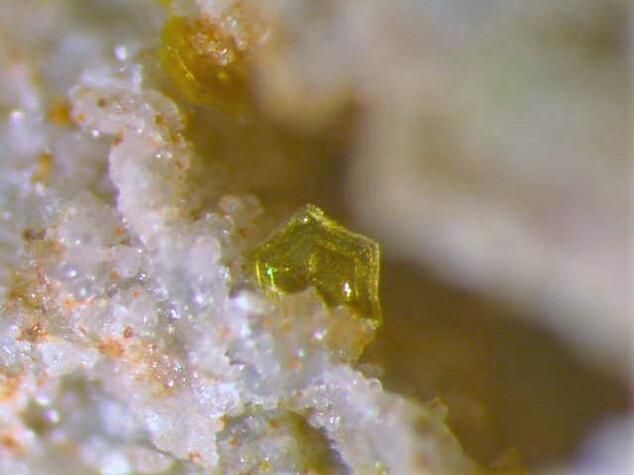
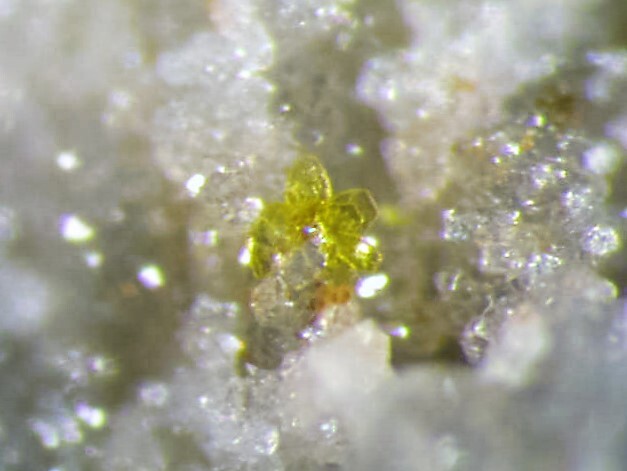
Pale yellow to pale orange-yellow
Lustre:
Vitreous
Hardness:
3 - 4
Specific Gravity:
3.41 (Calculated)
Crystal System:
Trigonal
Name:
Named by A.C. Roberts et al. in 1996 in honor of Joseph F. Leising (1949-), geologist and mineral collector of Reno, Nevada, USA, who helped collect the first known specimens.
Type Locality:
Unique Identifiers
Mindat ID:
7151
Long-form identifier:
mindat:1:1:7151:8
IMA Classification of Leisingite
Approved
First published:
1996
Approval history:
redefinition confirmed within the IMA Newsletter no. 52
Classification of Leisingite
4.FL.65
4 : OXIDES (Hydroxides, V[5,6] vanadates, arsenites, antimonites, bismuthites, sulfites, selenites, tellurites, iodates)
F : Hydroxides (without V or U)
L : Hydroxides with H2O +- (OH); sheets of edge-sharing octahedra
4 : OXIDES (Hydroxides, V[5,6] vanadates, arsenites, antimonites, bismuthites, sulfites, selenites, tellurites, iodates)
F : Hydroxides (without V or U)
L : Hydroxides with H2O +- (OH); sheets of edge-sharing octahedra
Mineral Symbols
As of 2021 there are now IMA–CNMNC approved mineral symbols (abbreviations) for each mineral species, useful for tables and diagrams.
| Symbol | Source | Reference |
|---|---|---|
| Lei | IMA–CNMNC | Warr, L.N. (2021). IMA–CNMNC approved mineral symbols. Mineralogical Magazine, 85(3), 291-320. doi:10.1180/mgm.2021.43 |
Physical Properties of Leisingite
Vitreous
Transparency:
Transparent, Translucent
Comment:
somewhat satiny to frosted
Colour:
Pale yellow to pale orange-yellow
Streak:
Pale yellow
Hardness:
3 - 4 on Mohs scale
Tenacity:
Brittle
Cleavage:
Perfect
{001}
{001}
Fracture:
Irregular/Uneven
Comment:
somewhat flexible
Density:
3.41 g/cm3 (Calculated)
Optical Data of Leisingite
Type:
Uniaxial (-)
RI values:
nω = 1.803 nε = 1.581
Max. Birefringence:
δ = 0.222
Based on recorded range of RI values above.
Based on recorded range of RI values above.
Interference Colours:
The colours simulate birefringence patterns seen in thin section under crossed polars. They do not take into account mineral colouration or opacity.
Michel-Levy Bar The default colours simulate the birefringence range for a 30 µm thin-section thickness. Adjust the slider to simulate a different thickness.
Grain Simulation You can rotate the grain simulation to show how this range might look as you rotated a sample under crossed polars.
The colours simulate birefringence patterns seen in thin section under crossed polars. They do not take into account mineral colouration or opacity.
Michel-Levy Bar The default colours simulate the birefringence range for a 30 µm thin-section thickness. Adjust the slider to simulate a different thickness.
Grain Simulation You can rotate the grain simulation to show how this range might look as you rotated a sample under crossed polars.
Surface Relief:
Moderate
Chemistry of Leisingite
Mindat Formula:
Cu2MgTe6+O6 · 6H2O
the "Mindat formula" is correct, as supported by the 2019 IMA redefinition
the "Mindat formula" is correct, as supported by the 2019 IMA redefinition
Element Weights:
Common Impurities:
Fe
Crystallography of Leisingite
Crystal System:
Trigonal
Class (H-M):
3 - Pyramidal
Space Group:
P3
Cell Parameters:
a = 5.305(1) Å, c = 9.693(6) Å
Ratio:
a:c = 1 : 1.827
Unit Cell V:
236.2 ų
Z:
1
Morphology:
{001} is the major form and {100} and {110} are minute forms
Crystal Structure
Load
Unit Cell | Unit Cell Packed
2x2x2 | 3x3x3 | 4x4x4
Unit Cell | Unit Cell Packed
2x2x2 | 3x3x3 | 4x4x4
Show
Big Balls | Small Balls | Just Balls | Spacefill
Polyhedra Off | Si Polyhedra | All Polyhedra
Remove metal-metal sticks
Big Balls | Small Balls | Just Balls | Spacefill
Polyhedra Off | Si Polyhedra | All Polyhedra
Remove metal-metal sticks
Display Options
Black Background | White Background
Perspective On | Perspective Off
2D | Stereo | Red-Blue | Red-Cyan
Black Background | White Background
Perspective On | Perspective Off
2D | Stereo | Red-Blue | Red-Cyan
View
CIF File Best | x | y | z | a | b | c
CIF File Best | x | y | z | a | b | c
Rotation
Stop | Start
Stop | Start
Labels
Console Off | On | Grey | Yellow
Console Off | On | Grey | Yellow
Data courtesy of the American Mineralogist Crystal Structure Database. Click on an AMCSD ID to view structure
| ID | Species | Reference | Link | Year | Locality | Pressure (GPa) | Temp (K) |
|---|---|---|---|---|---|---|---|
| 0005525 | Leisingite | Margison S M, Grice J D, Groat L A (1997) The crystal structure of leisingite, (Cu,Mg,Zn)2(Mg,Fe)TeO6.6H2O The Canadian Mineralogist 35 759-763 |  | 1997 | 0 | 293 |
CIF Raw Data - click here to close
X-Ray Powder Diffraction
Powder Diffraction Data:
| d-spacing | Intensity |
|---|---|
| 9.70 Å | (100) |
| 4.834 Å | (80) |
| 4.604 Å | (60) |
| 2.655 Å | (60) |
| 2.556 Å | (70) |
| 2.326 Å | (70) |
Geological Environment
Paragenetic Mode(s):
| Paragenetic Mode | Earliest Age (Ga) |
|---|---|
| Stage 7: Great Oxidation Event | <2.4 |
| 47a : [Near-surface hydration of prior minerals] | |
| 47e : [Vanadates, chromates, manganates] | |
| Stage 10b: Anthropogenic minerals | <10 Ka |
| 55 : Anthropogenic mine minerals |
Type Occurrence of Leisingite
General Appearance of Type Material:
isolated hexagonal-shaped very thin plates or foliated masses; rarely as clusters of crystals; individual crystals, subhedral to euhedral, are less than 0.1 mm on average
Place of Conservation of Type Material:
Canadian Geological Survey, Ottawa, Canada, 67882.
Geological Setting of Type Material:
small vugs of crumbly to drusy white to colourless quartz, within the dump material
Associated Minerals at Type Locality:
Synonyms of Leisingite
Other Language Names for Leisingite
Common Associates
Associated Minerals Based on Photo Data:
| 18 photos of Leisingite associated with Quartz | SiO2 |
| 8 photos of Leisingite associated with Eurekadumpite | (Cu,Zn)16(TeO3)2(AsO4)3Cl(OH)18 · 7H2O |
| 6 photos of Leisingite associated with Utahite | MgCu4Zn2Te6+3O14(OH)4 · 6H2O |
| 2 photos of Leisingite associated with Calcite | CaCO3 |
| 2 photos of Leisingite associated with Goethite | Fe3+O(OH) |
| 1 photo of Leisingite associated with Xocolatlite | Ca2Mn4+2(Te6+O6)2 · H2O |
| 1 photo of Leisingite associated with Pararaisaite | CuMg[Te6+O4(OH)2] · 6H2O |
| 1 photo of Leisingite associated with Mcalpineite | Cu3(Te6+O6) |
| 1 photo of Leisingite associated with Dugganite | Pb3Zn3(AsO4)2(TeO6) |
| 1 photo of Leisingite associated with Malachite | Cu2(CO3)(OH)2 |
Related Minerals - Strunz-mindat Grouping
| 4.FL. | Trébeurdenite | Fe2+2Fe3+4O2(OH)10CO3 · 3H2O |
| 4.FL. | Mariakrite | [Ca4Al2(OH)12(H2O)4][Fe2S4] |
| 4.FL.05 | Muskoxite | Mg7Fe4O13 · 10H2O |
| 4.FL.05 | Jamborite | Ni2+1-xCo3+x(OH)2-x(SO4)x · nH2O |
| 4.FL.05 | Mössbauerite | Fe3+6O4(OH)8[CO3] · 3H2O |
| 4.FL.05 | Meixnerite | Mg6Al2(OH)16(OH)2 · 4H2O |
| 4.FL.05 | Woodallite | Mg6Cr2(OH)16Cl2 · 4H2O |
| 4.FL.05 | Fougèrite | Fe2+4Fe3+2(OH)12[CO3] · 3H2O |
| 4.FL.05 | Dritsite | Li2Al4(OH)12Cl2 · 3H2O |
| 4.FL.05 | Rotemite | Ca4Cr2(OH)12Cl2 · 4H2O |
| 4.FL.05 | Iowaite | Mg6Fe3+2(OH)16Cl2 · 4H2O |
| 4.FL.10 | Hydrocalumite | Ca4Al2(OH)12(Cl,CO3,OH)2 · 4H2O |
| 4.FL.15 | Kuzelite | Ca4Al2(OH)12[SO4] · 6H2O |
| 4.FL.20 | Jianshuiite | (Mg,Mn,Ca)Mn3O7 · 3H2O |
| 4.FL.20 | Ernienickelite | NiMn3O7 · 3H2O |
| 4.FL.20 | Aurorite | Mn2+Mn4+3O7 · 3H2O |
| 4.FL.20 | Chalcophanite | ZnMn4+3O7 · 3H2O |
| 4.FL.25 | Woodruffite | Zn2+x/2(Mn4+1-xMn3+x)O2 · yH2O |
| 4.FL.30 | Asbolane | (Ni,Co)2-xMn4+(O,OH)4 · nH2O |
| 4.FL.30 va | Lampadite | Cu, Mn, O, H |
| 4.FL.35 | Buserite | Na4Mn14O27 · 21H2O |
| 4.FL.40 | Takanelite | (Mn,Ca)Mn4O9 · H2O |
| 4.FL.40 | Ranciéite | (Ca,Mn2+)0.2(Mn4+,Mn3+)O2 · 0.6H2O |
| 4.FL.45 | Birnessite | (Na,Ca)0.5(Mn4+,Mn3+)2O4 · 1.5H2O |
| 4.FL.55 | Cianciulliite | Mn(Mg,Mn)2Zn2(OH)10 · 2-4H2O |
| 4.FL.60 | Jensenite | Cu3[TeO6] · 2H2O |
| 4.FL.70 | Magnesiohongruiite-(Fe3+) | (Mg2Fe3+)Fe3+NbO7(OH) |
| 4.FL.70 | Akdalaite | Al10O14(OH)2 |
| 4.FL.75 | Cafetite | CaTi2O5 · H2O |
| 4.FL.80 | Mourite | UMo5O12(OH)10 |
| 4.FL.85 | Deloryite | Cu4(UO2)(MoO4)2(OH)6 |
| 4.FL.90 | Lagalyite | Ca2xMn1-xO2 · 1.5-2H2O |
| 4.FL.95 | Tunnerite (of Cornu) | |
| 4.FL.100 | Carbocalumite | Ca4Al2(OH)12(CO3) · 6H2O |
| 4.FL.100 | Mampsisite | Ca4Al2(CO3)(OH)12 · 5H2O |
Fluorescence of Leisingite
non-fluorescent
Other Information
IR Spectrum:
[cm-1]: 3253 (structural water with an O-H stretching frequency), 1670 (H-O-H flexing frequency)
Health Risks:
No information on health risks for this material has been entered into the database. You should always treat mineral specimens with care.
Internet Links for Leisingite
mindat.org URL:
https://www.mindat.org/min-7151.html
Please feel free to link to this page.
Please feel free to link to this page.
Search Engines:
External Links:
References for Leisingite
Reference List:
Roberts, Andrew C., Groat, Lee A., Grice, Joel D., Gault, Robert A., Jensen, Martin C., Moffatt, Elizabeth A., Stirling, John A. R. (1996) Leisingite, Cu(Mg,Cu,Fe,Zn)2Te6+O6·6H2O, a new mineral species from the Centennial Eureka mine, Juab County, Utah. Mineralogical Magazine, 60 (401) 653-657 doi:10.1180/minmag.1996.060.401.11
Margison, S. M., Grice, J. D., Groat, L. A. (1997) The crystal structure of leisingite, (Cu2+,Mg,Zn)2(Mg,Fe)Te6+O6·6H2O. The Canadian Mineralogist, 35 (3) 759-763
Jambor, John L., Roberts, Andrew C. (1998) New mineral names. American Mineralogist, 83 (3-4) 400-403
Localities for Leisingite
 symbol to view information about a locality.
The
symbol to view information about a locality.
The Locality List
 - This locality has map coordinates listed.
- This locality has estimated coordinates.
ⓘ - Click for references and further information on this occurrence.
? - Indicates mineral may be doubtful at this locality.
- This locality has map coordinates listed.
- This locality has estimated coordinates.
ⓘ - Click for references and further information on this occurrence.
? - Indicates mineral may be doubtful at this locality.
 - Good crystals or important locality for species.
 - World class for species or very significant.
(TL) - Type Locality for a valid mineral species.
(FRL) - First Recorded Locality for everything else (eg varieties).
- World class for species or very significant.
(TL) - Type Locality for a valid mineral species.
(FRL) - First Recorded Locality for everything else (eg varieties).
All localities listed without proper references should be considered as questionable.
Mongolia | |
| Davaasuren et al. (2016) |
USA | |
| Kampf et al. (2022) |
| Collected by and in the collection of ... |
| Collected by and in the collection of ... | |
| Roberts et al. (1996) |
Quick NavTopAbout LeisingiteUnique IdentifiersIMA Classification Classification Mineral SymbolsPhysical Properties Optical Data Chemistry Crystallography Crystal StructureX-Ray Powder DiffractionGeological EnvironmentType Occurrence SynonymsOther LanguagesCommon AssociatesStrunz-MindatFluorescence Other InformationInternet Links References Localities Locality List
Centennial Eureka Mine, Eureka, Juab County, Utah, USA