Malachite
A valid IMA mineral species - grandfathered
This page kindly sponsored by Christine Iacobuzio-Donahue


About Malachite
Formula:
Cu2(CO3)(OH)2
Colour:
Bright green, with crystals deeper shades of green, even very dark to nearly black; green to yellowish green in transmitted light.
Lustre:
Silky, Earthy
Hardness:
3½ - 4
Specific Gravity:
3.6 - 4.05
Crystal System:
Monoclinic
Member of:
Name:
Named "molochitus" in antiquity (see Pliny the Elder, 79 CE) after the Greek μαλαχή ("malachí"), "mallows," in allusion to the green colour of the leaves. Known in the new spelling, "malachites", at least by 1661.
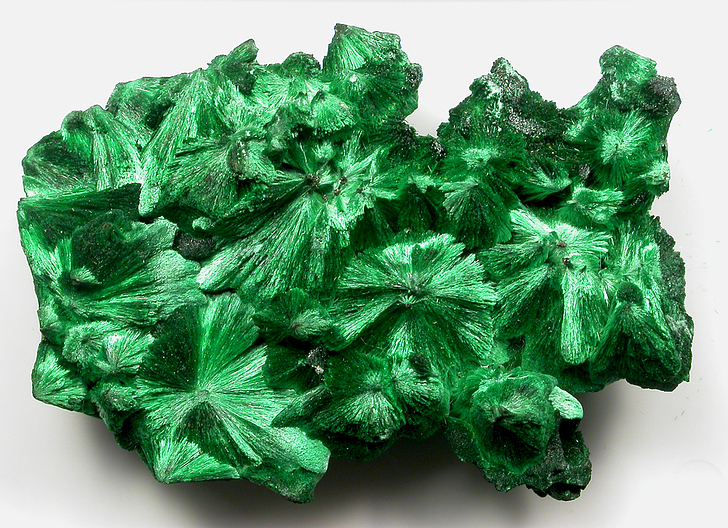
Malachite is a green, very common secondary copper mineral with a widely variable habit. Typically, it is found as crystalline aggregates or crusts, often banded in appearance, like agates. It is also frequently found as botryoidal clusters of radiating crystals, and as mammillary aggregates as well. Single crystals and clusters of distinguishable crystals are uncommon, but when found they are typically acicular to prismatic. It is also frequently found as a pseudomorph after azurite crystals, which are generally more tabular.
The Cu analogue of chukanovite. Structurally related to the Rosasite Group.
The crystal structure of malachite is stabilized by a high degree of [CuO6]-octahedron distortion, as is manifested by large variations in Cu–O bond lengths resulting from oxygen atoms that connect to hydrogen at crystallographically different sites. External pressure offsets the effect of hydrogen bond, promotes [CuO6] compression and regularization and accordingly [CO3] rotation. Rotation of [CO3]-triangles, in turn, assists in a conversion in the crystal orientation of the [CuO6] structural unit. During compression to above ~6 GPa, malachite begins to turn into the rosasite lattice, accompanied with a jump in density of 3.3%. Rosasite is characterized with a hardened lattice and preserves to the maximum pressure (18.2 GPa).
 Visit gemdat.org for gemological information about Malachite.
The Cu analogue of chukanovite. Structurally related to the Rosasite Group.
The crystal structure of malachite is stabilized by a high degree of [CuO6]-octahedron distortion, as is manifested by large variations in Cu–O bond lengths resulting from oxygen atoms that connect to hydrogen at crystallographically different sites. External pressure offsets the effect of hydrogen bond, promotes [CuO6] compression and regularization and accordingly [CO3] rotation. Rotation of [CO3]-triangles, in turn, assists in a conversion in the crystal orientation of the [CuO6] structural unit. During compression to above ~6 GPa, malachite begins to turn into the rosasite lattice, accompanied with a jump in density of 3.3%. Rosasite is characterized with a hardened lattice and preserves to the maximum pressure (18.2 GPa).
Visit gemdat.org for gemological information about Malachite.Unique Identifiers
Mindat ID:
2550
Long-form identifier:
mindat:1:1:2550:4
IMA Classification of Malachite
Approved, 'Grandfathered' (first described prior to 1959)
Classification of Malachite
5.BA.10
5 : CARBONATES (NITRATES)
B : Carbonates with additional anions, without H2O
A : With Cu, Co, Ni, Zn, Mg, Mn
5 : CARBONATES (NITRATES)
B : Carbonates with additional anions, without H2O
A : With Cu, Co, Ni, Zn, Mg, Mn
Dana 7th ed.:
16.3.2.1
16a.3.1.1
16a : ANHYDROUS CARBONATES CONTAINING HYDROXYL OR HALOGEN
3 : (AB)2(XO3)Zq
16a : ANHYDROUS CARBONATES CONTAINING HYDROXYL OR HALOGEN
3 : (AB)2(XO3)Zq
11.2.1
11 : Carbonates
2 : Carbonates of Cu
11 : Carbonates
2 : Carbonates of Cu
Mineral Symbols
As of 2021 there are now IMA–CNMNC approved mineral symbols (abbreviations) for each mineral species, useful for tables and diagrams.
Please only use the official IMA–CNMNC symbol. Older variants are listed for historical use only.
Please only use the official IMA–CNMNC symbol. Older variants are listed for historical use only.
| Symbol | Source | Reference |
|---|---|---|
| Mlc | IMA–CNMNC | Warr, L.N. (2021). IMA–CNMNC approved mineral symbols. Mineralogical Magazine, 85(3), 291-320. doi:10.1180/mgm.2021.43 |
| Mlc | Whitney & Evans (2010) | Whitney, D.L. and Evans, B.W. (2010) Abbreviations for names of rock-forming minerals. American Mineralogist, 95, 185–187 doi:10.2138/am.2010.3371 |
| Mal | The Canadian Mineralogist (2019) | The Canadian Mineralogist (2019) The Canadian Mineralogist list of symbols for rock- and ore-forming minerals (December 30, 2019). download |
Physical Properties of Malachite
Silky, Earthy
Transparency:
Opaque
Colour:
Bright green, with crystals deeper shades of green, even very dark to nearly black; green to yellowish green in transmitted light.
Streak:
Light green
Hardness:
3½ - 4 on Mohs scale
Hardness Data:
Measured
Tenacity:
Brittle
Cleavage:
Perfect
Perfect on {201}, fair on {010}.
Perfect on {201}, fair on {010}.
Fracture:
Splintery
Density:
3.6 - 4.05 g/cm3 (Measured) 4 g/cm3 (Calculated)
Optical Data of Malachite
Type:
Biaxial (-)
RI values:
nα = 1.655 nβ = 1.875 nγ = 1.909
2V:
Measured: 43° , Calculated: 38°
Max. Birefringence:
δ = 0.254
Based on recorded range of RI values above.
Based on recorded range of RI values above.
Interference Colours:
The colours simulate birefringence patterns seen in thin section under crossed polars. They do not take into account mineral colouration or opacity.
Michel-Levy Bar The default colours simulate the birefringence range for a 30 µm thin-section thickness. Adjust the slider to simulate a different thickness.
Grain Simulation You can rotate the grain simulation to show how this range might look as you rotated a sample under crossed polars.
The colours simulate birefringence patterns seen in thin section under crossed polars. They do not take into account mineral colouration or opacity.
Michel-Levy Bar The default colours simulate the birefringence range for a 30 µm thin-section thickness. Adjust the slider to simulate a different thickness.
Grain Simulation You can rotate the grain simulation to show how this range might look as you rotated a sample under crossed polars.
Surface Relief:
Moderate
Dispersion:
relatively weak
Optical Extinction:
Y = b; X ∧ c = 23.5°.
Pleochroism:
Visible
Comments:
X = nearly colorless; Y = yellowish green; Z = deep green.
Chemistry of Malachite
Mindat Formula:
Cu2(CO3)(OH)2
Element Weights:
Elements listed:
Common Impurities:
Zn,Co,Ni
Crystallography of Malachite
Crystal System:
Monoclinic
Class (H-M):
2/m - Prismatic
Space Group:
P21/b
Setting:
P21/a
Cell Parameters:
a = 9.502 Å, b = 11.974 Å, c = 3.240 Å
β = 98.75°
β = 98.75°
Ratio:
a:b:c = 0.794 : 1 : 0.271
Unit Cell V:
364.35 ų (Calculated from Unit Cell)
Z:
4
Morphology:
Crystals uncommon, usually short or long prismatic or acicular, parallel to [001]; often grouped in rosettes, sprays, or tufts. Botryoidal to mammillary aggregates of radiating fibrous crystals more common. It may also be massive, compact, and stalactitic. Very rarely as curls.
Twinning:
Untwinned crystals are extremely rare. Typically twinned on {100}, sometimes as penetration or polysynthetic twinning with the axis parallel to [201].
Crystallographic forms of Malachite
Crystal Atlas:
Image Loading
Click on an icon to view

Malachite no.17 - Goldschmidt (1913-1926)
Malachite no.20 - Goldschmidt (1913-1926)
3d models and HTML5 code kindly provided by
www.smorf.nl.
Toggle
Edge Lines | Miller Indices | Axes
Transparency
Opaque | Translucent | Transparent
View
Along a-axis | Along b-axis | Along c-axis | Start rotation | Stop rotation
Toggle
Edge Lines | Miller Indices | Axes
Transparency
Opaque | Translucent | Transparent
View
Along a-axis | Along b-axis | Along c-axis | Start rotation | Stop rotation
Crystal Structure
Load
Unit Cell | Unit Cell Packed
2x2x2 | 3x3x3 | 4x4x4
Unit Cell | Unit Cell Packed
2x2x2 | 3x3x3 | 4x4x4
Show
Big Balls | Small Balls | Just Balls | Spacefill
Polyhedra Off | Si Polyhedra | All Polyhedra
Remove metal-metal sticks
Big Balls | Small Balls | Just Balls | Spacefill
Polyhedra Off | Si Polyhedra | All Polyhedra
Remove metal-metal sticks
Display Options
Black Background | White Background
Perspective On | Perspective Off
2D | Stereo | Red-Blue | Red-Cyan
Black Background | White Background
Perspective On | Perspective Off
2D | Stereo | Red-Blue | Red-Cyan
View
CIF File Best | x | y | z | a | b | c
CIF File Best | x | y | z | a | b | c
Rotation
Stop | Start
Stop | Start
Labels
Console Off | On | Grey | Yellow
Console Off | On | Grey | Yellow
Data courtesy of the American Mineralogist Crystal Structure Database. Click on an AMCSD ID to view structure
| ID | Species | Reference | Link | Year | Locality | Pressure (GPa) | Temp (K) |
|---|---|---|---|---|---|---|---|
| 0009305 | Malachite | Susse P (1967) Verfeinerung der kristallstruktur des malachits, Cu2(OH)2CO3 Acta Crystallographica 22 146-151 |  | 1967 | 0 | 293 | |
| 0010795 | Malachite | Zigan F, Joswig W, Schuster H U, Mason S A (1977) Verfeinerung der Struktur von Malachit, Cu2(OH)2CO3, durch Neutronenbeugung Zeitschrift fur Kristallographie 145 412-426 | 1977 | 0 | 293 |
CIF Raw Data - click here to close
X-Ray Powder Diffraction
Loading XRD data...
Data courtesy of RRUFF project at University of Arizona, used with permission.
Powder Diffraction Data:
| d-spacing | Intensity |
|---|---|
| 5.99 Å | (60) |
| 5.06 Å | (80) |
| 3.69 Å | (90) |
| 2.86 Å | (100) |
| 2.82 Å | (40) |
| 2.78 Å | (50) |
| 2.52 Å | (60) |
| 2.46 Å | (40) |
Comments:
Data given are for synthetic material.
Geological Environment
Paragenetic Mode(s):
| Paragenetic Mode | Earliest Age (Ga) |
|---|---|
| Stage 7: Great Oxidation Event | <2.4 |
| 47a : [Near-surface hydration of prior minerals] | |
| 47c : [Carbonates, phosphates, borates, nitrates] | |
| Stage 10a: Neoproterozoic oxygenation/terrestrial biosphere | <0.6 |
| 53 : Other minerals with taphonomic origins | <0.4 |
Geological Setting:
It is the most common secondary mineral found in the oxidized zones of copper deposits.
Synonyms of Malachite
Other Language Names for Malachite
Arabic:الملكيت (ālmalakīt)
Basque:Malakita
Bosnian:Malahit
Breton:Malakit
Catalan:Malaquita
Czech:Malachit
Dutch:Malachiet
Esperanto:Malakito
Estonian:Malahhiit
Finnish:Malakiitti
Galician:Malaquita
German:Malachit
Grünkupfer
Malakhit
Molochit
Berggrün (in part)
Grünkupfer
Malakhit
Molochit
Berggrün (in part)
Hebrew:מלכיט
Hindi:ताप्रांगीयिज
Hungarian:Malachit
Japanese:孔雀石
Korean:공작석
Latin:Malachites
Ærugo nativa
Viride montanum (in part)
Ærugo nativa
Viride montanum (in part)
Lithuanian:Malachitas
Polish:Malachit
Portuguese:Malaquite
Romanian:Malachit
Russian:Малахит
Simplified Chinese:孔雀石
Slovak:Malachit
Slovenian:Malahit
Swedish:Malakit
Bärggrönt
Koppargrön
Bärggrönt
Koppargrön
Thai:มาลาไคต์
Traditional Chinese:孔雀石
Turkish:Malahit
Ukrainian:Малахіт
Vietnamese:Malachit
Varieties of Malachite
| Atlaserz | The German name for a fibrous variety of malachite. |
| Lime-Malachite | Probably an impure calcium-bearing malachite. |
| Lockenmalachit | A curl-shaped variety of malachite. |
| Mysorin | An impure Malachite. |
| Zinc-bearing Malachite | A Zn-bearing variety of malachite with Cu:Zn greater than 4:1. Can be distinguished from the visually similar rosasite by X-ray diffraction. |
Relationship of Malachite to other Species
Member of:
Other Members of Malachite-Rosasite Group:
| Chukanovite | Fe2+2(CO3)(OH)2 | Mon. 2/m : P21/b |
| Glaukosphaerite | (Cu,Ni)2(CO3)(OH)2 | Mon. 2/m : P21/b |
| Kolwezite | CuCo(CO3)(OH)2 | Tric. |
| Mcguinnessite | (Mg,Cu)2(CO3)(OH)2 | Mon. 2/m |
| Nullaginite | Ni2(CO3)(OH)2 | Mon. 2/m : P21/b |
| Parádsasvárite | Zn2(CO3)(OH)2 | Mon. 2/m : P21/b |
| Perchiazziite | Co2(CO3)(OH)2 | Mon. 2/m : P21/b |
| Pokrovskite | Mg2(CO3)(OH)2 | Mon. 2/m : P21/b |
| Rosasite | (Cu,Zn)2(CO3)(OH)2 | Mon. 2/m : P21/b |
| Zincrosasite | (Zn,Cu)2(CO3)(OH)2 | Mon. |
Common Associates
Associated Minerals Based on Photo Data:
| 8,935 photos of Malachite associated with Azurite | Cu3(CO3)2(OH)2 |
| 2,640 photos of Malachite associated with Quartz | SiO2 |
| 2,009 photos of Malachite associated with Chrysocolla | Cu2-xAlx(H2-xSi2O5)(OH)4 · nH2O, x < 1 |
| 1,829 photos of Malachite associated with Calcite | CaCO3 |
| 1,747 photos of Malachite associated with Cuprite | Cu2O |
| 1,385 photos of Malachite associated with Cerussite | PbCO3 |
| 1,061 photos of Malachite associated with Native Copper | Cu |
| 732 photos of Malachite associated with Baryte | BaSO4 |
| 715 photos of Malachite associated with Goethite | Fe3+O(OH) |
| 645 photos of Malachite associated with Chalcopyrite | CuFeS2 |
Related Minerals - Strunz-mindat Grouping
| 5.BA.05 | Azurite | Cu3(CO3)2(OH)2 |
| 5.BA.10 | Mcguinnessite | (Mg,Cu)2(CO3)(OH)2 |
| 5.BA.10 | Zincrosasite | (Zn,Cu)2(CO3)(OH)2 |
| 5.BA.10 | Parádsasvárite | Zn2(CO3)(OH)2 |
| 5.BA.10 | Rosasite | (Cu,Zn)2(CO3)(OH)2 |
| 5.BA.10 | Nullaginite | Ni2(CO3)(OH)2 |
| 5.BA.10 | Georgeite | [Cu(OH)2-x(H2O)x][CO3]x/2 |
| 5.BA.10 | Glaukosphaerite | (Cu,Ni)2(CO3)(OH)2 |
| 5.BA.10 | Pokrovskite | Mg2(CO3)(OH)2 |
| 5.BA.10 | Kolwezite | CuCo(CO3)(OH)2 |
| 5.BA.10 | Chukanovite | Fe2+2(CO3)(OH)2 |
| 5.BA.10 | Perchiazziite | Co2(CO3)(OH)2 |
| 5.BA.15 | Aurichalcite | (Zn,Cu)5(CO3)2(OH)6 |
| 5.BA.15 | Hydrozincite | Zn5(CO3)2(OH)6 |
| 5.BA.20 | Holdawayite | Mn6(CO3)2(OH)7(Cl,OH) |
| 5.BA.25 | UM1977-03-COSiO:CaClH | Ca10-11(CO3)7(SiO4)Cl1-2(OH)1-2 |
| 5.BA.25 | Defernite | Ca6(CO3)1.58(Si2O7)0.21(OH)7[Cl0.50(OH)0.08(H2O)0.42] |
| 5.BA.30 | Sclarite | Zn7(CO3)2(OH)10 |
| 5.BA.30 | Loseyite | (Mn2+,Zn,Mg)4Zn3(CO3)2(OH)10 |
Other Information
Thermal Behaviour:
Loses water at about 315°, leaving tenorite.
Notes:
Readily soluble in dilute acids. Very slightly soluble in water containing CO2.
Frequently found as pseudomorphs after azurite, or as alteration pseudomorphs after cuprite. Less frequently occurs as pseudomorphs after atacamite, brochantite, chalcopyrite, tetrahedrite, chalcophyllite, gypsum, libethenite, calcite, sphalerite, cerussite, and pyrite.
Rarely found altered to azurite or cuprite.
Frequently found as pseudomorphs after azurite, or as alteration pseudomorphs after cuprite. Less frequently occurs as pseudomorphs after atacamite, brochantite, chalcopyrite, tetrahedrite, chalcophyllite, gypsum, libethenite, calcite, sphalerite, cerussite, and pyrite.
Rarely found altered to azurite or cuprite.
Health Risks:
No information on health risks for this material has been entered into the database. You should always treat mineral specimens with care.
Industrial Uses:
A minor ore of copper when abundant enough in a copper deposit.
Malachite in petrology
An essential component of rock names highlighted in red, an accessory component in rock names highlighted in green.
Internet Links for Malachite
mindat.org URL:
https://www.mindat.org/min-2550.html
Please feel free to link to this page.
Please feel free to link to this page.
Search Engines:
External Links:
References for Malachite
Reference List:
Thomson, Thomas (1836) Outlines of Mineralogy, Geology and Mineral Analysis Vol. 1. Baldwin & Craddock. 734 pp.p.601 - as Mysorin
Maskelyne, N. S., von Lang, Viktor (1863) LX. Mineralogical notes. The London, Edinburgh, And Dublin Philosophical Magazine And Journal Of Science, S. 4 Vol. 25 (170) 432-453 doi:10.1080/14786446308643489pp.432-435 - "On the crystalline form and the optical properties of malachite"
Maskelyne, N. S., von Lang, Viktor (1864) LXII. Mineralogical notes. The London, Edinburgh, And Dublin Philosophical Magazine And Journal Of Science, S. 4 Vol. 28 (192) 502-508 doi:10.1080/14786446408643807pp.502-505 - "On the crystalline form of malachite"
Ramsdell, Lewis S., Wolfe, C. Wroe (1950) The unit cell of malachite. American Mineralogist, 35 (1-2) 119-120
Wells, A. F. (1951) Malachite: re-examination of crystal structure. Acta Crystallographica, 4 (3) 200-204 doi:10.1107/s0365110x51000714
Simpson, Dale R., Fisher, Richard, Libsch, Karl (1964) Mineralogical Notes: Thermal stability of azurite and malachite. American Mineralogist, 49 (7-8) 1111-1113
Süsse, P. (1967) Verfeinerung der Kristallstruktur des Malachits, Cu2(OH)2CO3. Acta Crystallographica, 22 (1) 146-151 doi:10.1107/s0365110x67000222
Goldsmith, J.A., Ross, S.D. (1968) The infra-red spectra of azurite and malachite. Spectrochimica Acta Part A: Molecular Spectroscopy, 24 (12). 2131-2137 doi:10.1016/0584-8539(68)80273-9
Zigan, F., Joswig, W., Schuster, H. D., Mason, S. A. (1977) Verfeinerung der Struktur von Malachit, Cu2(OH)2CO3, durch Neutronenbeugung. Zeitschrift für Kristallographie - Crystalline Materials, 145 (5-6) 412 doi:10.1524/zkri.1977.145.5-6.412
Symes, James L, Kester, Dana R (1984) Thermodynamic stability studies of the basic copper carbonate mineral, malachite. Geochimica et Cosmochimica Acta, 48 (11) 2219-2229 doi:10.1016/0016-7037(84)90218-7
Kiseleva, I.A.; Ogorodova, L.P.; Melchakova, L.V.; Bisengalieva, M.R.; Becturganov, N.S. (1992) Thermodynamic properties of copper carbonates - malachite Cu2(OH)2CO3 and azurite Cu3(OH)2(CO3)2. Physics and Chemistry of Minerals, 19 (5). 322-333 doi:10.1007/bf00204009
Frost, R. L., Martens, W. N., Rintoul, L., Mahmutagic, E., Kloprogge, J. T. (2002) Raman spectroscopic study of azurite and malachite at 298 and 77 K. Journal of Raman Spectroscopy, 33 (4). 252-259 doi:10.1002/jrs.848
Girgsdies, Frank, Behrens, Malte (2012) On the structural relations of malachite. II. The brochantite MDO polytypes. Acta Crystallographica Section B Structural Science, 68 (6) 571-577 doi:10.1107/s0108768112039274
Anthony, John W., Bideaux, Richard A., Bladh, Kenneth W., Nichols, Monte C. - Eds. (2016) Handbook of Mineralogy. https://www.handbookofmineralogy.org/
Makovicky, Emil, Merlino, Stefano (2019) Order-disorder Twinning of Malachite. The Canadian Mineralogist, 57 (4) 475-488 doi:10.3749/canmin.1900007
[1]Gao, Jing, Yuan, Xueyin, Chen, Bin, Liu, Zhenxian, Su, Wen (2021) High-pressure phase transformation of carbonate malachite Cu2(CO3)(OH)2 driven by [CuO6] regularization and [CO3] rotation. Geoscience Frontiers, 12 (2) 965-973 doi:10.1016/j.gsf.2020.07.006
Significant localities for Malachite
Showing 22 significant localities out of 15,072 recorded on mindat.org.
 symbol to view information about a locality.
The
symbol to view information about a locality.
The Locality List
 - This locality has map coordinates listed.
- This locality has estimated coordinates.
ⓘ - Click for references and further information on this occurrence.
? - Indicates mineral may be doubtful at this locality.
- This locality has map coordinates listed.
- This locality has estimated coordinates.
ⓘ - Click for references and further information on this occurrence.
? - Indicates mineral may be doubtful at this locality.
 - Good crystals or important locality for species.
 - World class for species or very significant.
(TL) - Type Locality for a valid mineral species.
(FRL) - First Recorded Locality for everything else (eg varieties).
- World class for species or very significant.
(TL) - Type Locality for a valid mineral species.
(FRL) - First Recorded Locality for everything else (eg varieties).
All localities listed without proper references should be considered as questionable.
Australia | |
| Noble et al. (1983) +1 other reference |
Austria | |
| Meixner et al. (1975) +1 other reference |
| - (1994, July) |
Bolivia | |
| Petrov (n.d.) |
Canada | |
| |
DR Congo | |
| Lhoest (1992) +1 other reference |
| |
| - (2022) +2 other references |
Germany | |
| www.alterbergbau.de |
| Markus Gerstmann - Collection +1 other reference |
| Markus Gerstmann - Collection | |
Ireland | |
| Morrissey (1970) +2 other references |
Mexico | |
| Valencia et al. (2006) +2 other references |
Namibia | |
| Graham et al. (2007) +1 other reference |
| Palache et al. (1951) +1 other reference |
Russia | |
| Kievlenko E.V. (1983) |
USA | |
| Galbraith et al. (1959) |
| Dana 6:1093 +9 other references |
| Heinrich et al. (2004) +1 other reference |
| A. Plante collection +3 other references |
| Walstrom (n.d.) +1 other reference |
| - (2005) |
Quick NavTopAbout MalachiteUnique IdentifiersIMA Classification Classification Mineral SymbolsPhysical Properties Optical Data Chemistry Crystallography Crystallographic forms Crystal StructureX-Ray Powder DiffractionGeological EnvironmentSynonymsOther LanguagesVarietiesRelationshipsCommon AssociatesStrunz-MindatOther InformationMalachite in petrologyInternet Links References Significant localities Locality List
Mashamba West Mine, Sicomines copper-cobalt project, Mutshatsha, Lualaba, DR Congo