Tazheranite
A valid IMA mineral species
This page is currently not sponsored. Click here to sponsor this page.
About Tazheranite

Formula:
(Zr,Ti,Ca)(O,◻)2
Colour:
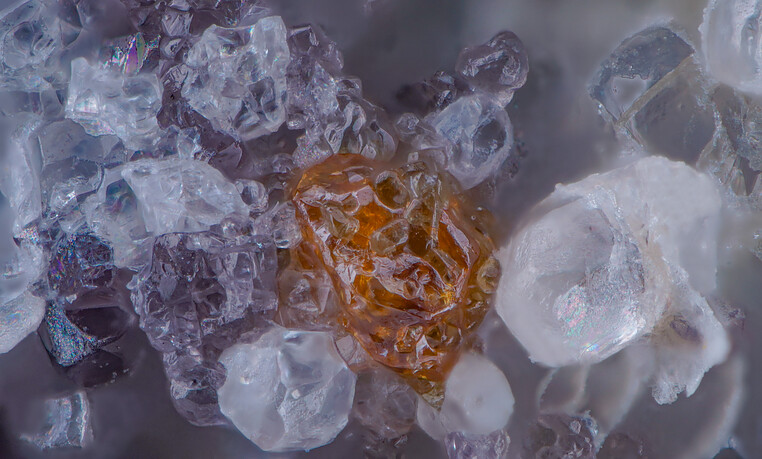
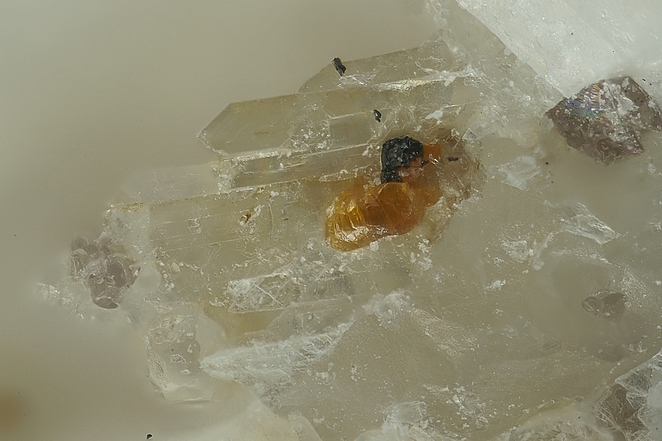
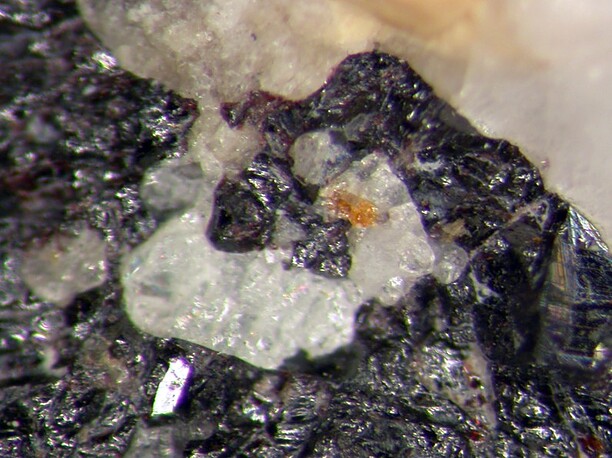
Yellowish orange to reddish orange, rarely cherry-red, then zoned, brownish green
Lustre:
Adamantine, Greasy
Hardness:
7½
Specific Gravity:
5.01
Crystal System:
Isometric
Member of:
Name:
Named after its discovery locality, Tazheran (Tazheranskii) alkaline complex, Baikal Alkaline Province, Russia.
Type Locality:
Compare also baddeleyite.
According to initial description Ti in Tazheranite is trivalent in difference from Zirkelite.
Possibly the natural form of 'cubic zirconia', although usually greatly impure compared to the synthetic gemstone.
A mineral with the name 'arkelite' was reported as isometric ZrO2 inclusions in zircon crystals. This is now regarded as synonymous with Tazheranite (Burke, 1989)
According to initial description Ti in Tazheranite is trivalent in difference from Zirkelite.
Possibly the natural form of 'cubic zirconia', although usually greatly impure compared to the synthetic gemstone.
A mineral with the name 'arkelite' was reported as isometric ZrO2 inclusions in zircon crystals. This is now regarded as synonymous with Tazheranite (Burke, 1989)
Unique Identifiers
Mindat ID:
3897
Long-form identifier:
mindat:1:1:3897:9
IMA Classification of Tazheranite
Approved
Approval year:
1969
Classification of Tazheranite
4.DL.10
4 : OXIDES (Hydroxides, V[5,6] vanadates, arsenites, antimonites, bismuthites, sulfites, selenites, tellurites, iodates)
D : Metal: Oxygen = 1:2 and similar
L : With large (+- medium-sized) cations; fluorite-type structures
4 : OXIDES (Hydroxides, V[5,6] vanadates, arsenites, antimonites, bismuthites, sulfites, selenites, tellurites, iodates)
D : Metal: Oxygen = 1:2 and similar
L : With large (+- medium-sized) cations; fluorite-type structures
4.4.13.1
4 : SIMPLE OXIDES
4 : AX2
4 : SIMPLE OXIDES
4 : AX2
7.10.7
7 : Oxides and Hydroxides
10 : Oxides of Zr and Th
7 : Oxides and Hydroxides
10 : Oxides of Zr and Th
Mineral Symbols
As of 2021 there are now IMA–CNMNC approved mineral symbols (abbreviations) for each mineral species, useful for tables and diagrams.
| Symbol | Source | Reference |
|---|---|---|
| Taz | IMA–CNMNC | Warr, L.N. (2021). IMA–CNMNC approved mineral symbols. Mineralogical Magazine, 85(3), 291-320. doi:10.1180/mgm.2021.43 |
Physical Properties of Tazheranite
Adamantine, Greasy
Transparency:
Translucent
Comment:
greasy on fractures.
Colour:
Yellowish orange to reddish orange, rarely cherry-red, then zoned, brownish green
Comment:
Colour of holotype mineral is very similar to mandarin
Streak:
White
Hardness:
7½ on Mohs scale
Tenacity:
Brittle
Fracture:
Conchoidal
Density:
5.01(2) g/cm3 (Measured) 4.9 g/cm3 (Calculated)
Optical Data of Tazheranite
Type:
Isotropic
RI values:
n = 2.25 - 2
Birefringence:
Isotropic minerals have no birefringence
Surface Relief:
Very High
Anisotropism:
weak to strong anisotropism, centrally zoned.
Chemistry of Tazheranite
Mindat Formula:
(Zr,Ti,Ca)(O,◻)2
formerly given as: (Zr,Ti,Ca)O2-x
Ideal formula ZrO2, same as cubic zirconia (?)
formerly given as: (Zr,Ti,Ca)O2-x
Ideal formula ZrO2, same as cubic zirconia (?)
Elements listed:
Crystallography of Tazheranite
Crystal System:
Isometric
Class (H-M):
m3m (4/m 3 2/m) - Hexoctahedral
Cell Parameters:
a = 5.111(1) Å
Unit Cell V:
133.51 ų (Calculated from Unit Cell)
Z:
4
Comment:
Space Group: Fm3 - m.
Crystal Structure
Load
Unit Cell | Unit Cell Packed
2x2x2 | 3x3x3 | 4x4x4
Unit Cell | Unit Cell Packed
2x2x2 | 3x3x3 | 4x4x4
Show
Big Balls | Small Balls | Just Balls | Spacefill
Polyhedra Off | Si Polyhedra | All Polyhedra
Remove metal-metal sticks
Big Balls | Small Balls | Just Balls | Spacefill
Polyhedra Off | Si Polyhedra | All Polyhedra
Remove metal-metal sticks
Display Options
Black Background | White Background
Perspective On | Perspective Off
2D | Stereo | Red-Blue | Red-Cyan
Black Background | White Background
Perspective On | Perspective Off
2D | Stereo | Red-Blue | Red-Cyan
View
CIF File Best | x | y | z | a | b | c
CIF File Best | x | y | z | a | b | c
Rotation
Stop | Start
Stop | Start
Labels
Console Off | On | Grey | Yellow
Console Off | On | Grey | Yellow
Data courtesy of the American Mineralogist Crystal Structure Database. Click on an AMCSD ID to view structure
| ID | Species | Reference | Link | Year | Locality | Pressure (GPa) | Temp (K) |
|---|---|---|---|---|---|---|---|
| 0019231 | Tazheranite | Howard C J, Hill R J, Reichert B E (1988) Structures of the ZrO2 polymorphs at room temperature by high-resolution neutron powder diffraction Acta Crystallographica B44 116-120 |  | 1988 | synthetic | 0 | 293 |
| 0019232 | Tazheranite | Howard C J, Hill R J, Reichert B E (1988) Structures of the ZrO2 polymorphs at room temperature by high-resolution neutron powder diffraction Acta Crystallographica B44 116-120 | | 1988 | synthetic | 0 | 293 |
| 0019233 | Tazheranite | Howard C J, Hill R J, Reichert B E (1988) Structures of the ZrO2 polymorphs at room temperature by high-resolution neutron powder diffraction Acta Crystallographica B44 116-120 | | 1988 | synthetic | 0 | 293 |
| 0012493 | Tazheranite | Rastsvetaeva R K, Pushcharovskii D Yu, Spiridonov E M, Gekimyants V M (1998) Tazheranite and calzirtite: structural-mineralogical similarity and distinction Doklady Akademii Nauk SSSR 359 529-531 | 1998 | 0 | 293 |
CIF Raw Data - click here to close
X-Ray Powder Diffraction
Powder Diffraction Data:
| d-spacing | Intensity |
|---|---|
| 2.94 Å | (10) |
| 1.804 Å | (10) |
| 1.539 Å | (10) |
| 2.55 Å | (6) |
| 1.171 Å | (5) |
| 1.044 Å | (5) |
| 0.9828 Å | (5) |
Geological Environment
Paragenetic Mode(s):
| Paragenetic Mode | Earliest Age (Ga) |
|---|---|
| Stage 1: Primary nebular phases | 4.567-4.561 |
| 3 : Solar nebular condensates (CAIs, AOAs, URIs) | >4.565 |
| Stage 4b: Highly evolved igneous rocks | >3.0 |
| 35 : Ultra-alkali and agpaitic igneous rocks |
Geological Setting:
Magnesia skarns and carbonatites.
Type Occurrence of Tazheranite
General Appearance of Type Material:
Anhedral crystals
Place of Conservation of Type Material:
Mining Institute, St. Petersburg, 1094/1; A.E. Fersman Mineralogical Museum, Academy of Sciences, Moscow, Russia, 72602, vis5748; National Museum of Natural History, Washington, D.C., USA, 145796.
Associated Minerals at Type Locality:
Synonyms of Tazheranite
Other Language Names for Tazheranite
Relationship of Tazheranite to other Species
Member of:
Other Members of Calzirtite Group:
| Calzirtite | Ca2Zr5Ti2O16 | Tet. 4/mmm (4/m 2/m 2/m) : I41/acd |
| Hiärneite | Ca2Zr4Mn3+SbTiO16 | Tet. 4/mmm (4/m 2/m 2/m) : I41/acd |
Common Associates
Associated Minerals Based on Photo Data:
| 2 photos of Tazheranite associated with Fluorapatite | Ca5(PO4)3F |
| 1 photo of Tazheranite associated with Geikielite | MgTiO3 |
| 1 photo of Tazheranite associated with Calcite | CaCO3 |
| 1 photo of Tazheranite associated with Azoproite | (Mg,Fe2+)2(Fe3+,Ti,Mg)(BO3)O2 |
| 1 photo of Tazheranite associated with Forsterite | Mg2SiO4 |
Related Minerals - Strunz-mindat Grouping
| 4.DL. | Xianhuaite-(Ce) | K2CeNb5O15 |
| 4.DL.05 | Uraninite | UO2 |
| 4.DL.05 | Aeschynite Group | AD2O6 |
| 4.DL.05 | Zirkelite | (Ti,Ca,Zr)O2-x |
| 4.DL.05 | Thorianite | ThO2 |
| 4.DL.05 | Cerianite-(Ce) | (Ce4+,Th)O2 |
| 4.DL.10 | Hiärneite | Ca2Zr4Mn3+SbTiO16 |
| 4.DL.10 | Calzirtite | Ca2Zr5Ti2O16 |
| 4.DL.15 | Vorlanite | Ca(U6+)O4 |
Other Information
Health Risks:
No information on health risks for this material has been entered into the database. You should always treat mineral specimens with care.
Internet Links for Tazheranite
mindat.org URL:
https://www.mindat.org/min-3897.html
Please feel free to link to this page.
Please feel free to link to this page.
Search Engines:
External Links:
References for Tazheranite
Localities for Tazheranite
 symbol to view information about a locality.
The
symbol to view information about a locality.
The Locality List
 - This locality has map coordinates listed.
- This locality has estimated coordinates.
ⓘ - Click for references and further information on this occurrence.
? - Indicates mineral may be doubtful at this locality.
- This locality has map coordinates listed.
- This locality has estimated coordinates.
ⓘ - Click for references and further information on this occurrence.
? - Indicates mineral may be doubtful at this locality.
 - Good crystals or important locality for species.
 - World class for species or very significant.
(TL) - Type Locality for a valid mineral species.
(FRL) - First Recorded Locality for everything else (eg varieties).
- World class for species or very significant.
(TL) - Type Locality for a valid mineral species.
(FRL) - First Recorded Locality for everything else (eg varieties).
All localities listed without proper references should be considered as questionable.
Algeria | |
| Ma (2011) |
Brazil | |
| Oliveira et al. (2020) |
| Menezes et al. (1984) | |
Canada | |
| D. Turner and L.A. Groat (2010) +1 other reference |
Germany | |
| in the collection of Christof Schäfer |
| in the collection of Christof Schäfer | |
Italy | |
| Ma (2012) |
Kazakhstan | |
| Ivanova et al. (2012) |
Mexico | |
| Ma et al. (2009) |
Russia | |
| Galuskin (2007) |
| Kislov +1 other reference | |
| Bailau |
| Galuskina et al. (2010) | |
| Galuskina et al. (2013) | |
| Sklyarov +7 other references |
South Africa | |
| Konzett et al. (2013) |
Sweden | |
| Sandström et al. (2010) |
| Sandström et al. (2010) |
Quick NavTopAbout TazheraniteUnique IdentifiersIMA Classification Classification Mineral SymbolsPhysical Properties Optical Data Chemistry Crystallography Crystal StructureX-Ray Powder DiffractionGeological EnvironmentType Occurrence SynonymsOther LanguagesRelationshipsCommon AssociatesStrunz-MindatOther InformationInternet Links References Localities Locality List
Tazheranskii Massif, Lake Baikal area, Russia