Ruby
A variety of Corundum
This page is currently not sponsored. Click here to sponsor this page.
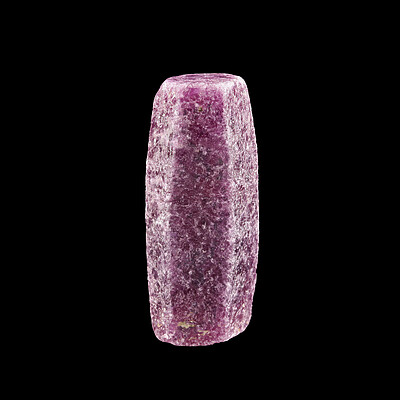
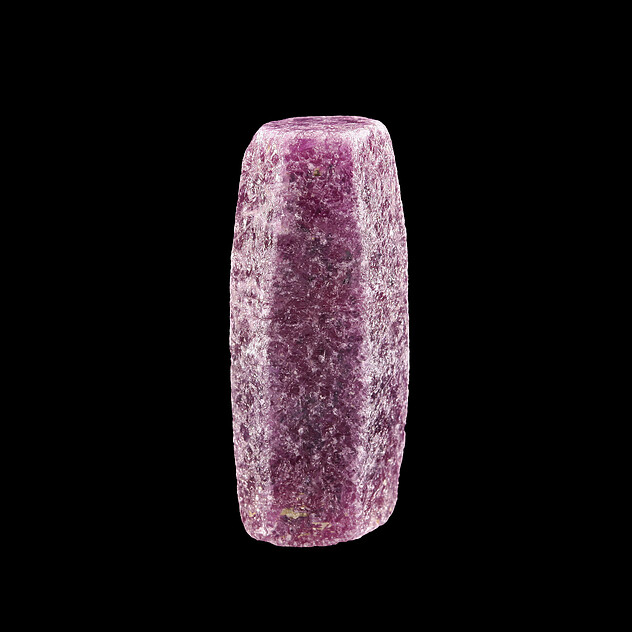
About Ruby
Formula:
Al2O3
Colour:
Red
Hardness:
9
Crystal System:
Trigonal
Name:
The word ruby comes from ruber, Latin for red
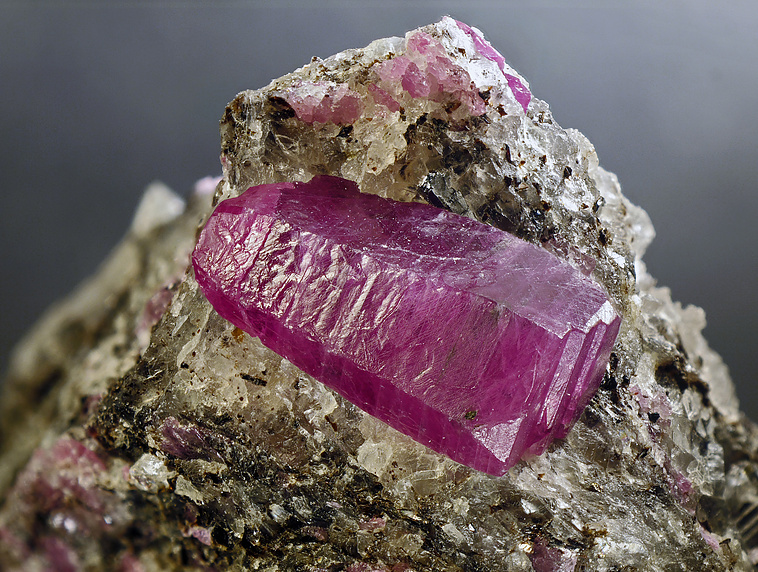
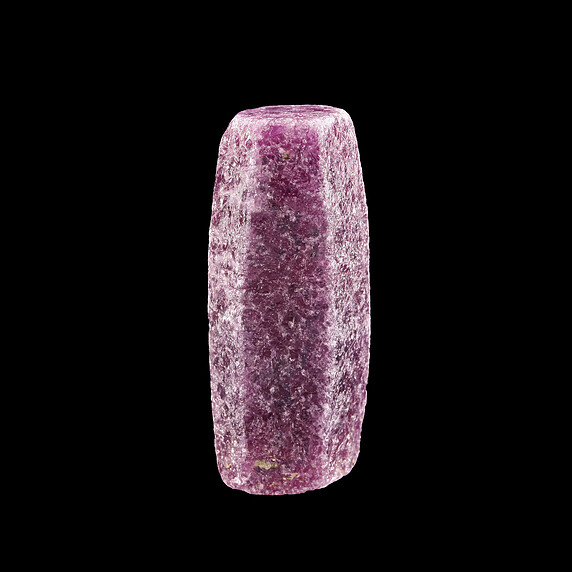
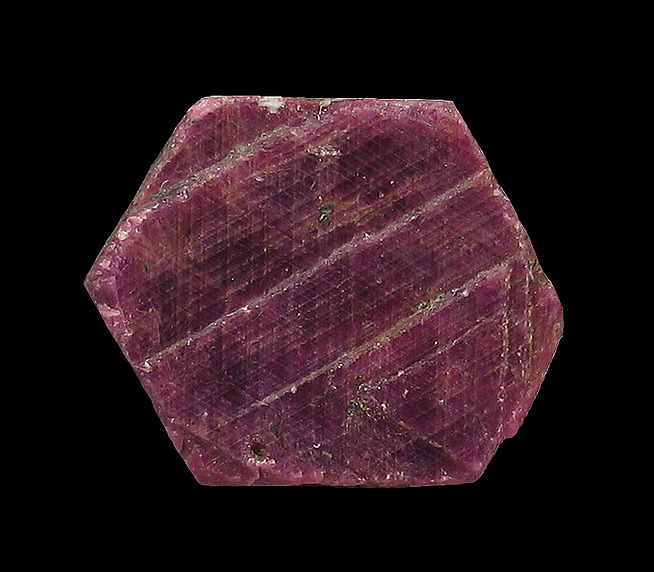
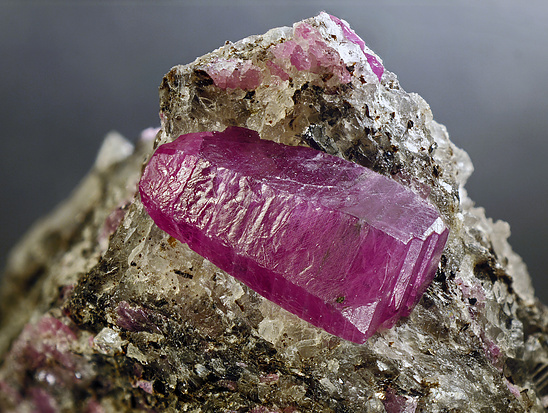
A red, gem variety of corundum. The red colour is caused by minor amounts of trivalent Cr replacing Al in the crystal structure.
In traditional gemmological terms, ruby has to be blood-red and of clear, facetable quality to justify the name. However, in wider usage, any corundum with a red or reddish colour has attracted the name 'ruby', and this name is usually applied in this way by mineral collectors.
Pink corundum is typically referred to in gemmological terminology as pink sapphire rather than ruby.
Pure Cr2O3 occurs in nature as the mineral eskolaite which is green.
The dehydration of diaspore in corundum occurs between 525 and 550 °C, whereas goethite transforms to hematite between 300 and 325 °C. As both diaspore and goethite may be present as inclusions in rubies, sapphires, and other corundum varieties (e.g., pink sapphires, padparadscha), these dehydration reactions and phase transformations can be considered important criteria to separate unheated from heated stones. Specifically, in cases in which other methods (e.g., microscopy, FTIR) are unsuccessful.
 Visit gemdat.org for gemological information about Ruby.
In traditional gemmological terms, ruby has to be blood-red and of clear, facetable quality to justify the name. However, in wider usage, any corundum with a red or reddish colour has attracted the name 'ruby', and this name is usually applied in this way by mineral collectors.
Pink corundum is typically referred to in gemmological terminology as pink sapphire rather than ruby.
Pure Cr2O3 occurs in nature as the mineral eskolaite which is green.
The dehydration of diaspore in corundum occurs between 525 and 550 °C, whereas goethite transforms to hematite between 300 and 325 °C. As both diaspore and goethite may be present as inclusions in rubies, sapphires, and other corundum varieties (e.g., pink sapphires, padparadscha), these dehydration reactions and phase transformations can be considered important criteria to separate unheated from heated stones. Specifically, in cases in which other methods (e.g., microscopy, FTIR) are unsuccessful.
Visit gemdat.org for gemological information about Ruby.Unique Identifiers
Mindat ID:
3473 (as Ruby)
1136 (as Corundum)
1136 (as Corundum)
Long-form identifier:
mindat:1:1:3473:5 (as Ruby)
mindat:1:1:1136:1 (as Corundum)
mindat:1:1:1136:1 (as Corundum)
Pronunciation of Ruby
Pronunciation:
| Play | Recorded by | Country |
|---|---|---|
| Jolyon Ralph | United Kingdom |
Physical Properties of Ruby
Colour:
Red
Comment:
The substitution of Al3+ by Cr3+ results in pink to red colours, depending on the Cr content. The pink corundum variety is called “pink sapphire” or “pink ruby”, and the red variety, with higher Cr contents (0.1 < Cr2O3 < 3.0 wt %; [5]), is called “ruby”. Concentrations of 9.4 wt % Cr2O3 were measured in ruby from Karelia in Russia and up to 13 and 13.4 wt % respectively, in ruby from Westland in New Zealand, and in ruby inclusions in diamond from placers associated with the Juina kimberlite.
Hardness:
9 on Mohs scale
Chemistry of Ruby
Mindat Formula:
Al2O3
Elements listed:
Crystallography of Ruby
Crystal System:
Trigonal
Synonyms of Ruby
Anthrax (in part)
Other Language Names for Ruby
Arabic:ياقوت
Basque:Errubi
Bulgarian:Рубин
Czech:Rubín
Danish:Rubin
Dutch:Robijn
Esperanto:Rubeno
Estonian:Rubiin
Farsi/Persian:یاقوت
Finnish:Rubiini
French:Rubis
Galician:Rubí
German:Rubin
Indonesian:Rubi
Italian:Rubino
Japanese:ルビー
Korean:루비
Latvian:Rubīns
Lithuanian:Rubinas
Norwegian:Rubin
Polish:Rubin
Portuguese:Rubin
Romanian:Rubin
Russian:Рубин
Serbian:Рубин
Simplified Chinese:红宝石
Slovak:Rubín
Slovenian:Rubin
Spanish:Rubí
Swedish:Rubin
Telugu:కెంపు
Thai:ทับทิม
Traditional Chinese:紅寶石
Turkish:Yakut
Ukrainian:Рубін
Vietnamese:Hồng ngọc
Varieties of Ruby
| Barklyite | A magenta-coloured variety of ruby (corundum). Originally reported from Victoria, Australia. |
| Star Ruby | A variety of ruby exhibiting a star pattern when viewed down the c axis. The chatoyance is due to oriented microscopic inclusions (nanorods) of diaspore (Nadin, 2007). |
| Trapiche ruby | Variety showing six-spoked growth features. Compare trapiche emerald. |
Common Associates
Associated Minerals Based on Photo Data:
| 91 photos of Ruby associated with Pargasite | NaCa2(Mg4Al)(Si6Al2)O22(OH)2 |
| 90 photos of Ruby associated with Zoisite | (CaCa)(AlAlAl)O[Si2O7][SiO4](OH) |
| 53 photos of Ruby associated with Calcite | CaCO3 |
| 46 photos of Ruby associated with Phlogopite | KMg3(AlSi3O10)(OH)2 |
| 39 photos of Ruby associated with Painite | CaZrAl9(BO3)O15 |
| 32 photos of Ruby associated with Sapphire | Al2O3 |
| 27 photos of Ruby associated with Corundum | Al2O3 |
| 26 photos of Ruby associated with Fuchsite | K(Al,Cr)3Si3O10(OH)2 |
| 25 photos of Ruby associated with Pyrite | FeS2 |
| 19 photos of Ruby associated with Muscovite | KAl2(AlSi3O10)(OH)2 |
Fluorescence of Ruby
The intensity of fluorescence is a function of Cr concentration and the Cr/Fe ratio, because the presence of Fe or an excess of Cr tends to eliminate or quench the fluorescence in ruby.
Other Information
Health Risks:
No information on health risks for this material has been entered into the database. You should always treat mineral specimens with care.
Internet Links for Ruby
mindat.org URL:
https://www.mindat.org/min-3473.html
Please feel free to link to this page.
Please feel free to link to this page.
Search Engines:
References for Ruby
Reference List:
Graham, J. (1960) Lattice spacings and colour in the system alumina-chromic oxide. Journal of Physics and Chemistry of Solids, 17. 18-25 doi:10.1016/0022-3697(60)90170-0
Saalfeld, H. (1964) Strukturuntersuchungen im System Al2O3–Cr2O3. Zeitschrift für Kristallographie, 120 (4-5). 342-348 doi:10.1524/zkri.1964.120.4-5.342
Steinwehr, Η. E. v. (1967) Gitterkonstanten im System α-(Al, Fe, Cr)2O3 und ihr Abweichen von der Vegardregel. Zeitschrift für Kristallographie, 125 (1-6). 377-403 doi:10.1524/zkri.1967.125.16.377
Giuliani, Gaston, Fallick, Anthony E., Garnier, Virginie, France-Lanord, Christian, Ohnenstetter, Daniel, Schwarz, Dietmar (2005) Oxygen isotope composition as a tracer for the origins of rubies and sapphires. Geology, 33 (4) 249 doi:10.1130/g21261.1
Palke, Aaron C.; Saeseaw, Sudarat; Renfro, Nathan D.; Sun, Ziyin; McClure, Shane F. (2019) Geographic Origin Determination of Ruby. Gems & Gemology, 55 (4). 580-612 doi:10.5741/gems.55.4.580
Giuliani, Gaston, Groat, Lee, Fallick, Anthony, Pignatelli, Isabella, Pardieu, Vincent (2020) Ruby Deposits: A Review and Geological Classification. Minerals, 10 (7) 597 doi:10.3390/min10070597
Yang, Ling, Lu, Qi, Ma, Di, Zheng, Hairong, Hu, Ruoshui, Shi, Zhuohang, Qin, Binrong (2023) Chemical Composition and Spectroscopic Characteristics of Heat-Treated Rubies from Madagascar, Mozambique and Tanzania. Crystals, 13 (7) doi:10.3390/cryst13071051
Localities for Ruby
 symbol to view information about a locality.
The
symbol to view information about a locality.
The Locality List
 - This locality has map coordinates listed.
- This locality has estimated coordinates.
ⓘ - Click for references and further information on this occurrence.
? - Indicates mineral may be doubtful at this locality.
- This locality has map coordinates listed.
- This locality has estimated coordinates.
ⓘ - Click for references and further information on this occurrence.
? - Indicates mineral may be doubtful at this locality.
 - Good crystals or important locality for species.
 - World class for species or very significant.
(TL) - Type Locality for a valid mineral species.
(FRL) - First Recorded Locality for everything else (eg varieties).
- World class for species or very significant.
(TL) - Type Locality for a valid mineral species.
(FRL) - First Recorded Locality for everything else (eg varieties).
All localities listed without proper references should be considered as questionable.
Mysore District, Karnataka, India