HARVARD
ARCHITECTURE
Harvard Architecture


                   HARVARD ARCHITECTURE
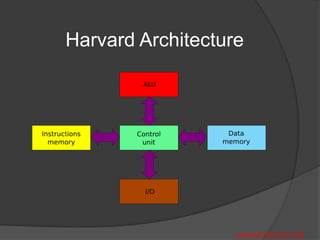
Harvard Architecture
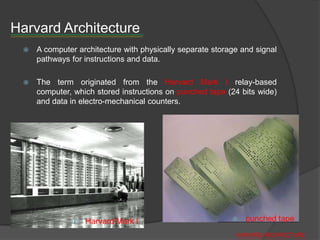
    A computer architecture with physically separate storage and signal
     pathways for instructions and data.

    The term originated from the Harvard Mark I relay-based
     computer, which stored instructions on punched tape (24 bits wide)
     and data in electro-mechanical counters.


                                                            HARVARD ARCHITECTURE
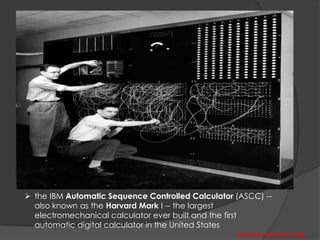
 the IBM Automatic Sequence Controlled Calculator (ASCC) --
  also known as the Harvard Mark I -- the largest
  electromechanical calculator ever built and the first
  automatic digital calculator in the United States
                                                   HARVARD ARCHITECTURE
Harvard Architecture
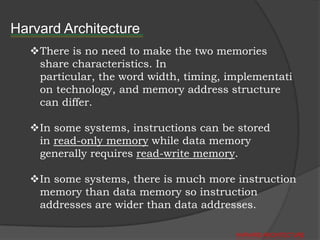
   There is no need to make the two memories
    share characteristics. In
    particular, the word width, timing, implementati
    on technology, and memory address structure
    can differ.

   In some systems, instructions can be stored
    in read-only memory while data memory
    generally requires read-write memory.

   In some systems, there is much more instruction
    memory than data memory so instruction
    addresses are wider than data addresses.

                                         HARVARD ARCHITECTURE
Speed

    The speed of the CPU has grown many times in comparison
    to the access speed of the main memory.

   If, for instance, every instruction run in the CPU requires an
    access to memory, the computer gains nothing for increased
    CPU speed—a problem referred to as being "memory bound".

   It is possible to make extremely fast memory but this is only
    practical for small amounts of memory for cost, power and
    signal routing reasons. The solution is to provide a small
    amount of very fast memory known as a CPU cache which
    holds recently accessed data.


                                                   HARVARD ARCHITECTURE
Internal vs. external design

   Modern high performance CPU chip designs incorporate
    aspects of both Harvard and von Neumann architecture. In
    particular, the Modified Harvard architecture is very
    common.

   CPU cache memory is divided into an instruction cache and
    a data cache. Harvard architecture is used as the CPU
    accesses the cache.


                                               HARVARD ARCHITECTURE
Modern uses of the Harvard Architecture


   The principal advantage of the pure Harvard
    architecture—simultaneous access to more than
    one memory system—has been reduced by
    modified Harvard processors using modern CPU
    cache systems.
 Digital signal processors

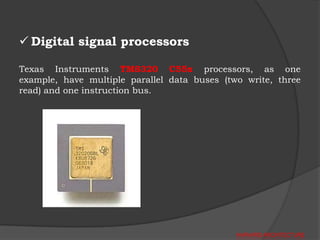
Texas Instruments TMS320 C55x processors, as one
example, have multiple parallel data buses (two write, three
read) and one instruction bus.


                                              HARVARD ARCHITECTURE
Microcontrollers

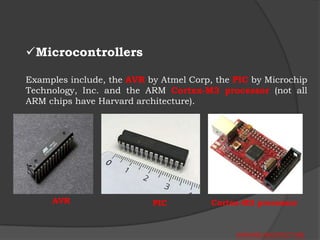
Examples include, the AVR by Atmel Corp, the PIC by Microchip
Technology, Inc. and the ARM Cortex-M3 processor (not all
ARM chips have Harvard architecture).


     AVR                   PIC          Cortex-M3 processor


                                             HARVARD ARCHITECTURE
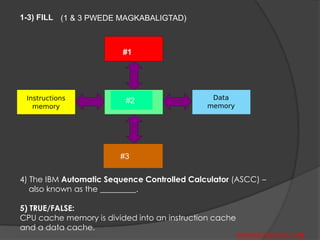
1-3) FILL (1 & 3 PWEDE MAGKABALIGTAD)


                         #1


                         #2


                        #3

4) The IBM Automatic Sequence Controlled Calculator (ASCC) –
   also known as the _________.

5) TRUE/FALSE:
CPU cache memory is divided into an instruction cache
and a data cache.
                                                        HARVARD ARCHITECTURE