Introduction
Types
Comparison
Control Memory
Address Sequencing
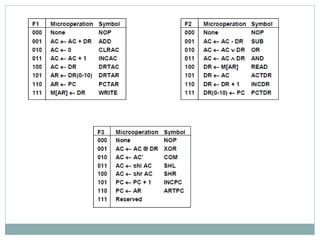
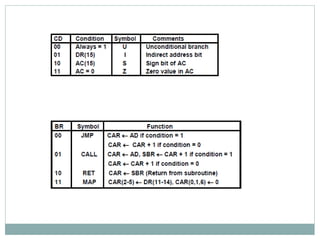
Micro instruction format and Description
Control Unit
Introduction
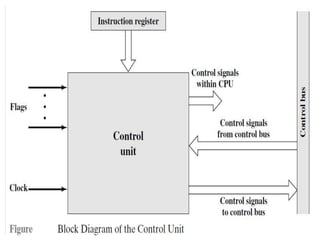
 CU is the engine that runs the entire computer with
the help of the control signals.
 It perform the correct sequencing of the correct
signals.
 It controls everything with a few control signals that
points within processor and a few control signals to
the system bus.
Introduction
 All the micro-operation are controlled by CU by
performing two basic tasks:
 Sequencing: It causes the processor to step through the series
of micro-operation in proper sequence, based on program
being executed.
 Execution: It causes each micro-operation to be performed.
Control Signal Sources
 Clock
 It helps to synchronize the operation. It causes one micro-
operation to be performed for each clock pulse
 Instruction Register
 Op-code for current instruction
 Determines which micro-instructions are performed
 Flags
 State of CPU
 Results of previous operations
Control Signal Sources
 From Control Bus
 Interrupts / Bus Requests
 Acknowledgements
Control Signal Outputs
 Within Processor
 Cause data movement
 Activate specific functions
 Via Main Bus
 To memory
 To I/O modules
Types
 There are two design approach for CU:
 Hardwired approach
 Micro-programming approach
Hardwired Approach
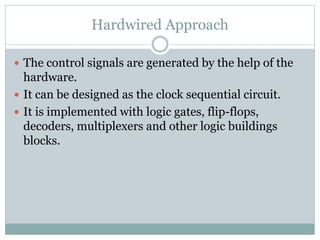
 The control signals are generated by the help of the
hardware.
 It can be designed as the clock sequential circuit.
 It is implemented with logic gates, flip-flops,
decoders, multiplexers and other logic buildings
blocks.
Micro programmed Approach
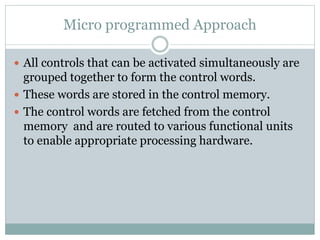
 All controls that can be activated simultaneously are
grouped together to form the control words.
 These words are stored in the control memory.
 The control words are fetched from the control
memory and are routed to various functional units
to enable appropriate processing hardware.
Comparison
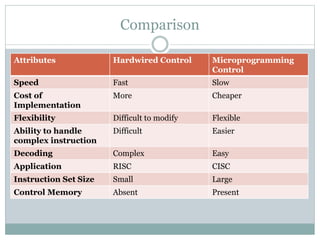
Attributes Hardwired Control Microprogramming
Control
Speed Fast Slow
Cost of
Implementation
More Cheaper
Flexibility Difficult to modify Flexible
Ability to handle
complex instruction
Difficult Easier
Decoding Complex Easy
Application RISC CISC
Instruction Set Size Small Large
Control Memory Absent Present
Micro programmed Control Unit
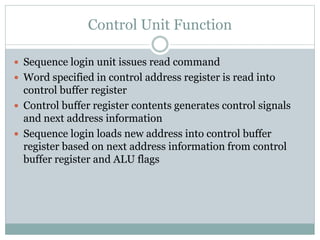
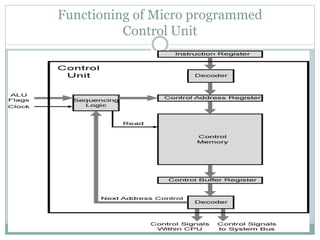
Control Unit Function
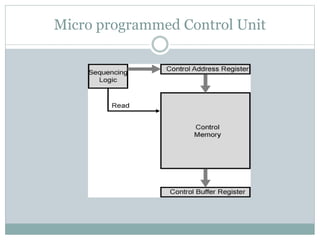
 Sequence login unit issues read command
 Word specified in control address register is read into
control buffer register
 Control buffer register contents generates control signals
and next address information
 Sequence login loads new address into control buffer
register based on next address information from control
buffer register and ALU flags
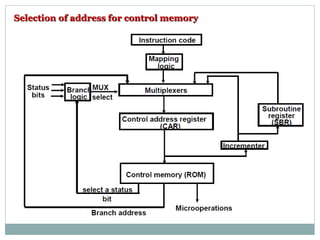
Next Address Decision
 Depending on ALU flags and control buffer register
 Get next instruction
 Add 1 to control address register
 Jump to new routine based on jump microinstruction
 Load address field of control buffer register into control address
register
 Jump to machine instruction routine
 Load control address register based on opcode in IR
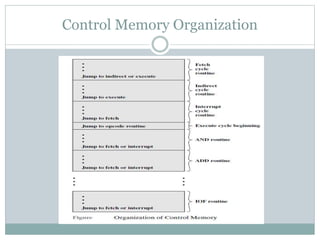
Control Memory Organization
Functioning of Micro programmed
Control Unit
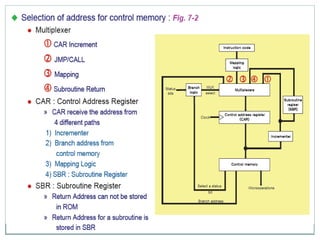
Selection of address for control memory
Conditional Branching
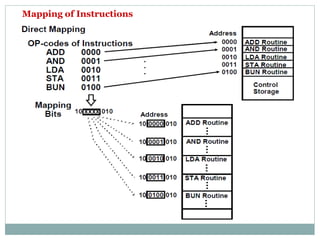
Mapping of Instructions
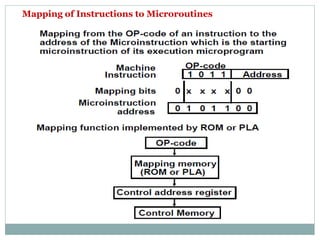
Mapping of Instructions to Microroutines
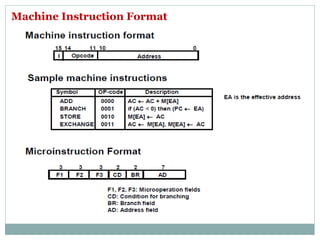
Machine Instruction Format
Micro Programmed Control Unit