WritingWithColor (Posts tagged tw)

1.5M ratings
277k ratings

See, that’s what the app is perfect for.

Sounds perfect Wahhhh, I don’t wanna

Am I handling the black woman character’s murder well?

@selfdxd2 asked:

Hello! My current project is a crime fiction set in KY, USA in which the instigating action is the death of a young black woman (W), with the first half being another young woman (L) investigating her disappearance and how it correlates with the disappearance of her close friend. That friend (P) is later found alive after having been kidnapped because he witnessed the crime, and is the POV character of the second half. He is also a white man, and him being white is relevant to other aspects of the story. My intention is for the “credit” for solving W’s death to go almost entirely to L (who is also a woman of color, specifically Romani), and for the tragedy to be centered around the unfair loss of life and the pain of her parents and others who knew W rather than how bad P feels about it.

My main cast also has two other prominent black women with arcs that extend outside this tragedy. All of this is intended to lend to one of the story’s major themes of social invisibility vs visibility. So does this exploration of that stray into harmful territory from the outset? I know successfully keeping away from any white manpain traps will take active caution while actually writing the story and I intend to get sensitivity readers as I work on it, but I wanted to get some feedback on my starting point before going too far down that road. Thanks so much for all you do!

It is important for us to know why this young Black woman was murdered to give specific advice. 

  • Was it racially motivated, gender motivated, or both? 
  • Wrong place, wrong time? 
  • Did someone take revenge?
  • Was she involved in something insidious? 
  • Was it truly an accident?

Depending on the reason, you should explore and acknowledge this violence and the existing societal problem behind it. For help, see the crime stats on violence against Black women.

…and for the tragedy to be centered around the unfair loss of life and the pain of her parents and others who knew W rather than how bad P feels about it.

Yes, give a voice to the people most affected by her death. Other Black women, people, and Women of Color. This will help further not make it about the feelings of a white man. He is absolutely a victim of the crime too, being kidnapped, so his trauma does matter and should be tended to. But ultimately, he gets to live.

On that note, his life being worth kidnapping vs. ending begs the question; why wasn’t he murdered while the Black woman’s life had to end? And for representation purposes, why couldn’t it be the other way around (Where the Black woman lives and witnesses the crime, and the white man dies)?

This is why knowing your reasoning for her death is so important. 

Otherwise, if she was thoughtlessly murdered, it does feel like her life was incredibly devalued in your story due to her being a Black woman. It’s a serious and true problem, so I’m not saying not to write this. This just needs careful exploring. If you’re choosing to bring this real life problem into your story, it deserves full and respectful acknowledgement. 

Please check out our resources on writing tragic material, Black suffering and abuse and avoiding exploitation. 

More readingtragedy exploitation tag

~Mod Colette

Death murder tw Black women Black person dies first Tragedy exploitation Black suffering

Jewish sex worker faces nazi roleplay request

Maria asked:

Hi there. I’m in the process of writing a protagonist (secular Jewish lady, English, queer) who moonlights as a sex worker (Professional Dominatrix) to add to her income from her prestigious but poorly paid government role. One of her clients requests a Nazi role-play scene. At the moment she just sees him as another bigoted racist older white man, and makes fun of him to her friend. I’m trying to show throughout the book in many ways that she’s at odds with herself, her sexuality and her heritage, trying to reject these things so brushes off the incident, making jokes etc. Racism is also a big feature of the “baddies”, who have a fascination with the whole alt-right, racial supremacist awfulness. Her own family background was somewhat removed from the Holocaust as they lived in the UK, but they would value their Jewish identity and still celebrate the major holidays as a family etc.

So my question is, what do i need to do/not do to this scene to not be insensitive? Apart from visceral horror and rage, what other emotions might she be suppressing?  Has anyone read anything similar before, or anything that deals with this subject matter?

Regarding the Jewish character

Well, there’s a lot beyond the single scene that is problematic. 

Essentially, you want to write a story about a Jewish woman, with government power (the “pulling the strings” trope), who is rejecting her heritage (another trope), who then has sexual contact with someone in Nazi roleplay.

I can tell you right now, there are no Jewish people who are “removed from the holocaust,” whether or not they lost family directly.

A story about a Jewish woman rejecting, or even trying to reject, her culture is one that should be told by Jewish people, and a story about a Jewish woman swallowing disgust to have sex with someone in some sort of Nazi fetish play is something that just shouldn’t be written.

– Dierdra

I have nothing extra to say about Nazis and sex, but would just like to add that I’m from the UK and my entire family were here in England throughout the whole Holocaust, and I absolutely do not feel ‘removed’ from the collective trauma. 

For example, I had an anxiety attack when my university sent an email to all students asking you to register your name if you were planning to observe Ramadan. Someone who didn’t have a Jewish lived experience might not associate this with the Holocaust at all. The university wanted the names so they could plan their exam timetable in the friendliest way possible. But all I could think was, in a time of rising Islamophobia in the UK, a marginalised ethno-religious group was being asked to register their names with the authorities. I don’t necessarily second that there are no Jews who feel disconnected from the Holocaust – apparently the creator of the The Little Dictator did an interview about this and pointed out that some Sephardi Jews don’t have the same connection to it because their struggles have been quite different, but I can’t find it now. So I I wouldn’t want to erase that experience but it’s also not my experience to speak about. 

Anyway, I would agree with Dierdra that at least all Ashkenazi Jews feel some connection because we’ve all had to deal on some level with the kind of anti-Semitism that exists in European cultures (including white America and other cultures that are descended from Europe), and those are the tropes from which the Holocaust evolved. Plus Hitler tried extremely hard to invade Britain so my grandparents were very actively fearing for their lives. Just for any future Jewish characters you might create, please do not think that a UK setting means no connection to the Holocaust or no reaction to Nazi imagery.

–Shoshi

This is a good point about many non-Ashkenazi folks not feeling the same connection. I certainly wouldn’t argue with anyone who says they don’t have any connection, or any feelings about the Shoah but to me, even having vague feelings about your many-times removed cousins suffering is still connection. Not on the same level as many folks from the region (or with family ties there) but it’s still there. Just knowing that people in your culture were targeted is a connection, even if it doesn’t have the impact on some folks that it has on others. Some people are living with generational trauma, and others aren’t, but knowing that your people are a target is still impactful for, lets say, the majority of Jewish people. I happily accept the need for a caveat there!

Regardless, it’s for Jewish people to say if they have feelings about the Shoah, and not a convenient way for an author to get around the issues with their Nazi-fetish piece.

–Dierdra

That is so true, Dierdra, thank you for that. Every Jewish character’s relationship to the Holocaust is going to be unique, but it’s something the author should think about carefully and sensitively, not brush aside with an answer that’s convenient to the story.

–Shoshi

Regarding the sex work & nazi roleplay

So here’s the thing: this would get the client pretty instantly blacklisted from the BDSM community.

An earnest request for a Nazi roleplay from somebody racist who actually likes Nazis is something the community doesn’t tolerate, especially if the person asks someone directly impacted by Nazi activities. That is such a deep violation of ethics, it completely goes against the BDSM code of conduct that things must be safe (emotionally and physically) and consensual. And the thing about being a professional Dominatrix is, you are in touch with the BDSM community. That’s how you’re going to find clients. That’s how you’re going to get paid. It starts through the BDSM community.

If this was through a dungeon, he’s out instantly. If this is through Fetlife, he’d be at a pretty high risk of being banned because racism and offensive statements are against the terms of service. 

The BDSM community is one of the places where Nazis get punched.

You’ve established she is not a survival sex worker and is not desperate for money, because she has another job. As a result, she is fully in her right to turn down every and any client request— sex work is not retail, which means sex workers have full permission to tell the client to fuck off with their terrible requests. The customer is absolutely not always right, and customers—especially those of pro Dommes—learn that really fast.

Pro Dommes have backbones of steel and will absolutely tell men that their ideas are terrible and they should feel bad. That is part of their job descriptions as pro Dommes. They tell their clients they’re terrible people for money. They tell their clients what to do for money. 

Yes, subs never have anything go beyond their lines of consent, and subs can revoke consent at any time, but a pro Domme will tell someone breaking the rules that they cannot do that and they are not getting any attention because of the rule break. This absolutely transfers into your personal life, and you get way better at saying no to anything that even starts to flirt with your boundaries.

You’re literally using a bdsm sex work coat of paint (that is a strawman compared to how actual BDSM communities are) to concoct a situation where she’s forced into an identity crisis 

Unless you are Jewish, that is really not your place to write (See: Can I Write About X?). This is beyond the fact this situation wouldn’t happen because he broke every last rule of the BDSM community and would be kicked out as the terrible person he was. You’re making up your idea of the BDSM community, and it has a solid ring of being untrue. Christian Gray is blacklisted from Seattle’s community for being an abuser, which is why Seattle’s community never comes up in the books. And Seattle is a big BDSM community that should come up in the books.

She would be empowered to tell him no, because sex workers have black belts in saying no and pro Dommes have it at the tenth degree. She would be empowered to have him kicked out of the community. She would be empowered to make money through other ways. This applies even if she’s new, because she would have the community who had taught her the rules and she would have protective figures telling her she’s allowed to say no.

BDSM is not an abuser’s paradise. Nazis do not flourish there.

Even if you go to other forms of sex work, you get very good at saying no. 

You have to be extremely careful you’re not falling into stereotypes about sex work, which includes the topic of consent. The main narrative around sex work, after all, is that nobody in the field (voluntarily) can consent to anything and as a result sex work should be abolished. This is a blatant lie.

Clients can absolutely get kicked out of clubs. They can get blacklisted because suddenly their references (that a lot of workers require) will warn all their friends to stay away. Sex workers start whisper networks of who to avoid. Warnings about predators circulate, and a Nazi would very much count as a predator.

Voluntary sex workers have autonomy (the place you get into no consent is trafficking victims, which are not sex workers). They do not simply take whatever a client gives.

And, honestly, even the most horrifying clients don’t leave much of a dent. Work personas are so thick that you know it’s really not about you. So much of sex work is marketing and sales that you are often a completely different person once your street clothes go back on.

Give her the backbone of the profession, both as a pro Domme and a sex worker, have her say no to something so horrifying, and have him kicked out.

End of story.

~Mod Lesya

These are excellent points about BDSM, and about sex work. This particular question feels very specifically targeted towards a Jewish Sex Worker, in a way that is repeated in a fair bit of literature. I would prefer if stories where Jewish people are confronted with Nazi fetishes were just not written at all, certainly not by anyone outside the community. If I can’t convince the author that it’s offensive, and shouldn’t be written, they could at least give her agency, and strength.

– Dierdra
TW antisemitism Holocaust TW Nazi TW Fetish TW sex sex work BDMS NSFW abuse abuse tw sex workers Representation asks submission

“Deconstructed” Assimilation Plot

My wife and I were thinking of writing a near-future (2030) sci-fi novel with utopian/dystopian themes, revolving around an viral video (produced by a team of researchers) that causes a profound quasi-religious experience in a receptive viewer. As a result, people who have watched it are generally happier and have a sense of shared purpose and trust of others who have watched. 

They also become more altruistic, tend to want to “convert” dissidents, and organize together to do so. Essentially an optimistic deconstruction of the Assimilation Plot, which maintains individuality, so most of the typical reasons why assimilation is bad aren’t such large factors. We thought this had some fascinating parallels with a lot of different issues about identity, religion and politics, as long as we present it as something not entirely good or bad. We figured that this would be a great opportunity to have a ethnically diverse cast of characters to discuss the moral issues posed by such a ideological group attempting to integrate/assimilate different communities and groups of people. Our main cast is fairly diverse, though we plan to use their families and friends to offer more varied viewpoints, and avoid tokenism.

Anyways, we’re concerned about crafting authentic and nuanced reactions to this event, particularly among our main characters, so if you have any suggestions about how their ethnic backgrounds might contribute to their viewpoints about the event (either as converts or dissidents), we’d love to hear them. Two of our characters we’re particularly concerned about are a 30 year old former Syrian refugee female software developer (non-practicing Muslim, married to a white agnostic ethicist), and a 23 year old Afro-Latino cyber-security expert/conspiracy theorist (middle child from a stable lower-middle class family).

[ask shortened due to exceeding length, reminder: aim for brevity, askers]

Deconstruction is not the word

I’m confused by this question.  Let’s look at what a “deconstruction” in literature actually is.  Quite literally, you take a common or established storyline and break it down into its component parts, then examine each of those parts closely and play them through to their (often painful) logical conclusions.  In a deconstruction, if some action has a consequence, the deconstruction of that plot point is to to play that consequence cruelly straight without handwaving things away, seeing in gruesome detail what effects that conceit has on the characters.

In brief, when you deconstruct high fantasy, what you get is Game of Thrones.  When you deconstruct space opera, what you get is Season 3 of Battlestar Galactica.  Deconstruction is an intentional reading of an established formula with an eye counter to that which was originally intended.  Deconstructing modernism gives you Kafka’s “The Metamorphosis” wherein the protagonist becomes a giant freaking bug for no god damn reason.  When you consider that many of the things that often occur in narratives would actually be incredibly psychologically damaging in real life, balance and optimism are not really a thing in deconstruction.

What Deconstructed Assimilation Looks Like

So, with this knowledge, let’s look at what deconstructing assimilation would look like in this context.

Cultural assimilation is about subsuming the characteristics of one’s native culture to the larger society in which one lives.  Wholesale assimilation requires you giving up your native food, your native dress, often your native name, because its “easier” or “cooler” or whatever.  People actually do this a lot. Often we choose to do so because it kind of greases the wheels when we live in a place where people like us are the minority.  But there’s a price.  Even the most psychologically well-balanced individuals are going to be torn by the tightrope act required by assimilation.  

I often give my name as “Nick” at Starbucks even against the twinges of feeling like I’m selling out my family, because it makes my afternoon proceed just a little bit easier.  Sometimes I don’t.  It’s basically a coin flip depending on how I’m feeling that very second.  But each act is a choice that changes a person’s sense of being an individual in an culture that regard them as an outsider.  If we deconstruct this notion we’re going to be playing the consequences through to the gory logical ends—every choice a person makes to assimilate or not assimilate is going to be affecting their sense of what being “an individual” means on a very basic level.  

In this sense, I see the whole point of a deconstruction being that “individuality” isn’t a discrete, concrete concept.  Deconstructing assimilation means deconstructing individuality, particularly cultural individuality, and a storyline that deconstructs the concept of assimilation can’t do so while maintaining “individuality” because the two concepts are inextricably and contradictorily linked.

Subverting Assimilation may be the word

If you mean subverting the concept, that’s different, but I have a very hard time seeing how deconstructing and closely examining the notion of assimilation can be done “optimistically” if you’re coming at it from the perspective that assimilation is a bad thing.

~Mod Nikhil

I’ve discussed people ‘deconstructing’ assimilation plots with a more positive twist here: [Pagan Scandinavians and Colonialism]. I’d suggest reading that post to get my full thoughts.

Risks of Adding Optimism to Assimilation

Broadly speaking, attempting to create a “positive” spin on assimilation runs an extremely high risk of sanitizing cultural genocide. The core rooted belief of converting others is that all other beliefs are wrong, your way of life is the best, and you should do whatever it takes to convince people to jump into your way of life because they’ll eventually see it’s the best thing ever.

This has huge problems. If you think it’s okay just because the doctrine will adapt to individual culture, allow me to point you to the sheer number of places Christianity got mixed with the local beliefs in order to convert more people. That’s what made it such an insidious religion; they were willing to adapt to whatever culture in order to get more converts (usually destroying parts of the Indigenous culture in the process, using the mix as a stepping stone to slowly assimilate them and have them lose touch with their original beliefs).

While some of the mixes have been taken back by their individual peoples, that doesn’t stop the mixed reaction many many many Indigenous people have with any religion that tries to take over. Trying to spin tactics that directly lead to cultural destruction as positive “this time” doesn’t hold up, because you haven’t created a situation that has addressed the problem. You’ve just draped it in new decoration, with a video instead of a metaphysical being. Otherwise, this mirrors colonialism. 

This sort of scenario has happened all over the world, with dozens of faiths, hundreds of ethnicities, and it always follows the same method: a group of people believes everyone should be like them, and is willing to use whatever tactics to get there. I see nothing different, at its heart, with your plot.

If you want to try and avoid it, get rid of the need to convert others. You could still have some squicky parts, but at least without a need to convert others there is far less room for psychological manipulation and coercion. 

~ Mod Lesya 

general writing advice assimilation settings utopia dystopia cultural genocide tw world building history religion asks submission
ayellowbirds

Terminology

biggadjeworld

I am going to do a break down of the various terminology as it is accepted in most Romani academic circles.

I realize that this can be very confusing, especially to those outside our ethnicity and culture, and even to those who were raised in our culture, but do not have a full grasp of our language.

I must also note that self-identification varies amongst us and many of our own people may not recognize what is considered proper terminology.

“Gypsy” - The pejorative term created by the British in the 1500s. The term was created to identify only those who are Romani, most specifically those who we now call UK Romany & the Romanichal. It was never intended to be used as a descriptor for any other ethnic population. It comes from the Old English term for Egyptian, and not Greek. It is a slur.

Romani - The term that refers to our entire ethnic population, including the Sinti. It refers to the ethnic population that left Northern India & Pakistan shortly after the invasion of the Persian Muslims who have since settled in Trukey, all of Europe, and the Americas. The term is used to refer to our culture & language in relation to the entire ethnic population:
Romani culture, Romani language, Romani people, Romani ethnicity.

Romany - The population of Romani who settled in the British Isles sometime in the late 14th century. They have since become two distinct populations self identifying as either Romany or Romanichal. This spelling is typically used to refer only to the ”native” Romani population of the region. It does not inculde more recent Romani immigrants or refugees from continental Europe. Romany is typically prefixed by British, UK, English, or another identifier of where in the region they have settled & lived.
Ex: Some Romani families have lived in the UK for one hundred years or more and they have even picked up some words from the Rromanes dialect spoken by the UK Romany. 

Sinti - The self-identifier of a sub-ethnic population of the Romani people who live in Germany, Austria, regions of Central Europe, and the United States of America. Many Sinti prefer their identifier over Romani, though they do indeed belong to the Romani ethnic population & their language is a dialect of the Romani language.

Rroma - A sub-ethnic group of the Romani population who live throughout Transylvania, Central Europe and Northern Italy.
(This is why referring to our entire ethnic population as the Rroma & Sinti tends to be problematic. It is inclusive of only these two very specific Romani sub ethnic populations, when in fact, we have likely over 80 self-identified distinct groups that are considered part of the Romani ethnicity.)

Rroma - A Romani woman. The adjective that describes a Romani woman or girl.
Ex: I am a Rroma woman, but I belong to the Romani people.

Rromni - A Romani woman who is married. A wife.
Ex: The Rromni took care of her sick husband.

Rrom - A Romani man. The adjective that describes a Romani man or boy.
Ex: The old Rrom told us stories about our history.

Rromanes - The language of the Romani people. Sometimes referred to as “Romani chib”, which means “Romani tongue”. This includes all dialects of the Romani language spoken in all of Europe, Turkey, South Africa, as well as North, Central & South America.

Dom - A sister population of the Romani ethnicity. They are believed to be descendants of similar North Indian & Pakistani ethnic groups. They likely began their diaspora before the people who are today considered the Romani. The Dom live throughout Northern Africa, the Middle East & Central Asia.

Domari - The language of the Dom people.

Lom - Speculatively related to the Romani in the same way as the Domari: a population of mixed Northern Indian ethnic groups who began their diaspora before the population that is considered the Romani. They settled mostly in the Caucasus Mountains, and largely in Armenia.

Lomavren - The language of the Lom people.


The Romani, Dom & Lom are related to some degree, but the exact relation is still contested by some. The Dom & Lom are sometimes lumped under the pejorative exonym, “gypsy”, though this term was never ascribed to them until rather recently.
When referring to this entire diasporic population from the Indian subcontinent, they should always be termed “The Romani, Dom & Lom”. Of course, order can vary, but the proper terms should be utilized instead of “gypsy”.

Single “R” & double “Rr” spellings - Both manner of spellings are correct. Some dialects use a double “Rr” spelling for phonetics purposes, while other use it to distinguish us from Romanians & inhabitants of Rome, Italy.


Non-Romani Ethnic Populations:

There are several ethnic populations that are wrongly lumped under the slur umbrella that is “gypsy”. Many have no relationship to us & should only be discussed in terms of contact. We are entirely separate ethnic populations.
(For those who still have not grasped this concept yet.)

Pavee - Commonly known as Irish Travellers, they are a sub-ethnic group of Irish who have lived a nomadic existence for several centuries. They reside in Ireland, and the United Kingdom.  Some self identify as “Irish Gypsies”, though the bastardization of that term from the UK Romany is a rather contentious topic.  
Some Pavee have had very close relations with UK Romany, even inter-marrying. However, it is important to note that the Romany & Romani are in no way related to Irish Travellers. We are not only two separate ethnic populations, but we even belong to two separate races.  We each have our own lanaguage & culture. 

Shelta - The language of the Pavee.

Banjara - An ethnic population living in Northern India. Though we have been genetically linked to the Banjara, the group is not the only Indian ethnicity that comprised of the initial Romani diasporic population. In fact, we have been linked to a wide variety of ethnic populations that live throughout Northern India, Pakistan, and even Eastern Afghanistan. The Banjara are just one of those many ethnicities.
The Banjara are not “gypsies” & they are not Romani.
They are Banjara. They are Indian.


There are many nomadic peoples throughout Europe.
The only ones who are Romani are the Romani.
The only ones who are “gypsy” are the Romani, most specifically, the Romany.

The Yeniche, Quinqui, Scottish Travellers, Norwegian Travellers, any generic nomadic people, nomads of India, Asia, or any other place on Earth are not Romani & they are not “gypsies”. Not even the Lom & Dom are “gypsies”, or Romani, even though they are our sister ethnic populations.

The only people who are Romani are the Romani.

tooyoungforthelivingdead

Needed this today, so reblogged for everyone else too

get it right, and maybe avoid being a racist at someone!

fixyourwritinghabits


Further Resources:

stevenandthebsharps

Bringing this back for International Romani Day

pagansofcolor

Reblogging cause people in the pagan tag (y’all know who you are) need to learn this and stop using that racist slur.

romani rromani resources racial slurs tw Terminology writer reference reblog
yestweetybird

The Criminal Unrapeability of Black Women

ablackwomansurvivingrape

image

By KALI NICOLE GROSS

Black womanhood = criminal perversion. This equation leapt to mind in wake of allegations of harassment claimed by Daniele Watts, a Black actress handcuffed and detained in Los Angeles earlier this month after a public display of affection with her White boyfriend. Though questions have swirled about what actually took place, that Watts was made to feel that officers though the couple was actually a prostitute and client is not surprising. 

More recently, a group of Black women enjoying an evening at New York’s swank Standard Hotel were harassed by security, who told them bluntly that he believed they were soliciting sex work.

To some extent, these incidents highlight an evolutionary conflict: Black women are subjected to dated stereotypes and clash with regulatory agencies unable to accept otherwise. 

In the days of old, Black sexual perversions went like this: Black men were all rapists, and Black women were all ‘whores.’ Our criminal justice system played a fundamental role in the sexual objectification of Black women. It decriminalized sexual assault against them, both during enslavement and in practice long after. Instead of punishing their attackers, society engaged in victim-blaming on a massive scale. Then as now, Black women were supposedly hypersexual to the point that they were always sexually available–they were essentially unrapeable. They could not be victims, girlfriends or wives, and certainly not ‘true’ women.  Their bodies belonged to whomever wanted to violate them, despite persistent messaging that Black women were also inherently undesireable. Consider:

-Stereotypes about Black women being prostitutes were so common in the late 19th century that some found ways to use this to their advantage. Black “badger thieves,” as they were called, pretended to be streetwalkers only to rob wannabe customers.

-In places like 1920’s Harlem, as historian Cheryl Hicks points out, innocent Black women standing in front of their buildings or walking home from work would be rounded up and arrested during prostitution sweeps.

-At the same time that Black women have been denied legal protection, they have been among the most criminalized. Black women’s incarceration for petty theft and substance abuse helped make them the most disproportionately, overrepresented group in prison.  

-Black women are also among the most victimized.  Some 40 percent of Black girls have been sexually coerced before reaching adulthood.

Myths of promiscuity have often left Black women vulnerable to sexual assault while masking their victimization. Historically, law enforcement officers and prison guards in particular have taken full advantage. Records indicate whether Black women were arrested in holding cells or locked in solitary units in female wards or laboring on chain gangs, guards and other male inmates sexually abused them.

Today, Black female prisoners face an increased likelihood of sexual assault by inmates as well as violation by guards during body searches.  The 16 felony charges of sexual assault by an accused Oklahoma City police officer Daniel Holtzclaw is one of the more disturbing cases of police violence against Black women. That the accused remains out on bail shows that, save for the local chapter of the NAACP, a petition on Change.org, and segments on Melissa Harris-Perry, few seem worried about the ongoing threat to Black women’s safety as well as the safety of the victims, many of whom were poor women allegedly targeted because the legal system would be unlikely to believe them.

Troubling, too, is the backlash that Watts faces: Audio and video footage surfaced revealing she was fully clothed, sitting on her boyfriend’s lap in his car and that she refused to show ID.  Since she was getting frisky with her man, how dare she not want to dignify specious prostitution allegations?   The nerve: a Black woman not wanting a White police officer, or any officer really, to have her name and address when she hasn’t committed a crime! There’s also now collective denial about the fact that if both she and her man were White in L.A. doing the same thing, no one would likely have batted an eye. The cops probably would have been attending to more pressing matters, which begs the question: Has that supposed 911 call surfaced?  Isn’t this what the officer said he was following up on?  

Either way, the reality is there is very little precedent for Black women to safely engage in sexual play or to be sexually desirable, let alone make out with White men in fancy cars. Ms. Watts had to the audacity to act as if she were a woman with that kind of space, almost like she were an actual citizen.  

For a brief moment, it seemed like the rest of the country thought she was, too.  

Hypersexualization Desexualization Racism Black history Discrimination intersectional feminism black women rape rape tw sexual assault tw reblog

Is Blackface okay in a fictional world without racism?

So, first I have a question which might be a bit weird, but anyway. My story takes place in an almost completely fictional universe. My main characters lives with their (non-human) people in subtropical/tropical area, so they all have kinda dark skin, like a medium brown (due to high migration rates from the cooler regions in the north, which results in them all being neither very dark nor very light- they’re pretty mixed up, so to say). Their Goddess of life however is said to have very dark skin, almost pitch black. They throw a feast for her and celebrate in the first days of summer; honoring her, bringing her sacrifices to the temples, singing to her etc.. and paint themselves with charcoal and ashes, so as to honor her. 

Now my question is, whether this is considered blackface or not, because it is not done to humiliate, (the opposite, actually) and in their society white supremacy basically doesn’t exist. Of course, if this is offensive, I will change it immediately and find something else!! I was just wondering, because, I mean, I do know that masquerading as a different race is not okay but since this isn’t the case here I’m just not sure. Also if it helps, there’s also people of their species that live further in the south that do have almost completely black skin, and are considered the same “ethnicity” as them.

And I have a second question too: I know this rule, that you shouldn’t write about the problems that other people have (like, as a white person to write about the specific probs of a black person). But since under the system of white supremacy all POC experience opression, can I write different non-white characters and mention the problems and the opression they face everyday , like not as a main plot thing or so, just the way it’s part of our daily life? 

“Their Goddess of life however is said to have very dark skin, almost pitch black.. [they] paint themselves with charcoal and ashes, so as to honor her.

Darkening your skin to appear as a Black person (coded or no) or even a darker-skinned Black person (a practice that Hollywood is currently doing!) is and will always be blackface. This is not honoring anybody.

Your idea is racist so please do not have your characters darken their skin to “honour” the dark-skinned goddess. It doesn’t matter if there’s no concept of white supremacy in your story, we the readers live in a world where there is white supremacy. 

Blackface has a history in our, the readers’ world, and is something Black people are still fighting against as everyone from celebrities to losers with a camera and social media account continue to engage in ignorantly and/or to taunt and demonize Black people. And as Halloween approaches and crap like “African/tribal” and “gangster” costumes prop up (and the new trend, dressing up as murdered Black people!), we’ll unfortunately endure more of this triggering mockery than usual.

image

So no, this is very un-okay no matter if it’s in a “Racist-less” world context.

To the second question on including racism in stories

We’ve talked about this numerous times on WWC.

There’s a way to go about including racism in stories without it becoming a story “about” racism. In fact, many marginalized people would prefer that. Sometimes we just want to have the kick ass adventures as center point, all the while not having the daily things that come with our identities completely ignored or erased.

Including incidents here and there would make sense, and racism comes in many forms as detailed in this post, and isn’t always blatant. On that same note, remember it’s not always about including racism, and just having say, a Black girl putting a silk scarf on at night is sometimes enough to make me feel like for once there’s a story about me.

I suggest you read How to Write POC if you are White and check out our tags on micro-aggressions and Incorporating MicroAggressions in Writing

Please take a thorough browse through the content on this blog to help you with writing non-harmful inclusive writing.

~Mod Colette

racism blackface settings submission brown face yellow face murder mention tw antiblackness asks tw
pro-gay-deactivated20170112
medievalpoc:
“searlait:
“hathor-aroha:
“lifeisliterallylimited:
“I AM SO BLOODY FURIOUS:
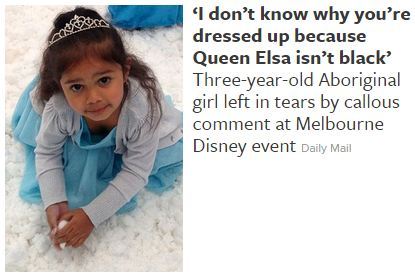
Three-year-old Aboriginal girl left in tears after she is racially abused by a grown woman for wearing her favourite Frozen costume
• Samara Muir, 3, had dressed...
lifeisliterallylimited

I AM SO BLOODY FURIOUS:

Three-year-old Aboriginal girl left in tears after she is racially abused by a grown woman for wearing her favourite Frozen costume

  • Samara Muir, 3, had dressed up as Queen Elsa from Disney film Frozen
  • The little girl wore the outfit to a Disney event in Melbourne
  • She was racially abused by a mother and her two daughters
  • ‘Black is ugly’ the three-year-old was told by one of the other girls
  • Samara was so upset she would not go to her Aboriginal dance class
  • When her mother asked why she replied: ‘It’s because I’m black’
medievalpoc

This is why people who seem to need “proof from history” that WE NEED MORE DIVERSE REPRESENTATION IN FANTASY piss me off so much. People of color get harassed at Renaissance Faires, at SCA events, in online fandoms, at LARPs, and events based entirely on fantasy and fairy tale stories, because supposedly “there were no PoC back then”.

That’s a lie, and it’s wrapped in another lie.

Despite that fact that Disney’s Frozen has nothing to do with actual history, people still have asked me over and over again about it. Because they want “proof” that it should have been more diverse. 

I really don’t get why anyone would need any more “proof” than the fact that a 3 year old child was told “Black is ugly” at a Disney event because she was dressed as Elsa.

I really wonder if things would change if Frozen really had been based on media from historical Denmark, as a lot of the mistaken “historical accuracy” police had claimed it was. Maybe then people would have seen someone in Frozen, maybe even Elsa, who looked like Karel Van Mander III’s Queen Persina (from a series for the Royal Court in the 1600s):

image
image

[The models for this series were Black people living in Denmark in the 1600s, if anyone was wondering.]

But it’s not set in historical Denmark, or Norway, or “somewhere in Scandinavia”. It’s set in a 100% make-believe world with magic ice powers and sentient snowmen. 

And in THIS world, the one we all live in, racist grown women attack toddlers for dressing up as characters who don’t look like them, when there are practically NO characters who DO look like them. 

WE NEED DIVERSE REPRESENTATION.

And we need it now.

racism erasure representation history poc in history frozen media disney aboriginal social issues harassment abuse tw antiblackness reblog

Extinct Religious/Ethnic groups and appropriation

Anonymous asked:

If one religious group has systematically slaughtered, repressed and force-converted another group to the point of extinction, does the first group have any claim to the cultural heritage of the second group? None of them are left. I’m thinking about ancient religions that meet unhappy endings and my own heritage as a descendant of an oppressive group which is very happy to claim the second group’s artifacts and history for tourism. It feels wrong on one hand but nobody is alive to object.

Frankly, we’re baffled by this question. So basically you’re saying “My ancestors were a nasty group of people who systematically destroyed another culture. Now that we’ve made sure these people are gone, we totally have a claim to the culture we smothered, right? I mean, it’s sad on one hand, but they’re dead so now we can have all their cool stuff, right?“

It feels wrong on one hand but nobody is alive to object.

Okay.. whether it’s true the entire group was completely eradicated or not (because you may think they’re all gone but really they’re not), it doesn’t feel wrong if nobody is alive to object to you? It’s not wrong that a whole group of people were murdered by [your] people and now you want to dress up in their bloody garments?

You seem to be attempting to justify cultural appropriation for one of the exact reasons why it’s so wrong.

People are insulted, degraded, abused, and murdered for upholding their culture and now the same people who did all the above want to flounce in and incorporate that same culture into theirs?

Nah. There’s no justifying that.

~WWC

cultural appropriation white privilege privilege racism history tw genocide religion oppression asks

Anonymous asked:

Are non-mixed African-American children jealous of mixed children? Why? It's not overly important to my story but my main female character was bullied slightly because of it, so she only identifies as black and shuns her white side.

Mixed (B&W) and Jealous Peers

You’re citing your character being bulled because she’s mixed, and bullied by whom? Black people, white people? Since you’re asking if non-mixed Black people are jealous of mixed Black people, I assume you’re making the bullies Black people.

Please do not perpetuate this harmful set-up that Black people are just so jealous and mean to mixed Black people. Yes, this does happen and there are haters and one might see why when Black people are told they’re ugly and undesirable unless they’re mixed or look like a mixed person should (there are mixed Black people who “only look” Black).   

But no, for the most part, light-skinned and mixed Black people are praised above other Black people, not the opposite. Colorism is an ugly, pervasive issue in many PoC communities. If anything, it’s dark-skinned Black people, particularly Black women, who are the subjects of hate for being dark. A quick search on twitter can show you that.

image

Note a lot of these posts are created by Black men (often dark-skinned!) and are co-signed by light-skinned Black women, White women, and other PoC (mostly non-black women of color). So if anything, the loudest bullies are often everyone but Black [women].

If you make your MC bullied by Black people for being mixed, she’s more than likely going to come across as a “special snowflake.” I suppose there are some Black communities where her being half white would make her not fit in (?), though in my experience they’re not the majority. Rather, she’d be praised over Black, dark and brown-skinned women.

On the Black vs. White and shunning one side thing: now, if she were in a [Black/PoC] community where her being half-white was really a problem to people, it’d make sense if she denied it to fit in. Though I believe what might typically happen is she’d internalize anti-blackness rather than run to embrace those who shunned her.

Every mixed Black person I know identifies as Black even though they’re half white. Because they are Black. And White/Other PoC, yes, but that doesn’t take away their Blackness.

Since this bullying deal isn’t even important to your story, I don’t think it requires this element at all as it’s opening a whole can of worms that it doesn’t seem like your narrative is meant to address.

~Mod Colette

colorism misogynoir bullying mixed race black antiblackness tw blackface tw asks

Anonymous asked:

This has to be an absolutely stupid question but idk where to actually ask. But I was thinking up a scene in my book and I was wondering if dried up blood on very dark skin tones could be seen. I think it would be noticeable anyway if one looked intently enough but would it be seen casually, regardless of having very dark skin tones?

Blood Contrast on Dark Skin

I’m not sure what “Very dark” means for you, so can’t be sure, but if someone with dark brown skin has a large swatch of skin covered in blood, someone is likely going to notice.

If there’s a little smudge on the cheek, it may or may not go noticed, lest you’re actually paying attention to that person. It’s also going to depend on the blood’s opaqueness, the texture, how close you are, how much one is even paying attention, etc.

Dried up blood is often darker, a maroonish red color, but I think it’d still show a contrast against dark brown skin, yeah. Just not as bright as on lighter skin obviously.

Perhaps this is a good visual example, despite the blood not being all dried. Actress Danai Gurira (Michonne from The Walking Dead) is dark-skinned, and the blood on her depicted below would obviously show less in dimmer lighting, but it’s quite clear in the sun, so consider lighting as well.

image

~Mod Colette

skin color description asks tw blood blood tw