IMC through a screen: the International Medieval Congress for 2021

The late post this Bank Holiday weekend is partly because of various stuff involving builders and friends that has kept me from a keyboard. But, it is also, I admit, because when I looked at where I was in my backlog I realised it was up to the International Medieval Congress of July 2021, and then my brain rapidly grabbed at anything else that would be easier to do for a while. And I asked myself as usual, what is the point in reporting on conferences from years ago? But on reviewing my notes quickly just now, it seemed to me that there was still a point, partly because apparently I saw some very interesting papers, but also because in 2021 the IMC was still fully virtual and I’ve never reported one of those before.
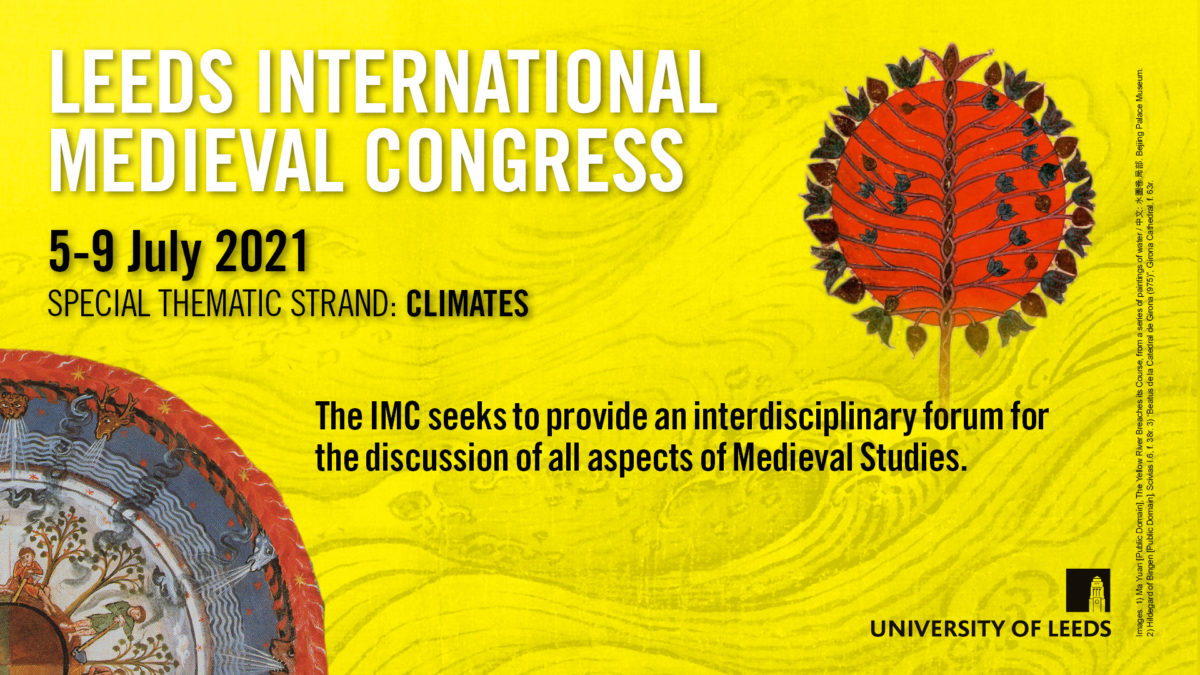
Postcard for the 2021 International Medieval Congress, Special Thematic Strand: Climates

Even that very modern feature has now acquired depths of history, however. After a reasonably successful trial the year before, when I just hadn’t been able to face being involved, the IMC had this year pinned their conference on a piece of conference software called Pathable. Now, I realise that there are quite a lot of tools for virtual conferencing, but the IMC, which usually runs between 24 and 30 parallel sessions over 4 days, day and full registration, and quite a few extras besides, scales up beyond what almost any of them will cope with. Pathable, I thought, was not bad given what we were asking it to do; it filled in its graphics behind loading the page in such a way that where you thought you were kept jumping away from you, but otherwise as an interface it was usable; it didn’t crash, which was kind of critical and always possible; and it managed to replicate or at least imitate a lot of the possibilities of the real conference. By that I mean it had facilities for inter-delegate messaging and personal meeting slots one could book between each other, standing pages for the various sellers (even if these were just static links out to their normal webpages) and so on. The one thing I don’t think it had was any way of replicating the serendipitous on-campus meeting, and looking back it occurs to me that maybe what it needed was an old-fashioned talker or something more like an IRC channel, where just anyone could chat with anyone else who was there. Maybe it did have that; or maybe we decided that was a netiquette horror-show waiting to be screened and forbade it; but either way I don’t remember it being bruited as a possibility. But whatever we might also have wished, it made the conference possible to hold, and we used it again for the hybrid portion the next year, and I think we’d have gone on using it had the company not gone out of business in spring 2023, hence all my past tenses in this paragraph. (Although, as the link above suggests, something seems still to exist, so it may be that a path out of bankruptcy was found… I don’t know, but we stopped using it.) Oh well…

Entry page for the Pathable site for the International Medieval Congress 2022

Entry page for the 2022 IMC Pathable site

Anyway. Using this software, I had a pretty good conference, and this is what I went to. The sessions titles are linked through to their static webpages, where the abstracts can be found. Detail comments on at least some of them follow below the cut.

Monday 5th July 2021

A day mainly of fine-grained Iberian Peninsula documentary stuff, with some Carolingian breaks out, a very on-brand bit of Jarrett conference paper selection, including in the former my sole actual contribution to the conference.

1. Keynote Lectures 2021

  • Innocent Pikirayi, "Towards New Climate and Environment Change Understanding in Africa: Re-Engaging the Medieval Climate Optimum/Anomaly and the Little Ice Age"
  • Jean-Pierre Devroey, "How to Write and Think about Political, Social, and Economic History in Dialogue with Climate and Environmental Data: a case-study in the age of Charlemagne, 740‒820"

103. Proprietary Memories: Notitiae-Inventories in Early Medieval Iberia, I – Making and Copying Lists

  • Wendy Davies, "List-Making in Old Castile before the Year 1000"
  • Julio Escalona, "An Inventory in Time: two versions of a San Millán List of Property"
  • R. M. Quetglas Munar, "Church Consecrations in Early Medieval Catalonia: the liturgy of making an inventory"

203. Proprietary Memories: Notitiae-Inventories in Early Medieval Iberia, II – Inventories and Serfs

  • David Peterson, "'Casati' and 'Collazos' in the Inventories of San Millán"
  • Lluís To Figueras, "Inventories and the Development of Serfdom in Catalonia in the High Middle Ages"
  • Letícia Agúndez San Miguel, "Counting People: lists of monastic dependents in the Kingdom of Castile and León (10th-13th Centuries)"

318. Living in the Carolingian World, II: peasants and the limits of social organisation

  • Noah Blan, "Conserve and Cultivate: peasants and a Carolingian moral economy"
  • Elina Screen, "Life in a Royal Landscape: evidence from ninth-century Carolingian royal charters"
  • Ellen Arnold, "Finding the Fishermen: hagiography and medieval traditional ecological knowledge"

403. Proprietary Memories: Notitiae-Inventories in Early Medieval Iberia, III – Inventories as Windows on Early Medieval Societies

Tuesday 6th July 2021

A day principally composed of sessions missing one person and a single super-powered keynote.

613. Frontiers and Crossroads of Italy in the Early Middle Ages

  • Christopher Heath, "Across the Border: communications, collaboration, and contact – Avars and Lombards, 567‒662"
  • Clemens Gantner, "Living in Interesting Times: the south Italian frontier in the ninth century"

699. Keynote Lectures 2021

    Ling Zhang, "Geoengineering an Empire – the Consumptive Mode of Analysis and China’s Medieval Economic Revolution"

718. Living in the Carolingian World III: testing the limits of the Carolingian world

813. Climate, the Environment, and the Natural World in Byzantium, III: environmental adaptation and social history

  • Anna Kelley, "Cotton Production and Environmental Adaptation in the First Millennium – a Chicken or Egg Argument"
  • Daniel Reynolds, "Political Climates: climatology in the Byzantine Negev and the politics of state building during the British Mandate"

Wednesday 7th July 2021

A day where I had to do my first digital moderating and apparently found it so taxing that I then missed almost all the rest of it.

1014. When Natures Punishes Humankind

  • Nikolas Hächler, "Natural and Supernatural Explanatons for Famines, Plagues, Natural Catastrophes and War under the Reign of Heraclius, 610‒641"
  • Chloe Patterson, "Contempt for the World? Apocalyptic Piety and Natural Retribution in Henry of Huntingdon’s Historia Anglorum"
  • Roque Sampedro López, "The 'Climate' of Political Opinion in the Libro de Gracián in Castile during the Reign of John II, 1405‒1454"

1303. New Faces in Medieval Iberian Studies, IV

  • Elisa Manzo & Donato Sitaro, "Orosius’s Hispania and Gildas’s Britannia: Roman imperialism through the Christian mirror"
  • Lilian Gonçalves Diniz, "Religion and Culture in Early Medieval Galicia: Christianisation, religious crafting, and popular piety on the outskirts of the world"
  • Abel Lorenzo Rodríguez, "Killing Bill? Murder Accounts and their Consequences through Documentary and Economy in Early Medieval Iberia"

Thursday 8th July 2021

A day in which I mainly stretched eastwards and backwards in time.

1501. Between Byzantium and Sasanian Persia, I: settlement and movement between limits of Erānshahr and the eastern Roman Empire

  • Kodad Rezakhani, "Between the Hammer and the Anvil: Byzantium, Sasanians, and north Syrian trade in the 6th century"
  • Domiziana Rossi, "How Did the Environment Affect the Spread of the So-Called Justinianic Plague?: New Reflections on Settlements and Movements between Persia and Byzantium"

1601. Between Byzantium and Sasanian Persia, II: the climate of leadership between Erānshahr and the eastern Roman Empire

  • Alberto Bernard, "Persian Military Officers: social and geographic mobility in the late Sasanian Empire"
  • Spencer C. Woolley, "Imperial Sacred Violence: Heraclius and ideological climate change between Byzantium and Sasanian Persia"
  • Sean Strong, "Vindicated, Dismissed, or Crushed: Roman-Sasanian Generalship and Punishment in the Late 6th Century"

1709. Late Antique Frontiers, I: authors and texts

  • E. V. Mulhern, “From Aurora to Britannia: Claudian and the limits of empire"
  • Allen Jones, "'It’s the End of the World as We Know It (and I Feel Fine)': Gregory of Tours, c. 594"
  • Conor Whately, "Ammianus Marcellinus on Frontier Landscapes and Romanity in the Fourth Century World"

1801. Between Byzantium and Sasanian Persia, IV: the climate of religious warfare between Erānshahr and the eastern Roman Empire

  • Callan Meynell, "From 'Eastern Rome' to 'Byzantium'? The Impact of the Last Roman-Sasanian War on the Intellectual Climate of the Miracles of St Demetrius"
  • Joaquin Serrano, "Relics, Icons, and Christian Holy Devices in the Roman-Persian Wars, 4th-7th Centuries"
  • Cosimo Paravano, "Political and Religious Warfare through Hagiography: The Case of St Golinduch between Byzantium and Persia in the Reign of Maurice, 582-602"

Even with all those missing papers, that’s still quite a lot. Where to start? Continue reading

Bad numbers by Karl-Ferdinand Werner

I’m not sure how true this is in this third decade of the twenty-first century, but if like me you were first learning about the Carolingian empire of Charlemagne and sons in the last decade of the previous one, you probably didn’t get far before you encountered the name Karl-Ferdinand Werner (1924-2008). Some of the really major studies of how that empire worked, administratively, came from his pen or typewriter, and he always seemed to be capable of understanding that the administration had to rely on and even create loyalty to operate, and so made affective response as much part of his thinking as procedures and law.1 He was, in short, quite important in the field, had a very interesting career between Germany and France, and was respected in both, and this post is not intended to diminish his legacy in any substantial way. It is just meant to suggest that like sadly far too many historians, he was far safer with words than with numbers…

Portrait photograph of Karl-Ferdinand Werner

Portrait photograph of Karl-Ferdinand Werner

The evidence for this comes from a conference paper he gave at the annual Settimane di Studio held at Spoleto by the Centro Italiano di Studi sull’alto medioevo, in 1967. So he was a little bit younger than I am now, for whatever that may be worth, and surrounded by the great and good of the field of that time, and the theme of the year’s conference was matters military. The reason I was reading this, back in 2021, was because after you get more than a couple of works deep, almost everything there is on the vexed question of how much of the population went to war in the post-Roman kingdoms of Western Europe cites or even just rests on the papers presented at this nearly sixty-year-old conference, and Werner’s perhaps most among them.2 So I was a bit surprised it was as free-flying as it is, since I had never read anything else by him that suggested he could jump so far from his evidence. And since I have a pedigree in calling account on bad numbers in history, and since this can’t go into my article on this whenever it finally comes out, I thought perhaps it would be entertainment for my erudite readership here.

What Werner really wanted to know is something that others have wanted to know since as well, and if David Bachrach is reading, well, thank goodness you did that work, Professor Bachrach, as certainly no-one should have let things rest where Werner did.3 The object of enquiry was the size of army that the Carolingians’ successors in Germany, the dynasty we call the Ottonians, could put into the field, and Werner wanted it to be big; his paper had been provoked by a work by a guy called Delbrück which wanted to minimise the war effort of which these sub-Roman kingdoms were capable, and to which Werner thought a response was needed.4 His starting point was a document from Salzburg called the Indiculus Loricatum, roughly ‘List of Armoured Men’, which does actually give some viable figures for an Ottonian call-out, probably in 981 (though Werner thought 983), and it’s a better source than we might hope to have.5 But it doesn’t quite deal with the situation Werner wanted, and so it had to be, well, stretched

What it’s not

The problems Werner faced lie in what the Indiculus isn’t, some of which are obviously related to what it actually is. So, for example:

  1. It seems to be a count of troops summoned to a campaign in Italy by Emperor Otto II, which means it’s not a call-out for the defence of Germany by Otto I, which would probably have been as close to a theoretical maximum as the numbers for service ever got. (One of the odd things about this paper is that it was in pursuit of that theoretical maximum despite occasionally admitting that that probably never happened).6
  2. It is a count only of armoured cavalry, which means it is possibly not a count of all the soldiers going, which one might expect to have included infantry, though I’ll come back to that.7
  3. It is a levy primarily from Saxony, which means it is obviously not the figures for the whole empire.8
  4. It is clear that not even all the known Saxon nobles were called, so that it’s not even a full levy from Saxony.9

All of that, of course, means that the figure it gives, which by Werner’s mathematics was 2,112 cavalrymen – remember that number, now – is necessarily a lot smaller than the figure Werner was after would have been. (It doesn’t help that the actual total seems to be 1,972.)10 And so the struggle begins to multiply it up to the "right" figure. Now, you know how I feel about this probably, but in case not, let me just quote once more the words of the late, great, Ted Buttrey:

When we enter on these kinds of calculation, we can be confident of two things. First, the answer will be wrong. Whatever it is, it will be wrong, since it cannot be right—once you are guessing, the number of possible permutations is gigantic. Worse, where the errors lie, and how serious they are, cannot be determined…11

And if we needed another example, this paper was it. Let me break it down, take it to the bridge and generally set the funk out (if I may)…

Multiplying up

How then shall we compare thee, o Indiculus, to a hypothetical full-scale imperial mobilisation? Let me count the ways.

  1. Firstly, we adopt a method already used by the rather later, but also great, Ferdinand Lot, who took early modern administrative divisions in France and their populations to give something like accurate multipliers for the fragmentary French records he was using for a similar, more pessimistic, exercise.12 Werner had some really quite good figures for known palaces, cities, fiscs and so on in Germany, and so some basis to repeat that, but…
  2. … they weren’t comprehensive, so he imposed an additional percentage as a guess for how many might not be included. First arbitrary alteration of the data…13
  3. The Indiculus figures also didn’t account for people who would not turn up, and neither did Lot’s.14 Firstly, obviously, we can’t know what that percentage in fact was, as this document only sets out what was expected, but it should make the real figure for turn-out lower than the Indiculus ones, you’d think; but Werner actually used this flaw as his excuse to go for the theoretical maximum hereafter.
  4. Then, going back to his early medieval administrative divisions, of course Werner didn’t have population numbers for these places as Lot had had from his anachronistic but proportional ancien régime data. So Werner just guessed, I’m afraid.15 Second arbitrary alteration…
  5. This had already got him to an empire-wide figure of 30,000 heavy cavalry that we can’t trust, but it was still only heavy cavalry, so he multiplied that by 3 to add the infantry. No basis for that multiplier was apparently thought necessary; just 3, you know, sounds about right.16 Third arbitrary alteration…
  6. Now, the Italian campaign factor. Here he made several assumptions: that troops would have been left at home for defence (extremely likely, I’d say, but of course unquantifiable except by step 1 above and that not really), that the campaign really was that of 983, not 981, and that therefore troops already sent to Italy in 982 might still be there, for a further discount; and that the nobility who are not listed should actually be included, even though the author of the source obviously didn’t think so. All of those, of course, need numbers making up to patch the gaps…17 Arbitrary alterations four, five and six.
  7. And lastly, because apparently none of this was enough, at around the twenty-five-page mark, the base number he got from the Indiculus in the first place, 2,112, suddenly becomes 4,000 for no obvious reason and without remark, which of course nearly doubles all his subsequent sums!18

But what if… ?

So just by way of illustration of where this gets us, we start with that actual early medieval figure of 2,112 people we could maybe even call knights, whom we know were expected to go to Italy, maybe in 983, on the emperor’s command, mainly from Saxony, and probably not all of whom did. By the time Werner had finished stretching this that expedition had become a force of 20,000 men, which as Carlrichard Brühl pointed out (and others have since repeated, mainly the late and also great Timothy Reuter), means that some of the armies we’re talking about exceeded the populations of most medieval cities.19 The potential error is therefore rather more than a full order of magnitude, but of course as Ted observed, we have no idea what it actually is. Werner could even have been right about all this, though I think the top end of the range is unlikely. But that is only to apply my own subjectivities in balance against his, and his basic assumption that the person responsible for the service would have brought people with him in support is probably fair. I am therefore temperamentally inclined to agree that the Indiculus isn’t a full picture, but…

Bamberg Staatsbibliothek Msc. Patr. 107 fo. 1, manuscript of the Indiculus Loricatorum

Speaking of full picture, here is the actual thing, Bamberg Staatsbibliothek Msc. Patr. 107 fo. 1, manuscript of the Indiculus Loricatorum, which was written into the leading blank page of a codex otherwise full of theology, largely Augustine. Image from the Bayerische Staatsbibliothek MDZ, licensed under CC BY-NC-SA 4.0

But let’s, just for a moment, try the counter-case. A different highly-respected German historian of this period, Hubert Mordek, once wrote another of my favourite methodological quotes, „[M]an muss der Überlieferung immer die Chance geben, recht zu behalten“, which we might translate loosely as, “You always gotta allow for the possibility the sources are just right”.20 And the source says, 2,112 mounted soldiers with mailcoats, almost all from Saxony. Not just that, either: Werner brought in numerous other sources from later or different German contexts to suggest that this was, indeed, roughly the sort of level at which kings in Germany could demand such service; another weird thing about this paper is that it itself gives you all the tools you need to dismantle it.21 So what if it is right? What if it was 983, there already was an army in the field in Italy, and Otto II felt it was necessary temporarily to weaken defence in Saxony and raise what could be raised from there to supplement the Italian force, with strictly mobile troops who could therefore get there soon enough to make a difference? What if therefore it was actually only cavalry and supporting grooms and so on that went, and from there and in that number because that was all they could safely levy? What if this was the operational maximum? It does still imply quite a large Ottonian army in total, what with a presumably-larger force in Italy with an infantry component and remaining defences in various places; but it doesn’t require us to think that an Ottonian Germany already at war could suddenly fling another 20,000 men at the problem. And I’m not saying that caution is right either. I’m just saying it’s a way way simpler conclusion than the one Werner reached which requires no messing with the numbers. And those, by and large, are the conclusions I prefer.


1. I guess I think here especially of K. F. Werner, "Missus – Marchio – Comes: entre l'administration centrale et l'administration locale de l'empire carolingienne" in Werner Paravicini and Karl Ferdinand Werner (edd.), Histoire comparée de l'administration (IVe–XVIIIe siècles) (München 1980), pp. 191–239, reprinted in Werner, Vom Frankenreich zur Entfaltung Deutschlands und Frankreichs: Ursprünge, Strukturen, Beziehungen. Ausgewählte Beiträge: Festgabe zu seinem sechzigsten Geburtstag (Sigmaringen 1984), pp. 121-161.

2. K. F. Werner, "Heeresorganisation und Kriegführung im deutschen Königreich des 10. und 11. Jahrhunderts" in Ordinamenti militari in Occidente nell'alto medioevo (Spoleto 1968), 2 vols, vol. II pp. 791–843 with discussion pp. 849–856.

3. Referring here of course to David S. Bachrach, Warfare in Tenth-Century Germany (Woodbridge 2012).

4. Werner, "Heeresorganisation und Kriegführung", p. 813, referring to the original publication of Hans Delbrück, Geschichte der Kriegskünst in Rahmen der politischen Geschichte, 2nd ed. (Berlin 1920), 4 vols, transl. Walter J. Renfroe Jr. as History of the Art of War (Lincoln NB 1975), 4 vols, vol. II in both editions, the German 1st ed. being in the Internet Archive here.

5. Printed as “Indiculus loricatorum Ottoni II. in Italiam mittendorum” in Ludovicus Weiland (ed.), Monumenta Germaniae Historica (Constitutiones et acta publica imperatorum et regum) I (Hannover 1893), pp. 632-633, online here, transl. W. North as “Indiculus Loricatorum (Index of Armored Contingents)”, Amazon Web Services, online here.

6. Werner, "Heeresorganisation und Kriegführung", pp. 823-824 and 817.

7. Ibid., pp. 820-821.

8. Ibid., pp. 831-832.

9. Ibid., pp. 806-808.

10. Ibid., pp. 817-819. The lower total I get by adding the figures given by North, “Indiculus Loricatum”. I probably should have added them myself from the manuscript, but come on guys, this is enough work already.

11. T. V. Buttrey, "Calculating Ancient Coin Production: Facts and Fantasies" in Numismatic Chronicle vol. 153 (London 1993), pp. 335–51, on JSTOR here, at p. 349.

12. Ferdinand Lot, L’art militaire et les armées au Moyen Âge en Europe et dans le Proche Orient (Paris 1946), 2 vols.

13. Werner, "Heeresorganisation und Kriegführung", pp. 817-820.

14. Ibid., p. 816.

15. Ibid., p. 820.

16. Ibid., pp. 820-821; he repeated this argument pp. 833-834 with a reference to an eleventh-century French call-out from Moyenmoutier where each knight was accompanied by a manus, a hand, of other troops, but that was somewhere else somewhen else and still doesn’t specify 3 as a multiplier.

17. Ibid., pp. 824-826 & 831-832.

18. Ibid., p. 829.

19. 20,000 men: ibid., p. 829; Brühl, in discussion p. 851; Reuter, in "Carolingian and Ottonian Warfare" in Maurice Keen (ed.), Medieval Warfare: a history (Oxford 1999), pp. 13–35.

20. Mordek, "Karolingische Kapitularien" in idem (ed.), Überlieferung und Geltung der normativer Texte des frühen und hohen Mittelalters (Sigmaringen 1986), pp. 25-50 at p. 30.

Not what the textbooks usually mean by ‘manuscript illustration’

Thankyou all those who have encouraged me to keep going with the blog! Plans remain afoot, but for now you can certainly have this little gem (not a lettuce) which apparently I stashed for future writing up in May 2021. It speaks to some of the blog’s oldest themes, to wit protochronism, micro-histories in administrative documents and, not least, medieval sex, and I owe it to the sharp observation of Rebecca Darley, who had she known she was going to be doing the blogging thing herself after a while might well have kept it; so thankyou Rebecca, but it’s mine now!

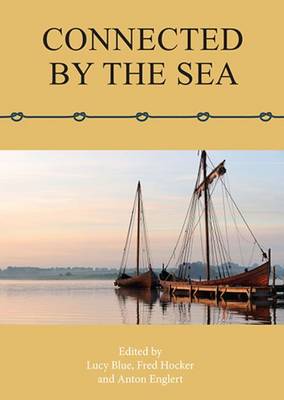
Cover of Lucy Blue, Fred Hocker and Anton Englert (edd.), Connected by the Sea: Proceedings of Tenth International Symposium on Boat and Ship Archaeology, Roskilde 2003 (Oxford 2006)

Cover of Lucy Blue, Fred Hocker and Anton Englert (edd.), Connected by the Sea: Proceedings of Tenth International Symposium on Boat and Ship Archaeology, Roskilde 2003 (Oxford 2006)

Right, so, we’re out of my usual territory now, because of Rebecca reading her way through the proceedings a Festkonferenz held at the Viking Ship Museum (as it then was) at Roskilde, no less, for archæologist of boats and ports, the late Seán MacGrail.1 Obviously not everything in the resulting volume is in either of our areas of interest, but it is nice all the same to read what you own and find out what others are interested in, and thus she came across Professor David Hinton, who gave Professor MacGrail a paper on tax returns from East Anglian shipowners as of 1344. That is apparently the first point at which we have that sort of record, as part of a series of occasional taxes on people’s movable property to pay for the Hundred Years War called lay subsidies.2 The 1344 returns go down, in some places, to individual shipowners, their named ships and it’s all very interesting, but midway through dealing with King’s Lynn Professor Hinton, who is at this point chasing a distinction between the texts seem to make sizes of ship, jumps to a fifteenth-century overseas tax record from the town, in which one of the smaller vessels, batelli, is recorded.3 And this is where the blogpost suddenly comes from:

"… overseas customs lists include a 15th-century account of a vessel in a creek, its forfeited cargo interesting for its mixture of wool and rabbit-skins, hardware, jet and glass beads, harp strings, lewd calendars and such-like, said to have been ‘in magno batello vocato kele‘…"

Professor Hinton is in many ways a better man than I, as is clear from the fact that he really is in this only for the boat-related philology and does nothing further with any element of that heterogenous cargo. Whereas I, and perhaps you, immediately reacted with: "lewd calendars?!"

So, perhaps these are well-known to scholars of high medieval England, but a long time ago in the history of this blog, and indeed others now long gone like The Naked Philologist and Got Medieval, we had quite the discussion about medieval pornography, largely because we kept getting searches for "medieval sex pictures" and the like.4 As I recall, the tentative conclusion was that there really wasn’t any, or at least none that survives or is referred to. Carl Pyrdum of Got Medieval, who had invented the rod for his own back that was Google Penance, where you try and post what people actually came to your blog looking for rather than what they found, eventually found one manuscript illumination of Lancelot and Guinevere in bed together where as well as their heads you can see, like, two naked upper chests, and that was about it. But we obviously just weren’t looking low enough (in society, I mean).

Alamy clip of Le Livre de Lancelot du Lac, British Library Additional MS 10293, fo. 312v, showing Lancelot and Guinevere conversing in bed

That image is actually pretty easy to find, being in Le Livre de Lancelot du Lac, British Library Additional MS 10293, fo. 312v. Unfortunately, because the British Library’s digitised manuscripts are still unavailable after the cyber-attack there last October, this Alamy clip is the best currently out there. I reproduce it anyway, however, since the real image is public domain.

But the news that in fifteenth-century England there was actually enough of a market for the saucy calendar that you could ship them in, albeit in a ship whose crew were trying, apparently badly, to smuggle their cargo in rather than pay duty, raises all kinds of questions. Where were these calendars actually being made? Amsterdam leaps to mind but for completely anachronistic reasons – unless they’re not! and so on. Also, are we talking just a count of days to the month, each with perhaps a seasonally-disattired woodcut, a list of festivals and dates? All the actual medieval calendars I know of are roughly page-per-month of almanackish text, saying what there is about the month that is notable, including feast days and so on, and they’re overall much more like books. In some cases they have marginal illustration, however, and the marginalia are presumably where, in this case and if you’ll forgive the phrase, the action was.

Labourers clearing land, in a calendar illustration for February in London, British Library, Cotton MS Tiberius B V/1, f. 3v

I know this isn’t very lewd, but we’ve already sailed quite close enough to the wind there thankyou, plus which, as I say, I’m not sure we have any of that sort of calendar. Instead, here are some labourers working at the top of February in London, British Library, Labourers clearing land, in a calendar illustration for February in London, British Library, Cotton MS Tiberius B V/1, f. 3v

So the "classic" pin-up calendar on the wall of a King’s Lynn chandler is probably not what we have here. But what did we? Professor Hinton is probably right that it’s not the important thing to focus on here – apart from anything else, it leaves cruelly ignored the question of what market there was in Lynn for black-market harp-strings… – but I can’t help but wonder, and then feel slightly prurient for doing so. Still. Anyone know more? If not, I hope at least this is some good old 2012-style entertainment for you all!


1. Lucy Blue, Fred Hocker and Anton Englert (edd.), Connected by the Sea: Proceedings of Tenth International Symposium on Boat and Ship Archaeology, Roskilde 2003 (Oxford 2006).

2. David Hinton, "Ships and Subsidies" in Blue, Hocker and Englert, Connected by the Sea, pp. 205-209.

3. Hinton, "Ships and Subsidies", p. 206.

4. The Naked Philologist clearly won that round by observing, of a search for "naked medieval people", "How are you going to tell? They’re naked."