In Marca Hispanica V: Vic (charters, cathedrals, metal bishops and stone slabs)

Vic is the capital of the old Carolingian county of Osona, and a place with a long history. There’s a standing Roman temple, to which we sadly didn’t get, but that belongs to the city of the site of pre-Roman Ausa, from which we get the county name of Ausona. That area stands away from the modern city which is built on the plain closer to the river, and seems to have been put there by none other than Count Guifré the Hairy some time shortly before 880.1 The historic centre is close by, however, because the cathedral was deliberately sited to take advantage of and reclaim the Roman site. And there, with none of the Carolingian fabric left but a fascinating set of strata of rebuilding visible in its walls, it remains:

The Catedral de Vic, seen by night from the Plaça de la Catedral

The oldest standing part of the cathedral now is the bell-tower, which dates to a rebuild in 1038 by Bishop Oliba, great-grandson of Guifré the Hairy and a complex figure who had been Count of the Ripollès before abandoning the world to become a monk at Santa Maria de Ripoll, that comarc’s main focus. Since he thus wound up as abbot there and at several other places, at the same point as his half-sister took over neighbouring Sant Joan de les Abadesses, whom he subsequently appealed as a “whore of Venus” before Pope Benedict VII, I’ve been known to wonder about how sincere and unpolitical that conversion was. But as his uncle Miró, who was one of the most educated men in Catalonia in his time, had seen no problem with being both Count of Besalú and Bishop of Girona, and Oliba turned out to be a liturgical and social innovator, I suppose he may just have been pushed into all the politics.2 Anyway, he is remembered at Vic, though not in a form that one would perhaps expect. Here he is:

Statue of Bishop Oliba of Vic in the Plaça de la Catedral

Metal! But in a nice way: the words on his chest, “Pau i Treva”, translate as ‘Peace and Truce’ and refer to his efforts to build a popular movement to limit knightly violence in his lands. That’s worth remembering him for, perhaps more so than for shopping his bastard sister for parricide and loose morals.3 So I was quite glad to see it, but again, it’s that sense I kept getting that round here the medieval history is an important explanation of political identity. I did try and get a picture of the metal bishop with the tower that he saw built as background, so as to make that connection visually again, but the strong light behind him basically made it unusable, and for a reason I don’t now recall it wasn’t possible to repeat it when I came back next day. We spent part of the evening in Vic, anyway, which is when these shots were taken, and my conclusion is that it’s a really nice city, but its liveliness is a little artificial. And it has a tremendous number of shoe-shops. I mean, a frightening and possibly apocalyptical number of shoe-shops. There is a lot of pig-farming round here, it permeated the rural atmosphere for miles around, and this may be part of an explanation, but it did seem as if Vic, like Cambridge again, was trying to drag in shoppers as an substitute for having any real purpose. (The silly thing with Cambridge being of course that it does have a purpose, and that the public transport and roads are so impassably minuscule that the number of shoppers they want could never reach the town. But moving back to the subject.)

An awful lot of what I have written about centres on Vic, if only because an awful lot of charter transactions I’ve used as evidence probably took place in that square where Oliba now glowers. The cool thing about that is that the evidence of this is also still there, in the Arxiu i Biblioteca Episcopal de Vic, and that was where I headed the next morning. It took us a little to find it in the skein of buildings around the cathedral—and the episcopal cats were uninformative:

Cats behind the Palau Episcopal de Vic, in the sun

—but soon I found the door and knocked and was welcomed. Now, most Hispanists I’ve talked to have had some real horror stories about access to archives, of the “we only open one day a week for two hours in the afternoon. What day? Well, when do you go home? Wednesday? Thursday, then. And only if you speak Galician throughout so I can mock you. And you can’t actually touch anything and whatever it is you want to see most is locked and can’t be used” kind. So although I was rather hoping things would be better than that, as the places I wanted to go had, for example, websites, I wouldn’t have minded a war-story or two. In this I was completely disappointed. They had missed the e-mail in which I’d told them of my visit, but this was in no way a problem and didn’t prevent me being allowed, having just walked in off the street and showing no identification beyond English confusion and some shelfmarks, to have practically all their tenth-century charters out at once to look at:

The volumes of Calaixs 6 & 9 of the Arxiu Episcopal de Vic

In this I principally owe thanks to Rafael Ginebra who was doing the fetching, and who had also previously done the indices for the biggest and most important charter edition I use, and has therefore saved me an incalculable amount of work.4 I also owe thanks however to the archivist, Miquel Sants i Gros, who was politely hauled out to show me the tenth-century papal papyri they also have here—in fact Vic has almost all of the surviving tenth-century papal papyri in the world—and about which I wrote something ages ago that may even some day make it to print. One of the things that a reviewer had to say about that paper was that it wasn’t at all clear I’d seen the things for real. And I hadn’t, indeed, but I’d worked from (and compared) two separate facsimile editions, one from before their restoration in 1928 and one after, the latter being far far easier to read, obviously, but also, I was concerned, perhaps too restorative.5 So working from the unaltered facsimiles actually seemed like better practice to me anyway. And seriously, what is the point of producing facsimile or even critical editions if work using them is automatically panned, eh? Calm down Jarrett, calm down. Right, yes. Anyway, so what I was doing in this archive was mainly heading off that sort of criticism…
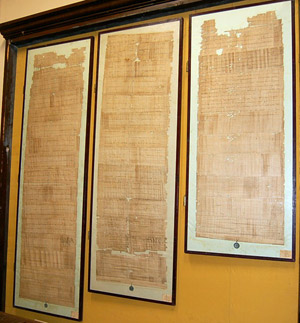
The three alleged papal bulls of 971 from John XIII to Catalonia

… and also solving some of the questions that editions won’t let you answer, like, is that the same scribe Agelà who writes this other one? (It wasn’t, in any of the three cases, and a really good edition ought to tell you that clearly anyway, but there is a certain level of data you have to omit or never ever publish, of course; the relevant edition here took long enough anyway.6)

This left me flicking carefully through those volumes above, which have rows of three or four parchments stitched into a binding to make a kind of flap-book leaf, and then another set, and so on, till no more will fit. Individually, they look like this one:

Arxiu Capitular de Vic, Calaix 6, núm. 2090

Let me give you an example of the sort of question I was trying to answer. In the edition of the Vic charters, the editor warns you of his no. 246, which is a bequest, that a legacy to Bishop Radulf is added in a different ink. As I’m continually trying to problematise the idea of charter production, people messing with charters is meat and drink to me, so I wanted to see the original, and actually it’s more interesting than you would suppose:

Close-up of Arxiu Capitular de Vic, calaix 9, episc. I, núm 50

Now the bit we’re interested in is five lines down, the gap, and the clause in the middle there which, you can take my word for it, reads (with gaps between words and the abbreviation expanded): “& ad seniori meo rodulfo ep[iscop]o ipso meo freno parato”, ‘and to my lord Bishop Radulf my selfsame embroidered bridle”. This is interesting because it’s not, as I had thought, an afterthought or even a fraud; for a start, although you can hopefully see that it is in a different ink, it’s by the same scribe, the handwriting is the same. More to the point, the bulk of that line was apparently left blank when the charter was first drawn up, as if they were expecting more to come. And where they added the first extra bit that we now see, it’s all squeezed up tight, as if there was going to be another extra clause put in after that. So three phases of redaction minimum, except that the third one never happens. Not, in any case, an on-the-spot production but something planned, worked out, agreed on and then somehow unfinished. This is the sort of problematisation I mean.

Before I emerged from the archive, Dr Sants had very kindly given me a tour round the whole thing. It’s huge. It occupies most of the old episcopal palace, and the stuff they have in there made me feel goshdarned ungrateful to be an early medievalist, because there’s so much brilliant stuff sitting there, perfectly preserved in dry cold, not being used. What could you do, for example, with a series of parish registers that runs from the Spanish Civil War back to circa 1280? With marriage registers for a town running from the fourteenth century to the present day? And quite a lot of gorgeous manuscripts too. In only wanting to use some 700 of their earliest tatty fragments, I did feel as if I was missing a trick somehow. I do recommend a trip to look if you’re in search of a project, though you will need to speak at least French and preferably Spanish, or best of all Catalan. If you must speak Spanish, at least affect a foreign accent so that they know you know no better.

The other thing that we did once I’d emerged into the light was visit the Museu Episcopal de Vic, which is on the same square in a very modern building. It sounds a little parochial, and I suppose it is but this is my parrochia, and it is actually the main museum of the surrounding area; when a local church is dug, for example, the bits wind up here. That said, they also have a small but interesting collection of Ancient and late Antique Egyptian stuff, why I don’t know, and a really good numismatic display, including the only two coins that really might come from tenth-century Catalonia. They also have, and this is what I was really after, a stone slab from the early church that preceded the monastery of Sant Pere de Casserres, which is (I have now seen and can say) covered in inscribed names in eleventh-century hands and spellings, and raises all kinds of questions I’ll solve some day about acceptance and integration of the monastery (which was founded in 1006). They also have a seemingly endless collection of wooden statues of Madonna and child but the other stuff, and the Museu bookshop, which sold me several vital things I could never have got in the UK, more than made up for this slight obsession, which didn’t really float my boat, gorgeous though some of it was. What they didn’t have, as you may by now have guessed, was permission for people to take photographs, but their website is good even if the English-language sections don’t go very deep, and I do recommend having a poke round it (requires Flash).

So that was Vic, and we left it having bought stuff to eat a peasant-style lunch with and went in search of a castle, which I’ll tell you about later.


1. The standard work on the city, if their website there isn’t enough for you, is Ramon Ordeig i Mata, Els orígens històrics de Vic (segles VIII-X) (Vic 1981), but some account is to be had in English from Paul H. Freedman, The Diocese of Vic: tradition and regeneration in medieval Catalonia (New Brunswick 1983), online at http://libro.uca.edu/vic/vic.htm, last modified 17 August 2000 as of 22 March 2008.

2. Oliba has been unusual in attracting quite a lot of attention from English-language scholars. The classic work on him is still in Catalan, Ramon d’Abadal i de Vinyals, L’Abat Oliba, Bisbe de Vic, i la seva època (Barcelona 1948; 2nd edn. 1948; 3rd edn. 1962), 3rd edn. repr. as “L’Abat Oliba i la seva època” in idem, Dels Visigots als Catalans, ed. J. Sobrequés i Callicó, Estudis i Documents XIII-XIV (Barcelona 1969, repr. 1974 & 1989), II pp. 141-277. However, to this one can now add Adam J. Kosto, “Oliba, Peacemaker” in I. Ollich i Castanyer (ed.), Actes del Congrés Internacional Gerbert d’Orlhac i el seu Temps: Catalunya i Europa a la fi del 1r mil·lenni, Vic-Ripoll, 10-13 de novembre de 1999 (Vic 1999), pp. 135-149, and, more obtainably, Paul H. Freedman, “A Charter of Oliba before his Entry into Religious Life” in Robert F. Berkhofer III, Alan Cooper & Adam J. Kosto (edd.), The Experience of Power in Medieval Europe, 950-1350: essays in honor of Thomas N. Bisson (Aldershot 2005), pp. 121-128. If you should want to study the metal man here, every scrap of writing that he produced or that mentions him (except that one presented by Freedman in the previous reference) is edited in Eduard Junyent i Subirà (ed.), Diplomatari i Escrits Literaris de l’Abat i Bisbe Oliba, ed. Anscari M. Mundó, Memòries de la Secció Històrico-Arqueològica XLIV (Barcelona 1992), and in there the papal condemnation of Abbess Ingilberga and her nuns is Diplomatari no. 49. Note that Oliba’s nephew Guillem immediately got the nunnery’s spare lands to become Bishop of Besalú with (ibid., no. 10); obviously nothing set-up about that at all! Meanwhile, on the Count-Bishop Miró, see Josep María Salrach, “El Bisbe-Comte Miró Bonfill i la seva obra de fundació i dotació de monestirs” in Eufèmia Fort i Cogul (ed.), II Col·loqui d’Història del Monaquisme Català, Sant Joan de les Abadesses 1970 vol. II, Scriptorium Populeti 9 (Poblet 1974), pp. 57-81, with English summary pp. 422-423.

3. See Kosto, “Oliba”, and more generally on the Peace of God, Thomas Head & Richard Landes (edd.), The Peace of God: social violence and religious responses in France around the year 1000 (Ithaca 1992).

4. Rafael Ginebra & Ramon Ordeig, “Índex alfabètic de noms” in Ramon Ordeig i Mata (ed.), Catalunya Carolíngia IV: els comtats de Osona i Manresa, Memòries de la Secció Històrico-Arqueòlogica LIII (Barcelona 1999), 3 vols, Pt. 3, pp. 1355-1563.

5. The two editions are P. Kehr, Die ältesten Papsturkunden Spaniens, erläutert und reproduziert, Abhandlungen der Preussischen Akademie der Wissenschaften, Jahrgang 1926, Philosophisch-Historische Klasse, Nr. 2 (Berlin 1926), and Pontificum Romanorum Diplomata Papyracea quae Supersunt in Tabulariis Hispaniae Italiae Germaniae phototypice expressa iussu Pii PP. XI (Roma 1929). The paper is called “Archbishop Ató of Osona: false metropolitans on the Marca Hispanica” and I hope to have it resubmitted some time in the latter part of this year.

6. That edition being E. Junyent i Subirà (ed.), El Diplomatari de la Catedral de Vic, segles IX i X, ed. R. Ordeig i Mata (Vic 1980-1996), 5 fascs, in which these two charters are nos 247 & 246 respectively.

More theory: genealogical narrative and the feudal transformation

There is a paper by Randolph Starn in that van Engen volume I mentioned starting so long ago, called “Who’s Afraid of the Renaissance?”.1 Its main purpose is to argue that medievalists and Renaissance scholars cannot afford, for all that they do subtly different things with their material, to exclude each other from their orbits. This may well be true but as someone whose period comes nowhere near the Quattrocento I’m not worrying too much just now. He does however say some interesting things about periodization.

He observes as an initial point that if you imagine there was a Renaissance at all, you are implicitly accepting three periods; the Renaissance itself, the golden period which it revives, and the interval in between in which that period was in eclipse. We usually call these the Renaissance, Antiquity and the Middle Ages respectively of course but they are all required by the concepts embodied in the first alone, and some have rejected them. Again, all fine. But because one of the things that occupies Renaissance and late medieval scholarship, he argues, is setting the boundary between each other, a boundary that he argues is unhelpful, it is very focused on a grand narrative transition between epochs. And he argues that this is unhelpful because it neglects things that don’t fit the story, and this is also all very fair and true and needs not to be forgot.

So his alternative is to suggest, rather than a narrative approach, a genealogical one. He suggests that rather than telling one story we follow lines down, or up, through history, looking for connections as a genealogist looks for ancestry or descent, expecting some branches to stop, other new ones to `marry’ in, thus allowing things to enter and leave the family without prejudice to their importance or the family’s. I quite like this conceptually, even though I don’t usually have to worry about grand narratives (except the ruddy feudal transformation) because of focusing on nature’s narrative duration, the lifespan, rather more than many. He is certainly right that this allows for a more nuanced and personalised reading of history than a truly big story like `the end of the Middle Ages’, and various analogies with modern family tree software that lets you zoom in and out on particular generations or groups could also be worked in.2 The trouble comes when you stop trying to work vertically.

A real family tree or genealogy has siblings on it. It also has collateral lines, running in parallel but not directly linked. This model has no power to distinguish between the two. Let’s take the good old Transformation, since I can discourse on it easily. As you’ll see from the diagram thumbnailed below, I have views on how things derive in the feudal transformation. I’d also like to keep them so please, if you should find it useful, use it with my name attached and copyright recognised, without other change. But back to the thread.

Teaching diagram of the Feudal Transformation

Somehow, for example, we descend down this notional tree from, for example, a system where the court is the dominant field of political interaction to one where castle lordships are as high as it gets. We also descend from, let’s pick something fairly neutral, an armed yeomanry to a subject and disarmed peasantry who are `protected’ by armoured horsemen. So is the court the `sibling’ of the armed peasantry? Is the castle the `sibling’ of the knights? That latter sounds as if it makes sense, the former less so, though it’s kind of been argued. So which of those two from the upper generation is the parent of the latter two? Do they in fact give rise to either? Even together? Or are they in fact separate `families’? Why are they on the same tree then? And yet they clearly are related, even if only by time, whereas our scheme demands more consequence than that.

So I think it’s a nice idea, but when I try and put something I want to explain into it, it doesn’t help, and probably forces me to make false associations or ignore important ones. Therefore I suspect that it’s not much use for explaining things that actually happened. We may have to keep telling stories instead.


1. Randolph Starn, “Who’s Afraid of the Renaissance?” in John van Engen (ed.), The Past and Future of Medieval Studies (Notre Dame 1994), pp. 129-147.

2. I should speak a word here for Spansoft‘s Kith & Kin, which has been helping me keep families sorted and Catalan noblewomen called Adelaide distinct since 1999. Not that modern, therefore, although current versions look very different from what I started with (a shareware version that you can still find on the internet in places), but really quite robust and useful. Doesn’t deal gracefully with cousins who marry, though; if anyone knows anything that does, I’m open to suggestions also.

In Marca Hispanica IV: Sacalm and Tona, and nationalist sentiment 889-2008

It’s everywhere in Catalonia, we found, not just in stickers on the walls in the cities, sometimes even sheets of A4 posted up like cheapskate posters in whatever space is to hand, peeling in the frequent rain; not just spray-painted on the roadside as you leave the towns and head into the hills, but really in a great many places. What am I talking about? This flag:

Flag of Catalonia

The most impressive example we saw was on the road from Arbúcies to Vic, on the way down from the hills around the rather lovely landscape of Sant Hilari Sacalm, which look like this:

Scenery around the hills south-west of Sant Hilari Sacalm

No flag there, but just over the crest, coming down off the hill onto a viaduct that took us across the next precipitous valley, one approaches the bridge from an oblique angle, which meant that we had plenty of time to observe that flag painted vertically up all sixty feet of the far side’s concrete piling. Invisible from the viaduct, impossible to miss from the hill, and testimony to a good few nights’ work with ropes and cradles I rather think! Strong convictions are at work here. These flags were often accompanied by slogans, most obviously the perennial “Catalunya no es Espanya!” but sometimes more serious ones like (I translate) ‘three hundred years of occupation and resistance!’. It’s a live issue here. The Catalan language was suppressed by Franco, and until the early 1970s, you could be jailed for speaking it in public. Although the language is now declining again, stickers saying “En català si us plau!”, ‘In Catalan, please!’, were not uncommon sightings during our stay. And we managed to be there during the General Elections, too, in which across Spain as a whole both mid-right and socialist parties gained seats and the socialists stayed in power. In Catalonia the right did not make any ground, and the country’s only remaining deputies from l’Esquerra, the far left party, were elected in Catalan seats. The paper next day was saying how Catalonia’s Socialists had kept Zapatero in power. Lots of people remember Franco in Catalonia. And as a consequence, the flag gets everywhere.

Sant Andreu de Tona and the Castell de Tona

We found it on top of a hill in a place called Tona, to the south of the city of Vic. I’d wanted to come to Tona because it’s documented very early. The church you see in the background of that picture, Sant Andreu, is eleventh-century as it stands but we have a consecration act from 889 which saw an earlier Sant Andreu set running by Bishop Godmar of Osona, almost the only sign that this very frontier place was in contact with the wider structures of authority for about forty years. They seem however to have had their own structures of authority, and I do mean structures: that tower in the foreground may be the oldest medieval building in Catalonia. Here it is in its full glory, viewed from across the ditch that separates it slightly from the rest of the hill:

The Castell de Tona

As you can see it’s been slightly reconstructed, but we don’t really know how old it is. It’s much more weathered than the church, and it basically looks like a Roman guard-tower. Its floor has been dug and remains that could have been late Roman were found, but archaeological opinion is unsure whether what we’re actually looking at here is a Roman tower itself or a medieval replacement, a question which is complicated because there’s no evidence that Tona was ever on a Roman route that might have merited a guardtower. Dates suggested have gone all the way from the fourth to the eleventh centuries. It’s a good place to put a tower, locally, but the landscape is pretty weird round here, full of sedimentary piles called turones, and as you can see…

The turones around the Turó del Castell de Tona

… you can’t really see very far from the hilltop.

The controversy over dating extends to the church. As I say, the existing fabric is eleventh-century, very early Romanesque, but when it was briefly dug in 1943, they found foundations of a smaller stone church beneath its floor. Now, prevailing opinion is that a stone church is very unlikely to have been put up on this hill in 889, though the local stone, of which the tower is made, is pretty easy to work. That implies either, that the foundations they found were from late tenth-century, and that church was almost immediately replaced by the current one; or else it implies that the stone church was there from much longer ago. At Santa Margarida de Martorell they have extensively dug a church that turns out to have been standing, subject to various alterations, since at least 351, and other places like Casserres and Olèrdola suggest that a hilltop like this could well have been the centre of a late antique necropolis. Sure enough, the one other test excavation that’s been done up here, at a place on the hill called Pla de les Lloses, ‘plain of bones’, turned up burials, but as the `dig’ was only a hole 50 cm by 50 cm, exact dating was tricky, and the ceramic sequence round here is almost useless for this anyway: the material culture as it survives in the record irritatingly fails to change at all during all these huge changes we feel sure peasant society was experiencing in the tenth and eleventh centuries :-) (It does however spread.) So the very old church, perhaps being reconsecrated in 889, is a definite possibility.

But they don’t say it’s an ancient church in the document, and at Olèrdola it’s been suggested that the church was actually much later than the burials. However, what the parishioners at Tona do seem to say is that they are different from others for whom the same scribe, a very elaborate priest based at Vic who goes by the name of Athanagild, writes. At Tona, the people who endow the new church are called viri illustri, and the others homines commanentes, terms which are straight out of the late Roman lexicon and which don’t appear in any other charter of the area and period. Furthermore, one of those endowing the church, whose son Albaro will be its priest, indeed, is called Centuri, in Latin centurius, in English Centurion, and we know from later documents (which are how I got into this wild spot’s history) that he had another son who also bore that name, and was identified by his father in an age when hardly anyone was. So this is an odd setup, and I’ve wondered before now why these people apparently thought of themselves as Romans; in fact I did it out loud at Queen Mary University of London not so long ago, which is why I’m not giving my usual cluster of references: this will be in print before long and you can get them from there.1 I suspect, however, that the answer is that they knew they were Romans because there was this tower that everybody knew perfectly well had been left by the Romans on their hill. I don’t know that it actually is that old, but I’m pretty sure that their strange romanitas here stems at least in part from their very Roman-looking focus on the hill. And I suspect that that in turn makes them quite likely to have built themselves a proper, Roman-style, meaning stone, church. That in turn brooks a reasonable amount of coordinated labour and appropriation of surplus, which is what I want to know about. So I made sure I’d been here:

A certain historian standing in the doorway of the Castell de Tona

But there was the initial point, somewhere back there. In Tona they seem to always have had a long sense of their past. 889 is not forgotten here: also on the hill with the various Iberian remains, the perhaps fourth-century mini-castle, the Romanesque church and the undatable burials hidden below the surface, and with the torn but proudly fluttering Catalan flag on its pole, is this memorial to the founders of the first-documented church of Sant Andreu here. Centuri’s name is in the middle of the eleventh line:

The memorial to the founders of Sant Andreu de Tona on the Turó del Castell de Tona

And from that memorial to something that happened eleven hundred years ago and isn’t detectable in anything except one flaky charter, you can look down on the now-thriving town:

View of the town of Tona from the Turó del Castell

And you can hear the Catalan flag fluttering off to your right, and it’s not just in one’s own mind that that tower, charter, church, memorial, town and flag are connected. When they say “Catalunya no es Espanya!” they know that the difference goes back to ‘Carlemany’ and that events of eleven hundred years ago are still significant because of the different, non-Castilian past to which they connect the people today, who fear for the dissolution of their language and whose support the political parties of the area have to court with talk of independence. That flag would have meant nothing to Centuri, who probably had his own strong views about centralised government, but it’s rooted, quite literally, in what he did, because the fact that that is known is part of what makes it possible to fly it.


1. It will be Jonathan Jarrett, “Centurions, Alcalas and Christiani perversi: organisation of society in the pre-Catalan ‘terra de ningú'” in Alan Deyermond & Martin Ryan (eds), Early Medieval Spain: a symposium, Papers of the Medieval Hispanic Research Seminar 63 (London: Queen Mary University of London forthcoming), ISSN 1460-051X, ISBN 0 902238 56 6. I’ll let you know when it can be ordered :-)

In which David Ganz makes me think twice about charters

A twelfth-century bifolium of a cartulary recording an 842 act of Charles the Bald for Burgundy

The second article in the Davies & Fouracre Property and Power volume is by David Ganz, who considers there the Roman thoughtworld in which people writing documents were circumscribing themselves.1 I’m not sure how convincing I find that, as yet; certainly the reason some of our early medieval charters look the way they do is because Roman documents looked like that, but a lot of them don’t, most of them survive in copies so we don’t really know what they looked like, and the content is so variable in formulae and style that I don’t think the practice of writing a charter is a conscious imitation of Rome so much as a conscious attempt to make an appeal to a higher law, be it of the people or of Heaven.2 David is striving to deal with this on the one side, but on the other the tension of the Church in handling this property that they have, and somehow reconciling it with the ideal of Apostolic community. On that part of the deal he is very clever indeed and I recommend it as reading.3

The reason this article got my attention however is David’s take on why people write charters. As I say the echo of Rome doesn’t convince me, and sometimes it was honestly, I’m sure, just an attempt to record something. Just, maybe not that often. All the same, David was wise to such concerns when he was writing; as anyone familiar with his work will know, David’s subtle prose can almost conceal that he is not so much thinking outside the box as leaning nonchalantly on its sides so as to push them out without you noticing, prior to pointing out that by now we’re standing in quite an odd place. An overworked metaphor, but I’ll explain the bit of this process that bit me in this article: in the middle of this fairly thick stuff about symbology and invocation of legal remedy, he suggests briefly that some people might have made donations that they had no intention of carrying out, simply so as to have their ownership of the property written down somewhere. From a modern perspective that seems crazy—the one way not to prove your ownership of something (whatever that might mean in the early Middle Ages) is surely to record your giving it to someone else!—but it does also indelibly associate you with the property and that association, we get readier and readier to accept, was not easily forgotten.4 It’s all very well saying that that isn’t the idea, but David is there to remind us that the people of the early Middle Ages didn’t necessarily have the same ideas as we do.


1. David Ganz, “The Ideology of Sharing: apostolic community and ecclesiastical property in the early Middle Ages” in Wendy Davies & Paul Fouracre (edd.), Property and Power in Early Medieval Europe (Cambridge 1995), pp. 17-30.

2. For the actual Roman precedents of early medieval diplomatic, the classic work, more cited than read as the saying goes, is P. Classen, “Fortleben und Wandel spätrömischen Urkundenwesens im frühen Mittelalter” in idem (ed.), Recht und Schrift im Mittelalter (Sigmaringen 1977), pp. 13–54.

3. It makes a useful counter to the inevitable Terry Jones arguments of a corruptly rich Church that you might get from books like Lester K. Little, Religious Poverty and the Profit Economy in Medieval Europe (London 1978).

4. This is now most ably brought out by the work of Barbara Rosenwein, especially her To Be the Neighbor of Saint Peter: The Social Meaning of Cluny’s Property, 909-1049 (Ithaca 1989).

In Marca Hispanica III: cartoon nationalism

An odd thing that I found while staying with family in the area, I felt I should report. My half-nephew is more interested in my field than most kids of his age would be, and dragged out for my inspection a book, which transpired to be a cartoon history of Catalonia’s founder figure, Count Guifré the Hairy (so called, intones the 12th-century Gesta Comitum Barcinonensium, because “he had hair in places which other men did not”1). I foolishly didn’t take down details at the time, but it wouldn’t have helped me much because the web seems almost empty of what it was, which I’m fairly sure is A. Jofré Battlorí, Històries i Llegendes de Catalunya, 7: Guifré el Pelós, Col·lecció Ayax (Barcelona s. d), one of a series of several which included, sadly, Comte Arnau (who was not real!) but also plenty that was solidly historical.

Catalan stamp depicting Count Guifré the Hairy

Now of course as the above image may suggest Guifré is quite deep in the Catalan national consciousness, but as I read I was quite spun by this book. Partly because it was weird to see people I’ve visualised in someone else’s versions. For example, I never think of Radulf, Guifré’s son who is oblated as a monk, rebels and leaves to be a priest instead and eventually becomes Bishop of Urgell, as blond,2 but I never would have realised that without someone else picturing him so. And I had never really stopped to think about what Cardona would have been like to come to as a traveller in Guifré’s time, mainly because I’d kind of forgotten it was on roads that were still in use then even when it was supposedly depopulated. Various things like this that make me wonder how much use such attempts to represent our imaginings are in actually getting us closer to the missing reality… Though I personally imagine even the poorest Catalans wearing at least one colour other than brown, which Batllorí seemingly did not.

But also, the history was pretty solid, and this was because the artist had as advisor no less a figure than Josep María Salrach, who is currently I suppose the leading man of the field and was probably so whenever this was written (my half-nephew’s copy was shiny and new, but Batllorí died in 1999, so it must have been a reprint or a very nice remainder). The effective result of this was that you got various properly cartoon action (I wish I could have scanned some of it for you) interspersed with travel sequences basically set up so that Salrach could dump exposition into them (“King Odo is a long way away, son, and cares nothing for his forgotten frontier” and so on). Lots of political thought on horseback therefore. But still, it’s an astonishing thing for a real historian to be involved with. It’s as if, in England, someone wrote a cartoon history of Alfred the Great and got Simon Keynes to advise. I mean, that would probably work; I wonder if it has actually happened?


1. L. Barrau Dihigo & J. Massó Torrents (edd.), Gesta Comitum Barcinonensium: textos llatí i català, Cróniques Catalanes 2 (Barcelona 1925). For work on Guifré in English one is basically limited to Roger Collins, “Charles the Bald and Wifred the Hairy”, in Janet Nelson & Margaret Gibson (edd.), Charles the Bald: Court and Kingdom, 2nd edn. (Aldershot 1990), pp. 169-188. In Catalan, the most recent thing I have seen is R. d’Abadal i de Vinyals, El Temps i el Regiment de Guifré el Pilós (Barcelona 1989), but there is also Jordí Mascarella i Rovira & Miquel Sitjar (edd.), Guifré el Pelós: documentació i identitat (Ripoll 1997). The Collins article is fun mind you.

2. On Radulf see Manuel Rovira, “Un Bisbe d’Urgell del segle X: Radulf” in Urgellia Vol. 3 (Montserrat 1980), pp. 167–84.