From the Sources XIX: Charles the Bald does not admit blame

Would you like another source to ponder? Oh good. I have, in the course of my teaching at the University of Leeds, done quite a lot of scratch translation of sources here and there, as have I here of course; but at Leeds I run a Special Subject, an archaic but effective Cambridge pattern of module which involves deep immersion in the primary evidence for a subject, and my students, of course, don’t have Latin, or Arabic, of if by some chance they do they don’t have the medieval versions of either. They don’t usually have any European languages other than English either, and everything crucial to the teaching has to be accessible to everyone, so no translations that aren’t in English can help. One way or another, I’ve piled up a lot, but still the time often comes, especially when dissertations loom, that a student finds something else that would be really handy if they could read it… And sometimes, if it’s short, I’m able to help. And that’s how in February 2021 I found myself in the back of volume II of the Catalunya Carolíngia translating the Capitulary of the Synod of Attigny, a meeting in 874 whose record describes…1 Well, I’ve written about it before here, but never given it in full, so I thought I would let you read and see and I saw one new point I could get out of it to make it worth your while. The post title mainly refers to the third heading, but it’s all interesting as an example of early medieval religious government.

In the Year of the Incarnation of the Lord 874, the lord King Charles issued these capitula, which follow, at Attigny on the Kalends of July.

  1. The bishop of Barcelona pleads that Tirs, priest of Córdoba, setting up a congregation around himself in a church between the walls of the selfsame city, is usurping almost two parts of the tithe of the selfsame city and, without any licence, presumes to celebrate masses and baptism in the selfsame city, and extends communion to those who are summoned by the bishop to the mother church even for the solemnities of Easter and the Nativity of the Lord and, despising the bishop, renounce him. Whereof the sacred Council of Nicæa says:

    "Whatever priests or deacons, or any others enrolled among the clergy, recklessly and dangerously and not having the fear of God before their eyes or regarding the rule of the Churches, shall separate from the Church, these ought not by any means to be received in another church, but every constraint should be imposed upon them so that they return to their own parishes. If they do not so, it is necessary to deprive them of communion."

    This is decreed of Tirs, who has irregularly separated from his own city. Further of him and of other contemptibles the Council of Antioch says:

    "If any priest or deacon, despising his own bishop, sequester himself from his Church and, gathering people around him, set up an altar and should neither acquire episcopal consent nor wish to consent to or obey the bishop though summoned to once and again, let this man be damned in every way, and let him find no other remedy, since he is not fit to receive the dignity. If he persist in disturbing and soliciting the Church, let him be suppressed like a rebel by external powers."

    This the canons of the African province also decree. But this chapter of the Antiochene council has established quite enough of a position. Of basilicas and tithes, moreover, the holy canons decree:

    "That all basilicas, which have been built in various places or are daily being built, shall according to the first rule of the canons be in the power of their bishop, in whose territory they are located."

    And the holy Gelasius in his decretals, says:

    "From the renders and just as much from the offerings of the faithful, just as the authority of the Church proportionally deems, and just as is reasonably decreed, it is suitable to make four portions: of which one should be the bishop’s, another the clergy’s, another the poor’s, and the fourth applied to buildings. Of these, just as the priests shall receive the whole of the noted quantity for the ministry of the Church, thus the clergy may insolvently add nothing to their expenses beyond their assigned sum. That indeed which is attributed to the ecclesiastical buildings, let be truly assigned to this work for the aforementioned manifest installation of the places of the saints; since it is evil, if the sacred altars lie destitute, for the chief-priest to convert this designated income into his own wealth. Let the selfsame portion assigned to the poor, by whatever divine means may be shown, have been dispensed, however, no less according to what is written: ‘so that they may see your good works and glorify your Father, who is in Heaven, it must be preached with present witness and the criers of good report not be silent.’"

    And indeed these things about the renders and offerings of the faithful are specially decreed of those which belong to the bishops of the churches in those regions where resources are not abundant, but which subsist as much from the tithes of the faithful as from offerings. As for the other rural parishes, how much the bishops in the regions of Septimania and Galicia ought to exact from their priests is demonstrated by the second canon of the Council of Braga and the fourth of the Council of Toledo. Of those moreover who retain the priest Tirs in the church of the city of Barcelona against the authority and the will of the bishop of Barcelona, the capitulary of the Augusti lord Charles and lord Louis decree as follows:

    "Of those, who without episcopal consent install priests in churches or eject them from them and do not care to be admonished by the bishop or by any missus Dominicus, that they shall suffer our bann, or endure some other punishment."

    Since indeed it is lengthy to bring those persons to the presence of the king and dangerous to remove them further from the March, the lord king will command his marquis that he should distrain and punish them. About the tithes indeed, which ought to be in the power and disposition of the bishop, which they have stolen from the mother church and by their pleasure give to another, the same capitulary says:

    "Whoever shall steal the tithe from a church to which it ought justly to be given, and presumptuously or on account of gifts or friendship or whatever other reason shall have given it to another church, let him be distrained by the count or by our missus so that he restore the same quantity of tithe as is required by law."

    And also:

    "Of those who have already neglected for many years to give ninths and tithes, either in part or in whole, we wish that they be constrained by our missi so that they answer according to the previous capitulum for the ninth and tithe of each year according to the law and also for our bann; and let this be made clear to them, that whoever should repeat this negligence, in which they ought to pay these ninths and tithes, let him know that he will lose his benefice."

  2. About this, which [the bishop] pleads, that through the insolence of the priest, by his ministry [the bishop’s] castle of Terrassa has been subjected to the power of the faction of Baio, the ruling of the aforesaid Council of Antioch is to be followed in the case of the insolence of a priest. Against the faction of Baio, moreover, is to be followed the canon of the council of Carthage, which says:

    "It is seen everywhere that defenders have been demanded by the emperors, on account of the affliction of the poor, by whose sufferings the Church is fatigued without intermission, so that the defenders may be delegated to them by the provision of the bishops against the powers of the wealthy."

    The above-placed capitulum from the capitulary of the Augusti is also to be followed:

    "Of those, who without episcopal consent install priests in churches or eject them from them."

  3. As for this, which [the bishop] pleads, that a certain Goth, Madeix, has by fraud and cunning has obtained by precept the noble and ancient church of Saint Stephen, where with the worship of God put aside the base conversation of rustics now occurs, and similarly the Goth Requesèn has by fraud and cunning obtained the field of Saint Eulalie by precept, let the royal order command these things to be diligently and truthfully investigated by our faithful missi, and let the selfsame inquest be made to be brought to our notice under seal through the guard of faithful men. And if it be found that the aforesaid church of Saint Stephen and the field of Saint Eulalie were obtained by the aforesaid Goths through precepts, let the selfsame precept be sealed according to the law and brought before the royal presence along with the selfsame inquest, for a public judgement of who there has been who has lied in their entreaties, so that what they have sought may not profit them and they may lose the selfsame benefice there in the documents which was transferred by the rescripts, and the Church of Barcelona may receive by royal magnificence that which is its own.

Lots of things to notice here, but let’s start with the fact that though this document is printed as a capitulary of the synod, I would say that it’s vanishingly unlikely that the sole business of a major synod of Charles the Bald’s kingdom was complaints raised by the bishop of Barcelona (who, by the way, though not named here, was probably at this time the mysterious Frodoí of whom we have talked here before). This is pretty obviously just the record which the bishop of Barcelona took home with him of the bits which mattered to him (although going further than that is hard, because the text is only known from a printing of 1623 that didn’t name its source). The issue of what counts or doesn’t as a capitulary or as Carolingian law is raised good and high by this text.2

Next, we see that whoever they were the bishop of Barcelona’s status was much challenged at this time! But lots of the challenges have back-stories that this document isn’t interested in discussing. Who Tirs was we have no idea, though it’s interesting that he came from Córdoba at a point when Charles the Bald was also interested in acquiring relics of the fairly recent and much-disputed Christian martyrs of that city; channels were maybe more open than usual to clergy moving zones at this point.3 But still: to waltz in and appropriate more than half of a city’s tithes, presumably by the will of its congregation? That suggests bigger things than charismatic authority; that suggests major problems with the standing of the actual bishop, perhaps even a disputed election. This document has thus been part of the case that Frodoí, who it may or may not have been complaining to the king here, was the king’s outsider candidate pursuing an unpopular agenda, perhaps the replacement of the local Mozarabic liturgy with the Carolingian-preferred Roman one, and meeting opposition, which, in the full version of this thesis, he would then try and master by "luckily" finding the relics of Saint Eulalie in Santa Maria del Mar, thus proving his divine backing.4 Well, maybe. But the apparent link between Tirs and Baio suggests a further dimension.

Panoramic view of the three churches of Egara at Terrassa.

Panoramic view of the three churches of Egara at Terrassa, “Egara. Conjunt episcopal” by Oliver-BonjochOwn work. Licensed under CC BY-SA 3.0 via Commons.

The key element here is Terrassa. The three palaeochristian churches of Terrassa, though very close to Barcelona, had under the Visigothic kings been the site of their own bishopric. That seems to have been inactive by the time of the Carolingian conquest, so the Carolingians combined its territory into Barcelona.5 That Tirs was in a position to put someone in Terrassa who could then keep the Carolingian bishop of Barcelona out has always suggested, to me, that what Tirs was actually doing was attempting a revival of the bishopric of Terrassa. At which rate, the "two thirds" of the bishopric the Carolingian bishop was complaining about losing to him might just be the old see, freshly split back off at least for now. All this wouldn’t necessarily make Tirs and Baio honest actors; but it does mean that they, too, could probably have found Church council legislation in support of what they had done.

Then on that subject, aren’t the sources of authority in play interesting? We have an ecumenical council (I Nicæa), provincial ones from Asia (I Antioch) Africa (IV Carthage), Gaul (I Orléans) and Hispania (IV Braga and VII Toledo), as if all were now in the inheritance that the Carolingian Church could draw on – but also, had they been there to plead their case, lending legitimacy to the Visigothic Church arrangements which Tirs and Baio may have been trying to revive – and then a Carolingian capitulary, cited as law whether or not this capitulary in which we have the cite counts as law. But it’s also misattributed: it’s the one we call the Capitulary of Worms, and it wasn’t issued by Charles and Louis, i. e. Charlemagne and Louis the Pious, Charles the Bald’s daddy and granddad, but by Louis the Pious and Lothar I, i. e. daddy and Charles’s sometimes-wicked half-brother.6 Charles was 1 at the time, so you could see why he might not remember; but were the available texts bad, was the memory of Lothar and the year 830 awkward, or was it just that Lothar I didn’t clearly have authority over the March so that it seemed better to attribute the ruling to the two kings who conquered it? But to me it’s also the idea that here secular law and Church law are equivalently valid, and as if to match that, not only was the bishop of Barcelona clearly hoping for the king, not the synod, to sort the matter out, but one of the synodal judgements cited, I Antioch 5, even requires "external authority" to get involved. So here we have a Church and a state which do recognise each other as external to themselves, but still assume the other’s unquestioning support.

12th-century copy of a precept of King Charles the Bald for Sant Medir

This isn’t the right charter – it won’t surprise you, perhaps, to know that Madeix and Requesèn’s charters don’t survive7 – but it gives you some idea of what these things usually look like as we have them. It is a 12th-century copy of a precept of Charles the Bald for the monastery of Sant Medir, now in the Arxiu Comarcal de la Selva

But then there’s cap. 3, which is no-one’s problem but the king’s. There’s no canon law to cite here, no Church councils that bear on the issue, because the only authority in question is Charles’s, through these precepts that the two Goths Madeix and Requesèn may have got from him. Here, of course, Charles was in a difficult position. In the early years of his reign he had handed out concessions of land to willing followers as only a man embroiled in a civil war of uncertain outcome with no other reliable access to information about the areas in question might – “I own that? Sure, have it, not like I’m seeing anything from it. How many troops did you bring again?” – but, although there is disagreement about this, I have argued elsewhere that pretty soon Charles had switched his policy with such Hispani begging land grants to handing over his rights and therefore their immunity from certain dues and duties to the local Church.8 At least, in most areas, but not, apparently, in Barcelona proper, where there seems to have been enough of a core group of people who could still be called Goths that they were worth maintaining as some species of royal following. That policy had here come back to bite Charles: he had given grants to lands to which, perhaps because they had belonged to Terrassa, it was possible that the cathedral of Barcelona had a claim. Furthermore, although it’s not clear from this document, he had done this quite some time ago, because when his son ratified Barcelona’s possession of these lands in 878, it was explained that, “formerly a Goth by the name of Requesèn took these lands from the power of Bishop Joan and held them without right”.9 Bishop Joan is only attested up to 858, and Bishop Adaulf between then and Frodoí turning up in 862, so Frodoí had in this respect walked into a situation that was at least four years and two bishops old when he became bishop himself and was at least sixteen years old by the time he felt able to get the king to address it. This, along with the non-standard coinage Frodoí may also have issued, makes me think that he was not Charles’s chosen agent of reform in the area, but rather someone with a weak power base who was only able to cultivate the kings quite late on. It makes one wonder how long Tirs had been at Terrassa: was he in fact a fugitive from the martyr movement? No way to know, but…

In any case, in 874 this mostly worked. In principle, as we see from the rest of the document, Charles would back up his bishop to the fullest extent; but where it meant going back on his own word, however hasty, it was better to hold a local inquest, "for a public judgement of who there has been who has lied in their entreaties". Because one thing had to be for sure: the blame would lie on the March, either with the Goths or, alarmingly for him perhaps with two-thirds of his congregation currently voting differently, with the bishop. The one place blame was not going to lie was with the king who had issued the precepts!

It’s easy to say that the rulers of this era moved in a different world to our politicians, in which they were apart from anything else primarily responsible in the eyes of all to God, and to the actual people, if at all, only through some quite selective and not very powerful organisations of the social élite who relied on the king too much for position ever really to hamper him. It’s equally or more easy, I guess, to go the other way instead and just assume that these rulers were just like ours, with their eyes only on the immediate prize and any talk of God just a cynical way to smooth out opposition to their own will. It’s certainly possible to read this document in either direction, according to your preference: was Charles mobilising Church authority to keep his man in power? Maybe, at least up to the point where his man called Charles’s own authority into question! And I suppose that the alternative perspective, in which Charles was here the prisoner of Church demands until they came down simply to property, could be seen equally cynically by the fashionable device of seeing the Church as an organisation whose goals were primarily political and financial, with any actual religious motive invisible behind their peculation; this is, after all, roughly how we see our own politicians now so why should anyone claiming power be different?10 It’s possible, indeed probably preferable, to see the medieval Church as a massive state-endorsed charity whose holdings amounted to substantial policy influence but whose goals remained ultimately religious; but it might fairly be said that the bishop of Barcelona here did not "surface" that priority in this plea to the king.11 All the same, it seems clear to me that at the end of this rather difficult interaction, Frodoí (if it was he) may have got most of what he wanted but the real winner was still Charles the Bald, and that’s politicianning however you see it, I reckon.


1. You can find it in Ramon de Abadal i de Vinyals (ed.), Catalunya carolíngia volum II: Els diplomes carolingis a Catalunya, Memòries de la Secció històrico-arqueològica 2-3 (Barcelona 1926-1952), 2 vols, Ap. VII. Abadal helpfully identified all the conciliar and legal references it makes, which I’ve hyperlinked rather than footnote as that seems more directly useful.

2. Abadal gave as ultimate source (ibid. vol. II p. 430), “Sirmond, Capitula Caroli Cavli et successorum, Paris, 1623, que el tragué d’un còdex desconegut.” For the difficulties of the genre see these days Christina Pössel, "Authors and recipients of Carolingian capitularies, 779–829" in Richard Corradini, Rob Meens, Pössel and Philip Shaw (edd.), Texts and Identities in the Early Middle Ages, Forschungen zur Geschichte des Mittelalters 12 (Wien 2006), pp. 253–274, or Shigeto Kikuchi, "Carolingian capitularies as texts: significance of texts in the goverment of the Frankish kingdom especially under Charlemagne" in Osamu Kano (ed.), Configuration du texte en histoire. Proceedings of the 12th International Conference Hermeneutic Study and Education of Textual Configuration, Global CEO Program International Conference Series 12 (Nagoya 2012), pp. 67–80, for my copy of which I must thank the author.

3. See, among other things, Ann Christys, "St-Germain des-Prés, St Vincent and the Martyrs of Cordoba" in Early Medieval Europe Vol. 7 (Oxford 1998), pp. 199–216, DOI: 10.1111/1468-0254.00025.

4. For this thesis, see Joan-F. Cabestany i Fort, "El culte de Santa Eulàlia a la Catedral de Barcelona (S. IX-X)" in Lambard: estudis d’art medieval Vol. 9 (Barcelona 1996), pp. 159–165, online here.

5. Manuel Riu, "L’església catalana al segle X" in Frederic Udina i Martorell (ed.), Symposium Internacional sobre els Orígens de Catalunya (segles VIII-XI) (Barcelona 1991), 2 vols, vol. I pp. 161–189, online here, pp. 161-164, is safe enough on this. For where it’s not, see Jonathan Jarrett, "Archbishop Ató of Osona: False Metropolitans on the Marca Hispanica" in Archiv für Diplomatik Vol. 56 (München 2010), pp. 1–42.

6. If the messy history of the Carolingian royal family at this point in history is new to you, the very short version would be: Charles was the youngest son, by a different mother, of Charlemagne’s son Louis the Pious, ruler like his father of most Western Europe, who had enough trouble settling his succession arrangements to the satisfaction of his three adult sons by his first marriage already when Charles came along, and the result when Louis died in 840 was three years of war and thirty years of mistrust and occasional coup attempts thereafter. The longer version is best got through Janet Nelson, Charles the Bald (London 1992).

7. Though this didn’t stop Abadal indexing them as documents we know once existed, as Catalunya Carolíngia II Particulars XXII & XXIII. He dated them to before 858, for reasons we’ll go on to discuss, but they would probably fit best of all among the many documents Charles issued for Catalonia in 844, for which see n. 8 below.

8. As just said above, Charles’s maximum generosity to Catalonia was while he was besieging his ertswhile marquis Bernard of Septimania in Toulouse during 844. Because the king’s location was both in reach and the same for long enough for news to get out, he seems to have been regularly beset with Marchers asking for charters; in the two months he was there he issued thirteen that we know of, and four more are known, including these two, which could also date to this period; see Jordi Rubió i Lois, "Índexs" in Abadal, Catalunya Carolíngia II vol. II, pp. 507-586 at pp. 511-513. All are of course edited in the same volumes, so I won’t give further references here. For my arguments about his policy, see Jonathan Jarrett, "Settling the Kings’ Lands: aprisio in Catalonia in perspective" in Early Medieval Europe Vol. 18 (Oxford 2010), pp. 320–342, DOI: 10.1111/j.1471-8847.2010.00301.x at pp. 329-330.

9. Abadal, Catalunya Carolíngia II, Barcelona: Església catedral de la Santa Creu II, cit. under ibid. Particulars XXII but not Particulars XXIII.

10. I meet this expectation from students a lot: a question about religious versus secular motives is always likely to confuse them since, having never experienced it themselves except as a vague part of the English state and education system, they mostly can’t conceive of religion except as a tool of secular power through indoctrination. However, it can’t be said that they don’t have academic company, as Jack Goody, The Development of the Family and Marriage in Europe (Cambridge 1983) and Robert B. Ekelund, Robert D. Tollison, Gary M. Anderson, Robert F. Hébert and Audrey B. Davidson, Sacred Trust: The Medieval Church as an Economic Firm (Oxford 1996) will always be there to remind us.

11. Of course the two aspects crossed; but you can’t understand the economic one without belief as a factor. See Ian Wood, "Entrusting Western Europe to the Church, 400–750" in Transactions of the Royal Historical Society 6th Series Vol. 23 (Cambridge 2013), pp. 37–73, DOI: 10.1017/S0080440113000030 and indeed behind that David Herlihy, "Church Property on the European Continent, 701-1200" in Speculum Vol. 36 (Cambridge MA 1961), pp. 81–105, DOI: 10.2307/2849846.

Seminars CLXXIV-CLXXVI: Crusaders, Cistercians and more at Leeds

Hullo again! Firstly, I should apologise for the unexpected skip week, which I can best explain as backwash from the end of the industrial action at Leeds; everything is now back at full power in our educational machine and I disappeared briefly back into the gears… But, on taking stock of where I was in my blog backlog, it turned out that for a while it was almost all papers I’d heard in Leeds at the end of 2020 or early 2021. And it’s worth remembering that there are reasons to be an academic in the UK system, for all the trouble it’s in, and that if you’re a medievalist Leeds’s name is still famous for some of those reasons. So I thought I’d showcase four of those papers here, and maybe do some more slightly later on.

So we start on 17th November 2020, when our then-resident Teaching Fellow Dr James Doherty, who is now helping to run things at Birmingham, spoke to the Institute of Medieval Studies Seminar with the title, “Count Hugh of Troyes and his Charters”. Jamie has for a long time been working on people who went on crusade when there wasn’t one of the big, numbered, crusades happening, of which there were many – he works on a project with a database you can look at – but Hugh doesn’t quite fit the profile, because he was to begin with a person who stayed home when others went, including two of his brothers, who died on crusade in 1100 and 1102. Now, if you’ve heard of Hugh at all it’s probably either because you’re Charles West (or one of his readers) or for bad reasons that Jamie should get to tell people about himself; but he was big news in his day: by various channels of inheritance he ended up running much of the future Champagne; he married a daughter of the King of France in 1095 and then lost her in an annulment in 1104; he donated Clairvaux to the Cistercian Order, ensuring that Bernard of Clairvaux would have somewhere to be of; he survived an assassination attempt in 1102; and he finally joined the Templar Order.1 And this, you know, is all notable.

Impression of the seal of Count Hugh I of Troyes

Impression of the seal of Count Hugh I of Troyes, image from Anne François Arnaud, Voyage archéologique et pittoresque dans le département de l'Aube et dans l'ancien diocèse de Troyes, Public Domain, via Wikimedia Commons

The failed marriage, however, presumably coming on the back of his loss of his brothers, seems at first to have been some kind of turning point for Hugh: he went east himself for three years in 1104, went again in 1114-1116 and then lastly, as a Templar, in 1124-1127 and possibly until his death in 1130. Some of that has been studied, but Jamie was looking at the bits of his life where he stayed home to find out what he did there. And part of the answer is that, at least for the First Crusade, he was working for Pope Urban II, settling cases to do with the properties of those who had gone on Crusades, trying to get donations completed that crusaders had made and not finished before they went, and also representing Urban’s candidature for the papacy in an area whose bishops largely did not recognise it (because people, and especially students, tend to forget that the pope who called the First Crusade was in France because he couldn’t get into Rome because of the rival, more successful, pope who was there already). Therefore, argued Jamie, instead of envisaging a dramatic change of heart from a man who had hitherto resisted the call to go east, we might see his departure in 1104 as a man who was finally free to follow his heart in a matter where he was already committed. And that seemed fair enough to me, although I did wonder whether he was also trying to make up for his brothers’ failure somehow. The documents, sadly, don’t give us that kind of perspective, but Jamie showed us that they do add something.

Jumping chronology slightly so as to stay on a theme, on 14th January 2021 the Northern Network for the Study of the Crusades met at Leeds, and I made it to that too, not least because the second speaker was someone who had taken part in my Rethinking the Medieval Frontier project a while before and I wanted to show solidarity. That was Professor Nicholas Paul, who was up second, but preceding him was Louis Pulford, speaking to the title “‘I can give no better or more authentic account of this’: the sources and intellectual context of Peter of les Vaux-de-Cernay’s Historia Albigense“. For those not familiar with that text, of whom I was one, Mr Pulford described it as a Cistercian preaching history of the Albigensian Crusade, which was directed not against Muslims but against the kind-of-Christian Cathar sect of southern France, the text being written very soon after 1219.2 Peter was nephew of the abbot of the place where he was a monk, but both were crusaders, having been on the disastrous 4th Crusade until its attack on Croatian Zara, and the abbot had also been in Cathar territory as a counter-preacher, with Peter sometimes there too, so this is a sort of religious soldier’s narrative. The text has been dismissed as being basically calqued from much older theology, however, and so is not reckoned much use as an account of the Cathars, and so Mr Pulford wanted to do a proper analysis on it to see just what texts it used and where it didn’t. There turn out to be lots, from the Bible through to Peter’s own day, including several papal letters (recorded as such), and Mr Pulford thought that the mass of this material, including some stuff from quite high up the command chain of the Crusade, might actually imply a role as official historian of it. I think I’d want a writer to say that if it was true – and why would you hide it? – so I asked and it turns out that it is dedicated to Pope Innocent III, but does not name him as sponsor. So my personal jury remains out on that, but at least this was a set of reasons to think that Peter was doing something quite specific with his text, and that its purpose might be worth divining as a source of understanding of the politics around the crusade in itself.

Ruins of Byblos Castle, Lebanon

The ruins of Byblos Castle, in modern Lebanon, a possible setting for crusader performance! Image by HeretiqOwn work, licensed under CC BY-SA 2.5, via Wikimedia Commons

After that, Professor Paul spoke to the title, “Setting the Stage: aristocratic performance and the Eastern theatre of crusading conflict”. I thought I’d heard this paper before but actually this was a revamped version with little left of the one he’d done for us. In it, he framed crusading, which we now appreciate was dangerous, very very expensive and in general not a surefire way to advance as a Christian aristocrat in the Middle Ages, as the ultimate performance of chivalry in a world where that was a competitive sport. At home you had tournaments, which were also good stages, but this was the real deal. It was also, however, a kind of Grand Tour avant la lettre, which might include visiting Constantinople, usually as a pilgrim, and of course the Holy Land itself. One would come back having seen the hearts of the Christian world and briefly, perhaps, added one way or another to the blood flowing through them. This much was cool, but not perhaps hard to see; but Professor Paul’s next step was one I recognise now from pilgrimage study, in which he argued that romances and stories of crusading became scripts for the would-be performers to follow, and that those who moved out there, knowing from such texts what they thought they should find there, were trying to perform those scripts, even in things as material as castle-building, making them sites of hospitality and giving them gardens which made it possible for them to be the fantastic eastern sites the romances had already told them of. Apparently Hildebrand of St-Omer, otherwise unknown to me, even reports that this was being done competitively with the Muslims, trying to out-east the Easterners.3 By the end of this I wanted to read Professor Paul’s book4

View from the west end of the north aisle of the church eastwards at Kirkstall Abbey

View eastwards from the west end of the north aisle of the church of my local Cistercian ex-establishment, Kirkstall Abbey, a building whose purpose was pretty clearly not just estate management. The photograph is mine.

But in between all this crusading stuff, another theme you may not have spotted there popped up again, that being Cistercians! I admit that this is actually a pretty strained link, but only because when our local Cistercians expert, Professor Emilia Jamroziak, spoke to the School of History Research Seminar on 25th November 2020, with the title, “The Theory of Modernisation and the Historiography of Medieval Monasticism”, you can tell she was working a much broader theme than just one monastic order studied more for their land-use or their angriest writer than for much else.5 She started by pointing out that monasticism is a subject whose history is usually written pretty much directly from its own institutional memory, which is of course selective, but usually written about monasteries’ connections to the wider world.6 Emilia was here instead looking at how the history that is written about these institutions come from the other side of a medieval/modern divide effectively set up by the Enlightenment (or, I might say, even earlier), preventing it being seen as a ‘rational’ response to the world whereas, of course, it did make sense to the people who did it (as they fairly clearly tell us). This tends to bring the Cistercians and their famous land management out on top as looking most ‘rational’ and ‘future-minded’, when actually the future on which all these places were focused was in fact the big eternity. Even the more recent historiography has tended to start valuing monasteries as innovators or precursors of phenomena which would later become significant, like eye-glasses, book production, and so on, which is all still basically an industrialised capitalist perspective that ignores the actual religion in these religious institutions. As Emilia said in questions, this kind of thinking lets modern Protestants engage with this Catholic movement without having to engage with its spirituality, which they consider suspect. Or else, monasteries get seen as tools of Europeanisation, bringing the periphery of the North and East onto the master narrative’s progressive track for their own teleological passages towards the Enlightenment and the current world order.

I’m putting my own spin on this, for sure, but you would be able to tell even more clearly from my notes that Emilia was quite ready to tear all this down and wants a history of monasticism at least to be told in its own terms to see what that looks like. There were lots of questions, including one person asking whether we shouldn’t therefore let monks do the history-writing themselves, to which Emilia suggested that monks wouldn’t want her doing it but that an outside perspective might still be desirable. Graham Loud suggested that another problem is that our sources are most vocal when things were going wrong, making normally-functioning monasticism much harder to see than you’d expect. But most of the questions focused around the idea of a ‘linear narrative’ which Emilia wanted us to abandon. By this she meant the progress narrative of modernisation, I’m pretty sure, but the phrasing led to various people asking if non-linear narratives are possible – Bill Flynn, liturgist until recently also at Leeds, suggested that monasteries themselves tend to see the narrative running backwards, from the age of perfection to them, and I unwittingly invoked the idea of cyclical establishment, corruption and reform that gave rise to the Cistercians themselves, which offered Emilia another pattern to suggest. As far as I can see from my desk at home, Emilia is still working on the new narrative that will answer these objections, and I should really just ask her about it, though conversations on my corridor these days tend to revolve around teaching and exhaustion and get no further. But I do rather want to see it.

The Parkinson Building, University of Leeds

The corridor is along the top of this, the Parkinson Building, University of Leeds, home of the IMS. Photo by Tim Green from Bradford [CC BY 2.0], via Wikimedia Commons.

Anyway, this all gives you some idea of the kind of things which go on in the Institute for Medieval Studies when it’s not the International Medieval Congress; and there is, as I say, more where this came from! I only wish I had then been and now was contributing more to it myself…


1. For Jamie’s take, see James Doherty, “Count Hugh of Troyes and the Prestige of Jerusalem” in History Vol. 102 (Oxford 2017), pp. 874–888, DOI: 10.1111/1468-229X.12521. For Charles’s, see Charles West, “Count Hugh of Troyes and the Territorial Principality in Early Twelfth-Century Western Europe” in English Historical Review Vol. 127 (Oxford 2012), pp. 523–548, DOI: 10.1093/ehr/ces080.

2. It has for some time been available in English as Peter of les Vaux-de-Cernay, The History of the Albigensian Crusade: Peter of les Vaux-de-Cernay’s Historia Albigensis, trans. W. A. Sibly and M. D. Sibly (Woodbridge 2002).

3. I can’t find any real trace of this person (bar this), but Professor Paul cited an article which must, I think, have been Uri Zvi Shachar, “Enshrined Fortification: A Trialogue on the Rise and Fall of Safed” in Medieval History Journal Vol. 23 (Cham 2020), pp. 265–290, DOI: 10.1177/0971945819895898. That said, the details don’t match perfectly and the only Latin source I can see in Schachar’s citation is Laura Minervini (ed.), Cronaca del Templare di Tiro (1243-1314): La caduta degli Stati crociati nel racconto di un testimone oculare (Napoli 2000), and I can’t find much out about that either. But that’s as far as I think it’s probably sensible to chase this particular hare…

4. It is Nicholas L. Paul, To Follow in Their Footsteps The Crusades and Family Memory in the High Middle Ages (Ithaca NY 2012).

5. Although if you are interested in Cistercians, obviously we at Leeds recommend Emilia Jamroziak, The Cistercian Order in Medieval Europe, 1090-1500 (London 2013), and Jamroziak, “East-Central European Monasticism: Between East and West?” in Alison I. Beach and Isabelle Cochelin (edd.), The Cambridge History of Medieval Monasticism in the Latin World (Cambridge 2019), 2 vols, vol. II pp. 882–900, is also important more generally, as is lots more of Emilia’s work.

6. I have to admit guilt here: this is exactly what Jonathan Jarrett, “Power over Past and Future: Abbess Emma and the nunnery of Sant Joan de les Abadesses” in Early Medieval Europe Vol. 12 (Oxford 2003), pp 229–258, DOI: 10.1111/j.0963-9462.2004.00128.x, does, though in my defence Jarrett, “Nuns, Signatures, and Literacy in late-Carolingian Catalonia” in Traditio Vol. 74 (Cambridge 2019), pp. 125–152, DOI: 10.1017/tdo.2019.7, is more like what Emilia suggests, so in this sense I have developed.

Digging Rendlesham through the screen

With the conclusion of my long photo odyssey of August 2020 through Scotland my backlog is pretty much into the academic cycle of the year 2020/21, leaving me almost exactly three years behind. Looking back, now is much more like three years before that than it is then, because in 2020 we were setting up for what would turn out to be a full year of teaching only online, a continuing halt to commuting and basically everything professional being done through a screen. Up till this point, the sheer effort of the digital pivot and keeping the educational show on the road had pushed everything else to the margins, but by early September 2020 people were beginning to wrestle with what the “new normal” meant for the world of research. The obvious development was, of course, the online seminar, one of the changes we’re obviously not going back on; but whether I’d been missing things or whatever, it was only then, in September, that I started realising this was a thing.

Digging in progress at Rendlesham

Digging in progress at Rendlesham

The thing which brought this new-age possibility to my notice was a series of online lectures about the early English royal site of Rendlesham, often supposed to be the royal vill, or even palace site, associated with the famous burial ground at Sutton Hoo as well as the less famous one at Snape, but mostly without much evidence.1 Over a long campaign between 2008 and 2017, largely because of disturbing levels of night-hawking, archæologists set out to change that, and in 2020, temporarily unable to do any more digging for obvious reasons, they set about disseminating. There was a series of 10 talks all told, all of which were recorded so you can still see them. That, also, I’m not used to: I have notes on the first four, after which it looks as if teaching got on top of me and I could no longer tune in, but in theory I could, maybe even should, validate those notes against the actual recordings… Or, better in some ways, you can, because I really only have scope right now to tell you my impressions at the time. So these are the ones I saw:

  1. Chris Scull, “Rendlesham and the East Anglian Kingdom“, Behind the Scenes: Analysing Anglo-Saxon Rendlesham 1, 9th September 2020
  2. Tom Williamson, “Rendlesham in the Landscape“, Behind the Scenes: Analysing Anglo-Saxon Rendlesham, 14th September 2020
  3. A. R. Woods, “The Money of Anglo-Saxon Rendlesham“, Behind the Scenes: Anglo-Saxon Rendlesham Revealed, 2nd October 2020
  4. and Eleanor Blakelock, “Metalworking at an Anglo-Saxon Palace Site: analysis of copper-alloy and precious metal objects and metalworking waste from Rendlesham“, Behind the Scenes: analysing Anglo-Saxon Rendlesham, 5th October 2020

So one thing you can tell from that immediately, which is that the team were reasonably confident that what they’d found could be called a palace. The thing you can’t tell, even from the recording, is that for the first one of these talks at least, there were 177 people tuned in and listening; I guess everyone in early English academia was a bit starved for news and hope at this point, but it was still my first indication that the online medium might actually be a really big deal for the research environment. Anyway, you can as I say watch the talks yourself if you really need to know about the site in detail, and there’s a leaflet now for those who just need the headlines.2 Best I can do here is tell you what struck me as the whole thing was revealed. The whole experience was actually something like reading a site report backwards, with the conclusions presented first and then three specialist pieces of the overall jigsaw lifted and examined so that we could see how the conclusions had been reached; it was pretty cool.

Professor Scull thus set the whole scene in his talk explaining that the site had been suspected a royal one since the 1980s but that the early 21st-century digs had identified a 50-hectare site that rather confirmed it was a big enough deal as not easily to be anything else, especially given the quantity of gold, garnet and copper-alloy adornment that came up. There had been settlement there since the Bronze Age, an Iron Age enclosure (as often seems to happen) in a big ditch, then sunken-floored buildings, a cremation burial ground of the 5th-6th centuries CE and occupation on into the 8th century. What they had not at this stage found, and may not have yet, was any halls, though one supposes there must have been one or two and some crop-marks are at least suggestive. (Stop press or spoiler: while looking up links for this post, I discover that in 2022 they did find the hall…) The animal remains also indicate a preference for young animals as well as big dogs and falcons (my notes even seem to say “and lioness” – I’m pretty sure I must be misreading or I would have starred it!). So they were living on the high here even if we’re (or were then) not quite sure what in. He also discussed the numerous coins, but since they were the focus of Andy’s talk I’ll cover that there.

Gold bead and fitting recovered from the Rendlesham archaeological site

Gold bead and fitting recovered from the Rendlesham archaeological site

The activity seems to begun to move away from the burial grounds and farms and focus on the putative hall in the 570s CE, and gold started arriving then too, so we’re looking at quite a late formation of power here, though if I remember rightly this also matches the development of the mound cemetery 4 kilometres away at Sutton Hoo. Professor Scull argued that there must have been a permanent settlement here even if the kings weren’t always there, given the volume of metalwork losses, and that seems reasonable to me. He then built this into a larger model of the end of Roman rule and arrival of English élites in the 5th century, and added to it the way this place became a single focus in an area that had previously had many (others being Coddenham and Hoxne and maybe Caistor-by-Norwich, to name but three) in a process of peer competition; all of this, I have to say, looks very much like how Professor Scull explained 5th-century developments already so it must have been gratifying to him that the new evidence fit his model.3. But if that is the model, it was a model which could cut both ways, as in the 8th century Ipswich seems to have done the same to Rendlesham and the latter site fairly quickly went back to being a collection of farms.

Archaeological excavation of the hall at Gudme in 1993

Archaeological excavation of the hall at Gudme in 1993

Dr Scull likened Rendlesham’s development here to the sequence we see with really big redistributive centres in Scandinavia over the 5th and 6th centuries, such as Gudme (shown) and Lundeborg, and I see the similarity but this was both later and smaller, even if not poorer, and I think he was right, even if not saying that, to suggest that there was a much firmer basis of stability in post-Roman East Anglia (as it would become) than in those territories, so that the process of formation took longer. The questions, meanwhile, showed what is either an upside or a downside of the public online format; we weren’t yet into the phenomenon of Zoom trolls, but there were a lot of non-academic questions, which led to fielding stuff about Germanic tribes (though that from Wolfram Brandes…), the inevitable wish to identify something, anything, with King Rædwald and a lot of local-interest questions and suggestions of links to people’s preferred other sites. But this, I think, is good. Even in a gathering as catholic, small-c, as for example the Institute of Historical Research, we’re all insiders. It makes a lot of background unnecessary, but it deprives us of these reminders that lots and lots of people do care about what we do. It’s just that they’re not usually our employers…

So then five days later we had Tom Williamson talking about the landscape setting of the site, something Professor Scull had also been pressed to do in questions but which, again, seems better to discuss with the session that was actually about it. His paper mainly operated by comparing the recent finds to later maps of the area. This threw up some anomalies: for example, there were for a long time two manors in the area, of which the obvious one was Rendlesham Hall, at one of the dig’s focal locations, but the other has moved around, being Colville once upon a time but now the apparently unconnected Naunton Hall, at two different other foci. He went into the geological profile of the area, too, showing that until the hall site developed it was mainly the slopes of the area, not the shoreline, that was in use. Then it was what else was around: woods, mainly, and for some reason – as in, a range of reasons suggest themselves but picking the right one or deciding between cause and effect is hard – very few monasteries anywhere nearby. Both Williamson and Scull reckoned that the unit of which Rendlesham was the centre is still pretty well represented by the Wickloaw Hundreds – I’m sure that’s what he said but I can’t find anyone else on the web who knows what that grouping is, maybe those reading do –, a reminder that hundreds are often apparently a lot older than the system of jurisdiction later rested on them, and he suggested other hundred-groups that might go back this far, such as Caistor-by-Norwich and Norwich itself as Caistor’s “north wic“, as well as some large single hundreds with Roman sites close to their centres…4

Map of the hundred divisons of Suffolk as of 1830

Map of the hundred divisions of Suffolk as of 1830, image by Smb1001Own work, CC BY-SA 3.0 via Wikimedia Commons

A quite interesting map of variegated segments was building up here, and it would be lovely to know more about whether they were all recognised or active at the same times or whether there was a shift from one sort to another… but this is where Williamson wrapped the lecture up, so that all remains speculation! In questions, he admitted that the focus on Roman sites might be as environmental as anything – just good places to settle – and was asked whether the River Deben was a supply route, which he agreed it might have been, but for nothing much bigger than punts, which might in the end be why Ipswich replaced it; bigger ships could come in there. And that was about that!

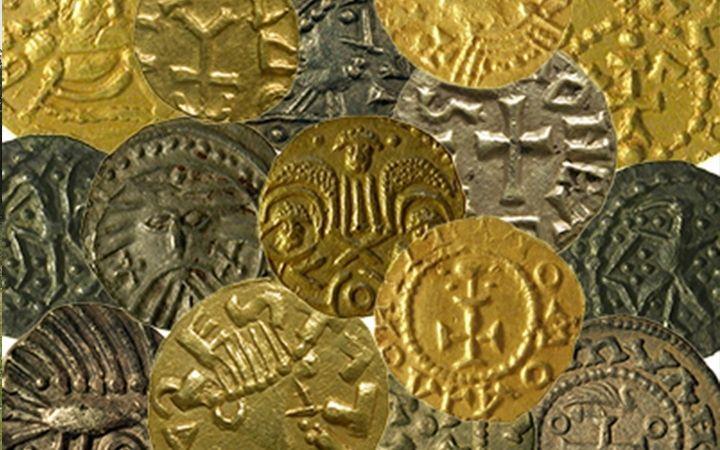
Masthead image of coins from early English Rendlesham used by Andy Woods for his 2020 talk on the subject

Masthead image of coins from early English Rendlesham used by Andy Woods for his talk

Then, I missed an episode, (Faye Minter’s “Exploring the Metal Objects from Anglo-Saxon Rendlesham“), but made sure I tuned in for my old Fitzwilliam colleague’s Andy Woods. He started by telling us there had been 277 coins found, and 272 of them were from the sixth and seventh centuries, a pretty clear sign of how the site’s importance was focused. The earliest ones were knock-off imperial tremisses of the probably-sixth century, rather rare items that turn up in very few other places, and real seventh-century imperial copper-alloy coins, likewise extremely unusual, and whatever may have brought them here this all tends to confirm that Rendlesham was a special site. The finds record also contains one third of all Suffolk’s so-far-found Merovingian tremisses; basically, fancy coin collected here, and more or less all over the site. The North Sea zone however provided more and more of the coin as the slow shift from gold to silver happened, and as the coinage decreased in value its use spread, as the finds record shows.5 Basically, while coin was rare and precious it came here by preference; as it became more normal, so the site gave up its monopoly on money. However, Dr Scull had said and Andy agreed, it was probably also making its own coins, as there is debris and blanks from such processes in the finds record here, suggesting I guess that it was at least one of the East Anglian mints we blame for certain sorts of what the numismatists call sceattas.

Series R4 sceatta, Classical Numismatic Group Auction 545 lot 822

Series R4 sceatta, Classical Numismatic Group Auction 545 lot 822; Series R has long been reckoned to be associated with East Anglia

I’m still a bit dubious about the minting, to be honest. It’s not that I doubt it was happening, given the remains, but I might doubt that it happened very much. The sceattas we call Series H are so named for Hamwic, the early English port site across the River Itchen from modern Southampton, because they dominate the finds there so much that it seems likely that not only were they locally made, but were also perhaps the required medium of exchange for certain transactions in the emporium.6 Unless I missed anyone pointing it out, there’s no such dominant type in the Rendlesham corpus, and while this was obviously a different class of site (and again, a smaller one), if they were making lots of coin I’d still expect those types to be the most common losses here. That they weren’t suggests to me that the issues were not economical in purpose, and might have more to do with the performance of royalty than the need for a trading or taxing medium. In any case, by the 720s coin use at the site seems to have ended almost entirely, with even the Series R coins which we’re pretty sure were East Anglian issues not showing up, and this all probably signifies that Rendlesham was no longer on the royal map by then. Questions here focused on weight standards, where to my surprise a standard gold weight for coins does seem to have been in evidence (some coins being built up to it with plugs) and circulation duration (gold for 40 or 50 years, silver less long), and what the things were actually being used for, which Andy was suitably careful about. I asked about the Byzantine copper-alloy, inevitably, and Andy reckoned they probably counted as curiosity items but said I should wait for Sam Moorhead‘s appraisal, which may now have happened but I can’t find it.7 This was all meat and drink to me, anyway; I’m not saying I understand this site particularly well, but if I’m going to understand it at all, the coinage is my personal best way in, and having such an expert and careful presentation of it really helped me anchor the basis for what I was being told across all the talks.

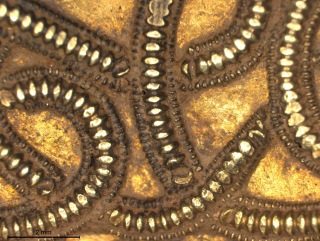
The last of those that I managed to tune in for was Eleanor Blakelock’s analysis of the metalworking techniques. Eleanor may or may not be known to you for her work on the gold-smithing literally behind some pieces of the Staffordshire Hoard, and here she turned her tools on the Rendlesham finds.8 She started by explaining what kind of debris metalworking leaves behind in the archæological record and the modern tools with which we can analyse it. It was pretty clear that dress items here were being made in moulds, in multiple copies and possibly even in chain castings, all suggesting quite the output. Some of this was obvious because the sprues survive: as Eleanor said, that’s weird, because they could have been recycled, but other than an archæologist’s handwave at possible ritual elements of the process, she couldn’t explain it. The metal was largely “gun-metal” rather than brass, copper + tin + zinc, with a little bronze early on coming probably from recycling of Roman material; later on brass would have been usual, so again we have signs here that the site didn’t go on very late. Where gold was involved, the sprues did get recycled but ingots and blanks enough survive to tell us that stock exceeded production before it ended. The metal here may have been from continental or imperial coins but it was better than average if so, suggesting older coins were selected for melting down even though some were still there to be found. She found some of her trademark enhancement techniques on the gold pieces and wondered if it was too obvious to suggest that Rendlesham’s were the workshops that made some of the Sutton Hoo objects; it’d be surprising if it weren’t, it seems to me. They weren’t, however, producing the Staffordshire Hoard objects, which are generally more complicated and better-finished; here speed or quantity was a bit more important than quality.

Close-up of Staffordshire Hoard metalwork showing enhanced background beneath filigree overlay

Close-up of Staffordshire Hoard metalwork showing the enhanced background beneath the filigree overlay

Obviously, we only have what didn’t leave the site, but even that raises plenty of questions about what the impetus for production was. Other questions too! There was a bit of an argument about garnets: someone wanted to suggest that they would have been cut before supply, so that metalwork had to be made to fit them, whereas Eleanor was pretty sure that wouldn’t work and that the stones must have been ground to fit. Chris Fern tried to impose a chronology of technique on the casting processes involved, and Eleanor resisted that on the grounds that a metalworker could obviously choose his or her own technique. She was, however, much less sure that the finds showed coin production than the other speakers had been, and I would like to have heard why. This was not the only talk of Eleanor’s I’ve heard where I really wanted to pick her brains afterwards, but that, of course, is the disadvantage of the online format; there is no free discussion over wine afterwards…9 Instead, it was back to work in our isolation pods. But there was still a lot over these talks to think with and I hope I’ve found at least some bits that make you think too.


1. The place to start when I heard these talks would seem to have been Christopher Scull, Faye Minter and Judith Plouviez, “Social and economic complexity in early medieval England: a central place complex of the East Anglian kingdom at Rendlesham, Suffolk” in Antiquity Vol. 90 (London 2016), pp. 1594–1612, DOI: 10.15184/aqy.2016.186, though I gotta confess, I did not know that then.

2. Now, one could get some version of the latest news from Faye Minter, Rendlesham Revealed: The Heart of a Kingdom AD 400-800 (Ipswich 2023), a booklet online here.

3. See Chris Scull, “Social Archaeology and Anglo-Saxon Kingdom Origins” in Tania Dickinson and David Griffiths (edd.), The Making of Kingdoms, Anglo-Saxon Studies in Archaeology and History 10 (Oxford 1999), pp. 17–24.

4. See Stuart Brookes and Andrew Reynolds, “The Origins of Political Order and the Anglo-Saxon State” in Archaeology International no. 13/14 (London 2009), pp. 84–93, DOI: 10.5334/ai.1318.

5. Here, I have to admit, despite my somewhat variable review of it, my perspective is coming partly from Tony Abramson, Coinage in the Northumbrian landscape and economy, c. 575-c. 867, British Archaeological Reports (British Series) 641 (Oxford 2018), though don’t ask me to find where in it…

6. The whole sceatta series system was first laid out, with Series H in it, in S. E. Rigold, “The Principal Series of English Sceattas” in British Numismatic Journal Vol. 47 (London 1977), pp. 21–30, online here, and as yet despite its numerous inadequacies no-one has been able to come up with a better enough one to replace it.

7. There is, at least, Sam Moorhead, “Byzantine Copper Coins in Dark Age Britain” in Spink Insider (26th March 2021), online here, but all that really does is report the find.

8. For her work on the Staffordshire Hoard, see E. S. Blakelock, “Never Judge A Gold Object by Its Surface Analysis: A Study of Surface Phenomena in a Selection of Gold Objects From the Staffordshire Hoard” in Archaeometry Vol. 58 (Oxford 2016), pp. 912–929, DOI: 10.1111/arcm.12209, and Blakelock, Susan La Niece and Chris Fern, “Secrets of the Anglo-Saxon goldsmiths: Analysis of gold objects from the Staffordshire Hoard” in Journal of Archaeological Science Vol. 72 (Amsterdam 2016), pp. 44–56, online here.

9. See now Blakelock, Marcos Martinón-Torres and Christopher Scull, “Early Medieval Copper-Alloy Metalworking at Rendlesham, Suffolk, England” in Medieval Archaeology Vol. 66 (Abingdon 2022), pp. 343–367, DOI: 10.1080/00766097.2022.2129684.