life lived in dot points

Jul. 12th, 2026 09:00 pm
fred_mouse: bright red 'love' heart with stethoscope (health)
[personal profile] fred_mouse
  • I'm struggling to keep up with things. Across multiple categories. This coming week is a bit stressful as I have two deliverables, one of which I worked out was required on Friday afternoon (poor communication means that while I could have done this months ago when I was doing the rest, I didn't know it was needed)
  • we rehomed the last chicken. J, who I've known since my uni years has an acre out at Maida Vale, and was happy to add a sixth chicken to the flock. Hopefully all goes well -- J was well able to catch our chicken when it headed in the wrong direction, and thus should be fine to be put away at night (here, there might be foxes, but we have a 3m noise wall behind our property; the foxes can't get in. J's place has much more open space for foxes, and is directly down the hill from where I grew up, and we lost multiple animals to foxes)
  • handstands: I've been doing handstands against one of the bathroom walls most days of the last, hmm, fifteen years? It has done wonders for keeping the dodgy shoulder functional. Three nights ago I felt muscles across the upper back engaging in ways I hadn't previously noticed. And then again the last two nights. The first two I had associated hand pain with whatever I was doing differently, and lasted 10s. Last night, it was all going really well, and engaging the newly active muscles meant that I came off the wall and managed 10s of free standing, which is far more than I remember doing as an adult.
  • swimming: did not go swimming with [personal profile] chaosmanor this weekend; I have over spent my spoons elsewhere. But I would like to have it as a thing in my life, if only I can work out the when.
  • I'm making slow progress on one of the quilts. The number of active quilts is 3-5 depending. I have two that have come out of [personal profile] chaosmanor's archive to be finished (and we forgot to talk about the plan for the one I don't have notes on. The other is just 'lots of stitching'.
  • induced peri-menopause continues apace. I'll have a few good nights of sleep and think something foolish like 'oh, it's not that bad'. And then I'll have one where I fail to fall asleep, and then wake up for an hour, and then wake before 6am and can't get back to sleep, and lo! but I hate everything and everything is awful. Also, minor temperature regulation issues. On the plus side there, I'm not as cold as everyone else most of the time.
  • Youngest is at the offsite offspring house, catsitting, because the household have gone to Pingelly for the weekend. I gather the cats have been good company. They came home for dinner both nights; we watched episodes 3 and 4 of Heated Rivalry tonight. I will probably watch the rest at the end of the month - I'm travelling to Brisbane for most of a week, and I'll have a hotel room to myself at least one of those nights.
  • food continues to be difficult. The moments of 'that tastes wrong' are less frequent ([personal profile] artisanat noted last night when it was discussed that they hadn't realised that it had been happening while I was having the radiation treatment; I'm suspecting I hadn't quite worked out what was going on at that point).

podcast friday

Jul. 10th, 2026 09:51 am
sabotabby: (doom doom doom)
[personal profile] sabotabby
 Relatively new-to-me podcast this week: Canuck Is a Slur's "Skwxwú7mesh Sníchim — Squamish Language with Victoria Fraser." It's a look at a critically endangered Coast Salish language that only a small number of people speak fluently; Victoria is involved with efforts to reclaim it. I always love this kind of story, and in particular the internationalism of the effort is impressive. There have been successful language revitalization efforts in Aotearoa (New Zealand) and Ireland, and the efforts in the Squamish nation draw from these experiences. It's a very fascinating, very nerdy discussion. For folks who know nothing about the country, I'm on the other side of it, so I do not have to worry much about how to pronounce a glottal stop in the middle of a word, but as I'm trying to at least incorporate some Anishinaabemowin and Kanienʼkéha terms in my teaching practice, this is really interesting to learn about.

Modern day lotus eaters

Jul. 8th, 2026 10:17 am
fayanora: No AI (No AI)
[personal profile] fayanora
AI truly is doing to people, for real, what people used to think TV would do to people: turn them into mindless shambling zombies.

These AI addicts have zero creativity, zero intelligence, and zero care about anything but their addiction. It's sad to see. All that noise pollution, heat pollution, water consumption, and stress to the electric grid just so some knuckle-dragging lotus eaters can atrophy their brains on bot-pureed brain vomit.

Reading Wednesday

Jul. 8th, 2026 08:47 am
sabotabby: (books!)
[personal profile] sabotabby
Just finished: Owning the Unknown: A Science Fiction Writer Explores Atheism, Agnosticism, and the Idea of God by Robert Charles Wilson. I think I would have liked more sci-fi in this book about sci-fi and religion (Christianity) and atheism, as evidenced by there being two short stories at the end that I enjoyed a great dea.

As an atheist, I found the arguments in this book convincing up to the point of being agnostic about a specifically Christian God, but didn't make the logical leap that the other did to atheism about all gods. Which doesn't mean it's not worth reading, but I wanted it to go farther and deeper than it did.

Encampment: Resistance, Grace, and an Unhoused Community by Maggie Helwig. Complete coincidence that I read these one after another by the way; Encampment was next up on my list anyway. But I do think they provide an interesting contrast and go a long way to explaining why I find Wilson's arguments less interesting.

Encampment isn't about religion per se, despite being written by a priest and taking place on the grounds of a church and including some sermons. It's about mutual aid and community and the cruelty of the state towards its nominal subjects.

I once really weirded out a friend of mine of the more stoner persuasion by saying that I was almost completely uninterested in questions of where the universe came from or how it was created or whether there's life after death—things that he apparently spent a long time pondering. What is much more interesting to me is how we ought to act now, in relationship to each other and the planet. What we owe to each other by virtue of our own shared beinghood.

Maggie will say that she did nothing special. She allowed a tent encampment on her church's property (well, the issue of whose property becomes a major question in the City's fight to dismantle the encampment, but I've been there and it's very obviously part of the church). Then she tried to take care of those people as best she could. Unfortunately in the world that we live in, this is in fact extremely special and extremely heroic. This is not an easy task; many of these people have untreated psychiatric disorders, many have addictions, and beyond that, the tangled bureaucracies that nominally exist to help them are fragile as cobwebs, underfunded, and under resourced. 

This book broke my heart. I of course know this story well. Everyone in Toronto does. I argue about encampments in Facebook groups on the regular. The upcoming municipal election may hinge on them. I'm old enough to remember that Star Trek DS9 episode where a tent city was an indication of how deeply into dystopia Earth had fallen; now they are common enough that most people just walk by them every day. Maggie tells the story of the individuals who found themselves in these tents and their fight for basic dignity along with survival. She makes the invisible visible (which, isn't that part of what both religion and literature do?).

It's the best thing I've read this year, and I might buy like a million copies to give to people, especially if it looks like might Bradford win—not that Chow is great, but Bradford would build death camps if he could. Anyway, read it. It'll take you like a night.

Currently reading: Obstetrix by Naomi Kritzer. I love everything Naomi writes though I went into this with a little trepidation as I have a phobia around pregnancy and birth. It's about an OB/GYN who finds herself unemployed after terminating a pregnancy in North Dakota to save a woman's life. She gets a weird call about an interview for a job with a group of midwifes, which turns out to be bait to kidnap her and bring her to a cult compound, where many of the women and girls are pregnant. Also, the last doctor they brought there was murdered by one of the cult members.

If I hadn't been so tired last night I'd have binged through this in one night—it's hella tense and unsettling and Dr. Liz's wry, grounded narration is a perfect contrast to how disturbing the cultists are (fundie baby voice is a real thing and  y i k e s  on bikes).

Pill organizer

Jul. 8th, 2026 12:53 am
fayanora: disguised as an adult (disguised as an adult)
[personal profile] fayanora
I finally got one of those "day of the week" pill organizers because I kept skipping doses for as many as several days in a row despite having Dosecast, mainly because:

1. The Dosecast app I use to track my pills doesn't consistently do its pop up notifications like it should, and there's no beeping or other sounds associated with its pop up notifications even when it is doing them.

2. The process of getting out all the bottles, getting the pills out of each bottle, piling the pills up in front of me, taking the pills, and putting everything away takes SO many spoons / energy slots that even when I was getting the notifications for the daily pills, I would get pre-emptive stress that depleted my energy and made me more prone to postponing it. Then it would be two or three days of skipping them because of my time blindness and I would get extremely annoyed with myself.

3. It doesn't help that doing all the activity every day to get that many pills ready depleted my energy enough that it made actually taking the pills harder to do. If you don't know what I mean: I have always had a problem with swallowing pills. I find most people's directions/instructions on how to do something new to be very confusing, to the point that I have to figure out how to do the thing myself pretty much all the time because of it. And when I was a kid, up into my teens, I was taking pills so infrequently - despite getting frequent migraines - that my poor ADHD memory and difficulty forming new habits meant that even when I was managing to figure out how to swallow pills, I was forgetting how to do it by the time I next had to do it. This lasted until a couple years ago, when I finally figured out and memorized how to take pills without gagging or choking. But the thing is, this takes concentration and focus to do. I have to mute anything with words in it to free up processing power for the task. And even though I know how to swallow all those pills at once, my having to go through a very difficult and stressful process of getting eight pills ready at once depletes enough system resources that if I tried swallowing all those pills at once, I would gag, choke, and possibly even puke. So to prevent that, I was having to take no more than three pills at once, and STILL had to concentrate very hard on doing it, because the smallest bit of mind wandering or split attention would make me gag on them.(1)

Anyway, I finally bought a pill organizer, so I could skip the daily, energy-depleting, stressful process of getting the pills ready. I now only have to do that process once a week, and I can do it AFTER taking the pills. How is it going, you ask? Two days in a row, I popped open the pill box for the day, tossed all eight pills into my mouth, drank some iced tea (I can NOT dry-swallow pills), and swallowed all those fuckers all at once. I did still have to pause YouTube to be able to do it, but still, I did it!

I have never had any issues taking the Metformin on time unless it was at the same time as the others, since it's just two pills, so I didn't get one separated by day/night. Just the "once daily" version. (Hell, sometimes when I would skip most of the pills, I would still take the Metformin since it's a pretty important one.)

So that's a big relief. One less stressor in my life, two if you count my annoyance at myself from skipping taking the daily pills. Life got easier, and it only cost me like $4. (I had to get a big one because there are so many pills.)

(1) = This tendency to forget how to do things I've done before applies to pleasant things, too. It was only two or three months ago that I finally figured out how to properly roll a burrito, and it has taken all that time since to get mostly consistently good at it. I still sometimes fuck it up.
defrog: (books)
[personal profile] defrog
One of these books took me nine months to finish. It was for a class, but it might have taken me that long anyway, for reasons that shall perhaps become clear.

A History of Christianity: The First Three Thousand YearsA History of Christianity: The First Three Thousand Years by Diarmaid MacCulloch

My rating: 3 of 5 stars

I started reading this last year as part of a class on the same topic. Class wraps up tomorrow, and I finished reading the book last week, and I can’t remember the last time I thought at the end of a book, “Man, I’m glad that’s over!” Which is not to say it’s a bad book. It’s just a lot to take in. Diarmaid MacCulloch essentially compresses 3,000 years of history into a little over a thousand pages, which – even with his accessible writing style (compared to academic textbooks, anyway) – makes for very dense reading.

While Christianity as a religion started almost 2,000 years ago, MacCulloch starts a thousand years earlier with the Greek and Roman empires to provide the context in which Christianity emerged from Israel (which was occupied by Rome when Jesus arrived, while Greek language and philosophy were well known in the Levant). From there, he goes back and forth through time in order to cover parallel developments in Western Europe, Eastern Europe, Asia Minor, North Africa and Russia as Christianity spread all over the world, and ends with the “culture wars” that have engulfed the Catholic and Protestant churches from 1960 up to the book’s publication in 2011.

I’m not sure how much I learned – as I say, it’s a dense infodump of a book, and even then, MacCulloch necessarily oversimplifies a lot of details with passing references (the Avignon papacy comes to mind). I will say MacCulloch is good at pointing out specific turning points in history where the Church could have gone in a different direction or wiped out completely if not by happy accidents of history, which is interesting. Probably the biggest takeaway for me is that the book makes very clear that the Church (and its underpinning theology) has never been a static thing – it has always evolved and adapted with the times along with the rest of the world. And given much of the bigoted, bloody horrors of its history, that can only be a good thing. As bad as some people think the Church is now, it used to be a lot worse.

It’s also something to keep in mind as people still argue about LGBTIA issues and theology evolves outside of the Western Heterosexual Man box to include feminist theology, queer theology, trans theology, anti-colonialist theology, etc, while certain conservative Evangelicals are panicking over this and advocating Christian nationalism as an antidote. Point being: it’s the latest stage of Christianity’s evolution, which shows that it’s still evolving. Just as we look back today at the Church’s involvement in the Crusades and slavery and say, “That’s not what Jesus preached – how could they get that so wrong?”, in a couple hundred years, history students may be looking at the current Church arguing over gay marriage, gender fluidity and ordaining women and asking similar questions about us.
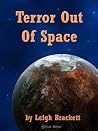

Terror Out Of SpaceTerror Out Of Space by Leigh Brackett

My rating: 2 of 5 stars

Continuing my exploration of the works of Leigh Brackett, this is a 1944 novelette in which Lundy, an officer of the Tri-Worlds Police (Special Branch!), is flying over Venus, tasked with delivering an alien lifeform to scientists for analysis. This is dangerous work – not least because the alien is telepathic and can make men worship her, and anyone who has ever looked in its eyes has gone insane.

That includes Farrell, who is tied up on the ship with Lundy and his partner Jackie Smith. Almost right away, Farrell breaks free, Smith is controlled by the alien, and the ship crashes into the Venusian ocean. Only Lundy survives, but the alien escapes in the crash. As he makes his way across the ocean floor, he’s almost eaten by flesh-eating monster flowers before being rescued by telepathic Venusians who are sort of like sentient kelp. The alien has hypnotised all their males, and ask him to help.

And, well. I like a lot of Brackett’s Golden Age stuff, but this one didn’t really work for me overall. I appreciate her vivid imagination of different types of alien races, and the fact that she actually presents the alien’s point of view, turning a standard hunt-the-alien tale into something a little richer that also makes for a more interesting ending. But getting there is a slog, with the opening action a bit jumbly, and the middle section hallucinatory to the point of being hard to follow – at least for me.

View all my reviews

Unafraid,

This is dF

The worst part of waking up

Jul. 7th, 2026 09:42 am
fayanora: lil girl knife (lil girl knife)
[personal profile] fayanora
I was having a great dream where I had the superpower of speed like The Flash. I looked out over a large field of short grass that led to a large body of water like a lake, and I was thinking I was going to run across that field and then across the water. I tensed my body in preparation--

Instantly awake with a horrible pain in my leg because that moment of tensing had activated a leg cramp.
pilottttt: (Бипланы)
[personal profile] pilottttt

Я тут уже писал, что наш Дархан – это очень подходящее место, чтобы поискать здесь остатки старого Ташкента, пусть даже эти остатки пребывают в плачевном состоянии и постепенно сносятся. И мы даже попытались погулять среди этих остатков в ночной тьме. Теперь же у нас наконец нашлось время и желание погулять там же, но в светлое время суток (под жарким ташкентским солнцем). Но ведь просто погулять – это ещё не ретропрогулка, а потому мы погуляем и поснимаем так, как будто это было сделано фотографом конца XIX века, используя оптику тех времён и… Нет, моё плёночное хозяйство всё ещё пылится в шкафу в Лобне, а потому использовать я буду всё-ж-таки современную беззеркалку, но при переводе в ч/б сделаю имитацию плёнки ортохром (в конце XIX века была только такая).

Итак, мы вооружены моей любимой беззеркалкой Olympus PEN E-PL8, на которую установлен монокль – исторически первый тип объектива, активно применявшийся в пейзажной съёмке во второй половине XIX века (ну, вы помните, у меня есть такой, собранный из двух старых советских Индустар-50 и Индустар-61). Да-да, это – тот самый объектив, который даёт светящиеся кадры, особенно если у вас есть яркое ташкентское солнце. И ещё у нас в кармане припасены современные цифровые технологии: монохромный микшер каналов, с помощью которого можно имитировать плёнку ортохром (по крайней мере, соотношение яркостей в кадре будет именно таким, как на ортохроме). Теперь берём всё это в охапку и идём прочёсывать Дархан в поисках старых построек.

Гулять дальше )

Если вам понравился этот эксперимент – дайте знать, будем делать ещё такие ретропрогулки.

fayanora: qrcode (Default)
[personal profile] fayanora
It's ridiculous to think that alien life doesn't exist just because we can't see any evidence of it. If we were as far from Earth as we are from other planets, we wouldn't see any evidence of our own civilization, because light takes thousands or even millions of years to cross that distance. There could be a civilization building a Dyson sphere around their sun out there right now, and we wouldn't see it yet because we're looking at the light from their equivalent of the bronze age.

Furthermore, even if we could see a planet as its people were starting their space race, we still wouldn't be able to see any signs of it from this distance because our best telescopes still can't see cities. Hell, if we had a space telescope pointing at Earth right now from the distance of Pluto, I doubt we would be able to see cities with it. Even if we could, that's literally in our back yard. From a distance of light years, we would have to be extremely lucky to record a glimpse of one of their rockets leaving the atmosphere.

I mean, looking at Earth from the international space station during the day, you really can't see any cities or structures. The Great Wall of China is a vague line at that distance. Frankly it's a miracle we can see other Earth sized planets in other solar systems at all.

So yeah, there could be aliens in every solar system that we've looked at and we would have no idea because we can't see that well at such distances. And radio waves thin out and dissipate the further they go. Lack of evidence is not evidence of lack.

Also, there is this major assumption that intelligent life by definition will end up becoming industrialized and sending out radio signals and polluting their planet. But it's far more reasonable to assume that most intelligent life would be intelligent enough to not do that, and the fact that we do that and the fact that we wage war on each other are signs that we as a species are fucking insane, literally a mentally ill species. Or at least a species that has allowed mentally ill cultures to dominate the planet.

AMERICAN TERRORDOME

Jul. 4th, 2026 07:34 pm
defrog: (puzzler)
[personal profile] defrog
America is 250 years old today.

Here’s how that’s going.


Not much I can add to this, really, except that it’s completely within the character of this admin to take a major national anniversary like this and turn it into a cringey projection of Trump’s ego.

If it helps, remember that time is an illusion and thus so are calendars, which means anniversaries, while nice, don’t define who we are. Also, empires come and go like leaves on the wind, etc.

Anyway, enjoy your weekend. Such as it is.

Bread and circuses,

This is dF

podcast friday

Jul. 3rd, 2026 10:40 am
sabotabby: (jetpack)
[personal profile] sabotabby
You're a nerd, right? You're a nerd who likes Galaxy Quest (1999) starring Tim Allen, Alan Rickman, and Sigourney Weaver. Sure you are. You want to hear some nerds talk about it for an hour or so? Why not!

Two Old Farts Talk Sci-Fi ft. Rachel A. Rosen "Galaxy Quest (Sigourney Weaver Pt 2)," is ironically the first part of a two parter about nerd comedy, sci-fi conventions, and Acting.

Health update

Jul. 3rd, 2026 09:10 pm
fred_mouse: bright red 'love' heart with stethoscope (health)
[personal profile] fred_mouse

Last week, I saw the radiation oncologist*; they were reasonably happy with the post-radiation healing. At that point there was quite a bit of puffiness in the armpit area, and I've been actively doing more to mobilise the area. Including going to the warm pool at Riverton with [personal profile] chaosmanor and [personal profile] cupidsbow on Sunday.

Today, I saw the surgeon* and they looked at the surgical site. Nothing there to worry about, and the swelling in the armpit area has significantly gone down. I was warned to keep an eye out for swelling / anything that feels like fluid retention in the breast because of the infection risk, but that otherwise everything is good there. They were a bit concerned about me turning up using the cane (although, pretty sure I've used it there before, but it might not be in my records), because apparently there are joint issues that can come from taking tamoxifen, even at the very low dose I'm on. Which might go with the fact that the pain is sharper this year; I've had a sequence of things that I've been blaming it on.

Overall - monitoring monitoring monitoring, but no concerns.

* in both cases, I actually saw one of their team who handles follow up.

rachelmanija: (Books: old)
[personal profile] rachelmanija


Eleven climbers died on K-2 in a three-day stretch the summer of 2008. Amidst the tragedy were some extraordinary feats of heroism. The two most impressive ones, in my mind, were performed by a Sherpa who rescued another Sherpa, and a Pakistani cook who rescued a Pakistani climber/expedition organizer. Neither of those heroes were recognized by the American, European, and South Korean climbers, most of whom ignored the Sherpas and one of whom publicly disparaged the Pakistanis who struggled and died on the mountain. (Seriously, fuck that guy.)

This book is partly the story of those converging and ill-fated expeditions, but mostly of those two Sherpas, Chhiring Dorje Sherpa and Pasang Lama. It also gives a lot of eye-opening background on Sherpas, their ethnic and class divisions, the social and economic forces that lead so many of them to climb mountains, and the cultural forces that affect them when they do so.

(It also explains why so many Sherpas have the same name. Traditionally, they are named after the day of the week that they were born, and don't have last names so they mostly use "Sherpa" for outsiders who demand one. This is fine in a village of 100, where there will only, statistically, be 14.28 people named Pasang so you can easily distinguish Old Grandpa Pasang from Teenage Yak Herder Pasang from Pasang With The Missing Finger. Then you get to Kathmandu, where there's 350 Pasang Sherpas who are all 25 years old and are porters on mountain climbing expeditions so if you want to identify one of them you have to resort to naming what expeditions they were on and what village they come from and then you will still probably need to use a nickname as that could easily be five different people.)

Until I read this book, I had completely forgotten that the crown prince of Nepal had massacred the entire royal family in 2001. To be fair, there was a lot going on in 2001. Still, what a bizarre incident that was. It also caused a lot of political and economic chaos which, as always, drove people to move in search of safety and better living conditions.

The Sherpas almost all started climbing because the pay was good. But some of them, like Chhiring, got a taste for the risk as well. But even they seem, overall, vastly more level-headed than the paying climbers, who mostly don't come across particularly well in this book. This may be because whatever sort of person climbs Mt. Everest, you have to be fifty times more like that to climb the notoriously bloodthirsty K-2.

Between that, a very narrow window of good weather, the inevitable breaking of vows to turn around if you're not on track to summit at 2:00 PM, the one person who could translate between the multiple language groups having to be medevaced out, and some plain bad luck, it's not surprising that so many people died. It's actually surprising that so many survived.

This book is both excellent in its own right and a great antidote to all the books that don't focus on the Sherpas. Every time you read one of those, just remember that the Sherpas are doing everything the paying climbers are doing, but carrying heavy packs, with shoddy gear, without fame or glory, and often against the wishes of their families. They're like Ginger Rogers doing everything Fred Astaire does, but backwards and in high heels.

Space Invaders, by Nona Fernández

Jul. 1st, 2026 11:09 am
rachelmanija: (Books: old)
[personal profile] rachelmanija


During the Pinochet dictatorship in Chile, one girl in a school never showed up for class one day, and never returned again. Years later, as adults, her former classmates still think and dream and talk about her. She and a friend exchanged letters even though they also saw each other in class every day. A boy had a crush on her, and maybe she had a crush on him too. A friend came to her house to play "Space Invaders," and her father showed them his prosthetic hand. A bodyguard began to drive her to school. Her classmates went to a protest. And then she was gone. Memories, dreams, letters, and imagery intertwine, then twist into a knot that can never be undone.

A perfect little book, incredibly sharp and precise despite being largely about dreams and uncertain memories. There's not a single wasted word; I think the translation must be excellent. I read it with gathering dread, as if I was in the sort of nightmare where nothing overtly violent is happening but but you somehow know that something will appear at any moment, something so terrifying that just seeing it will destroy you. Which is probably what it felt like to be a child during the Pinochet regime.

I was right to read the book with dread, though what happened to the missing classmate is less predictable than what I'd assumed. It's a very quick read but one which sticks in your memory and haunts you. It was recommended to me by my friend/occasional employee Ana, who is from Chile. I recommend it to you.

Reading Wednesday

Jul. 1st, 2026 09:49 am
sabotabby: (books!)
[personal profile] sabotabby
Just finished: Killing Shakespeare by Koom Kankesan. This is a weird one, friends. After a fairly lighthearted concept you'd be expecting a time travel romp but our protagonists are quickly thrust into the sheer grimness of the era, with quite a bit more gore than one typically gets in YA. (That said, it's something I would have appreciated as a teenager.) Not to mention a sophisticated reckoning with the dark colonialist side of the period, where Suresh, who has grown to idolize John Dee, realizes the role he plays in the expansion of the British Empire and the eventual genocidal war on the Tamils.

Then it gets weirder? Because as the story progresses, the kids seem less concerned with getting back to their own time and the interior first-person narration of the kids gets progressively more sophisticated, something that feels like an inconsistency until spoilers )

Currently reading: Owning the Unknown: A Science Fiction Writer Explores Atheism, Agnosticism, and the Idea of God by Robert Charles Wilson. This has some interesting takes on belief and atheism, and in particular a defence of the idea of "intuitive atheist," which has more or less been my standpoint for the last few decades (the less said about my stint as an Internet Atheist, the better). There are a few things that I'm learning while reading it, like that the Big Bang theory was first proposed by a Catholic priest.

That said it almost immediately does the thing that I hate in atheist writing, which is using Christianity as a stand-in for all religion. I have a pet theory that all self-proclaimed atheists are actually Christians who have decreased the number of gods they believe in by one. It's not that I'm not an atheist myself so much as I think most other atheists are being just as silly as most of the religious people who like to enforce their beliefs on others.

Look, when I was 13 I read the Satanic Bible and went, oh, that's just Christianity but goth, and I feel the same way when I read a lot of atheist writing. It's not racist like New Atheism (the author is quite a lovely guy!) but by advancing a religion=Christianity framework, it erases the diversity and complexity about what much of the human race believes. So it's a non-starter for me.

Внезапное

Jun. 30th, 2026 12:46 am
pilottttt: (Санта Клаус)
[personal profile] pilottttt

Пересмотрели мы тут неувядающую классику комедийного жанра – фильм «Большие гонки» Блейка Эдвардса, и внезапно поняли, что всё это – про нынешнюю Россию. Да, там есть и дефицит бензина, и горящее топливохранилище, и почтовые голуби вместо нормальной связи. А ещё – ну конечно же – там есть Макс! Один известный всем политический деятель на букву Пу долго и устойчиво ассоциировался у меня с Профессором Фэйтом, хотя в последнее время он всё больше напоминает Принца Хэпника.

The Unmothers, by Leslie J. Anderson

Jun. 29th, 2026 11:42 am
rachelmanija: (Books: old)
[personal profile] rachelmanija


A journalist recovering from the death of her husband is sent to a small town to investigate the claim that A HORSE GAVE BIRTH TO A HUMAN BABY.

I strongly dislike reading about normal human pregnancy and birth, but I love stories about bizarre births. I also love folk horror. So a story about a small town where a horse gives birth to a human baby sounded like just my jam.

Sadly, I really disliked this book. In fact the more I think about it, the more I dislike it.

My main beef with it is that very little of interest happens until about the last ten pages. The parts about the horse-human birth are cool! Ten pages of cool. Would've been a good short story.

There are eleven or twelve POV characters, but only one is actually necessary (the journalist) and only one is at all interesting (the teenage boy who is raising and claims to be the father of the horse baby). The rest are townspeople whose POVs don't add anything to the story, plus "The Horses," which ought to be interesting but wasn't because half of it was explaining what humans thought about the horses. I don't care what humans think about horses! When I'm in supposed horse POV, I want to be immersed in HORSE POV!

The setting is incredibly vague. I couldn't figure out if it was even in America or England until it mentioned the opioid crisis.

Aggravated spoilers. Read more... )

The premise is better than the book and the cover is also better than the book. I was in it for the horse baby but that's only about 10% of the book.

Profile

franklanguage: (Default)
franklanguage

May 2025

S M T W T F S
    123
45678910
1112131415 1617
18192021222324
25262728293031

Style Credit

Expand Cut Tags

No cut tags
Page generated Jul. 13th, 2026 02:54 am
Powered by Dreamwidth Studios