The Television Portal

Television (TV) is a telecommunication medium for transmitting moving images and sound. Additionally, the term can refer to a physical television set rather than the medium of transmission. Television is a mass medium for advertising, entertainment, news, and sports. The medium is capable of more than "radio broadcasting", which refers to an audio signal sent to radio receivers.
Television became available in crude experimental forms in the 1920s, but only after several years of further development was the new technology marketed to consumers. After World War II, an improved form of black-and-white television broadcasting became popular in the United Kingdom and the United States, and television sets became commonplace in homes, businesses, and institutions. During the 1950s, television was the primary medium for influencing public opinion. In the mid-1960s, color broadcasting was introduced in the U.S. and most other developed countries.
In 2013, 79% of the world's households owned a television set. The replacement of earlier cathode-ray tube (CRT) screen displays with compact, energy-efficient, flat-panel alternative technologies such as LCDs (both fluorescent-backlit and LED), OLED displays, and plasma displays was a hardware revolution that began with computer monitors in the late 1990s. Most television sets sold in the 2000s were still CRT, and it was only in early 2010s that flat-screen TVs decisively overtook CRT. Major manufacturers announced the discontinuation of CRT, Digital Light Processing (DLP), plasma, and even fluorescent-backlit LCDs by the mid-2010s. LEDs are being gradually replaced by OLEDs. Also, major manufacturers have started increasingly producing smart TVs in the mid-2010s. Smart TVs with integrated Internet and Web 2.0 functions became the dominant form of television by the late 2010s.[better source needed] (Full article...)
Selected article -

Selected image -

The Apollo TV camera refers to several television cameras used in the Apollo program's space missions, and on the later Skylab and Apollo-Soyuz Test Project missions, in the late 1960s and 1970s. These cameras varied in design, with image quality improving significantly with each successive model. Two companies made these various camera systems: RCA and Westinghouse. Originally, these slow-scan television (SSTV) cameras, running at 10 frames-per-second (fps), produced only black-and-white pictures and first flew on the Apollo 7 mission in October 1968. A color camera — using a field-sequential color system — flew on the Apollo 10 mission in May 1969, and every mission after that. The Color Camera ran at the North American standard 30 fps. The cameras all used image pickup tubes that were initially fragile, as one was irreparably damaged during the live broadcast of the Apollo 12 mission's first moonwalk. Starting with the Apollo 15 mission, a more robust, damage-resistant camera was used on the lunar surface. All of these cameras required signal processing back on Earth to make the frame rate and color encoding compatible with analog broadcast television standards.
Did you know (auto-generated) -

- ... that Donald A. Morgan is the first director of photography to be inducted into the Television Hall of Fame?
- ... that, although Self's fifth studio album was cancelled, its songs were still used in television commercials?
- ... that Pedro Berroeta Morales, a diplomat and later the president of a Venezuelan television channel, has also written fiction and essays on topics from science to esotericism?
- ... that a cable TV channel in the UK was still broadcasting primarily in black and white as late as 1979?
- ... that Oliver Hutchinson was the subject of the first successful live demonstration of the television on 26 January 1926?
- ... that Angelito de Canal 13, the mascot of the Chilean television network Canal 13, was inspired by its creator's son?
Selected quote -

More did you know

- ...that The Simpsons' history began when Matt Groening conceived of the dysfunctional family in the lobby of James L. Brooks's office?
- ...that Molly Badham, co-founder of Twycross Zoo, trained the chimpanzees who appeared in the long-running Brooke Bond PG Tips television advertisements?
- ...that children up to the age of five can find it difficult to distinguish between television programmes and toy advertising campaigns?
- ...that Tomorrow's Pioneers, a television program for children produced by Hamas, features a mascot similar to Mickey Mouse?
- ...that Great American Country television host Nan Kelley (then Nan Sumrall) became Miss Mississippi in 1985 after her fellow Mississippian Susan Akin was crowned Miss America?
Selected biography -
.jpg)
Aaron Benjamin Sorkin (born June 9, 1961) is an American screenwriter, playwright, and filmmaker. As a writer for stage, television, and film, he is recognized for his trademark fast-paced dialogue and extended monologues, complemented by frequent use of the storytelling technique called the "walk and talk". Sorkin has earned numerous accolades including an Academy Award, a BAFTA Award, five Primetime Emmy Awards, three Golden Globes, and two WGA Awards, in addition to a Laurence Olivier Award nomination.
Born in New York City, Sorkin developed a passion for writing at an early age. He rose to prominence as a writer-creator and showrunner of the television series Sports Night (1998–2000), The West Wing (1999–2006), Studio 60 on the Sunset Strip (2006–2007), and The Newsroom (2012–2014). He is also known for his work on Broadway including the plays A Few Good Men (1989), The Farnsworth Invention (2007), To Kill a Mockingbird (2018), and the revival of Lerner and Loewe's musical Camelot (2023). (Full article...)
General images
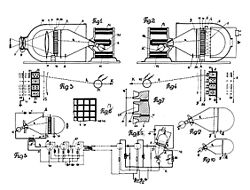 Tihanyi' Radioskop patent (1926) was recognized as Document of Universal Significance by the UNESCO (from History of television)
 A map depicting digital terrestrial television standards (from Digital television)
 Color bars used in a test pattern, sometimes used when no program material is available (from History of television)
 The Philco Predicta, 1958. In the collection of The Children's Museum of Indianapolis (from History of television)
 RCA 630-TS, the first mass-produced television set, which sold in 1946–1947 (from History of television)
 Ad for the beginning of experimental television broadcasting in New York City by RCA in 1939 (from History of television)
 John Logie Baird in 1925 with his televisor equipment and dummies "James" and "Stooky Bill" (right) (from History of television)
 Philo Farnsworth in 1924 (from History of television)
 Manfred von Ardenne in 1933 (from History of television)
 Comparison of image quality between ISDB-T (1080i broadcast, top) and NTSC (480i transmission, bottom) (from Digital television)
 An RCA Victor Color TV ad featuring milliner Lilly Daché in 1959. (from Color television)
 The earliest photograph of a television picture, showing the face of Oliver Hutchinson in June 1926. The television picture was projected using Baird's television camera. (from History of television)
 LG smart TV using the Web browser (from Smart TV)
 The first mass-produced Czechoslovak TV-set Tesla 4001A (1953–57) (from History of television)
 RCA CT-100 at the SPARK Museum of Electrical Invention playing Superman. The RCA CT-100 was the first mass-produced color TV set. (from Color television)
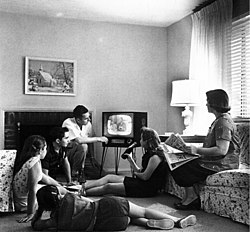 Family watching TV, 1958 (from History of television)
 Hovannes Adamian c. 1900s (from Color television)
 Samsung Smart TVs on display (from Smart TV)
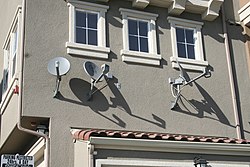 DBS satellite dishes (from History of television)
 First television test broadcast transmitted by the NHK Broadcasting Technology Research Institute in May 1939 (from History of television)
 LG Electronics smart TV from 2011 (from Smart TV)
 The Nipkow disk. This schematic shows the circular paths traced by the holes, which may also be square for greater precision. The area of the disk outlined in black shows the region scanned. (from History of television)
 Samsung's discontinued Orsay platform (from Smart TV)
 This live image of actress Paddy Naismith was used to demonstrate Telechrome, John Logie Baird's first all-electronic color television system, which used two projection CRTs. The two-color image would be similar to the basic Telechrome system. (from Color television)
- An early Smart TV from 2012 running the discontinued Orsay platform (from History of television)


.jpg)

 Featured lists -

 The first season of Family Guy aired on Fox from January 31 to May 16, 1999, and consisted of only seven episodes, making it the shortest season to date. The series follows the dysfunctional Griffin family—father Peter, mother Lois, daughter Meg, son Chris, son Stewie and their anthropomorphic dog Brian, all of whom reside in their hometown of Quahog, a fictional city in the U.S. state of Rhode Island. The show features the voices of series creator Seth MacFarlane, Alex Borstein, Seth Green, and Lacey Chabert in the roles of the Griffin family. The executive producers for the first season were David Zuckerman and MacFarlane. It is also the only full season to feature Chabert, before she was replaced by Mila Kunis for the rest of the series' run, starting with the season two episode "Da Boom".
The series premiere, "Death Has a Shadow", was broadcast directly after Super Bowl XXXIII and was watched by 22.01 million viewers. The rest of the first season would then air between 11 April and 16 May 1999, with all of its episodes airing on Sundays; following the first season, the show left Sunday nights, and would not return to airing on Sundays until 2005. The series received praise from most critics, particularly "I Never Met the Dead Man" and "Brian: Portrait of a Dog", however some critics disliked the themes of the episodes. The Volume One DVD box set, including all seven episodes and the second season, was released in Region 1 on April 15, 2003, Region 2 on November 12, 2001, and Region 4 on October 20, 2003. The series has since been released in syndication. (Full article...)
Stone at the UK premiere of Maniac in 2018
Emma Stone is an American actress who aspired to an acting career from an early age. She had her first role onstage at age 11, and followed with parts in 16 plays in a regional theater in Arizona. Stone made her television debut in the unsold pilot for the reality show The New Partridge Family (2005). After brief television roles in Medium, Malcolm in the Middle, and Lucky Louie, she made her film debut in the comedy Superbad (2007).
Stone appeared as a ghost in Ghosts of Girlfriends Past (2009), and found commercial success with the horror comedy Zombieland. Her breakthrough came with her first leading role as a high school student perceived to be sexually promiscuous in the comedy Easy A (2010). In 2011, she starred in the romantic comedy Crazy, Stupid, Love and in the period drama The Help, which were both commercial successes. Stone's success continued with her role as Gwen Stacy in the 2012 superhero film The Amazing Spider-Man that became her highest-grossing release, with a worldwide revenue of $757 million, and she later reprised the role in its 2014 sequel. Critical success followed with her performance as a recovering drug addict in Alejandro González Iñárritu's black comedy-drama Birdman (2014). It earned her a nomination for the Academy Award for Best Supporting Actress. Later that year, she made her Broadway debut in a revival of the musical Cabaret. (Full article...)- Supernatural is an American supernatural drama television series, created by Eric Kripke, that follows brothers Sam (Jared Padalecki) and Dean Winchester (Jensen Ackles) as they travel throughout the United States hunting supernatural creatures. The series borrows heavily from folklore and urban legends, and explores mythology and Christian theology, and their main adversaries throughout the series are demons.
The series premiered on September 13, 2005, on The WB. The first season was broadcast on The WB, and following The WB's merger with UPN in September 2006, Supernatural continued to be aired on the new network, The CW. All fifteen seasons are available on DVD in Regions 1, 2, and 4 and are also available on Blu-ray. (Full article...) - The third season of Seinfeld, an American television series created by Jerry Seinfeld and Larry David, began airing on September 18, 1991, on NBC, an American broadcast television network. It comprises 23 episodes and concluded its initial airing on May 6, 1992. "The Tape", "The Pen", and "The Letter" are some of the season's episodes that were inspired by the writers' own experiences. Co-creator Larry David admits that season three was a big turning point for the series in terms of how the show was made; it's where the writers started doing nonlinear story lines with episodes containing multiple stories. George was becoming a bigger liar, Elaine was becoming more quirky, and Kramer was becoming surer of himself throughout his crazy antics. This season received eight Emmy nominations and one Directors Guild of America Award.
The DVD boxset for season three was released by Sony Pictures Home Entertainment in Region 1 on November 23, 2004, twelve years after it had completed broadcast on television. It was also released in Region 2 on November 1, 2004, and on October 18, 2004, in Region 4. As well as every episode from the season (minus "The Stranded" which was produced for the second season), the DVD release features bonus material including deleted scenes, exclusive stand-up material, and commentaries. (Full article...) 
The Flash is an American superhero television series developed for The CW by Greg Berlanti, Andrew Kreisberg, and Geoff Johns, based on the DC Comics character Barry Allen / Flash. It is set in the Arrowverse, sharing continuity with the other television series of the franchise, and is a spin-off of Arrow. The series premiered on October 7, 2014, and has been renewed through its seventh season. Grant Gustin stars as Barry, a crime scene investigator who gains superhuman speed, which he uses to fight criminals, including others who have also gained superhuman abilities.
The series has been a candidate for television awards in a variety of categories recognizing its writing, acting, directing, production, score, and visual effects. The Flash has been nominated for many awards, including six BMI Film, TV & Visual Media Awards (won all), two Hollywood Post Alliance Awards, one Hugo Award, seventeen IGN Awards (winning four), eleven Kids' Choice Awards, eighteen Leo Awards (winning seven), two MTV Movie & TV Awards, five People's Choice Awards (winning one), one Primetime Emmy Award, twenty-three Saturn Awards (winning seven), one TCA Award, twenty-seven Teen Choice Awards (winning six), one TV Guide Award (won), and one Visual Effects Society Award. Gustin is the most decorated of the show's cast, with thirty nominations and seven wins. The show also holds the world records for "Most in-demand superhero TV show" and "Most in-demand action and adventure TV show" from the Guinness World Records. (Full article...)- Trinity Blood is an anime series of twenty-four episodes produced by Gonzo based on a series of light novels of the same name by Sunao Yoshida. Directed by Tomohiro Hirata, it features character designs by Atsuko Nakajima and music by Takahito Eguchi. In a post-apocalyptic future, the series' main character, Abel Nightroad, a vampire feeding on the blood of other vampires, protects humanity in service of the Vatican. The series premiered on the Japanese satellite network Wowow from April 28 through October 6, 2005 and was first released on DVD from August 26, 2005, through July 28, 2006.
After producing an English dub for the series, Funimation Entertainment promoted it in the United States by combining the first four episodes into a 90-minute film named Trinity Blood: Genesis and showed it in select theaters starting on May 5, 2006. The series then premiered in English-language on the Canadian digital station Razer from July 6 through December 14, 2006. On DVD, Funimation's English adaptation was first made available in North America from September 26, 2006, through April 24, 2007, in Australia and New Zealand from December 6, 2006, to July 18, 2007, and in Europe from July 2, 2007, through May 26, 2008. (Full article...) - The second season of Veronica Mars, an American drama television series created by Rob Thomas, premiered on UPN in the United States on September 28, 2005. The series was produced by Warner Bros. Television, Silver Pictures Television and Rob Thomas Productions, and Joel Silver and Thomas served as the executive producers.
The season begins with the introduction of two new cases: when a school bus full of Neptune High students plunges off a cliff, killing almost everyone on board, Veronica Mars (Kristen Bell) makes it her mission to discover why the bus crashed. Logan Echolls (Jason Dohring) is accused of killing a Pacific Coast Highway (PCH) biker gang member after a drunken fight with Eli "Weevil" Navarro (Francis Capra) and the PCHers. (Full article...) 
Richardson in the 1962 film, Long Day's Journey into Night
Sir Ralph Richardson (1902–1983) was an English actor who appeared on radio, film, television and stage. Described by The Guardian as "indisputably our most poetic actor", and by the director David Ayliff as "a natural actor ... [who] couldn't stop being a perfect actor", Richardson's career lasted over 50 years. He was—in the words of his biographer, Sheridan Morley—one "of the three great actor knights of the mid-twentieth century", alongside Laurence Olivier and John Gielgud.
After seeing a production of Hamlet starring Sir Frank Benson, Richardson decided to become an actor and made his stage debut, playing a gendarme in The Bishop's Candlesticks in December 1920. After touring and appearing in rep, he made his London debut in July 1926 as the stranger in Oedipus at Colonus. In 1930 he joined the Old Vic where he first met Gielgud, staying with the company until the following year. After service during the Second World War with the Royal Naval Volunteer Reserve, he returned to acting, preferring the works of the more modern authors Luigi Pirandello, Joe Orton, Harold Pinter, George Bernard Shaw and J. B. Priestley to the classic plays of Shakespeare. A radio career ran in parallel to that on the stage, and Richardson was first broadcast in The City in 1929. (Full article...)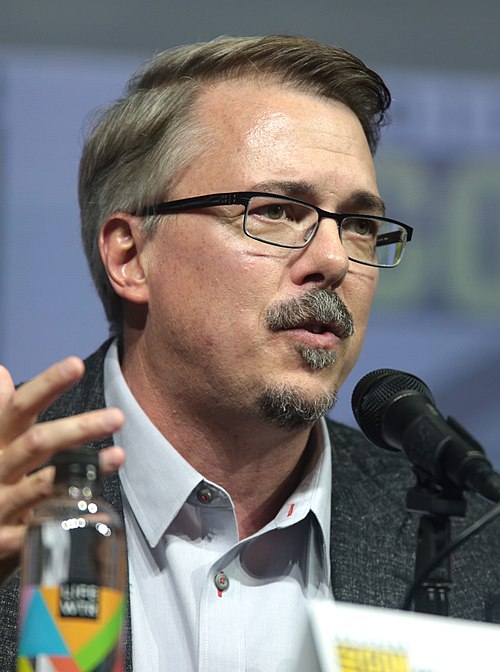
Better Call Saul is an American television crime drama series created by Vince Gilligan and Peter Gould that premiered on AMC on February 8, 2015. It is a spin-off, prequel, and sequel of Gilligan's previous series, Breaking Bad. It stars Bob Odenkirk, Jonathan Banks, Rhea Seehorn, Patrick Fabian, Michael Mando, Michael McKean, Giancarlo Esposito, and Tony Dalton. Set in the early-to-mid-2000s in Albuquerque, New Mexico, the series develops Jimmy McGill (Odenkirk), an earnest lawyer and former con-man, into an egocentric criminal defense attorney known as Saul Goodman. After six seasons and a total of 63 episodes, the series concluded on August 15, 2022.
Since its release, Better Call Saul has received critical acclaim, with particular praise for its acting, characters, writing, direction, and cinematography. The series has been nominated for numerous accolades, winning five awards for Television Program of the Year from the American Film Institute. For his performance as Jimmy McGill, Bob Odenkirk was nominated for five Golden Globes for Best Actor in a Television Series Drama. Rhea Seehorn's portrayal of Kim Wexler won her two Satellite Awards for Best Supporting Actress in a Series, Miniseries or Television Film, and one Saturn Award for Best Supporting Actress on Television. (Full article...)
The Bill is a British police procedural television series that ran from 1983 to 2010. The show, whose name is derived from "old bill"—a British slang term for police officers—was unusual among police dramas in that it focused on the lives and work of one shift of police officers, rather than on any particular aspect of police work. The series originated in 1983 as a one-off drama titled Woodentop (another British slang term for the police, derived from the helmets worn by British police officers), written by Geoff McQueen and produced by Thames Television. ITV were sufficiently impressed with Woodentop that they commissioned a full series, which started in 1984 under the title of The Bill. From 2009 until the show's cancellation in 2010, the number of episodes was reduced to one episode a week in a post-watershed slot of 9pm which incorporated a new format and a new theme tune. At the time of the series' end on 31 August 2010 due to a drop in ratings, The Bill was the United Kingdom's longest-running police drama and was among the longest-running of any British television series, having run for almost 27 years.
The Bill has earned various awards and nominations during its run, with the nominations in categories ranging from Best Drama to its camera and editing work to the cast's acting performance. It received nominations for eight awards from the British Academy of Film and Television Arts, winning Best Video Cameraman in 1990 and Best Continuing Drama in 2009—an award for which it was unsuccessfully nominated in a further three years. In addition, The Bill enjoyed success at the Inside Soap Awards, where it won Best Drama six times, including four consecutive wins, as well as a nomination in 2010—losing to Waterloo Road. Other awards include a Writers' Guild of Great Britain award for Best Soap/Continuing Drama Series in 2008, Best Serial Drama at the Digital Spy Soap Awards of the same year and a nomination for Most Popular Overseas Drama at the 2005 Logie Awards. The Bill has also received multiple nominations at the EMMAs, National Television Awards, where it won Most Popular Drama in 1996 and 2004, and six Royal Television Society award nominations, having won awards in 2006 and 2008. (Full article...)- Moonlight is an American paranormal romance television drama created by Ron Koslow and Trevor Munson, who was also executive producer for all episodes with Joel Silver, Gerard Bocaccio, Gabrielle Stanton and Harry Werksman. The series follows private investigator Mick St. John (Alex O'Loughlin), who was turned into a vampire by his bride Coraline (Shannyn Sossamon) on the couple's wedding night fifty-five years earlier. In the present day, he struggles with his attraction to a mortal woman, Beth Turner (Sophia Myles), his friendship with his mentor and fellow vampire Josef Kostan (Jason Dohring), and his dealings with other vampires in Los Angeles.
The series was commissioned by Warner Bros. Television in 2007 as a presentation lasting 14–20 minutes. Alex O'Loughlin, Shannon Lucio, Rade Šerbedžija and Amber Valletta were cast in the lead roles, and Rod Holcomb was hired as director. David Greenwalt joined the staff in May 2007 as showrunner and executive producer with Joel Silver; however, health reasons forced Greenwalt to leave the series. All of the original actors, apart from the male lead role, were recast in June 2007 with Sophia Myles, Jason Dohring and Shannyn Sossamon. A retooled, full-length pilot for television audiences was then shot. (Full article...) - Grey's Anatomy is an American television medical drama that debuted on the American Broadcasting Company (ABC), as a mid-season replacement for Boston Legal on March 27, 2005. While creating the show, producers emphasized the casting process. The series has aired for twenty-two seasons, and focuses on the fictional lives of surgical interns and residents, as they gradually evolve into seasoned doctors, while trying to maintain personal lives. The show's premise originated with Shonda Rhimes, who serves as an executive producer, along with Betsy Beers, Mark Gordon, Krista Vernoff, Rob Corn, Mark Wilding, and Allan Heinberg. It is primarily filmed in Los Angeles, California. The series was created to be racially diverse, utilizing a color-blind casting technique. All roles for the series are cast without the characters' races being pre-specified, in keeping with Rhimes' vision of diversity.
The series' protagonist, Meredith Grey, is portrayed by Ellen Pompeo. Pompeo starred in the leading role in Moonlight Mile, which led to her being cast as Meredith. Meredith is assigned to work under Miranda Bailey, the only character developed with a racial description in mind, who is portrayed by Chandra Wilson. On Wilson's addition to the cast Rhimes reported, "[Wilson] is exactly who Miranda is." The other interns working with Meredith under Bailey are Cristina Yang, George O'Malley, Izzie Stevens, and Alex Karev played by Sandra Oh, T.R. Knight, Katherine Heigl and Justin Chambers respectively Chambers' character was not originally part of the pilot but was added later as the fifth and final intern. Oh was initially brought to play the character of Bailey, but she was pressed to read for the role of Cristina instead at the audition. Many actors read for the role of Dr. Derek Shepherd including Isaiah Washington, but when Patrick Dempsey read for the part, "he was just perfect", according to Rhimes. Washington was cast as Burke because the original actor to play Burke had to withdraw. (Full article...) - The sixth season of the Canadian teen drama television series Degrassi: The Next Generation commenced airing in Canada on November 28, 2006, concluded on May 14, 2007 and contains nineteen episodes. This season depicts the lives of high school juniors, seniors and graduates as they deal with some of the challenges and issues young adults face such as imprisonment, online predators, burglary, substance abuse, stress, gambling addiction, financial difficulties, school rivalries, pregnancy scares and death. This is the first season in franchise history to feature college aged characters in prominent roles. Unlike the previous seasons, which took place over the course of an entire school year, season six only covers the fall semester (September to December) of the school year, utilizing a semi-floating timeline. It also marks the first death of a main character in the series.
Production took place between May and December 2006. (Full article...) - Myself ; Yourself is a Japanese animated television series, directed by Tetsuaki Matsuda, animated by the Japanese animation studio Dogakobo and produced by the Myself ; Yourself Production Committee, which is composed of Happinet Pictures, Marvelous Entertainment, The 5pb and Pony Canyon Enterprises. The series is based on the visual novel Myself ; Yourself by Yeti, adapting the source material over thirteen episodes. The episodes' plots follows Sana Hidaka and his return to the town of Sakuranomori after leaving the town and his friends five years earlier.
The series was broadcast from October 3 to December 26, 2007, on TV Kanagawa, and later on Chiba TV, TV Aichi, TV Saitama, TV Osaka and AT-X. The AT-X broadcast was notably late, starting on November 22, 2007. (Full article...) - Project Runway is an American reality television show in which contestants compete to be the best fashion designer, as determined by the show's judges. The series first broadcast in 2004, and twenty one regular seasons and seven all-stars seasons have aired as of October 2025. The first five seasons aired on Bravo, while the succeeding seasons aired on Lifetime. Project Runway contestants are chosen by the show's producers through an application process that includes a videotape submission and "virtual portfolio" of sketches and completed designs, semi-final interviews at select cities, and a final interview.
Two hundred contestants have competed, three of whom have competed twice—Daniel Franco competed in both season 1 and season 2 and Kate Pankoke in season 11 and season 12 in addition to Amanda Valentine in season 11 and season 13. This is with the exception of all season 20 contestants, as this season used exclusively past contestants despite not being a part of the All Stars series. Angela Keslar and Vincent Libretti were originally eliminated in Episodes 8 and 9, respectively, of season 3, but were brought back due to that season's twist. Justin LeBlanc would have originally been eliminated in episode 6 of season 12, but was given a second chance due to the newly instituted "Tim Gunn Save". During season 13, the "Tim Gunn Save" was used to retroactively bring Charketa Glover back into the competition for Episode 7 after she was eliminated in Episode 6. Seven contestants left Project Runway for reasons other than being eliminated by the show's judges. Keith Michael was disqualified in season 3 for bringing design books to the contest, which is prohibited. On the other hand, Jack Mackenroth of season 4, Maya Luz of season 7, Cecilia Motwani of season 9, Andrea Katz of season 10, Kooan Kosuke of season 10, and Sandro Masmanidi of season 12 all withdrew from the show for personal reasons. (Full article...)

.jpg)
_logo_3.svg)


News

- December 28: US professional wrestler Jon Huber dies aged 41
- September 2: Tributes paid to recently deceased US actor Chadwick Boseman
- May 24: Japanese professional wrestler and Netflix star Hana Kimura dies aged 22
- January 16: BBC newsreader Alagiah to undergo treatment for bowel cancer
- Upcoming events
Featured content


Main topics

History of television: Early television stations • Geographical usage of television • Golden Age of Television • List of experimental television stations • List of years in television • Mechanical television • Social aspects of television • Television systems before 1940 • Timeline of the introduction of television in countries • Timeline of the introduction of color television in countries
Inventors and pioneers: John Logie Baird • Alan Blumlein • Walter Bruch • Alan Archibald Campbell-Swinton • Allen B. DuMont • Philo Taylor Farnsworth • Charles Francis Jenkins • Boris Grabovsky • Paul Gottlieb Nipkow • Constantin Perskyi • Boris Rosing • David Sarnoff • Kálmán Tihanyi • Vladimir Zworykin
Technology: Comparison of display technology • Digital television • Liquid crystal display television • Large-screen television technology • Technology of television
Terms: Broadcast television systems • Composite monitor • HDTV • Liquid crystal display television • PAL • Picture-in-picture • Pay-per-view • Plasma display • NICAM • NTSC • SECAM
Categories

WikiProjects
 |
You are invited to participate in WikiProject Television, a WikiProject dedicated to developing and improving articles about Television. |
- Main projects

- Sub-projects
Television Stations • American animation • American television • Australian television • British TV • BBC • Canadian TV shows • Television Game Shows • ITC Entertainment Productions • Digimon • Buffyverse • Doctor Who • Degrassi • EastEnders • Episode coverage • Firefly • Futurama • Grey's Anatomy • Indian television • Lost • Nickelodeon • The O.C. • Professional Wrestling • Reality TV • The Simpsons • Seinfeld • South Park • Stargate • Star Trek • Star Wars • Soap operas • Avatar: The Last Airbender • House
- Related projects
Animation • Anime and manga • Comedy • Comics • Fictional characters • Film • Media franchises
What are WikiProjects?
Things you can do

- Place the {{WikiProject Television}} project banner on the talk pages of all articles within the scope of the project.
- Write: Possible Possum
- Cleanup: color television, Alien Nation: Body and Soul, The Sopranos, Alien Nation: Dark Horizon, Alien Nation: The Enemy Within, Alien Nation: Millennium, Aang
- Expand: Timeline of the introduction of color television in countries
- Stubs: Flow (television), Just for Kicks (TV series), Play of the Month, Nova (Dutch TV series), More stubs...
Subportals


.svg)


Related portals


Associated Wikimedia
The following Wikimedia Foundation sister projects provide more on this subject:
-
 Commons
Free media repository -
 Wikidata
Free knowledge base -
 Wikiquote
Collection of quotations -
 Wikisource
Free-content library -
 Wikiversity
Free learning tools -
 Wiktionary
Dictionary and thesaurus