The Telephones Portal


A telephone, commonly shortened to phone, is a telecommunications device that enables two or more users to conduct a conversation when they are too far apart to be easily heard directly. A telephone converts sound, typically and most efficiently the human voice, into electronic signals that are transmitted via cables and other communication channels to another telephone which reproduces the sound to the receiving user. The term is derived from Ancient Greek: τῆλε, romanized: tēle, lit. 'far' and φωνή (phōnē, voice), together meaning distant voice.
In 1876, Alexander Graham Bell was the first to be granted a United States patent for a device that produced clearly intelligible replication of the human voice at a second device. This instrument was further developed by many others, and became rapidly indispensable in business, government, and in households. (Full article...)

A mobile phone or cell phone is a portable wireless telephone that allows users to make and receive calls over a radio frequency link while moving within a designated telephone service area, unlike fixed-location phones (landline phones). This radio frequency link connects to the switching systems of a mobile phone operator, providing access to the public switched telephone network (PSTN). Modern mobile telephony relies on a cellular network architecture, which is why mobile phones are often referred to as 'cell phones' in North America. (Full article...)
A smartphone is a mobile device that combines the functionality of a traditional mobile phone with advanced computing capabilities. It typically has a touchscreen interface, allowing users to access a wide range of applications and services, such as web browsing, email, and social media, as well as multimedia playback and streaming. Smartphones have built-in cameras, GPS navigation, and support for various communication methods, including voice calls, text messaging, and internet-based messaging apps. Smartphones are distinguished from older-design feature phones by their more advanced hardware capabilities and extensive mobile operating systems, access to the internet, business applications, mobile payments, and multimedia functionality, including music, video, gaming, radio, and television. (Full article...)
Selected article -
The National Do Not Call Registry is a database maintained by the United States federal government, listing the telephone numbers of individuals and families who have requested that telemarketers not contact them. Certain callers are required by federal law to respect this request. Separate laws and regulations apply to robocalls in the United States.
The Federal Trade Commission (FTC) opened the National Do Not Call Registry in order to comply with the Do-Not-Call Implementation Act of 2003 (Pub. L. 108–10 (text) (PDF), was H.R. 395, and codified at 15 U.S.C. § 6101 et seq.), sponsored by Representatives Billy Tauzin and John Dingell and signed into law by President George W. Bush on March 11, 2003. The law established the FTC's National Do Not Call Registry in order to facilitate compliance with the Telephone Consumer Protection Act of 1991. A guide by FTC addresses a number of cases.
Registration for the Do-Not-Call list began on June 27, 2003, and enforcement started on October 1, 2003. Since January 1, 2005, telemarketers covered by the registry have up to 31 days (initially the period was 90 days) from the date a number is registered to cease calling that number. Originally, phone numbers remained on the registry for a period of five years, but are now permanent because of the Do-Not-Call Improvement Act of 2007, effective February 2008. (Full article...)
Types of phones -

Mobile radio telephone systems were mobile telephony systems that preceded modern cellular network technology. Since they were the predecessors of the first generation of cellular telephones, these systems are sometimes retroactively referred to as pre-cellular (or sometimes zero generation, that is, 0G) systems. Technologies used in pre-cellular systems included the push-to-talk (PTT or manual), Mobile Telephone Service (MTS), Improved Mobile Telephone Service (IMTS), and Advanced Mobile Telephone System (AMTS) systems. These early mobile telephone systems can be distinguished from earlier closed radiotelephone systems in that they were available as a commercial service that was part of the public switched telephone network, with their own telephone numbers, rather than part of a closed network such as a police radio or taxi dispatching system.
These mobile telephones were usually mounted in cars or trucks (thus called car phones), although portable briefcase models were also made. Typically, the transceiver (transmitter-receiver) was mounted in the vehicle trunk and attached to the "head" (dial, display, and handset) mounted near the driver seat. They were sold through WCCs (wireline common carriers, or telephone companies), RCCs (Radio Common Carriers), and two-way radio dealers. (Full article...)
Selected audio -

A busy signal (or busy tone or engaged tone) in telephony is an audible call-progress tone or audible signal to the calling party that indicates failure to complete the requested connection of that particular telephone call. (Full article...)
List articles

- Comparison of smartphones
- List of best-selling mobile phones
- List of countries by number of broadband Internet subscriptions
- List of countries by number of telephone lines in use
- List of countries by smartphone penetration
- List of country calling codes
- List of iPhone models
- List of mobile network operators
- List of mobile phone brands by country
- List of mobile phone generations
- List of telecommunications companies
Related portals


General images -
 A driver using two handheld mobile phones at once (from Mobile phone)
 1917 wall telephone, open to show magneto and local battery (from History of the telephone)
 Innocenzo Manzetti considered the idea of a telephone in 1844 (from History of the telephone)
 A Nexus 6, an Android smartphone, displaying the Main Page of the English Wikipedia (from Smartphone)
 Active mobile broadband subscriptions per 100 inhabitants (from Mobile phone)
 Tooltip in Kiwi Browser, a Google Chromium derivative, reveals the full URL by hovering over the tab list using the stylus on a Samsung Galaxy Note 4. (from Smartphone)
 The Motorola DynaTAC 8000X. In 1983, it became the first commercially available handheld cellular mobile phone. (from Mobile phone)
 A New York City driver holding two phones (from Smartphone)
 Blackview A60 Andoid Go mobile phone smartphone cell phone showing the front-facing camera is put in notch display (from Smartphone)
 Private conversation, 1910 (from History of the telephone)
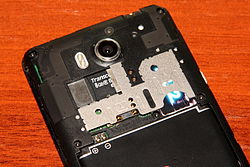 Inserted memory and SIM cards (from Smartphone)
 Mobile cellular subscriptions per 100 people (from Mobile phone)
 A sign along Bellaire Boulevard in Southside Place, Texas (Greater Houston) states that using mobile phones while driving is prohibited from 7:30 am to 9:00 am and from 2:00 pm to 4:15 pm. (from Smartphone)
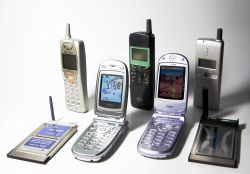 Personal Handy-phone System mobiles and modems, 1997–2003 (from Mobile phone)
 Mobile phone subscribers per 100 inhabitants. 2014 figure is estimated. (from Mobile phone)
 Replica of the telettrofono at Museo Nazionale Scienza e Tecnologia Leonardo da Vinci of Milan, Italy, invented by Antonio Meucci and credited by several sources as the first telephone. (from History of the telephone)
- A sign in the US restricting cell phone use to certain times of day (no cell phone use between 7:30–9:00 am and 2:00–4:15 pm) (from Mobile phone)
 The master telephone patent granted to Bell, 174465, March 7, 1876 (from History of the telephone)
 Thomas Edison invented the carbon microphone which produced a strong telephone signal. (from History of the telephone)
 Reis's telephone around 1861, first device called telephone (from History of the telephone)
 A pedestrian looking down at a smartphone while crossing a road (from Mobile phone)
 Typical mobile phone mini-SIM card (from Mobile phone)
 Historical marker commemorating the first telephone central office in New York State (1878) (from History of the telephone)
 Alexander Graham Bell was awarded the first U.S. patent for the invention of the telephone in 1876. (from History of the telephone)
 A smartphone touchscreen (from Smartphone)
 Bell prototype telephone stamp(from History of the telephone)
Centennial Issue of 1976 Two decades of evolution of mobile phones, from a 1992 Motorola DynaTAC 8000X to the 2014 iPhone 6 Plus (from Mobile phone)
 Dupuis and Haug during a GSM meeting in Belgium, April 1992 (from Mobile phone)
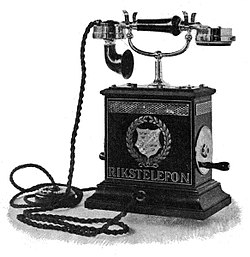 1896 telephone (Sweden) (from History of the telephone)
 Cellular networks work by only reusing radio frequencies (in this example frequencies f1–f4) in non adjacent cells to avoid interference (from Mobile phone)
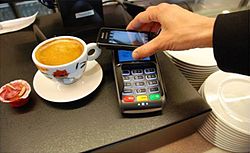 Mobile payment system (from Mobile phone)
 Apple iPhone smartphone (from History of the telephone)
 A young woman speaking on a mobile phone in Copenhagen, 2025 (from Mobile phone)
 Optical track pad sensor of an HTC Legend, 2010 (from Smartphone)

 Elisha Gray, 1876, designed a telephone using a water microphone in Highland Park, Illinois. (from History of the telephone)
 Mobile payment system (from Smartphone)
 Philipp Reis, 1861, constructed the first telephone, today called the Reis telephone. (from History of the telephone)
 A French Gower telephone of 1912 at the Musée des Arts et Métiers in Paris (from History of the telephone)
 Receiver schematic, c.1906 (from History of the telephone)
 "Device options" menu of Samsung Mobile's TouchWiz user interface as of 2013, accessed by holding the power button for a second (from Smartphone)
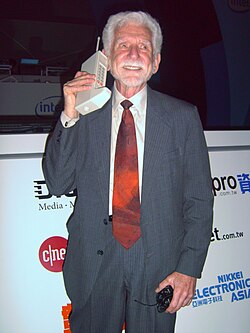 Martin Cooper of Motorola, shown here in a 2007 reenactment, made the first publicized handheld mobile phone call on a prototype DynaTAC model on 3 April 1973. (from Mobile phone)
 A text message (SMS) (from Mobile phone)
 Scrapped mobile phones (from Mobile phone)
 Actor portraying Alexander Graham Bell in a 1932 silent film. Shows Bell's second telephone transmitter (microphone), invented 1876 and first displayed at the Centennial Exposition, Philadelphia. (from History of the telephone)
 A 19th century acoustic tin can or "lovers' telephone" (from History of the telephone)
 Antonio Meucci, 1849, developing a voice-communication apparatus that several sources credit as the first telephone. (from History of the telephone)
 Smartphone with infrared transmitter on top for use as remote control (from Smartphone)
 Android smartphones (from Mobile phone)
 A user consulting a mapping app on a phone (from Smartphone)
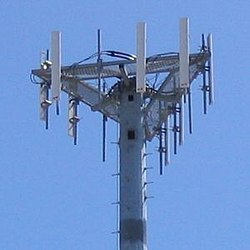 Top of cellular telephone tower (from History of the telephone)
.JPG)


.svg)


.jpg)
.jpg)


.jpg)


.jpg)

._Photograph_by_L._Alman._Wellcome_V0026857.jpg)
.jpg)


Selected biography

Pat Trumble Fleet is an American voice actress. Widely recognized for the tens of thousands of recordings she has made for US telephone companies such as AT&T, Verizon, Qwest, the former Bell System companies, and others since 1981, she is still most recognized as the person who says "AT&T" in the company's sound trademark, which played prior to any operator assisted or credit card paid call, and on answer when calling AT&T customer service numbers.
She is also the voice for most "star" services (e.g. last-call return, call blocking, etc.) for AT&T local telephone companies, and the voice heard when making AT&T handled calls through 1-800-CALL-ATT (225-5288) and through international AT&T access numbers such as USADirect. (Full article...)
Selected images
 Track-side emergency brake and emergency telephones at the platform of the metro station Aspern Nord, Donaustadt, Vienna, Austria
 Wooden wall telephone with a hand-cranked magneto generator
 Mailbox and public telephone in Haßfurt, Germany
 Landline call blocking in use
 A police box outside Earl's Court tube station in London, built in 1996 and based on the 1929 Gilbert Mackenzie Trench design
 Apple iPhones
 Automatic electric Rotary dial telephone
 Telephone booth box art outside the Tower of London, 2012
 Android smartphones
 Historical telephone with the German imperial eagle and the heraldic shield of the House of Hohenzollern dynasty; Vollmer's Mill, Seebach, Baden-Württemberg, Germany
 A traditional North American rotary phone dial. The associative lettering was originally used for dialing named exchanges but was kept because it facilitated memorization of telephone numbers.
 Photograph of the interior of the Prairie Grove Airlight Outdoor Telephone Booth in Prairie Grove, Arkansas, which is listed on the National Register of Historic Places
 Rotary dial telephone, probably from Belgium; the circuit diagram inside is in Dutch and French
 An example of a K6, the most common red telephone box model, photographed in London in 2012
 A Bell Canada payphone with digital display
 A Funke + Huster telephone inside the Idrija Mine, Slovenia
 A Northern Electric telephone, model number N415H, circa 1950 (probably)
 Emergency telephones, on the Paris-Bordeaux railway line, Saint-Saviol station, Vienne, France
 Acoustic telephone ad, The Consolidated Telephone Co., Jersey City, New Jersey, 1886
 Public telephone, Bucharest, Romania
 A historic telephone booth in Skansen, Stockholm
 A Western Electric candlestick phone from the 1920s
 The AUTOVON was a worldwide American military telephone system that was built starting in 1963.
 Rotary dial telephone, probably from Belgium; the circuit diagram inside is in Dutch and French


Topics
| Types | |
|---|---|
| Accessories | |
| Connectivity | |
| Calls | |
| Applications | |


| Mobile networks, protocols |
| ||||||
|---|---|---|---|---|---|---|---|
| General operation | |||||||
| Mobile devices |
| ||||||
| Mobile specific software |
| ||||||
| Culture | |||||||
| Environment and health | |||||||
| Law | |||||||

| |


Cellular network standards | |||||||||
|---|---|---|---|---|---|---|---|---|---|
| 0G radio telephones (1946) | |||||||||
| 1G (1979) |
| ||||||||
| 2G (1991) |
| ||||||||
| 2G transitional (2.5G, 2.75G, 2.9G) |
| ||||||||
| 3G (1998) IMT-2000 (2001) |
| ||||||||
| 3G transitional (3.5G, 3.75G, 3.9G) |
| ||||||||
| 4G (2009) IMT Advanced (2013) |
| ||||||||
| 5G (2018) IMT-2020 (2021) |
| ||||||||
| Related articles | |||||||||
Subcategories

More
 |
Here are some tasks awaiting attention:
|

Telephones in the news
- 8 May 2026 – 2026 Iran war
- Iranian foreign minister Abbas Araghchi and Turkish foreign minister Hakan Fidan hold a phone call to review the status of talks between Iran and the United States. (AA)
- 4 May 2026 – 2026 Iran war
- Iranian foreign minister Abbas Araghchi and Pakistani foreign minister Ishaq Dar hold a phone call to discuss Pakistan's efforts to revive ceasefire talks between Iran and the United States aimed at ending the war. (AA) (Al Arabiya)
- 29 April 2026 – Russo-Ukrainian war
- During a phone call with U.S. president Donald Trump, Russian president Vladimir Putin offers a ceasefire for Victory Day on May 9. (The Moscow Times) (Kyiv Independent)
Associated Wikimedia
The following Wikimedia Foundation sister projects provide more on this subject:
-
 Commons
Free media repository -
 Wikidata
Free knowledge base -
 Wikiquote
Collection of quotations -
 Wikisource
Free-content library -
 Wikiversity
Free learning tools -
 Wiktionary
Dictionary and thesaurus