The Sports Portal

A sport is a physical activity or game, often competitive and organized, that maintains or improves physical ability and skills. Sport may provide enjoyment to participants and entertainment to spectators. The number of participants in a particular sport can vary from hundreds of people to a single individual.
Sport competitions may use a team or single person format, and may be open, allowing a broad range of participants, or closed, restricting participation to specific groups or those invited. Competitions may allow a "tie" or "draw", in which there is no single winner; others provide tie-breaking methods to ensure there is only one winner. They also may be arranged in a tournament format, producing a champion. Many sports leagues make an annual champion by arranging games in a regular sports season, followed in some cases by playoffs. (Full article...)
Selected articles
 The 1980 World Snooker Championship, officially known as the 1980 Embassy World Snooker Championship for sponsorship reasons, was a ranking professional snooker tournament that took place from 22 April to 5 May 1980 at the Crucible Theatre in Sheffield, England. The tournament was the 1980 edition of the World Snooker Championship and was the fourth consecutive world championship to take place at the Crucible Theatre since 1977. It was authorised by the World Professional Billiards and Snooker Association. The total prize fund for the tournament was £60,000, of which £15,000 went to the winner.
There were 53 entrants to the competition, although four later withdrew. Qualifying rounds for the tournament took place at Romiley Forum, Stockport, from 5 to 18 April 1980; at the Redwood Lodge Country Club, Bristol, from 11 to 16 April; and at Sheffield Snooker Centre from 12 to 17 April. The main stage of the tournament featured 24 players: the top 16 players from the snooker world rankings and another eight players from the qualifying rounds. Ray Edmonds, Jim Meadowcroft, Tony Meo, Cliff Wilson and Jim Wych made their Crucible debuts. The defending champion and top seed in the tournament was Terry Griffiths, who had defeated Dennis Taylor 24–16 in the 1979 final. (Full article...)
The Metacomet Ridge, Metacomet Ridge Mountains, or Metacomet Range of southern New England is a narrow and steep fault-block mountain ridge known for its extensive cliff faces, scenic vistas, microclimate ecosystems, and rare or endangered plants. The ridge is an important recreation resource located within 10 miles (16 km) of more than 1.5 million people, offering four long-distance hiking trails and over a dozen parks and recreation areas, including several historic sites. It has been the focus of ongoing conservation efforts because of its natural, historic, and recreational value, involving municipal, state, and national agencies and nearly two dozen non-profit organizations.
The Metacomet Ridge extends from Branford, Connecticut, on Long Island Sound, through the Connecticut River Valley region of Connecticut and Massachusetts, to northern Franklin County, Massachusetts, 2 miles (3 km) short of the Vermont and New Hampshire borders for a distance of 100 miles (160 km). It is geologically distinct from the nearby Appalachian Mountains and surrounding uplands, and is composed of volcanic basalt (also known as trap rock) and sedimentary rock in faulted and tilted layers many hundreds of feet thick. In most cases, the basalt layers are dominant, prevalent, and exposed. The ridge rises dramatically from much lower valley elevations, although only 1,200 feet (370 m) above sea level at its highest, with an average summit elevation of 725 feet (221 m). (Full article...)
The 1956 FA Cup final was the final match of the 1955–56 staging of English football's primary cup competition, the Football Association Challenge Cup, better known as the FA Cup. The showpiece event was contested between Manchester City and Birmingham City at Wembley Stadium in London on Saturday 5 May 1956. Two-time winners Manchester City were appearing in their sixth final, whereas Birmingham City were seeking to win the competition for the first time, having lost their only previous final in 1931.
Each club needed to win five matches to reach the final. Manchester City's victories were close affairs, each settled by the odd goal, and they needed a replay to defeat fifth-round opponents Liverpool. Birmingham City made more comfortable progress: they scored eighteen goals while conceding only two, and won each match at the first attempt despite being drawn to play on their opponents' ground in every round. They became the first team to reach an FA Cup final without playing at home. (Full article...)- Burnley Football Club is an English professional association football club based in Burnley, Lancashire. It was founded on 18 May 1882 by members of rugby club Burnley Rovers, who voted for a change from rugby to association football. The suffix "Rovers" was dropped in the following days. Burnley became professional in 1883—one of the first to do so—putting pressure on the Football Association (FA) to permit payments to players. In 1885, the FA legalised professionalism, so the team entered the FA Cup for the first time in 1885–86, and were one of the twelve founder members of the Football League in 1888–89, the world's first league football competition.
The team remained in the top tier until they were relegated to the Second Division at the end of the 1896–97 season. They won promotion the following season, but were relegated again in 1899–1900. Burnley achieved promotion back to the First Division in 1912–13 under manager John Haworth, and the following year, the side won the FA Cup for the first—and to date only—time, after they defeated Liverpool in the final. In the 1920–21 campaign, Burnley were crowned champions of England for the first time. During that season they embarked on a 30-match unbeaten run, setting an English record. Burnley remained in the top tier of English football until 1929–30, when they sank to the second tier. The team gained promotion back to the first tier in 1946–47 and stayed there for 24 consecutive seasons. (Full article...)
The 2016 FA Cup final was an association football match between Crystal Palace and Manchester United on 21 May 2016 at Wembley Stadium in London, England, organised by the Football Association (FA). It marked the 135th final of the Football Association Challenge Cup (FA Cup) and was the showpiece match of English football's primary cup competition. It was Manchester United's first FA Cup final appearance since 2007, when they lost 1–0 to Chelsea. Crystal Palace were playing their second FA Cup final, the previous occasion being in 1990, when they lost to Manchester United after a replay following a 3–3 draw in the first match.
Mark Clattenburg, from Consett, County Durham, was the referee for the match, which was played in front of 88,619 spectators. The first half was goalless although Clattenburg was the subject of some controversy when he awarded Crystal Palace a free kick instead of playing advantage after Manchester United's Chris Smalling was adjudged to have fouled Connor Wickham. After coming on as a second-half substitute, Jason Puncheon gave Crystal Palace the lead when he scored from close range past David de Gea in the Manchester United goal. The lead lasted three minutes before Juan Mata's deflected volley beat Wayne Hennessey, the Crystal Palace goalkeeper. Regular time ended with a scoreline of 1–1, sending the final into extra time. Just before the interval in the additional period, Smalling was sent off after receiving a second yellow card, becoming the fourth player to be dismissed in an FA Cup final. Jesse Lingard, who had been brought on to replace Mata close to the end of regular time, then shot from distance, sending the ball into the top corner of the Crystal Palace goal to give Manchester United a 2–1 victory, and their twelfth FA Cup. (Full article...)
Roberto Luongo (born April 4, 1979) is a Canadian former professional ice hockey player. He played 19 seasons in the National Hockey League (NHL) as a goaltender for the New York Islanders, Florida Panthers, and Vancouver Canucks. In 2022, Luongo was inducted into the Hockey Hall of Fame. Luongo is a two-time NHL All-Star (2004 and 2007) and winner of the William M. Jennings Trophy for backstopping his team to the lowest goals against average in the league (2011, with backup Cory Schneider). He was a finalist for several awards, including the Vezina Trophy as the league's best goaltender (2004, 2007, and 2011), the Lester B. Pearson Award as the top player voted by his peers (2004 and 2007), and the Hart Memorial Trophy as the league's most valuable player (2007). Luongo is third all-time in games played as an NHL goaltender (1,044) and fourth all-time in wins (489). He employed the butterfly style of goaltending.
Born in Montreal, Quebec, he played in the Quebec Major Junior Hockey League (QMJHL) for the Val-d'Or Foreurs and the Acadie-Bathurst Titan, winning back-to-back President's Cups and establishing the league's all-time playoff records for games played and wins. Following his second QMJHL season, Luongo was selected fourth overall by the Islanders in the 1997 NHL entry draft. After splitting his professional rookie season between the Islanders and their American Hockey League (AHL) affiliate, the Lowell Lock Monsters in 1999–2000, he was traded to the Panthers. In five seasons with Florida, Luongo established team records for games played, wins, and shutouts; despite several strong seasons, however, the Panthers remained a weak team and were unable to qualify for the Stanley Cup playoffs during Luongo's initial stint with the team. During the 2006 offseason, he was traded to the Canucks after failed contract negotiations with the Panthers. (Full article...)
Shah Rukh Khan (pronounced [ˈʃaːɦɾʊx xäːn] ⓘ; born as Shahrukh Khan on 2 November 1965), popularly known by the initials SRK, is an Indian actor and film producer renowned for his work in Hindi cinema. Referred to in the media as the "Baadshah of Bollywood" and "King Khan", he has appeared in more than 100 films and earned numerous accolades, including a National Film Award and 15 Filmfare Awards. He has been awarded the Padma Shri by the Government of India, as well as the Order of Arts and Letters and Legion of Honour by the Government of France. Khan has a significant following in Asia and among the Indian diaspora worldwide. In terms of audience size and income, several media outlets have described him as one of the most successful film stars in the world. Many of his films thematise Indian national identity and connections with diaspora communities, or gender, racial, social and religious differences and grievances.
Khan began his career with appearances in several television series in the late 1980s and made his Hindi film debut in 1992 with the musical romance Deewana. He was initially recognised for playing villainous roles in the films Baazigar (1993) and Darr (1993). Khan established himself by starring in a series of top-grossing romantic films, including Dilwale Dulhania Le Jayenge (1995), Dil To Pagal Hai (1997), Kuch Kuch Hota Hai (1998), Mohabbatein (2000), Kabhi Khushi Kabhie Gham (2001), Kal Ho Naa Ho (2003), Veer-Zaara (2004), and Kabhi Alvida Naa Kehna (2006). He earned critical acclaim for his portrayal of an alcoholic in the period romantic drama Devdas (2002), a NASA scientist in the social drama Swades (2004), a hockey coach in the sports drama Chak De! India (2007), and a man with Asperger syndrome in the drama My Name Is Khan (2010). Further commercial successes came with the romances Om Shanti Om (2007) and Rab Ne Bana Di Jodi (2008), and with his expansion to comedies in Chennai Express (2013) and Happy New Year (2014). Following a brief setback and hiatus, Khan made a career comeback with the 2023 action thrillers Pathaan and Jawan, both of which rank among the highest-grossing Indian films. For Jawan, he received the National Film Award for Best Actor in a Leading Role. (Full article...)- During the 1934–35 English football season, Gillingham F.C. competed in the Football League Third Division South, the third tier of the English football league system. It was the 15th season in which Gillingham competed in the Football League. Gillingham won two of their first four games of the season but then won only once in the next eleven league games; they were in 18th place out of 22 teams in the league table at the end of November. During a match on 1 December, Gillingham's Sim Raleigh suffered a head injury and died later that day. The team ended 1934 with five consecutive defeats during which they conceded 24 goals. After only winning 4 out of 22 games between August and December, Gillingham performed better in the second half of the campaign, with 7 victories in 20 games between January and May. An unbeaten run of seven games during March and April helped ensure that they finished the season in 20th place, avoiding by one place the need to apply for re-election to the league for the following season.
Gillingham competed in two knock-out competitions but were eliminated in the first round of both the FA Cup and the Third Division South Cup. The team played 44 competitive matches, winning 11, drawing 13 and losing 20. Bill Baldwin was the club's top goalscorer with 13 goals, all scored in the league. Fred Lester made the most appearances, playing in all 44 games. The highest attendance recorded at the club's home ground, Priestfield Road, during the season was 9,233 for a league match against Coventry City on 26 December 1934. (Full article...) - The Wales national rugby union team represents Wales in men's international rugby union. Its governing body, the Welsh Rugby Union (WRU), was established in 1881, the same year that Wales played their first international against England. The team plays its home matches at the Millennium Stadium in Cardiff, which replaced Cardiff Arms Park as the national stadium of Wales in 1999.
Wales has competed annually in the Six Nations Championship (previously the Home Nations Championship and Five Nations Championship) since it was established in 1883. They have won the tournament (and its predecessors) outright 28 times, most recently in 2021. Since the Six Nations was formed in 2000, Wales have won six Six Nations titles, including four Grand Slams, and finished bottom three times. Wales has also participated in every Rugby World Cup since the competition was established in 1987; they finished third in the inaugural tournament and have since made two semi-finals, in 2011 and 2019. Wales were the host nation for the 1999 Rugby World Cup, although matches were also played in England, Scotland, Ireland and France. (Full article...)
Charles Dillon "Casey" Stengel (/ˈstɛŋɡəl/; July 30, 1890 – September 29, 1975) was an American Major League Baseball (MLB) right fielder and manager, best known as the manager of the championship New York Yankees of the 1950s and later, the expansion New York Mets. Nicknamed "the Ol' Perfessor", he was elected to the Baseball Hall of Fame in 1966.
Stengel was born in Kansas City, Missouri, in 1890. In 1910, he began a professional baseball career that would span over half a century. After almost three seasons in the minor leagues, Stengel reached the major leagues late in 1912, as an outfielder, for the Brooklyn Dodgers. His six seasons there saw some success, among them playing for Brooklyn's 1916 National League championship team. During this time he also developed a reputation as a clown. After repeated clashes over pay with the Dodgers owner, Charlie Ebbets, Stengel was traded to the Pittsburgh Pirates in 1918; however, he enlisted in the Navy that summer, for the remainder of World War I. After returning to baseball, he continued his pay disputes, resulting in trades to the Philadelphia Phillies (in 1919) and to the New York Giants (in 1921). There, he learned much about baseball from the manager, John McGraw, and had a number of highlights in his career, including hitting an inside-the-park home run in Game 1 of the 1923 World Series to defeat the Yankees. His major league playing career ended with the Boston Braves in 1925, after which he began a career as a manager. (Full article...)
The 2008 FedEx Orange Bowl was a post-season college football bowl game between the Virginia Tech Hokies and the Kansas Jayhawks on January 3, 2008, at Dolphin Stadium in Miami Gardens, Florida. Spread bettors favored Virginia Tech by three points, but in a game dominated by defensive and special teams play, Kansas defeated Virginia Tech 24–21. The game was part of the 2007–08 Bowl Championship Series (BCS) of the 2007 NCAA Division I FBS football season and was the concluding game of the season for both teams. This 74th edition of the Orange Bowl was televised in the United States on Fox and was watched by more than eight million viewers.
The game between the fifth-ranked ACC champion Virginia Tech Hokies and the eighth-ranked Kansas Jayhawks from the Big 12 Conference (Big 12) was played at neutral-site Dolphins Stadium. Tech served as the home team in the contest. Virginia Tech automatically qualified for the Orange Bowl by virtue of the ACC's tie-in with the bowl, while the Orange Bowl selected Kansas over West Virginia, which had been upset by then 4–7 Pittsburgh, and conference rival Missouri. Two weeks after Kansas's selection, controversy erupted when a deal was revealed to put 4th-ranked Oklahoma against Virginia Tech. The deal was vetoed by BCS commissioners, and the selection of Kansas was upheld. (Full article...)
Lawrence Winchester Wetherby (January 2, 1908 – March 27, 1994) was an American politician who served as 40th lieutenant governor and the 48th governor of Kentucky. He was the first of only two Kentucky governors born in Jefferson County, despite the fact that Louisville (the county seat) is the state's most populous city. The second governor born in Jefferson County is the incumbent governor, Democrat Andy Beshear, who grew up in the Lexington area. Two other governors have been elected when residents of Jefferson: Republicans Augustus Willson, 1907–11, and Matt Bevin, 2015–19.
After graduating from the University of Louisville, Wetherby held several offices in the Jefferson County judicial system before being elected lieutenant governor in 1947 as the quiet choice of 2nd District U.S. Rep. Earle C. Clements, D-Morganfield, who won the primary for the top job. Wetherby was called Kentucky's first "working" lieutenant governor because Clements had him carry out duties beyond his constitutional responsibility to preside over the state Senate, such as preparing the state budget and attending the Southern Governors Conference. In 1950, Clements was elected to the U.S. Senate, elevating Wetherby to governor on Nov. 27. Wetherby won immediate acclaim by calling a special legislative session to increase funding for education and government benefits from the state's budget surplus, which had been boosted by the Korean War. In 1951, campaigning as a "Middletown farmer" in a largely rural state, he won a full four-year term, during which he continued and expanded many of Clements' programs, including increased road construction and industrial diversification. He endorsed the Supreme Court's 1954 desegregation order in the case of Brown v. Board of Education and appointed a biracial commission to oversee the successful integration of the state's schools. As chairman of the Southern Governors Conference in 1954 and 1955, he encouraged other Southern governors to accept and implement desegregation. (Full article...)
Blackburn Olympic Football Club was an English football club based in Blackburn, Lancashire in the late 19th century. Although the club was only in existence for just over a decade, it is significant in the history of football in England as the first club from the north of the country and the first from a working-class background to win the country's leading competition, the Football Association Challenge Cup (FA Cup). The cup had previously been won only by teams of wealthy amateurs from the home counties, and Olympic's victory marked a turning point in the sport's transition from a pastime for upper-class gentlemen to a professional sport.
The club was formed in 1878 and initially took part only in minor local competitions. In 1880, the club entered the FA Cup for the first time, and three years later defeated Old Etonians at Kennington Oval to win the trophy. Olympic, however, proved unable to compete with wealthier and better-supported clubs in the new professional era, and folded in 1889. (Full article...)- The 2023 World Snooker Championship (officially the 2023 Cazoo World Snooker Championship) was a professional snooker tournament that took place from 15 April to 1 May 2023 at the Crucible Theatre in Sheffield, England, the 47th consecutive year that the World Snooker Championship was staged at the venue. The qualifying rounds took place from 3 to 12 April 2023 at the English Institute of Sport in Sheffield. The 15th and final ranking tournament of the 2022–23 snooker season, it was organised by the World Snooker Tour and sponsored for the first time by car retailer Cazoo. It was broadcast in the United Kingdom by the BBC, in Europe by Eurosport, and elsewhere in the world by Matchroom Sport and other broadcasters. The total prize fund was £2,395,000, of which the winner received £500,000.
Ronnie O'Sullivan was the defending champion, having defeated Judd Trump 18–13 in the 2022 final. He made a record 31st Crucible appearance, surpassing the 30 appearances by Steve Davis, and reached a record-extending 21st quarter-final—also becoming the first player to compete in 100 matches at the Crucible—but lost 10–13 to Belgian player Luca Brecel. Crucible debutants at the event were Fan Zhengyi, Jak Jones, Pang Junxu, Si Jiahui, and Wu Yize. Si, aged 20, became the first debutant to reach the semi-finals since Andy Hicks at the 1995 event and the youngest player to do so since O'Sullivan at the 1996 event. Brecel came from 5–14 behind in the semi-finals to defeat Si 17–15, the first time a player had won a match at the Crucible after trailing by nine frames. Brecel went on to defeat Mark Selby 18–15 in the final, winning his first world title, first Triple Crown title, and fourth ranking title. He became the sport's first world champion from mainland Europe. (Full article...) 
George Henry Stevens Trott (5 August 1866 – 9 November 1917) was an Australian cricketer who played 24 Test matches as an all-rounder between 1888 and 1898. Although Trott was a versatile batsman, spin bowler and outstanding fielder, "it is as a captain that he is best remembered, an understanding judge of human nature". After a period of some instability and ill discipline in Australian cricket, he was the first in a succession of assertive Australian captains that included Joe Darling, Monty Noble and Clem Hill, who restored the prestige of the Test team. Respected by teammates and opponents alike for his cricketing judgement, Trott was quick to pick up a weakness in opponents. A right-handed batsman, he was known for his sound defence and vigorous hitting. His slow leg-spin bowling was often able to deceive batsmen through subtle variations of pace and flight, but allowed opposition batsmen to score quickly.
Trott made his Test debut in 1888, on a tour of England, and would tour England another three times (in 1890, 1893 and 1896), scoring more than 1000 runs on each occasion. For the 1896 tour, Trott was elected captain by his teammates. Despite England winning the series two Tests to one and retaining The Ashes, Trott's ability as a captain was highly regarded. In the return series in Australia during the 1897–98 season, Trott's team was more successful, winning the five-Test series 4–1 and regaining The Ashes. At a time when the federation of the Australian colonies was under discussion, the victory saw Trott praised as a "national institution" and his team as having "done more for the federation of Australian hearts than all the big delegates put together". (Full article...)


.jpg)


.png)


Selected pictures
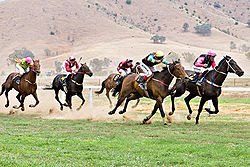 Credit: Fir0002Horses race on grass at the 2006 Tambo Valley Races in Swifts Creek, Victoria, Australia. Horseracing is the third most popular spectator sport in Australia, behind Australian rules football and rugby league, with almost 2 million admissions to the 379 racecourses throughout Australia in 2002–03.
 Photograph credit: Kontizas DimitriosBASE jumping is the recreational sport of jumping from fixed objects, using a parachute to descend safely to the ground. The acronym stands for four categories of fixed objects from which the jumps can be made: buildings, antennae, spans, and earth (cliffs). In this photograph, a BASE jumper launches himself from the top of the Sapphire Tower in Istanbul, Turkey.
 Photo credit: Christopher BattJuuso Pykälistö, driving a Peugeot 206 WRC at the 2003 Swedish Rally, lands a high-speed "yump" on two wheels in the snow. This rally competition is part of the World Rally Championship and was the first rally to be held on snow.
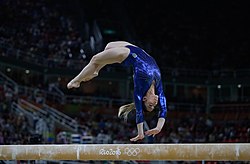 Credit: Fernando FrazãoThe balance beam is a rectangular artistic gymnastics apparatus, as well as the event performed using the apparatus. Pictured is Daniele Hypólito in the final of the women's artistic gymnastics competition at the Rio 2016 Olympic Games, where Brazil finished in 8th place.
 Credit: PierreSelim
 Photo credit: Mike Kaplan, USAFIn gridiron football, the quarterback is the leader of the offensive team. At most levels, but especially at the college and professional level, the quarterback is one of the most visible and important roles on the team, being responsible both for calling plays and making decisions during the play. Shown here is Shea Smith of the Air Force Falcons during the 2007 Armed Forces Bowl.
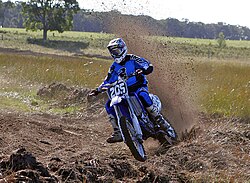 Motocross is form of motorcycle or ATV racing held on enclosed off-road circuits. The tracks are often quite large, natural, terrains with very few man made jumps, unlike Supercross, a sport that was originally derived from Motocross and is executed on a smaller track with many more extreme man made obstacles.
 Photograph credit: Savyasachi, retouched by ukexpatLaura Dekker (born 1995) is a New Zealand–born Dutch sailor who completed a solo circumnavigation of the globe in a 12.4-metre (41-foot) two-masted ketch from 2010 to 2012. Dekker was fourteen years old when she set off from Gibraltar rather than the Netherlands, because the Dutch shipping regulations did not permit anyone under the age of sixteen to skipper a boat of that size in Dutch waters. After crossing the Atlantic Ocean, she started her record-breaking attempt from Sint Maarten in the Caribbean, passing through the Panama Canal and traversing the Pacific, Indian and Atlantic Oceans before completing her circumnavigation back at Sint Maarten. This picture shows Dekker attending the 2011 Hiswa Boat Show in Amsterdam.
 Photo: Bolshoi SportKsenia Semenova (b. 1992) is a Russian artistic gymnast. She was the 2007 World Champion on the uneven bars. At the 2008 European Championships, she was a member of the silver-medal-winning Russian team, as well as champion on the uneven bars and the balance beam. She followed this up by winning the all-around championship at the 2009 European Championships and was part of the gold-medal Russian team at the 2010 European and 2010 World Championships. Injuries have prevented her from competing since then.
 Credit: ChePriit Narusk in the qualification for the Tour de Ski cross-country skiing competition in Prague.
 Photograph: Pierre SelimA line-out at a rugby union match between Stade Toulousain and Lyon OU. When a player puts the ball out of the field of play, the opposing team is awarded a line-out; in the case of a penalty kick, the team that was awarded the penalty throws into the resulting line-out. A line-out is also awarded if a player in possession of the ball crosses or touches the touch-line while still in possession of the ball.
 Photo: KallernaNasser Al-Attiyah, a Qatari rally driver, in a Ford Fiesta S2000 at the 2010 Rally Finland. He is the only Arab to have won the Dakar Rally, which he did in 2011. In addition to driving, Al-Attiyah is a sport shooter and won a bronze medal in the 2012 Summer Olympics in skeet.
 Photograph: Аркадий ЗарубинBalzhinima Tsyrempilov is a World Cup-winning and former world number-one archer from Russia. He has competed in both the 2004 and 2008 Summer Olympics, though he has not medalled.
 Credit: KuebiMara Friton in a handball match in the German Handball-Bundesliga.
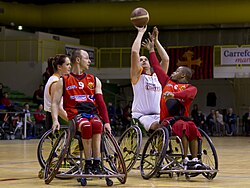 Photograph: Pierre-SelimWheelchair basketball is basketball played by people in wheelchairs and is considered one of the major disabled sports practiced. Depicted here is a game from the first round of the 2012 Euroleague tournament, showing players from Toulouse (in red) and Roma (in white).
 Photograph: Ira Rosenberg; restoration: Chris WoodrichMuhammad Ali (1942-2016) was an American former professional boxer, generally considered among the greatest heavyweights in the history of the sport. A controversial and polarizing figure during his early career, Ali is now highly regarded for the skills he displayed in the ring plus the values he exemplified outside of it: religious freedom, racial justice and the triumph of principle over expedience. Ali remains the only three-time lineal world heavyweight champion, having won the title in 1964, 1974, and 1978.
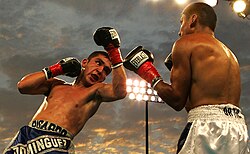 Boxing is a sport where two participants of similar weight attack each other with their fists in a series of one to three-minute intervals called "rounds". Modern boxing began in 1867 with the Marquess of Queensberry rules. Currently, there are two distinct branches of boxing: Professional and Olympic, which have different rules, but are similar in execution.
 Photo: John O'NeillRobbie McEwen, Australian professional road cyclist, wearing his Team Katusha (Russian: Катюша) cycling kit at the start of the 2010 Jayco Bay Cycling Classic. McEwen's accolades include winning the maillot vert (green jersey) overall Points Classification in the Tour de France three times, along with winning 12 individual stages, and competing in three Olympic Games. The green and gold bands around his arms identify him as an Australian National Cycling Champion.
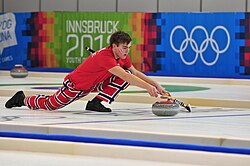 Credit: Ralf RoletschekMartin Sesaker representing Norway in curling at the 2012 Winter Youth Olympics.
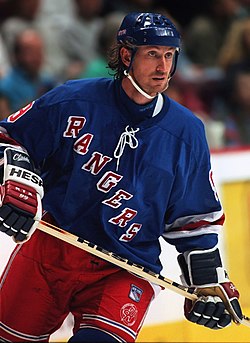 Photo credit: Håkan DahlströmIce hockey player Wayne Gretzky, as a member of the New York Rangers of the National Hockey League (NHL) in 1997. Gretzky, nicknamed "The Great One", is widely considered the best hockey player of all time. Upon his retirement in 1999, he held forty regular-season records, fifteen playoff records, and six All-Star records. He is the only NHL player to total over 200 points in one season—a feat he accomplished four times. In addition, he tallied over 100 points in 15 NHL seasons, 13 of them consecutively. He is the only player to have his number (99) officially retired by the NHL for all teams.
 Photograph credit: Rodney EeThe pacu jawi is a traditional bull race in Tanah Datar, West Sumatra, Indonesia. In the race, a jockey stands holding on to a pair of loosely tied bulls while the bulls run across a muddy track in a rice field. Recently, it has become a tourist attraction supported by the government, and the subject of multiple award-winning photographs. Dramatic high-speed action, mud splashing, and the jockeys' distinctive facial expressions add to its aesthetic value.
 Photograph: Carlos DelgadoZoran Dragić (right) committing a personal foul on Carl English during a 2013 basketball game between Game Estudiantes and Unicaja Málaga. Personal fouls, defined as illegal personal contact with an opponent which affects gameplay, are the most common type of foul in basketball, but are not always considered unsportsmanlike.
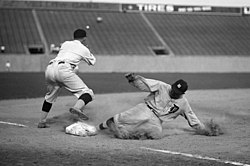 Photo: National Photo Company; restoration: Lise Broer; crop: jjronTy Cobb (1886–1961), shown here sliding into third base on August 16, 1924, was an American Major League Baseball (MLB) outfielder. He spent twenty-two seasons with the Detroit Tigers, including six as the team's player-manager, and finished his career with the Philadelphia Athletics. During this time Cobb set ninety MLB records, though his abilities were sometimes overshadowed by his surly temperament and aggressive playing style. In 1936 Cobb was made an inaugural member of the Baseball Hall of Fame, and in 1999 editors at the Sporting News ranked him third on their list of "Baseball's 100 Greatest Players".


_(cropped).jpg)


.jpg)


Did you know...

- ...that in 1968, Swedish pentathlete Hans-Gunnar Liljenwall became the first Olympian disqualified for drug use, for drinking two beers?
- ...that golf ball (pictured) design is a real world application of Platonic solids?
- ...that the 2007 Fiesta Bowl ended on a Statue of Liberty play from Jared Zabransky to Ian Johnson, giving the Boise State Broncos the winning two-point conversion?
- ...that the French footballer Lucien Laurent scored the first ever World Cup goal, against Mexico in 1930?
- ...that the Arctic Winter Games are held biennially for athletes from the "circumpolar North"?
Selected quote

Selected athlete
.jpg)
Thorpe grew up in the Sac and Fox nation in Oklahoma. He attended Carlisle Indian Industrial School, where he attracted the attention of Pop Warner. In 1911 he played as running back, defensive back, placekicker and punter, for Carlisle, scoring 25 touchdowns and leading the team to a collegiate championship, and was awarded All-American honors in both 1911 and 1912. Thorpe with the New York Giants baseball team in 1913, he would also play for the Cincinnati Reds and the Boston Braves (now Atlanta Braves), and in the minor leagues before leaving the sport in 1922. He continued playing football during this time, playing professionally for the Canton Bulldogs, which he led to several titles. He played professional sports until age 41, the end of his sports career coinciding with the start of the Great Depression. Thorpe struggled to earn a living after that, working several odd jobs. Thorpe suffered from alcoholism, and lived his last years in failing health and poverty.
In a poll of sports fans conducted by ABC Sports, Thorpe was voted the Greatest Athlete of the Twentieth Century. (Full article...)
Selected team

Rugby was introduced to France in 1872 by the British, and on New Year's Day 1906 the national side played its first Test match — against New Zealand in Paris. France played sporadically against the Home Nations until they joined them to form a Five Nations tournament (now the Six Nations Championship) in 1910. France also competed in the rugby competitions at early Summer Olympics, winning the gold medal in 1900 and two silver medals in the 1920s. The national team came of age during the 1950s and 1960s, winning their first Five Nations title outright in 1959. They won their first Grand Slam in 1968.
Since the inaugural World Cup in 1987, France have qualified for the knock-out stage of every tournament. They have reached the final three times, losing to the All Blacks in 1987 and 2011 and to Australia in 1999. France hosted the 2007 Rugby World Cup, where, as in 2003, they were beaten in the semi-finals by England.
French international matches are played at several venues across the country; the Stade de France in the Paris suburb of Saint-Denis is used for their games during the Six Nations, and they have a formidable home record at the Stade Vélodrome in Marseille where they have only lost twice, to Argentina in 2004 and to New Zealand in 2009. (Full article...)
In this month
.jpg)
- May 8, 1954 – The Asian Football Confederation, the governing body of association football in Asia, is founded
- May 15, 1908 – The International Ice Hockey Federation is founded in Paris as Ligue International de Hockey sur Glace
- May 17, 1875 – The first Kentucky Derby is held, with Aristides winning the race
- May 22, 1987 – The inaugural Rugby World Cup (2011 match pictured), co-hosted by New Zealand and Australia, begins
- May 23, 1985 – The first Games of the Small States of Europe, a multi-sport event for European microstates, begins in San Marino
Topics


Related portals


.jpg)


Categories

Things you can do
 |
Here are some tasks awaiting attention:
|
Associated Wikimedia
The following Wikimedia Foundation sister projects provide more on this subject:
-
 Commons
Free media repository -
 Wikidata
Free knowledge base -
 Wikiquote
Collection of quotations -
 Wikisource
Free-content library -
 Wikiversity
Free learning tools -
 Wiktionary
Dictionary and thesaurus