
Spent the last two nights at the hospital with a resident
Jul. 9th, 2026 12:30 pm![[personal profile]](https://www.dreamwidth.org/img/silk/identity/user.png) conuly
conulyTaking the bus back from the hospital always gets me thinking about Hurricane Sandy. They named a corner after those two boys. They'd be in high school now, or even entering college. It's easy to judge their mother - and don't get me wrong, I do judge her, because she made every possible mistake from before the storm even hit, starting with not evacuating - but people do dumb stuff all the time and it usually works out just fine. People don't usually die because they did something stupid, they don't usually lose their kids over it.
It's been rainy too. It's really just a maudlin way to start a week.
But I still think, every time I take that bus from the hospital, that those kids should've gotten to grow up, and instead they didn't even get to go trick-or-treating that year.
The moral of this post, inasmuch as there even is one, is that if your area is under an evacuation order, or ought to be, fucking evacuate. Or if you've decided to shelter in place, shelter in place. Don't try to evacuate after the storm is already upon you. That's how it all goes wrong.
Anyone finding my journal slow?
Jul. 7th, 2026 12:54 pmandrewduckerCan anyone replicate this? (I'm putting in a support request to DW over it, and it would be good to know if this is something special about him, or a more widespread problem.)
And before anyone asks, yes, we've replicated on multiple browsers, multiple devices, and multiple networks.
Edit: Support ticket raised
Interesting Links for 07-07-2026
Jul. 7th, 2026 12:00 pmandrewducker- 1. Challenging the EHRC Code of Practice: A Judicial Review (I've just donated)
- (tags:UK transgender bigotry law CrowdFunding )
- 2. Endometriosis could be diagnosed by blood test
- (tags:endometriosis blood GoodNews )
- 3. If this is Tuesday, Doctor Who must have just ended
- (tags:drwho TV UK bbc )
- 4. A Hacker's Arrest Reveals Microsoft Can Track Users Via a Windows Device ID | PCMag
- (tags:surveillance Microsoft windows )
Raining, raining, raining...
Jul. 7th, 2026 09:53 pmconuly(I always picture all this rain after a heat wave like somebody reaching up and literally wringing out the damp air.)
( Read more... )
Oz, Part 3 - OzFest in Darwin
Jul. 6th, 2026 08:59 pmfauxkloreOzFest officially started Friday night. Several of us met up at Lizards Bar & Grill for lunch around 1 p.m. I got (alcoholic) ginger beer and beef tacos, which were fairly good, though not as spicy as I would have preferred. A lot of the conversation ran to either people trying to remember where they’d met before (e.g. “oh, you were at that dinner in XXX, right?”) or introducing themselves to people they were sure they’d never met before. Most of us walked over to the Novotel afterwards for a little birthday party for one of the attendees.
The first official event was dinner at Stokes Hill Wharf. This is a seaside area with a bunch of food stalls and a pleasant view of the sunset. There’s also a memorial to the bombing of Darwin there.

The directions for meeting up there had been a bit vague, but it worked out in the end. We’d managed to grab a few tables close to one another and I think most of the people who intended to come managed to find the group. I have deeply mixed feelings about WhatsApp, but it is very useful for this sort of thing.
We had an early departure on Saturday with a hired bus that picked people up at a few hotels. We drove out a ways from Darwin to take the Original Jumping Crocodiles Cruise. This was one of the highlights of the weekend for me. Yes, they do dangle food to attract the crocodiles, but we definitely got good views of them.


By the way, these are estuarine crocodiles, which can live in either freshwater or saltwater, but they’re usually just called “salties.” We did also see some birds (generally raptors, e.g. kites).

The boat trip was about an hour. And everybody came back with all their limbs, so it must have been a success.
Our next stop was the Purple Mango Cafe and Brewery, where we had drinks and pizza. Most of the pizza was kinds of weird in my opinion, e.g. mango chicken or potato and onions. After that we drove to Corroboree Billabong Wetland Cruises, where we got on two boats for a cruise along the billabong, with more wildlife viewing and a boxed lunch. While we did see a few crocodiles and several birds (e.g. cormorants and egrets), it was hot out by then and, overall, this was less enjoyable than the morning boat ride had been.

On the way back to Darwin, we saw a lot of wallabies along the road. They’re very cute, but they ran off when they heard the bus, so I couldn’t get any decent pictures of them.
We had a brief stop to drop people off at the hotels so they could refresh themselves. Then we reboarded the bus and got dropped off at the Darwin Trailer Boat Club for dinner. It was very crowded, so there was a long line at the bar and a long wait for food.I got fish and chips and Thai salad, which was pretty good. I also had a gin and tonic because anybody over about 40 should have already decided on their default go-to drink. You can get a G&T anywhere in the world and you can always pretend the quinine in the tonic water is healthy even if there isn’t really enough to prevent malaria. Anyway, there was lots of lively travel-related conversation. Eventually, I shared an Uber back to the Doubletree with a couple of other people.
Our bus driver on Saturday had told us the true story of Crocodile Dundee, i.e. the actual man who had vaguely inspired the movie. We had a different driver on Sunday, who was called “Magpie Mike” and told us stories about his entertainment career imitating bird calls.
Our first stop was the Darwin Military Museum. There are outside areas that have displays of everything from uniforms to cannons to aircraft.


There are more displays inside and one of the major ones is a film about the Japanese bombing of Darwin. I can’t speak for other Americans, but given that we learned fairly little about Pearl Harbor, I’m pretty sure Australia’s involvement in World War II was never even mentioned in my high school history classes. (We spent months on the French Revolution and less than a week on the entire 20th Century.) There is also a section on the Holocaust and I was also interested in a scheme for creating a Jewish state in northern Australia.
Our next stop was the Mangrove Boardwalk. This was very pretty and I wish we had had more time there so I could enjoy it at a more leisurely pace. Note that it was high tide, so a lot of the roots were covered by the water.

We stopped for lunch at the Cool Spot Cafe, where I had a (non-alcoholic) ginger beer and a very tasty Korean chicken burger with chips (i.e. fries). After lunch, we got back on the bus and people got dropped off at their choice of a few places. I opted for the Northern Territory Museum and Art Gallery. The art gallery focused on pieces by students finishing high school. Here are a couple of pieces I liked.


There was an interesting film with interviews with the students. Many of them had entirely unrealistic visions for their futures, focusing on money and stardom.
Other exhibits in the museum included natural history and a large exhibit about Cyclone Tracy, which destroyed Darwin 50 years ago. Another person and I shared an Uber back to the Doubletree. People were meeting up at the Mindil Beach Sunset Markets for dinner, but I decided I needed a nap and some introvert time, so passed on that.
Overall, I had a good time with interesting activities and good conversation. As I’ve said before, while there is great scenery and cool animals, the major reason to go to Australia is Australians. While I am not planning to go to next year’s OzFest in Canberra, I am sure I will go again in the future.
One issue with Darwin is flight schedules. There are a lot of flights that depart at absurd hours like 1 a.m. I opted to take a more reasonable flight on Monday afternoon, on Virgin Australia to Brisbane. Since I’ve been there a couple of times, I just stayed overnight at the Ibis Hotel (a short walk from the domestic terminal). It was fine for what it was, though the only charging port was in the back of the clock radio.
In the morning, I took the (paid) shuttle to the International Terminal. I had breakfast in the Air New Zealand lounge. Shortly before boarding, I got a notice that I’d gotten upgraded to Polaris for my flight to SFO. It was (as is typical at SFO) a bit of a hike to get to my connecting flight, which was completely full and, hence, uncomfortable. But, I had an aisle seat and I had no issues getting home, which is the important part. Getting caught up at home is, alas, another story.
Oz, Part 2 - The Ghan and Alice Springs
Jul. 6th, 2026 11:17 amfauxklore
Shortly after we departed, we had lunch. It was a long walk from my car to the lounge car, where we waited. I sat with 3 other people, one of whom was deaf and, while he could read lips, he communicated by writing on a pad of paper. I had a nicely spicy vegetable curry for my main course and cheesecake for dessert. After eating, I went back to my cabin to relax, listen to music (they have several radio channels to choose from), and watch the world go by. At about 5:30 p.m., I went back to the lounge for trivia. The questions were decidedly Aussie focused, though I knew the answers to several of them and the team I was on tied for fourth place. For dinner, I started with kangaroo loin (delicious!), followed by lamb for the main course, and a parfait for dessert. After the previous day’s wine excess, I stuck to drinking sparkling water. When I got back to my cabin, the seats had been made up into a bed. I read for a while before trying to sleep.
Key word was “trying.” It was a bit noisy and my bladder had decided to be a bit hyperactive, so I didn’t get a lot of high quality sleep. We stopped early in the morning - well, really, in the middle of the night - at Marla, where we had an opportunity to get off the train to watch the sunrise. Unfortunately, it was overcast, so I didn’t get a decent sunrise photo. Have a couple of pictures of the train, instead.


It was also really cold out. They did give us coffee and a light meal. I really liked the spinach and cheese biscuits they served. I also liked getting back on board to warm up and go back to sleep for a bit longer. They served brunch at 10 a.m. and I had a tasty omelet with French toast for dessert.
Along the way, we crossed the border between South Australia and the Northern Territory. I failed to get a picture of the sign marking the border, but I did get one of an Iron Man statue a bit further on. (Note that the statue is a bit to the left of the sign.)

We arrived at the Alice Springs station at about 2 in the afternoon.

I had booked a hotel and tour package in Alice. It was a bit of a wait for the bus that would drop people off at their hotels, but it’s not like I had anything better to do. I stayed at the Crowne Plaza, which was fine. Overall, I enjoyed the trip on the Ghan, but I would still like to do the full route (most likely from Darwin to Adelaide) some day. Note that: 1) it IS expensive and 2) if you were looking to do one classic Australian train trip, I’d probably recommend the Indian Pacific (which I did in 2013) instead.
The hotel included a buffet breakfast, after which I was picked up for the Alice Springs Highlight tour. There were only 4 of us on the tour, but we were on a 50 passenger bus, apparently because that’s all that the tour company had. Our first stop was at the grave of John Flynn, who founded the Royal Flying Doctor Service.

We continued on to Simpsons Gap, which is a break in the West MacDonnell Ranges. It was definitely scenic, but the trail is a bit rocky at some points and I found myself wishing I’d had trekking poles witth me at a few points.


Our next stop was Stanley Chasm. The walk there was easier, except for one bit near the very end.

I should also mention that both of these walks were within the West MacDonnell National Park, which requires purchasing a Northern Territory parks pass. This is cheap (AUD 20, if I recall correctly) but it seemed odd to me that the tour company didn’t include it in the package and you had to buy it yourself on-line.
Our next stop was the Anzac Hill Memorial. This was built as a memorial to those who died in World War I and opened in 1934. But they have added memorials to later wars in which Australia participated. It has excellent views over the entire city of Alice Springs, which is, frankly, not a particularly attractive city.

We went on to the Telegraph Station. This was built in the early 1870’s and is, essentially, the birthplace of Alice Springs. It’s now a museum and is fairly interesting to look around. You can look at buildings where the telegraph equipment was set up and where the staff worked.

The most interesting displays have to do with “The Bungalow,” a residential institution for mixed race Aboriginal children. It’s probably needless to say that those children were not treated well and the native cultures were not respected.
There is also a cafe, where we got lunch (at our own cost, but it is reasonably cheap.) I found this sign (on the way to the toilets) interesting.

Our final stop on the tour was at the School of the Air. This serves students who live in remote places, allowing them to get an education meeting state standards for primary and early secondary school. Most of the students go to boarding schools after that. I hadn’t realized that all of the children have “home tutors” (either a parent or a hired tutor) to help them in their daily work. (I had always assumed it was entirely correspondence school.) It’s good to see that they get lots of interaction with the teachers and fellow students. That is, of course, easier in these days of the internet. They also come to the physical school facility (in this case, the one in Alice Springs we visited) a few times a year, which gives them further interaction with other students.
Overall, the tour gave me a fairly good overview of the tourist attractions of Alice Springs and was easier than trying to set things up on my own.
I did have a free day the next day and had looked up various things to do. There are tours of galleries specializing in aboriginal art, but they were all sold out. However, I found an aboriginal art workshop, taught by a woman named Marie Ryder. This sounded like fun, so I signed up for it. It was held in Olive Park Botanic Gardens and, after some confusion with exactly where the class was, we got started. Marie uses watercolor paints and she demonstrated various symbols used in her paintings. One of the key characteristics of a lot of aboriginal art is the dotting around the symbols.

The painting on the right is Marie’s with symbols for two women (her and me), a plant with berries, and two honey ants. The painting on the left is my feeble attempt at representing a journey to three places. Overall, it was interesting listening to Marie talk about her family, the development of her artwork, and the problems with galleries that exploit artists. It as worth the 90 minutes or so of the class.
After we were done, I walked around the botanical gardens a bit more, then walked to downtown Alice Springs. I got lunch at a banh mi shop and browsed a few shops. I took this picture of the wall outside one of the art galleries.

I also liked this mural.

Eventually, I walked over to the Royal Flying Doctor Service Museum. This is an excellent site to visit. They start with a film about the history of the RFDS. But the real highlight is their virtual reality set-up, where you can experience being either a pilot or a nurse. (Most people do both.) There are also more conventional museum exhibits, e.g. this one showing radio equipment.

Eventually, I meandered back to my hotel. Since I’d had a 15,000 step day, I felt no guilt about just grabbing a quick snack at the casino bar for supper. Overall, I spent just about the right amount of time in Alice Springs. If I do take the Ghan again, I would focus on going to Uluru for a few days instead. I felt ready to move on the next morning.
The Mario Meeting
Jul. 6th, 2026 03:00 pm![[syndicated profile]](https://www.dreamwidth.org/img/silk/identity/feed.png) rands_in_repose_feed
rands_in_repose_feedReview season. You start your career thinking the review is the most important milestone of the year, but as an individual, you only see part of the picture.
Everyone cares about the compensation (base salary, bonus, and stock). That’s the data they care about, but where did this pile of compensation come from? Who decided how big it is? And how is it allocated? It is a long, complicated, and large process that began over a year ago.
And as a Senior Leader, it’s your job to figure it out.
The Most Important Milestone
I’m going to work backward because we’re all — correctly — focused on compensation. Before I do, one thing to hold onto, because it’s the thing that trips everyone up: in any given Summer, two budgets are moving at once. One is being spent — the money for this year’s raises, which was locked in a year ago. The other is being built — next year’s budget, which is just now getting decided in rooms most people never see. Keep those two apart in your head, and the rest of this article is more digestible.
Disclaimer: This article makes a lot of assumptions, which I’ll explain as I go. The first is that you work in a business that is doing well enough to afford a merit budget for the team. No merit budget? Probably no promotions and likely no raises. Reading this article is still worth your while.
Fall. Reviews. Critical milestone. You receive a letter that says some words and then has some numbers. Hopefully, your boss explains these words and these numbers and gives you context on what they mean relative to your performance. I have found that the number of words I’ve received as a Senior Leader has gone down as a function of seniority. The number usually goes up. Usually. Why the Fall? It’s the last moment the company can pay out against a budget it defined a year ago, before the next fiscal year begins.
Earlier that Summer. Another critical milestone/meeting. Talent Planning. Before the review is written, the Senior Leaders for a team gather together and debate some version of ratings. There are many variants of these ratings for each company, but the punch line is that for each level (basically senior, mid, and junior), an employee is put in one of four performance buckets:
- Exceptional
- Strong
- Fine
- Needs Work
Worth repeating now, because it matters later: the money you’re allocating in this room was decided roughly a year ago. You are dividing up a pile whose size is already fixed.
If you’ve had the opportunity to be in one of these meetings in your career, you realize the intense hand-waving I’m doing with these four bullets. Get used to it. I’ve run eight versions of this process over the last 30 years, and I’m providing a high-level description without many details. However, the principles behind this process are the same.
Sidebar: If you haven’t had one of these meetings, I wonder why. How are you calibrating your ratings with your peers? How are you making sure your ratings are fair? Good questions that deserve answers.
Back to the meeting. The tricky part of this Talent Planning process is the constraints:
- For a given team, there is a limit on how many individuals can go in each bucket, and
- For a given rating bucket, there is a limit (usually a range) on how much comp can be allocated to an individual.
These counts and ranges vary by level. More junior folks can receive higher ratings. The higher the level, the higher the compensation range. If it’s not obvious yet, these restrictions exist for two reasons:
- By restricting how many humans can go in each bucket, the company enforces a curve for ratings.1
- When you add compensation ranges to all of it, you have all the pieces in place for a budget. X humans at Y compensation equals the total budget for raises.
These restrictions exist because every manager believes their team is doing better than other teams. This is normal human behavior; they better understand the data in front of them than the abstract data sitting in someone else’s head.
Psychologists call this the Lake Wobegon effect, named for the fictional town where all the children are above average. Your team’s work is vivid because you’re standing next to it; everyone else’s is a bullet on a slide. It’s not a lie — it’s a bias, and it’s why this meeting requires you to prove it.
However, without a mechanism that requires managers to defend their ratings, you get unbridled compensation and title bloat. That’s a future article.
Also, promotions are usually a part of this whole process. Some companies keep the promotion budget separate, but for the sake of simplicity, I’m tossing promotions into this Talent Planning process.
The Talent Planning process is essential. If you’re throwing promotions into the mix, you’re defining critical growth narratives for your most productive employees while also having honest debates about the unproductive ones. This article is not where I’m going to talk about how to do this well, when to debate, and when not to debate, or whether this process is fair or not. This is where I am looking at you, Mario. Yes, you. You and I have been Senior Directors on this team for three years, and every year, you think this is the meeting where we can argue for more dollars. I respect the moxie, but, Mario, this is not a budget meeting.
Your team, your organization, or your company carefully sets aside a chunk of money for compensation and promotions, and your job is to fit your plans for your team against this budget. Mario, yes, sometimes we pushed and discovered that the CFO or the VP had squirreled away dollars for the inevitable “We need more” conversations, but these were saved for one-off special circumstances. Our job is to hit our number.
Mario, do you want to affect this number? Good, wait just a few weeks.
Meanwhile Next Year is Already Happening
Everything up to this point — Reviews, Talent Planning, all of Mario’s arguing — has been about spending a budget that was set a year ago. Now turn around. Because in that very same July, while you’re sweating the ratings, a completely different set of meetings has already started: the ones that build next year’s budget. Same month. Different money. This is the cycle Mario never shows up for.
To vastly oversimplify even more, the process goes like this:
Strategy meetings — What are our big swings for the next year (or many years)? Product-wise. This often shows initially as themes or ideas from the CEO or VP of Product, and it’s designed to get a conversation started.
Product planning meetings — From that initial list of dreams, we (Product, Design, Engineering) start to build a defined set of concrete ideas that we could build. These are still scribbles, but on this long list of scribbles is the set of products and features the team is going to build in the next year.
Finance meetings — Once features start showing up, that’s when it’s time to get really uncomfortable. Important people are going to start asking hard questions about how much money it’s going to require to purchase that hardware or how many engineers will be required to staff that new feature or technology. If you’ve never done this before, my first bit of advice is: get comfortable with swags. While there are real dollars being decided here, you do not have the time to develop data-justified cost and headcount estimates. You are going to make well-informed guesses that have a significant impact on your team.
The cascade continues like this:
- Finance looks at the possible features and the costs and builds a forecast on how these new features could affect the business. They bolt that onto how the business is currently doing and start to make estimates on how much money can be spent on the various parts of the business.
- Quite often, the CEO creates working groups whose job it is to figure out different parts of the business. One of these working groups is the Compensation Committee, and its job is to figure out how much money the company can use in the next year for the merit budget based on finance guidance. They do a lot of research on hiring trends across the industry, promotion rates, and attrition rates, and then propose a number — “a 3.5% merit budget,” which means the budget is 3.5% of the total compensation of the current set of employees.
Every meeting I just described happens months before anyone writes a review. And the person whose budget depends on them wasn’t in the room.
Now Even Simpler
What’s my problem with Mario? He and I have been through this process three times now, and he still hasn’t figured out that the time to argue for more budget for his team has long passed. It’s not during Talent Planning; it’s during those Product Planning meetings he hasn’t shown up at for the last two years. His thought: I’m not a product guy — just tell me what you want me to build.
The wheels that are set in motion during Planning Meetings will define the budget that your team will be held to for the entire year. Chances are, they will never see a budget spreadsheet, but they will certainly feel the consequences of a budget where you did not successfully argue for headcount growth by drawing a clear line from strategy to product to features to the additional resources your team needs to get the job done in the coming year.
Arguing for a budget during a Talent Planning meeting demonstrates a profound lack of understanding of how business works. It’s all connected and, in business, it’s usually defined by money.
But that still isn’t my issue with Mario.
Has this article confused you? Is it completely clear how all compensation decisions are made? Probably not, but it gets worse. This is a model inspired by a consumer software company that ships annual releases — and you… work somewhere else. With an entirely different process.
And, as a Senior Leader, no one is going to take the time to explain all of this to you.
They are assuming you will take the time to figure out how the system works.
I’m looking at you, Mario.
- Yes, a curve. Yes, your boss lied to you when you asked if there was a curve, and he talked for a while about fairness, but there’s a curve. Always.
Interesting Links for 06-07-2026
Jul. 6th, 2026 12:00 pmandrewducker- 1. 'Hotter and hotter and hotter' - Europe's new climate in seven charts
- (tags:UK Europe globalwarming visualisation )
- 2. Burnham told to speed up switch to EVs and heat pumps to cut bills by £500
- (tags:electricity UK money )
- 3. Autonomous flying umbrella follows and shields users from rain
- (tags:drone rain sun )
- 4. What do Amazon think is going to happen when they break your devices? |
- (tags:Amazon technology doom )
- 5. Tripadvisor AI summaries give glowing reviews to dangerous hotels
- (tags:reviews holidays AI fraud )
- 6. Sky to pay £1.6bn for ITV's broadcast and streaming division
- (tags:TV UK )
- 7. It's not about physical vs digital games, it's about ownership
- (tags:games business streaming services )
- 8. Live Train Map of the UK
- (tags:UK trains visualisation maps )
Sloppy rhetoric kills credibility
Jul. 6th, 2026 09:38 ammcgathblog_feedThe ACLU of New Hampshire has taken a position against New Hampshire SB 434, which it characterizes as “a bill to create avenues to ban books in New Hampshire.” As the word “ban” is normally understood in the legal sense, it means to categorically prohibit. A banned book is one that it’s illegal to own or distribute. The bill may be a bad one, but that’s not what it would do.
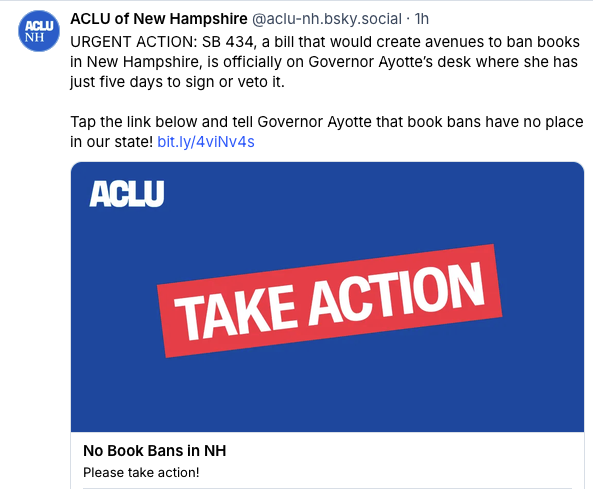
Governor Ayotte has vetoed the bill, so the issue is effectively dead for now. An override is possible but unlikely. What I’m writing about here is how the NH ACLU framed the issue.
The bill would have created a mechanism by which parents or guardians can challenge a book that’s available in a public school as “obscene and harmful to minors.” Successfully challenged books would not be “banned in New Hampshire”; anyone could still get them through the usual markets. Arguably it makes it too easy to challenge books based on little or no knowledge of their content, but schools already can and do exclude books. In most cases, it’s just that they can’t get every book that’s in print, but sometimes it’s because the books are badly written garbage. If intentionally excluding a book is “banning,” then every school already “bans” books.
There’s legitimate concern that making challenges easier would lead to the exclusion of books that have real value. But the point is not that schools should indiscriminately carry any and all books, or that any policy that excludes some books “bans” them.
In her veto statement, Ayotte correctly framed the issue as one of policy: “As a parent, I understand and appreciate the concerns parents have about their children being exposed to age-inappropriate or objectionable materials in schools. At the same time, existing New Hampshire law already requires school districts to adopt a policy allowing an exception to specific course material based on a parent’s determination that the material is objectionable.”
In its call for action, the NH ACLU claimed, “The right to free expression includes the freedom to read whatever we choose. Yet our state government is attempting to make it easier to ban books right here in New Hampshire.” You have the right to read whatever you choose, but not the right to get it for free. It isn’t “banning” to say you have to pay for something out of your own pocket.
How schools select books is an important issue. A challenge procedure that encourages moral panics could be very bad, pushing schools into carrying only the safest books. But it’s a policy issue, not a rights issue. The real threats to free expression are growing: intimidation and even arrests of people who criticize officials, groundless lawsuits against news sources backed by threats of executive action, proposals for Internet censorship. If people who are already skeptical see library policies called “book bans,” they won’t pay as much attention to the real dangers to liberty.
There has been real book banning in the United States. The Comstock Act criminalized mailing “obscene” material, such as information on birth control. It’s never been repealed, though court rulings have greatly narrowed it. The owners of a bookstore in San Francisco were arrested and prosecuted for carrying Howl and Other Poems by Allan Ginsberg, eventually winning a landmark case. Such prosecution is rare today, but it could come back.
It’s especially bad when a chapter of the ACLU trivializes the concept. When individuals, even well-known ones, abuse the language, it mostly reflects on them personally. When a civil liberties organization does it, it damages the cause of civil liberties.
Oz, Part 1 - Adelaide
Jul. 5th, 2026 09:41 pmfauxkloreI’m very good at leveraging off one thing I want to do to add on other things I want to do and that was exactly how I arranged my trip to Australia. There is an annual FlyerTalk get-together called OzFest, which is held in different parts of Australia every year during U.S. Memorial Day weekend. I’d been to it a couple of times before (in Canberra and in Perth) and decided I wanted to go to this year’s get-together in Darwin. To make things more interesting, I decided I could combine that with a trip on the Ghan, which is generally considered among the greatest train journeys in the world. For various scheduling reasons, it made sense only to do the first part of the Ghan journey, from Adelaide to Alice Springs. That also allowed me to visit with a friend in Adelaide and to do a couple of things there that I hadn’t done before.
My flight from IAD to LAX wasn’t very crowded. We were projected to land 50 minutes early, but got put in a holding pattern so it was only 20 minutes early. Still, that gave me plenty of time to make my connection. I was in Premium Plus for the LAX to MEL flight, but was disappointed in the seat design, which made it hard to find the headphone jack and the USB port. We ended up getting delayed due to some ground equipment issue. As a result, we got in just a little too late for me to make my connection (on Virgin Australia) to ADL. Still, there are millions of worse places to have to spend an extra few hours waiting and the flight from MEL to ADL was fine. After so many hours traveling, I opted for a taxi to my hotel. After resting for a little while and catching up on-line, I had dinner at a nearby Thai restaurant. Then I came back to my room and collapsed for the night.
The Hotel Indigo Adelaide Markets was comfortable and conveniently located - a block from the Central Market, in an area with lots of restaurants and easy access to public transportation. Note that public transit is free within the central Adelaide urban core. There are a couple of circular bus routes that can get you to the major tourist attractions, as well as a tram system. So, overall, the city is quite tourist friendly. In the morning, after getting coffee and a croissant at one of the cafes nearby, I took advantage of one of those circular bus routes and headed off to the Adelaide Zoo.
The first animals I saw were little blue penguins (also called fairy penguins). These are very cute and are found along part of the south coast of Australia, as well as in New Zealand.

The big attraction at the zoo is their giant panda exhibit. These are cute, but not indigenous to Australia. Because the one who was outside had turned its back to the audience and the other one was inside behind glass that mostly reflected the people looking at it, I was unable to get a photo worth sharing. The red panda, however, was: a) even cuter and b) far more cooperative.

There was an exhibit area for Australian animals and it did have a couple of kangaroos. There were no koalas and both the wombat and the Tasmanian devil were hiding from the public. The non-native animals were more eager to show off, with both the komodo dragon and the giraffes eager to pose.


There were also lots of other things to look at (primates, birds, and so on). It was getting pretty warm out, so I decided to wander over to the botanical gardens (which are free) and spent a little time walking around there.

I’d have liked to spend longer, but jet lag was catching up with me. So I took the bus back to the Central Market, which I meandered around a little bit (including buying a pastry) before going back to my hotel for a late afternoon nap.
Friday’s weather forecast was for rain, so it was a good day to go to a museum. I chose the Art Gallery of South Australia, which was easily reached by a tram. Half of the museum has Australian art and half has international art. The Australian art, especially pieces by indigenous artists, was generally more to my taste. I didn’t take good notes, alas, but you can look at some pieces I liked.


One which I did capture a little information about is this installation by the Japanese artist Chiharu Shiota, who created this labyrinth of string (titled “Absence embodied) specifically for the space it’s in.

There was also a special exhibition which included an interesting movie called “Pocket Money” by Emmaline Zanelli, which had to do with young people working their first jobs. There was some film footage about moths, too, but I never figured out if that was connected to this or completely separate.
I’d made plans with my friend, Amanda, for later in the day. We started out going over to the Central Market for her (and her partner, Chris) to buy a few things. We also went to Chinatown (maybe a block further) to get hand-pulled noodles. Then we went to their home in the Adelaide Hills for dinner and conversation. It was great to see them after 13 years and catch up / reminisce.
My final full day in Adelaide was spent taking a Barossa Valley Food and Wine Tour. There were only 5 of us - me, a couple from Brisbane, and a mother and daughter from Singapore. I’m not really a big wine drinker, but I do try to educate myself on it every now and then.
After picking everyone up, we drove on twisty back roads to our first winery, Kersbrook Hill. Along the way, we saw some pretty scenery, along with sheep and some cows here and there.


My usual experience with wine tasting has been that a given winery will give you samples of 3 or 4 wines. At Kersbrook Hill, I think we had about 10. Most of them were variants of shiraz, but there were sweet and dry, red and white, still and sparkling. My favorite of what we tasted there was a tawny port.
Our next stop was at Kies Family Winery. I have to admit that I don’t particularly remember any of the wines we tasted there, one way or another. We did also have lunch there. I had a meat pie which was just okay. There was also a nice salad and overly salty fries.
Our next stop was Maggie Beer’s Farm. Maggie Beer has done television cooking shows and written cookbooks and so on, in addition to running this store and cafe. I suppose this is a good stop if you live in Australia and want to buy fancy food, e.g. jam and vinegar and sauces and the like, as gifts. The property is pretty and there’s an aviary with several different types of pheasants.
Next we drove to Chateau Dorrien, which proved to be my favorite of the wineries we visited. They had a really cool historic area, with paintings of the history of the winery on old concrete wine vats.


More to the point, they had some very unusual wines, including fortified wines and mead. We did start with some more normal wines, e.g. semillon and several variants of shiraz (including a shiraz rose). But the highlights were things like their fortified wines with various liqueurs, e.g. Chocolatino (with chocolate flavor, duh). If I weren’t going to be traveling for several more days, I would definitely have bought a bottle of that. And then there was mead, which our hostess heated up for us to taste. There was a spiced mead with cinnamon and cloves and honey. Even better was the Scarlet Mead, which had cinnamon and cocoa over a base of honey. That would be perfect served in a chocolate liqueur cup. It’s probably a good thing that the logistics were just too challenging for me.
Our final winery was Chateau Tanunda.

This was much larger than the other three, so we got much less personal service for our tastings. I was, frankly, not really interested in any more wine at that point. That’s really my problem with going wine tasting. I’m hesitant to buy anything at the first place or two since I might like something later on better. But I’m jaded by the time we get to the later places on the itinerary. The ideal situation is to go to an art or music event at one winery, taste just a few wines, and have the good fortune to find one that you like enough to buy. (For example, many years ago, I bought a really nice white wine at a storytelling event at a winery in the Santa Ynez Valley in California.)
We did have one more stop before returning to Adelaide. That was at the Barossa Valley Chocolate Company. We sampled small bits of several of their chocolates. And I did buy two of their miniature chocolate bars - one with milk chocolate and honeycomb and one with dark chocolate, orange, and almonds.
Back in Adelaide, I pretty much collapsed. I would be off on the next segment of the trip in the morning and I definitely slept very well that night.
Perfectly Balanced
Jul. 5th, 2026 03:25 pmbread posting in ![[community profile]](https://www.dreamwidth.org/img/silk/identity/community.png) dreamwidthlayouts
dreamwidthlayoutsCredit to:
vuvuzelaBase style: Practicality
Type: CSS
Best resolution: Built in 1912x1074 – Mobile responsive
Tested in: Built in Firefox. Tested in Chrome & Opera on Windows OS. Tested in Android OS with Firefox.
Features: Mobile Responsive! Intended for "navigation panel" splash page style layouts.. Perfectly centers journal content vertically. Uses base dreamwidth CSS to prevent "navigation panel" codes from shifting.
( Layout Instructions, Live Preview, & CSS ) | |
I am reduced to cliches and memes from the 12th century.
Jul. 5th, 2026 01:56 pmwaterswordWILL NO ONE RID ME OF THIS TROUBLESOME FATHER.
Someone get this man to take my name out of his fucking mouth.
(One of his cousins died, he posted about it on Facebook and talked about how much I liked that cousin, someone saw fit to forward it to me. Leave me the fuck alone.)
The One About The Joy of Bots
Jul. 5th, 2026 05:23 pmrands_in_repose_feed
In our 98th episode, we list the things we’ve been building with our robots and figure out who we’re really yelling at when it all goes wrong.
Mentioned, referenced, or obsessed over:
- Planetfall, the Infocom game that gave Floyd his name
- Rands Leadership Slack
- Managing Humans
- Railway
- Supabase
- Bear
- Ghostty
- Cory Doctorow on centaurs and reverse-centaurs
Related Important Things episodes:
Enjoy it now, or download for later. Here’s a handy feed or subscribe via Overcast or iTunes.
- and we're home.
Jul. 5th, 2026 05:09 pmshewhomustA pleasant evening in Pitlochry, though with time only to fail to buy anything from the Mountain Warehouse sale - pity, because
durham_rambler could do with some new trousers, but at least we tried, and to discover that last year's excellent Pooh Bear postbox topper had been replaced by another, even even more excellent bear:
I particularly admire the marmalade sandwich. Can anyone better acquainted than I am with the works of Michael Bond tell me whether that is a Mouse called Thursday? And might that be Olga da Polga just peering over the edge? Or, if not, can anyone tell me who they are?
When our host at the B&B recommended Fern Cottage restaurant, we were suspicious: did they just have an agreement, being so conveniently next door to each other? And what did "Scottish food with a touch of the Mediterranean" mean? Haggis pizza? But it turned out to be perfectly cooked, unshowy but tasty: we shared hummus and dolmades for starters, both chose the vegetable kebab (and if
durham_rambler goes for the vegetarian option, it must be exceptional), and were sufficiently impressed by the 'Los Gansos' Chilean viognier to start looking for a stockist. Another long day's drive, pausing only for lunch at Main Street Trading in the Borders - and, since it is primarily a bookshop, books may have been purchased. Which still brought us home by early evening. I had time to unpack the smaller suitcase, and set the first batch of laundry going. This morning we went to Sedgefield for the Farmers' Market, so we have supplies for the immediate future. I have attacked the larger suitcase, and there is nothing left in it but dirty washing: which won't fit in the laundry basket until I do another batch of laundry, so that's on the list for tomorrow (alongside an eye appointment and some actual work for clients).
Done Since 2026-06-28
Jul. 5th, 2026 04:46 pmmdlbearA very mixed week. Wednesday, and to a lesser extent Thursday, spent the morning in an exceptionally good mood. "Cheerful." I even upper-cased it. Tuesday was my first real PT appointment, concentrating on my shoulders. It seemed to go well, but one of the exercises seems to have made things worse, not better. Paracetamol may be helping a little, but it's hard to say. The fact that my refill for Buspirone (for both anxiety and depression) got screwed up hasn't helped at. all.
My right shoulder has deteriorated to the point where I can't lift my arm high enough to play a full-sized guitar. Plink to the rescue. And my mood has deteriorated as well -- I understand that chronic pain will do that. It may also be behind my declining interest in cooking and trouble deciding what to eat for breakfast and lunch. (G usually makes dinner, saving me the trouble of havng to decide about it.)
A lot of my reading has gone over to dead trees lately. Not sure what to make of that. Seeing a review of Crossing the Wine-Dark Sea: Journeys Through Ancient Literature by Emily Wilson, and going from there to her translation of the Iliad, probably had a lot to do with it. There may be some reviews in our near future. But don't hold your breath -- I'm not a very reliable blogger these days.
Linkie: Keeping the Internet Human: 25 Years of Choosing to Share - Creative Commons It's too late for you to get in on the Goodreads ebook giveaway, but ebooks of The World As it Ought To Be, by Naomi Rivkis are still on sale for $2.99 until the end of this month.