Celestine
A valid IMA mineral species - grandfathered
This page kindly sponsored by Richard Eddy
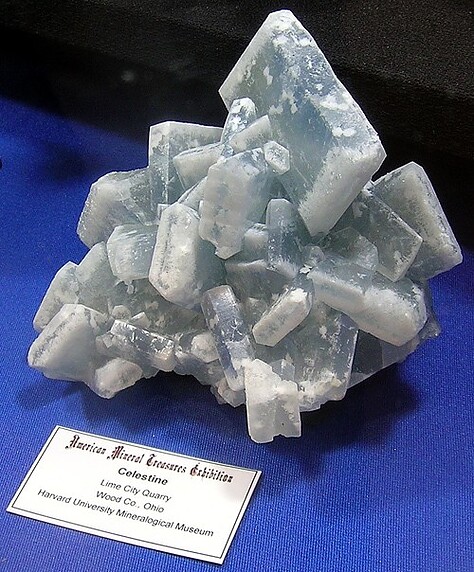
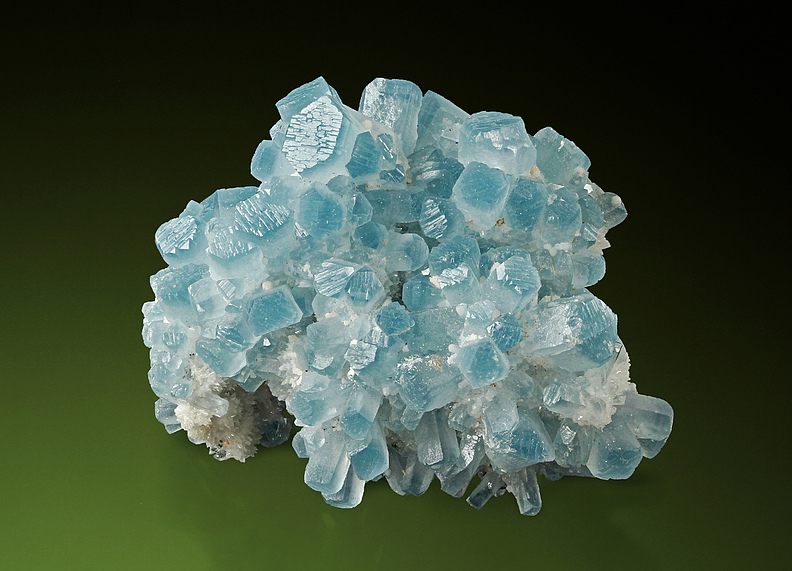

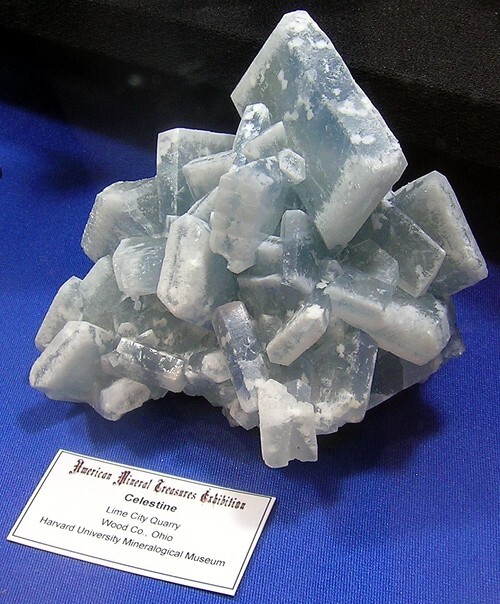
About Celestine
Formula:
SrSO4
Colour:
Colourless, shades of light blue, white, reddish, greenish, brownish, greyish; colourless or lightly tinted in transmitted light
Lustre:
Vitreous, Pearly
Hardness:
3 - 3½
Specific Gravity:
3.96 - 3.98
Crystal System:
Orthorhombic
Member of:
Name:
Originally named fasriger schwerspath by Andreas Gotthelf Schütz in 1791. Renamed schwefelsaurer strontianite aus Pennsylvania by Martin Klaproth in 1797. Renamed by Abraham Gottlieb Werner in 1798 in German zoelestin from the Greek cœlestis for celestial, in allusion to the faint blue color of the original specimen. Renamed Schützit by Dietrich Ludwig Gustav Karsten in 1800. Although far superior celestine crystals were previously known from Sicily, they were thought to be barium-rich as the element strontium was not discovered until the late 1780s and not formally described until 1792.
Type Locality:
Baryte Group. Baryte-Celestine Series. The strontium analogue of baryte, anglesite and hashemite.
By far the most common strontium mineral.
 Visit gemdat.org for gemological information about Celestine.
By far the most common strontium mineral.
Visit gemdat.org for gemological information about Celestine.Unique Identifiers
Mindat ID:
927
Long-form identifier:
mindat:1:1:927:4
IMA Classification of Celestine
Approved, 'Grandfathered' (first described prior to 1959)
IMA Formula:
Sr(SO4)
Classification of Celestine
7.AD.35
7 : SULFATES (selenates, tellurates, chromates, molybdates, wolframates)
A : Sulfates (selenates, etc.) without additional anions, without H2O
D : With only large cations
7 : SULFATES (selenates, tellurates, chromates, molybdates, wolframates)
A : Sulfates (selenates, etc.) without additional anions, without H2O
D : With only large cations
28.3.1.2
28 : ANHYDROUS ACID AND NORMAL SULFATES
3 : AXO4
28 : ANHYDROUS ACID AND NORMAL SULFATES
3 : AXO4
25.4.15
25 : Sulphates
4 : Sulphates of Ca, Sr and Ba
25 : Sulphates
4 : Sulphates of Ca, Sr and Ba
Mineral Symbols
As of 2021 there are now IMA–CNMNC approved mineral symbols (abbreviations) for each mineral species, useful for tables and diagrams.
Please only use the official IMA–CNMNC symbol. Older variants are listed for historical use only.
Please only use the official IMA–CNMNC symbol. Older variants are listed for historical use only.
| Symbol | Source | Reference |
|---|---|---|
| Clt | IMA–CNMNC | Warr, L.N. (2021). IMA–CNMNC approved mineral symbols. Mineralogical Magazine, 85(3), 291-320. doi:10.1180/mgm.2021.43 |
| Cls | Kretz (1983) | Kretz, R. (1983) Symbols of rock-forming minerals. American Mineralogist, 68, 277–279. |
| Cls | Siivolam & Schmid (2007) | Siivolam, J. and Schmid, R. (2007) Recommendations by the IUGS Subcommission on the Systematics of Metamorphic Rocks: List of mineral abbreviations. Web-version 01.02.07. IUGS Commission on the Systematics in Petrology. download |
| Clt | Whitney & Evans (2010) | Whitney, D.L. and Evans, B.W. (2010) Abbreviations for names of rock-forming minerals. American Mineralogist, 95, 185–187 doi:10.2138/am.2010.3371 |
| Cls | The Canadian Mineralogist (2019) | The Canadian Mineralogist (2019) The Canadian Mineralogist list of symbols for rock- and ore-forming minerals (December 30, 2019). download |
Physical Properties of Celestine
Vitreous, Pearly
Transparency:
Transparent, Translucent
Colour:
Colourless, shades of light blue, white, reddish, greenish, brownish, greyish; colourless or lightly tinted in transmitted light
Streak:
White
Hardness:
3 - 3½ on Mohs scale
Tenacity:
Brittle
Cleavage:
Perfect
On {001} perfect; on {210} good; on {010} poor. Also reported on {011}.
On {001} perfect; on {210} good; on {010} poor. Also reported on {011}.
Parting:
Twin gliding and translation gliding.
Fracture:
Irregular/Uneven
Density:
3.96 - 3.98 g/cm3 (Measured) 3.98 g/cm3 (Calculated)
Optical Data of Celestine
Type:
Biaxial (+)
RI values:
nα = 1.619 - 1.622 nβ = 1.622 - 1.624 nγ = 1.63 - 1.632
2V:
Measured: 50° to 51°, Calculated: 54° to 58°
Max. Birefringence:
δ = 0.010 - 0.011
Based on recorded range of RI values above.
Based on recorded range of RI values above.
Interference Colours:
The colours simulate birefringence patterns seen in thin section under crossed polars. They do not take into account mineral colouration or opacity.
Michel-Levy Bar The default colours simulate the birefringence range for a 30 µm thin-section thickness. Adjust the slider to simulate a different thickness.
Grain Simulation You can rotate the grain simulation to show how this range might look as you rotated a sample under crossed polars.
The colours simulate birefringence patterns seen in thin section under crossed polars. They do not take into account mineral colouration or opacity.
Michel-Levy Bar The default colours simulate the birefringence range for a 30 µm thin-section thickness. Adjust the slider to simulate a different thickness.
Grain Simulation You can rotate the grain simulation to show how this range might look as you rotated a sample under crossed polars.
Surface Relief:
Moderate
Dispersion:
moderate r < v
Optical Extinction:
X = c; Y = b; Z = a.
Pleochroism:
Weak
Comments:
Blue-coloured material: shades of indigo- and lavender-blue, bluish green or violet.
Comments:
Absorption: Z > Y > X.
Chemistry of Celestine
Mindat Formula:
SrSO4
Element Weights:
Elements listed:
Crystallography of Celestine
Crystal System:
Orthorhombic
Class (H-M):
mmm (2/m 2/m 2/m) - Dipyramidal
Space Group:
Pnma
Cell Parameters:
a = 8.359 Å, b = 5.352 Å, c = 6.866 Å
Ratio:
a:b:c = 1.562 : 1 : 1.283
Unit Cell V:
307.17 ų (Calculated from Unit Cell)
Z:
4
Morphology:
Crystals commonly thin to thick tabular {001}, usually with large {210}; tabular {001} and elongated [100] yielding lath-like forms; or elongated [100] with equant cross section. Equant by development of {001}, {011}, {101} of otherwise, less common. Pyramidal {122}; elongated [010] or [001]; tabular {100}, {100} commonly striated [001]. Fibrous veinlets or nodules with parallel or radiated fiber structure; massive granular; lamellar, earthy, rare.
Twinning:
Reported on {210}, {101}, and other planes (doubtful).
Crystallographic forms of Celestine
Crystal Atlas:
Image Loading
Click on an icon to view

Celestine no.87 - Goldschmidt (1913-1926)
3d models and HTML5 code kindly provided by
www.smorf.nl.
Toggle
Edge Lines | Miller Indices | Axes
Transparency
Opaque | Translucent | Transparent
View
Along a-axis | Along b-axis | Along c-axis | Start rotation | Stop rotation
Toggle
Edge Lines | Miller Indices | Axes
Transparency
Opaque | Translucent | Transparent
View
Along a-axis | Along b-axis | Along c-axis | Start rotation | Stop rotation
Crystal Structure
Load
Unit Cell | Unit Cell Packed
2x2x2 | 3x3x3 | 4x4x4
Unit Cell | Unit Cell Packed
2x2x2 | 3x3x3 | 4x4x4
Show
Big Balls | Small Balls | Just Balls | Spacefill
Polyhedra Off | Si Polyhedra | All Polyhedra
Remove metal-metal sticks
Big Balls | Small Balls | Just Balls | Spacefill
Polyhedra Off | Si Polyhedra | All Polyhedra
Remove metal-metal sticks
Display Options
Black Background | White Background
Perspective On | Perspective Off
2D | Stereo | Red-Blue | Red-Cyan
Black Background | White Background
Perspective On | Perspective Off
2D | Stereo | Red-Blue | Red-Cyan
View
CIF File Best | x | y | z | a | b | c
CIF File Best | x | y | z | a | b | c
Rotation
Stop | Start
Stop | Start
Labels
Console Off | On | Grey | Yellow
Console Off | On | Grey | Yellow
Data courtesy of the American Mineralogist Crystal Structure Database. Click on an AMCSD ID to view structure
| ID | Species | Reference | Link | Year | Locality | Pressure (GPa) | Temp (K) |
|---|---|---|---|---|---|---|---|
| 0000664 | Celestine | Miyake M, Minato I, Morikawa H, Iwai S I (1978) Crystal structure and sulphate force constants of barite, celestite, and anglesite American Mineralogist 63 506-510 |  | 1978 | 0 | 293 | |
| 0018844 | Celestine | Antao S M (2012) Structural trends for celestite (SrSO4), anglesite (PbSO4), and barite (BaSO4): confirmation of expected variations within SO4 groups American Mineralogist 97 661-665 | 2012 | Saxony, Ngar Majunga, Madagascar | 0 | 293 | |
| 0005112 | Celestine | Hawthorne F C, Ferguson R B (1975) Anhydrous sulphates. I: Refinement of the crystal structure of celestite with an appendix on the structure of thenardite The Canadian Mineralogist 13 181-187 | | 1975 | 0 | 293 | |
| 0005557 | Celestine | Jacobsen S D, Smyth J R, Swope R J, Downs R T (1998) Rigid-body character of the SO4 groups in celestine, anglesite and barite The Canadian Mineralogist 36 1053-1060 | | 1998 | 0 | 293 | |
| 0010619 | Celestine | Garske D, Peacor D R (1965) Refinement of the structure of celestite SrSO4 Zeitschrift fur Kristallographie 121 204-210 | | 1965 | France Stone Company's quarry near Waterville, Ohio, USA | 0 | 293 |
| 0014527 | Celestine | Brigatti M F, Galli E, ,Medici L (1997) Ba-rich celestine: new data and crystal structure refinement Mineralogical Magazine 61 447-451 | | 1997 | filling cavities of volcanoclastic rocks, Montecchio Maggiore, Vicenza, Italy | 0 | 293 |
| 0017448 | Celestine | James R (1925) The Crystal Structures of Barytes, Celestine and Anglesite _cod_database_code 1010543 Proceedings of the Royal Society of London A109 598-620 | 1925 | 0 | 293 |
CIF Raw Data - click here to close
X-Ray Powder Diffraction
Loading XRD data...
Data courtesy of RRUFF project at University of Arizona, used with permission.
Powder Diffraction Data:
| d-spacing | Intensity |
|---|---|
| 2.972 Å | (100) |
| 3.295 Å | (98) |
| 2.731 Å | (63) |
| 3.177 Å | (59) |
| 2.041 Å | (57) |
| 2.045 Å | (55) |
| 2.674 Å | (49) |
Comments:
Synthetic.
Geological Environment
Paragenetic Mode(s):
| Paragenetic Mode | Earliest Age (Ga) |
|---|---|
| Stage 3b: Earth’s earliest hydrosphere | >4.45 |
| 14 : Hot springs, geysers, and other subaerial geothermal minerals | |
| Near-surface Processes | |
| 21 : Chemically precipitated carbonate, phosphate, iron formations | |
| 23 : Subaerial aqueous alteration by non-redox-sensitive fluids (see also #47) | |
| 24 : Authigenic minerals in terrestrial sediments (see also #17) | |
| 25 : Evaporites (prebiotic) | |
| Stage 10a: Neoproterozoic oxygenation/terrestrial biosphere | <0.6 |
| 49 : Oxic cellular biomineralization (see also #44) | <0.54 |
Geological Setting:
Occurs mainly in sedimentary rocks such as bedded deposits of gypsum and halite; also in bedded limestone and dolomite, in cavities.
Type Occurrence of Celestine
General Appearance of Type Material:
Fibrous veinlets.
Place of Conservation of Type Material:
Technische Universität, Bergakademie Freiberg, Freiberg, Germany, 45 samples (holotype).
Geological Setting of Type Material:
Sedimentary rocks.
Synonyms of Celestine
Other Language Names for Celestine
Varieties of Celestine
| Barium-bearing Celestine | A barium-bearing variety of celestine. Belongs to the Sr-dominant part of the Baryte-Celestine Series. Compare Strontium-bearing Baryte. |
| Barytosulfate of Strontian | A barium-bearing variety of celestine. |
| Calciocelestine | A calcium-bearing variety of Celestine. |
Relationship of Celestine to other Species
Member of:
Other Members of Baryte Group:
Forms a series with:
Common Associates
Associated Minerals Based on Photo Data:
| 986 photos of Celestine associated with Calcite | CaCO3 |
| 653 photos of Celestine associated with Fluorite | CaF2 |
| 542 photos of Celestine associated with Native Sulphur | S8 |
| 193 photos of Celestine associated with Strontianite | SrCO3 |
| 90 photos of Celestine associated with Quartz | SiO2 |
| 85 photos of Celestine associated with Baryte | BaSO4 |
| 76 photos of Celestine associated with Dolomite | CaMg(CO3)2 |
| 61 photos of Celestine associated with Gypsum | CaSO4 · 2H2O |
| 50 photos of Celestine associated with Aragonite | CaCO3 |
| 37 photos of Celestine associated with Pyrite | FeS2 |
Related Minerals - Strunz-mindat Grouping
| 7.AD. | Bubnovaite | K2Na8Ca(SO4)6 |
| 7.AD. | Dobrovolskyite | Na4Ca(SO4)3 |
| 7.AD. | Calciolangbeinite | K2Ca2(SO4)3 |
| 7.AD. | Murphyite | Pb(Te6+O4) |
| 7.AD. | Cuprodobrovolskyite | Na4Cu(SO4)3 |
| 7.AD. | Kristjánite | KNa2H(SO4)2 |
| 7.AD.05 | Mascagnite | (NH4)2SO4 |
| 7.AD.05 | Arcanite | K2SO4 |
| 7.AD.10 | Mercallite | KHSO4 |
| 7.AD.15 | Misenite | K8H6(SO4)7 |
| 7.AD.20 | Letovicite | (NH4)3H(SO4)2 |
| 7.AD.25 | Thénardite | Na2SO4 |
| 7.AD.25 | Glauberite | Na2Ca(SO4)2 |
| 7.AD.30 | Metathénardite | Na2SO4 |
| 7.AD.30 | Anhydrite | CaSO4 |
| 7.AD.35 | Baryte | BaSO4 |
| 7.AD.35 | Olsacherite | Pb2(Se6+O4)(SO4) |
| 7.AD.35 | Anglesite | PbSO4 |
| 7.AD.40 | Kalistrontite | K2Sr(SO4)2 |
| 7.AD.40 | Palmierite | K2Pb(SO4)2 |
| 7.AD.45 | Ivsite | Na3H(SO4)2 |
| 7.AD.55 | Markhininite | TlBi(SO4)2 |
Other Information
Thermal Behaviour:
Inverts at about 1152°C to a hexagonal polymorph. Melting Point = ~1605°C.
Notes:
Slowly soluble in hot concentrated acids or alkali carbonate solutions. Very slightly soluble in water.
Health Risks:
No information on health risks for this material has been entered into the database. You should always treat mineral specimens with care.
Industrial Uses:
Major ore for strontium.
Internet Links for Celestine
mindat.org URL:
https://www.mindat.org/min-927.html
Please feel free to link to this page.
Please feel free to link to this page.
Search Engines:
External Links:
References for Celestine
Reference List:
Thomson, Thomas (1836) Outlines of Mineralogy, Geology and Mineral Analysis Vol. 1. Baldwin & Craddock. 734 pp.p.111 - Barytosulfate of Strontian
Barker, Th. V. (1908) I. Untersuchungen über regelmäßige Verwachsungen. Zeitschrift für Kristallographie - Crystalline Materials, 45 (1) 1-59 doi:10.1524/zkri.1908.45.1.1
Lacroix, A. (1910) Minéralogie de la France et de ses colonies Vol. 4. Library Polytechnique, Paris. p.103
Kolb, R. (1911) IV. Vergleich von Anhydrit, Cölestin, Baryt und Anglesit in bezug auf die Veränderung ihrer geometrischen und optischen Verhältnisse mit der Temperatur. Zeitschrift für Kristallographie - Crystalline Materials, 49 (1) 14-61 doi:10.1524/zkri.1911.49.1.14
Basche, W., Mark, H. (1926) I. Über die Struktur von Verbindungen des Typus MeXO4. Zeitschrift für Kristallographie - Crystalline Materials, 64 (1) 1-70 doi:10.1524/zkri.1926.64.1.1
Landes, Kenneth K. (1929) The strontium occurrence near La Conner, Washington. American Mineralogist, 14 (11) 408-413
Heide, F. (1931) Über Deformationen an Kristallen bei erhöhtem Druck und erhöhter Temperatur. Zeitschrift für Kristallographie - Crystalline Materials, 78 (1) 257-278 doi:10.1524/zkri.1931.78.1.257
Garske, David, Peacor, Donald R. (1965) Refinement of the structure of celestite SrSO4. Zeitschrift für Kristallographie - Crystalline Materials, 121 (2) 204-210 doi:10.1524/zkri.1965.121.2-4.204
Blount, Charles W. (1974) Synthesis of barite, celestite, anglesite, witherite, and strontianite from aqueous solutions. American Mineralogist, 59 (11-12) 1209-1219
Hawthorne, F. C., Ferguson, R. B. (1975) Anhydrous sulphates. I: Refinement of the crystal structure of celestite with an appendix on the structure of thenardite. The Canadian Mineralogist, 13 (2) 181-187
Miyake, Michihiro, Minato, Ichiro, Morikawa, Hideki, Iwai, Shin-ichi (1978) Crystal structures and sulphate force constants of barite, celestite, and anglesite. American Mineralogist, 63 (5-6) 506-510
Brigatti, M. F., Galli, E., Medici, L. (1997) Ba-rich celestine: new data and crystal structure refinement. Mineralogical Magazine, 61 (406) 447-451 doi:10.1180/minmag.1997.061.406.10
Jacobsen, Steven D., Smyth, Joseph R., Swope, R. Jeffrey, Downs, Robert T. (1998) Rigid-Body Character of the SO4 Groups in Celestine, Anglesite and Barite. The Canadian Mineralogist, 36 (4) 1053-1060
Hanor, Jeffrey S. (2000) Barite–Celestine Geochemistry and Environments of Formation, in Sulfate Minerals. Reviews in Mineralogy and Geochemistry, 40 (1). 193-275 doi:10.2138/rmg.2000.40.4
Majzlan, J., Navrotsky, A., Neil, J.M. (2002) Energetics of anhydrite, barite, celestine, and anglesite: a high-temperature and differential scanning calorimetry study. Geochimica et Cosmochimica Acta, 66 (10) 1839-1850 doi:10.1016/s0016-7037(01)00881-x
Lee, Jiann-Shing, Wang, Hsiu-Ru, Iizuka, Yoshiyuki, Yu, Shu-Cheng (2005) Crystal structure and Raman spectral studies of BaSO4—PbSO4 solid solution. Zeitschrift für Kristallographie - Crystalline Materials, 220 (1) 1-9 doi:10.1524/zkri.220.1.1.58891
Jehlička, J., Vítek, P., Edwards, H.G.M., Hargreaves, M. D., Čapoun, T. (2009) Fast detection of sulphate minerals (gypsum, anglesite, baryte) by a portable Raman spectrometer. Journal of Raman Spectroscopy, 40 (8). 1082-1086 doi:10.1002/jrs.2246
Zaidi, S. R., Sitepu, H., Shen, S., Al-Yami, N. (2010) Characterization of X-ray Powder Diffraction Data of BaxSr1−xSO4 (0≤x≤1) by Rietveld Refinement. Powder Diffraction, 25 (2). 217 doi:10.1154/1.3455008
Antao, S. M. (2012) Structural trends for celestite (SrSO4), anglesite (PbSO4), and barite (BaSO4): Confirmation of expected variations within the SO4 groups. American Mineralogist, 97 (4) 661-665 doi:10.2138/am.2012.3905
Zhou, Li, Mernagh, Terrence P., Mo, Bing, Wang, Li, Zhang, Shuai, Wang, Chunyao (2020) Raman Study of Barite and Celestine at Various Temperatures. Minerals, 10 (3) 260 doi:10.3390/min10030260
Tančić, Pavle, Milošević, Maja, Spahić, Darko, Kostić, Bojan, Kremenović, Aleksandar, Poznanović-Spahić, Maja, Kovačević, Jovan (2024) Characterisation, axial anisotropy, and formation conditions of celestine minerals from the Jabal Eghei (Nuqay) late Neogene – Pleistocene volcanic province, southeastern edge of the Sirt Basin, southern Libya: Constraints on the mineralogical geothermometer. Mineralogical Magazine, 88 (1) 1-18 doi:10.1180/mgm.2023.88
Localities for Celestine
 symbol to view information about a locality.
The
symbol to view information about a locality.
The Locality List
 - This locality has map coordinates listed.
- This locality has estimated coordinates.
ⓘ - Click for references and further information on this occurrence.
? - Indicates mineral may be doubtful at this locality.
- This locality has map coordinates listed.
- This locality has estimated coordinates.
ⓘ - Click for references and further information on this occurrence.
? - Indicates mineral may be doubtful at this locality.
 - Good crystals or important locality for species.
 - World class for species or very significant.
(TL) - Type Locality for a valid mineral species.
(FRL) - First Recorded Locality for everything else (eg varieties).
- World class for species or very significant.
(TL) - Type Locality for a valid mineral species.
(FRL) - First Recorded Locality for everything else (eg varieties).
All localities listed without proper references should be considered as questionable.
Quick NavTopAbout CelestineUnique IdentifiersIMA Classification Classification Mineral SymbolsPhysical Properties Optical Data Chemistry Crystallography Crystallographic forms Crystal StructureX-Ray Powder DiffractionGeological EnvironmentType Occurrence SynonymsOther LanguagesVarietiesRelationshipsCommon AssociatesStrunz-MindatOther InformationInternet Links References Localities Locality List
Stoneco Lime City Quarry, Lime City, Wood County, Ohio, USA