Clinocervantite
A valid IMA mineral species
This page is currently not sponsored. Click here to sponsor this page.
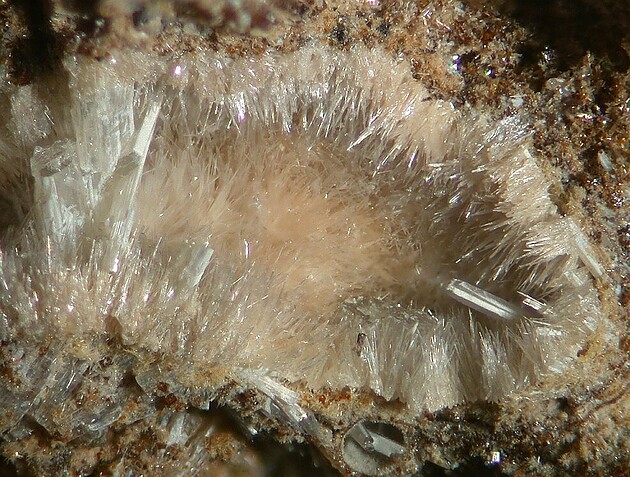


About Clinocervantite
Formula:
Sb3+Sb5+O4
Possibly stabilised in the presence of Mo, V or Fe (Golunski and Jackson, 1989).
Colour:
Colorless
Lustre:
Vitreous
Specific Gravity:
6.72 (Calculated)
Crystal System:
Monoclinic
Member of:
Name:
The name reflects its symmetry and relationship to cervantite.
Type Locality:
Dimorph of:
Isostructural with:
The Sb3+ analogue of kyawthuite.
Natural analogue of synthetic β-Sb2O4.
Note on the type locality: The type specimen described by Basso et al. (1999) was reported to come from the Cetine di Cotorniano mine, but was later recognised as coming from a slag at Tafone (Grosseto) (Ciriotti et al., 2009; Menchetti & Batoni, 2017).
Natural analogue of synthetic β-Sb2O4.
Note on the type locality: The type specimen described by Basso et al. (1999) was reported to come from the Cetine di Cotorniano mine, but was later recognised as coming from a slag at Tafone (Grosseto) (Ciriotti et al., 2009; Menchetti & Batoni, 2017).
Unique Identifiers
Mindat ID:
6879
Long-form identifier:
mindat:1:1:6879:2
IMA Classification of Clinocervantite
Approved
First published:
1999
Classification of Clinocervantite
4.DE.30
4 : OXIDES (Hydroxides, V[5,6] vanadates, arsenites, antimonites, bismuthites, sulfites, selenites, tellurites, iodates)
D : Metal: Oxygen = 1:2 and similar
E : With medium-sized cations; with various polyhedra
4 : OXIDES (Hydroxides, V[5,6] vanadates, arsenites, antimonites, bismuthites, sulfites, selenites, tellurites, iodates)
D : Metal: Oxygen = 1:2 and similar
E : With medium-sized cations; with various polyhedra
Mineral Symbols
As of 2021 there are now IMA–CNMNC approved mineral symbols (abbreviations) for each mineral species, useful for tables and diagrams.
| Symbol | Source | Reference |
|---|---|---|
| Ccvn | IMA–CNMNC | Warr, L.N. (2021). IMA–CNMNC approved mineral symbols. Mineralogical Magazine, 85(3), 291-320. doi:10.1180/mgm.2021.43 |
Physical Properties of Clinocervantite
Vitreous
Transparency:
Transparent
Colour:
Colorless
Streak:
White
Tenacity:
Brittle
Cleavage:
None Observed
Fracture:
Irregular/Uneven
Density:
6.72 g/cm3 (Calculated)
Optical Data of Clinocervantite
Type:
Biaxial
RI values:
nα = 1.72 nγ = 2.10
Max. Birefringence:
δ = 0.380
Based on recorded range of RI values above.
Based on recorded range of RI values above.
Interference Colours:
The colours simulate birefringence patterns seen in thin section under crossed polars. They do not take into account mineral colouration or opacity.
Michel-Levy Bar The default colours simulate the birefringence range for a 30 µm thin-section thickness. Adjust the slider to simulate a different thickness.
Grain Simulation You can rotate the grain simulation to show how this range might look as you rotated a sample under crossed polars.
The colours simulate birefringence patterns seen in thin section under crossed polars. They do not take into account mineral colouration or opacity.
Michel-Levy Bar The default colours simulate the birefringence range for a 30 µm thin-section thickness. Adjust the slider to simulate a different thickness.
Grain Simulation You can rotate the grain simulation to show how this range might look as you rotated a sample under crossed polars.
Surface Relief:
Moderate
Dispersion:
r < v moderate
Chemistry of Clinocervantite
Mindat Formula:
Sb3+Sb5+O4
Possibly stabilised in the presence of Mo, V or Fe (Golunski and Jackson, 1989).
Possibly stabilised in the presence of Mo, V or Fe (Golunski and Jackson, 1989).
Elements listed:
Crystallography of Clinocervantite
Crystal System:
Monoclinic
Class (H-M):
2/m - Prismatic
Space Group:
B2/b
Setting:
C2/c
Cell Parameters:
a = 12.061(1) Å, b = 4.836(1) Å, c = 5.383(1) Å
β = 104.60(4)°
β = 104.60(4)°
Ratio:
a:b:c = 2.494 : 1 : 1.113
Unit Cell V:
303.84 ų (Calculated from Unit Cell)
Z:
4
Morphology:
Elongated along [001]. Dominant prism {110} combined with lesser {122} and {211} prisms.
Twinning:
Twinned with composition plane {100}
Crystal Structure
Load
Unit Cell | Unit Cell Packed
2x2x2 | 3x3x3 | 4x4x4
Unit Cell | Unit Cell Packed
2x2x2 | 3x3x3 | 4x4x4
Show
Big Balls | Small Balls | Just Balls | Spacefill
Polyhedra Off | Si Polyhedra | All Polyhedra
Remove metal-metal sticks
Big Balls | Small Balls | Just Balls | Spacefill
Polyhedra Off | Si Polyhedra | All Polyhedra
Remove metal-metal sticks
Display Options
Black Background | White Background
Perspective On | Perspective Off
2D | Stereo | Red-Blue | Red-Cyan
Black Background | White Background
Perspective On | Perspective Off
2D | Stereo | Red-Blue | Red-Cyan
View
CIF File Best | x | y | z | a | b | c
CIF File Best | x | y | z | a | b | c
Rotation
Stop | Start
Stop | Start
Labels
Console Off | On | Grey | Yellow
Console Off | On | Grey | Yellow
Data courtesy of the American Mineralogist Crystal Structure Database. Click on an AMCSD ID to view structure
| ID | Species | Reference | Link | Year | Locality | Pressure (GPa) | Temp (K) |
|---|---|---|---|---|---|---|---|
| 0006763 | Clinocervantite | Basso R, Lucchetti G, Zefiro L, Palenzona A (1999) Clinocervantite, B-Sb2O4, the natural monoclinic polymorph of cervantite from the Cetine mine, Siena, Italy European Journal of Mineralogy 11 95-100 | 1999 | Cetine mine, Siena, Italy | 0 | 293 | |
| 0012698 | Clinocervantite | Amador J, Gutierrez-Puebla E, Monge M A, Rasines I, Ruiz-Valero C (1988) Diantimony tetraoxides revisited Inorganic Chemistry 27 1367-1370 | 1988 | synthetic | 0 | 293 |
CIF Raw Data - click here to close
X-Ray Powder Diffraction
Powder Diffraction Data:
| d-spacing | Intensity |
|---|---|
| 1.244 Å | (100) |
| 2.877 Å | (68) |
| 2.920 Å | (33) |
| 2.640 Å | (23) |
| 1.861 Å | (21) |
| 1.783 Å | (21) |
| 1.812 Å | (20) |
Geological Environment
Paragenetic Mode(s):
| Paragenetic Mode | Earliest Age (Ga) |
|---|---|
| Stage 7: Great Oxidation Event | <2.4 |
| 47d : [Arsenates, antimonates, selenates, bismuthinates] | |
| 47h : [Near-surface oxidized, dehydrated minerals] | |
| Stage 10b: Anthropogenic minerals | <10 Ka |
| 55 : Anthropogenic mine minerals |
Type Occurrence of Clinocervantite
General Appearance of Type Material:
Aggregates of prismatic crystals. The crystals do not exceed 0.2 mm.
Place of Conservation of Type Material:
Department of Earth Science, University of Genoa, Italy.
Associated Minerals at Type Locality:
Synonyms of Clinocervantite
Other Language Names for Clinocervantite
Dutch:Clinocervantiet
German:Klinocervantit
Clinocervantit
Clinocervantit
Russian:Клиносервантит
Spanish:Clinocervantita
Relationship of Clinocervantite to other Species
Member of:
Other Members of Cervantite Group:
| Bismutocolumbite | Bi(Nb,Ta)O4 | Orth. mmm (2/m 2/m 2/m) |
| Bismutotantalite | BiTaO4 | Orth. |
| Cervantite | Sb3+Sb5+O4 | Orth. mm2 |
| Stibiocolumbite | Sb(Nb,Ta)O4 | Orth. mm2 |
| Stibiotantalite | Sb(Ta,Nb)O4 | Orth. mm2 |
Common Associates
Associated Minerals Based on Photo Data:
| 11 photos of Clinocervantite associated with Valentinite | Sb2O3 |
| 6 photos of Clinocervantite associated with Rosiaite | PbSb5+2O6 |
| 1 photo of Clinocervantite associated with Mopungite | Na[Sb5+(OH)6] |
| 1 photo of Clinocervantite associated with Senarmontite | Sb2O3 |
Related Minerals - Strunz-mindat Grouping
| 4.DE. | Colchesterite | Bi3+2Mo6+2O9 |
| 4.DE. | Pertoldite | GeO2 |
| 4.DE. | Ziroite | ZrO2 |
| 4.DE.05 | Downeyite | SeO2 |
| 4.DE.10 | Koragoite | (Mn2+,Fe3+)3(Nb,Ta,Ti)2(Nb,Mn)2(W,Ta)2O20 |
| 4.DE.15 | Russellite | Bi2WO6 |
| 4.DE.15 | Koechlinite | Bi2MoO6 |
| 4.DE.15 | Tungstibite | Sb3+2WO6 |
| 4.DE.20 | Tellurite | TeO2 |
| 4.DE.25 | Paratellurite | TeO2 |
| 4.DE.30 | Bismutotantalite | BiTaO4 |
| 4.DE.30 | Stibiotantalite | Sb(Ta,Nb)O4 |
| 4.DE.30 | Cervantite | Sb3+Sb5+O4 |
| 4.DE.30 | Bismutocolumbite | Bi(Nb,Ta)O4 |
| 4.DE.30 | Stibiocolumbite | Sb(Nb,Ta)O4 |
| 4.DE.35 | Baddeleyite | ZrO2 |
| 4.DE.40 | Billwiseite | Sb3+5Nb3WO18 |
| 4.DE.45 | Kyawthuite | Bi3+Sb5+O4 |
Fluorescence of Clinocervantite
Does not fluoresce
Other Information
Health Risks:
No information on health risks for this material has been entered into the database. You should always treat mineral specimens with care.
Internet Links for Clinocervantite
mindat.org URL:
https://www.mindat.org/min-6879.html
Please feel free to link to this page.
Please feel free to link to this page.
Search Engines:
External Links:
References for Clinocervantite
Reference List:
Amador, J., Gutierrez Puebla, E., Monge, M. A., Rasines, I., Ruiz Valero, C. (1988) Diantimony tetraoxides revisited. Inorganic Chemistry, 27 (8) 1367-1370 doi:10.1021/ic00281a011
Golunski, Stanislaw E., Jackson, David (1989) Antimony Oxides: A guide to phase changes during catalyst preparation. Applied Catalysis, 48 (1). 123-135 doi:10.1016/s0166-9834(00)80270-5
Localities for Clinocervantite
 symbol to view information about a locality.
The
symbol to view information about a locality.
The Locality List
 - This locality has map coordinates listed.
- This locality has estimated coordinates.
ⓘ - Click for references and further information on this occurrence.
? - Indicates mineral may be doubtful at this locality.
- This locality has map coordinates listed.
- This locality has estimated coordinates.
ⓘ - Click for references and further information on this occurrence.
? - Indicates mineral may be doubtful at this locality.
 - Good crystals or important locality for species.
 - World class for species or very significant.
(TL) - Type Locality for a valid mineral species.
(FRL) - First Recorded Locality for everything else (eg varieties).
- World class for species or very significant.
(TL) - Type Locality for a valid mineral species.
(FRL) - First Recorded Locality for everything else (eg varieties).
All localities listed without proper references should be considered as questionable.
Greece | |
| Rieck et al. (2020) |
| Rieck et al. (2020) |
Italy (TL) | |
| Ciriotti et al. (2009) |
| Palenzona A. +3 other references |
Quick NavTopAbout ClinocervantiteUnique IdentifiersIMA Classification Classification Mineral SymbolsPhysical Properties Optical Data Chemistry Crystallography Crystal StructureX-Ray Powder DiffractionGeological EnvironmentType Occurrence SynonymsOther LanguagesRelationshipsCommon AssociatesStrunz-MindatFluorescence Other InformationInternet Links References Localities Locality List
Tafone Mine, Manciano, Grosseto Province, Tuscany, Italy