Schizolite
A valid IMA mineral species
This page is currently not sponsored. Click here to sponsor this page.
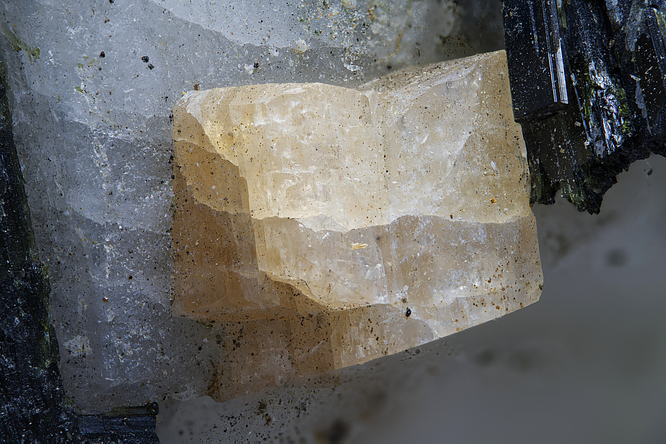
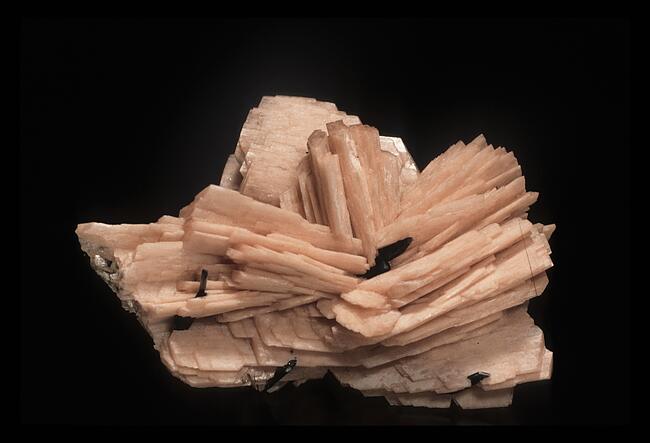


About Schizolite
Formula:
NaCaMnSi3O8(OH)
Colour:
Pale red or pink to brownish
Lustre:
Vitreous, Sub-Vitreous
Hardness:
5
Specific Gravity:
3.09 (Calculated)
Crystal System:
Triclinic
Member of:
Name:
Described from Greenland by Winther (1901) and named from the greek 'σϗιζω' for its perfect cleavage. Based on Schaller's work (1955) the mineral was "dropped" from valid species status (pre IMA no official discreditation). In the early 2000s, the first specimens from the Wessels Mine were thought to be bustamite and later approved by IMA as a new species, marshallsussmanite (Origlieri, et. al., 2013). Name reverted from marshallsussmanite to schizolite within the April-May 2018 CNMNC newsletter. See IMA approval history for more information.
An ordered (CaMn) intermediate member of the Pectolite-Serandite Series. Also reported as a part of the serandite-schizolite-pectolite series.
Unique Identifiers
Mindat ID:
44010
Long-form identifier:
mindat:1:1:44010:7
IMA Classification of Schizolite
Approved
IMA status notes:
Renamed by the IMA
Approval year:
2019
First published:
1901
Approval history:
Was originally proposed as a mineral (schizolite) in 1901.
Dropped from valid species status as a variety of pectolite in 1955, prior to the formation of the IMA
Approved as marshallsussmanite in 2013.
This name was discredited and reverted to schizolite in 2018.
Dropped from valid species status as a variety of pectolite in 1955, prior to the formation of the IMA
Approved as marshallsussmanite in 2013.
This name was discredited and reverted to schizolite in 2018.
Classification of Schizolite
9.DG.05
9 : SILICATES (Germanates)
D : Inosilicates
G : Inosilicates with 3-periodic single and multiple chains
9 : SILICATES (Germanates)
D : Inosilicates
G : Inosilicates with 3-periodic single and multiple chains
Mineral Symbols
As of 2021 there are now IMA–CNMNC approved mineral symbols (abbreviations) for each mineral species, useful for tables and diagrams.
| Symbol | Source | Reference |
|---|---|---|
| Szl | IMA–CNMNC | Warr, L.N. (2021). IMA–CNMNC approved mineral symbols. Mineralogical Magazine, 85(3), 291-320. doi:10.1180/mgm.2021.43 |
Physical Properties of Schizolite
Vitreous, Sub-Vitreous
Transparency:
Transparent, Translucent
Colour:
Pale red or pink to brownish
Hardness:
5 on Mohs scale
Tenacity:
Brittle
Fracture:
Splintery
Density:
3.09 g/cm3 (Calculated)
Optical Data of Schizolite
Type:
Biaxial (+)
RI values:
nα = 1.626(3) nβ = 1.630(2) nγ = 1.661(2)
2V:
Measured: 71° (4), Calculated: 40°
Max. Birefringence:
δ = 0.035
Based on recorded range of RI values above.
Based on recorded range of RI values above.
Interference Colours:
The colours simulate birefringence patterns seen in thin section under crossed polars. They do not take into account mineral colouration or opacity.
Michel-Levy Bar The default colours simulate the birefringence range for a 30 µm thin-section thickness. Adjust the slider to simulate a different thickness.
Grain Simulation You can rotate the grain simulation to show how this range might look as you rotated a sample under crossed polars.
The colours simulate birefringence patterns seen in thin section under crossed polars. They do not take into account mineral colouration or opacity.
Michel-Levy Bar The default colours simulate the birefringence range for a 30 µm thin-section thickness. Adjust the slider to simulate a different thickness.
Grain Simulation You can rotate the grain simulation to show how this range might look as you rotated a sample under crossed polars.
Surface Relief:
Moderate
Pleochroism:
Non-pleochroic
Chemistry of Schizolite
Mindat Formula:
NaCaMnSi3O8(OH)
Element Weights:
Crystallography of Schizolite
Crystal System:
Triclinic
Class (H-M):
1 - Pinacoidal
Space Group:
P1
Setting:
P1
Cell Parameters:
a = 7.7834(4) Å, b = 6.9373(4) Å, c = 6.8496(3) Å
α = 90.680(3)°, β = 94.329(3)°, γ = 102.854(3)°
α = 90.680(3)°, β = 94.329(3)°, γ = 102.854(3)°
Ratio:
a:b:c = 1.122 : 1 : 0.987
Unit Cell V:
359.40 ų (Calculated from Unit Cell)
Z:
2
X-Ray Powder Diffraction
Powder Diffraction Data:
| d-spacing | Intensity |
|---|---|
| 3.227 Å | (45) |
| 3.104 Å | (15) |
| 3.041 Å | (100) |
| 2.868 Å | (20) |
| 2.657 Å | (15) |
| 2.534 Å | (20) |
| 2.202 Å | (25) |
| 1.715 Å | (15) |
Geological Environment
Paragenetic Mode(s):
| Paragenetic Mode | Earliest Age (Ga) |
|---|---|
| High-? alteration and/or metamorphism | |
| 32 : Ba/Mn/Pb/Zn deposits, including metamorphic deposits | |
| Stage 4b: Highly evolved igneous rocks | >3.0 |
| 35 : Ultra-alkali and agpaitic igneous rocks |
Type Occurrence of Schizolite
General Appearance of Type Material:
Pink blocky to somewhat bladed crystals.
Place of Conservation of Type Material:
Natural History Museum of Denmark, Copenhagen (NHMD 1899.856 and 1899.8)
Geological Setting of Type Material:
Alkaline intrusions and manganese ore deposit.
Associated Minerals at Type Locality:
Synonyms of Schizolite
Other Language Names for Schizolite
Dutch:Schizoliet
German:Schizolith
Relationship of Schizolite to other Species
Member of:
Other Members of Wollastonite Group:
| Barrydawsonite-(Y) | Na1.5Y0.5CaSi3O8(OH) | Mon. 2/m : P21/b |
| Bustamite | CaMn2+(Si2O6) | Tric. 1 : P1 |
| Cascandite | CaScSi3O8(OH) | Tric. 1 |
| Dalnegorskite | Ca5Mn(Si3O9)2 | Tric. 1 : P1 |
| Ferrobustamite | CaFe2+(Si2O6) | Tric. 1 |
| Mendigite | Mn2Mn2MnCa(Si3O9)2 | Tric. 1 : P1 |
| Murakamiite | LiCa2Si3O8(OH) | Tric. 1 : P1 |
| Pectolite | NaCa2Si3O8(OH) | Tric. 1 : P1 |
| Serandite | NaMn2+2Si3O8(OH) | Tric. 1 : P1 |
| Tanohataite | LiMn2Si3O8(OH) | Tric. 1 : P1 |
| Vistepite | SnMn4B2Si4O16(OH)2 | Tric. 1 : P1 |
| Wollastonite | Ca3(Si3O9) | Tric. 1 : P1 |
Common Associates
Associated Minerals Based on Photo Data:
| 18 photos of Schizolite associated with Aegirine | NaFe3+Si2O6 |
| 9 photos of Schizolite associated with Analcime | Na(AlSi2O6) · H2O |
| 6 photos of Schizolite associated with Hydroxyapophyllite-(K) | KCa4(Si8O20)(OH,F) · 8H2O |
| 6 photos of Schizolite associated with Mckelveyite Group | A3B3(CO3)6 · 3H2O |
| 4 photos of Schizolite associated with Microcline | K(AlSi3O8) |
| 4 photos of Schizolite associated with Rhodochrosite | MnCO3 |
| 3 photos of Schizolite associated with Calcite | CaCO3 |
| 2 photos of Schizolite associated with Albite | Na(AlSi3O8) |
| 2 photos of Schizolite associated with Polylithionite | KLi2Al(Si4O10)(F,OH)2 |
| 2 photos of Schizolite associated with Eudialyte Group | [N(1)N(2)N(3)N(4)N(5)]3[M(1.1)M(1.2)]3[M(2.1)M(2.2)M(2.3)]3-6[M(3)M(4)]Z3[Si24O72]Θ4X(1)X(2) |
Related Minerals - Strunz-mindat Grouping
| 9.DG. | Barrydawsonite-(Y) | Na1.5Y0.5CaSi3O8(OH) |
| 9.DG. | Paratobermorite | Ca5AlSi5O16(OH) · 5H2O |
| 9.DG. | Calcinaksite | KNaCa(Si4O10) · H2O |
| 9.DG. | Alvesite | NaKZrSi6O15 · 2H2O |
| 9.DG.02 | Steedeite | NaMn2[Si3BO9](OH)2 |
| 9.DG.02 | Nolzeite | NaMn2[Si3BO9](OH)2 · 2H2O |
| 9.DG.05 | Murakamiite | LiCa2Si3O8(OH) |
| 9.DG.05 | Serandite | NaMn2+2Si3O8(OH) |
| 9.DG.05 | Bustamite | CaMn2+(Si2O6) |
| 9.DG.05 | Pectolite | NaCa2Si3O8(OH) |
| 9.DG.05 | Tanohataite | LiMn2Si3O8(OH) |
| 9.DG.05 | Dalnegorskite | Ca5Mn(Si3O9)2 |
| 9.DG.05 | Wollastonite-1A | CaSiO3 |
| 9.DG.05 | Wollastonite | Ca3(Si3O9) |
| 9.DG.05 | Ferrobustamite | CaFe2+(Si2O6) |
| 9.DG.07 | Cascandite | CaScSi3O8(OH) |
| 9.DG.08 | Plombièrite | Ca5Si6O16(OH)2 · 7H2O |
| 9.DG.10 | Clinotobermorite | Ca5Si6O17 · 5H2O |
| 9.DG.10 | Riversideite | Ca5Si6O16(OH)2 · 2H2O |
| 9.DG.10 | Tobermorite | Ca5Si6O17 · 5H2O |
| 9.DG.12 | Jusite | Na2Ca15Al4Si16O54 · 17H2O |
| 9.DG.12 | Kenotobermorite | Ca4Si6O15(OH)2 · 5H2O |
| 9.DG.15 | Foshagite | Ca4(Si3O9)(OH)2 |
| 9.DG.20 | Jennite | Ca9(Si3O9)2(OH)8 · 8H2O |
| 9.DG.20 | Kamenevite | K2TiSi3O9 · H2O |
| 9.DG.25 | Paraumbite | K3Zr2H(Si3O9)2 · nH2O |
| 9.DG.25 | Umbite | K2(Zr,Ti)Si3O9 · H2O |
| 9.DG.30 | Sørensenite | Na4SnBe2Si6O16(OH)4 |
| 9.DG.32 | Escheite | Ca2NaMnTi5[Si12O34]O2(OH)3 · 12H2O |
| 9.DG.35 | Xonotlite | Ca6(Si6O17)(OH)2 |
| 9.DG.40 | Hillebrandite | Ca2(SiO3)(OH)2 |
| 9.DG.45 | Zorite | Na8(Ti,Nb)5(Si6O17)2(OH,O)5 · 14H2O |
| 9.DG.45 | Chivruaiite | Ca4(Ti,Nb)5(Si6O17)2(OH,O)5 · 13-14H2O |
| 9.DG.50 | Haineaultite | (Na,Ca)5Ca(Ti,Nb)5(Si6O17)2(OH,F)8 · 5H2O |
| 9.DG.55 | Epididymite | Na2Be2Si6O15 · H2O |
| 9.DG.60 | Eudidymite | Na2Be2Si6O15 · H2O |
| 9.DG.65 | Elpidite | Na2ZrSi6O15 · 3H2O |
| 9.DG.65 | Patynite | NaKCa4[Si9O23] |
| 9.DG.67 | Whelanite | Cu2+2Ca6[Si6O17(OH)](CO3)(OH)3 · 2H2O |
| 9.DG.70 | Enricofrancoite | KNaCaSi4O10 |
| 9.DG.70 | Yusupovite | Na2Zr(Si6O15) · 2.5H2O |
| 9.DG.70 | Litidionite | KNaCuSi4O10 |
| 9.DG.70 | Fenaksite | (K,Na)4(Fe,Mn)2(Si4O10)2(OH,F) |
| 9.DG.70 | Manaksite | KNaMnSi4O10 |
| 9.DG.75 | Senkevichite | CsKNaCa2TiO[Si7O18](OH) |
| 9.DG.75 | Tinaksite | K2Na(Ca,Mn2+)2TiO[Si7O18(OH)] |
| 9.DG.75 | Tokkoite | K2Ca4[Si7O18(OH)](OH,F) |
| 9.DG.80 | Fluorcanasite | K3Na3Ca5Si12O30F4 · H2O |
| 9.DG.80 | Canasite | K3Na3Ca5Si12O30(OH)4 |
| 9.DG.85 | Miserite | K1.5-x(Ca,Y,REE)5(Si6O15)(Si2O7)(OH,F)2 · yH2O |
| 9.DG.90 | Frankamenite | K3Na3Ca5(Si12O30)(F,OH)4 · H2O |
| 9.DG.92 | Charoite | (K,Sr)15-16(Ca,Na)32[Si6O11(O,OH)6]2[Si12O18(O,OH)12]2[Si17O25(O,OH)18]2(OH,F)4 · ~3H2O |
| 9.DG.95 | Yuksporite | K4(Ca,Na)14(Sr,Ba)2(◻,Mn,Fe)(Ti,Nb)4(O,OH)4(Si6O17)2(Si2O7)3(H2O,OH)3 |
| 9.DG.97 | Eveslogite | (Na,K,Ca,Sr,Ba)48 [(Ti,Nb,Mn,Fe2+)12Si48O144(OH)12](F,OH,Cl)14 |
Fluorescence of Schizolite
Not fluorescent.
Other Information
Health Risks:
No information on health risks for this material has been entered into the database. You should always treat mineral specimens with care.
Internet Links for Schizolite
mindat.org URL:
https://www.mindat.org/min-44010.html
Please feel free to link to this page.
Please feel free to link to this page.
Search Engines:
External Links:
References for Schizolite
Reference List:
Schaller, Waldemar T. (1955) The pectolite-schizolite-serandite series. American Mineralogist, 40 (11-12) 1022-1031
Ohashi, Yoshikazu, Finger, Larry W. (1978) The role of octahedral cations in pyroxenoid crystal chemistry. I. Bustamite, wollastonite, and the pectolite-schizolite-serandite series. American Mineralogist, 63 (3-4) 274-288
Williams, P. A., Hatert, F., Pasero, M., Mills, S. J. (2013) New minerals and nomenclature modifications approved in 2013. CNMNC Newsletter No 18. Mineralogical Magazine, 77 (8) 3249-3258 doi:10.1180/minmag.2013.077.8.15
Pohwat, Paul W. (2014) Connoisseur's Choice: Marshallsussmanite, Wessels mine, Kalahari Manganese Field, Northern Cape Province, South Africa. Rocks & Minerals, 89 (3) 258-260 doi:10.1080/00357529.2014.878184
Nagashima, Mariko, Imaoka, Teruyoshi, Fukuda, Chihiro, Pettke, Thomas (2018) Relationship between cation substitution and hydrogen-bond system in hydrous pyroxenoids with three-periodic single-chain of SiO4 tetrahedra: pectolite, murakamiite, marshallsussmanite, serandite and tanohataite. European Journal of Mineralogy, 30 (3) 451-463 doi:10.1127/ejm/2018/0030-2744
Localities for Schizolite
 symbol to view information about a locality.
The
symbol to view information about a locality.
The Locality List
 - This locality has map coordinates listed.
- This locality has estimated coordinates.
ⓘ - Click for references and further information on this occurrence.
? - Indicates mineral may be doubtful at this locality.
- This locality has map coordinates listed.
- This locality has estimated coordinates.
ⓘ - Click for references and further information on this occurrence.
? - Indicates mineral may be doubtful at this locality.
 - Good crystals or important locality for species.
 - World class for species or very significant.
(TL) - Type Locality for a valid mineral species.
(FRL) - First Recorded Locality for everything else (eg varieties).
- World class for species or very significant.
(TL) - Type Locality for a valid mineral species.
(FRL) - First Recorded Locality for everything else (eg varieties).
All localities listed without proper references should be considered as questionable.
Australia | |
| Johns-Mead et al. (2024) |
| Carr et al. (1976) |
Canada | |
| Horváth et al. (2019) |
| EMPA Canadian Museum of Nature |
| Canadian Museum of Nature WDS & XRD |
Greenland | |
| Ohashi et al. (1978) |
| Oen (1964) |
| Bøggild (1953) | |
| Winther (1901) |
Italy | |
| Balestra et al. (2020) |
Namibia | |
| Blaß et al. (2016) +2 other references |
Russia | |
| Dmitriy lLisitsin analysis. |
South Africa | |
| Cairncross et al. (2013) |
| Cairncross et al. (2013) +1 other reference |
Quick NavTopAbout SchizoliteUnique IdentifiersIMA Classification Classification Mineral SymbolsPhysical Properties Optical Data Chemistry Crystallography X-Ray Powder DiffractionGeological EnvironmentType Occurrence SynonymsOther LanguagesRelationshipsCommon AssociatesStrunz-MindatFluorescence Other InformationInternet Links References Localities Locality List
Tugtup Agtakôrfia, Tunulliarfik Fjord, Ilímaussaq complex, Kujalleq, Greenland