Pyrobelonite
A valid IMA mineral species - grandfathered
This page is currently not sponsored. Click here to sponsor this page.

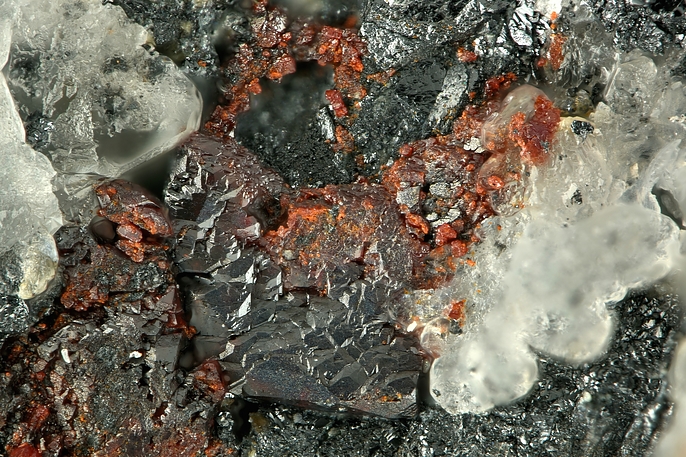

About Pyrobelonite

Formula:
PbMn2+(VO4)(OH)
Colour:
Red, dark red
Lustre:
Adamantine, Sub-Adamantine
Hardness:
3½
Specific Gravity:
5.58 - 5.79
Crystal System:
Orthorhombic
Member of:
Name:
Named by Gustav Flink in 1919 from the Greek πυρ for "fire" and βελόνη for "needle," in allusion to its colour and the acicular habit of its crystals.
Isostructural with:
Unique Identifiers
Mindat ID:
3315
Long-form identifier:
mindat:1:1:3315:8
IMA Classification of Pyrobelonite
Approved, 'Grandfathered' (first described prior to 1959)
IMA Formula:
PbMn2+VO4(OH)
First published:
1919
Classification of Pyrobelonite
8.BH.40
8 : PHOSPHATES, ARSENATES, VANADATES
B : Phosphates, etc., with additional anions, without H2O
H : With medium-sized and large cations, (OH,etc.):RO4 = 1:1
8 : PHOSPHATES, ARSENATES, VANADATES
B : Phosphates, etc., with additional anions, without H2O
H : With medium-sized and large cations, (OH,etc.):RO4 = 1:1
41.5.2.3
41 : ANHYDROUS PHOSPHATES, ETC.CONTAINING HYDROXYL OR HALOGEN
5 : (AB)2(XO4)Zq
41 : ANHYDROUS PHOSPHATES, ETC.CONTAINING HYDROXYL OR HALOGEN
5 : (AB)2(XO4)Zq
21.4.17
21 : Vanadates (and vanadates with arsenate or phosphate)
4 : Vanadates of U, Mn, Fe or Ni
21 : Vanadates (and vanadates with arsenate or phosphate)
4 : Vanadates of U, Mn, Fe or Ni
Mineral Symbols
As of 2021 there are now IMA–CNMNC approved mineral symbols (abbreviations) for each mineral species, useful for tables and diagrams.
| Symbol | Source | Reference |
|---|---|---|
| Pbl | IMA–CNMNC | Warr, L.N. (2021). IMA–CNMNC approved mineral symbols. Mineralogical Magazine, 85(3), 291-320. doi:10.1180/mgm.2021.43 |
Pronunciation of Pyrobelonite
Pronunciation:
| Play | Recorded by | Country |
|---|---|---|
| Jolyon Ralph | United Kingdom |
Physical Properties of Pyrobelonite
Adamantine, Sub-Adamantine
Transparency:
Transparent
Colour:
Red, dark red
Streak:
Orange-yellow, red-orange
Hardness:
3½ on Mohs scale
Tenacity:
Brittle
Cleavage:
None Observed
Fracture:
Conchoidal
Density:
5.58 - 5.79 g/cm3 (Measured) 5.82 g/cm3 (Calculated)
Optical Data of Pyrobelonite
Type:
Biaxial (-)
RI values:
nα = 2.32 nβ = 2.36 nγ = 2.37
2V:
Measured: 29° , Calculated: 52°
Birefringence:
0.05
Max. Birefringence:
δ = 0.050
Based on recorded range of RI values above.
Based on recorded range of RI values above.
Interference Colours:
The colours simulate birefringence patterns seen in thin section under crossed polars. They do not take into account mineral colouration or opacity.
Michel-Levy Bar The default colours simulate the birefringence range for a 30 µm thin-section thickness. Adjust the slider to simulate a different thickness.
Grain Simulation You can rotate the grain simulation to show how this range might look as you rotated a sample under crossed polars.
The colours simulate birefringence patterns seen in thin section under crossed polars. They do not take into account mineral colouration or opacity.
Michel-Levy Bar The default colours simulate the birefringence range for a 30 µm thin-section thickness. Adjust the slider to simulate a different thickness.
Grain Simulation You can rotate the grain simulation to show how this range might look as you rotated a sample under crossed polars.
Surface Relief:
Moderate
Anisotropism:
Strong
Bireflectance:
Visible
Dispersion:
none
Optical Extinction:
Parallel, XYZ = acb
Colour in reflected light:
Gray with red to orange internal glints
Pleochroism:
Visible
Comments:
shades of red-brown.
Chemistry of Pyrobelonite
Mindat Formula:
PbMn2+(VO4)(OH)
Element Weights:
Crystallography of Pyrobelonite
Crystal System:
Orthorhombic
Class (H-M):
mmm (2/m 2/m 2/m) - Dipyramidal
Space Group:
Pnma
Setting:
Pnma
Cell Parameters:
a = 7.62 Å, b = 6.17 Å, c = 9.47 Å
Ratio:
a:b:c = 1.235 : 1 : 1.535
Unit Cell V:
445.24 ų (Calculated from Unit Cell)
Z:
4
Morphology:
Acicular [001] or acute pyramidal; blocky.
Forms: {100}, {110}, {120}, {210}, {001}, {011}, {031}, {111}, {221}.
Forms: {100}, {110}, {120}, {210}, {001}, {011}, {031}, {111}, {221}.
Comment:
Given as Pnam. Kolitsch (2001) gives the following parameters for a practically pure sample: a = 7.646(2), b = 6.179(1), c = 9.507(2) Å.
Crystal Structure
Load
Unit Cell | Unit Cell Packed
2x2x2 | 3x3x3 | 4x4x4
Unit Cell | Unit Cell Packed
2x2x2 | 3x3x3 | 4x4x4
Show
Big Balls | Small Balls | Just Balls | Spacefill
Polyhedra Off | Si Polyhedra | All Polyhedra
Remove metal-metal sticks
Big Balls | Small Balls | Just Balls | Spacefill
Polyhedra Off | Si Polyhedra | All Polyhedra
Remove metal-metal sticks
Display Options
Black Background | White Background
Perspective On | Perspective Off
2D | Stereo | Red-Blue | Red-Cyan
Black Background | White Background
Perspective On | Perspective Off
2D | Stereo | Red-Blue | Red-Cyan
View
CIF File Best | x | y | z | a | b | c
CIF File Best | x | y | z | a | b | c
Rotation
Stop | Start
Stop | Start
Labels
Console Off | On | Grey | Yellow
Console Off | On | Grey | Yellow
Data courtesy of the American Mineralogist Crystal Structure Database. Click on an AMCSD ID to view structure
| ID | Species | Reference | Link | Year | Locality | Pressure (GPa) | Temp (K) |
|---|---|---|---|---|---|---|---|
| 0000071 | Pyrobelonite | Donaldson D M, Barnes W H (1955) The structures of the minerals of the descloizite and adelite groups: II - pyrobelonite. American Mineralogist 40 580-596 |  | 1955 | 0 | 293 | |
| 0010371 | Pyrobelonite | Kolitsch U (2001) Refinement of pyrobelonite, PbMnIIVO4(OH), a member of the descloizite group Acta Crystallographica E57 i119-i121 |  | 2001 | synthetic | 0 | 293 |
CIF Raw Data - click here to close
X-Ray Powder Diffraction
Powder Diffraction Data:
| d-spacing | Intensity |
|---|---|
| 5.14 Å | (70) |
| 4.27 Å | (40) |
| 3.672 Å | (65) |
| 3.24 Å | (100) |
| 2.914 Å | (50) |
| 2.635 Å | (70) |
| 2.323 Å | (70) |
| 1.667 Å | (65) |
Comments:
ICDD 20-588
Geological Environment
Paragenetic Mode(s):
| Paragenetic Mode | Earliest Age (Ga) |
|---|---|
| High-? alteration and/or metamorphism | |
| 32 : Ba/Mn/Pb/Zn deposits, including metamorphic deposits | |
| Stage 7: Great Oxidation Event | <2.4 |
| 47a : [Near-surface hydration of prior minerals] | |
| 47d : [Arsenates, antimonates, selenates, bismuthinates] | |
| 47e : [Vanadates, chromates, manganates] |
Geological Setting:
Mineralization in fractures
Type Occurrence of Pyrobelonite
General Appearance of Type Material:
Long-prismatic needles, seldom over one mm long.
Associated Minerals at Type Locality:
Other Language Names for Pyrobelonite
Dutch:Pyrobeloniet
German:Pyrobelonit
Russian:Пиробелонит
Simplified Chinese:钒锰铅矿
Spanish:Pirobelonita
Traditional Chinese:釩錳鉛礦
Relationship of Pyrobelonite to other Species
Member of:
Other Members of Adelite-Descloizite Group:
| Adelite | CaMg(AsO4)(OH) | Orth. 2 2 2 : P21 21 21 |
| Arsendescloizite | PbZn(AsO4)(OH) | Orth. 2 2 2 : P21 21 21 |
| Austinite | CaZn(AsO4)(OH) | Orth. 2 2 2 : P21 21 21 |
| Čechite | PbFe2+(VO4)(OH) | Orth. mmm (2/m 2/m 2/m) |
| Cobaltaustinite | CaCo(AsO4)(OH) | Orth. 2 2 2 : P21 21 21 |
| Conichalcite | CaCu(AsO4)(OH) | Orth. 2 2 2 : P21 21 21 |
| Descloizite | PbZn(VO4)(OH) | Orth. mmm (2/m 2/m 2/m) : Pnma |
| Duftite | PbCu(AsO4)(OH) | Orth. 2 2 2 : P21 21 21 |
| Duftite-alpha | PbCu(AsO4)(OH) | |
| Gottlobite | CaMg(VO4)(OH) | Orth. 2 2 2 : P21 21 21 |
| Hermannroseite | CaCu(PO4)(OH) | Orth. 2 2 2 : P21 21 21 |
| Mottramite | PbCu(VO4)(OH) | Orth. mmm (2/m 2/m 2/m) : Pnma |
| Nickelaustinite | CaNi(AsO4)(OH) | Orth. 2 2 2 : P21 21 21 |
| Tangeite | CaCu(VO4)(OH) | Orth. 2 2 2 : P21 21 21 |
| Unnamed (Pb-analogue of Nickelaustinite) | PbNi(AsO4)(OH) | |
| Vuagnatite | CaAl(SiO4)(OH) | Orth. 2 2 2 : P21 21 21 |
Common Associates
Associated Minerals Based on Photo Data:
| 4 photos of Pyrobelonite associated with Calcite | CaCO3 |
| 3 photos of Pyrobelonite associated with Rhodochrosite | MnCO3 |
| 3 photos of Pyrobelonite associated with Beudantite | PbFe3+3(AsO4)(SO4)(OH)6 |
| 3 photos of Pyrobelonite associated with Phosgenite | Pb2CO3Cl2 |
| 2 photos of Pyrobelonite associated with Braunite | Mn2+Mn3+6(SiO4)O8 |
| 2 photos of Pyrobelonite associated with Native Copper | Cu |
| 2 photos of Pyrobelonite associated with Willemite | Zn2SiO4 |
| 2 photos of Pyrobelonite associated with Andradite | Ca3Fe3+2(SiO4)3 |
| 2 photos of Pyrobelonite associated with Shigaite | Mn6Al3(OH)18[Na(H2O)6](SO4)2 · 6H2O |
| 2 photos of Pyrobelonite associated with Adelite | CaMg(AsO4)(OH) |
Related Minerals - Strunz-mindat Grouping
| 8.BH. | Peterchinite | Zn3Zn2(OH)6As[O3(OH)3] |
| 8.BH. | Reznitskyite | CaMg(VO4)F |
| 8.BH. | Cuprozheshengite | Pb4CuZn2(AsO4)2(PO4)2(OH)2 |
| 8.BH. | Zheshengite | Pb4ZnZn2(AsO4)2(PO4)2(OH)2 |
| 8.BH. | Crimsonite | PbFe3+2(PO4)2(OH)2 |
| 8.BH.05 | Thadeuite | Ca(Mg,Fe2+)3(PO4)2(OH,F)2 |
| 8.BH.10 | Panasqueiraite | CaMg(PO4)(OH) |
| 8.BH.10 | Isokite | CaMg(PO4)F |
| 8.BH.10 | Lacroixite | NaAl(PO4)F |
| 8.BH.10 | Arsenatrotitanite | NaTi(AsO4)O |
| 8.BH.10 | Maxwellite | NaFe3+(AsO4)F |
| 8.BH.10 | Durangite | NaAl(AsO4)F |
| 8.BH.10 | Kononovite | NaMg(SO4)F |
| 8.BH.15 | Drugmanite | Pb2Fe3+(PO4)(PO3OH)(OH)2 |
| 8.BH.20 | Nigelcookite | PbFe2+2V3+2(PO4)3(OH)3 |
| 8.BH.20 | Plumbojohntomaite | PbFe2+2Fe3+2(PO4)3(OH)3 |
| 8.BH.20 | Cirrolite | Ca3Al2(PO4)3(OH)3 (?) |
| 8.BH.20 | Penikisite | Ba(Mg,Fe2+,Ca)2Al2(PO4)3(OH)3 |
| 8.BH.20 | Perloffite | Ba(Mn2+,Fe2+)2Fe3+2(PO4)3(OH)3 |
| 8.BH.20 | Bjarebyite Group | |
| 8.BH.20 | Strontioperloffite | SrMn2+2Fe3+2(PO4)3(OH)3 |
| 8.BH.20 | Plumboperloffite | PbMn2+2Fe3+2(PO4)3(OH)3 |
| 8.BH.20 | Johntomaite | BaFe2+2Fe3+2(PO4)3(OH)3 |
| 8.BH.20 | Bjarebyite | (Ba,Sr)(Mn2+,Fe2+,Mg)2Al2(PO4)3(OH)3 |
| 8.BH.20 | Kulanite | Ba(Fe2+,Mn2+,Mg)2(Al,Fe3+)2(PO4)3(OH)3 |
| 8.BH.25 | Bertossaite | Li2CaAl4(PO4)4(OH)4 |
| 8.BH.25 | Natropalermoite | Na2SrAl4(PO4)4(OH)4 |
| 8.BH.25 | Palermoite | Li2SrAl4(PO4)4(OH)4 |
| 8.BH.30 | Sewardite | CaFe3+2(AsO4)2(OH)2 |
| 8.BH.30 | Carminite | PbFe3+2(AsO4)2(OH)2 |
| 8.BH.35 | Adelite | CaMg(AsO4)(OH) |
| 8.BH.35 | Duftite | PbCu(AsO4)(OH) |
| 8.BH.35 | Cobaltaustinite | CaCo(AsO4)(OH) |
| 8.BH.35 | Nickelaustinite | CaNi(AsO4)(OH) |
| 8.BH.35 | Gabrielsonite | PbFe3+(As3+O3)O |
| 8.BH.35 | Conichalcite | CaCu(AsO4)(OH) |
| 8.BH.35 | Arsendescloizite | PbZn(AsO4)(OH) |
| 8.BH.35 | Duftite-alpha | PbCu(AsO4)(OH) |
| 8.BH.35 | Gottlobite | CaMg(VO4)(OH) |
| 8.BH.35 | Austinite | CaZn(AsO4)(OH) |
| 8.BH.35 | Hermannroseite | CaCu(PO4)(OH) |
| 8.BH.35 | Tangeite | CaCu(VO4)(OH) |
| 8.BH.40 | Čechite | PbFe2+(VO4)(OH) |
| 8.BH.40 | Khorixasite | (Bi0.67◻0.33)Cu(VO4)(OH) |
| 8.BH.40 | Mottramite | PbCu(VO4)(OH) |
| 8.BH.40 | Descloizite | PbZn(VO4)(OH) |
| 8.BH.45 | Bayldonite | PbCu3(AsO4)2(OH)2 |
| 8.BH.45 | Vésigniéite | BaCu3(VO4)2(OH)2 |
| 8.BH.50 | Paganoite | NiBi(AsO4)O |
| 8.BH.55 | Jagowerite | BaAl2(PO4)2(OH)2 |
| 8.BH.55 | Harrisonite | Ca(Fe2+,Mg)6(PO4)2(SiO4)2 |
| 8.BH.60 | Attakolite | CaMn2+Al4(SiO3OH)(PO4)3(OH)4 |
| 8.BH.65 | Leningradite | PbCu3(VO4)2Cl |
| 8.BH.70 | Katiarsite | KTiO(AsO4) |
| 8.BH.70 | Yurgensonite | K2SnTiO2(AsO4)2 |
| 8.BH.75 | Melanarsite | K3Cu7Fe3+O4(AsO4)4 |
| 8.BH.80 | Evseevite | Na2Mg(AsO4)F |
| 8.BH.80 | Moraskoite | Na2Mg(PO4)F |
| 8.BH.85 | Piccoliite | NaCaMn3+2(AsO4)2O(OH) |
Fluorescence of Pyrobelonite
Not fluorescent.
Other Information
Health Risks:
No information on health risks for this material has been entered into the database. You should always treat mineral specimens with care.
Internet Links for Pyrobelonite
mindat.org URL:
https://www.mindat.org/min-3315.html
Please feel free to link to this page.
Please feel free to link to this page.
Search Engines:
External Links:
References for Pyrobelonite
Reference List:
Strunz, H. (1939) Mineralien der Descloizitgruppe. Konichalcit, Staszizit, Austinit, Duftit, Aräoxen, Volborthit, Pyrobelonit. Zeitschrift für Kristallographie, Mineralogie und Petrographie, 101 (1). 496-506 doi:10.1524/zkri.1939.101.1.496
Richmond, Wallace E. (1940) Crystal chemistry of the phosphates, arsenates and vanadates of the type A2XO4(Z). American Mineralogist, 25 (7). 441-479
Barnes, W. H., Qurashi, M. M. (1952) Unit cell and space group data for certain vanadium minerals. American Mineralogist, 37 (5-6) 407-422
Donaldson, D. M., Barnes, W. H. (1955) The structures of the minerals of the descoloizite and adelite groups: II-Pyrobelonite. American Mineralogist, 40 (7-8) 580-596
Criddle, A. J., Symes, R. F. (1977) Mineralization at Tŷ Coch, Glamorgan (Mid Glamorgan), Wales: the second occurrence of pyrobelonite. Mineralogical Magazine, 41 (317) 85-90 doi:10.1180/minmag.1977.041.317.13
Localities for Pyrobelonite
 symbol to view information about a locality.
The
symbol to view information about a locality.
The Locality List
 - This locality has map coordinates listed.
- This locality has estimated coordinates.
ⓘ - Click for references and further information on this occurrence.
? - Indicates mineral may be doubtful at this locality.
- This locality has map coordinates listed.
- This locality has estimated coordinates.
ⓘ - Click for references and further information on this occurrence.
? - Indicates mineral may be doubtful at this locality.
 - Good crystals or important locality for species.
 - World class for species or very significant.
(TL) - Type Locality for a valid mineral species.
(FRL) - First Recorded Locality for everything else (eg varieties).
- World class for species or very significant.
(TL) - Type Locality for a valid mineral species.
(FRL) - First Recorded Locality for everything else (eg varieties).
All localities listed without proper references should be considered as questionable.
Australia | |
| Segnit et al. (1983) +6 other references |
Austria | |
| Kolitsch et al. (2021) |
| Kolitsch et al. (2025) | |
| Kolitsch et al. (2025) | |
| Kolitsch et al. (2019) |
| Kolitsch et al. (2018) |
Canada | |
| SASSANO et al. (1987) |
Germany | |
| Brugger et al. (2001) |
| Roppel et al. (08/22) |
| Gröbner et al. (2011) |
Italy | |
| Ciriotti et al. (2011) |
| Pagano et al. (2001) | |
| Castellaro-Kampf | |
| Gianluca Armellino specimen | |
| Bracco et al. (2001) |
| Castellaro et al. (2023) |
| |
| Castellaro et al. (2011) |
| Piccoli et al. (2021) |
| Cámara et al. (2017) |
Japan | |
| Färber (n.d.) |
Kazakhstan | |
| Brusnitsyn et al. (2021) |
Namibia | |
| Dunn (1991) |
Norway | |
| Breivik et al. (2007) |
Spain | |
| Dill et al. (2023) |
Sweden | |
| Holtstam et al. (2001) |
| Geologiska Föreningens I Stockholm. Förhandlinger (1919) +2 other references |
| Wiklund (2016) | |
| Gustafsson (2003) | |
| Folvik (2009) |
| Sandström et al. (2009) |
| Sandström et al. (2009) | |
| Torbjorn Lorin | |
Switzerland | |
| Brugger et al. (1996) |
| Brugger J. (1996) | |
| The Canadian Mineralogist 44 (2006) +1 other reference |
UK | |
| Criddle et al. (1977) |
USA | |
| Dunn (1979) +1 other reference |
| King (n.d.) |
Quick NavTopAbout PyrobeloniteUnique IdentifiersIMA Classification Classification Mineral SymbolsPronunciation Physical Properties Optical Data Chemistry Crystallography Crystal StructureX-Ray Powder DiffractionGeological EnvironmentType Occurrence Other LanguagesRelationshipsCommon AssociatesStrunz-MindatFluorescence Other InformationInternet Links References Localities Locality List
Iron Monarch Main Pit, Iron Knob, Pastoral Unincorporated Area, South Australia, Australia