Hydroxylborite
A valid IMA mineral species
This page is currently not sponsored. Click here to sponsor this page.

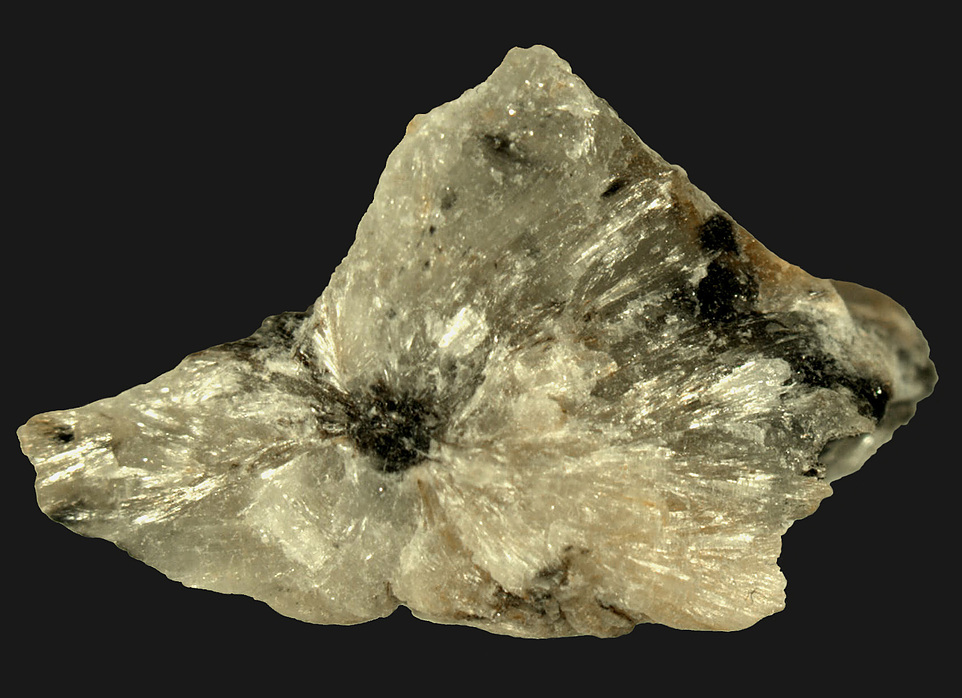
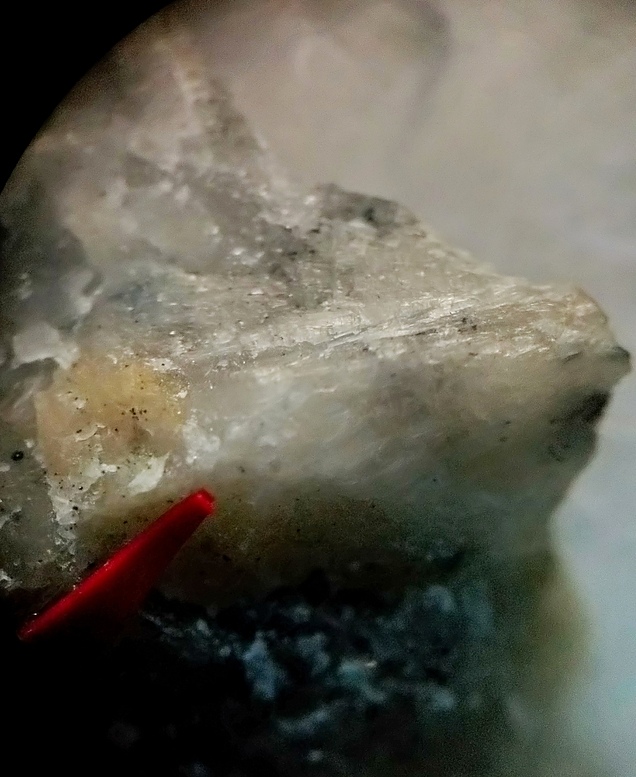
About Hydroxylborite
Formula:
Mg3(BO3)(OH)3
Colour:
Colourless
Lustre:
Vitreous
Hardness:
3½
Specific Gravity:
2.89
Crystal System:
Hexagonal
Name:
In allusion to its composition, being the HYDROXYL dominant member of the series with fluoBORITE.
Type Locality:
Isostructural with:
Unique Identifiers
Mindat ID:
31567
Long-form identifier:
mindat:1:1:31567:0
IMA Classification of Hydroxylborite
Approved
Approval year:
2007
Classification of Hydroxylborite
6.AB.50
6 : BORATES
A : Monoborates
B : BO3, with additional anions; 1(D) + OH, etc.
6 : BORATES
A : Monoborates
B : BO3, with additional anions; 1(D) + OH, etc.
Mineral Symbols
As of 2021 there are now IMA–CNMNC approved mineral symbols (abbreviations) for each mineral species, useful for tables and diagrams.
| Symbol | Source | Reference |
|---|---|---|
| Hyb | IMA–CNMNC | Warr, L.N. (2021). IMA–CNMNC approved mineral symbols. Mineralogical Magazine, 85(3), 291-320. doi:10.1180/mgm.2021.43 |
Physical Properties of Hydroxylborite
Vitreous
Transparency:
Transparent
Colour:
Colourless
Streak:
White
Hardness:
3½ on Mohs scale
Tenacity:
Brittle
Cleavage:
Imperfect/Fair
On {0001}, imperfect.
On {0001}, imperfect.
Parting:
None.
Fracture:
Conchoidal
Density:
2.89 g/cm3 (Measured) 2.872 g/cm3 (Calculated)
Optical Data of Hydroxylborite
Type:
Uniaxial (-)
RI values:
nω = 1.566 nε = 1.531
Max. Birefringence:
δ = 0.035
Based on recorded range of RI values above.
Based on recorded range of RI values above.
Interference Colours:
The colours simulate birefringence patterns seen in thin section under crossed polars. They do not take into account mineral colouration or opacity.
Michel-Levy Bar The default colours simulate the birefringence range for a 30 µm thin-section thickness. Adjust the slider to simulate a different thickness.
Grain Simulation You can rotate the grain simulation to show how this range might look as you rotated a sample under crossed polars.
The colours simulate birefringence patterns seen in thin section under crossed polars. They do not take into account mineral colouration or opacity.
Michel-Levy Bar The default colours simulate the birefringence range for a 30 µm thin-section thickness. Adjust the slider to simulate a different thickness.
Grain Simulation You can rotate the grain simulation to show how this range might look as you rotated a sample under crossed polars.
Surface Relief:
Moderate
Chemistry of Hydroxylborite
Mindat Formula:
Mg3(BO3)(OH)3
Element Weights:
Elements listed:
Crystallography of Hydroxylborite
Crystal System:
Hexagonal
Class (H-M):
6/m - Dipyramidal
Space Group:
P63/m
Cell Parameters:
a = 8.912 Å, c = 3.112 Å
Ratio:
a:c = 1 : 0.349
Unit Cell V:
214.05 ų
Z:
2
Morphology:
Crystals prismatic with dominant {1010} and without distinct terminal faces; also occurs as radial aggregates.
Crystal Structure
Load
Unit Cell | Unit Cell Packed
2x2x2 | 3x3x3 | 4x4x4
Unit Cell | Unit Cell Packed
2x2x2 | 3x3x3 | 4x4x4
Show
Big Balls | Small Balls | Just Balls | Spacefill
Polyhedra Off | Si Polyhedra | All Polyhedra
Remove metal-metal sticks
Big Balls | Small Balls | Just Balls | Spacefill
Polyhedra Off | Si Polyhedra | All Polyhedra
Remove metal-metal sticks
Display Options
Black Background | White Background
Perspective On | Perspective Off
2D | Stereo | Red-Blue | Red-Cyan
Black Background | White Background
Perspective On | Perspective Off
2D | Stereo | Red-Blue | Red-Cyan
View
CIF File Best | x | y | z | a | b | c
CIF File Best | x | y | z | a | b | c
Rotation
Stop | Start
Stop | Start
Labels
Console Off | On | Grey | Yellow
Console Off | On | Grey | Yellow
Data courtesy of the American Mineralogist Crystal Structure Database. Click on an AMCSD ID to view structure
| ID | Species | Reference | Link | Year | Locality | Pressure (GPa) | Temp (K) |
|---|---|---|---|---|---|---|---|
| 0009139 | Hydroxylborite | Takeuchi Y (1950) The structure of fluoborite Acta Crystallographica 3 208-210 |  | 1950 | Tallgruvan, Sweden | 0 | 293 |
| 0012664 | Hydroxylborite | Rudnev V V, Chukanov N V, Nechelyustov G N, Yamnova N A (2007) Hydroxylborite, Mg3(BO3)(OH)3, a new mineral species and isomorphous series fluoborite-hydroxylborite series Geology of Ore Deposits 49 710-719 | 2007 | the Titovsky deposit, Sakha-Yakutia Republic, Russia | 0 | 293 |
CIF Raw Data - click here to close
X-Ray Powder Diffraction
Powder Diffraction Data:
| d-spacing | Intensity |
|---|---|
| 2.422 Å | (100) |
| 4.45 Å | (82) |
| 2.573 Å | (65) |
| 2.128 Å | (60) |
| 7.69 Å | (52) |
| 2.551 Å | (49) |
| 2.141 Å | (44) |
Comments:
Visyachy area, Sakha-Yakutia Republic, Russia. Data from the type description.
Geological Environment
Paragenetic Mode(s):
| Paragenetic Mode | Earliest Age (Ga) |
|---|---|
| Near-surface Processes | |
| 23 : Subaerial aqueous alteration by non-redox-sensitive fluids (see also #47) |
Type Occurrence of Hydroxylborite
General Appearance of Type Material:
Hexagonal prisms without end faces, about 1-1.5 x 0.1-0.2 mm in size. Commonly as radial and fan-like aggregate.
Place of Conservation of Type Material:
Fersman Mineralogical Museum, Moscow (#91968), and the Geology Museum of the All-Russian Scientific Research Institute of Mineral Resources (#M-1663).
Geological Setting of Type Material:
Mineralized skarn, calciphyre, and marble. Clinohumite calciphyre.
Associated Minerals at Type Locality:
Synonyms of Hydroxylborite
Other Language Names for Hydroxylborite
German:Hydroxylborit
Relationship of Hydroxylborite to other Species
Forms a series with:
Related Minerals - Strunz-mindat Grouping
| 6.AB. | Chubarovite | KZn2(BO3)Cl2 |
| 6.AB. | Rhabdoborite-(Mo) | Mg12Mo6+1.33O6(BO3)6F2 |
| 6.AB.05 | Hambergite | Be2(BO3)(OH) |
| 6.AB.10 | Berborite | Be2(BO3)(OH,F) · H2O |
| 6.AB.15 | Jeremejevite | Al6(BO3)5(F,OH)3 |
| 6.AB.20 | Yuanfuliite | Mg(Fe3+,Al)O(BO3) |
| 6.AB.20 | Warwickite | (Mg,Ti,Fe,Al)2O(BO3) |
| 6.AB.25 | Karlite | (Mg,Al)6.5(BO3)3(OH)4(◻,Cl)0.5 |
| 6.AB.30 | Marinaite | Cu2Fe3+O2(BO3) |
| 6.AB.30 | Savelievaite | Mg2Cr3+O2(BO3) |
| 6.AB.30 | Fredrikssonite | Mg2(Mn3+,Fe3+)(BO3)O2 |
| 6.AB.30 | Vonsenite | Fe2+2Fe3+(BO3)O2 |
| 6.AB.30 | Ludwigite | Mg2Fe3+(BO3)O2 |
| 6.AB.30 | Azoproite | (Mg,Fe2+)2(Fe3+,Ti,Mg)(BO3)O2 |
| 6.AB.30 | Bonaccordite | Ni2Fe3+(BO3)O2 |
| 6.AB.35 | Folvikite | Sb5+Mn3+(Mg,Mn2+)10O8(BO3)4 |
| 6.AB.35 | Pinakiolite | (Mg,Mn2+)2Mn3+(BO3)O2 |
| 6.AB.40 | Takéuchiite | (Mg,Mn2+)2(Mn3+,Fe3+)(BO3)O2 |
| 6.AB.40 | Blatterite | Sb5+3(Mn3+,Fe3+)9(Mn2+,Mg)35(BO3)16O32 |
| 6.AB.40 | Orthopinakiolite | (Mg,Mn2+)2Mn3+(BO3)O2 |
| 6.AB.40 | Chestermanite | Mg2(Fe3+,Mn3+,Al,Sb3+)(BO3)O2 |
| 6.AB.45 | Aluminomagnesiohulsite | (Mg,Fe2+)2(Al,Mg,Sn)(BO3)O2 |
| 6.AB.45 | Hulsite | Fe2+2Fe3+O2(BO3) |
| 6.AB.45 | Magnesiohulsite | Mg2Fe3+O2(BO3) |
| 6.AB.50 | Fluoborite | Mg3(BO3)(F,OH)3 |
| 6.AB.55 | Shabynite | Mg5(BO3)(OH)5(Cl,OH)2 · 4H2O |
| 6.AB.55 | Wightmanite | Mg5(BO3)O(OH)5 · 2H2O |
| 6.AB.60 | Gaudefroyite | Ca4Mn3+2-3(BO3)3(CO3)(O,OH)3 |
| 6.AB.65 | Sakhaite | Ca48Mg16(BO3)32(CO3)16 · 2(H2O,HCl) |
| 6.AB.70 | Harkerite | Ca48Mg16[AlSi4O15(OH)]4(BO3)16(CO3)16 · 2(H2O,HCl) |
| 6.AB.75 | Pertsevite-(F) | Mg2(BO3)(F,OH) |
| 6.AB.75 | Pertsevite-(OH) | Mg2(BO3)(OH) |
| 6.AB.80 | Jacquesdietrichite | Cu2(H2BO3)(OH)3 |
| 6.AB.85 | Rhabdoborite-(V) | Mg12(V5+,Mo6+,W6+)1.5O6{[BO3]6-x[(P,As)O4]xF2-x} (x < 1) |
| 6.AB.85 | Rhabdoborite-(W) | Mg12(W6+,V5+)1.5O6{[BO3]6-x[(P,As)O4]xF2-x} |
| 6.AB.85 | Painite | CaZrAl9(BO3)O15 |
| 6.AB.90 | Mengxianminite | (Ca,Na)2Sn2(Mg,Fe)3Al8[(BO3)(BeO4)O6]2 |
Fluorescence of Hydroxylborite
Bluish fluorescence under SW UV.
Other Information
Notes:
Dissolves in concentrated H2SO4, readily reacts with quinalizarin, and remains insoluble in water and dilute HCl.
Health Risks:
No information on health risks for this material has been entered into the database. You should always treat mineral specimens with care.
Internet Links for Hydroxylborite
mindat.org URL:
https://www.mindat.org/min-31567.html
Please feel free to link to this page.
Please feel free to link to this page.
Search Engines:
External Links:
References for Hydroxylborite
Reference List:
Localities for Hydroxylborite
 symbol to view information about a locality.
The
symbol to view information about a locality.
The Locality List
 - This locality has map coordinates listed.
- This locality has estimated coordinates.
ⓘ - Click for references and further information on this occurrence.
? - Indicates mineral may be doubtful at this locality.
- This locality has map coordinates listed.
- This locality has estimated coordinates.
ⓘ - Click for references and further information on this occurrence.
? - Indicates mineral may be doubtful at this locality.
 - Good crystals or important locality for species.
 - World class for species or very significant.
(TL) - Type Locality for a valid mineral species.
(FRL) - First Recorded Locality for everything else (eg varieties).
- World class for species or very significant.
(TL) - Type Locality for a valid mineral species.
(FRL) - First Recorded Locality for everything else (eg varieties).
All localities listed without proper references should be considered as questionable.
Russia | |
| The Chersky Range is within the Saha ... |
| Rudnev et al. (2007) |
Quick NavTopAbout HydroxylboriteUnique IdentifiersIMA Classification Classification Mineral SymbolsPhysical Properties Optical Data Chemistry Crystallography Crystal StructureX-Ray Powder DiffractionGeological EnvironmentType Occurrence SynonymsOther LanguagesRelationshipsStrunz-MindatFluorescence Other InformationInternet Links References Localities Locality List
Titovskoe B deposit, Tas-Khayakhtakh Range, Dogdo River Basin, Polar Yakutia, Sakha, Russia