Featured articles are displayed here, which represent some of the best content on English Wikipedia.
Image 1
The most complete skeleton (specimen PM120/107) shown from above (left, A) and below (right, B) as preserved, with diagrams showing individual bones
Catopsbaatar is a genus of multituberculate, an extinctorder of rodent-like mammals. It lived in what is now Mongolia during the late Campanian age of the Late Cretaceousepoch, about 72 million years ago. The first fossils were collected in the early 1970s, and the animal was named as a new species of the genus Djadochtatherium in 1974, D. catopsaloides. The specific name refers to the animal's similarity to the genus Catopsalis. The species was moved to the genus Catopsalis in 1979, and received its own genus (Catopsbaatar, Greek and Mongolian for 'visible hero') in 1994. Five skulls, one molar, and one skeleton with a skull are known; the last is the genus' most complete specimen. Catopsbaatar was a member of the family Djadochtatheriidae. (Full article...)
Image 2
Range of Oryzomys dimidiatus (yellow) and the related O. couesi (red and yellow) in Central America.
Oryzomys dimidiatus, also known as the Nicaraguan oryzomys, Thomas's rice rat, or the Nicaraguan rice rat, is a rodent in the family Cricetidae. It is known from only three specimens, all collected in southeastern Nicaragua since 1904. Placed in Nectomys upon its discovery, it was later classified in its own subgenus of Oryzomys and finally recognized as closely related to other species now placed in Oryzomys, including the marsh rice rat and Coues' rice rat, which occurs in the same region. (Full article...)
Ficus obliqua, commonly known as the small-leaved fig, is a tree in the family Moraceae, native to eastern Australia, New Guinea, eastern Indonesia to Sulawesi and islands in the southwestern Pacific Ocean. Previously known for many years as Ficus eugenioides, it is a banyan of the genus Ficus, which contains around 750 species worldwide in warm climates, including the edible fig (Ficus carica). Beginning life as a seedling, which grows on other plants (epiphyte) or on rocks (lithophyte), F. obliqua can grow to 60 m (200 ft) high and nearly as wide with a pale grey buttressed trunk, and glossy green leaves. (Full article...)
The Teloschistaceae are a large family of mostly lichen-forming fungi belonging to the classLecanoromycetes in the divisionAscomycota. The family has a cosmopolitan distribution, although its members occur predominantly in temperate regions. Most members are lichens that either live on rock or on bark, but about 40 species are lichenicolous – meaning they are non-lichenised fungi that live on other lichens. Many members of the Teloschistaceae are readily identifiable by their vibrant orange to yellow hue, a result of their frequent anthraquinone content. The presence of these anthraquinone pigments, which confer protection from ultraviolet light, enabled this group to expand from shaded forest habitats to harsher environmental conditions of sunny and arid ecosystems during the Late Cretaceous. (Full article...)
An early volume of the General Stud Book, Volume 6 The Jersey Act was a regulation introduced to prevent the registration of most American-bred Thoroughbred horses in the British General Stud Book. It had its roots in the desire of British horse breeders to halt the influx of American-bred racehorses of possibly impure bloodlines during the early 20th century. Many American-bred horses were exported to Europe to race and retire to a breeding career after a number of U.S. states banned gambling, which depressed Thoroughbred racing—and thus breeding—in the United States. The loss of breeding records during the American Civil War and the late beginning of the registration of American Thoroughbreds led many in the British racing establishment to doubt that the American-bred horses were purebred. (Full article...)
Image 10
Approximate distribution of Hypericum sechmenii within Turkey
The Brown Dog affair was a political controversy about vivisection that raged in Britain from 1903 until 1910. It involved the infiltration of University of London medical lectures by Swedish feminists, battles between medical students and the police, police protection for the statue of a dog, a libel trial at the Royal Courts of Justice, and the establishment of a Royal Commission to investigate the use of animals in experiments. The affair became a cause célèbre that divided the country. (Full article...)
Image 12
Serpens (Ancient Greek: Ὄφις, romanized: Óphis, lit.'the Serpent') is a constellation in the northern celestial hemisphere. One of the 48 constellations listed by the 2nd-century astronomer Ptolemy, it remains one of the 88 modern constellations designated by the International Astronomical Union. It is unique among the modern constellations in being split into two non-contiguous parts, Serpens Caput (Serpent Head) to the west and Serpens Cauda (Serpent Tail) to the east. Between these two halves lies the constellation of Ophiuchus, the "Serpent-Bearer". In figurative representations, the body of the serpent is represented as passing behind Ophiuchus between Mu Serpentis in Serpens Caput and Nu Serpentis in Serpens Cauda. (Full article...)
The Eurasian crag martin or just crag martin (Ptyonoprogne rupestris) is a small passerinebird in the swallow family. It is about 14 cm (5.5 in) long with ash-brown upperparts and paler underparts, and a short, square tail that has distinctive white patches on most of its feathers. It breeds in the mountains of southern Europe, northwestern Africa and across the Palearctic. It can be confused with the three other species in its genus, but is larger with brighter tail spots and different plumage tone. Many European birds are resident, but some northern populations and most Asian breeders are migratory, wintering in northern Africa, the Middle East or India. (Full article...)
This portal needs to be updated. Please help update this portal to reflect recent events or newly available information. Relevant discussion may be found on the talk page.
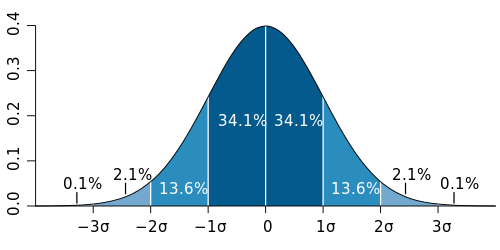
Many naturally occurring phenomena approximate a normal distribution.
Complete requests of other editors on the talk pages of science-related articles (examples)
Expand 2025 in science and/or other articles for science-related topics of the year (in the box on the right)
Create new articles for items of this article, mostly articles relating to new scientific fields/topics/findings (the page does not use redlinks anymore but you will quickly identify possible new articles when reading it; here you can find a version with over 60 redlinked examples)
Some of the lists' items have not yet been integrated into their wikilinked articles; if you add a study there it should also be relevant to at least one other article
Find studies published under a compatible open license (like CC BY 4.0) and upload the studies' images with descriptions from the study and add these images to articles if they are relevant and useful there
When a study with a useful image is published under an incompatible or unclear license (or the image is published not in a study but elsewhere), you could contact its authors (Twitter/Mail) and ask them to give you the permission to upload them under CC BY 4.0 (or whether they could upload the image/s under a compatible license)
You can also think about whether images would be useful as you read a science-related article and then search for such images:
if they already exist add them (if already on WMCommons) or upload them (if the license is ok) or ask their authors for permissions
Nigeria's Senate passes the Endangered Species Conservation and Protection Bill, introducing fines of up to ₦12 million (US$8,250) and prison sentences of up to 10 years for wildlife smuggling and strengthening enforcement against illegal trade in ivory, pangolin scales, and other endangered species. (Reuters)
Snapshot of chain fountain process The chain fountain phenomenon, also known as the Mould effect, self-siphoning beads, or Newton's beads, is a physical phenomenon observed with a chain placed inside a jar. One end of the chain is pulled from the jar and is allowed to fall under the influence of gravity. This process establishes a self-sustaining flow of the chain which rises over the edge and goes down to the floor or ground beneath it, as if being sucked out of the jar by an invisible siphon. For chains with small adjacent beads, the arc can ascend into the air over and above the edge of the jar with a noticeable gap; this gap is greater when the chain falls farther. (Full article...)
Image 6
A plot of normal distribution (or bell-shaped curve) where each band has a width of 1 standard deviation – See also: 68–95–99.7 rule. In statistics, the standard deviation is a measure of the amount of variation of the values of a variable about its mean. A low standard deviation indicates that the values tend to be close to the mean (also called the expected value) of the set, while a high standard deviation indicates that the values are spread out over a wider range. Standard deviation may be abbreviated SD or std dev, and is most commonly represented in mathematical texts and equations by the lowercase Greek letterσ (sigma), for the population standard deviation, or the Latin letters, for the sample standard deviation. (Full article...)
Image 7
Sci-Hub is a shadow library that provides free access to millions of research papers, regardless of copyright, by bypassing publishers' paywalls in various ways. Unlike Library Genesis, it does not provide access to books. Sci-Hub was founded in Kazakhstan by Alexandra Elbakyan in 2011, in response to the rising costs of research papers behind paywalls. The site is extensively used worldwide. In September 2019, the site's operator(s) said that it served approximately 400,000 requests per day. In addition to its intensive use, Sci-Hub stands out among other shadow libraries because of its easy use/reliability and because of the enormous size of its collection; a 2018 study estimated that Sci-Hub provided access to most of the scholarly publications with issued DOI numbers. On 15 July 2022, Sci-Hub reported that its collection comprised 88,343,822 files. Since December 2020, the site has paused uploads due to legal troubles. (Full article...)
Personification of Music by Antonio Franchi, c. 1650 Anthropomorphism (from the Greek words "ánthrōpos" (ἄνθρωπος), meaning "human," and "morphē" (μορφή), meaning "form" or "shape") is the attribution of human form, character, or attributes to non-human entities. It is considered to be an innate tendency of human psychology. Personification is the related attribution of human form and characteristics to abstract concepts such as nations, emotions, and natural forces, such as seasons and weather. Both have ancient roots as storytelling and artistic devices, and most cultures have traditional fables with anthropomorphized animals as characters. People have also routinely attributed human emotions and behavioral traits to wild as well as domesticated animals. (Full article...)



 Featured articles are displayed here, which represent some of the best content on English Wikipedia.


.jpg)


.jpg)
 Drop impact on a liquid surface, by José Manuel Suárez (from Wikipedia:Featured pictures/Sciences/Others)

 Animation of a water drop, by Chris 73 and Gmaxwell (from Wikipedia:Featured pictures/Sciences/Others)
 Section of the Large Hadron Collider, by Maximilien Brice (from Wikipedia:Featured pictures/Sciences/Others)
 Color cathodoluminescence of a diamond, by Pavel.Somov (from Wikipedia:Featured pictures/Sciences/Others)


 NASA study on wingtip vortices at Wake turbulence, by Langley Research Center (edited by Fir0002) (from Wikipedia:Featured pictures/Sciences/Others)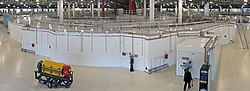

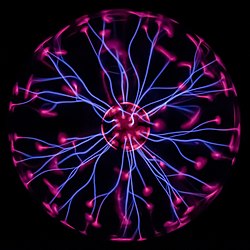
 Toroid magnets of the ATLAS detector, by Maximilien Brice, CERN (edited by Bammesk) (from Wikipedia:Featured pictures/Sciences/Others)
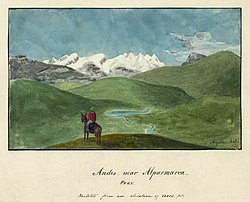 Peruvian Andes at United States Exploring Expedition, by Alfred Thomas Agate (edited by Durova) (from Wikipedia:Featured pictures/Sciences/Others)
 Simulation of liquids with different viscosities, by Synapticrelay (from Wikipedia:Featured pictures/Sciences/Others)
 Vibrating glass beam at Euler–Bernoulli beam theory, by Ben pcc (from Wikipedia:Featured pictures/Sciences/Others)
 Nobel Prize in Physics diploma, by Sofia Gisberg (restored by Jebulon) (from Wikipedia:Featured pictures/Sciences/Others)

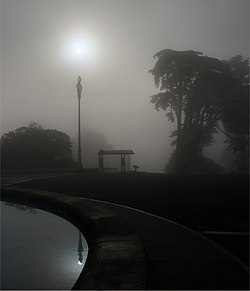 Parallax, by Mila Zinkova (edited by Richard Bartz) (from Wikipedia:Featured pictures/Sciences/Others)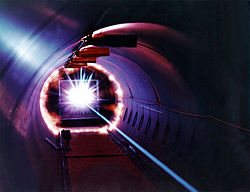

 Translational motion at Thermodynamic temperature, by Greg L (from Wikipedia:Featured pictures/Sciences/Others)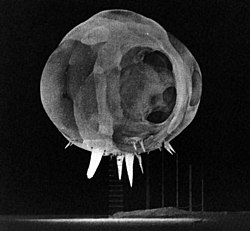
 Global oceanic and terrestrial photoautotroph abundance at Primary production, by SeaWiFS Project (from Wikipedia:Featured pictures/Sciences/Others)
 Projectile motion of a bouncing ball at Inelastic collision, by MichaelMaggs (from Wikipedia:Featured pictures/Sciences/Others)
 Archaeologists prospecting Santa Ana Cave at Excavation (archaeology), by Mario modesto (from Wikipedia:Featured pictures/Sciences/Others)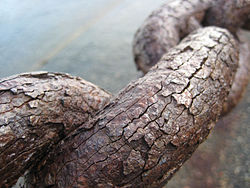
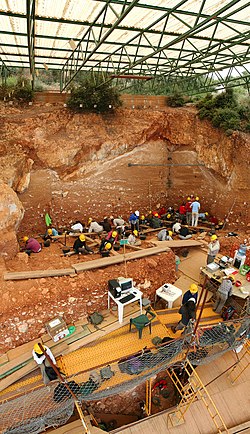 Archaeological excavation at Atapuerca Mountains, by Mario modesto (from Wikipedia:Featured pictures/Sciences/Others)
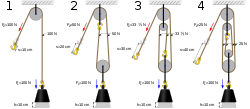 Mechanical advantage device, by Prolineserver (edited by Tomia, Ss181292 and Atropos235) (from Wikipedia:Featured pictures/Sciences/Others)


.png)


.jpg)


_-_Climate_Lab_Book_(Ed_Hawkins).png)


 Vital articles to understand Science.




.svg)
.svg)


_-_WGA08164.jpg)


