Geography (from Ancient Greekγεωγραφίαgeōgraphía; combining gê 'Earth' and gráphō 'write', literally 'Earth writing') is the study of the lands, features, inhabitants, and phenomena of Earth. Geography is an all-encompassing discipline that seeks an understanding of Earth and its human and natural complexities—not merely where objects are, but also how they have changed and come to be. While geography is specific to Earth, many concepts can be applied more broadly to other celestial bodies in the field of planetary science. Geography has been called "a bridge between natural science and social science disciplines."
The history of geography as a discipline spans cultures and millennia, being independently developed by multiple groups, and cross-pollinated by trade between these groups. Geography as a discipline dates back to the earliest attempts to understand the world spatially, with the earliest example of an attempted world map dating to the 9th century BCE in ancient Babylon. Origins of many of the concepts in geography can be traced to Greek Eratosthenes of Cyrene, who may have coined the term "geographia" (c. 276 BC – c. 195/194 BC). The first recorded use of the word γεωγραφία was as the title of a book by Greek scholar Claudius Ptolemy (100 – 170 AD). During the Middle Ages, geography was influenced by Islamic scholars, like Muhammad al-Idrisi, producing detailed maps of the world. The Age of Discovery was influential in the development of geography, as European explorers mapped the New World. Modern developments include the development of geomatics and geographic information science.
The core concepts of geography consistent between all approaches are a focus on space, place, time, and scale. Today, geography is an extremely broad discipline with multiple approaches and modalities. The main branches of geography are physical geography, human geography, and technical geography. Physical geography focuses on the natural environment, human geography focuses on how humans interact with the Earth, and technical geography focuses on the development of tools for understanding geography. Techniques employed can generally be broken down into quantitative and qualitative approaches, with many studies taking mixed-methods approaches. Common techniques include cartography, remote sensing, interviews, and surveying. (Full article...)
Featured articles are displayed here, which represent some of the best content on English Wikipedia.
Image 1
Lithograph of Weissenburg in 1902
SMS Weissenburg was one of the first ocean-going battleships of the Imperial German Navy. She was the third pre-dreadnought of the Brandenburg class, which also included her sister ships Brandenburg, Wörth, and Kurfürst Friedrich Wilhelm. Weissenburg was laid down in 1890 in the AG Vulcan dockyard in Stettin, launched in 1891, and completed in 1894. The Brandenburg-class battleships were unique for their era in that they carried six large-caliber guns in three twin turrets, as opposed to four guns in two turrets, as was the standard in other navies. Weissenburg served with I Division during the first decade of her service with the fleet. This period was generally limited to training exercises and goodwill visits to foreign ports. These training maneuvers were nevertheless very important to developing German naval tactical doctrine in the two decades before World War I, especially under the direction of Alfred von Tirpitz. Weissenburg, along with her three sisters, saw only one major overseas deployment during this period, to China in 1900–1901, during the Boxer Uprising. The ship underwent a major modernization in 1904–1905. (Full article...)
The conflict has been viewed as a continuation of the First Silesian War, which had concluded only two years before. After the Treaty of Berlin ended hostilities between Austria and Prussia in 1742, the Habsburg monarchy's fortunes improved greatly in the continuing War of the Austrian Succession. As Austria expanded its alliances with the 1743 Treaty of Worms, Prussia entered a renewed alliance with Austria's enemies in the League of Frankfurt and rejoined the war, hoping to prevent a resurgent Austria from taking back Silesia. (Full article...)
Image 3
A B-52G, similar to the one that crashed at Thule Air Base
The United States and Denmark launched an intensive clean-up and recovery operation, but the secondary stage of one of the nuclear weapons could not be accounted for after the operation was completed. USAF Strategic Air Command "Chrome Dome" operations were discontinued immediately after the accident, which highlighted the safety and political risks of the missions. Safety procedures were reviewed, and more stable explosives were developed for use in nuclear weapons. (Full article...)
Following Austria-Hungary's defeat in 1918, she was allocated to the Navy of the Kingdom of Serbs, Croats and Slovenes, which later became the Royal Yugoslav Navy, and was renamed T3. At the time, she and the seven other 250t-class boats were the only modern sea-going vessels of the fledgling maritime force. During the interwar period, T3 and the rest of the navy were involved in training exercises and cruises to friendly ports, but activity was limited by reduced naval budgets. The ship was captured by the Italians during the Axisinvasion of Yugoslavia in April 1941. After her main armament was modernised and her crew increased to 62, she served with the Royal Italian Navy under her Yugoslav designation, although she was only used for coastal and second-line tasks. Following the Italian capitulation in September 1943, she was captured by Germany and, after being fitted with additional anti-aircraft guns, served with the German Navy or the Navy of the Independent State of Croatia as TA48. In German/Croatian service her crew of 52 consisted entirely of Croatian officers and enlisted men. She was sunk by Allied aircraft in February 1945 while in the port of Trieste, where she had been built. (Full article...)
Image 5
A map of the position of the former shorelines of Lake Estancia
Lake Estancia was a lake formed in the Estancia Valley, central New Mexico, which left various coastal landforms in the valley. The lake was mostly fed by creek and groundwater from the Manzano Mountains, and fluctuated between freshwater stages and saltier stages. The lake had a diverse fauna, including cutthroat trout; they may have reached it during a possible past stage where it was overflowing.
Lake Estancia appears to have formed between the Pliocene and Pleistocene, when a previous river system broke up. It reached a maximum water level ("highstand") presumably during the Illinoian glaciation and subsequently fluctuated between fuller stages and a desiccated basin. Around the Last Glacial Maximum (LGM) time interval, several highstands and a low water level state occurred during the "Big Dry" climate interval. Between 16,100 and 14,500 years ago the lake reached its highest stand of the last 30,000 years before drying up again during the Bølling-Allerød climate interval. The lake briefly returned during the Younger Dryas climate interval and eventually desiccated during the Holocene, after about 8,500 years ago. Wind-driven erosion has excavated depressions in the former lakebed that are in part filled with playas (dry lake beds). (Full article...)
The Terra NovaExpedition, officially the British Antarctic Expedition, was an expedition to Antarctica which took place between 1910 and 1913. Led by Captain Robert Falcon Scott, the expedition had various scientific and geographical objectives. Scott wished to continue the scientific work that he had begun when leading the Discovery Expedition from 1901 to 1904, and wanted to be the first to reach the geographic South Pole.
He and four companions attained the pole on 17 January 1912, where they found that a Norwegian team led by Roald Amundsen had preceded them by 34 days. Scott's party of five died on the return journey from the pole; some of their bodies, journals, and photographs were found by a search party eight months later. The expedition, named after its supply ship, was a private venture financed by public contributions and a government grant. It had further backing from the Admiralty, which released experienced seamen to the expedition, and from the Royal Geographical Society. The expedition's team of scientists carried out a comprehensive scientific programme, while other parties explored Victoria Land and the Western Mountains. An attempted landing on and exploration of King Edward VII Land was unsuccessful. A journey to Cape Crozier in June and July 1911 was the first extended sledging journey in the depths of the Antarctic winter. (Full article...)
In his youth, Prince Frederick was more interested in music and philosophy than war, which led to clashes with his authoritarian father, Frederick William I of Prussia. However, upon ascending to the throne, he attacked and annexed the rich Austrian province of Silesia in 1742, winning military acclaim. He became an influential military theorist, whose analyses emerged from his extensive personal battlefield experience and covered issues of strategy, tactics, mobility and logistics. (Full article...)
Evidence of Stone Age, Roman and Anglo-Saxon activity has previously been discovered locally. Sale was historically a rural township in the parish of Ashton upon Mersey; its fields and meadows were used for crop and cattle farming. By the 17th century, Sale had a cottage industry manufacturing garthweb, the woven material from which horses' saddle girths were made. (Full article...)
The eruption was preceded by a series of earthquakes and steam-venting episodes caused by an injection of magma at shallow depth below the volcano that created a large bulge and a fracture system on the mountain's north slope. An earthquake at 8:32:11am PDT (UTC−7) on May 18, 1980, caused the entire weakened north face to slide away, a sector collapse which was the largest subaerial landslide in recorded history. This allowed the partly molten rock, rich in high-pressure gas and steam, to suddenly explode northward toward Spirit Lake in a hot mix of lava and pulverized older rock, overtaking the landslide. An eruption column rose 80,000 feet (24 km; 15 mi) into the atmosphere and deposited ash in eleven U.S. states and various Canadian provinces. At the same time, snow, ice, and several entire glaciers on the volcano melted, forming a series of large lahars (volcanic mudslides) that reached as far as the Columbia River, nearly 50 miles (80 km; 260,000 ft) to the southwest. Less severe outbursts continued into the next day, only to be followed by other large, but not as destructive, eruptions later that year. The thermal energy released during the eruption was equal to 26 megatons of TNT. (Full article...)
Image 10
Cannon decorate the quayside of Balfour Harbour on Shapinsay, the round tower in the background is The Douche
Shapinsay (/ˈʃæpɪnziː/, Scots: Shapinsee) is one of the Orkney Islands off the north coast of mainland Scotland. With an area of 29.5 square kilometres (11.4 sq mi), it is the eighth largest island in the Orkney archipelago. It is low-lying and, with a bedrock formed from Old Red Sandstone overlain by boulder clay, fertile, causing most of the area to be used for farming. Shapinsay has two nature reserves and is notable for its bird life. Balfour Castle, built in the Scottish Baronial style, is one of the island's most prominent features, a reminder of the Balfour family's domination of Shapinsay during the 18th and 19th centuries; the Balfours transformed life on the island by introducing new agricultural techniques. Other landmarks include a standing stone, an Iron Agebroch, a souterrain and a salt-water shower.
There is one village on the island, Balfour, from which roll-on/roll-off car ferries sail to Kirkwall on the Orkney Mainland. At the 2011 census, Shapinsay had a population of 307. The economy of the island is primarily based on agriculture with the exception of a few small businesses that are largely tourism-related. A community-owned wind turbine was constructed in 2011. The island has a primary school but, in part due to improving transport links with mainland Orkney, no longer has a secondary school. Shapinsay's long history has given rise to various folk tales. (Full article...)
Image 11
Ice core sample taken from drill An ice core is a core sample that is typically removed from an ice sheet or a high mountain glacier. Since the ice forms from the incremental buildup of annual layers of snow, lower layers are older than upper ones, and an ice core contains ice formed over a range of years. Cores are drilled with hand augers (for shallow holes) or powered drills; they can reach depths of over two miles (3.2 km), and contain ice up to 800,000 years old.
The physical properties of the ice and of material trapped in it can be used to reconstruct the climate over the age range of the core. The proportions of different oxygen and hydrogen isotopes provide information about ancient temperatures, and the air trapped in tiny bubbles can be analysed to determine the level of atmospheric gases such as carbon dioxide. Since heat flow in a large ice sheet is very slow, the borehole temperature is another indicator of temperature in the past. This data can be combined to find the climate model that best fits all the available data. (Full article...)
Image 12
The sky at Cherry Springs State Park, the second International Dark Sky Park and the first in the eastern US, is so dark that the Milky Way casts a visible shadow.
The earliest recorded inhabitants of the area were the Susquehannocks, followed by the Seneca nation, who hunted there. The first settlement within the park was a log tavern built in 1818 along a trail; the trail became a turnpike by 1834 and a hotel replaced the tavern in 1874, then burned in 1897. In the late 19th and early 20th centuries the old-growth forests were clearcut; the state forest was established in 1901 and contains second growth woodlands. "Cherry Springs Scenic Drive" was established in 1922, and the Civilian Conservation Corps built much of Cherry Springs State Park during the Great Depression, including a picnic pavilion listed on the National Register of Historic Places (NRHP). An annual "Woodsmen's Show" has been held in the park each August since 1952. (Full article...)
Image 13
Map of Lajjun Sanjak, the territory governed by the Turabay dynasty for most of the 16th and 17th centuries
During the conquest of the Levant and Egypt by the Ottoman Empire in 1516–1517, the Turabay chief Qaraja and his son Turabay aided the forces of Ottoman Sultan Selim I. The Ottomans kept them in their Mamluk-era role as guardians of the strategic Via Maris and Damascus–Jerusalem highways and rewarded them with tax farms in northern Palestine. Their territory became a sanjak in 1559 and Turabay's son Ali became its first governor. His brother Assaf was appointed in 1573, serving for ten years before being dismissed and exiled to Rhodes for involvement in a rebellion. His nephew Turabay was appointed in 1589 and remained in office until his death in 1601. His son and successor Ahmad, the most prominent chief of the dynasty, ruled Lajjun for nearly a half-century and repulsed attempts by the powerful Druze chief and Ottoman governor of Sidon-Beirut and Safed, Fakhr al-Din Ma'n, to take over Lajjun and Nablus in the 1620s. He consolidated the family's alliance with the Ridwan and Farrukh governing dynasties of Gaza and Nablus, which remained intact until the dynasties' demise toward the end of the century. (Full article...)
Image 14
Screenshot of gameplay (1977 version)
Colossal Cave Adventure (also known as Adventure or ADVENT) is a text-based adventure game, released in 1976 by developer Will Crowther for the PDP-10mainframe computer. It was expanded upon in 1977 by Don Woods. In the game, the player explores a cave system rumored to be filled with treasure and gold. The game is composed of dozens of locations, and the player moves between these locations and interacts with objects in them by typing one- or two-word commands which are interpreted by the game's natural language input system. The program acts as a narrator, describing the player's location and the results of the player's attempted actions. It is the first well-known example of interactive fiction, as well as the first well-known adventure game, for which it was also the namesake.
The original game, written in 1975 and 1976, was based on Crowther's maps and experiences caving in Mammoth Cave in Kentucky, the longest cave system in the world; further, it was intended, in part, to be accessible to non-technical players, such as his two daughters. Woods's version expanded the game in size and increased the number of fantasy elements present in it, such as a dragon and magic spells. Both versions, typically played over teleprinters connected to mainframe computers, were spread around the nascent ARPANET, the precursor to the Internet, which Crowther was involved in developing. (Full article...)
Image 15
Satellite image of Level Mountain (middle-right) and Heart Peaks (upper-left corner). This image is approximately 80 km (50 mi) east–west.
Level Mountain is a large volcanic complex in the Northern Interior of British Columbia, Canada. It is located 50 kilometres (31 miles) north-northwest of Telegraph Creek and 60 km (37 mi) west of Dease Lake on the Nahlin Plateau. With a maximum elevation of 2,164 metres (7,100 feet), it is the second-highest of four large complexes in an extensive north–south trending volcanic region. Much of the mountain is gently sloping; when measured from its base, Level Mountain is about 1,100 m (3,600 ft) tall, slightly taller than its neighbour to the northwest, Heart Peaks. The lower, broader half of Level Mountain consists of a shield-like structure whereas its upper half has a more steep, jagged profile. Its broad summit is dominated by the Level Mountain Range, a small mountain range with prominent peaks cut by deep valleys. These valleys serve as a radial drainage for several small streams that flow from the mountain. Meszah Peak is the only named peak in the Level Mountain Range.
The mountain began forming about 15 million years ago and has experienced volcanism up until geologically recent times. There have been four stages of activity throughout the long volcanic history of Level Mountain. The first stage commenced 14.9 million years ago with the eruption of voluminous lava flows; these created a large shield volcano. The second stage began 7.1 million years ago to form a structurally complicated stratovolcano located centrally atop the shield. A series of lava domes was established during the third stage, which began 4.5 million years ago. This was followed by the fourth and final stage with the eruption of lava flows and small volcanic cones in the last 2.5 million years. A wide range of rock types were produced during these stages, namely ankaramites, alkali basalts, trachybasalts, mugearites, hawaiites, phonolites, trachytes and rhyolites. Alkali basalts and ankaramites are the most voluminous and form most of Level Mountain. The remaining rock types are less extensive and are largely restricted to the central region of the volcanic complex. Several types of volcanic eruptions produced these rocks. (Full article...)
The marked territories on this global map from the United Nations are mostly of countries which are sovereign states with full international recognition (brackets denote the country of a marked territory that is not a sovereign state). Some territories are countries in their own right but are not recognized as such (e.g. Taiwan), some few marked territories are disputed about which country they belong to (e.g. Kashmir) or if they are countries in their own right (e.g. Western Sahara (territory) or the state known by the same name).
Daedongyeojido is a large scale map of Korea produced by Chosun Dynasty cartographer and geologist Kim Jeong-ho in 1861. Considered to mark the zenith of pre-modern Korean cartography, the map consists of 22 separate, foldable booklets, each covering approximately 47 kilometres (29 mi) (north-south) by 31.5 kilometres (19.6 mi) (east-west). Combined, they form a map of Korea that is 6.7 metres (22 ft) wide and 3.8 metres (12 ft) long. Daedongyeojido is praised for precise delineations of mountain ridges, waterways, and transportation routes, as well as its markings for settlements, administrative areas, and cultural sites.
A satellite image of the Sahara, the world's largest hot desert and second largest desert after Antarctica at over 9,000,000 km² (3,500,000 mi²), almost as large as the United States. The Sahara is located in Northern Africa and is 2.5 million years old.
An isothermal map of the world, based on the research of Alexander von Humboldt, a German naturalist whose work laid the foundation for the sciences of physical geography and meteorology, among other things. By delineating "isothermal lines", he simultaneously suggested the idea and devised the means of comparing the climatic conditions of various countries.
The Aitoff projection is a modified azimuthal map projection first proposed by David A. Aitoff in 1889. Based on the equatorial form of the azimuthal equidistant projection, Aitoff halved longitudes from the central meridian, projected by the azimuthal equidistant, and then stretched the result horizontally into a 2:1 ellipse.
This picture is a panoramic map of North Cascades National Park, as viewed from the east, created in 1987 by Austrian painter and cartographer Heinrich C. Berann for the National Park Service.
Map: Strebe, using the Geocart map projection software
A two-point equidistant projection of Eurasia. All distances of other points from the two points marked in red (45°N 40°E and 30°N 110°E) are correct. This map is a derivative of NASA's Blue Marble summer month composite, with oceans lightened to enhance legibility and contrast.
Caspar David Friedrich (German:[ˌkaspaʁˌdaːvɪtˈfʁiːdʁɪç]ⓘ; 5 September 1774 – 7 May 1840) was a German Romanticlandscape painter, generally considered the most important German artist of his generation, whose often symbolic, and anti-classical work, conveys a subjective, emotional response to the natural world. Friedrich's paintings often set contemplative human figures silhouetted against night skies, morning mists, barren trees or Gothic ruins. Art historian Christopher John Murray described their presence, in diminished perspective, amid expansive landscapes, as reducing the figures to a scale that directs "the viewer's gaze towards their metaphysical dimension".
Friedrich was born in the town of Greifswald on the Baltic Sea in what was at the time Swedish Pomerania. He studied in Copenhagen 1794–1798, before settling in Dresden. He came of age during a period when, across Europe, a growing disillusionment with materialistic society was giving rise to a new appreciation of spirituality. This shift was often expressed through a reevaluation of the natural world, as artists such as Friedrich, J. M. W. Turner and John Constable sought to depict nature as a "divine creation, to be set against the artifice of human civilization". (Full article...)
The United Nations uses three definitions for what constitutes a city, as not all cities in all jurisdictions are classified using the same criteria. Cities may be defined as the cities proper, their metropolitan regions, or the extent of their urban area. A complicating factor is that many large cities in the world have not only homeless or the unhoused, but also vast slum communities. This leads to official census data being less accurate in representing the actual number of residents in a given area. (Full article...)
Image 4
Cartogram of the world's population in 2018; each square represents 500,000 people.
Generation Z, often shortened to Gen Z and informally known as Zoomers, is the demographic cohort succeeding Millennials and preceding Generation Alpha. Researchers and popular media use the mid-to-late 1990s as starting birth years and the early 2010s as ending birth years, with the generation typically being defined as people born from 1997 to 2012. Most members of Generation Z are the children of Generation X, and it is predicted that many will be the parents of the proposed Generation Beta. (Full article...)



 Featured article -


.jpg)


 Vital article


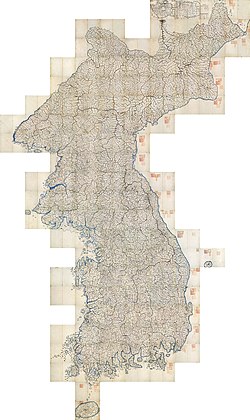 Daedongyeojido is a large scale map of Korea produced by Chosun Dynasty cartographer and geologist Kim Jeong-ho in 1861. Considered to mark the zenith of pre-modern Korean cartography, the map consists of 22 separate, foldable booklets, each covering approximately 47 kilometres (29 mi) (north-south) by 31.5 kilometres (19.6 mi) (east-west). Combined, they form a map of Korea that is 6.7 metres (22 ft) wide and 3.8 metres (12 ft) long. Daedongyeojido is praised for precise delineations of mountain ridges, waterways, and transportation routes, as well as its markings for settlements, administrative areas, and cultural sites.
 A satellite image of the Sahara, the world's largest hot desert and second largest desert after Antarctica at over 9,000,000 km² (3,500,000 mi²), almost as large as the United States. The Sahara is located in Northern Africa and is 2.5 million years old.
 Map: Strebe, using GeocartThe Hammer retroazimuthal projection is a modified azimuthal proposed by Ernst Hermann Heinrich Hammer in 1910. As a retroazimuthal projection, azimuths (directions) are correct from any point to the designated center point. In whole-world presentation, the back and front hemispheres overlap, making the projection a surjective function. Here, the frontside and backside hemispheres, both with a 15° graticule and center point of 45°N, 90°W, are presented side-by-side.
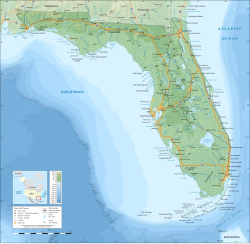 A map showing the geography of Florida, a state in the United States. Situated on a peninsula between the Gulf of Mexico, the Atlantic Ocean, and the Straits of Florida, Florida has an extensive coastline. Its highest point, Britton Hill, is the lowest highpoint of any U.S. state. Florida is home to over 19 million people, living in 410 municipalities.
 Map: William C. Woodbridge; Restoration: Jujutacular and Lise BroerAn isothermal map of the world, based on the research of Alexander von Humboldt, a German naturalist whose work laid the foundation for the sciences of physical geography and meteorology, among other things. By delineating "isothermal lines", he simultaneously suggested the idea and devised the means of comparing the climatic conditions of various countries.
 Map: Strebe, using GeocartThe Aitoff projection is a modified azimuthal map projection first proposed by David A. Aitoff in 1889. Based on the equatorial form of the azimuthal equidistant projection, Aitoff halved longitudes from the central meridian, projected by the azimuthal equidistant, and then stretched the result horizontally into a 2:1 ellipse.
 Map credit: Heinrich C. BerannNorth Cascades National Park is an American national park in the state of Washington. At more than 500,000 acres (200,000 ha), North Cascades National Park is the largest of the three National Park Service units that comprise the North Cascades National Park Complex. North Cascades National Park consists of a northern and southern section, bisected by the Skagit River that flows through Ross Lake National Recreation Area. Lake Chelan National Recreation Area lies on the southern border of the south unit of the park. In addition to the two national recreation areas, other protected lands including several national forests and wilderness areas, as well as Canadian provincial parks in British Columbia, nearly surround the park. North Cascades National Park features the rugged mountain peaks of the North Cascades Range, the most expansive glacial system in the contiguous United States, the headwaters of numerous waterways, and vast forests with the highest degree of flora biodiversity of any American national park.
 Map: Strebe, using GeocartThe Albers projection is a conic, equal area map projection, named after Heinrich C. Albers, that uses two standard parallels. Although scale and shape are not preserved, distortion is minimal between the standard parallels. This map is used by such agencies as the United States Geological Survey, the United States Census Bureau, and the governments of British Columbia and Yukon.
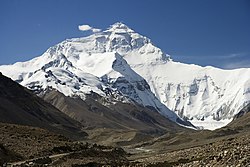 Photo credit: Luca GaluzziThe north face of Mount Everest, as seen from Tibet. Everest is the highest mountain on Earth, as measured by the height of its summit above sea level, which is 8,848 metres (29,029 ft). In 1865, Everest was given its official English name by the Royal Geographical Society upon recommendation of Andrew Waugh, the British Surveyor General of India at the time.
 A map of the Olmec heartland, the southern portion of Mexico's Gulf Coast region between the Tuxtla mountains and the Olmec archaeological site of La Venta. It is considered the heartland of the Olmec culture, which was widespread over Mesoamerica from 1400 BCE until roughly 400 BCE.
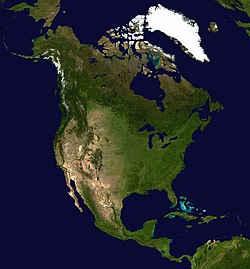 Photo: NASAA composite satellite image of the continent of North America in orthographic projection. North America occupies the northern portion of the landmass generally known as the Americas, with its southern border at the Darién watershed along the Colombia–Panama border. The vast majority of North America rests on the North American Plate, while small parts of California and western Mexico rest on the Pacific Plate; Central America and the Caribbean islands rest on the Caribbean Plate.
 Map: Strebe, using GeocartThe Littrow projection, created by Joseph Johann Littrow in 1838, is a conformal retroazimuthal map projection. It allows direct measurement of the azimuth from any point on the map to the center.
 Map: Strebe, using GeocartA gnomonic projection of a portion of the Northern Hemisphere, centered on the geographic North Pole. Such projections display all great circles as straight lines, resulting in any line segment on a gnomonic map showing the shortest route between the segment's two endpoints.
 A composite relief satellite image of South America, the fourth-largest continent. South America occupies the southern portion of the landmass in the Western Hemisphere. The continent is generally delimited on the northwest by the Darién watershed along the Colombia–Panama border. Almost all of mainland South America sits on the South American Plate, as do nearby outlying islands.
 Map: Strebe, using the Geocart map projection softwareA two-point equidistant projection of Eurasia. All distances of other points from the two points marked in red (45°N 40°E and 30°N 110°E) are correct. This map is a derivative of NASA's Blue Marble summer month composite, with oceans lightened to enhance legibility and contrast.




.svg)
.svg)
.jpeg)


 Categories
 Commons
 Wikibooks
 Wikidata
 Wikinews
 Wikiquote
 Wikisource
 Wikiversity
 Wikivoyage
 Wiktionary


