

The Computer Programming Portal

Computer programming or coding is the composition of sequences of instructions, called programs, that computers can follow to perform tasks. It involves designing and implementing algorithms, step-by-step specifications of procedures, by writing code in one or more programming languages. Programmers typically use high-level programming languages that are more easily intelligible to humans than machine code, which is directly executed by the central processing unit. Proficient programming usually requires expertise in several different subjects, including knowledge of the application domain, details of programming languages and generic code libraries, specialized algorithms, and formal logic.
Auxiliary tasks accompanying and related to programming include analyzing requirements, testing, debugging (investigating and fixing problems), implementation of build systems, and management of derived artifacts, such as programs' machine code. While these are sometimes considered programming, often the term software development is used for this larger overall process – with the terms programming, implementation, and coding reserved for the writing and editing of code per se. Sometimes software development is known as software engineering, especially when it employs formal methods or follows an engineering design process. (Full article...)
Selected articles -
-
 In computing, a compiler is software that translates computer code written in one programming language (the source language) into another language (the target language). The name "compiler" is primarily used for programs that translate source code from a high-level programming language to a low-level programming language (e.g. assembly language, object code, or machine code) to create an executable program.
There are many different types of compilers which produce output in different useful forms. A cross-compiler produces code for a different CPU or operating system than the one on which the cross-compiler itself runs. A bootstrap compiler is often a temporary compiler, used for compiling a more permanent or better optimized compiler for a language.
Related software include decompilers, programs that translate from low-level languages to higher level ones; programs that translate between high-level languages, usually called source-to-source compilers or transpilers; language rewriters, usually programs that translate the form of expressions without a change of language; and compiler-compilers, compilers that produce compilers (or parts of them), often in a generic and reusable way so as to be able to produce many differing compilers. (Full article...) -

A 12-row/80-column IBM punched card from the mid-twentieth century
A punched card (also punch card) is a stiff paper-based medium used to store digital information via the presence or absence of holes in predefined positions. Developed over the 18th to 20th centuries, punched cards were widely used for data processing, the control of automated machines, and computing. Early applications included controlling weaving looms and recording census data.
Punched cards were widely used in the 20th century, where unit record machines, organized into data processing systems, used punched cards for data input, data output, and data storage. The IBM 12-row/80-column punched card format came to dominate the industry. Many early digital computers used punched cards as the primary medium for input of both computer programs and data. Punched cards were used for decades before being replaced by magnetic tape data storage. While punched cards are now obsolete as a storage medium, as of 2012, some voting machines still used punched cards to record votes.
Punched cards had a significant cultural impact in the 20th century. Their legacy persists in modern computing, influencing the 80-character line standard still present in some command-line interfaces and programming environments. (Full article...) -
Java is a high-level, general-purpose, memory-safe, object-oriented programming language. It is intended to let programmers write once, run anywhere (WORA), meaning that compiled Java code can run on all platforms that support Java without the need to recompile. Java applications are typically compiled to bytecode that can run on any Java virtual machine (JVM) regardless of the underlying computer architecture. The syntax of Java is similar to C and C++, but has fewer low-level facilities than either of them. The Java runtime provides dynamic capabilities (such as reflection and runtime code modification) that are typically not available in traditional compiled languages.
Java gained popularity shortly after its release, and has been a popular programming language since then. Java was the third most popular programming language in 2022[update] according to GitHub. Although still widely popular, there has been a gradual decline in use of Java in recent years with other languages using JVM gaining popularity.
Java was designed by James Gosling at Sun Microsystems. It was released in May 1995 as a core component of Sun's Java platform. The original and reference implementation Java compilers, virtual machines, and class libraries were released by Sun under proprietary licenses. As of May 2007, in compliance with the specifications of the Java Community Process, Sun had relicensed most of its Java technologies under the GPL-2.0-only license. Oracle, which bought Sun in 2010, offers its own HotSpot Java Virtual Machine. However, the official reference implementation is the OpenJDK JVM, which is open-source software used by most developers and is the default JVM for almost all Linux distributions. (Full article...) -

The source code for a computer program in C. The gray lines are comments that explain the program to humans. When compiled and run, it will give the output "Hello, world!".
A programming language is an artificial language for expressing computer programs.
Programming languages typically allow software to be written in a human readable manner.
Execution of a program requires an implementation. There are two main approaches for implementing a programming language – compilation, where programs are compiled ahead-of-time to machine code, and interpretation, where programs are directly executed. In addition to these two extremes, some implementations use hybrid approaches such as just-in-time compilation and bytecode interpreters. (Full article...) -
MATLAB (Matrix Laboratory) is a proprietary multi-paradigm programming language and numeric computing environment developed by MathWorks. MATLAB allows matrix manipulations, plotting of functions and data, implementation of algorithms, creation of user interfaces, and interfacing with programs written in other languages.
Although MATLAB is intended primarily for numeric computing, an optional toolbox uses the MuPAD symbolic engine allowing access to symbolic computing abilities. An additional package, Simulink, adds graphical multi-domain simulation and model-based design for dynamic and embedded systems.
As of 2020[update], MATLAB has more than four million users worldwide. They come from various backgrounds of engineering, science, and economics. As of 2017[update], more than 5000 global colleges and universities use MATLAB to support instruction and research. (Full article...) -

A Blender screenshot displaying Suzanne, a 3D test model
Computer graphics deals with generating images and art with the aid of computers. Computer graphics is a core technology in digital photography, film, video games, digital art, cell phone and computer displays, and many specialized applications. A great deal of specialized hardware and software has been developed, with the displays of most devices being driven by computer graphics hardware. It is a vast and recently developed area of computer science. The phrase was coined in 1960 by computer graphics researchers Verne Hudson and William Fetter of Boeing. It is often abbreviated as CG, or typically in the context of film as computer generated imagery (CGI). The non-artistic aspects of computer graphics are the subject of computer science research.
Computer graphics is responsible for displaying art and image data effectively and meaningfully to the consumer. It is also used for processing image data received from the physical world, such as photo and video content. Computer graphics development has had a significant impact on many types of media and has revolutionized animation, movies, advertising, and video games in general. (Full article...) -
In computer systems a loader is the part of an operating system that is responsible for loading programs and libraries. It is one of the essential stages in the process of starting a program, as it places programs into memory and prepares them for execution. Loading a program involves either memory-mapping or copying the contents of the executable file containing the program instructions into memory, and then carrying out other required preparatory tasks to prepare the executable for running. Once loading is complete, the operating system starts the program by passing control to the loaded program code.
All operating systems that support program loading have loaders, apart from highly specialized computer systems that only have a fixed set of specialized programs. Embedded systems typically do not have loaders, and instead, the code executes directly from ROM or similar. In order to load the operating system itself, as part of booting, a specialized boot loader is used. In many operating systems, the loader resides permanently in memory, though some operating systems that support virtual memory may allow the loader to be located in a region of memory that is pageable.
In the case of operating systems that support virtual memory, the loader may not actually copy the contents of executable files into memory, but rather may simply declare to the virtual memory subsystem that there is a mapping between a region of memory allocated to contain the running program's code and the contents of the associated executable file. (See memory-mapped file.) The virtual memory subsystem is then made aware that pages with that region of memory need to be filled on demand if and when program execution actually hits those areas of unfilled memory. This may mean parts of a program's code are not actually copied into memory until they are actually used, and unused code may never be loaded into memory at all. (Full article...) -
Laboratory Virtual Instrument Engineering Workbench (LabVIEW) is a graphical system design and development platform produced and distributed by National Instruments, based on a programming environment that uses a visual programming language. It is widely used for data acquisition, instrument control, and industrial automation. It provides tools for designing and deploying complex test and measurement systems.
The visual (aka graphical) programming language is called "G" (not to be confused with G-code). It is a dataflow language originally developed by National Instruments. LabVIEW is supported on a variety of operating systems (OSs), including macOS and other versions of Unix and Linux, as well as Microsoft Windows.
The latest versions of LabVIEW are LabVIEW 2024 Q3 (released in July 2024) and LabVIEW NXG 5.1 (released in January 2021). National Instruments released the free for non-commercial use LabVIEW and LabVIEW NXG Community editions on April 28, 2020. (Full article...) -
Computer programming or coding is the composition of sequences of instructions, called programs, that computers can follow to perform tasks. It involves designing and implementing algorithms, step-by-step specifications of procedures, by writing code in one or more programming languages. Programmers typically use high-level programming languages that are more easily intelligible to humans than machine code, which is directly executed by the central processing unit. Proficient programming usually requires expertise in several different subjects, including knowledge of the application domain, details of programming languages and generic code libraries, specialized algorithms, and formal logic.
Auxiliary tasks accompanying and related to programming include analyzing requirements, testing, debugging (investigating and fixing problems), implementation of build systems, and management of derived artifacts, such as programs' machine code. While these are sometimes considered programming, often the term software development is used for this larger overall process – with the terms programming, implementation, and coding reserved for the writing and editing of code per se. Sometimes software development is known as software engineering, especially when it employs formal methods or follows an engineering design process. (Full article...) -
In C++ computer programming, allocators are a component of the C++ Standard Library. The standard library provides several data structures, such as list and set, commonly referred to as containers. A common trait among these containers is their ability to change size during the execution of the program. To achieve this, some form of dynamic memory allocation is usually required. Allocators handle all the requests for allocation and deallocation of memory for a given container. The C++ Standard Library provides general-purpose allocators that are used by default; however, custom allocators may also be supplied by the programmer.
Allocators were invented by Alexander Stepanov as part of the Standard Template Library (STL). They were originally intended as a means to make the library more flexible and independent of the underlying memory model, allowing programmers to utilize custom pointer and reference types with the library. However, in the process of adopting STL into the C++ standard, the C++ standardization committee realized that a complete abstraction of the memory model would incur unacceptable performance penalties. To remedy this, the requirements of allocators were made more restrictive. As a result, the level of customization provided by allocators is more limited than was originally envisioned by Stepanov.
Nevertheless, there are many scenarios where customized allocators are desirable. Some of the most common reasons for writing custom allocators include improving performance of allocations by using memory pools, and encapsulating access to different types of memory, like shared memory or garbage-collected memory. In particular, programs with many frequent allocations of small amounts of memory may benefit greatly from specialized allocators, both in terms of running time and memory footprint. (Full article...) -

D, also known as dlang, is a multi-paradigm system programming language created by Walter Bright at Digital Mars and released in 2001. Andrei Alexandrescu joined the design and development effort in 2007. Though it originated as a re-engineering of C++, D is now a very different language. As it has developed, it has drawn inspiration from other high-level programming languages. Notably, it has been influenced by Java, Python, Ruby, C#, and Eiffel.
The D language reference describes it as follows: (Full article...) -
Programming languages are used for controlling the behavior of a machine (often a computer). Like natural languages, programming languages follow rules for syntax and semantics.
There are thousands of programming languages and new ones are created every year. Few languages ever become sufficiently popular that they are used by more than a few people, but professional programmers may use dozens of languages in a career.
Most programming languages are not standardized by an international (or national) standard, even widely used ones, such as Perl or Standard ML (despite the name). Notable standardized programming languages include ALGOL, C, C++, JavaScript (under the name ECMAScript), Smalltalk, Prolog, Common Lisp, Scheme (IEEE standard), ISLISP, Ada, Fortran, COBOL, SQL, and XQuery. (Full article...) -
Rust is a general-purpose programming language. It is noted for its emphasis on performance, type safety, concurrency, and memory safety.
Rust supports multiple programming paradigms. It was influenced by ideas from functional programming, including immutability, higher-order functions, algebraic data types, and pattern matching. It also supports object-oriented programming via structs, enums, traits, and methods. Rust is noted for enforcing memory safety (i.e., that all references point to valid memory) without a conventional garbage collector; instead, memory safety errors and data races are prevented by the "borrow checker", which tracks the object lifetime of references at compile time.
Software developer Graydon Hoare created Rust in 2006 while working at Mozilla, which officially sponsored the project in 2009. The first stable release, Rust 1.0, was published in May 2015. Following a layoff of Mozilla employees in August 2020, four other companies joined Mozilla in sponsoring Rust through the creation of the Rust Foundation in February 2021. (Full article...) -

PDP-11 CPU board
Computer hardware includes the physical parts of a computer, such as the central processing unit (CPU), random-access memory (RAM), motherboard, computer data storage, graphics card, sound card, and computer case. It includes external devices such as a monitor, mouse, keyboard, and speakers.
By contrast, software is a set of written instructions that can be stored and run by hardware. Hardware derived its name from the fact it is hard or rigid with respect to changes, whereas software is soft because it is easy to change.
Hardware is typically directed by the software to execute any command or instruction. A combination of hardware and software forms a usable computing system, although other systems exist with only hardware. (Full article...) -
Paul Gardner Allen (January 21, 1953 – October 15, 2018) was an American businessman, computer programmer and investor. He co-founded Microsoft Corporation with his childhood friend Bill Gates in 1975, which was followed by the microcomputer revolution of the 1970s and 1980s. He was also known for discovering the wrecks of various famous warships, like the IJN Musashi and USS Indianapolis. Allen was ranked as one of the richest people in American history by Forbes with an estimated net worth of $20.3 billion at the time of his death in October 2018.
Allen quit from day-to-day work at Microsoft in early 1983 after a Hodgkin lymphoma diagnosis, remaining on its board as vice-chairman. He and his sister, Jody Allen, founded Vulcan Inc. in 1986, a privately held company that managed his business and philanthropic efforts. At the time of his death, he had a multi-billion dollar investment portfolio, including technology and media companies, scientific research, real estate holdings, private space flight ventures and stakes in other sectors. He owned the Seattle Seahawks of the National Football League and the Portland Trail Blazers of the National Basketball Association, and was part-owner of the Seattle Sounders FC of Major League Soccer. Under Allen's helm, the Seahawks won Super Bowl XLVIII and made it to two other Super Bowls (XL and XLIX). In 2000 he resigned from his position on Microsoft's board and assumed the post of senior strategy advisor to the company's management team.
Allen founded the Allen Institutes for Brain Science, Artificial Intelligence, and Cell Science, as well as companies like Stratolaunch Systems and Apex Learning. He gave more than $2 billion to causes such as education, wildlife and environmental conservation, the arts, healthcare and community services. In 2004, he funded the first crewed private spaceplane with SpaceShipOne. He received numerous awards and honors and was listed among the Time 100 Most Influential People in the World in 2007 and 2008. (Full article...)

.jpg)


.jpg)
Selected images
-
 This image (when viewed in full size, 1000 pixels wide) contains 1 million pixels, each of a different color.
 -
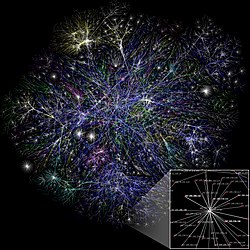 Partial map of the Internet based on the January 15, 2005 data found on opte.org. Each line is drawn between two nodes, representing two IP addresses. The length of the lines are indicative of the delay between those two nodes. This graph represents less than 30% of the Class C networks reachable by the data collection program in early 2005.
 -
 Animation of a Non-uniform rational B-spline surface. Modeled and rendered in Cobalt.
 -
 A head crash on a modern hard disk drive
 -
 GNOME Shell, GNOME Clocks, Evince, gThumb and GNOME Files at version 3.30, in a dark theme
 -

-
 Partial view of the Mandelbrot set. Step 1 of a zoom sequence: Gap between the "head" and the "body" also called the "seahorse valley".
 -
 Output from a (linearised) shallow water equation model of water in a bathtub. The water experiences 5 splashes which generate surface gravity waves that propagate away from the splash locations and reflect off of the bathtub walls.
 -
 Grace Hopper at the UNIVAC keyboard, c. 1960. Grace Brewster Murray: American mathematician and rear admiral in the U.S. Navy who was a pioneer in developing computer technology, helping to devise UNIVAC I. the first commercial electronic computer, and naval applications for COBOL (common-business-oriented language).
 -
 Bill Gosper's Glider Gun in action
 -
 Ada Lovelace was an English mathematician and writer, chiefly known for her work on Charles Babbage's proposed mechanical general-purpose computer, the Analytical Engine. She was the first to recognize that the machine had applications beyond pure calculation, and to have published the first algorithm intended to be carried out by such a machine. As a result, she is often regarded as the first computer programmer.
 -
 A view of the GNU nano Text editor version 6.0
 -
 Margaret Hamilton standing next to the navigation software that she and her MIT team produced for the Apollo Project.
 -
 Stephen Wolfram is a British-American computer scientist, physicist, and businessman. He is known for his work in computer science, mathematics, and in theoretical physics.
 -
-
 Deep Blue was a chess-playing expert system run on a unique purpose-built IBM supercomputer. It was the first computer to win a game, and the first to win a match, against a reigning world champion under regular time controls. Photo taken at the Computer History Museum.
 -
 A lone house. An image made using Blender 3D.
 -
 An IBM Port-A-Punch punched card


_in_Dark_theme.png)


Did you know? -

- ... that the programming language Acorn System BASIC was so non-standard that one commenter suggested that using it on the BBC Micro would be a disaster?
- ... that both Thackeray and Longfellow bought paintings by Fanny Steers?
- ... that the Gale–Shapley algorithm was used to assign medical students to residencies long before its publication by Gale and Shapley?
- ... that Phil Fletcher as Hacker T. Dog caused Lauren Layfield to make the "most famous snort" in the United Kingdom in 2016?
- ... that the 2024 psychological horror game Mouthwashing utilises non-diegetic scene transitions that mimic glitches and crashes?
- ... that NATO was once targeted by a group of "gay furry hackers"?
Subcategories

WikiProjects

- There are many users interested in computer programming, join them.
Computer programming news
- 28 October 2025 – AI boom, Workplace impact of artificial intelligence
- Multinational technology and e-commerce company Amazon announces it will lay off 14,000 corporate positions as it invests more in building AI and cloud computing infrastructure. (DW) (CNBC)
Topics


Related portals


Associated Wikimedia
The following Wikimedia Foundation sister projects provide more on this subject:
-
 Commons
Free media repository -
 Wikibooks
Free textbooks and manuals -
 Wikidata
Free knowledge base -
 Wikinews
Free-content news -
 Wikiquote
Collection of quotations -
 Wikisource
Free-content library -
 Wikiversity
Free learning tools -
 Wiktionary
Dictionary and thesaurus


