

The Novels Portal

A novel is an extended work of narrative fiction usually written in prose and published as a book. The word derives from the Italian: novella for 'new', 'news', or 'short story (of something new)', itself from the Latin: novella, a singular noun use of the neuter plural of novellus, diminutive of novus, meaning 'new'. According to Margaret Doody, the novel has "a continuous and comprehensive history of about two thousand years", with its origins in the Ancient Greek and Roman novel, Medieval chivalric romance, and the tradition of the Italian Renaissance novella. The ancient romance form was revived by Romanticism, in the historical romances of Walter Scott and the Gothic novel. Some novelists, including Nathaniel Hawthorne, Herman Melville, Ann Radcliffe, and John Cowper Powys, preferred the term romance. Such romances should not be confused with the genre fiction romance novel, which focuses on romantic love. M. H. Abrams and Walter Scott have argued that a novel is a fiction narrative that displays a realistic depiction of the state of a society, like Harper Lee's To Kill a Mockingbird. The romance, on the other hand, encompasses any fictitious narrative that emphasizes marvellous or uncommon incidents. In reality, such works are nevertheless also commonly called novels, including Mary Shelley's Frankenstein and J. R. R. Tolkien's The Lord of the Rings.
The spread of printed books in China led to the appearance of the vernacular classic Chinese novels during the Ming dynasty (1368–1644), and Qing dynasty (1616–1911). An early example from Europe was Hayy ibn Yaqdhan by the Sufi writer Ibn Tufayl in Muslim Spain. Later developments occurred after the invention of the printing press. Miguel de Cervantes, author of Don Quixote (the first part of which was published in 1605), is frequently cited as the first significant European novelist of the modern era. Literary historian Ian Watt, in The Rise of the Novel (1957), argued that the modern novel was born in the early 18th century with Robinson Crusoe.
Recent technological developments have led to many novels also being published in non-print media: this includes audio books, web novels, and ebooks. Another non-traditional fiction format can be found in graphic novels. While these comic book versions of works of fiction have their origins in the 19th century, they have only become popular recently. (Full article...)
 Featured article -


Selected novel quote

- In past ages, a war, almost by definition, was something that sooner or later came to an end, usually in unmistakable victory or defeat.In the past, also, war was one of the main instruments by which human societies were kept in touch with physical reality. All rulers in all ages have tried to impose a false view of the world upon their followers, but they could not afford to encourage any illusion that tended to impair military efficiency. So long as defeat meant the loss of independence, or some other result generally held to be undesirable, the precautions against defeat had to be serious. Physical facts could not be ignored. In philosophy, or religion, or ethics, or politics, two and two might make five, but when one was designing a gun or an aeroplane they had to make four. Inefficient nations were always conquered sooner or later, and the struggle for efficiency was inimical to illusions. Moreover, to be efficient it was necessary to be able to learn from the past, which meant having a fairly accurate idea of what had happened in the past. Newspapers and history books were, of course, always coloured and biased, but falsification of the kind that is practiced today would have been impossible. War was a sure safeguard of sanity, and so far as the ruling classes were concerned it was probably the most important of all safeguards. While wars could be won or lost, no ruling class could be completely irresponsible.
Did you know...
- ...that Chinua Achebe's novel A Man of the People described a coup d'état so similar to the real circumstances of Johnson Aguiyi-Ironsi's rise to power in Nigeria that Achebe was suspected of knowing about the coup in advance?
- ...that the 1923 children's novel King Matt the First is as popular in Poland as Peter Pan is in the English-speaking world?
- ...that the Finnish novel Puhdistus (Purge) by Sofi Oksanen has won awards in Finland and France but had mixed reviews in Estonia, where the story takes place?
General images
-
 "Oh Edward! How can you?", a late-19th-century illustration from Sense and Sensibility (1811) by Jane Austen, a pioneer of the genre (from Romance novel)
 -

-
 King Kong (1932) novelization of King Kong (1933) (from Novelization)
 -
 Chaucer reciting Troilus and Criseyde: early-15th-century manuscript of the work at Corpus Christi College, Cambridge (from Novel)
 -
 One of the most influential novels on the picaresque genre was The Golden Ass by Apuleius, which he published sometime in the 2nd century AD. (ms. Vat. Lat. 2194, Vatican Library) (1345 illustration). (from Picaresque novel)
 -
 A modern chapbook (from Chapbook)
 -
 Richard Head, The English Rogue (1665) (from Novel)
 -

-
 A light novel bookstore in Macau (from Light novel)
 -
 The frontispiece of a late 18th-century chapbook edition of Voltaire's The Extraordinary Tragical Fate of Calas, depicting Jean Calas being broken on the wheel (from Chapbook)
 -
 Novelization of chapter 8 of the film series Les Vampires (1915–16) (from Novelization)
 -
 Aleksandr Solzhenitsyn, Vladivostok, 1995 (from Novel)
 -
 1719 newspaper reprint of Robinson Crusoe (from Novel)
 -
 Chapbook (c. 1800) of Jack the Giant Killer (from Chapbook)
 -
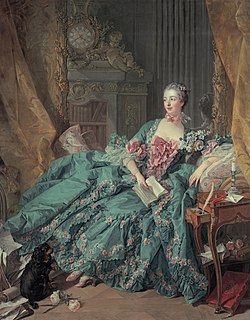
-
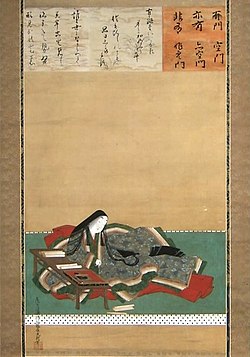 Paper as the essential carrier: Murasaki Shikibu writing her The Tale of Genji in the early 11th century, 17th-century depiction (from Novel)
 -
 Adventure novels and short stories were popular subjects for American pulp magazines. (from Adventure fiction)
 -

-
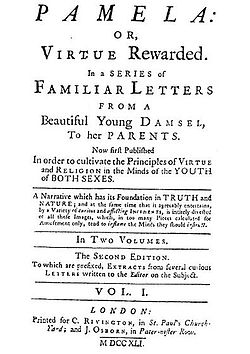
-

-

-
 Chinua Achebe, Buffalo, 2008 (from Novel)
 -
 Harlequin novels (from Romance novel)
 -
 Paranormal Novels: The Twilight Saga (from Romance novel)
 -
 A nineteenth-century painting by the Swiss-French painter Marc Gabriel Charles Gleyre depicting a scene from Longus's Daphnis and Chloe (from Romance novel)
 -
 Intimate short stories: The Court and City Vagaries (1711). (from Novel)
 -

-
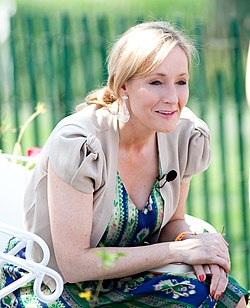 J. K. Rowling, 2010 (from Novel)
 -
 1915 novelization of the original 1904 play Peter and Wendy (from Novelization)
 -
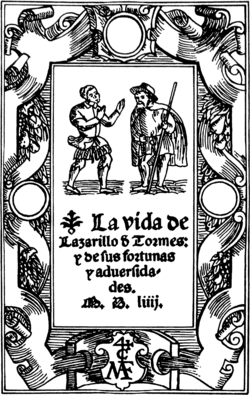 The picaresque genre began with the Spanish novel Lazarillo de Tormes (1554) (Pictured: Its title page) (from Picaresque novel)
 -
 Woodcut of a fairy-circle from a 17th-century chapbook (from Chapbook)


.jpg)


Subcategories

Featured content

 | This is a list of recognized content, updated weekly by JL-Bot (talk · contribs) (typically on Saturdays). There is no need to edit the list yourself. If an article is missing from the list, make sure it is tagged (e.g. {{WikiProject Novels}}) or categorized correctly and wait for the next update. See WP:RECOG for configuration options. |
Featured articles
 Ace Books
- All God's Children Need Traveling Shoes
- The All-Story Magazine
- A Beautiful Crime
- Big Two-Hearted River
- Boenga Roos dari Tjikembang (novel)
- The Bread-Winners
- Brother Jonathan (novel)
- Burger's Daughter
- Candide
- Casino Royale (novel)
- Chitty-Chitty-Bang-Bang
- A Christmas Carol
- Colonel Sun
- The Coral Island
- Cousin Bette
- The Day Before the Revolution
- Len Deighton
- Diamonds Are Forever (novel)
- The Diary of a Nobody
- Doc Savage (magazine)
- Dr. No (novel)
- Dracula
- Drama dari Krakatau
- Dreamsnake
- Farseer trilogy
- For Your Eyes Only (short story collection)
- The Fountainhead
- The Fox and the Hound (novel)
- From Russia, with Love (novel)
- The General in His Labyrinth
- Gods' Man
- Goldfinger (novel)
- The Good Terrorist
- The Great Gatsby
- The Green Child
- Halo: Contact Harvest
- The Halo Graphic Novel
- A Handful of Dust
- The Historian
- Hogwarts Express (Universal Orlando Resort)
- The Hunger Games (novel)
- I Know Why the Caged Bird Sings
- In Our Time (short story collection)
- Indian Camp
- Irish Thoroughbred
- Jonathan Strange & Mr Norrell
- Lad, A Dog
- The Left Hand of Darkness
- Live and Let Die (novel)
- Logan (novel)
- Louis Lambert (novel)
- The Man in the Moone
- The Man with the Golden Gun (novel)
- Mom & Me & Mom
- The Monster (novella)
- Moonraker (novel)
- Naruto
- Night (memoir)
- Octopussy and The Living Daylights
- On Her Majesty's Secret Service (novel)
- The Open Boat
- The Ordeal of Gilbert Pinfold
- Paradises Lost
- Pattern Recognition (novel)
- La Peau de chagrin
- The Penelopiad
- Père Goriot
- The Phantom Tollbooth
- The Portage to San Cristobal of A.H.
- Rachel Dyer
- Raptor Red
- Reception history of Jane Austen
- The Red Badge of Courage
- El Señor Presidente
- Seventy-Six (novel)
- The Snow Queen (Kernaghan novel)
- A Song Flung Up to Heaven
- Southern Cross (wordless novel)
- The Spy Who Loved Me (novel)
- Starship Troopers
- The Sun Also Rises
- The Temple at Thatch
- Through the Looking-Glass
- Thunderball (novel)
- The Time Traveler's Wife
- To Kill a Mockingbird
- True at First Light
- Uncle Tom's Cabin
- Vision in White
- Emma Watson
- A Wizard of Earthsea
- Wordless novel
- You Only Live Twice (novel)
- Z. Marcas

Featured lists
- Adaptations of Manon Lescaut
- List of Alien (franchise) characters
- Aurealis Award for Best Horror Novel
- Aurealis Award for Best Science Fiction Novel
- Aurealis Award for Best Fantasy Novel
- Aurealis Award for Best Young Adult Novel
- List of works by John Buchan
- List of Charmed novels and short stories
- List of works by Leslie Charteris
- Winston Churchill as a writer
- Roald Dahl bibliography
- Len Deighton bibliography
- Arthur Conan Doyle bibliography
- William Faulkner bibliography
- The Flashman Papers
- List of works by H. Rider Haggard
- List of Harry Potter cast members
- List of works by Georgette Heyer
- List of works by E. W. Hornung
- Hugo Award for Best Novel
- Hugo Award for Best Novelette
- Hugo Award for Best Novella
- Hugo Award for Best Short Story
- List of James Bond novels and short stories
- John W. Campbell Memorial Award for Best Science Fiction Novel
- List of works by W. E. Johns
- List of works by Kwee Tek Hoay
- Lambda Literary Award for Speculative Fiction
- List of awards and nominations received by J. K. Rowling
- List of works by W. Somerset Maugham
- List of works by H. C. McNeile
- Nebula Award for Best Novella
- Nebula Award for Best Novel
- Newbery Medal
- List of Nobel laureates in Literature
- List of Women's Prize for Fiction winners
- George Orwell bibliography
- List of works by Sax Rohmer
- List of works by Dorothy L. Sayers
- Theodore Sturgeon Award
- P. G. Wodehouse bibliography
- World Fantasy Award—Anthology
- World Fantasy Award—Collection
- World Fantasy Award—Novella
- World Fantasy Award—Novel
- World Fantasy Award—Short Fiction
- World Fantasy Special Award—Non-professional
Featured portals

Featured pictures
 File:Alfons Mucha - 1896 - La Dame aux Camélias - Sarah Bernhardt.jpg
- File:Archibald Standish Hartrick - Rudyard Kipling - Soldier Tales 18 - The Taking of Lungtungpen 1.jpg
- File:Archibald Standish Hartrick - Rudyard Kipling - Soldier Tales 19 - The Taking of Lungtungpen 2.jpg
- File:Hall Another World and Yet the Same 1607 Cornell CUL PJM 1009 01.jpg
- File:Jules-Joseph Lefebvre, Graziella, The Metropolitan Museum of Art.jpg
- File:N. M. Price - Sir Walter Scott - Guy Mannering - At the Kaim of Derncleugh.jpg
- File:William Hatherell - Robert Louis Stephenson - The Bottle Imp 1.jpg
- File:William Hatherell - Robert Louis Stephenson - The Bottle Imp 2.jpg

Things you can do

|
|
Related portals


WikiProjects
- Main projects

- Arts • Books • Literature • Novels • Entertainment • Visual arts
- Related Projects
- Animation • Anime and manga • Biography • Comics • Film • Fictional characters • Media franchises • Music • Television • Video games
What are WikiProjects?
Associated Wikimedia
The following Wikimedia Foundation sister projects provide more on this subject:
-
 Commons
Free media repository -
 Wikibooks
Free textbooks and manuals -
 Wikidata
Free knowledge base -
 Wikinews
Free-content news -
 Wikiquote
Collection of quotations -
 Wikisource
Free-content library -
 Wikiversity
Free learning tools -
 Wiktionary
Dictionary and thesaurus


