
Inflation rates in a global comparison
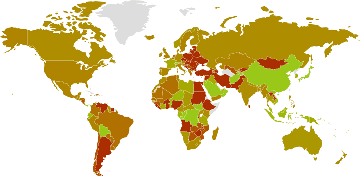
The prices of consumer goods are determined and evaluated annually in almost all countries. If prices are higher than in the previous year, this is known as inflation. If they are lower, it is deflation. This calculated inflation rate is an essential component of monetary stability.In 2025, the global inflation rate was 4.0 percent. In the European Union, it was 2.2 percent. For the United States, a year-over-year price increase of 2.7 percent was determined.
What is inflation?
Inflation refers to the rise in the general price level of goods and services. This reduces the purchasing power of money, meaning consumers can buy less for the same amount than before. Inflation is usually measured using consumer price indices.There are many causes of inflation: often it is rising production costs, strong demand coupled with limited supply, or an expansionary monetary policy. External factors such as supply bottlenecks or sharply rising energy prices can also trigger or exacerbate inflation. This leads to a chain reaction, especially in sensitive industries. If gas prices rise, not only do heating costs increase, but so do the manufacturing costs for numerous energy-intensive production processes.
For consumers, inflation is particularly noticeable in everyday life. Food, rent, energy, and services become more expensive. Although wages and pensions are adjusted for inflation over time, they rise more slowly and only after a delay, which means that real income falls. Savings also lose value.
However, inflation does not only have negative effects. To a moderate extent, it makes it easier for debtors to repay loans, as their debts also lose value in real terms. Companies sometimes benefit from rising prices, provided they can pass on costs. Very low or no inflation, on the other hand, can hamper economic development.
Inflation rates 2025 in comparison
| Country/Region | 2024 | 2025 |
|---|---|---|
| Switzerland | 0.7 % | 0.2 % |
| China | 0.0 % | 0.5 % |
| Thailand | 1.2 % | 0.6 % |
| Singapore | 1.5 % | 1.1 % |
| France | 1.7 % | 1.5 % |
| Philippines | 2.9 % | 1.5 % |
| Italy | 1.4 % | 1.5 % |
| Sweden | 1.8 % | 1.6 % |
| Cambodia | 3.1 % | 1.6 % |
| Ireland | 1.0 % | 1.6 % |
| Germany | 2.5 % | 1.8 % |
| Denmark | 1.9 % | 1.8 % |
| South Korea | 1.9 % | 1.9 % |
| Chad | 5.1 % | 1.9 % |
| Finland | 1.6 % | 2.0 % |
| Canada | 1.9 % | 2.0 % |
| Spain | 2.8 % | 2.1 % |
| Portugal | 3.1 % | 2.2 % |
| Norway | 2.2 % | 2.2 % |
| Malta | 1.8 % | 2.2 % |
| Malaysia | 1.7 % | 2.4 % |
| Netherlands | 4.0 % | 2.5 % |
| Indonesia | 1.6 % | 2.6 % |
| United States of America | 2.7 % | 2.7 % |
| Albania | 2.1 % | 2.7 % |
| Israel | 3.2 % | 2.8 % |
| New Zealand | 2.2 % | 2.8 % |
| Greece | 3.0 % | 2.8 % |
| Poland | 4.7 % | 2.8 % |
| Japan | 2.9 % | 2.8 % |
| Bosnia and Herzegovina | 2.9 % | 3.2 % |
| Australia | 2.4 % | 3.2 % |
| Pakistan | 12.6 % | 3.2 % |
| India | 3.7 % | 3.3 % |
| United Kingdom | 2.5 % | 3.4 % |
| Vietnam | 3.0 % | 3.4 % |
| Ecuador | 0.5 % | 3.6 % |
| Austria | 2.1 % | 3.6 % |
| Mexico | 4.2 % | 3.7 % |
| Hong Kong * | 0.0 % | 3.8 % |
| South Africa | 3.0 % | 4.0 % |
| Nauru | 12.3 % | 4.1 % |
| Kosovo | 1.1 % | 4.1 % |
| Serbia | 4.3 % | 4.7 % |
| Gambia | 10.2 % | 4.8 % |
| Brazil | 4.8 % | 4.9 % |
| Montenegro | 2.1 % | 5.0 % |
| Laos | 16.9 % | 5.0 % |
| Russia | 9.5 % | 7.6 % |
| Sao Tome and Principe | 11.6 % | 7.8 % |
| Kyrgyzstan | 6.3 % | 8.0 % |
| Belarus | 5.1 % | 8.1 % |
| Liberia | 10.7 % | 8.1 % |
| Mongolia | 8.3 % | 8.2 % |
| Madagascar | 8.6 % | 8.3 % |
| Bangladesh | 9.7 % | 8.5 % |
| Uzbekistan | 9.8 % | 8.5 % |
| Romania | 6.1 % | 8.5 % |
| Ukraine | 12.0 % | 9.0 % |
| Sierra Leone | 13.8 % | 9.0 % |
| Ethiopia | 17.0 % | 9.8 % |
| Suriname | 10.1 % | 10.6 % |
| Zambia | 16.8 % | 11.1 % |
| Ghana | 23.8 % | 12.0 % |
| Kazakhstan | 8.6 % | 12.7 % |
| Egypt | 27.5 % | 14.9 % |
| Angola | 27.5 % | 20.0 % |
| Nigeria | 15.4 % | 21.0 % |
| Bolivia | 10.0 % | 26.2 % |
| South Sudan | 195.5 % | 27.2 % |
| Malawi | 28.1 % | 27.7 % |
| Argentina | 117.8 % | 28.0 % |
| Burundi | 36.4 % | 29.2 % |
| Haiti | 27.9 % | 29.4 % |
| Myanmar | 28.0 % | 30.0 % |
| Zimbabwe | 686.8 % | 30.7 % |
| Yemen | 8.9 % | 31.0 % |
| Turkey | 44.4 % | 31.0 % |
| Iran | 37.1 % | 45.0 % |
| Sudan | 151.1 % | 49.0 % |
| Venezuela | 47.2 % | 548.6 % |
Price increases compared by country
Inflation is determined here on the basis of the consumer price index. In addition to this, there are other indices based on other target groups. In these indices, a typical national basket of goods is filled with everyday products and their prices are observed over a period of many years. Usually, there are several hundred types of goods in such a basket, which are occasionally exchanged depending on technical progress or changing living standards. The more a normal household spends on an item, the more it is weighted. Coffee or stamps, for example, usually have only a very small share, while the price of electricity is much more clearly included in this basket of goods.Within the European Union and the European Free Trade Association (EFTA), this calculation method is harmonized (HICP = Harmonized Index of Consumer Prices), so all member countries use the same evaluation scheme, making the inflation rate very comparable. Understandably, the weighting of the individual products must differ, since, for example, heating costs in Scandinavia account for a completely different proportion of annual expenditure than in the southern, warmer countries.
The highest inflation rate in recent years was achieved in Zimbabwe in 2023. The inflation rate there was 779 percent.
Perceived inflation
In contrast to inflation measured statistically and by government agencies, perceived inflation is always somewhat more drastic. This is mainly due to the fact that people perceive a price increase much earlier and more intensively than a price reduction. The frequency of shopping also plays a role. For example, we notice higher prices in the supermarket much more often than when we buy a television once. In addition, our brain plays a little trick on us: The published inflation figures always apply only to the past period of one year. However, the brain mixes its impressions and memories from several past years.The optimal inflation
Low inflation is actually healthy, because economic performance is also measured on the basis of the inflation rate (and other factors). If inflation were 0%, the economy would hardly grow at all. Inflation only becomes problematic when it rises sharply or uncontrollably. Depending on who you ask, the optimal inflation rate is considered to be between 0 and 4 percent.The higher the inflation rate, the greater the safety margin to the “zero interest rate limit,” which the EU already had to fall below in 2021-2022. In such a case, central banks have little chance of taking compensatory measures by lowering key interest rates. Planning security is lost, social inequality increases, and confidence in money and institutions declines.
It also facilitates real adjustments in wages and prices. Understandably, nominal wages can hardly be adjusted downward. With moderate inflation, however, real wages can fall or stagnate without the need for wage cuts. This increases the flexibility of the labor market and gives employers the necessary leeway.
Inflation also supports investment. When money loses purchasing power, saving becomes less attractive than productive investment. Companies have stronger incentives to use capital rather than build up or maintain liquidity.
From the consumer's point of view, however, it is better if the prices of everyday goods rise only very slightly.
The Federal Reserve Bank, the European Central Bank, and the Bank of Japan have been aiming for the 2% mark for years. This threshold is considered high enough to allow for economic adjustments, yet low enough to keep losses in purchasing power limited and predictable.
Historical development since 1980
Looking at the inflation trend over a longer period, the current 4.0 percent is still relatively moderate. Significant inflation rates have already occurred in the past. These were mainly in 1979/80 during the second oil crisis, in 1994 during the tequila crisis and during the banking and financial crisis started in 2007. The highest global inflation rate since the middle of the last century was 39.8% in 1993.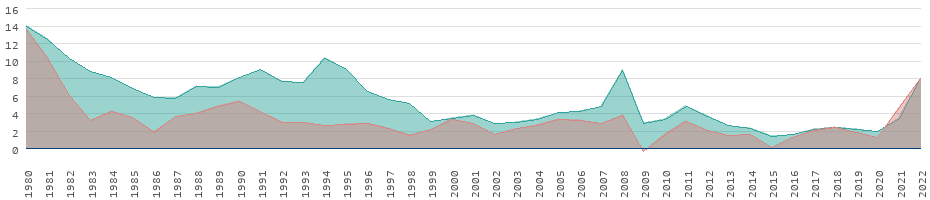
What can consumers do about inflation?
Consumers cannot prevent inflation, but they can limit its impact on their purchasing power. The key is to be mindful of how they manage their income, savings, and spending. Savings should not be held in interest-free accounts for long periods of time. However, call money and fixed-term deposits are often not enough to offset inflation. Securities investments offer better opportunities in the long term. It is important to diversify as widely as possible, as this prevents the risk of individual losses. Companies can often pass on rising costs by raising prices, thereby adjusting their nominal earnings. Stocks represent these real corporate values, whose profits and assets can grow in line with price levels. Diversification spreads capital across many industries and regions, reducing dependence on individual markets or companies.Tangible assets such as real estate or commodities are also suitable. They are more likely to retain their value when prices rise. However, the risk must also be taken into account here, as prices fluctuate and not every form of investment is suitable for every household.
Debt can also provide relief during inflation, provided it has been taken out at fixed interest rates over the long term and the interest rate is below the inflation rate. This reduces the real debt burden because the nominal amount of debt remains the same while income can rise.
Global inflation rise due to the war in Ukraine
The war in Ukraine since early 2022 has caused a noticeable rise in inflation worldwide. The war was not the sole cause, but rather a strong amplifier of already existing price increases. This example shows how regional conflicts can lead to a global rise in consumer prices in numerous segments.Immediately after the war began, Ukrainian exports collapsed. Ukraine is one of the world's most important suppliers of wheat, corn, sunflower oil, and other agricultural products. Fighting, destroyed infrastructure, mined fields, and blocked Black Sea ports led to an abrupt decline in supply. Just weeks later, retail food prices rose significantly, especially for grain products and vegetable oils.
Russia, on the other hand, is one of the world's most important exporters of crude oil, natural gas, and coal. Sanctions, supply cuts, and political uncertainty led to sharply higher energy prices, particularly in Europe. However, energy is a fundamental factor of production, and rising prices affect nearly all sectors of the economy, from industry to transportation to services, driving up the general price level.
Fertilizers also often come from Russia and have suffered from the sanctions. Delivery shortfalls have made these intermediate products much more expensive, putting many parts of the international agricultural industry under increased price pressure. As a result, the cost of agricultural products also rose worldwide. It is obvious that Europe, the Middle East, and North Africa were particularly hard hit by the consequences, as these are the main buyers of products from the warring parties. However, due to the disruption of import opportunities, the missing products now had to be purchased on the rest of the world market. This led to strong international demand and rising prices.
Energy and food prices in particular have risen massively as a result of the war. These are product categories that have an immediate and direct impact on the wallets of end consumers.
* Hong Kong is not an independent and sovereign country, but special administrative region of China. Further information on the definition of a country can be found in our article What is a country?
Data basis: International Monetary Fund, World Bank and financial statistics from the individual countries. All data in the table are from the years 2024 - 2025. Earlier years can be shown on the map display if more recent data are not yet available. These year figures are then named there.