Loading...
| Rebecca was Powhatan. Join: Native Americans Project Discuss: native_americans |

Please do not make any changes to this profile without first contacting the Native Americans Project.
Contents |
Biography


Pocahontas was a Native American woman of the Powhatan nation with an incredible amount of mythology surrounding her. Her legacy as a positive influence on early settlers of Virginia remains popular today.
Early Life
Pocahontas was born about 1596, based on her telling her portraitist in London that she was in her 21st year in 1616.[1] She may have been born in the Werowocomoco village Tsenacomoco, on the Pamunkey River (present-day Gloucester County, Virginia), but the exact location of her birth is not known. Her father was Wahunsenacawh, chief of the Powhatan.[2] [3] Her mother's name was not recorded by either John Smith or John Rolfe. [4]
Pocahontas had more than one name during her lifetime, which was common for Native Americans. She may have been given the name Amonute when she was born, [5] and she also had the name Matoaka (or Mataoaks) which she did not reveal until after her marriage and conversion to Christianity. The name by which she is best known, Pocahontas, was her childhood nickname, loosely translated as "playful one", "little wanton", or "laughing, joyous one", due to her curious nature.[4][2]
Pocahontas and John Smith
The incident Pocahontas is best known for involved the nearly as famous Captain John Smith.[2][3] The story Smith gave versus the one the Native American histories give vary somewhat.
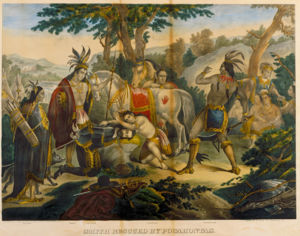
According to Smith, in the winter of 1607, when Pocahontas was only around 11 years old, John was captured by her brother. In a scene where he believed he was in danger of being executed, Pocahontas stepped forward and offered her life for his, saving him.[6][7] [8]
Some modern scholars suggest that he was not in danger, but rather was being initiated as a brother.[2][3] (A later letter of John Smith's also seems to support this, indicating a meal and interview, nothing dangerous.) It is also suggested that Pocahontas would never have been at such a ceremony, due to her age, but might have helped serve a meal in her father's home.[2][3]

|
The story has been examined for centuries, and no one knows the truth for certain, but it did procure a place for both Pocahontas and John Smith in United States' mythology and history.
Following the incident, Powhatan informed Smith that he was part of the tribe, and proceeded to trade with him. Powhatan also sent gifts to the Jamestown settlement, which was starving in the winter conditions. Pocahontas served as a symbol of peace to the colonists, and would visit Jamestown frequently, playing with the children there.[2]
Despite what transpired, relations deteriorated as the English became more demanding and less grateful. Smith claimed Pocahontas would again save his life, warning him of Powhatan's plot to kill him, which prompted him and his companions to leave. Native American history again dictates that Pocahontas, being as young as she was, wouldn't have knowledge of such a plan and certainly wouldn't have made it as far as where Smith was without someone's knowledge.[2][3]
Documented Marriage - John Rolfe
In 1613, Pocahontas was captured by English Captain Samuel Argall for ransom, with help from members of a neighboring tribe who lured her onto an English ship.[9][10] Pocahontas was taken to Jamestown, then Henrico, and began learning more of the English culture. She was converted to Christianity in 1614, baptized with the name Rebecca, and with Powhatan's blessing, married English widower and tobacco planter John Rolfe in April of that year.[3][11] Pocahontas and John Rolfe had one child, a son named Thomas, born around 1615.[2] He is Pocahontas' only known child.[12]

|
Lady Rebecca, Death & Legacy
Pocahontas, now referred to as Lady Rebecca Rolfe, accompanied her husband to England in 1616 on a public relations tour on behalf of the Virginia Company, which included meeting King James I. They took up residence in rural Brentford for a time. It was there that Pocahontas encountered John Smith once more, and confronted him on the behaviors of his company in the colonies.[2][3]
In March 1617, the Rolfes decided to return to Virginia. Shortly after they began their return voyage, Rebecca became ill and the ship she was on put in at Gravesend, Kent, England. Rebecca died on shore and was buried under the chancel of St. George's Church on 21 March 1617.[13] [14] John Rolfe returned to Virginia, while young Thomas stayed in England with family.[15]
Little else is known about Pocahontas for certain. Most that is told was written by others or passed down via oral history, and many families claim a connection to her, though far fewer than claim it can prove it.
Her son Thomas was educated in England, but later returned to Virginia and became an important settler; many prominent Virginians claim to be his descendants.[16]
- Profiles for Thomas and his descendants may display the Descendant of Pocahontas sticker, which adds them to the category used by the Descendants of Pocahontas Team (a sub project of WikiTree's Native Americans Project.
Images
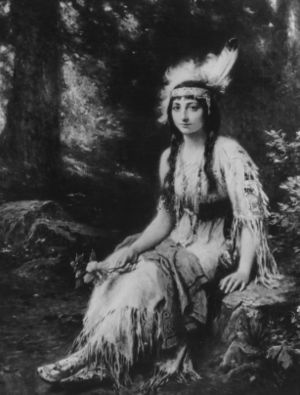
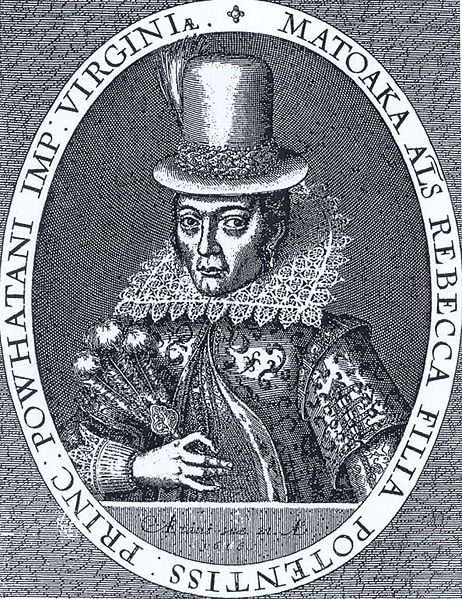
There is only one known image of Pocahontas made during her lifetime. Many romanticized portraits and images of events in her life were created around the time of the American centennial, still more at the 300th anniversary of the Jamestown settlement, and others done under the aegis of the Works Progress Administration in the 1930s. Few, if any, of these images are historically accurate. For a discussion of several images of Pocahontas, see [Browne, Allen C., The Portrait Gallery blog. 3 posts on portraits of Pocahontas: 2015 Dec 15, 2015 Dec 20, 2015 Dec 22 Allen Browne
Research Notes
Disputed Family
An Englishman, William Strachey, was in Jamestown in 1610 and lived there for about one year. Upon his return to England, he wrote a book about Jamestown, and in it is the only mention of a possible earlier, first marriage for Pocahontas. Strachey wrote that she had been married about two years to a "private captain named Kocoum".[5] There is some confusion about when Strachey wrote this work, and to what extent he had direct contact with Pocahontas. Depending on this timing, she was married as early as 1608 (when by her own report she would have been 12-13 years of age), or as late as 1614, in which case Strachey was referring to her marriage to Rolfe. An analysis of the timing and evidence (or lack thereof) through examination of documents written during that era, was published in 2006.[17]
There is no record or mention in contemporaneous records that there were children from this possible earlier union, though some 20th century authors refer to one, and nothing further was recorded about Kocoum.[2][3]
- Subsequent claims were made in the late 20th century, citing "sacred oral tradition" [18] that Kocoum and Pocahontas had a child named Ka-Okee. [19] [20] Some say Ka-Okee was a son; others say this was a daughter.
- Custalow's work has been analyzed.[21]
There are legends that Pocahontas and John Smith had a child named Peregrine Smith. No reliable evidence has been found to support this theory, which is discussed in more detail on Peregrine Smith's profile.[22]
Sources
- ↑ Engraving, Smithsonian National Portrait Gallery (NPG), "Aetatis suae 21 An 1616." meaning in the 21st year of her age. Image at NPG Blog
- ↑ 2.0 2.1 2.2 2.3 2.4 2.5 2.6 2.7 2.8 2.9 Pocahontas: Her Life and Legend, US Parks Service
- ↑ 3.0 3.1 3.2 3.3 3.4 3.5 3.6 3.7 Helen C. Rountree, "Pocahontas," in Encyclopedia Virginia, (https://www.encyclopediavirginia.org/Pocahontas_d_1617: accessed 6 September 2017).
- ↑ 4.0 4.1 Helen C. Rountree, Pocahontas, Powhatan Opechancanough, Three Indian Lives Changed by Jamestown, Charlottesville: University of Virginia Press, 2005) 35, 37-8; 176-8.
- ↑ 5.0 5.1 William Strachey, Historie of Travell into Virginia Britania (1612), eds. Louis B. Wright and Virginia Freund, Kraus Reprint Limited, Liechtenstein 1967, p. 62. (In an 1849 edition, the information will be found on p 54.) See also, p 111
- ↑ Smith John, "True Relation" (1608) , ed Deane (1866), with footnotes, [1]. Smith is taken captive, p. 25. Pocahontas visits the fort, p. 72.
- ↑ Smith, John or William Symonds. "Proceedings" (1612). Appendix to Smith (1612), Map of Virginia. In Tyler, L.G (1907), Narratives of Early Virginia, p. 119. Smith is taken captive, p. 130. Pocahontas visits the fort, p. 139.
- ↑ Smith, John, The Generall Historie of Virginia, New-England, and The Summer Isles (London, 1624). Books 3 and 4. 1907 edn, Vol. 1. (Book 3) Smith is taken captive, p. 96. Smith is saved by Pocahontas, p. 101. Pocahontas brings food, p. 103. Pocahontas saves Smith again, p. 162. (Book 4) Pocahontas kidnapped, p. 217. Pocahontas married, p. 220 (extracted from Hamor, but with no mention of conversion). Pocahontas in England, p. 235-240 (includes letter to Queen Anne). Book 4 is also in Tyler, L.G, Narratives of Early Virginia, p. 289.
- ↑ Argall, Sir Samuel Argall, Letter to Nicholas Hawes, dated June 1613, relating the kidnapping of Pocahontas. In Brown, Alexander, Genesis of the United States, Vol. 2 (1897), p. 640. Brown takes it from Purchas, iv, p. 1764, the same source cited by Robertson (1860).
- ↑ Harmor, Ralph, True Discourse (1615), ed. Harwell (1957), p. 4. Describes the capture, detention and marriage of Pocahontas, as told to the English public in 1614. Hamor was an eye-witness, or close to those who were, but he was also a Company propagandist. Includes the letters of Dale (p. 51), Whitaker (p. 59), and Rolfe (p. 61). (All other publications of these letters are derived from Hamor, as manuscripts do not exist).
- ↑ Robertson, Wyndham: "The Marriage of Pocahontas", in Southern Literary Messenger, Vol. 31, no. 2 (Aug 1860), p. 81. Explains and corrects the mistaken date of 1613 given by Stith and many other early writers. Also in Virginia Historical Reporter, Vol. 1 (1860), p. 65.
- ↑ Smithsonian Institution. Do All Indians Live in Tipis? Smithsonian Books, Washington, D.C. 2018. p75-77.
- ↑ Parish register burial entry for Rebecca Wroth [sic], 21 March 1616/7, Gravesend, Kent; citing St. George's Church; Burial Record. There is no image of the record on this site. The record lists her as the "wife" of "Thomas Wroth", seeming to confuse the name of her son with the name of her husband.
- ↑ "The Burial of Pocahontas", in Virginia Historical Register, Vol. 2, no. 4 (Oct 1849), p. 187.
- ↑ Kingsbury, Susan M (1906). Virginia Company Records, Vol. 2, p. 105. Henry Rolfe's petition touching "the Child his said Brother had by Powhatan's Daughter".
- ↑ “The Ancestors and Descendants of John Rolfe with Notices of Some Connected Families.” The Virginia Magazine of History and Biography, vol. 21, no. 1, 1913, pp. 105–106. JSTOR link (First of 10 articles over three years).
- ↑ Charles Dudley Warner, "The Story of Pocahontas," Part II (https://www.gutenberg.org/files/3129/3129-h/3129-h.htm), 22 Aug 2006
- ↑ Custalow, Linwood & Daniel, Angela.True Story of Pocahontas: The Other Side of History, 2007,
- ↑ Farris, Phoebe, "Pocahontas’ First Marriage: The Powhatan Side of the Story", Huffington Post
- ↑ Misinformation on the Pettus Family (Unsourced blog supporting the Kocoum marriage, daughter Ka-Okee and marriage to Thomas Pettus).
- ↑ Kevin Miller, "Meeting in the Middle: Myth-making in The True Story of Pocahontas: The Other Side of History," Tsurumi University Kiyo, No. 55-2, Feb. 28, 2018 (https://www.pocahontaslives.com/on-custalows-true-story.html)
- ↑ Teri Hiatt. Genealogy.com Forum. Re: John Smith and Pocahontas, July 13, 2012, reply to Larry Anderson note of the same date. (1) butleigh. org, under Butleigh People for Hiett, Smith; (2) en.wikisource.org/wiki/Bertie,_Richard_(DNB00) Info on Richard Bertie; (3) zipworld.com.au/~nbdds/home/smythwinchester.htm Info on Peregrine Bertie, John Smith, and Pocahontas; (4) rotherhamweb.co.uk/h/jhewett.htm About Dr. John Hewitt (on WayBack Machine) ; (5) Capt. John Smith Capt. John Smith; (6) [https://womenshistory.about.com/od/mythsofwomenshistory/a/pocahontas.htm Womens History About Pocahontas]; (7) [https://encyclopediavirginia.org/Smith_John_bap_1580-1631 John Smith] (Encyclopedia of Virginia);(8) God Wants You to Colonize Virginia (Blog); (9) Book "Burke's Peerage, Baronetage, and Knightage" 107th ed. 3 vol. Wilmington, Del 2003. Accessed 5 March 2020.
See also:
- Fourth and Fifth Corrections and Additions to Pocahontas' Descendants. Genealogical Publishing Com; 1 June 2009. ISBN 978-0-8063-5242-8.
- Jamestowne Society: Pocahontas / Matoaka - A6212; died March 1617 Gravesend, England; wife of John Rolfe. accessed 5 December 2020
- The Pocahontas Archive, collection of materials relating to the study of Pocahontas including Annotated Bibliography of historical mentions of Pocahontas
- Beverley, Robert, jr., The History and Present State of Virginia, 2nd edn (1722), p. 25-31.
- Boddie, John Bennett, Historical Southern Families, Vol. 9 (1957-1980), pgs 191-217 and Southside Virginia Families, Vol. 1 (2009?), pages 227-331.
- Burk, John (1804). History of Virginia, Vol. 1, p. 168.
- Hardy, Stella Pickett, "Colonial Families of the Southern States of America," 2nd edition (1958), page 71, Bolling family. Refers to Robert Bolling as the Honorable Robert Bolling.
- McCartney, Martha W. Virginia Immigrants and Adventurers, p. 563.
- Randolph, Wassell, "William Randolph I of Turkey Island, Henrico County, Virginia, and his immediate descendants," Memphis, Tenn. : Seebode Mimeo Service, 1949. Digital version (Hathi Trust)
- Robertson, Wyndham (1887), Pocahontas and her Descendants, p. 1.
- Stith, Rev. William (1747). History of the First Discovery and Settlement of Virginia, p. 136.
- Tyler, L.G , Narratives of Early Virginia, Publisher? (1907); p. 25. Smith is taken captive, p. 44. Pocahontas visits the fort, p. 69.
- Wheeler, Geraldine Hartshorn, Laying Claim to Pocahontas, Washington Post, July 9, 1995
- Wheeler, John H., "Reminiscences & Memories of North Carolina and Eminent North Carolinians," Columbus, OH: Columbus Printing Works (1884); describes Rev. William Hill, Jr.
- Wikipedia contributors, "Pocahontas," Wikipedia, The Free Encyclopedia, (accessed March 5, 2017).
- Wikitree contributors, Bolling Pocahontas Fabrication
- Wood, Karenne, Ed. The Virginia Indian Trail, 2nd ed. Charlottesville, VA: The Virginia Foundation for the Humanities (2008).