CRICOS No.00213J
Investigating the Dynamics
of Destructive Polarisation
in Public Communication
Axel Bruns with important contributions from:
Australian Laureate Fellow Laura Vodden Katharina Esau Sebastian Svegaard
Digital Media Research Centre Tariq Choucair Samantha Vilkins Kate O’Connor Farfan
Queensland University of Technology Laura Lefevre Vishnu PS Carly Lubicz-Zaorski
Brisbane, Australia Ehsan Dehghan Kateryna Kasianenko
a.bruns@qut.edu.au
Bluesky: @snurb.info | Mastodon: @snurb@aoir.social | Xitter: @snurb_dot_info
CRICOS No.00213J
CRICOS No.00213J
Filter Bubbles? Echo Chambers?
No: Polarisation – Constructive or Destructive
Practice Mapping to Detect Symptoms
Roadmap
CRICOS No.00213J
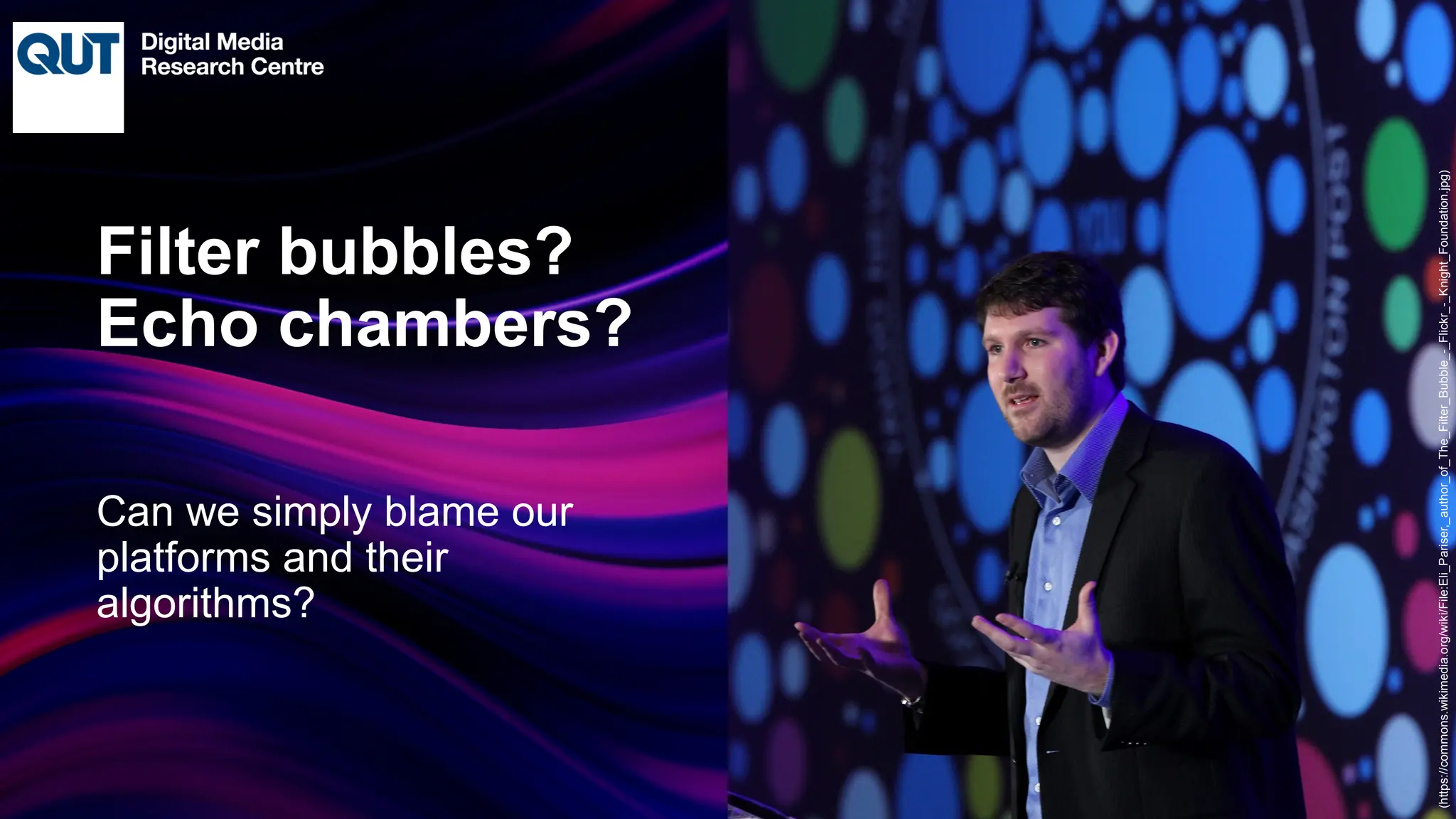
Can we simply blame our
platforms and their
algorithms?
Filter bubbles?
Echo chambers?
(https://commons.wikimedia.org/wiki/File:Eli_Pariser,_author_of_The_Filter_Bubble_-_Flickr_-_Knight_Foundation.jpg)
CRICOS No.00213J
Bubble Trouble
• Echo Chambers? Filter Bubbles?
• Where exactly?
• General search engines
• News search engines, portals, and recommender systems
• Social media (but where – profiles, pages, hashtags, groups …?)
• What exactly?
• Hermetically sealed information enclaves full of misinformation?
• Self-reinforcing ideological in-groups of hyperpartisans?
• Politically partisan communities of any kind?
• Why exactly?
• Ideological and societal polarisation amongst citizens?
• Algorithmic construction of distinct and separate publics?
• Feedback loop between the two?
• Defined how exactly?
• Argument from anecdote and ‘common sense’, rather than empirical evidence
• Promoted by non-experts (Sunstein: legal scholar; Pariser: activist and tech entrepreneur)
Image: Midjourney
CRICOS No.00213J
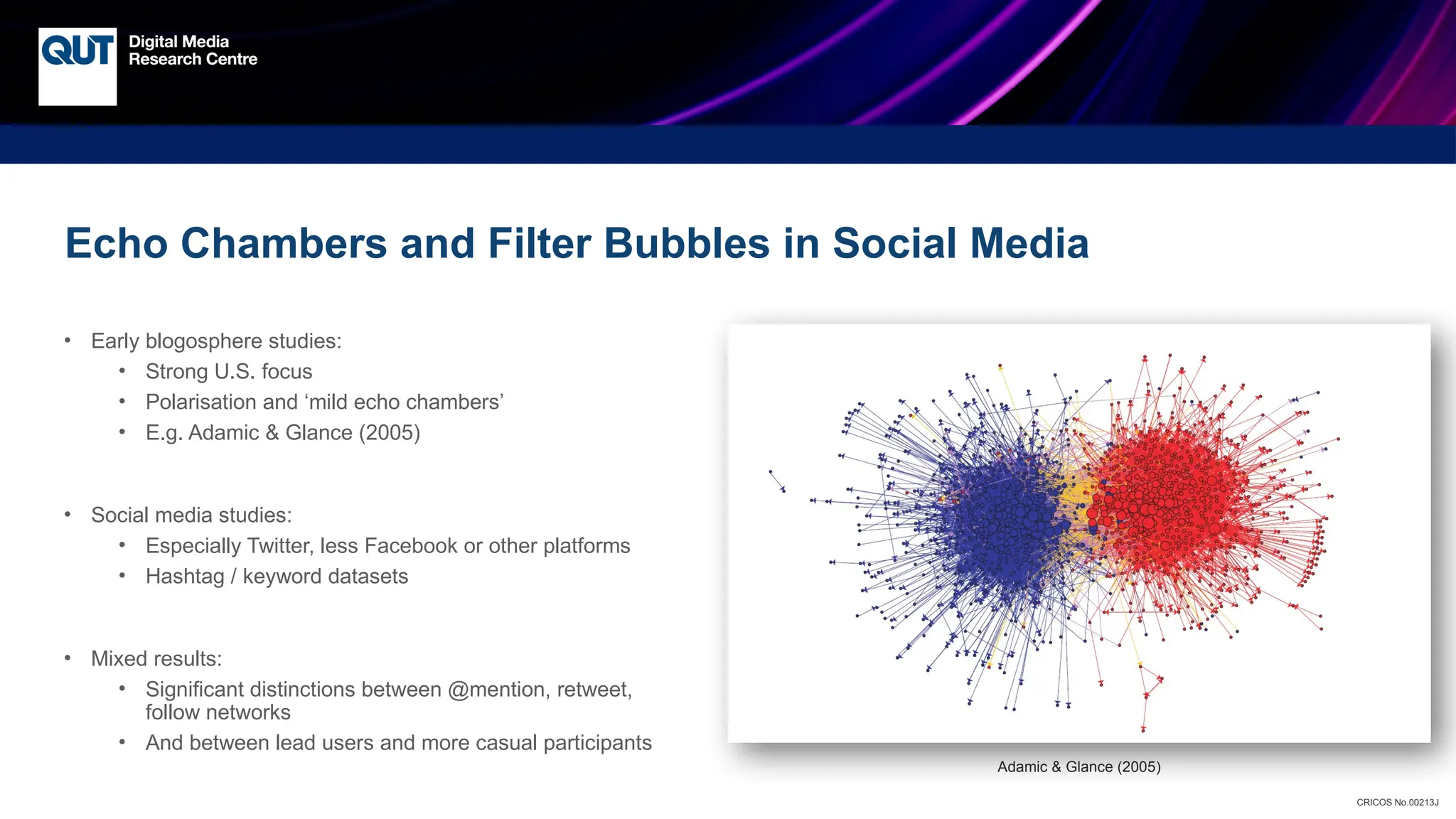
Echo Chambers and Filter Bubbles in Social Media
• Early blogosphere studies:
• Strong U.S. focus
• Polarisation and ‘mild echo chambers’
• E.g. Adamic & Glance (2005)
• Social media studies:
• Especially Twitter, less Facebook or other platforms
• Hashtag / keyword datasets
• Mixed results:
• Significant distinctions between @mention, retweet,
follow networks
• And between lead users and more casual participants
Adamic & Glance (2005)
CRICOS No.00213J
No. Just No.
• No evidence for ‘hard’ echo chambers / filter bubbles
• Success of mis- and disinformation campaigns depends on their absence
• Hyperpartisan activists actively seeking out enemies and their content
• Social media are only one part of a more diverse media mix (and themselves very diverse)
• Most people simply don’t care enough about news and politics to get locked in
• ‘Mild’ echo chambers / filter bubbles are an oxymoron
• Mild selective attachment is nothing new, and doesn’t prevent encounters with diverse views
• We already have names for this: communities of interest, counterpublics, parasitic publics
• Yes, these groups can be deeply problematic – but not because they’re echo chambers
• We must confront the underlying issues, not blame technology for societal problems
• (Yes, there are serious problems with social media platforms. No, not these ones.)
CRICOS No.00213J
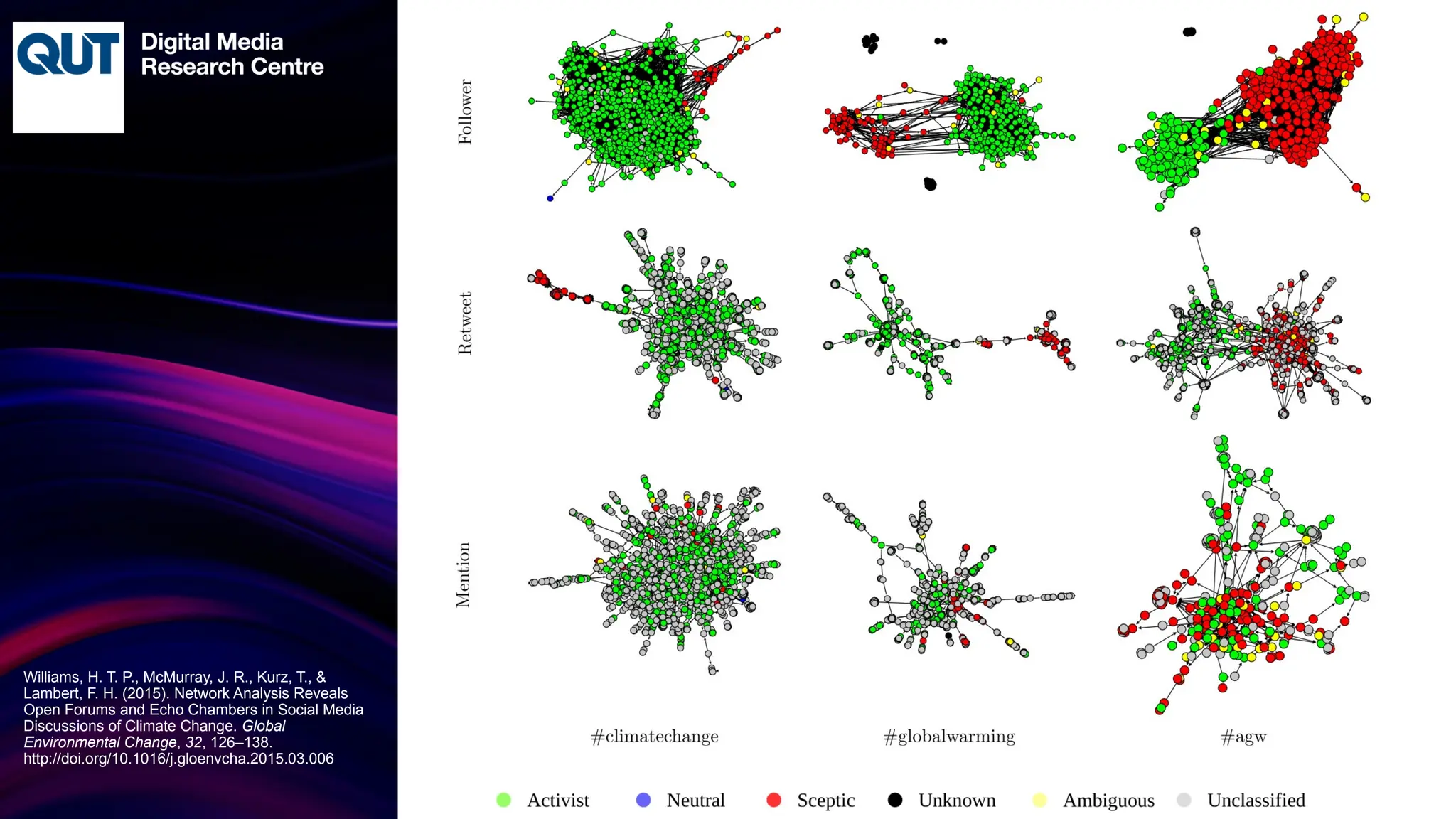
Williams, H. T. P., McMurray, J. R., Kurz, T., &
Lambert, F. H. (2015). Network Analysis Reveals
Open Forums and Echo Chambers in Social Media
Discussions of Climate Change. Global
Environmental Change, 32, 126–138.
http://doi.org/10.1016/j.gloenvcha.2015.03.006
CRICOS No.00213J
Connectivity,
Not Disconnection
Image: Midjourney
CRICOS No.00213J
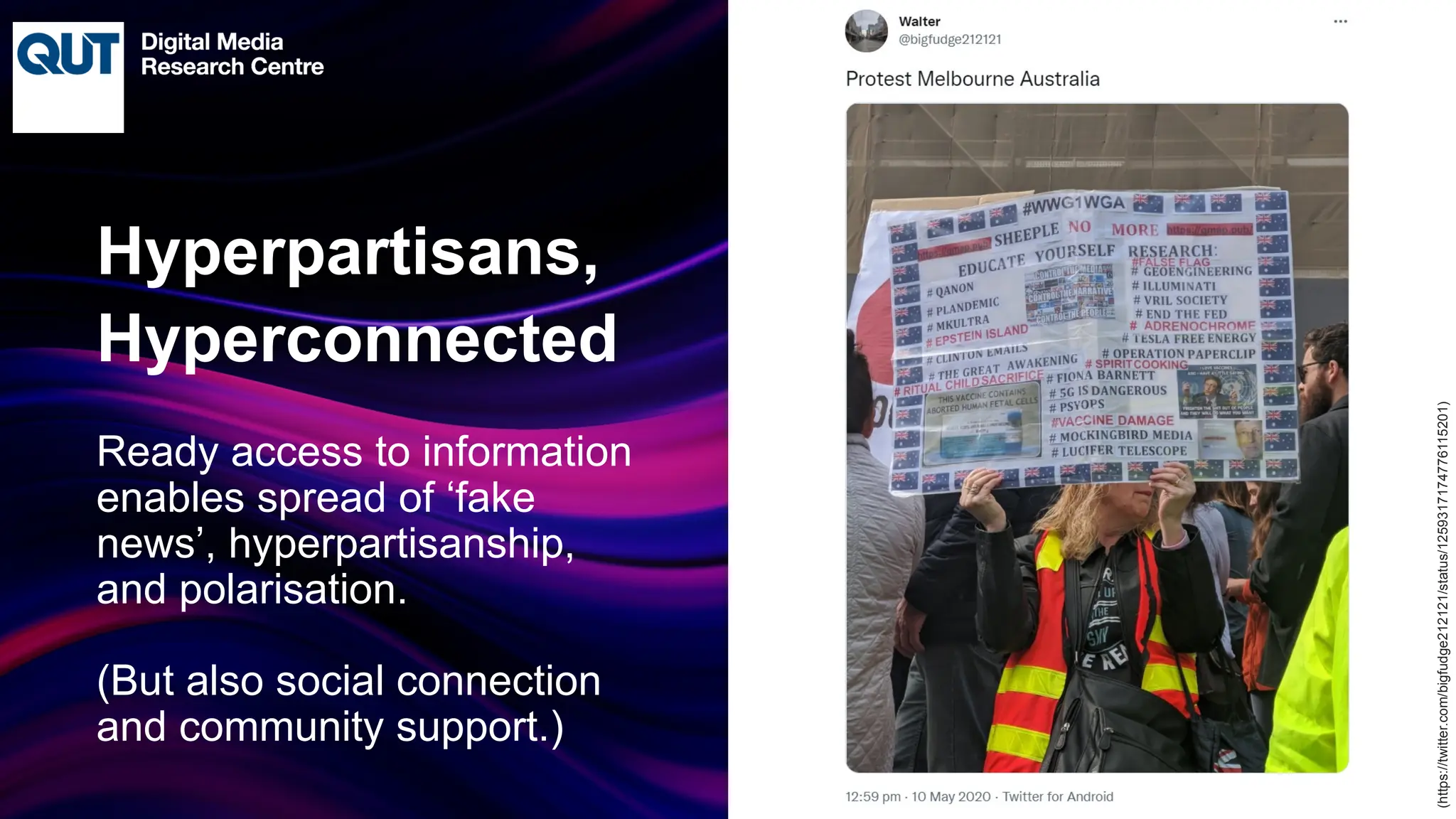
Ready access to information
enables spread of ‘fake
news’, hyperpartisanship,
and polarisation.
(But also social connection
and community support.)
Hyperpartisans,
Hyperconnected
(https://twitter.com/bigfudge212121/status/1259317174776115201)
CRICOS No.00213J
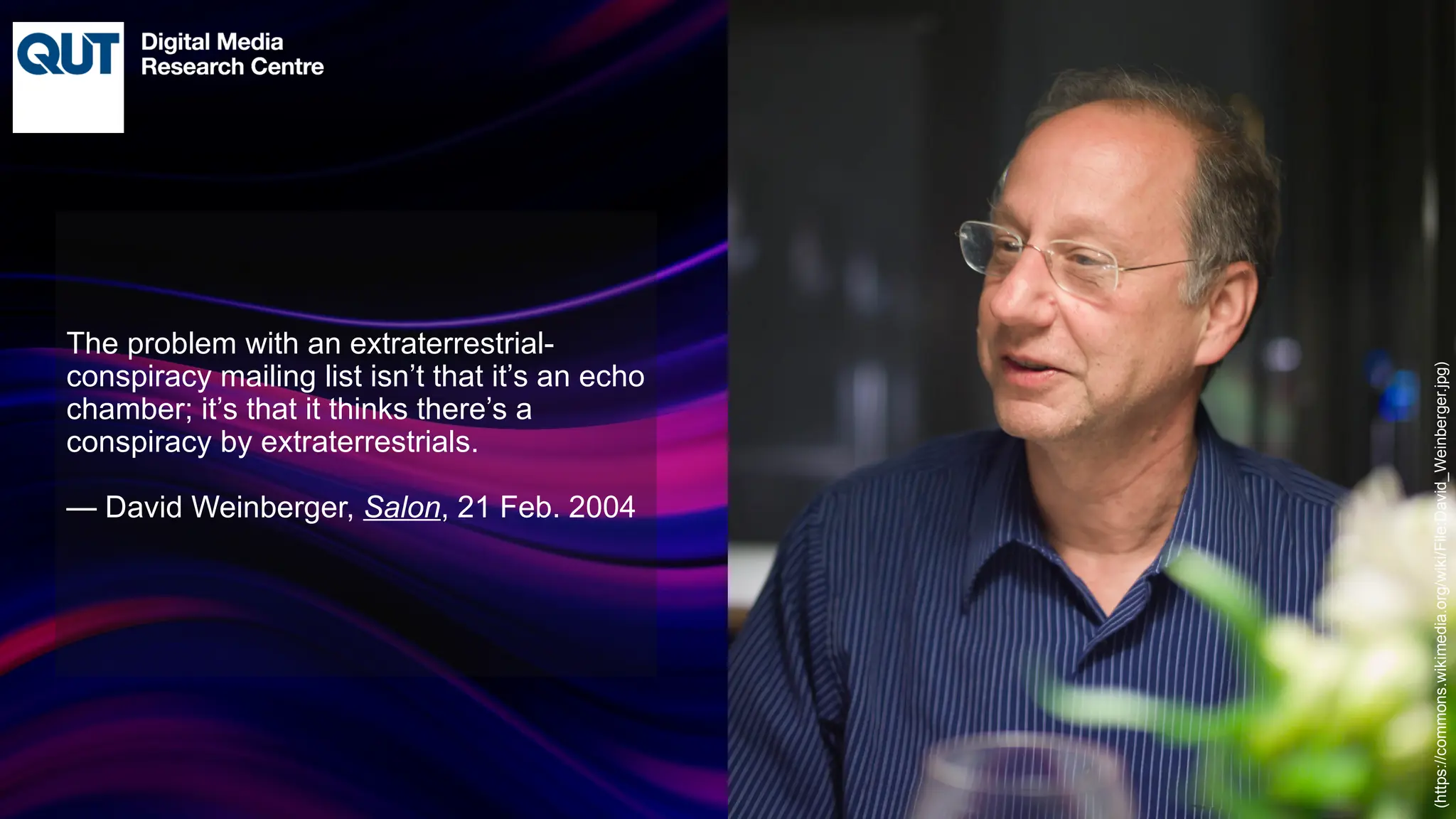
The problem with an extraterrestrial-
conspiracy mailing list isn’t that it’s an echo
chamber; it’s that it thinks there’s a
conspiracy by extraterrestrials.
— David Weinberger, Salon, 21 Feb. 2004
(https://commons.wikimedia.org/wiki/File:David_Weinberger.jpg)
CRICOS No.00213J
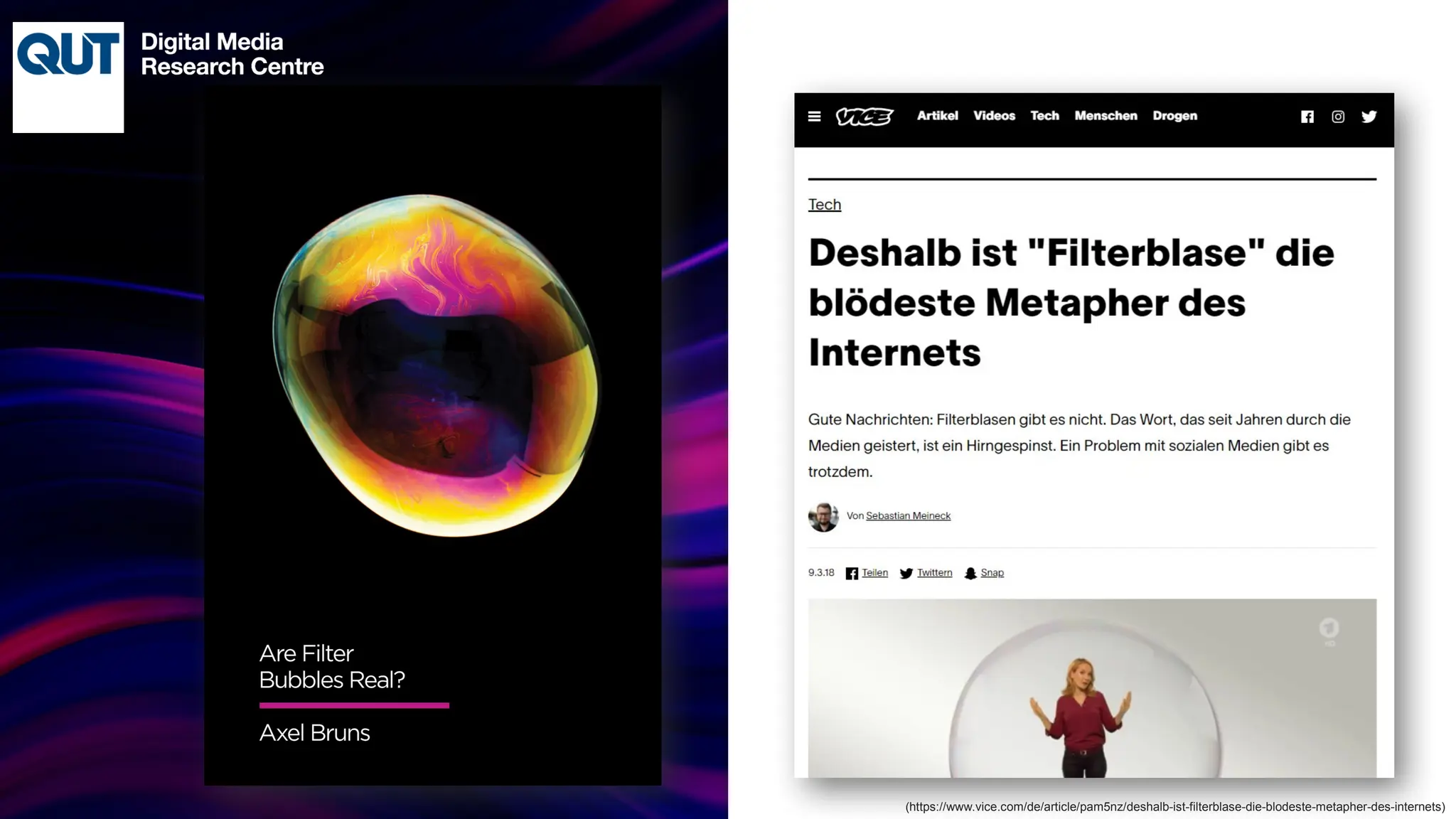
(https://www.vice.com/de/article/pam5nz/deshalb-ist-filterblase-die-blodeste-metapher-des-internets)
Frankfurter Allgemeine
Sonntagszeitung, 25 May 2025
CRICOS No.00213J
Image: Midjourney
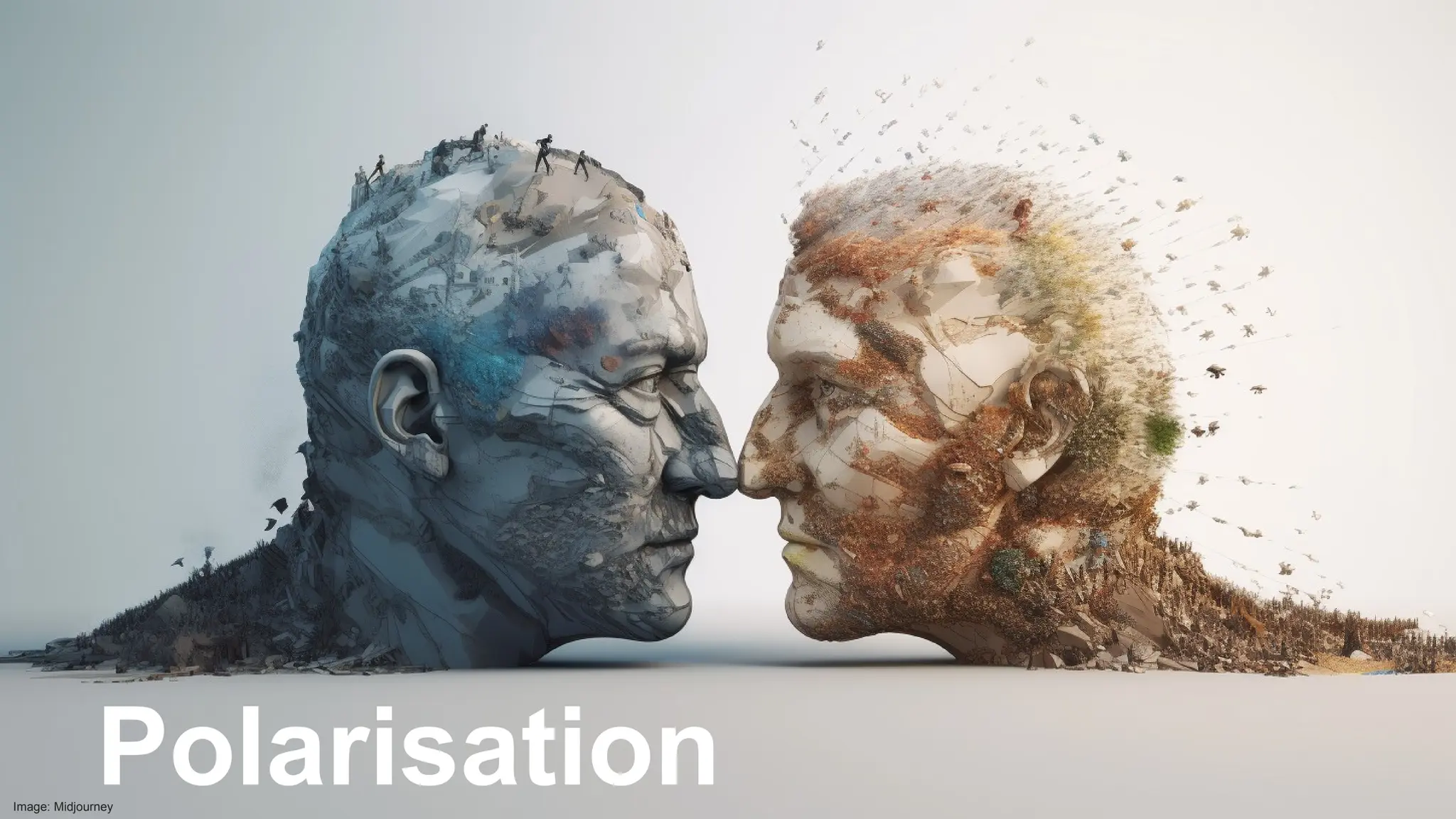
Polarisation
CRICOS No.00213J
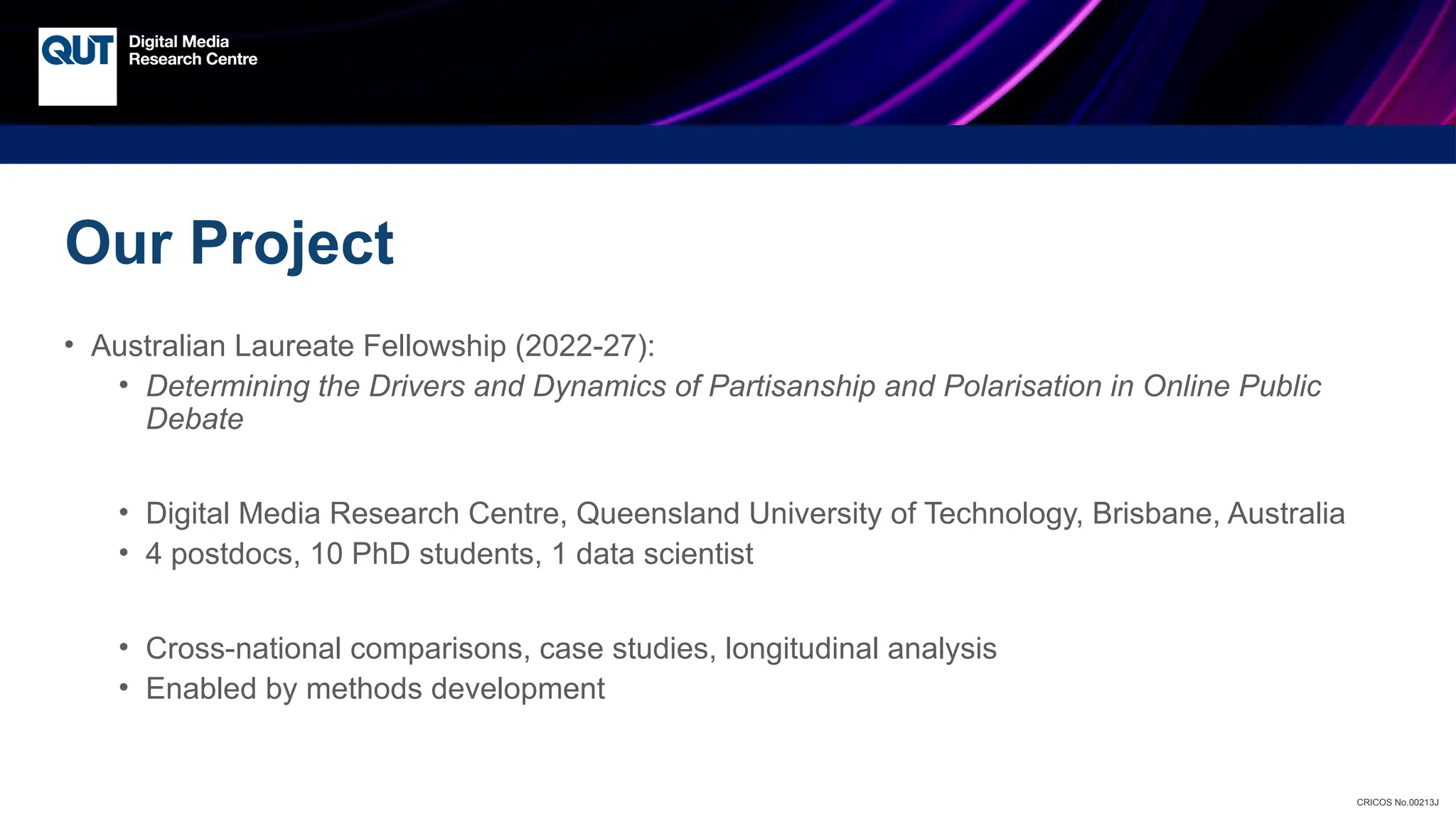
Our Project
• Australian Laureate Fellowship (2022-27):
• Determining the Drivers and Dynamics of Partisanship and Polarisation in Online Public
Debate
• Digital Media Research Centre, Queensland University of Technology, Brisbane, Australia
• 4 postdocs, 10 PhD students, 1 data scientist
• Cross-national comparisons, case studies, longitudinal analysis
• Enabled by methods development
CRICOS No.00213J
Image: Midjourney
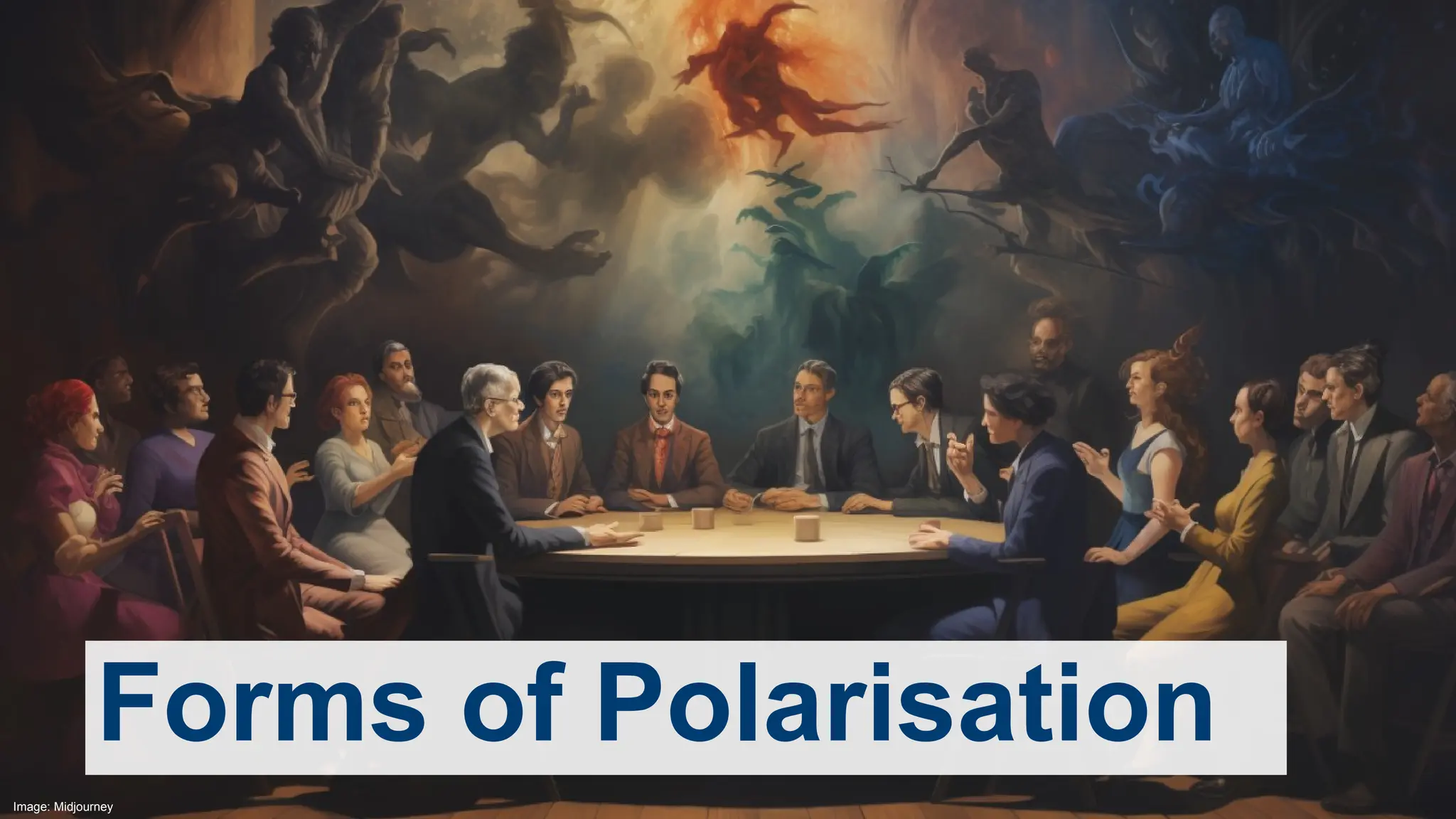
Forms of Polarisation
CRICOS No.00213J
(https://www.pewresearch.org/politics/2017/10/05/1-partisan-divides-over-political-values-widen/)
CRICOS No.00213J
(https://www.pewresearch.org/politics/2022/08/09/as-partisan-hostility-grows-signs-of-
frustration-with-the-two-party-system/pp_2022-08-09_partisan-hostility_01-08/)
(https://www.pewresearch.org/politics/2023/09/19/the-republican-and-
democratic-parties/pp_2023-09-19_views-of-politics_04-02/)
CRICOS No.00213J
Forms of Polarisation
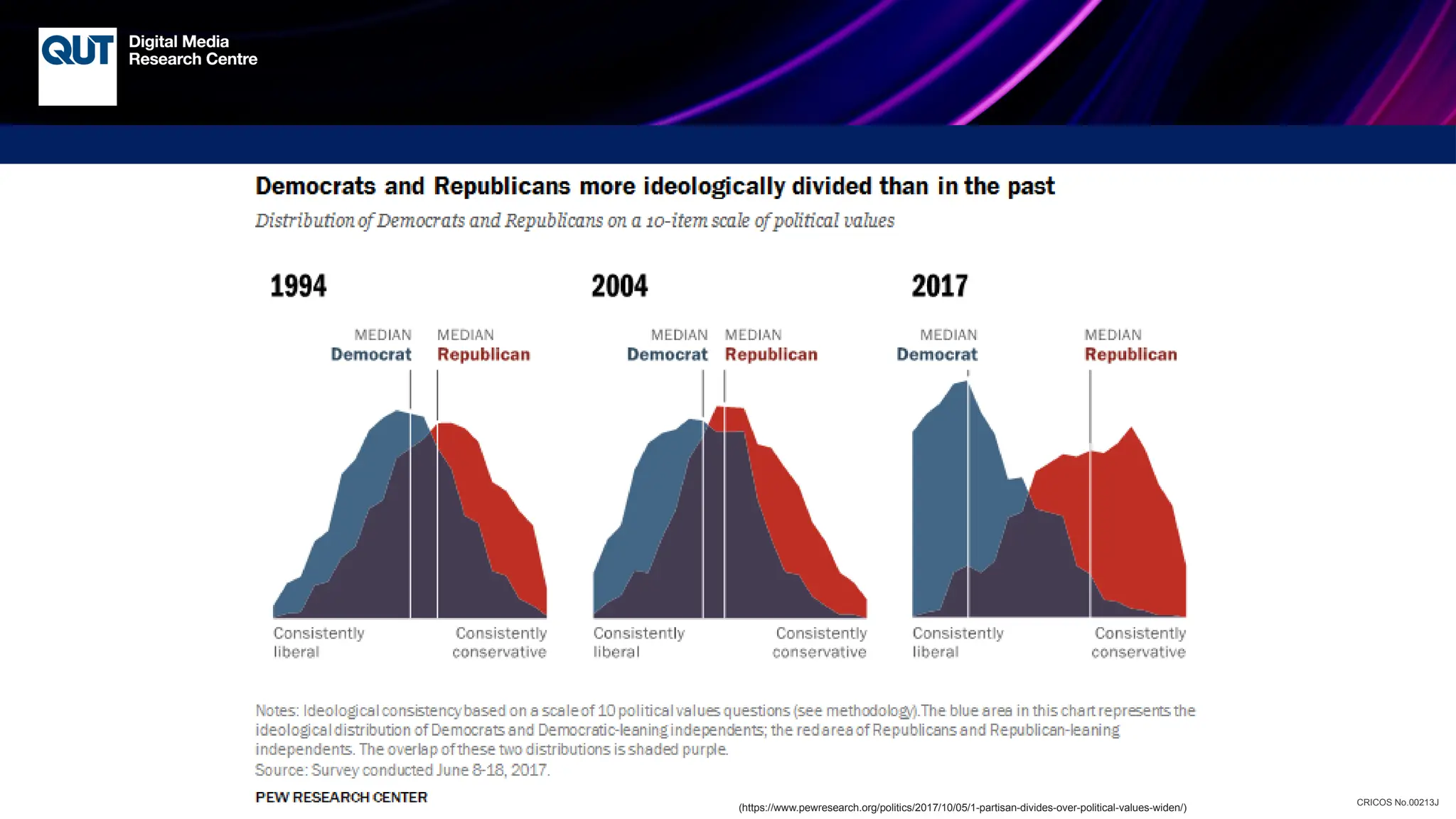
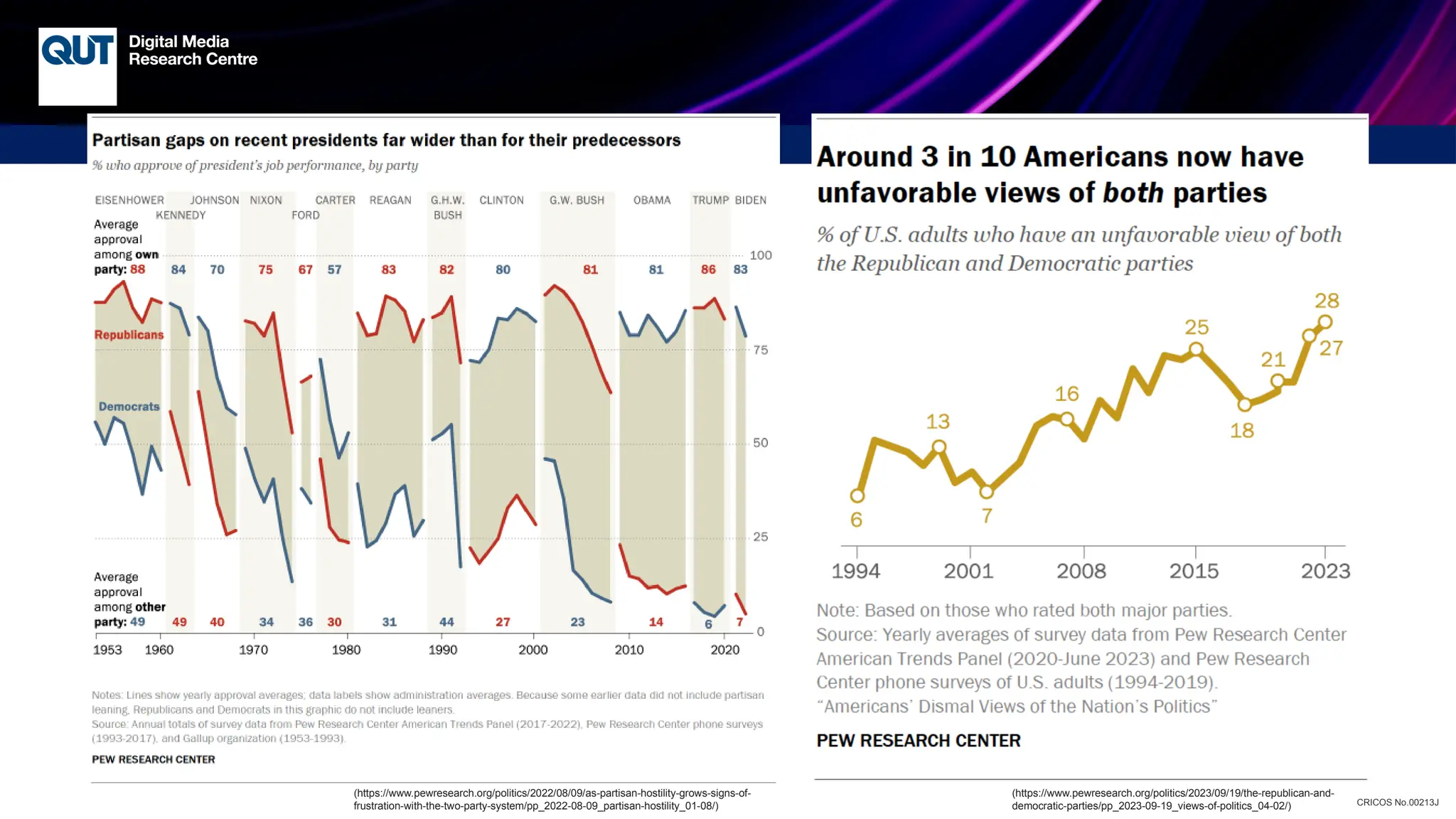
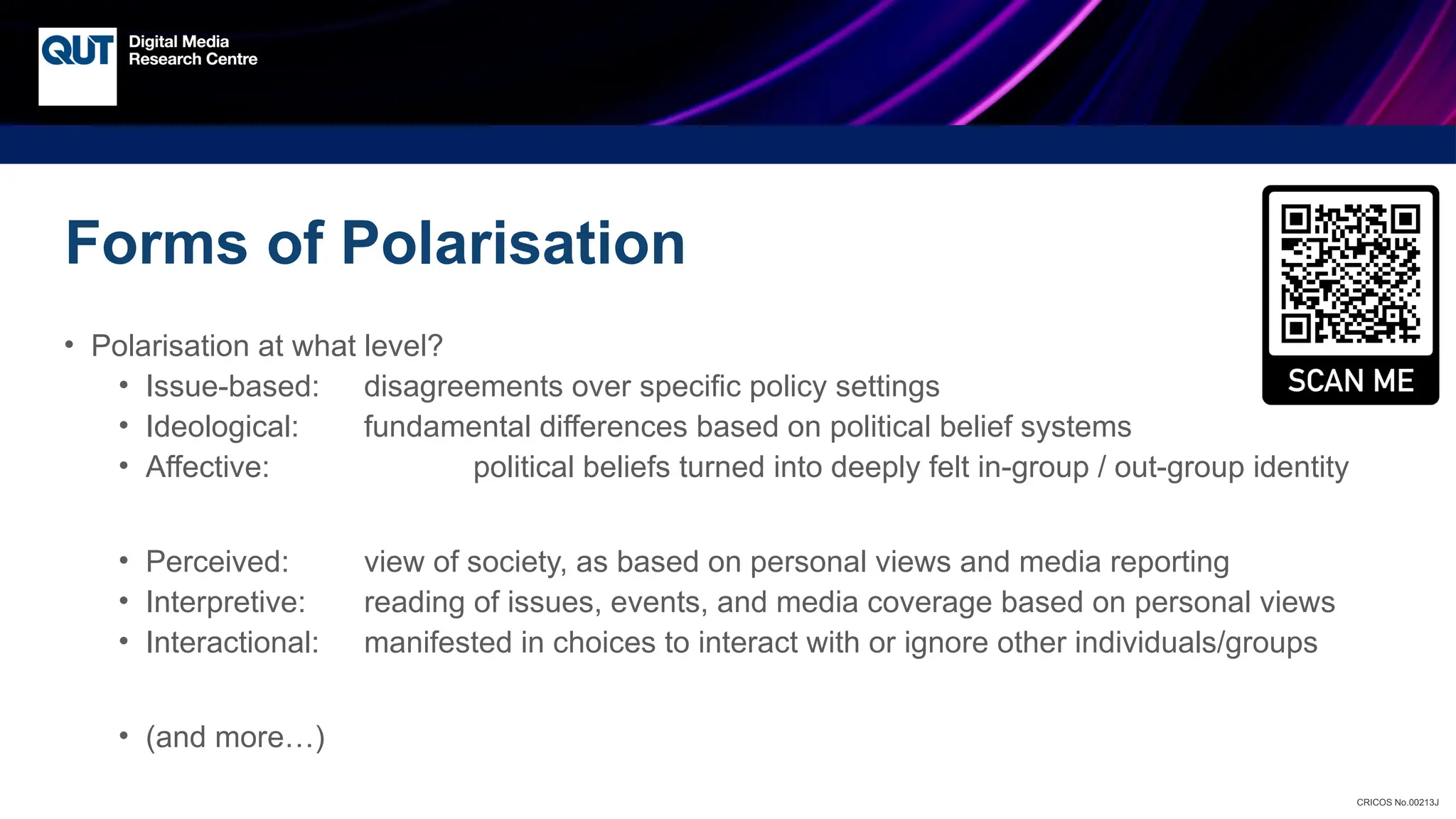
• Polarisation at what level?
• Issue-based: disagreements over specific policy settings
• Ideological: fundamental differences based on political belief systems
• Affective: political beliefs turned into deeply felt in-group / out-group identity
• Perceived: view of society, as based on personal views and media reporting
• Interpretive: reading of issues, events, and media coverage based on personal views
• Interactional: manifested in choices to interact with or ignore other individuals/groups
• (and more…)
CRICOS No.00213J
Image: Midjourney
A Problem? (When?)
CRICOS No.00213J
CRICOS No.00213J
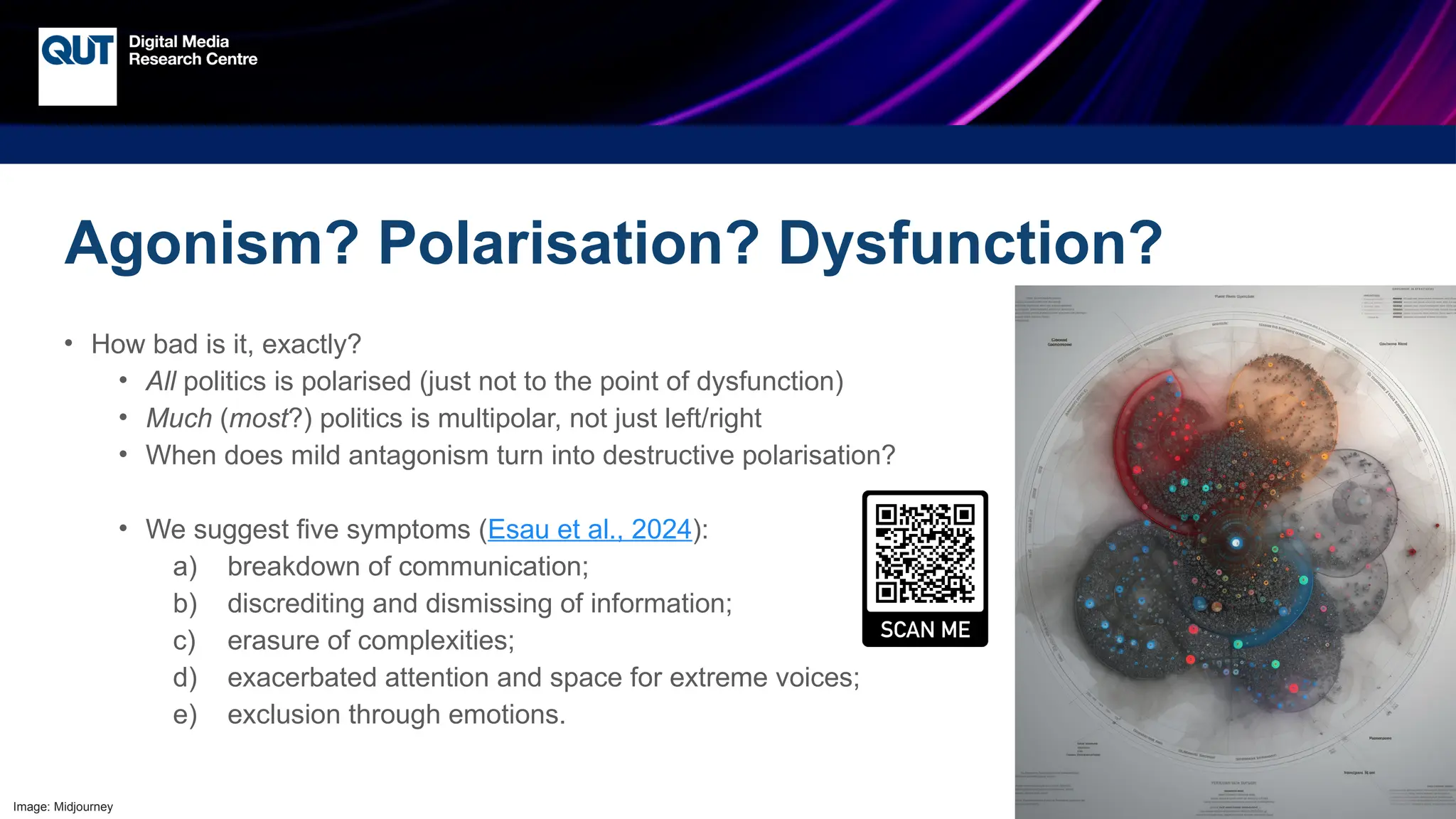
Agonism? Polarisation? Dysfunction?
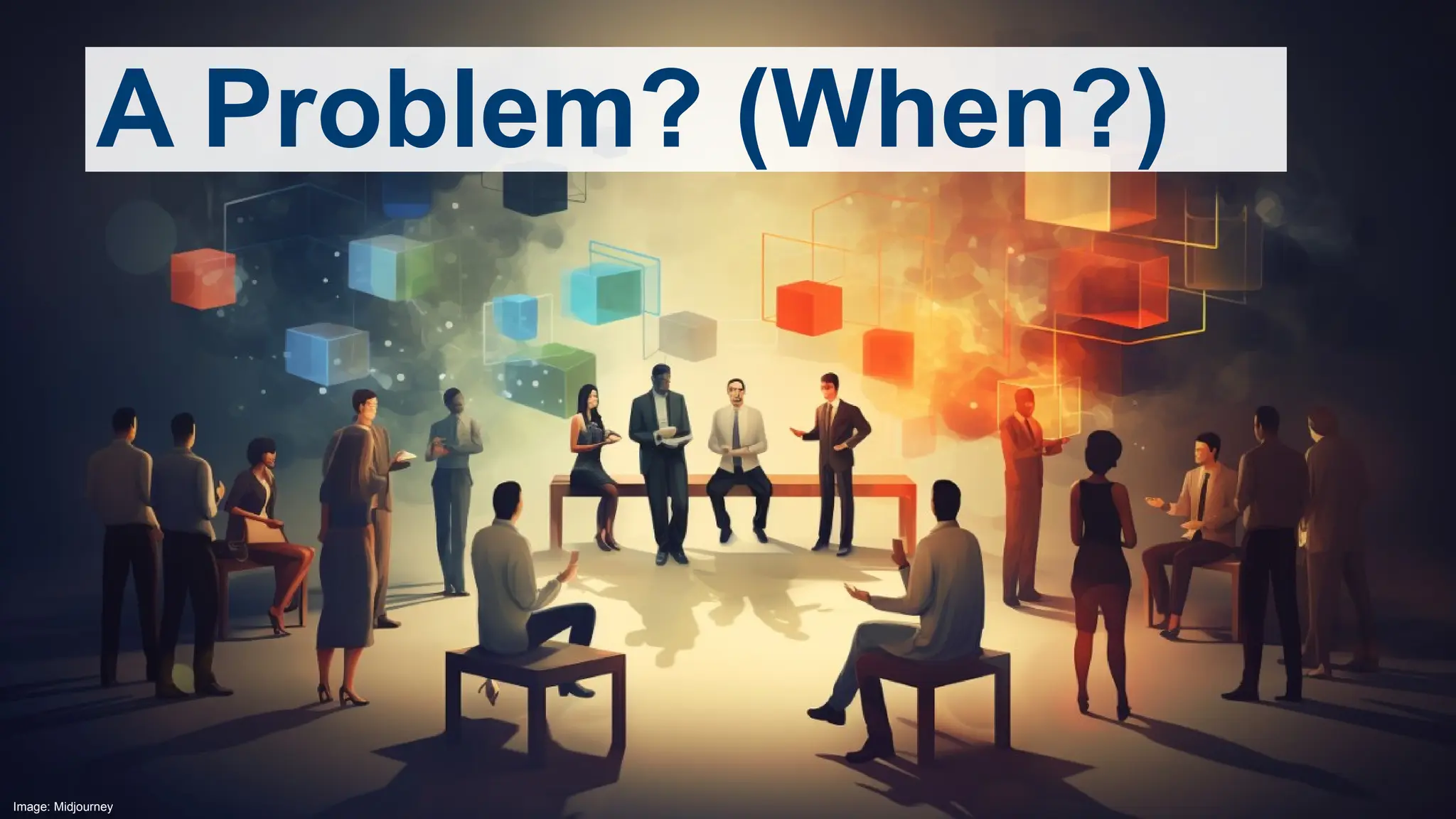
• How bad is it, exactly?
• All politics is polarised (just not to the point of dysfunction)
• Much (most?) politics is multipolar, not just left/right
• When does mild antagonism turn into destructive polarisation?
• We suggest five symptoms (Esau et al., 2024):
a) breakdown of communication;
b) discrediting and dismissing of information;
c) erasure of complexities;
d) exacerbated attention and space for extreme voices;
e) exclusion through emotions.
Image: Midjourney
CRICOS No.00213J
Practice:
the sum total of each account’s actions and
interactions – its patterns of engagement with other
accounts, its use of language, its sharing of URLs,
images, and videos, etc.
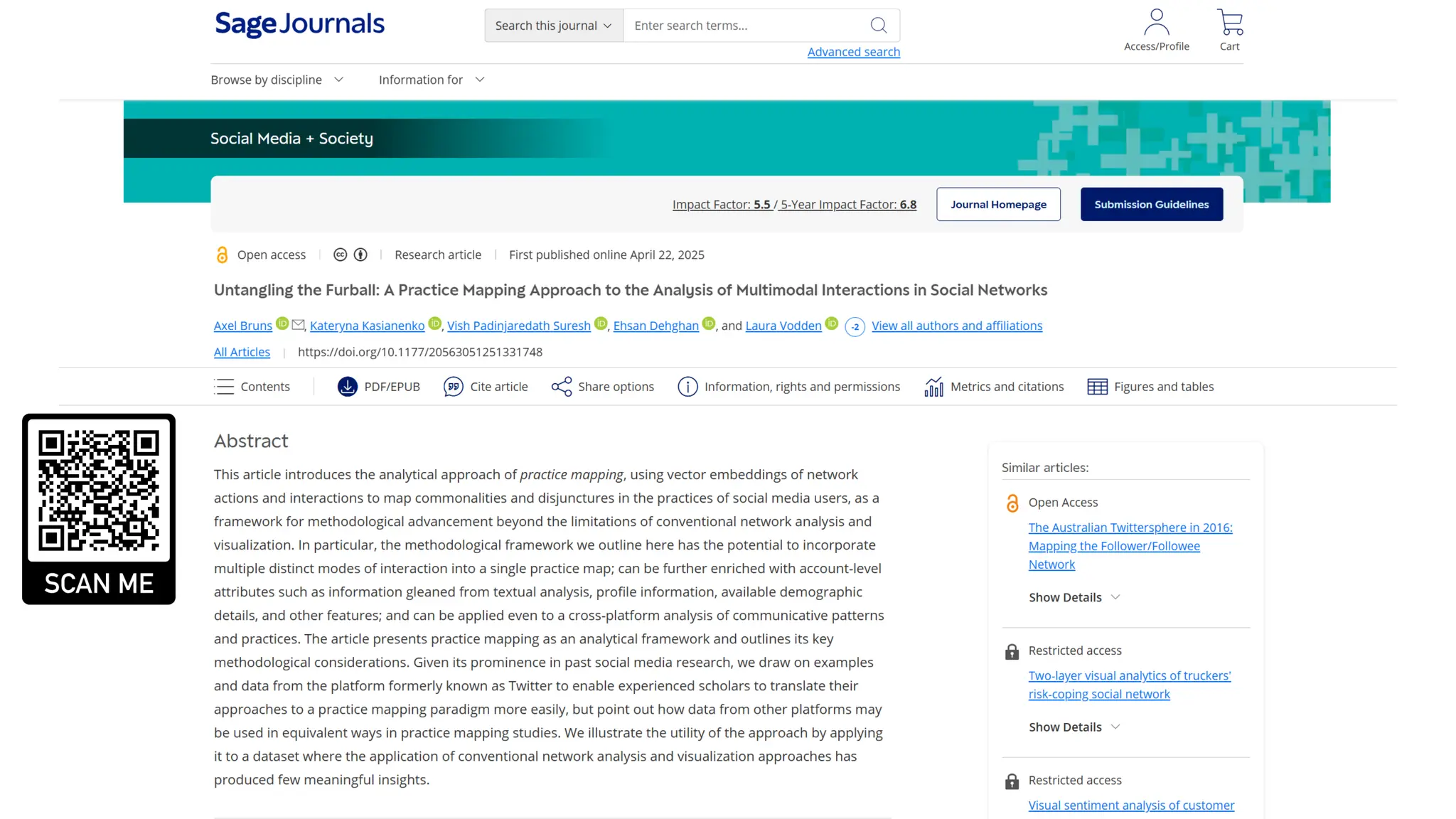
Practice Mapping
CRICOS No.00213J
Social Network Analysis beyond Twitter
• The Golden Age of network data is over (for now?):
• Social network analysis mostly meant Twitter network analysis
• Data on networked interactions not widely available for Facebook, Instagram, …
• No real networks of interaction on Reddit, YouTube, TikTok, …: threads, not networks
• Communities, not network clusters – that means attention to content, too:
• Networks very often a tool for finding clusters and communities with similar practices
• Those practices include activities other than direct interaction with each other
• Communities defined by shared language, identities, beliefs, values, ideas, sources, …
• How do we identify such communities in contemporary social media platforms?
Image: Midjourney
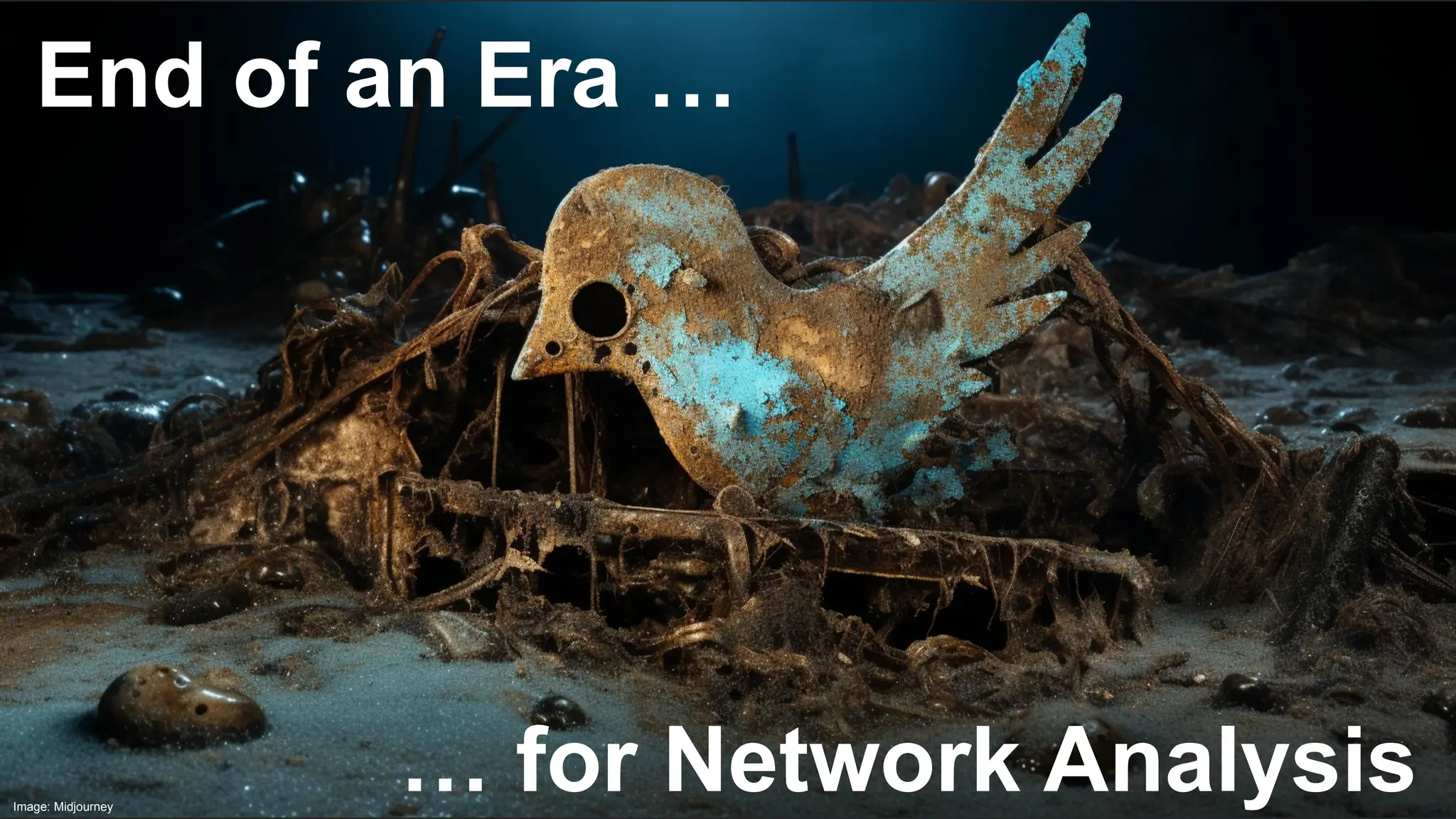
End of an Era …
… for Network Analysis
CRICOS No.00213J
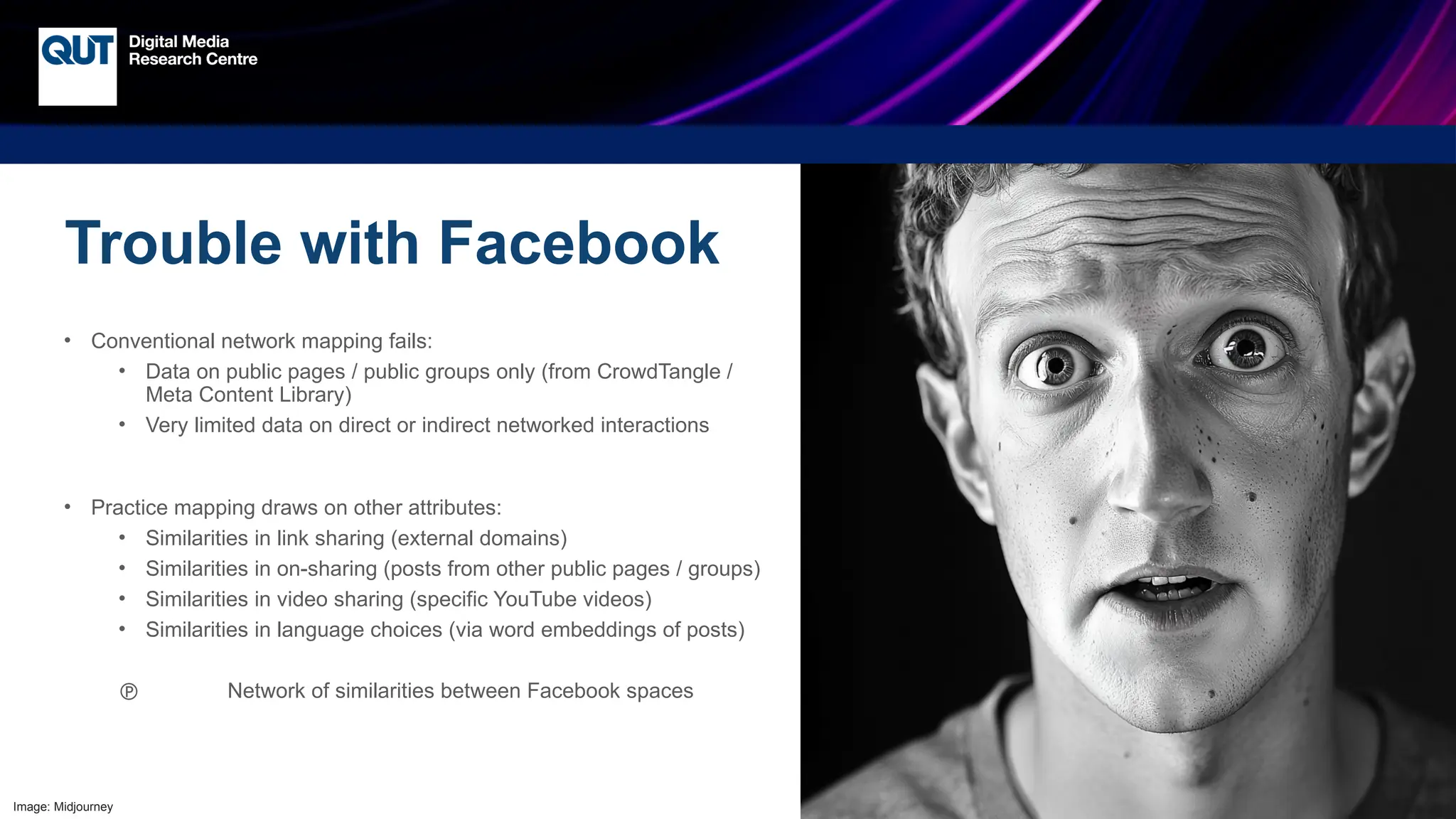
Trouble with Facebook
• Conventional network mapping fails:
• Data on public pages / public groups only (from CrowdTangle /
Meta Content Library)
• Very limited data on direct or indirect networked interactions
• Practice mapping draws on other attributes:
• Similarities in link sharing (external domains)
• Similarities in on-sharing (posts from other public pages / groups)
• Similarities in video sharing (specific YouTube videos)
• Similarities in language choices (via word embeddings of posts)
 Network of similarities between Facebook spaces
Image: Midjourney
CRICOS No.00213J
• Account-to-account interactions
(relative to interactive affordances available
on any given social media platform)
• Account’s post content (topics, sentiment,
hashtags, named entities, etc.)
• Account’s use of sources (URLs, domains,
embedded videos and images, etc.)
• Account’s profile information (name,
description, etc.)
• Manually and computationally coded
information about the account and its posts
• …
Potential Patterns
to Operationalise
in Practice Mapping
Image: Midjourney
CRICOS No.00213J
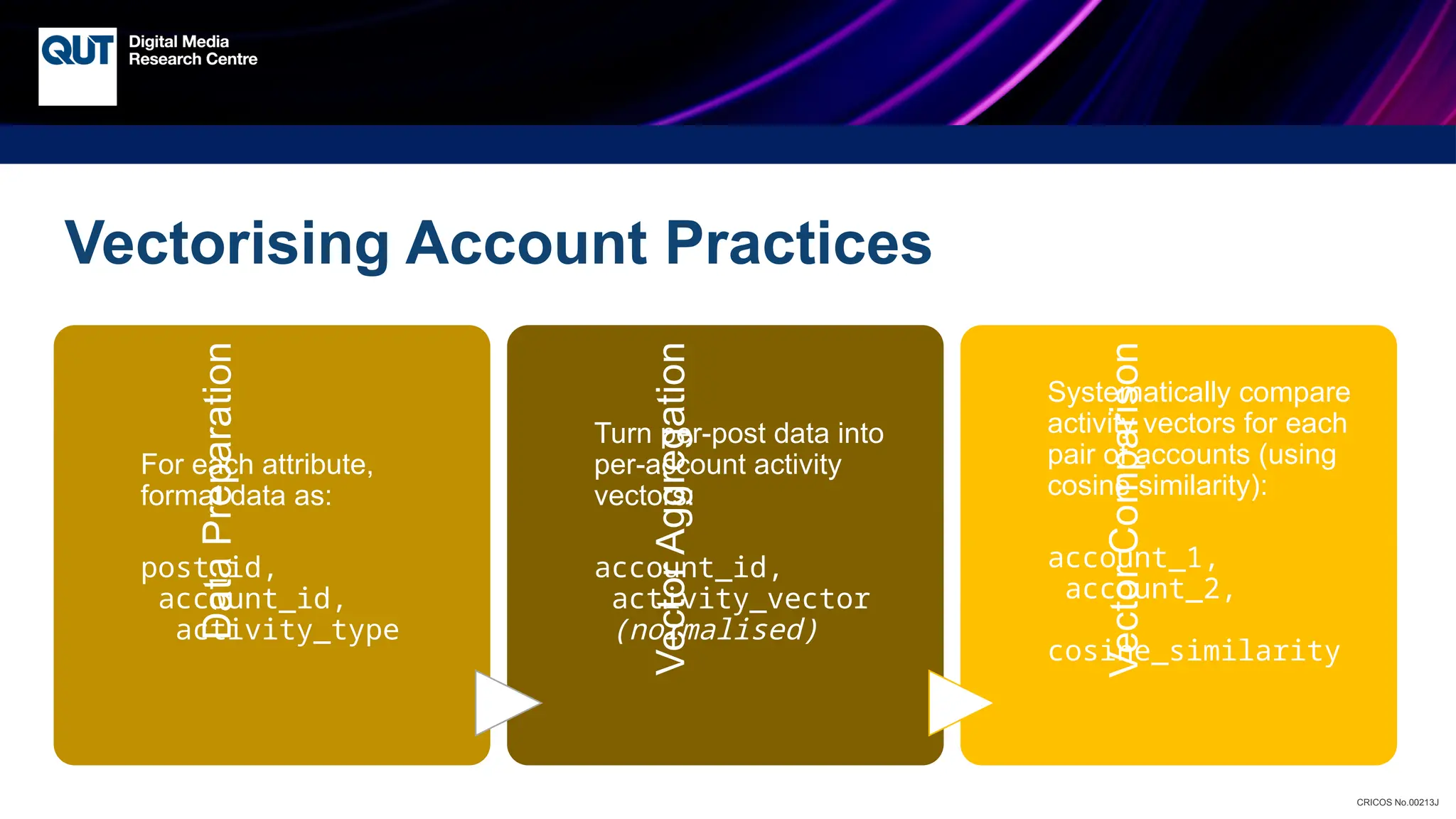
Vectorising Account Practices
Data
Preparation
For each attribute,
format data as:
post_id,
account_id,
activity_type
Vector
Aggregation
Turn per-post data into
per-account activity
vectors:
account_id,
activity_vector
(normalised)
Vector
Comparison
Systematically compare
activity vectors for each
pair of accounts (using
cosine similarity):
account_1,
account_2,
cosine_similarity
CRICOS No.00213J
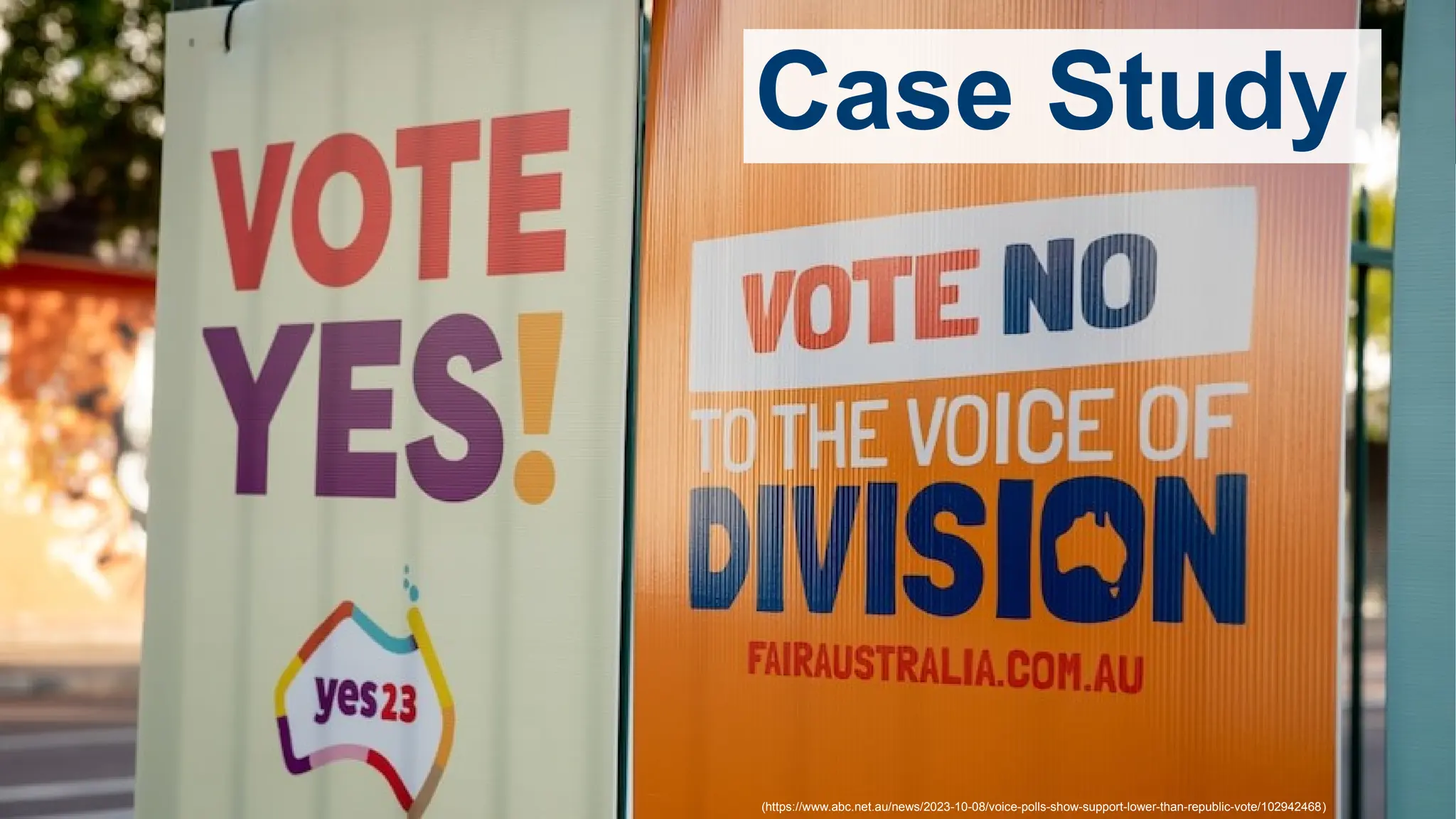
Case Study
(https://www.abc.net.au/news/2023-10-08/voice-polls-show-support-lower-than-republic-vote/102942468)
CRICOS No.00213J
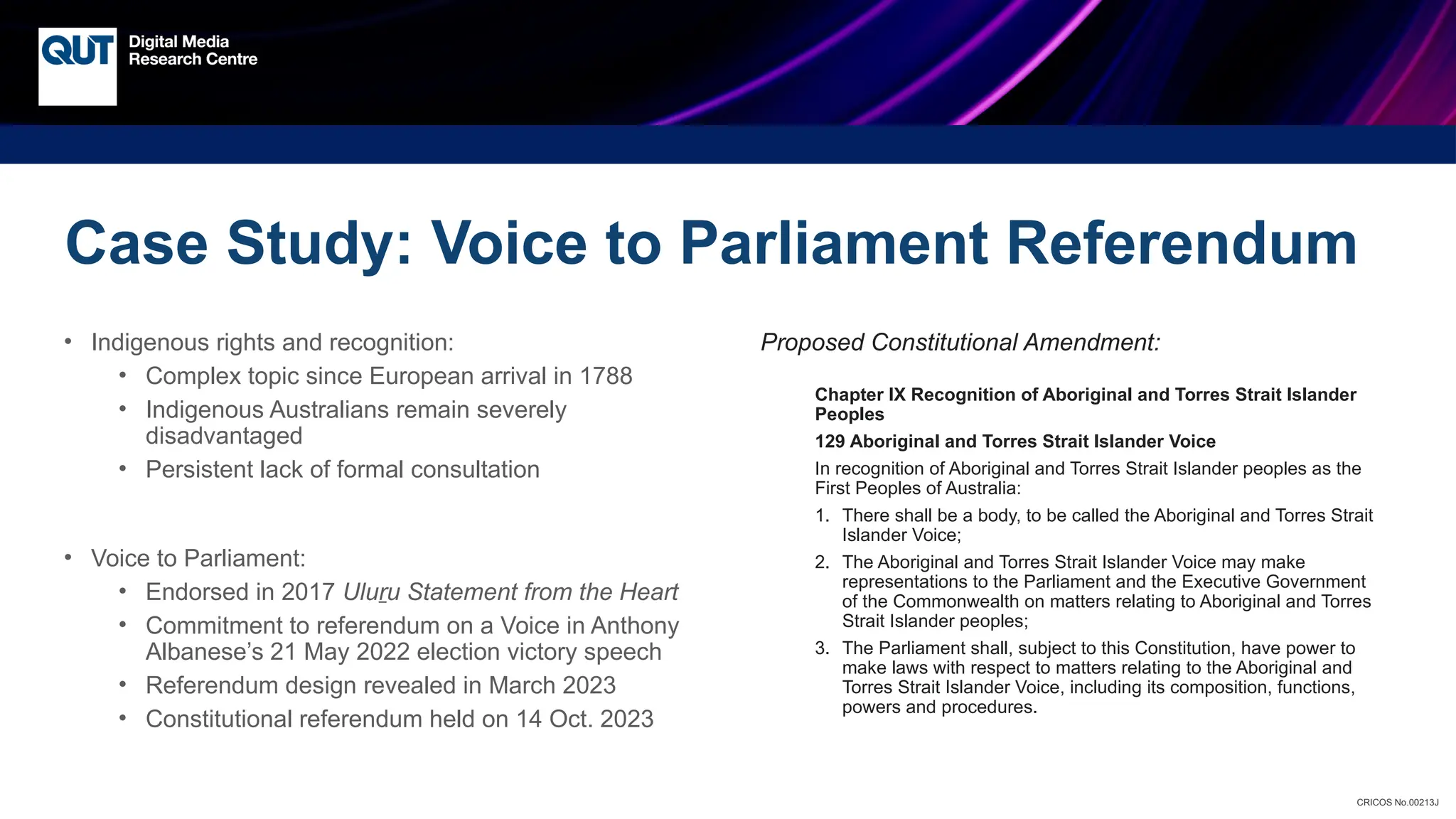
• Indigenous rights and recognition:
• Complex topic since European arrival in 1788
• Indigenous Australians remain severely
disadvantaged
• Persistent lack of formal consultation
• Voice to Parliament:
• Endorsed in 2017 Uluru Statement from the Heart
• Commitment to referendum on a Voice in Anthony
Albanese’s 21 May 2022 election victory speech
• Referendum design revealed in March 2023
• Constitutional referendum held on 14 Oct. 2023
Proposed Constitutional Amendment:
Chapter IX Recognition of Aboriginal and Torres Strait Islander
Peoples
129 Aboriginal and Torres Strait Islander Voice
In recognition of Aboriginal and Torres Strait Islander peoples as the
First Peoples of Australia:
1. There shall be a body, to be called the Aboriginal and Torres Strait
Islander Voice;
2. The Aboriginal and Torres Strait Islander Voice may make
representations to the Parliament and the Executive Government
of the Commonwealth on matters relating to Aboriginal and Torres
Strait Islander peoples;
3. The Parliament shall, subject to this Constitution, have power to
make laws with respect to matters relating to the Aboriginal and
Torres Strait Islander Voice, including its composition, functions,
powers and procedures.
Case Study: Voice to Parliament Referendum
CRICOS No.00213J
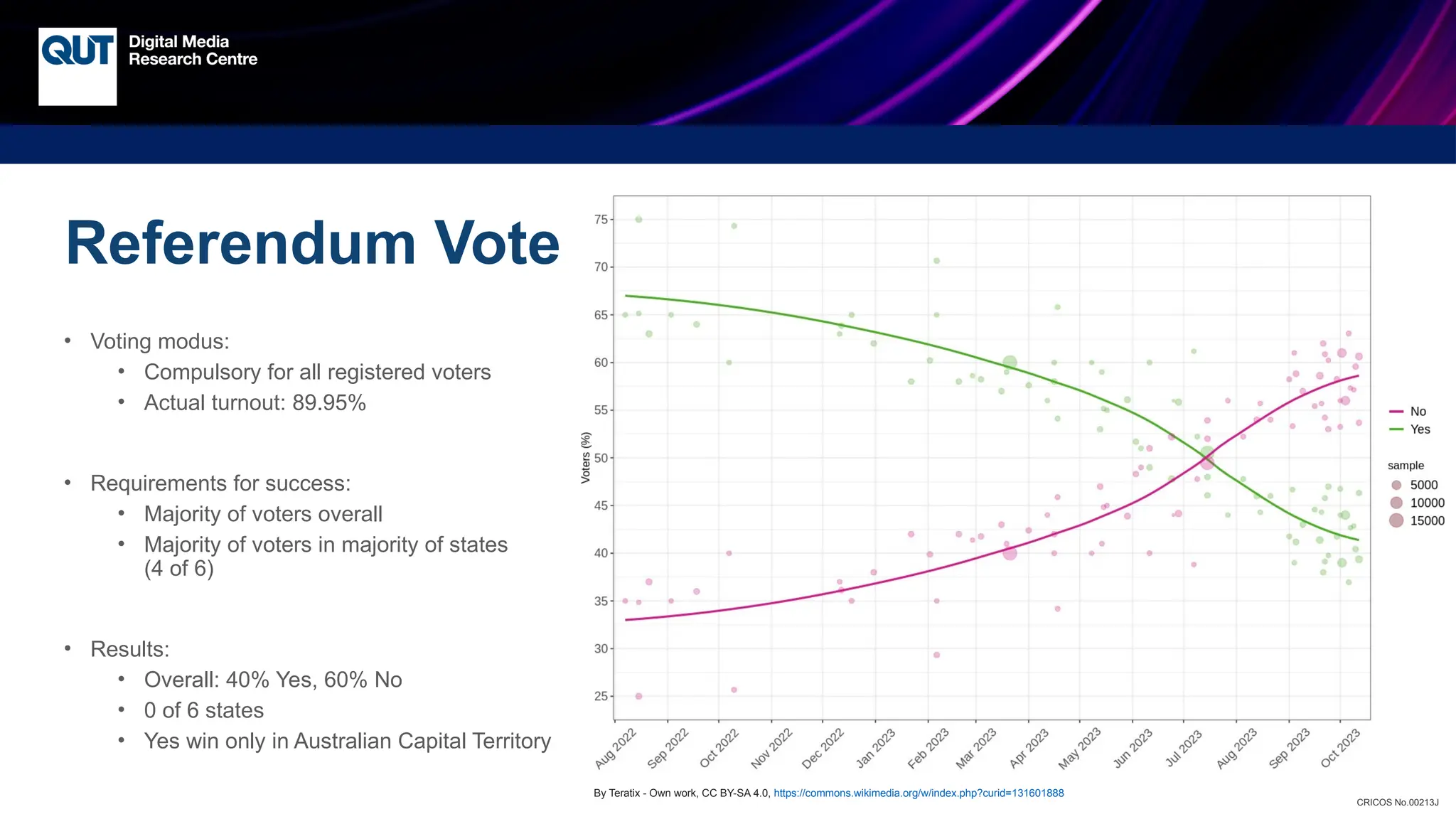
Referendum Vote
• Voting modus:
• Compulsory for all registered voters
• Actual turnout: 89.95%
• Requirements for success:
• Majority of voters overall
• Majority of voters in majority of states
(4 of 6)
• Results:
• Overall: 40% Yes, 60% No
• 0 of 6 states
• Yes win only in Australian Capital Territory
By Teratix - Own work, CC BY-SA 4.0, https://commons.wikimedia.org/w/index.php?curid=131601888
CRICOS No.00213J
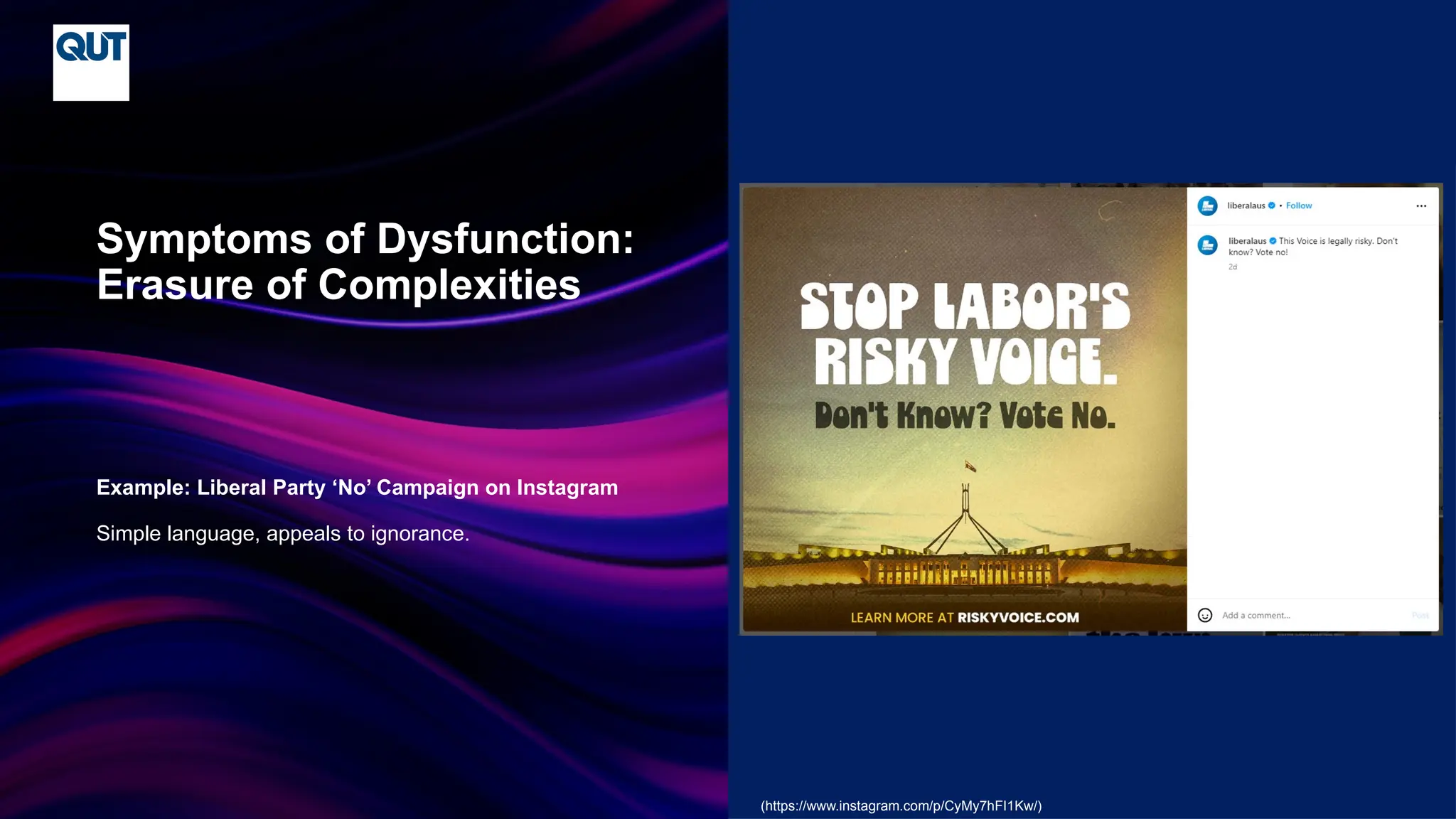
Example: Liberal Party ‘No’ Campaign on Instagram
Simple language, appeals to ignorance.
Symptoms of Dysfunction:
Erasure of Complexities
(https://www.instagram.com/p/CyMy7hFI1Kw/)
CRICOS No.00213J
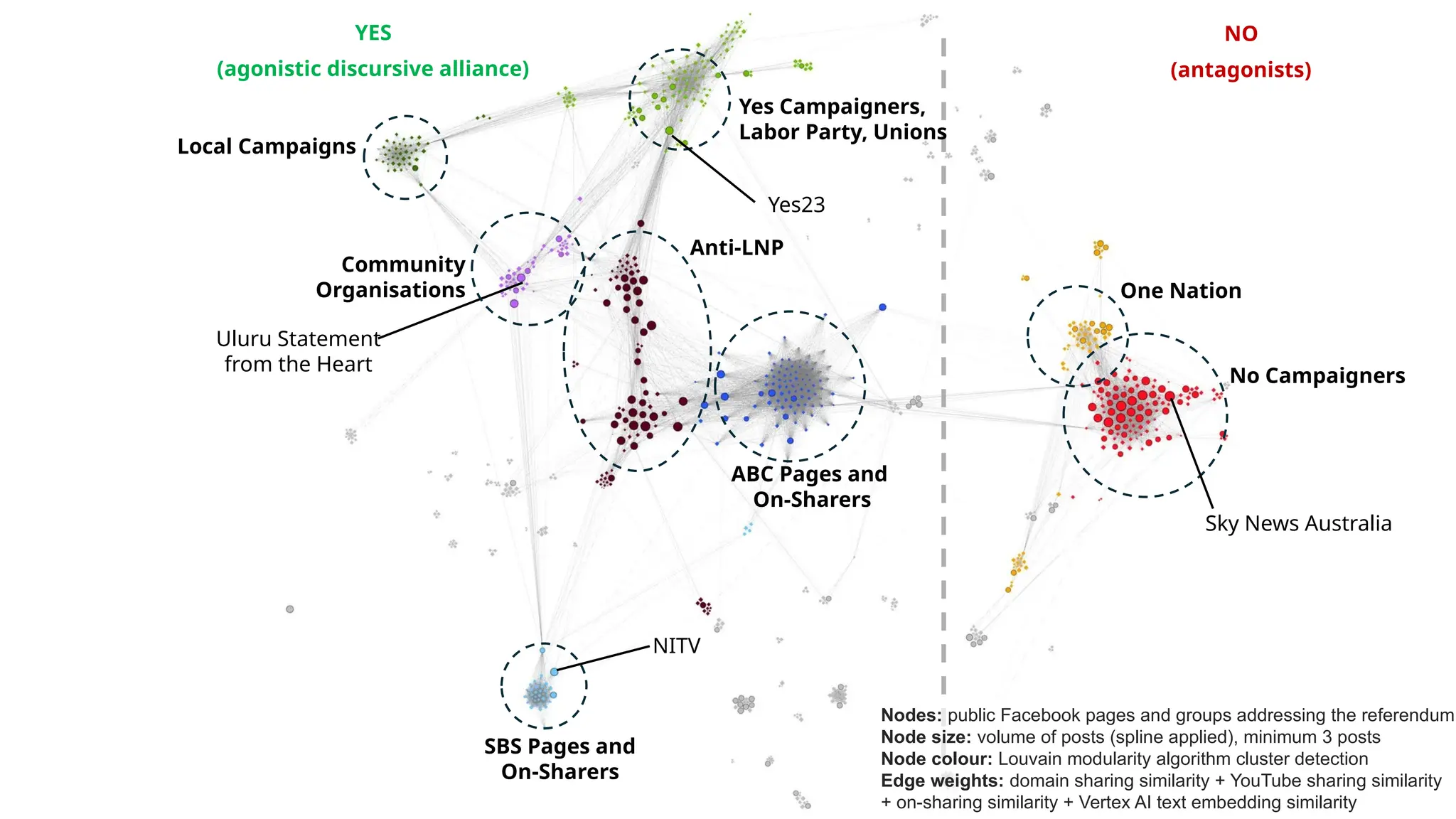
Dataset: posts about the Voice to Parliament constitutional
referendum in Australia, from public Facebook pages and
groups (1 Jan. to 13 Oct. 2023)
Practice attributes: domains shared, YouTube videos shared,
posts on-shared, language choices
Voice to Parliament
Sky News Australia
No Campaigners
Anti-LNP
ABC Pages and
On-Sharers
Uluru Statement
from the Heart
Yes23
Community
Organisations
SBS Pages and
On-Sharers
YES NO
(agonistic discursive alliance) (antagonists)
One Nation
Yes Campaigners,
Labor Party, Unions
Local Campaigns
NITV
Nodes: public Facebook pages and groups addressing the referendum
Node size: volume of posts (spline applied), minimum 3 posts
Node colour: Louvain modularity algorithm cluster detection
Edge weights: domain sharing similarity + YouTube sharing similarity
+ on-sharing similarity + Vertex AI text embedding similarity
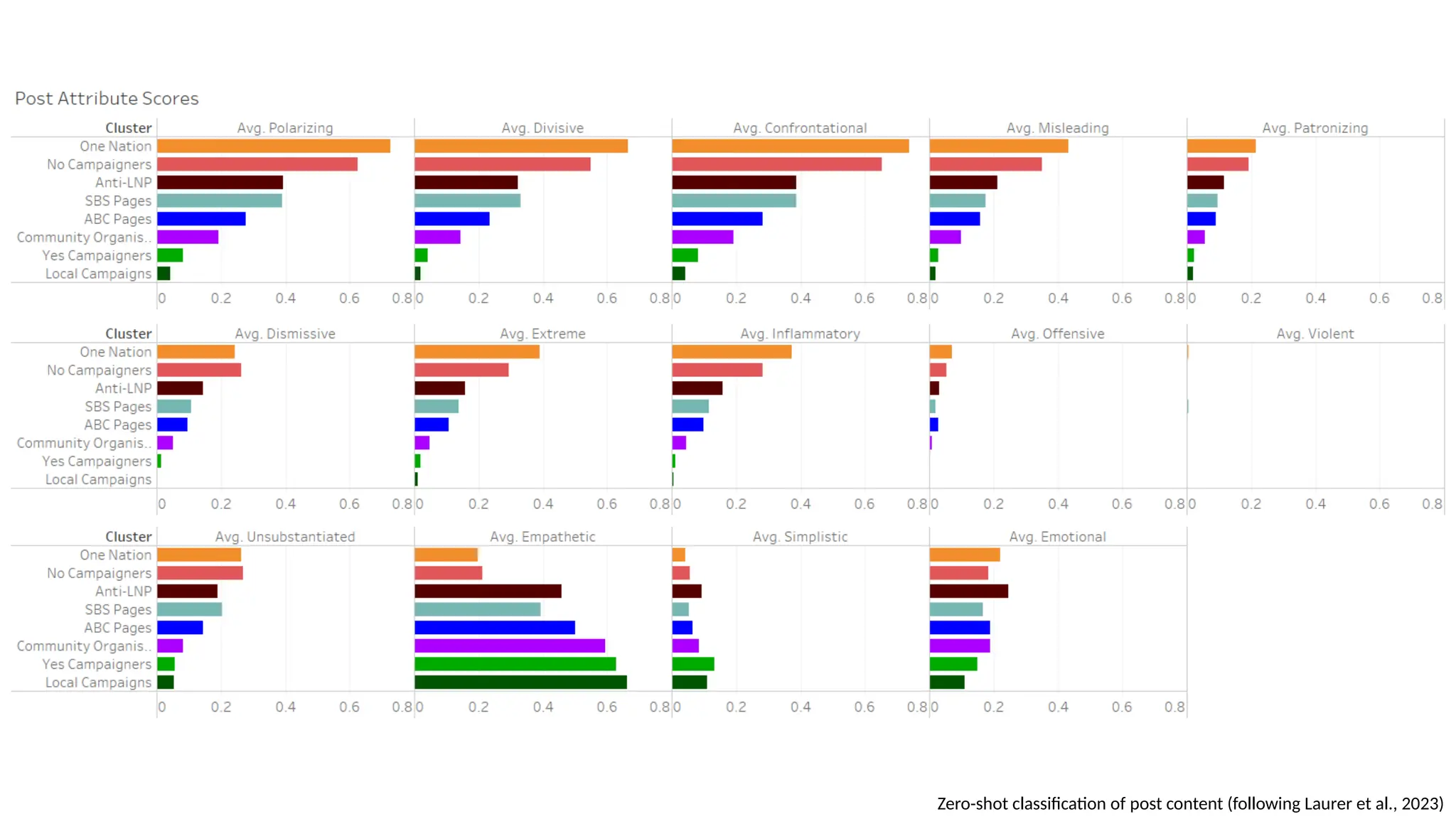
Zero-shot classification of post content (following Laurer et al., 2023)
CRICOS No.00213J
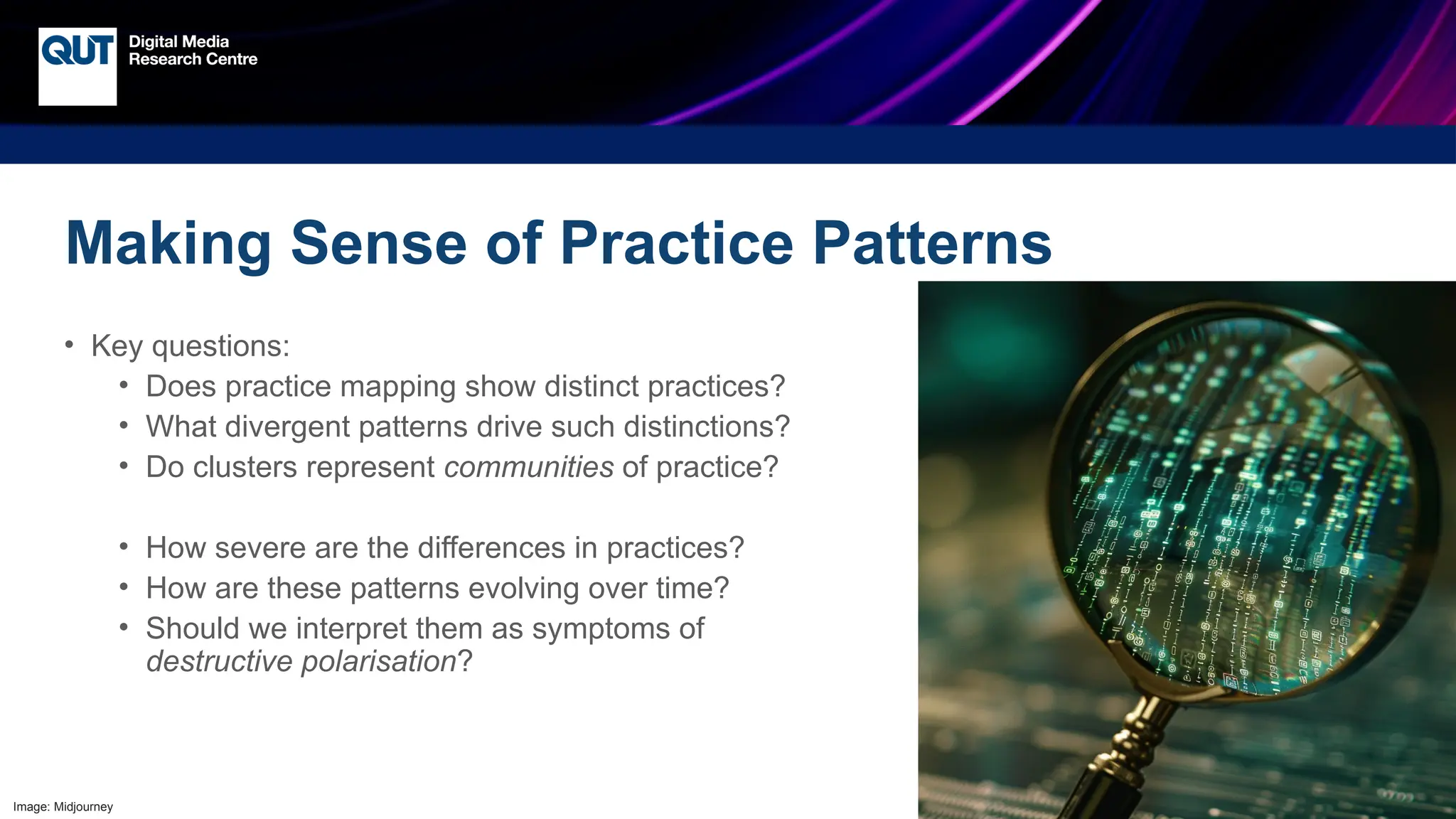
Making Sense of Practice Patterns
• Key questions:
• Does practice mapping show distinct practices?
• What divergent patterns drive such distinctions?
• Do clusters represent communities of practice?
• How severe are the differences in practices?
• How are these patterns evolving over time?
• Should we interpret them as symptoms of
destructive polarisation?
Image: Midjourney
CRICOS No.00213J
Thank you
Image: Midjourney
CRICOS No.00213J
This research is supported by the Australian Research Council through the
Australian Laureate Fellowship project Determining the Dynamics of
Partisanship and Polarisation in Online Public Debate.
Acknowledgments
Investigating the Dynamics of Destructive Polarisation in Public Communication

  • 1.
    CRICOS No.00213J Investigating theDynamics of Destructive Polarisation in Public Communication Axel Bruns with important contributions from: Australian Laureate Fellow Laura Vodden Katharina Esau Sebastian Svegaard Digital Media Research Centre Tariq Choucair Samantha Vilkins Kate O’Connor Farfan Queensland University of Technology Laura Lefevre Vishnu PS Carly Lubicz-Zaorski Brisbane, Australia Ehsan Dehghan Kateryna Kasianenko [email protected] Bluesky: @snurb.info | Mastodon: @[email protected] | Xitter: @snurb_dot_info
  • 2.
  • 3.
    CRICOS No.00213J Filter Bubbles?Echo Chambers? No: Polarisation – Constructive or Destructive Practice Mapping to Detect Symptoms Roadmap
  • 4.
    CRICOS No.00213J Can wesimply blame our platforms and their algorithms? Filter bubbles? Echo chambers? (https://commons.wikimedia.org/wiki/File:Eli_Pariser,_author_of_The_Filter_Bubble_-_Flickr_-_Knight_Foundation.jpg)
  • 5.
    CRICOS No.00213J Bubble Trouble •Echo Chambers? Filter Bubbles? • Where exactly? • General search engines • News search engines, portals, and recommender systems • Social media (but where – profiles, pages, hashtags, groups …?) • What exactly? • Hermetically sealed information enclaves full of misinformation? • Self-reinforcing ideological in-groups of hyperpartisans? • Politically partisan communities of any kind? • Why exactly? • Ideological and societal polarisation amongst citizens? • Algorithmic construction of distinct and separate publics? • Feedback loop between the two? • Defined how exactly? • Argument from anecdote and ‘common sense’, rather than empirical evidence • Promoted by non-experts (Sunstein: legal scholar; Pariser: activist and tech entrepreneur) Image: Midjourney
  • 6.
    CRICOS No.00213J Echo Chambersand Filter Bubbles in Social Media • Early blogosphere studies: • Strong U.S. focus • Polarisation and ‘mild echo chambers’ • E.g. Adamic & Glance (2005) • Social media studies: • Especially Twitter, less Facebook or other platforms • Hashtag / keyword datasets • Mixed results: • Significant distinctions between @mention, retweet, follow networks • And between lead users and more casual participants Adamic & Glance (2005)
  • 7.
    CRICOS No.00213J No. JustNo. • No evidence for ‘hard’ echo chambers / filter bubbles • Success of mis- and disinformation campaigns depends on their absence • Hyperpartisan activists actively seeking out enemies and their content • Social media are only one part of a more diverse media mix (and themselves very diverse) • Most people simply don’t care enough about news and politics to get locked in • ‘Mild’ echo chambers / filter bubbles are an oxymoron • Mild selective attachment is nothing new, and doesn’t prevent encounters with diverse views • We already have names for this: communities of interest, counterpublics, parasitic publics • Yes, these groups can be deeply problematic – but not because they’re echo chambers • We must confront the underlying issues, not blame technology for societal problems • (Yes, there are serious problems with social media platforms. No, not these ones.)
  • 8.
    CRICOS No.00213J Williams, H.T. P., McMurray, J. R., Kurz, T., & Lambert, F. H. (2015). Network Analysis Reveals Open Forums and Echo Chambers in Social Media Discussions of Climate Change. Global Environmental Change, 32, 126–138. http://doi.org/10.1016/j.gloenvcha.2015.03.006
  • 9.
  • 10.
    CRICOS No.00213J Ready accessto information enables spread of ‘fake news’, hyperpartisanship, and polarisation. (But also social connection and community support.) Hyperpartisans, Hyperconnected (https://twitter.com/bigfudge212121/status/1259317174776115201)
  • 11.
    CRICOS No.00213J The problemwith an extraterrestrial- conspiracy mailing list isn’t that it’s an echo chamber; it’s that it thinks there’s a conspiracy by extraterrestrials. — David Weinberger, Salon, 21 Feb. 2004 (https://commons.wikimedia.org/wiki/File:David_Weinberger.jpg)
  • 12.
  • 13.
  • 14.
  • 15.
    CRICOS No.00213J Our Project •Australian Laureate Fellowship (2022-27): • Determining the Drivers and Dynamics of Partisanship and Polarisation in Online Public Debate • Digital Media Research Centre, Queensland University of Technology, Brisbane, Australia • 4 postdocs, 10 PhD students, 1 data scientist • Cross-national comparisons, case studies, longitudinal analysis • Enabled by methods development
  • 16.
  • 17.
  • 18.
  • 19.
    CRICOS No.00213J Forms ofPolarisation • Polarisation at what level? • Issue-based: disagreements over specific policy settings • Ideological: fundamental differences based on political belief systems • Affective: political beliefs turned into deeply felt in-group / out-group identity • Perceived: view of society, as based on personal views and media reporting • Interpretive: reading of issues, events, and media coverage based on personal views • Interactional: manifested in choices to interact with or ignore other individuals/groups • (and more…)
  • 20.
  • 21.
  • 22.
    CRICOS No.00213J Agonism? Polarisation?Dysfunction? • How bad is it, exactly? • All politics is polarised (just not to the point of dysfunction) • Much (most?) politics is multipolar, not just left/right • When does mild antagonism turn into destructive polarisation? • We suggest five symptoms (Esau et al., 2024): a) breakdown of communication; b) discrediting and dismissing of information; c) erasure of complexities; d) exacerbated attention and space for extreme voices; e) exclusion through emotions. Image: Midjourney
  • 23.
    CRICOS No.00213J Practice: the sumtotal of each account’s actions and interactions – its patterns of engagement with other accounts, its use of language, its sharing of URLs, images, and videos, etc. Practice Mapping
  • 24.
    CRICOS No.00213J Social NetworkAnalysis beyond Twitter • The Golden Age of network data is over (for now?): • Social network analysis mostly meant Twitter network analysis • Data on networked interactions not widely available for Facebook, Instagram, … • No real networks of interaction on Reddit, YouTube, TikTok, …: threads, not networks • Communities, not network clusters – that means attention to content, too: • Networks very often a tool for finding clusters and communities with similar practices • Those practices include activities other than direct interaction with each other • Communities defined by shared language, identities, beliefs, values, ideas, sources, … • How do we identify such communities in contemporary social media platforms?
  • 25.
    Image: Midjourney End ofan Era … … for Network Analysis
  • 26.
    CRICOS No.00213J Trouble withFacebook • Conventional network mapping fails: • Data on public pages / public groups only (from CrowdTangle / Meta Content Library) • Very limited data on direct or indirect networked interactions • Practice mapping draws on other attributes: • Similarities in link sharing (external domains) • Similarities in on-sharing (posts from other public pages / groups) • Similarities in video sharing (specific YouTube videos) • Similarities in language choices (via word embeddings of posts)  Network of similarities between Facebook spaces Image: Midjourney
  • 28.
    CRICOS No.00213J • Account-to-accountinteractions (relative to interactive affordances available on any given social media platform) • Account’s post content (topics, sentiment, hashtags, named entities, etc.) • Account’s use of sources (URLs, domains, embedded videos and images, etc.) • Account’s profile information (name, description, etc.) • Manually and computationally coded information about the account and its posts • … Potential Patterns to Operationalise in Practice Mapping Image: Midjourney
  • 29.
    CRICOS No.00213J Vectorising AccountPractices Data Preparation For each attribute, format data as: post_id, account_id, activity_type Vector Aggregation Turn per-post data into per-account activity vectors: account_id, activity_vector (normalised) Vector Comparison Systematically compare activity vectors for each pair of accounts (using cosine similarity): account_1, account_2, cosine_similarity
  • 30.
  • 31.
    CRICOS No.00213J • Indigenousrights and recognition: • Complex topic since European arrival in 1788 • Indigenous Australians remain severely disadvantaged • Persistent lack of formal consultation • Voice to Parliament: • Endorsed in 2017 Uluru Statement from the Heart • Commitment to referendum on a Voice in Anthony Albanese’s 21 May 2022 election victory speech • Referendum design revealed in March 2023 • Constitutional referendum held on 14 Oct. 2023 Proposed Constitutional Amendment: Chapter IX Recognition of Aboriginal and Torres Strait Islander Peoples 129 Aboriginal and Torres Strait Islander Voice In recognition of Aboriginal and Torres Strait Islander peoples as the First Peoples of Australia: 1. There shall be a body, to be called the Aboriginal and Torres Strait Islander Voice; 2. The Aboriginal and Torres Strait Islander Voice may make representations to the Parliament and the Executive Government of the Commonwealth on matters relating to Aboriginal and Torres Strait Islander peoples; 3. The Parliament shall, subject to this Constitution, have power to make laws with respect to matters relating to the Aboriginal and Torres Strait Islander Voice, including its composition, functions, powers and procedures. Case Study: Voice to Parliament Referendum
  • 32.
    CRICOS No.00213J Referendum Vote •Voting modus: • Compulsory for all registered voters • Actual turnout: 89.95% • Requirements for success: • Majority of voters overall • Majority of voters in majority of states (4 of 6) • Results: • Overall: 40% Yes, 60% No • 0 of 6 states • Yes win only in Australian Capital Territory By Teratix - Own work, CC BY-SA 4.0, https://commons.wikimedia.org/w/index.php?curid=131601888
  • 33.
    CRICOS No.00213J Example: LiberalParty ‘No’ Campaign on Instagram Simple language, appeals to ignorance. Symptoms of Dysfunction: Erasure of Complexities (https://www.instagram.com/p/CyMy7hFI1Kw/)
  • 34.
    CRICOS No.00213J Dataset: postsabout the Voice to Parliament constitutional referendum in Australia, from public Facebook pages and groups (1 Jan. to 13 Oct. 2023) Practice attributes: domains shared, YouTube videos shared, posts on-shared, language choices Voice to Parliament
  • 35.
    Sky News Australia NoCampaigners Anti-LNP ABC Pages and On-Sharers Uluru Statement from the Heart Yes23 Community Organisations SBS Pages and On-Sharers YES NO (agonistic discursive alliance) (antagonists) One Nation Yes Campaigners, Labor Party, Unions Local Campaigns NITV Nodes: public Facebook pages and groups addressing the referendum Node size: volume of posts (spline applied), minimum 3 posts Node colour: Louvain modularity algorithm cluster detection Edge weights: domain sharing similarity + YouTube sharing similarity + on-sharing similarity + Vertex AI text embedding similarity
  • 36.
    Zero-shot classification ofpost content (following Laurer et al., 2023)
  • 38.
    CRICOS No.00213J Making Senseof Practice Patterns • Key questions: • Does practice mapping show distinct practices? • What divergent patterns drive such distinctions? • Do clusters represent communities of practice? • How severe are the differences in practices? • How are these patterns evolving over time? • Should we interpret them as symptoms of destructive polarisation? Image: Midjourney
  • 39.
  • 40.
    CRICOS No.00213J This researchis supported by the Australian Research Council through the Australian Laureate Fellowship project Determining the Dynamics of Partisanship and Polarisation in Online Public Debate. Acknowledgments