CRICOS No.00213J
Diagnosing Destructive Polarisation in Public
Discourse: The Practice Mapping Framework
Axel Bruns, Katharina Esau, Kateryna Kasianenko, Tariq Choucair, Vish Padinjaredath Suresh
Digital Media Research Centre
Queensland University of Technology
Brisbane, Australia
a.bruns@qut.edu.au
Bluesky: @snurb.info | Mastodon: @snurb@aoir.social | Xitter: @snurb_dot_info
CRICOS No.00213J
2026
SUMMER
SCHOOL
DIGITAL MEDIA RESEARCH CENTRE
MON2FEB-FRI6FEB2026
QUEENSLANDUNIVERSITYOFTECHNOLOGY,BRISBANE
Seehereformoredetails
CRICOS No.00213J
Filter Bubbles? Echo Chambers?
No: Polarisation – Constructive or Destructive
Practice Mapping to Detect Symptoms
Roadmap
CRICOS No.00213J
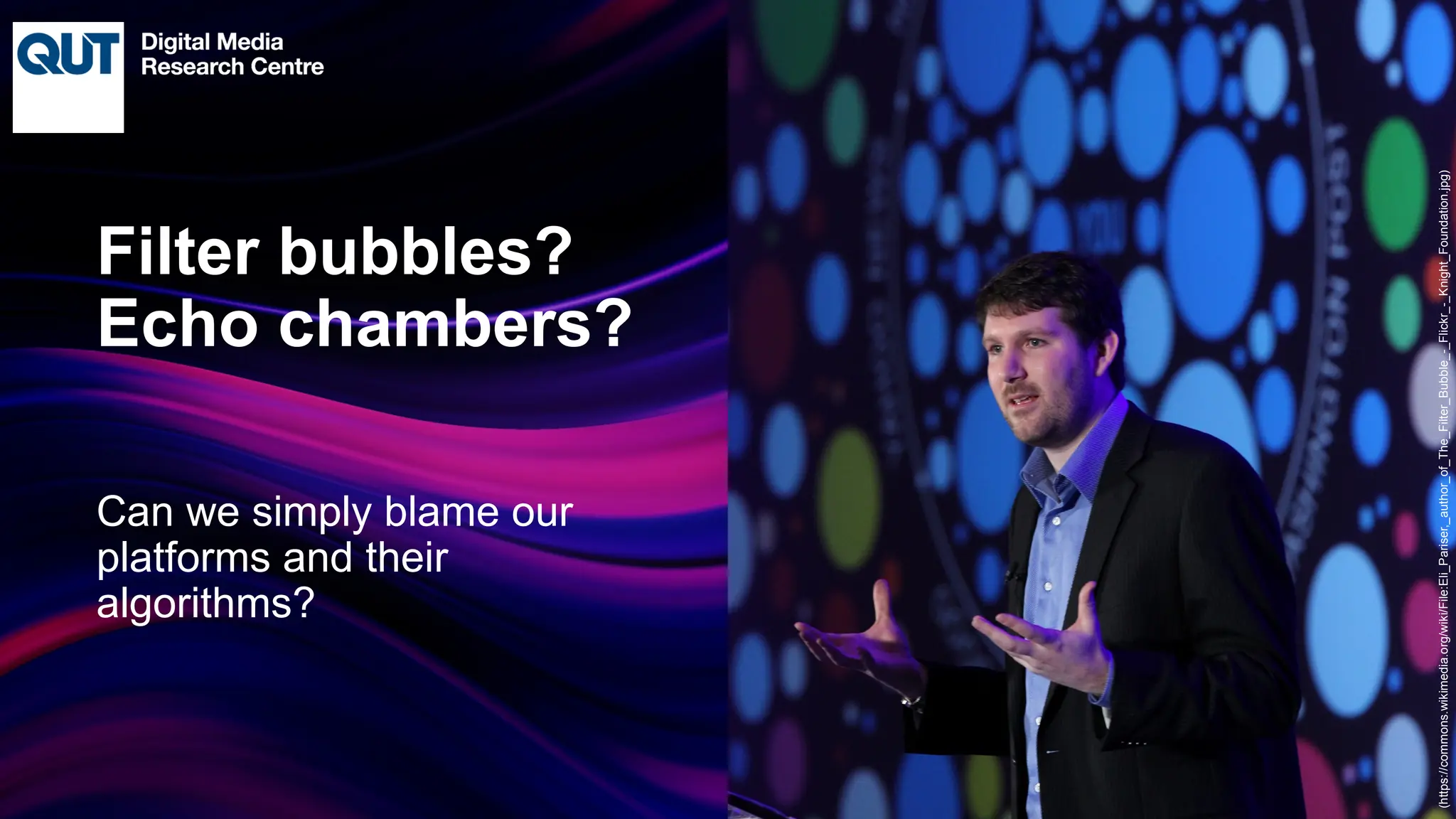
Can we simply blame our
platforms and their
algorithms?
Filter bubbles?
Echo chambers?
(https://commons.wikimedia.org/wiki/File:Eli_Pariser,_author_of_The_Filter_Bubble_-_Flickr_-_Knight_Foundation.jpg)
CRICOS No.00213J
No. Just No.
• No evidence for ‘hard’ echo chambers / filter bubbles
• Success of mis- and disinformation campaigns depends on their absence
• Hyperpartisan activists actively seeking out enemies and their content
• Social media are only one part of a more diverse media mix (and themselves very diverse)
• Most people simply don’t care enough about news and politics to get locked in
• ‘Mild’ echo chambers / filter bubbles are an oxymoron
• Mild selective attachment is nothing new, and doesn’t prevent encounters with diverse views
• We already have names for this: communities of interest, counterpublics, parasitic publics
• Yes, these groups can be deeply problematic – but not because they’re echo chambers
• We must confront the underlying issues, not blame technology for societal problems
• (Yes, there are serious problems with social media platforms. No, not these ones.)
CRICOS No.00213J
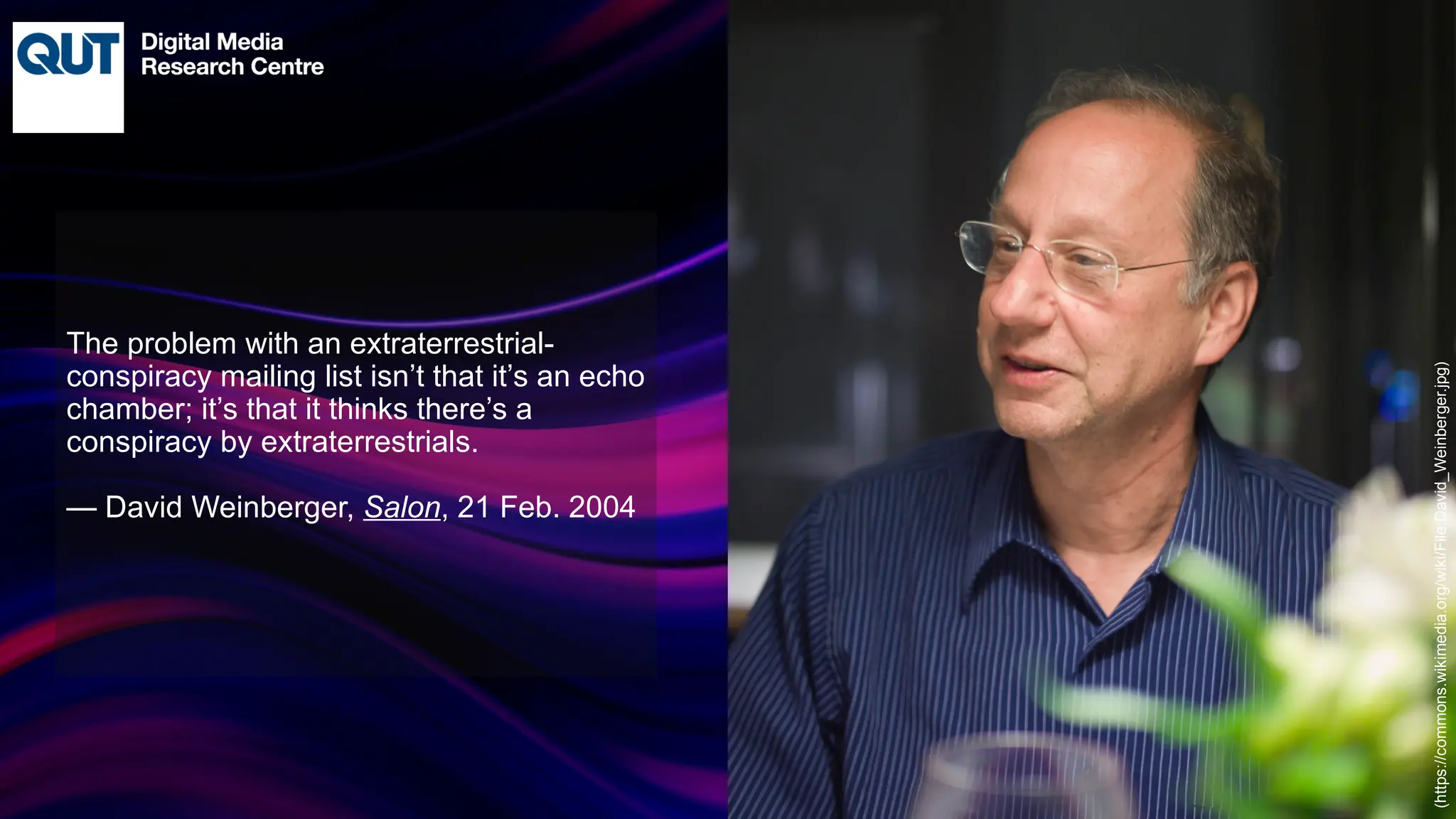
The problem with an extraterrestrial-
conspiracy mailing list isn’t that it’s an echo
chamber; it’s that it thinks there’s a
conspiracy by extraterrestrials.
— David Weinberger, Salon, 21 Feb. 2004
(https://commons.wikimedia.org/wiki/File:David_Weinberger.jpg)
CRICOS No.00213J
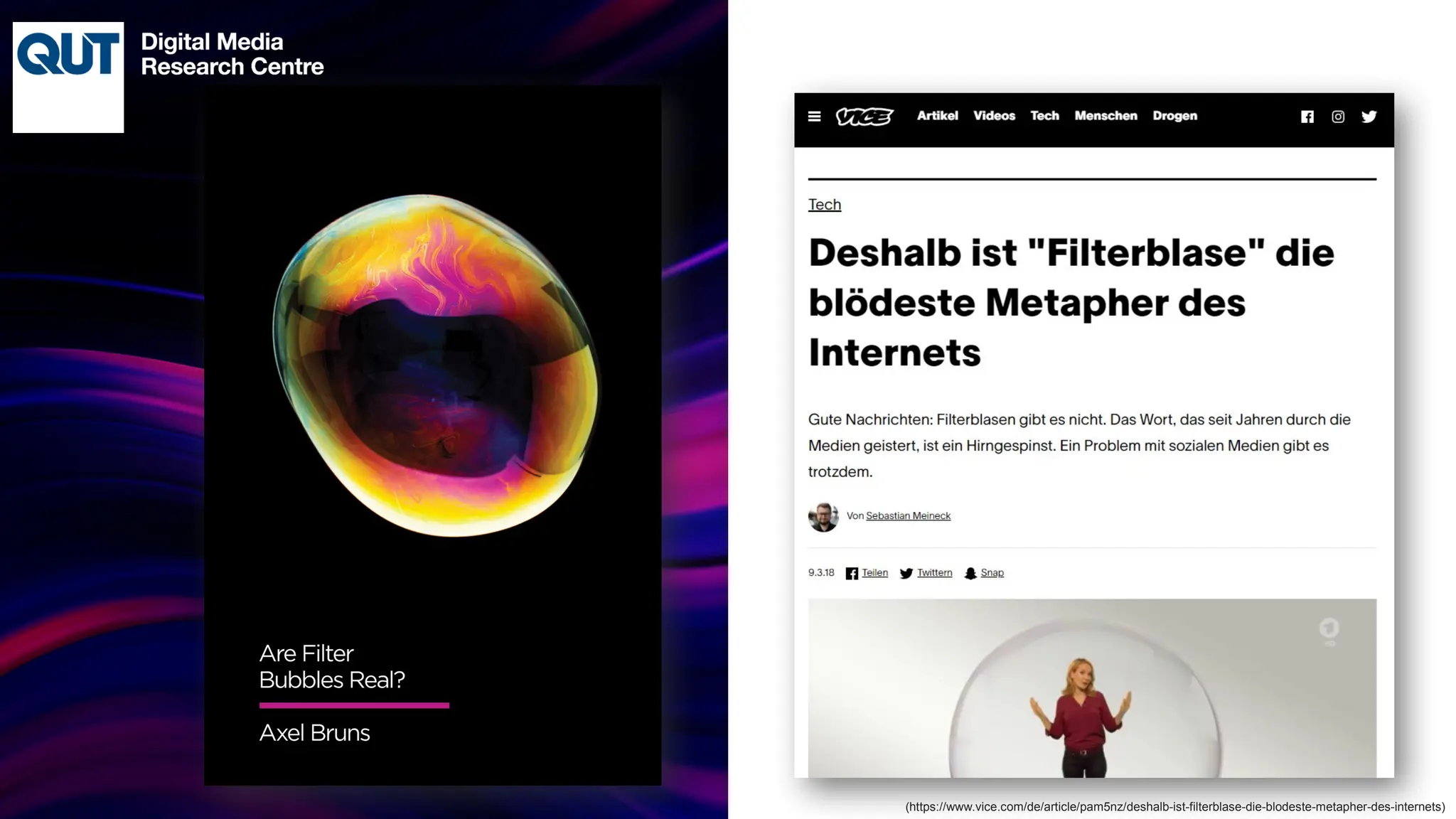
(https://www.vice.com/de/article/pam5nz/deshalb-ist-filterblase-die-blodeste-metapher-des-internets)
CRICOS No.00213J
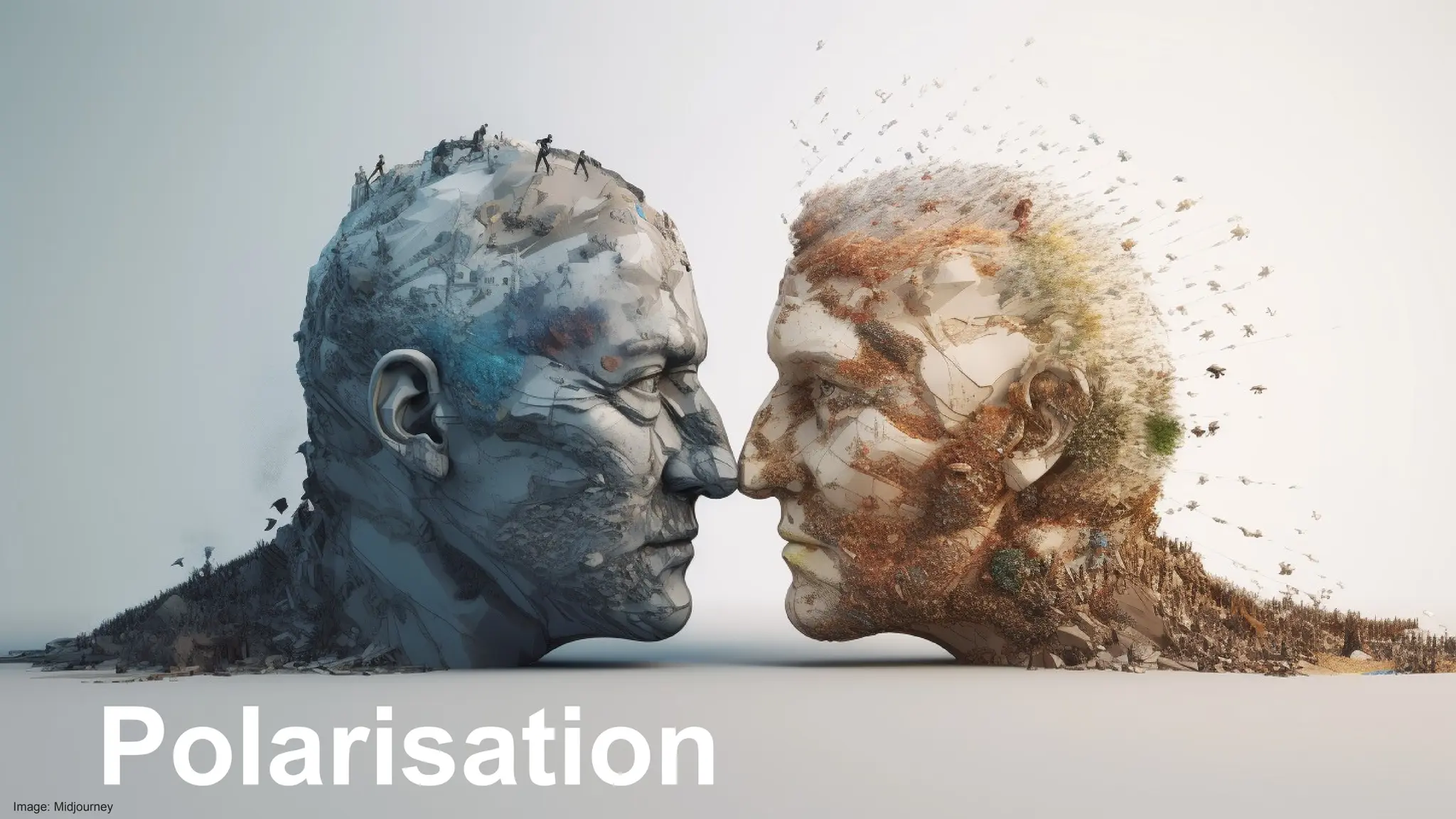
Image: Midjourney
Polarisation
CRICOS No.00213J
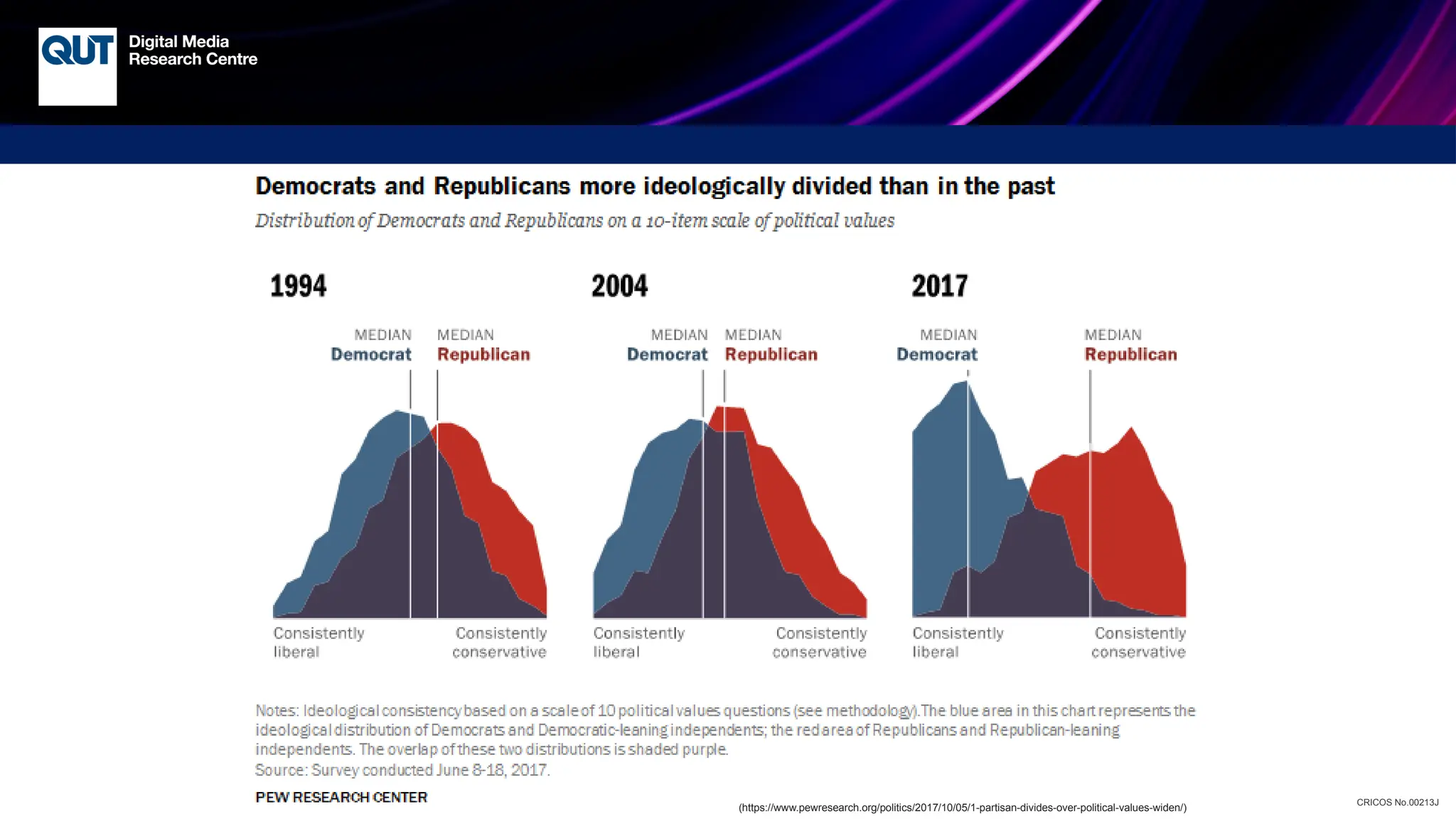
(https://www.pewresearch.org/politics/2017/10/05/1-partisan-divides-over-political-values-widen/)
CRICOS No.00213J
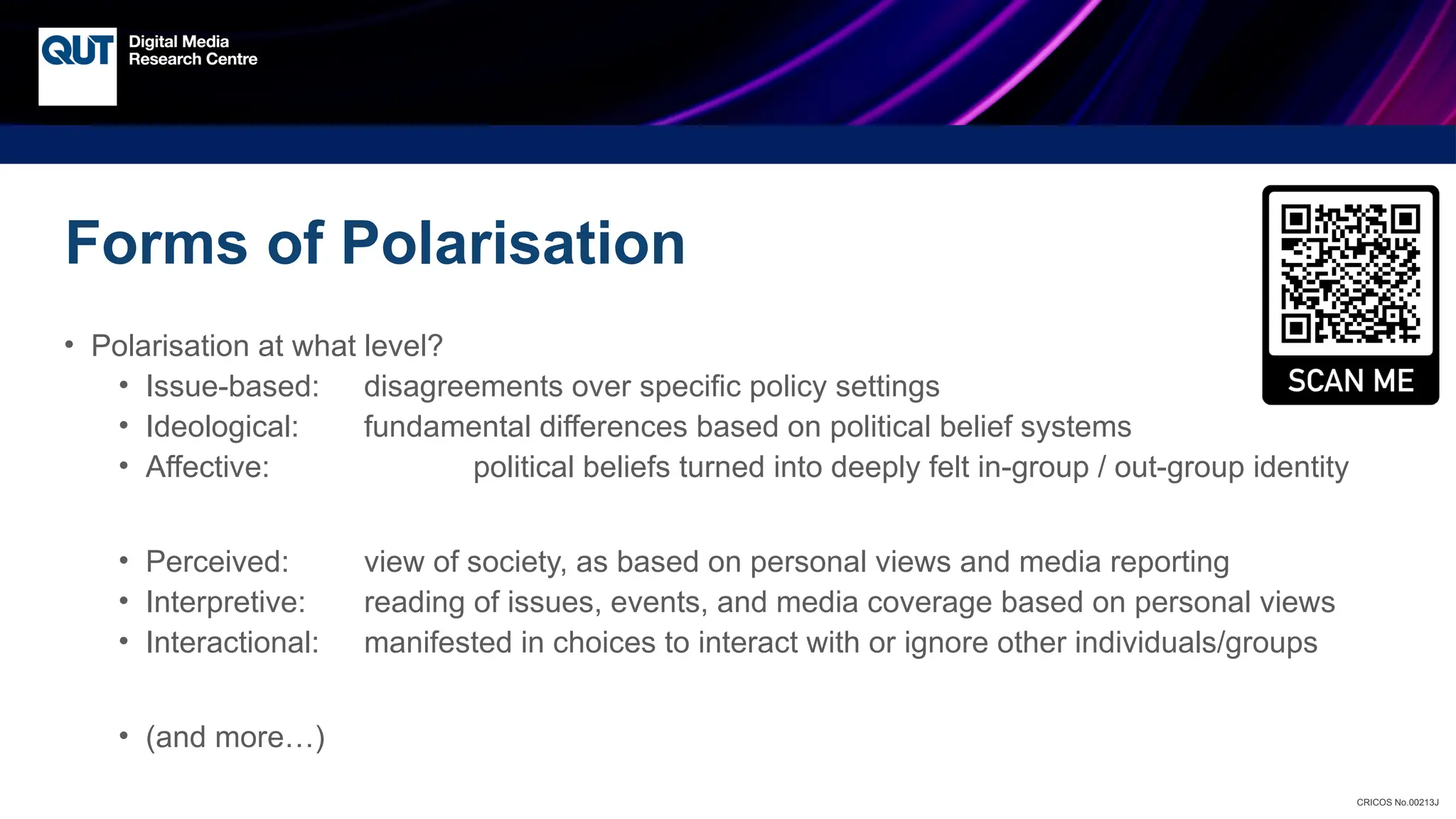
Forms of Polarisation
• Polarisation at what level?
• Issue-based: disagreements over specific policy settings
• Ideological: fundamental differences based on political belief systems
• Affective: political beliefs turned into deeply felt in-group / out-group identity
• Perceived: view of society, as based on personal views and media reporting
• Interpretive: reading of issues, events, and media coverage based on personal views
• Interactional: manifested in choices to interact with or ignore other individuals/groups
• (and more…)
CRICOS No.00213J
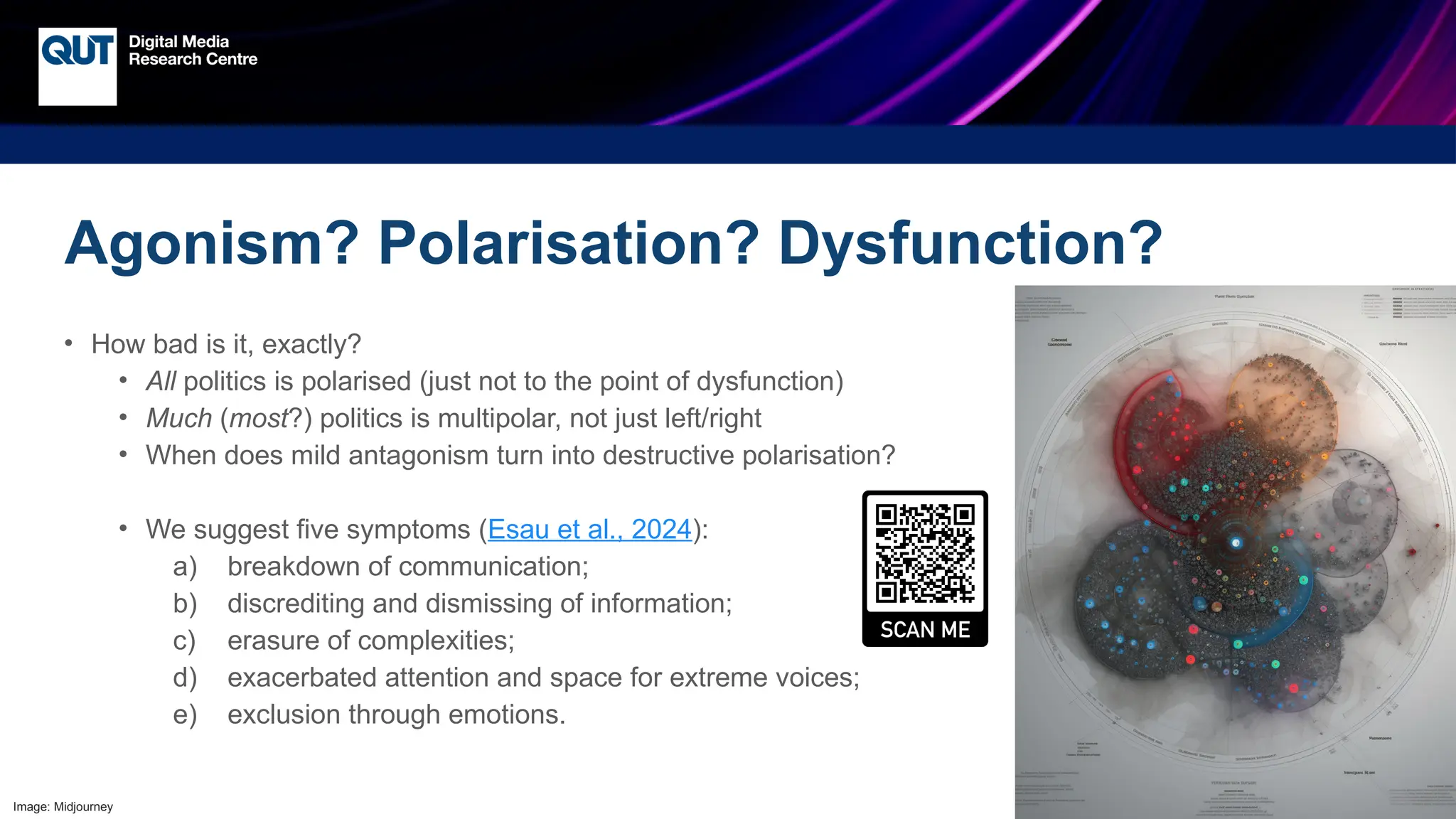
Agonism? Polarisation? Dysfunction?
• How bad is it, exactly?
• All politics is polarised (just not to the point of dysfunction)
• Much (most?) politics is multipolar, not just left/right
• When does mild antagonism turn into destructive polarisation?
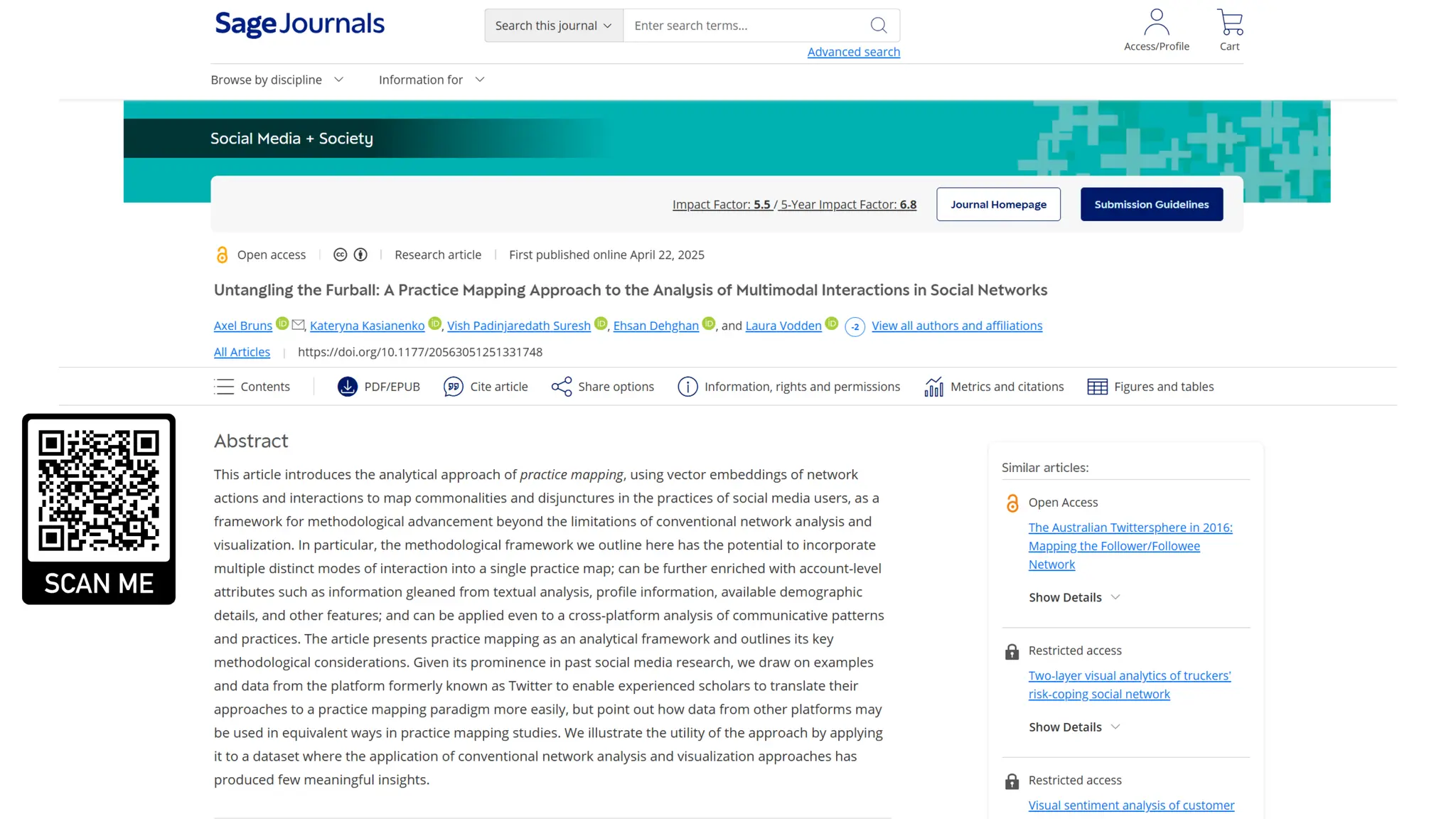
• We suggest five symptoms (Esau et al., 2024):
a) breakdown of communication;
b) discrediting and dismissing of information;
c) erasure of complexities;
d) exacerbated attention and space for extreme voices;
e) exclusion through emotions.
Image: Midjourney
CRICOS No.00213J
Practice:
the sum total of each account’s actions and
interactions – its patterns of engagement with other
accounts, its use of language, its sharing of URLs,
images, and videos, etc.
Practice Mapping
CRICOS No.00213J
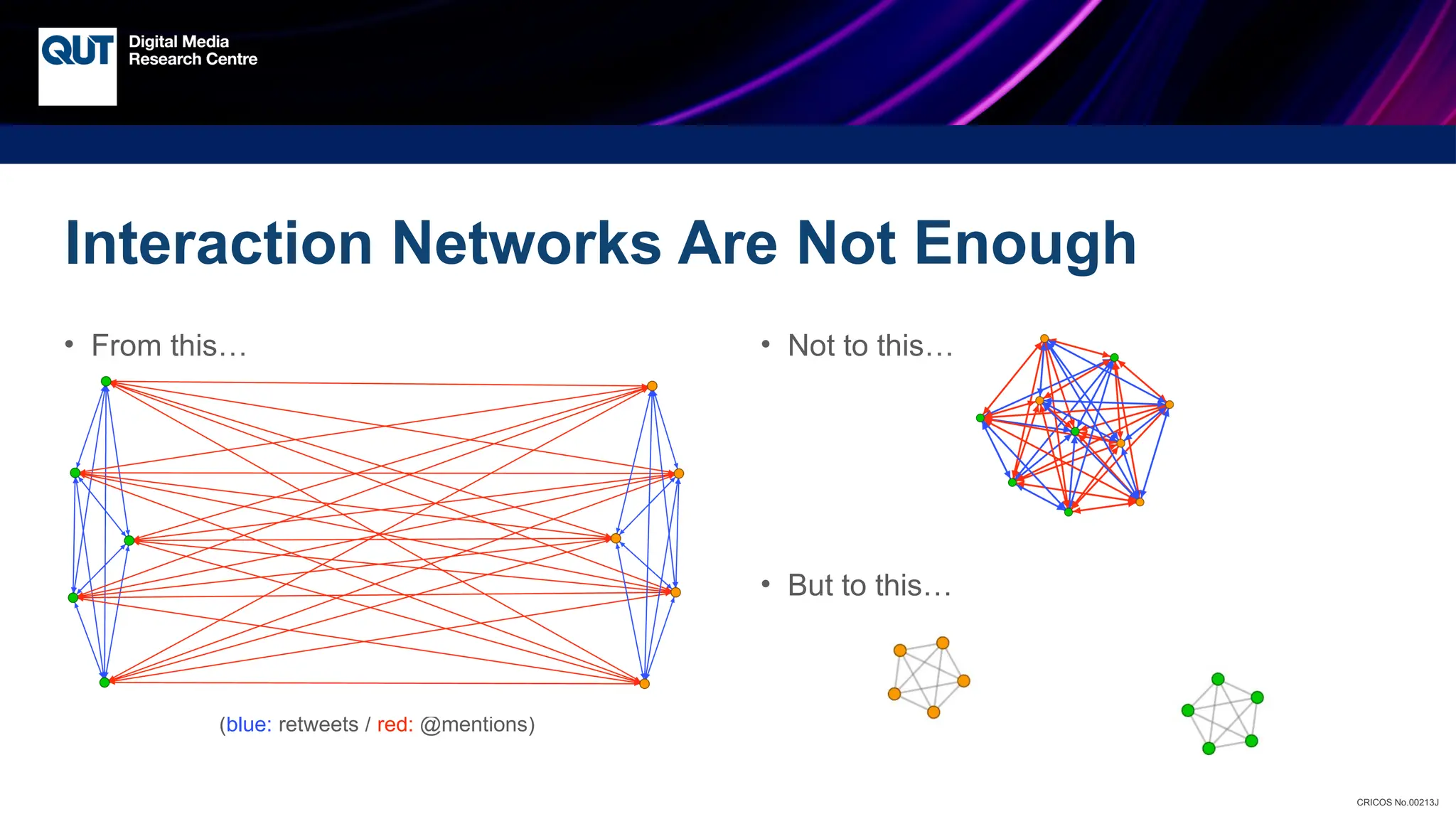
• From this…
(blue: retweets / red: @mentions)
• Not to this…
• But to this…
Interaction Networks Are Not Enough
CRICOS No.00213J
When Social Network Analysis Fails…
• What’s the problem?
• Difficulty in combining various multi-modal interactions into one graph:
• E.g. @mentions, @replies, retweets, quote tweets, follower relationships, …
• Difficulty in representing directionality:
• E.g. distinguishing between reciprocal and non-reciprocal @replies, retweets, …
• Difficulty in interpreting ‘community detection’ results:
• Popular algorithms may ignore directionality / reciprocality
• Clusters of interconnected accounts are not necessarily actual communities
• (… and more …)
CRICOS No.00213J
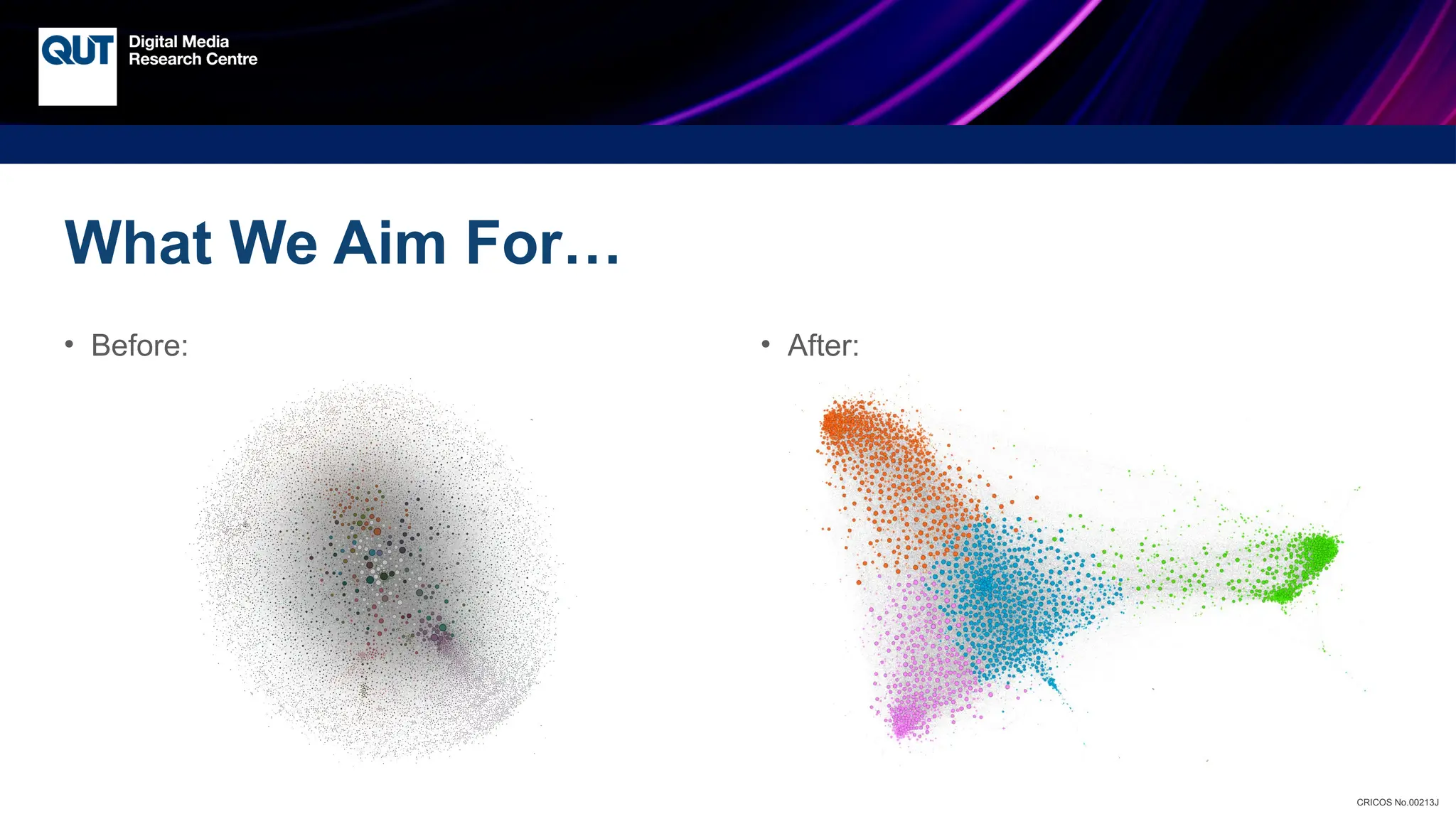
• Before: • After:
What We Aim For…
CRICOS No.00213J
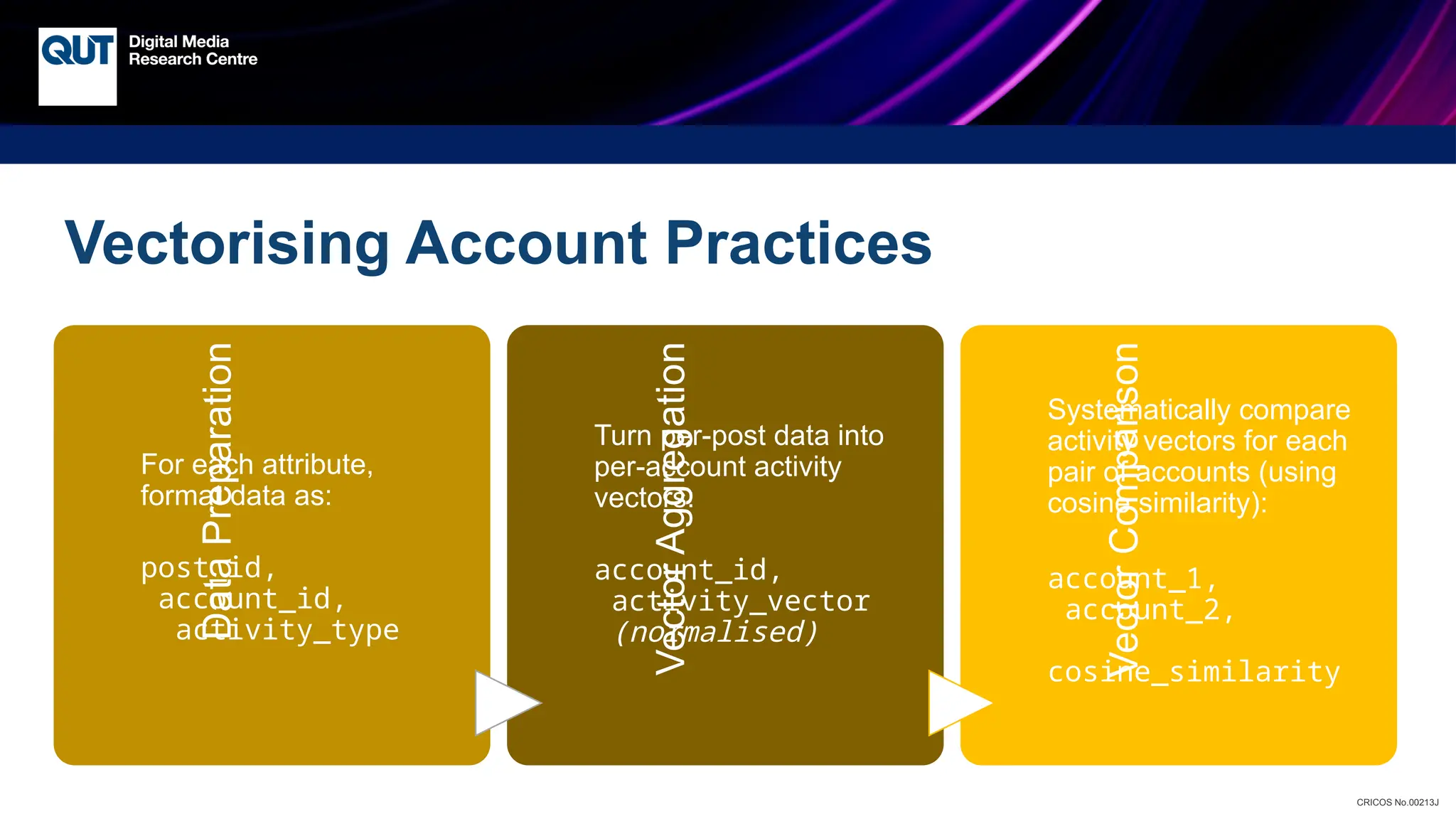
Vectorising Account Practices
Data
Preparation
For each attribute,
format data as:
post_id,
account_id,
activity_type
Vector
Aggregation
Turn per-post data into
per-account activity
vectors:
account_id,
activity_vector
(normalised)
Vector
Comparison
Systematically compare
activity vectors for each
pair of accounts (using
cosine similarity):
account_1,
account_2,
cosine_similarity
CRICOS No.00213J
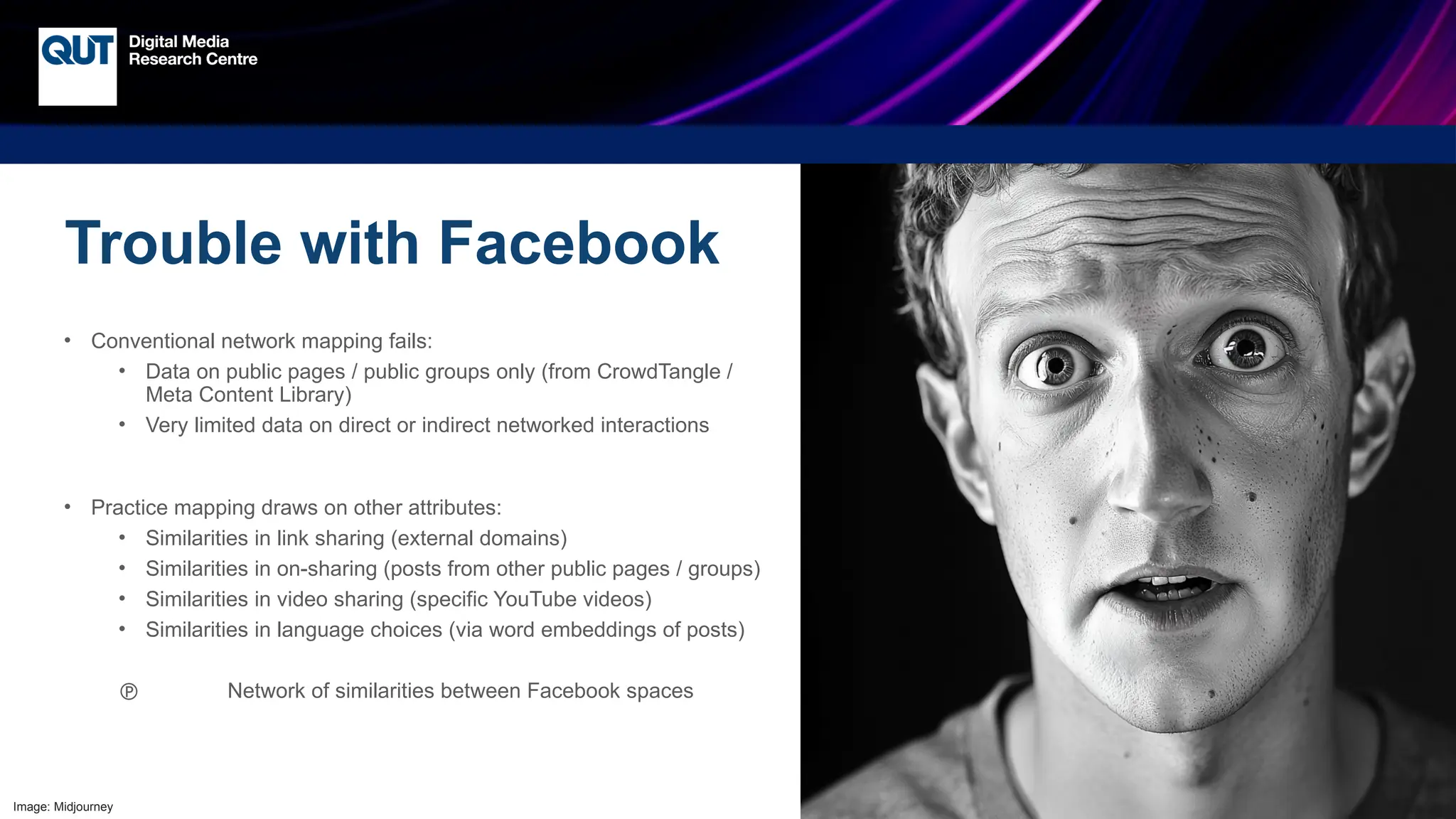
Trouble with Facebook
• Conventional network mapping fails:
• Data on public pages / public groups only (from CrowdTangle /
Meta Content Library)
• Very limited data on direct or indirect networked interactions
• Practice mapping draws on other attributes:
• Similarities in link sharing (external domains)
• Similarities in on-sharing (posts from other public pages / groups)
• Similarities in video sharing (specific YouTube videos)
• Similarities in language choices (via word embeddings of posts)
 Network of similarities between Facebook spaces
Image: Midjourney
CRICOS No.00213J
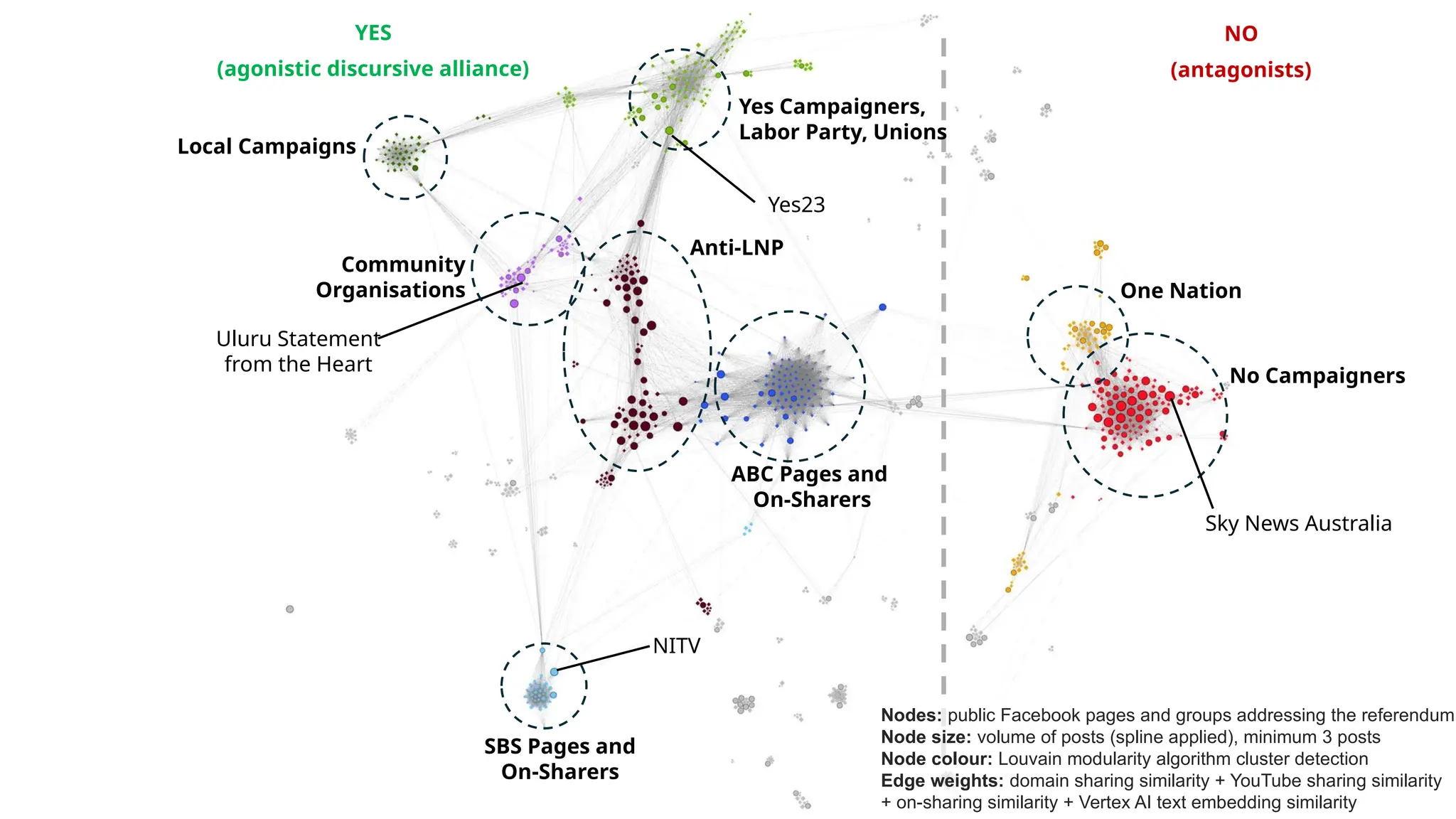
Dataset: posts about the Voice to Parliament constitutional
referendum in Australia, from public Facebook pages and
groups (1 Jan. to 13 Oct. 2023)
Practice attributes: domains shared, YouTube videos shared,
posts on-shared, language choices
Voice to Parliament
Sky News Australia
No Campaigners
Anti-LNP
ABC Pages and
On-Sharers
Uluru Statement
from the Heart
Yes23
Community
Organisations
SBS Pages and
On-Sharers
YES NO
(agonistic discursive alliance) (antagonists)
One Nation
Yes Campaigners,
Labor Party, Unions
Local Campaigns
NITV
Nodes: public Facebook pages and groups addressing the referendum
Node size: volume of posts (spline applied), minimum 3 posts
Node colour: Louvain modularity algorithm cluster detection
Edge weights: domain sharing similarity + YouTube sharing similarity
+ on-sharing similarity + Vertex AI text embedding similarity
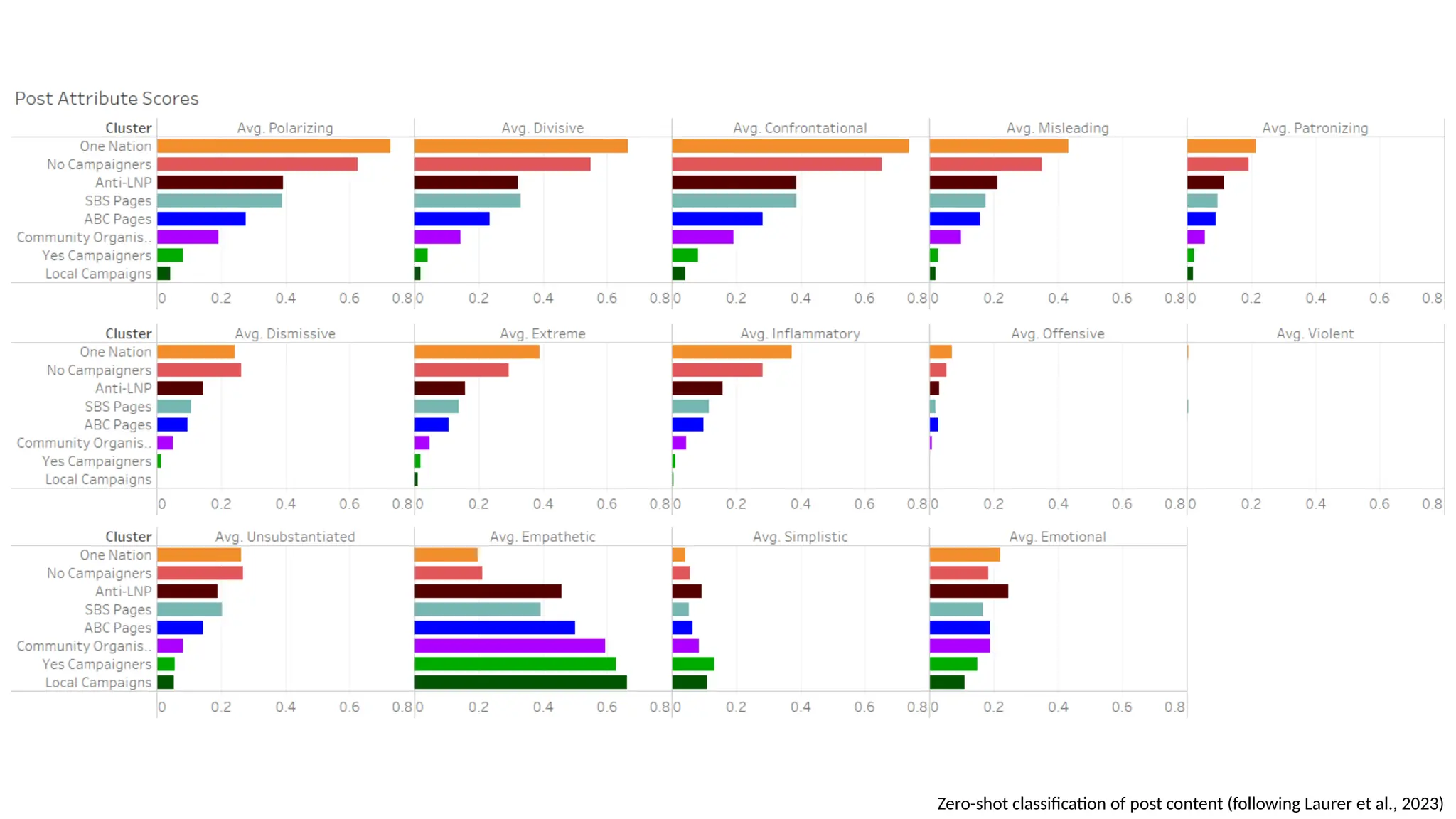
Zero-shot classification of post content (following Laurer et al., 2023)
CRICOS No.00213J
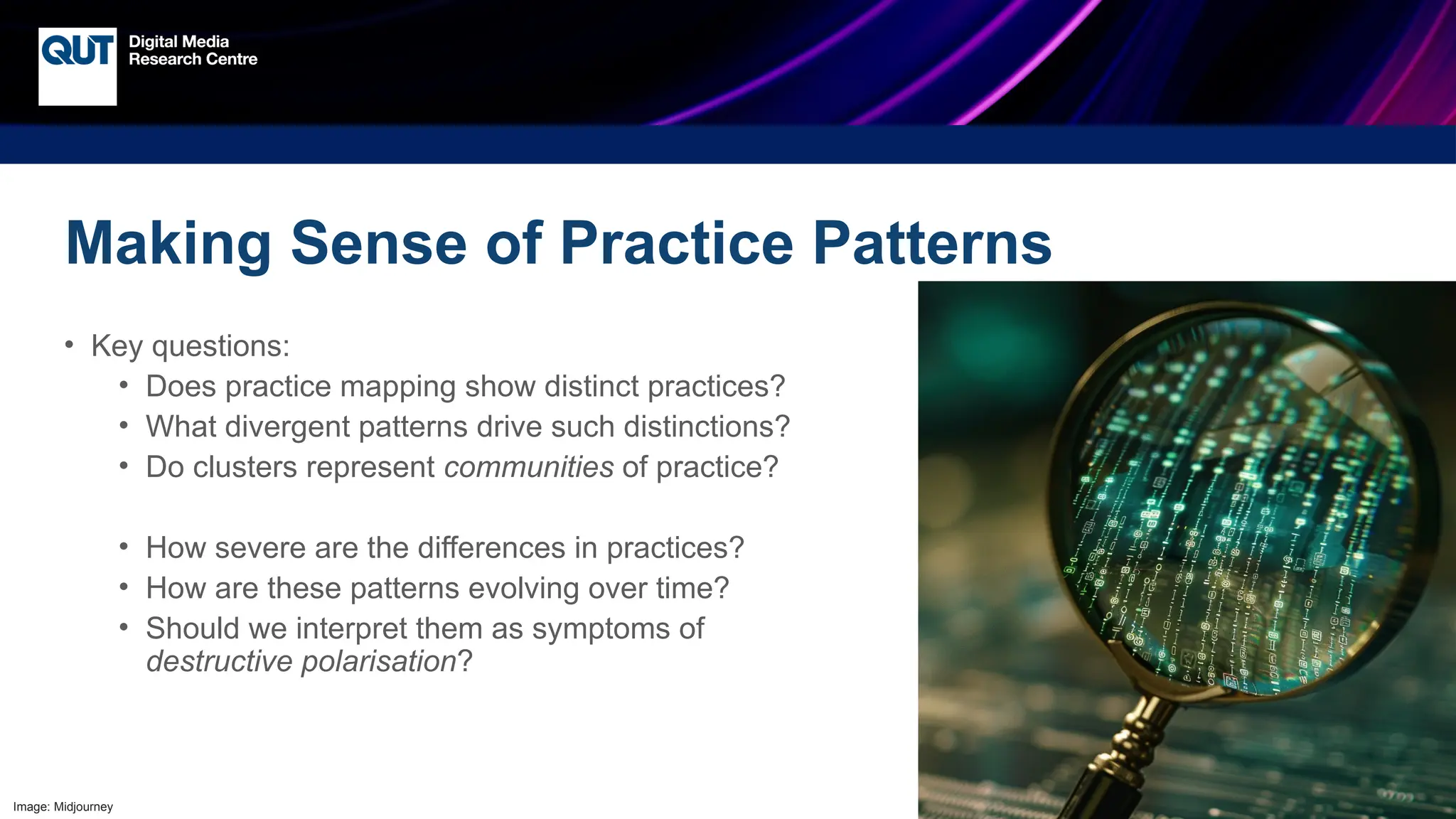
Making Sense of Practice Patterns
• Key questions:
• Does practice mapping show distinct practices?
• What divergent patterns drive such distinctions?
• Do clusters represent communities of practice?
• How severe are the differences in practices?
• How are these patterns evolving over time?
• Should we interpret them as symptoms of
destructive polarisation?
Image: Midjourney
CRICOS No.00213J
Thank you
Image: Midjourney
MON2FEB- FRI6FEB2025
QUTKELVINGROVECAMPUS
2026
SUMMER
SCHOOL
DIGITAL MEDIA RESEARCH CENTRE
Registernowtoattend
the
Open to research students in Master or Doctorate programs, as
well as to early career researchers. Join us for a week of inspiring
and thought-provoking training by world-leading DMRC
researchers.
The Summer School focusses on theories, approaches, methods
and digital research skills, and will allow you to build career-long
connections with digital media researchers from around the
world. Delegate registrations open on Monday
13th October
. Please formally register to
attendbynolaterthan5pm AESTFriday
19December2025.
CRICOS No.00213J
This research is supported by the Australian Research Council through the
Australian Laureate Fellowship project Determining the Dynamics of
Partisanship and Polarisation in Online Public Debate.
Acknowledgments
Diagnosing Destructive Polarisation in Public Discourse: The Practice Mapping Framework

  • 1.
    CRICOS No.00213J Diagnosing DestructivePolarisation in Public Discourse: The Practice Mapping Framework Axel Bruns, Katharina Esau, Kateryna Kasianenko, Tariq Choucair, Vish Padinjaredath Suresh Digital Media Research Centre Queensland University of Technology Brisbane, Australia [email protected] Bluesky: @snurb.info | Mastodon: @[email protected] | Xitter: @snurb_dot_info
  • 2.
  • 3.
    2026 SUMMER SCHOOL DIGITAL MEDIA RESEARCHCENTRE MON2FEB-FRI6FEB2026 QUEENSLANDUNIVERSITYOFTECHNOLOGY,BRISBANE Seehereformoredetails
  • 4.
    CRICOS No.00213J Filter Bubbles?Echo Chambers? No: Polarisation – Constructive or Destructive Practice Mapping to Detect Symptoms Roadmap
  • 5.
    CRICOS No.00213J Can wesimply blame our platforms and their algorithms? Filter bubbles? Echo chambers? (https://commons.wikimedia.org/wiki/File:Eli_Pariser,_author_of_The_Filter_Bubble_-_Flickr_-_Knight_Foundation.jpg)
  • 6.
    CRICOS No.00213J No. JustNo. • No evidence for ‘hard’ echo chambers / filter bubbles • Success of mis- and disinformation campaigns depends on their absence • Hyperpartisan activists actively seeking out enemies and their content • Social media are only one part of a more diverse media mix (and themselves very diverse) • Most people simply don’t care enough about news and politics to get locked in • ‘Mild’ echo chambers / filter bubbles are an oxymoron • Mild selective attachment is nothing new, and doesn’t prevent encounters with diverse views • We already have names for this: communities of interest, counterpublics, parasitic publics • Yes, these groups can be deeply problematic – but not because they’re echo chambers • We must confront the underlying issues, not blame technology for societal problems • (Yes, there are serious problems with social media platforms. No, not these ones.)
  • 7.
    CRICOS No.00213J The problemwith an extraterrestrial- conspiracy mailing list isn’t that it’s an echo chamber; it’s that it thinks there’s a conspiracy by extraterrestrials. — David Weinberger, Salon, 21 Feb. 2004 (https://commons.wikimedia.org/wiki/File:David_Weinberger.jpg)
  • 8.
  • 9.
  • 10.
  • 11.
    CRICOS No.00213J Forms ofPolarisation • Polarisation at what level? • Issue-based: disagreements over specific policy settings • Ideological: fundamental differences based on political belief systems • Affective: political beliefs turned into deeply felt in-group / out-group identity • Perceived: view of society, as based on personal views and media reporting • Interpretive: reading of issues, events, and media coverage based on personal views • Interactional: manifested in choices to interact with or ignore other individuals/groups • (and more…)
  • 12.
    CRICOS No.00213J Agonism? Polarisation?Dysfunction? • How bad is it, exactly? • All politics is polarised (just not to the point of dysfunction) • Much (most?) politics is multipolar, not just left/right • When does mild antagonism turn into destructive polarisation? • We suggest five symptoms (Esau et al., 2024): a) breakdown of communication; b) discrediting and dismissing of information; c) erasure of complexities; d) exacerbated attention and space for extreme voices; e) exclusion through emotions. Image: Midjourney
  • 13.
    CRICOS No.00213J Practice: the sumtotal of each account’s actions and interactions – its patterns of engagement with other accounts, its use of language, its sharing of URLs, images, and videos, etc. Practice Mapping
  • 15.
    CRICOS No.00213J • Fromthis… (blue: retweets / red: @mentions) • Not to this… • But to this… Interaction Networks Are Not Enough
  • 16.
    CRICOS No.00213J When SocialNetwork Analysis Fails… • What’s the problem? • Difficulty in combining various multi-modal interactions into one graph: • E.g. @mentions, @replies, retweets, quote tweets, follower relationships, … • Difficulty in representing directionality: • E.g. distinguishing between reciprocal and non-reciprocal @replies, retweets, … • Difficulty in interpreting ‘community detection’ results: • Popular algorithms may ignore directionality / reciprocality • Clusters of interconnected accounts are not necessarily actual communities • (… and more …)
  • 17.
    CRICOS No.00213J • Before:• After: What We Aim For…
  • 18.
    CRICOS No.00213J Vectorising AccountPractices Data Preparation For each attribute, format data as: post_id, account_id, activity_type Vector Aggregation Turn per-post data into per-account activity vectors: account_id, activity_vector (normalised) Vector Comparison Systematically compare activity vectors for each pair of accounts (using cosine similarity): account_1, account_2, cosine_similarity
  • 19.
    CRICOS No.00213J Trouble withFacebook • Conventional network mapping fails: • Data on public pages / public groups only (from CrowdTangle / Meta Content Library) • Very limited data on direct or indirect networked interactions • Practice mapping draws on other attributes: • Similarities in link sharing (external domains) • Similarities in on-sharing (posts from other public pages / groups) • Similarities in video sharing (specific YouTube videos) • Similarities in language choices (via word embeddings of posts)  Network of similarities between Facebook spaces Image: Midjourney
  • 20.
    CRICOS No.00213J Dataset: postsabout the Voice to Parliament constitutional referendum in Australia, from public Facebook pages and groups (1 Jan. to 13 Oct. 2023) Practice attributes: domains shared, YouTube videos shared, posts on-shared, language choices Voice to Parliament
  • 21.
    Sky News Australia NoCampaigners Anti-LNP ABC Pages and On-Sharers Uluru Statement from the Heart Yes23 Community Organisations SBS Pages and On-Sharers YES NO (agonistic discursive alliance) (antagonists) One Nation Yes Campaigners, Labor Party, Unions Local Campaigns NITV Nodes: public Facebook pages and groups addressing the referendum Node size: volume of posts (spline applied), minimum 3 posts Node colour: Louvain modularity algorithm cluster detection Edge weights: domain sharing similarity + YouTube sharing similarity + on-sharing similarity + Vertex AI text embedding similarity
  • 22.
    Zero-shot classification ofpost content (following Laurer et al., 2023)
  • 24.
    CRICOS No.00213J Making Senseof Practice Patterns • Key questions: • Does practice mapping show distinct practices? • What divergent patterns drive such distinctions? • Do clusters represent communities of practice? • How severe are the differences in practices? • How are these patterns evolving over time? • Should we interpret them as symptoms of destructive polarisation? Image: Midjourney
  • 25.
  • 26.
    MON2FEB- FRI6FEB2025 QUTKELVINGROVECAMPUS 2026 SUMMER SCHOOL DIGITAL MEDIARESEARCH CENTRE Registernowtoattend the Open to research students in Master or Doctorate programs, as well as to early career researchers. Join us for a week of inspiring and thought-provoking training by world-leading DMRC researchers. The Summer School focusses on theories, approaches, methods and digital research skills, and will allow you to build career-long connections with digital media researchers from around the world. Delegate registrations open on Monday 13th October . Please formally register to attendbynolaterthan5pm AESTFriday 19December2025.
  • 27.
    CRICOS No.00213J This researchis supported by the Australian Research Council through the Australian Laureate Fellowship project Determining the Dynamics of Partisanship and Polarisation in Online Public Debate. Acknowledgments