
Thank you for visiting nature.com. You are using a browser version with limited support for CSS. To obtain the best experience, we recommend you use a more up to date browser (or turn off compatibility mode in Internet Explorer). In the meantime, to ensure continued support, we are displaying the site without styles and JavaScript.

Volume 10 Issue 7, July 2026

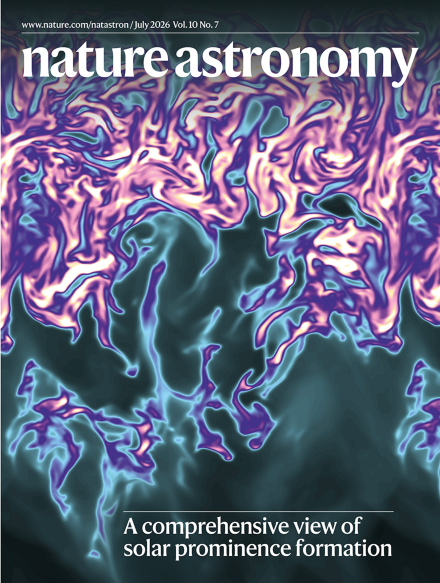
A comprehensive view of solar prominence formation

Comprehensive three-dimensional numerical simulations reproduce solar prominences of various shapes and sizes, highlighting the importance of self-consistently modelling physical processes across the solar atmospheric layers.

See Zessner et al.

Image: Lisa-Marie Zessner. Cover design: Bethany Vukomanovic
Editorial

  • For a long time, gravitational wave astronomy has been a data-scarce field. That status seems to be changing as existing detectors find ever more compact-object mergers and plans for new instruments take shape.

    Editorial

    Advertisement

Top of page ⤴

Comment & Opinion

  • We can do more than defend science from a flood of AI-assisted papers. Used well, AI offers a historic opportunity to correct distortions in the publication system, help us publish fewer and better papers, and give scientists back the time to do their best work.

    • Gianfranco Bertone
    Comment
Top of page ⤴

Research Highlights

Top of page ⤴

News & Views

  • A simulation from sub-photosphere to the corona shows how our Sun forms prominences in a dipped magnetic arcade: through synergy between sporadic injection of chromospheric matter and a siphoned mass supply from thermal instability.

    • Rony Keppens
    News & Views
  • Recent work finds that an influx of microscopic interplanetary meteoric dust particles can provide a plausible explanation for two long standing mysteries of the Venus clouds: the identification of both the lower haze and the unknown UV absorber.

    • Kevin McGouldrick
    News & Views
  • The second international workshop on “AI + Astronomy: Models, Data, Discovery”, held in Lausanne from 31 March to 1 April 2026 convened more than 50 scholars from the EPFL Laboratory of Astrophysics (Versoix, Switzerland) and Zhejiang Lab (Hangzhou, China). The event focused on the transformative impact of artificial intelligence (AI) on data-intensive astronomical research and provided a platform to address the complexities arising from its use.

    • Jean-Paul Kneib
    • Junhui Shi
    Meeting Report
  • This workshop examined the rapidly evolving role of language-based artificial intelligence in astronomy, discussing retrieval-augmented generation, agent-based systems, and multimodal models, alongside challenges around evaluation, trust, and responsible deployment.

    • Kelly Lockhart
    • Ioana Ciucă
    • Jan Reerink
    Meeting Report
  • The IAU’s first fully online symposium brought researchers together from around the globe to discuss technosignatures. Upcoming all-sky surveys, exoplanet missions and tools to search data archives offer new directions for the field.

    • Jacob Haqq-Misra
    Meeting Report
Top of page ⤴

Research Briefings

  • Stellar occultation observations reveal that the trans-Neptunian object 2002 XV93, which has a radius of only ~250 km, is surrounded by a very tenuous atmosphere. The result shows that even a small distant icy body can host a detectable atmosphere, at least transiently.

    Research Briefing
  • For a black hole X-ray binary system, the deflection of its radio jets by the stellar wind has been measured across an entire orbit. By balancing the momentum flux of the jets and the wind, the instantaneous kinetic power of the jet is determined and its value vindicates standard assumptions from cosmological simulations.

    Research Briefing
  • The mass spectrum of binary black-hole mergers has been expected to show a ‘mass gap’ above 45 solar masses, consistent with the physics of pair-instability supernovae. An extensive catalogue of gravitational-wave detections reveals a high-spin population above this threshold that probably results from repeated black-hole mergers in dense star clusters, and fits with the existence of the mass gap. The inferred boundary also constrains the carbon-to-oxygen fusion rate during helium burning in massive stars.

    Research Briefing
Top of page ⤴

Reviews

Top of page ⤴

Research

  • Self-consistent 3D simulations reveal how solar prominences can form and demonstrate dynamic structures that are consistent with observations. Plasma ejected from the surface creates cool structures in the hot solar atmosphere that continue to grow by coronal condensation.

    • Lisa-Marie Zessner
    • Robert H. Cameron
    • Damien Przybylski
    Article Open Access
  • Modelling demonstrates that the Venus’ lower haze originates from cosmic dust. These particles also provide a plausible source for the long-unidentified UV absorber, establishing cosmic dust as a vital component of the planet’s climate system.

    • Hiroki Karyu
    • Takeshi Kuroda
    • Michel Crucifix
    Article
  • Earth’s origin is debated. Meteorites formed in the inner and outer Solar System, but Earth represents an endmember, inner Solar System source alone. Venus and Mercury are predicted to be more extreme, implying a gradient in the inner Solar System.

    • Paolo A. Sossi
    • Dan J. Bower
    Article Open Access
  • A stellar occultation campaign reveals a thin atmosphere around the plutino 2002 XV93, showing that even a modest-sized trans-Neptunian object can host an atmosphere, perhaps through cryovolcanism or a recent impact.

    • Ko Arimatsu
    • Fumi Yoshida
    • Jun-ichi Watanabe
    Article
  • ALMA observations of the interstellar comet 3I/ATLAS provide a limit on the deuterium-to-hydrogen ratio in water. This ratio is a sensitive probe of temperature, suggesting that comet 3I formed in an ultracold environment with minimal thermal processing in its home system.

    • Luis E. Salazar Manzano
    • Teresa Paneque-Carreño
    • John J. Tobin
    Article Open Access
  • LHAASO has detected γ-ray emission with a spectrum extending to 2 PeV from the pulsar wind nebula (PWN) powered by PSR J1849-0001, indicating an extreme particle acceleration efficiency and challenging the current particle acceleration theories.

    • Zhen Cao
    • F. Aharonian
    • X. Zuo
    Article
  • An 18-year high-resolution radio image dataset of Cygnus X-1 has revealed that its radio jets are bent by the stellar wind. Modelling of jet–wind interactions strongly supports the standard assumptions of an accreting black hole in cosmological simulations.

    • S. Prabu
    • J. C. A. Miller-Jones
    • V. Tudose
    Article Open Access
Top of page ⤴

Search

Quick links