Zirconolite
A valid IMA mineral species - grandfathered
This page is currently not sponsored. Click here to sponsor this page.


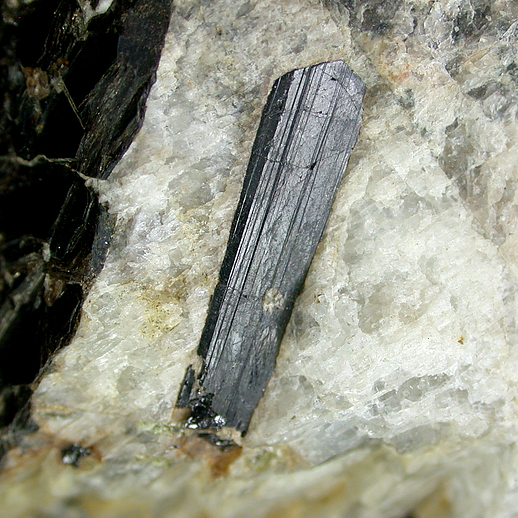
About Zirconolite
Formula:
CaZrTi2O7
Colour:
Black to brown, red
Lustre:
Adamantine, Greasy, Sub-Metallic
Hardness:
5½
Specific Gravity:
4.38 (Calculated)
Crystal System:
Orthorhombic
Name:
Named for the zirconium in its composition.
A complex zirconium titanium oxide with three polytypoids known (2M, 3O, 3T).
Gieré et al. (1998) identified five hypothetical end-members, CaZrTi2O7, CaZrMe5+Me3+O7, ACTZrTiMe2+O7, REEZrTiMe3+O7 and REEZrMe5+Me2+O7.
The last one has been observed as a 53% percentage of REEZrNb(Mn,Fe)O7 in a sample from the Eifel volcanic region (Della Ventura et al., 2000).
Related to laachite. Also compare UM2000-79-O:CaFeMnNbREEThTiZr.
Originally described as a new mineral given the name polymignite by Berzelius (1824) from a syenite pegmatite at Fredriksvärn (now: Stavern), Vestfold, Norway. The specimens were collected by Nils Otto Tank (1800-1864) around 1823-1824, when he was a student of mineralogy. Polymignite at Stavern is metamict. Brögger (1890) described in detail the morphology and the chemical and physical properties. Lima-de-Faria (1958) found that recrystallization at 700℃ of the type material gave a cubic phase (with fluorite structure). Pudovkina et al. (1969) calculated, based on the axial ratios (0.712:1:0.512) given by Brögger (1890) and the cell unit volume, that polymignite is orthorhombic. Later shown to be identical with zirconolite described in 1956, and subsequently discredited in 1988. In spite of its priority and wide use in the literature, polymignite is now considered a metamict, originally orthorhombic variety of zirconolite.
Haifler et al. (2021) investigated three samples of metamict "Polymignite" from different syenite pegmatites near Stavern and found that the chemical composition corresponded to the zirconolite-related minerals stefanweissite and nöggerathite-(Ce).
Gieré et al. (1998) identified five hypothetical end-members, CaZrTi2O7, CaZrMe5+Me3+O7, ACTZrTiMe2+O7, REEZrTiMe3+O7 and REEZrMe5+Me2+O7.
The last one has been observed as a 53% percentage of REEZrNb(Mn,Fe)O7 in a sample from the Eifel volcanic region (Della Ventura et al., 2000).
Related to laachite. Also compare UM2000-79-O:CaFeMnNbREEThTiZr.
Originally described as a new mineral given the name polymignite by Berzelius (1824) from a syenite pegmatite at Fredriksvärn (now: Stavern), Vestfold, Norway. The specimens were collected by Nils Otto Tank (1800-1864) around 1823-1824, when he was a student of mineralogy. Polymignite at Stavern is metamict. Brögger (1890) described in detail the morphology and the chemical and physical properties. Lima-de-Faria (1958) found that recrystallization at 700℃ of the type material gave a cubic phase (with fluorite structure). Pudovkina et al. (1969) calculated, based on the axial ratios (0.712:1:0.512) given by Brögger (1890) and the cell unit volume, that polymignite is orthorhombic. Later shown to be identical with zirconolite described in 1956, and subsequently discredited in 1988. In spite of its priority and wide use in the literature, polymignite is now considered a metamict, originally orthorhombic variety of zirconolite.
Haifler et al. (2021) investigated three samples of metamict "Polymignite" from different syenite pegmatites near Stavern and found that the chemical composition corresponded to the zirconolite-related minerals stefanweissite and nöggerathite-(Ce).
Unique Identifiers
Mindat ID:
4422
Long-form identifier:
mindat:1:1:4422:2
IMA Classification of Zirconolite
Approved, 'Grandfathered' (first described prior to 1959)
IMA status notes:
Redefined by the IMA
IMA Formula:
(Ca,Y)Zr(Ti,Mg,Al)2O7
First published:
1956
Approval history:
Redefined 1989 s.p.: Bayliss et al. (1989).
Classification of Zirconolite
4.DH.30
4 : OXIDES (Hydroxides, V[5,6] vanadates, arsenites, antimonites, bismuthites, sulfites, selenites, tellurites, iodates)
D : Metal: Oxygen = 1:2 and similar
H : With large (+- medium-sized) cations; sheets of edge-sharing octahedra
4 : OXIDES (Hydroxides, V[5,6] vanadates, arsenites, antimonites, bismuthites, sulfites, selenites, tellurites, iodates)
D : Metal: Oxygen = 1:2 and similar
H : With large (+- medium-sized) cations; sheets of edge-sharing octahedra
8.2.5.5
8 : MULTIPLE OXIDES CONTAINING NIOBIUM,TANTALUM OR TITANIUM
2 : A2B2O6(O,OH,F)
8 : MULTIPLE OXIDES CONTAINING NIOBIUM,TANTALUM OR TITANIUM
2 : A2B2O6(O,OH,F)
7.10.5
7 : Oxides and Hydroxides
10 : Oxides of Zr and Th
7 : Oxides and Hydroxides
10 : Oxides of Zr and Th
Mineral Symbols
As of 2021 there are now IMA–CNMNC approved mineral symbols (abbreviations) for each mineral species, useful for tables and diagrams.
Please only use the official IMA–CNMNC symbol. Older variants are listed for historical use only.
Please only use the official IMA–CNMNC symbol. Older variants are listed for historical use only.
| Symbol | Source | Reference for Standard |
|---|---|---|
| Zrc | IMA–CNMNC | Warr, L.N. (2021). IMA–CNMNC approved mineral symbols. Mineralogical Magazine, 85(3), 291-320. doi:10.1180/mgm.2021.43 |
| Zrc | The Canadian Mineralogist (2019) | The Canadian Mineralogist (2019) The Canadian Mineralogist list of symbols for rock- and ore-forming minerals (December 30, 2019). download |
Physical Properties of Zirconolite
Adamantine, Greasy, Sub-Metallic
Transparency:
Translucent, Opaque
Colour:
Black to brown, red
Streak:
Dark brown, brownish yellow
Hardness:
5½ on Mohs scale
Tenacity:
Brittle
Cleavage:
Imperfect/Fair
{100}, {010} in traces
{100}, {010} in traces
Fracture:
Irregular/Uneven, Conchoidal
Density:
4.38 g/cm3 (Calculated)
Optical Data of Zirconolite
Type:
Isotropic
RI values:
n = 2.06 - 2.17
Birefringence:
Isotropic minerals have no birefringence
Surface Relief:
Very High
Dispersion:
r > v strong
Chemistry of Zirconolite
Mindat Formula:
CaZrTi2O7
Element Weights:
Elements listed:
Crystallography of Zirconolite
Polytype:
Formula:
Crystal System:
Class (H-M)
Space Group:
Space Group Setting:
Cell Parameters:
Ratio:
Unit Cell Volume (calc):
Z:
Comment:
| Zirconolite-2M | Zirconolite-3O | Zirconolite-3T |
|---|---|---|
| (Ca,REE)2Zr2(Ti,Nb)3FeO14 | (Ca,REE)2Zr2(Ti,Nb)3FeO14 | (Ca,REE)2Zr2(Ti,Nb)3FeO14 |
| Monoclinic | Orthorhombic | Trigonal |
| 2/m - Prismatic | mmm (2/m 2/m 2/m) - Dipyramidal | 3 2 - Trapezohedral |
| B2/b | P31 2 1 | |
| C2/c | ||
| a = 12.443(1) Å, b = 7.224(1) Å, c = 11.483(3) Å β = 100.59(1)° | a = 10.148(4) Å, b = 14.147(5) Å, c = 7.278(3) Å | a = 7.287(2) Å, c = 16.886(9) Å |
| a:b:c = 1.722 : 1 : 1.59 | a:b:c = 0.717 : 1 : 0.514 | a:c = 1 : 2.317 |
| V 1,014.61 ų (Calculated from Unit Cell) | V 1,044.86 ų (Calculated from Unit Cell) | V 776.52 ų (Calculated from Unit Cell) |
| 8 | 8 | 3 |
| Space Group: C2/c or Cc | Space group Acam. |
Crystal Structure
Load
Unit Cell | Unit Cell Packed
2x2x2 | 3x3x3 | 4x4x4
Unit Cell | Unit Cell Packed
2x2x2 | 3x3x3 | 4x4x4
Show
Big Balls | Small Balls | Just Balls | Spacefill
Polyhedra Off | Si Polyhedra | All Polyhedra
Remove metal-metal sticks
Big Balls | Small Balls | Just Balls | Spacefill
Polyhedra Off | Si Polyhedra | All Polyhedra
Remove metal-metal sticks
Display Options
Black Background | White Background
Perspective On | Perspective Off
2D | Stereo | Red-Blue | Red-Cyan
Black Background | White Background
Perspective On | Perspective Off
2D | Stereo | Red-Blue | Red-Cyan
View
CIF File Best | x | y | z | a | b | c
CIF File Best | x | y | z | a | b | c
Rotation
Stop | Start
Stop | Start
Labels
Console Off | On | Grey | Yellow
Console Off | On | Grey | Yellow
Data courtesy of the American Mineralogist Crystal Structure Database. Click on an AMCSD ID to view structure
| ID | Species | Reference | Link | Year | Locality | Pressure (GPa) | Temp (K) |
|---|---|---|---|---|---|---|---|
| 0014037 | Zirconolite | Grey I E, Mumme W G, Ness T J, Roth R S, Smith K L (2003) Structural relations between weberite and zirconolite polytypes - refinements of doped 3T and 4M Ca2Ta2O7 and 3T CaZrTi2O7 Journal of Solid State Chemistry 174 285-295 | 2003 | synthetic | 0 | 293 | |
| 0000892 | Zirconolite | Mazzi F, Munno R (1983) Calciobetafite (new mineral of the pyrochlore group) and related minerals from Campi Flegrei, Italy; crystal structures of polymignyte and zirkelite: comparison with pyrochlore and zirconolite American Mineralogist 68 262-276 |  | 1983 | Campi Flegrei, Italy | 0 | 293 |
| 0014676 | Zirconolite | Rossell H J (1980) Zirconolite - a fluorite-related superstructure Note polytype Zirconolite-2M Nature 283 282-283 | 1980 | Synthetic | 0 | 293 |
CIF Raw Data - click here to close
X-Ray Powder Diffraction
Powder Diffraction Data:
| d-spacing | Intensity |
|---|---|
| 2.914 Å | (10) |
| 1.980 Å | (9) |
| 1.792 Å | (9) |
| 2.506 Å | (4) |
| 3.176 Å | (3) |
| 1.517 Å | (1) |
| 1.156 Å | (1) |
Comments:
after heating at 1000 ◦C for two hours; polytypes cannot be distinguished by powder X-ray methods
Geological Environment
Paragenetic Mode(s):
| Paragenetic Mode | Earliest Age (Ga) |
|---|---|
| Stage 1: Primary nebular phases | 4.567-4.561 |
| 3 : Solar nebular condensates (CAIs, AOAs, URIs) | >4.565 |
| 4 : Primary chondrule phases | 4.566–4.561 |
| Near-surface Processes | |
| 26 : Hadean detrital minerals | |
| High-? alteration and/or metamorphism | |
| 31 : Thermally altered carbonate, phosphate, and iron formations | |
| Stage 4b: Highly evolved igneous rocks | >3.0 |
| 34 : Complex granite pegmatites | |
| 35 : Ultra-alkali and agpaitic igneous rocks | |
| 36 : Carbonatites, kimberlites, and related igneous rocks |
Type Occurrence of Zirconolite
Co-Type Localities:
Place of Conservation of Type Material:
A.E. Fersman Mineralogical Museum, Academy of Sciences, Moscow, Russia, 59249–59251, vis6008, vis6012, vis6018.
Associated Minerals at Type Locality:
Other Language Names for Zirconolite
Varieties of Zirconolite
| Niobozirconolite | A Nb-bearing variety of zirconolite. The Nb-richest zirconolite from Vuoriyarvi, Northern Karelia, Russia, was described by Borodin et al. (1960) as “niobozirconolite”. Compare nöggerathite-(Ce) |
Common Associates
Associations Based on Photo Data:
| 5 photos of Zirconolite associated with Spinel | MgAl2O4 |
| 5 photos of Zirconolite associated with Sanidine | K(AlSi3O8) |
| 3 photos of Zirconolite associated with Goethite | Fe3+O(OH) |
| 3 photos of Zirconolite associated with Fluorophlogopite | KMg3(Si3Al)O10F2 |
| 3 photos of Zirconolite associated with Calcite | CaCO3 |
| 3 photos of Zirconolite associated with Calzirtite | Ca2Zr5Ti2O16 |
| 3 photos of Zirconolite associated with Phlogopite | KMg3(AlSi3O10)(OH)2 |
| 3 photos of Zirconolite associated with Baddeleyite | ZrO2 |
| 2 photos of Zirconolite associated with Rutile | TiO2 |
| 2 photos of Zirconolite associated with Magnetite | Fe2+Fe3+2O4 |
Related Minerals - Strunz-mindat Grouping
| 4.DH. | Cesiokenopyrochlore | ◻Nb2(O,OH)6(Cs,◻) |
| 4.DH. | Roméite Group | A2(Sb5+)2O6Z |
| 4.DH. | Oxyplumboroméite | Pb2Sb2O6O |
| 4.DH. | Fluornatropyrochlore | (Na,Pb,Ca,REE,U)2Nb2O6F |
| 4.DH. | Hydroxykenomicrolite | (◻,Na,Sb3+)2Ta2O6(OH,Cs) |
| 4.DH. | 'Fluornatroroméite' | (Na,Ca)2Sb2(O,OH)6F |
| 4.DH. | Oxyyttrobetafite-(Y) | Y2Ti2O6O |
| 4.DH.05 | Thorutite | (Th,U,Ca)Ti2(O,OH)6 |
| 4.DH.05 | Orthobrannerite | U4+U6+Ti4O12(OH)2 |
| 4.DH.05 | Brannerite | UTi2O6 |
| 4.DH.10 | Kassite | CaTi2O4(OH)2 |
| 4.DH.10 | Lucasite-(La) | |
| 4.DH.10 | Lucasite-(Ce) | CeTi2(O,OH)6 |
| 4.DH.15 | 'Fluorhydropyrochlore' | |
| 4.DH.15 | Hydrokenoelsmoreite | ◻2W2O6(H2O) |
| 4.DH.15 | 'Hydroxynatromicrolite' | (Na,Bi3+,◻)2Ta2O6(OH) |
| 4.DH.15 | Hydroplumboelsmoreite | (Pb,◻)(W,Fe3+)2O6 · H2O |
| 4.DH.15 | Hydropyrochlore | (H2O,◻)2Nb2(O,OH)6(H2O) |
| 4.DH.15 | 'Unnamed (Sb-analogue of Hydroxymanganopyrochlor)' | (Mn,Ca,Y)2(Sb,Ti)2O6(OH) |
| 4.DH.15 | Hydroxynatropyrochlore | (Na,Ca,Ce)2Nb2O6(OH) |
| 4.DH.15 | Hydrokenopyrochlore | (◻,x)2Nb2O6(H2O,Cs) |
| 4.DH.15 | Oxybismutomicrolite | (Bi1.33◻0.67)Σ2Ta2O6O |
| 4.DH.15 | Kenomicrolite | ◻2Ta2[O4(OH)2]◻ |
| 4.DH.15 | Fluornatromicrolite | (Na1.5Bi0.5)Ta2O6F |
| 4.DH.15 | 'Oxynatropyrochlore' | (Na,Ca,U)2Nb2O6(O,OH) |
| 4.DH.15 | Hydroxycalciopyrochlore | (Ca,Na,U,◻)2(Nb,Ti)2O6(OH) |
| 4.DH.15 | Fluorcalciopyrochlore | (Ca,Na)2(Nb,Ti)2O6F |
| 4.DH.15 | Oxycalciopyrochlore | Ca2Nb2O6O |
| 4.DH.15 | 'Fluorstrontiopyrochlore' | (Sr,◻)2Nb2(O,OH)6F |
| 4.DH.15 | Oxyplumbopyrochlore | Pb2Nb2O6O |
| 4.DH.15 | 'Fluorplumbopyrochlore' | (Pb,Y,Th,U,Na,Ca)2-x(Nb,Ti)2O6F |
| 4.DH.15 | 'Bismutomicrolite (of Hogarth 1977)' | |
| 4.DH.15 | 'Bismutopyrochlore (of Chukanov et al.)' | (Bi,Ca,U,Pb)2-xNb2(O,OH)6(OH) |
| 4.DH.15 | 'Kenoplumbopyrochlore' | (Pb,◻)Nb2O6(◻,O) |
| 4.DH.15 | Hydroxyplumbopyrochlore | (Pb1.5◻0.5)Nb2O6(OH) |
| 4.DH.15 | 'Stibiomicrolite (of Groat et al.)' | |
| 4.DH.15 | 'Oxyyttropyrochlore-(Y)' | (Y,◻)2Nb2O6O |
| 4.DH.15 | 'Fluorkenopyrochlore' | (◻,Sr,Ce,Ca,Na)2(Nb,Ti)2O6F |
| 4.DH.15 | Hydroxycalciomicrolite | Ca1.5Ta2O6(OH) |
| 4.DH.15 | 'Strontiopyrochlore (of Hogarth 1977)' | A2Nb2(O,OH)6Z |
| 4.DH.15 va | 'Alumotungstite' | ◻2W2O6(H2O) |
| 4.DH.15 | 'Oxycalciobetafite' | Ca2(Ti,Nb)2O6O |
| 4.DH.15 | 'Oxyuranobetafite' | (U,Ca,◻)2(Ti,Nb)2O6O |
| 4.DH.15 | Fluorcalciomicrolite | (Ca,Na)2(Ta,Nb)2O6F |
| 4.DH.15 | Oxycalciomicrolite | Ca2Ta2O6O |
| 4.DH.15 | Oxystannomicrolite | Sn2Ta2O6O |
| 4.DH.15 | Kenoplumbomicrolite | (Pb,◻)2Ta2O6(◻,OH,O) |
| 4.DH.15 | Oxynatromicrolite | (Na,Ca,U)2(Ta,Nb)2O6(O,F) |
| 4.DH.15 | Oxystibiomicrolite | (Sb3+,Ca)2Ta2O6O |
| 4.DH.15 | 'Hydromicrolite' | (H2O,◻)2Ta2(O,OH)6(H2O) |
| 4.DH.15 | 'Plumbomicrolite (of Hogarth 1977)' | |
| 4.DH.15 | Hydrokenomicrolite | (◻,H2O)2Ta2(O,OH)6(H2O) |
| 4.DH.15 | Hydroxykenoelsmoreite | (◻,Pb)2(W,Fe3+,Al)2(O,OH)6(OH) |
| 4.DH.15 va | 'Yttromicrolite (of Hogarth)' | (Ca,Y3+,U,Na)2-x(Ta,Nb,Ti,Fe3+)2O7 |
| 4.DH.15 | Hydroxykenopyrochlore | (◻,Ce,Ba)2(Nb,Ti)2O6(OH,F) |
| 4.DH.15 | Hydroxymanganopyrochlore | (Mn2+,Th,Na,Ca,REE)2(Nb,Ti)2O6(OH) |
| 4.DH.20 | 'Cuproroméite' | Cu2Sb2(O,OH)7 |
| 4.DH.20 | Hydroxycalcioroméite | (Ca,Sb3+)2(Sb5+,Ti)2O6(OH) |
| 4.DH.20 | Bindheimite | Pb2Sb2O6O |
| 4.DH.20 | Hydroxyferroroméite | (Fe2+1.5◻0.5)Sb5+2O6(OH) |
| 4.DH.20 | Fluorcalcioroméite | (Ca,Na,◻)2Sb5+2(O,OH)6F |
| 4.DH.20 | Oxycalcioroméite | Ca2Sb2O6O |
| 4.DH.20 | Stetefeldtite | Ag2Sb2(O,OH)7 |
| 4.DH.20 | Stibiconite | Sb3+Sb5+2O6(OH) |
| 4.DH.20 | Monimolite | Pb2Sb5+2O7 |
| 4.DH.25 | Rosiaite | PbSb5+2O6 |
| 4.DH.30 | Stefanweissite | (Ca,REE)2Zr2(Nb,Ti)(Ti,Nb)2Fe2+O14 |
| 4.DH.30 | Laachite | (Ca,Mn)2Zr2Nb2TiFeO14 |
| 4.DH.30 | Nöggerathite-(Ce) | (Ce,Ca)2Zr2(Nb,Ti)(Ti,Nb)2Fe2+O14 |
| 4.DH.35 | Liandratite | U(Nb,Ta)2O8 |
| 4.DH.35 | Petscheckite | UFe(Nb,Ta)2O8 |
| 4.DH.40 | Ingersonite | Ca3Mn2+Sb5+4O14 |
| 4.DH.45 | Pittongite | Na0.22(W,Fe3+)(O,OH)3 · 0.44H2O |
| 4.DH.50 | Tazzoliite | Ba4-xNaxTi2Nb3SiO17[PO2(OH)2]x(OH)(1-2x) |
Other Information
Health Risks:
May be slightly radioactive.
Internet Links for Zirconolite
mindat.org URL:
https://www.mindat.org/min-4422.html
Please feel free to link to this page.
Please feel free to link to this page.
Search Engines:
External Links:
Mineral Dealers:
References for Zirconolite
Reference List:
Berzelius, J. (1824) Undersökning af några Mineralier. 2. Polymignit. Kungliga Svenska vetenskapsakademiens handlingar, S. 3 Vol. 12. Kungl. Svenska vetenskapsakademien. 338-345
Gatehouse, B. M., Grey, I. E., Hill, R. J., Rossell, H. J. (1981) Zirconolite, CaZrxTi3−xO7; structure refinements for near-end-member compositions with x = 0.85 and 1.30. Acta Crystallographica Section B Structural Crystallography and Crystal Chemistry, 37 (2) 306-312 doi:10.1107/s0567740881002914
Mazzi, Fiorenzo, Munno, Rosalba (1983) Calciobetafite (new mineral of the pyrochlore group) and related minerals from Campi Flegrei, Italy; crystal structures of polymignyte and zirkelite: comparison with pyrochlore and zirconolite. American Mineralogist, 68 (1-2) 262-276
Bayliss, Peter, Mazzi, Fiorenzo, Munno, Rosalba, White, Tim J. (1989) Mineral nomenclature: zirconolite. Mineralogical Magazine, 53 (373) 565-569 doi:10.1180/minmag.1989.053.373.07
Cheary, Robert W. (1992) Zirconolite CaZr0.92Ti2.08O7 from 294 to 1173 K. Journal of Solid State Chemistry, 98. 323-329 doi:10.1016/s0022-4596(05)80241-5
Rossell, H.J. (1992) Solid solution of metal oxides in the zirconolite phase CaZrTi2O7. I. Heterotype solid solutions. Journal of Solid State Chemistry, 99. 38-51 doi:10.1016/0022-4596(92)90286-5
Harley, Simon L. (1994) Mg-Al yttrian zirconolite in a partially melted sapphirine granulite, Vestfold Hills, East Antarctica. Mineralogical Magazine, 58 (391) 259-269 doi:10.1180/minmag.1994.058.391.08
Calos, N. J., Forrester, T. S., Kennard, C. H. L., White, T. J. (1996) Crystal structure of calcium titanium ytterbium zirkonium oxide (zirkonolite-2M), Ca0.71Ti1.16Yb0.66Zr1.46O7. Zeitschrift für Kristallographie - Crystalline Materials, 211 (10) 703 doi:10.1524/zkri.1996.211.10.703
Della Ventura, G., Bellatreccia, F., Williams, C. T. (2000) Zirconolite with Significant REE ZrNb(Mn,Fe)O7 from a Xenolith Of the Laacher See Eruptive Center, Eifel Volcanic Region, Germany. The Canadian Mineralogist, 38 (1) 57-65 doi:10.2113/gscanmin.38.1.57
Bellatreccia, Fabio, Della Ventura, Giancarlo, Williams, C. Terry, Lumpkin, Gregory R., Smith, Katherine L., Colella, Michael (2002) Non-metamict zirconolite polytypes from the feldspathoid-bearing alkali-syenitic ejecta of the Vico volcanic complex (Latium, Italy) European Journal of Mineralogy, 14 (4) 809-820 doi:10.1127/0935-1221/2002/0014-0809
Zubkova, Natalia V., Chukanov, Nikita V., Pekov, Igor V., Ternes, Bernd, Schüller, Willi, Ksenofontov, Dmitry A., Pushcharovsky, Dmitry Yu. (2018) The crystal structure of nonmetamict Nb-rich zirconolite-3T from the Eifel paleovolcanic region, Germany. Zeitschrift für Kristallographie - Crystalline Materials, 233 (7) 463-468 doi:10.1515/zkri-2017-2133
Haifler, Jakub, Škoda, Radek, Filip, Jan, Larsen, Alf Olav, Rohlíček, Jan (2021) Zirconolite from Larvik Plutonic Complex, Norway, its relationship to stefanweissite and nöggerathite, and contribution to the improvement of zirconolite end-member systematics. American Mineralogist, 106 (8) 1255-1272 doi:10.2138/am-2021-7510
Urueña, Cindy L., Möller, Charlotte, Plan, Anders (2023) Metamorphic titanite–zircon pseudomorphs after igneous zirconolite. European Journal of Mineralogy, 35 (5) 773-788 doi:10.5194/ejm-35-773-2023
Guo, Qian, Guo, Shun, Yang, Yueheng, Mao, Qian, Yuan, Jiangyan, Wu, Shitou, Liu, Xiaochi, Sein, Kyaing (2024) Multiple growth of zirconolite in marble (Mogok metamorphic belt, Myanmar): evidence for episodes of fluid metasomatism and Zr–Ti–U mineralization in metacarbonate systems. European Journal of Mineralogy, 36 (1). doi:10.5194/ejm-36-11-2024
Localities for Zirconolite
Showing 270 localities.
 symbol to view information about a locality.
The
symbol to view information about a locality.
The Locality List
 - This locality has map coordinates listed.
- This locality has estimated coordinates.
ⓘ - Click for references and further information on this occurrence.
? - Indicates mineral may be doubtful at this locality.
- This locality has map coordinates listed.
- This locality has estimated coordinates.
ⓘ - Click for references and further information on this occurrence.
? - Indicates mineral may be doubtful at this locality.
 - Good crystals or important locality for species.
 - World class for species or very significant.
(TL) - Type Locality for a valid mineral species.
(FRL) - First Recorded Locality for everything else (eg varieties).
- World class for species or very significant.
(TL) - Type Locality for a valid mineral species.
(FRL) - First Recorded Locality for everything else (eg varieties).
All localities listed without proper references should be considered as questionable.
Quick NavTopAbout ZirconoliteUnique IdentifiersIMA Classification Classification Mineral SymbolsPhysical Properties Optical Data Chemistry Crystallography Crystal StructureX-Ray Powder DiffractionGeological EnvironmentType Occurrence Other LanguagesVarietiesCommon AssociatesStrunz-MindatOther InformationInternet Links References Localities Locality List
Pumice quarry, Ribeira Grande, São Miguel, Azores, Portugal