Dusty Mac gold-silver mine, Okanagan Falls, Osoyoos Mining Division, British Columbia, Canadai
| Regional Level Types | |
|---|---|
| Dusty Mac gold-silver mine | Mine |
| Okanagan Falls | - not defined - |
| Osoyoos Mining Division | Division |
| British Columbia | Province |
| Canada | Country |
This page is currently not sponsored. Click here to sponsor this page.
Latitude & Longitude (WGS84):
49° 20' 41'' North , 119° 32' 44'' West
Latitude & Longitude (decimal):
Type:
Köppen climate type:
Nearest Settlements:
| Place | Population | Distance |
|---|---|---|
| Penticton | 37,721 (2017) | 15.3km |
| Oliver | 4,647 (2008) | 18.0km |
| Summerland | 6,292 (2008) | 29.7km |
| Osoyoos | 4,314 (2008) | 35.3km |
| Oroville | 1,677 (2017) | 45.8km |
Nearest Clubs:
Local clubs are the best way to get access to collecting localities
Local clubs are the best way to get access to collecting localities
| Club | Location | Distance |
|---|---|---|
| Penticton Geology & Lapidary Club | Penticton, British Columbia | 16km |
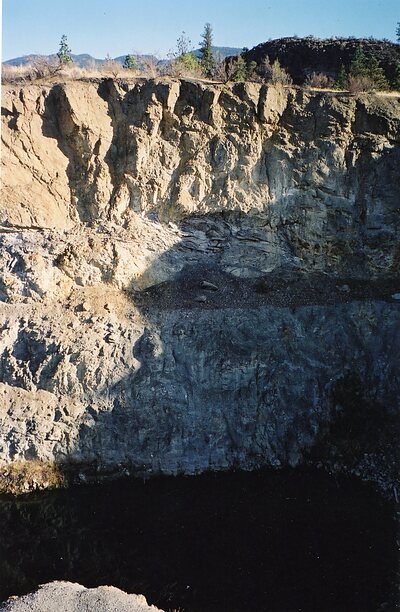
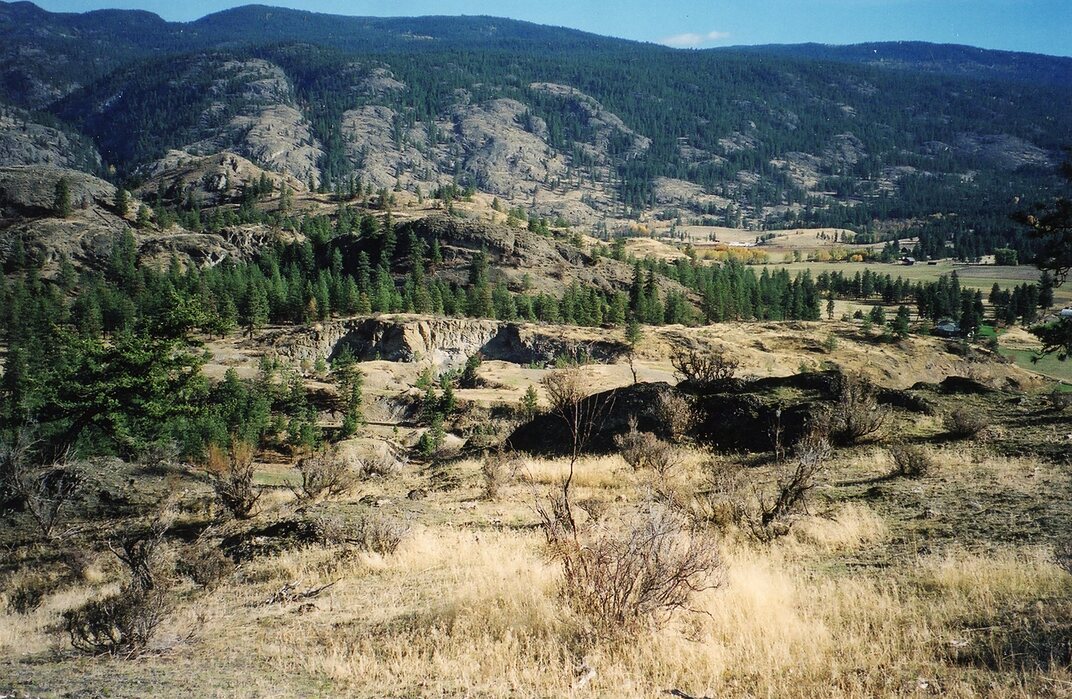
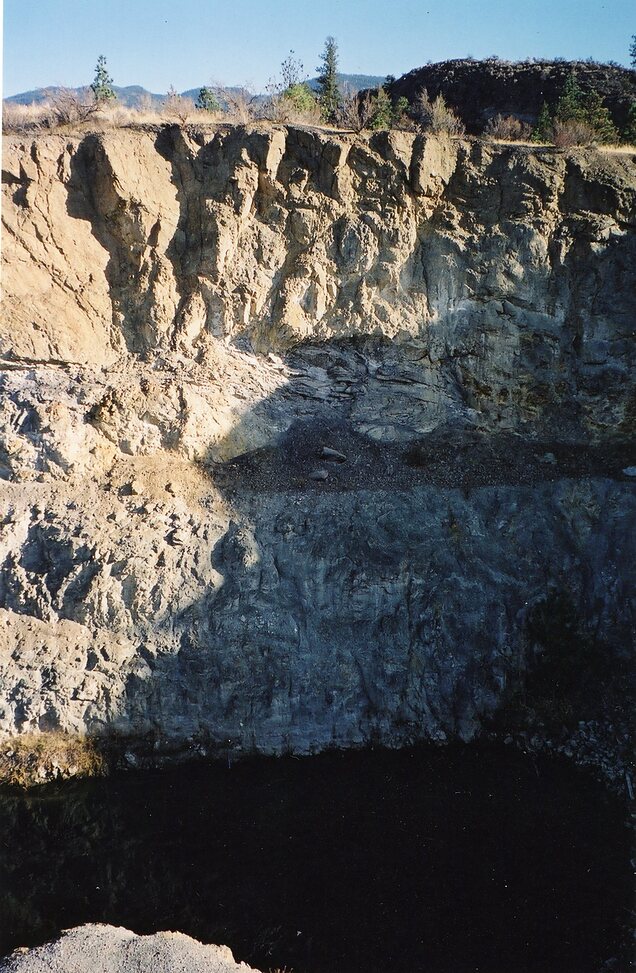
The past producing Dusty Mac gold-silver mine is located about 1.5 kilometres east of the small community of Okanagan Falls, about 18 kilometres south of Penticton, British Columbia, in the Osoyoos Mining Division.
There is a description of the property, including regional geology, on the British Columbia “Minfile” site, current to 2008. Relevant portions are quoted below:
“The Dusty Mac property lies within the eastern part of the White Lake basin, a thick accumulation of Eocene Penticton Group volcanic rocks, interlayered with clastic sedimentary rocks which are largely of volcanic derivation. The Eocene rocks rest unconformably on Triassic metavolcanic and metasedimentary rocks of the Independence, Old Tom and Shoemaker formations, and Jurassic granitic intrusions. The White Lake basin forms a topographic low and is truncated by early gravity faults. The units generally dip to the east and are folded and faulted.
The hostrocks at Dusty Mac belong to the Eocene White Lake Formation of the upper part of the Penticton group. This unit consists of light coloured pyroclastic rocks, thick feldspathic andesite lahar deposits, minor andesitic lavas, and minor sandstones and carbonaceous shales. In the immediate area, these overlie older Eocene Marama Formation volcanics, composed mainly of massive rhyodacite lava.”
“At Dusty Mac, mineralization appears to be largely controlled by an important system of reverse faults. The system trends southeast with interwoven eastern and southern striking segments and splays. The direction and magnitude of movement on these faults are indicated by large thrust slices of Marama lava which have been thrust outward and upward from the core of the syncline through several hundreds of metres of White Lake strata. In the White Lake basin, reverse faulting is thought to be the result of concentric folding and accommodation of the stratigraphic pile to bedding plane slip (Bulletin 61 [Church, 1973]). Quartz veins and gossans are present in or adjacent to most of the main faults. The deposit consists of a lens-like zone of silicified volcanic rocks and sedimentary debris containing minor disseminated pyrite, native silver, chalcopyrite, galena and sphalerite. Also, some quartz veins on the property carry minor bornite and tetrahedrite.
The main mineralized zone is a gently dipping lens of quartz breccia with varying admixtures of crushed andesite. The body is exposed over a length of approximately 213 metres striking roughly 140 degrees with a central cross-section width of about 48 metres and a maximum thickness of 9 metres. A similar large lens of quartz breccia is located approximately 762 metres northwest of the main ore zone. Epithermal fluids from the Dusty Mac had a temperature of about 240 degrees Celsius, a low salinity of about 0.5 weight per cent and an oxygen del 18 value between minus 7 and minus 9 per mil (relative to standard mean ocean water). The mineralization process probably occurred at a depth of more than 380 metres (Zhang, 1986).”
Giles Peatfield comments:
There is a summary of exploration and mining history on the Minfile page, which may be of interest to some readers.
There was a small shipment of ore, for a test, in 1969 and serious production in 1976 and 1977. British Columbia Government records state that a total of 93,372 tonnes of ore were milled, yielding 339,279 troy ounces of silver, 19,484 troy ounces of gold, 2,432 kilograms of copper, 2,312 kilograms of lead and 242 kilograms of zinc. The ore was milled at the Dankoe Mine operation, about 35 kilometres straight line distance to the south (see Mindat “Dankoe Mine (Utica Mine; Horn Silver Mine; Cawston), Keremeos, Osoyoos Mining Division, British Columbia, Canada.” for information on this interesting deposit).
Comments on the Minerals Reported:
Note that the minerals reported are from the property, not just from the orebody as mined. Some drill holes are located several hundreds of metres from the open pit area, but in the same geologic package. Note also that there are rock-forming minerals present; descriptions of these are not given as they are not necessarily germane to the issue of gold-silver mineralization. Many of the mineral identifications are by field observation, others are by microscopy; comments regarding validity of identification are presented below.
Adularia?: The only reference to adularia is in Evans (1990), who wrote that “Generally mineralization is found in the various forms of silicification but can be hosted in peripheral alteration as well as in this [the?] sericite-adularia type epithermal system.” There are no analytical data available, and adularia must be regarded as tentative at Dusty Mac.
Bornite: McLeod (2002) described bornite in polished section, writing that in one case “The opaques are seen to fill fractures within breccia fragments and replaced fragments along preferred bands or layers. Some of the sulfides occur in aggregates of 1 – 2 mm in size. They tend to be mutual boundary to segregated composites of chalcopyrite and bornite (altered to chalcocite and covellite) with contained grains of galena. The galena may have wormy to graphically intergrown grains of tetrahedrite. Sphalerite tends to occur in contact with other sulfides but as grains at edges of these sulfides. They are discrete but may have emulsion chalcopyrite. The presence of one hackly grain of gold/electrum in bornite is noted.”
Calcite: Reported by Evans (1990) in drill core, by Zhang et al. (1989), and by McLeod (2002) in thin section. Bowen (2003) made numerous references to ‘carbonate’, by which he probably meant calcite.
Celadonite?: Evans (1990) mentioned one occurrence of celadonite in drill core, but gave no further data. I would regard this as tentative.
Chalcedony: Evans (1990) reported chalcedony, and indeed described the ‘Chalcedony Zone’ where “A large area in the northwest portion of the [property] grid has laminated and brecciated chalcedonic quartz veins averaging a consistent 1.15 g/t Au and 6.3 g/t Ag on surface.”
Chalcocite: See note above for bornite.
Chalcopyrite: See note above for bornite.
Chlorite group: ‘Chlorite’ is reported as common by all referenced workers.
Covellite: See note above for bornite.
Epidote group: Evans (1990) reported ‘epidote’, but gave no further details.
Fluorite: Evans (1990) noted fluorite in drill core; McLeod (2002) reported fluorite fragments in breccia in thin section.
Galena: See note above for bornite.
Gold: See note above for bornite.
Graphite: Melnyk (1985) mentioned black graphitic shale in drill core logging. Evans (1990), describing the White Lake Formation, wrote that “Thick (50+ m) plagioclase phyric andesite flows are common near the base of the upper lahar while coarse sandstone beds with graphitic shales and rare coal seams become more abundant at the top.”
Hematite: Several workers mentioned hematite in drill core logging. Evans (1990) wrote that “Another common feature is pervasive hematite alteration between Marama dacites and lahars of the White Lake Formation. This is probably a primary alteration feature of the flows in a sub- aerial environment.”
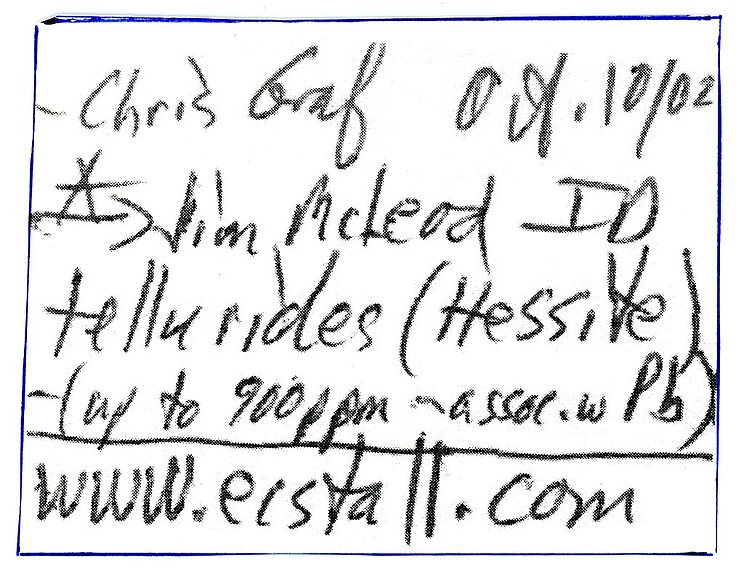
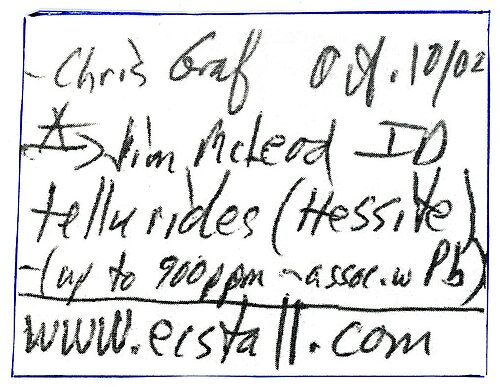
Hessite?: This is an interesting, if somewhat speculative species occurrence at Dusty Mac. Warren et al. (1974), in a discussion of the Dusty Mac analytical results, noted that “Silver values cannot be related directly to either lead or arsenic and it seems probable that some lead and silver can be attributed to telluride minerals.” Tom Schroeter, in a handwritten note on his copy of McLeod (2002) – I recognize Tom’s distinctive hand-writing – wrote: “Chris Graf Oct. 10/02 * Jim McLeod ID tellurides (Hessite) – up to 900 ppm [Te?] assoc. w. Pb. www.ecstall.com.” The website is no longer active, and I cannot reach Chris Graf for comment. Hessite has been reported in quartz veins in older rocks in the general region (see Mindat “Standard Mine, Osoyoos Mining Division, ….”) about 15 kilometres to the south of Dusty Mac. The jury is out on this one.
Heulandite?: Evans (1990), in drill core logging, reported ‘heulandite/laumontite’, but gave no analytical data. It is likely that there are zeolites, but which species remains uncertain. I would regard both heulandite and laumontite (q.v.) as tentative.
Laumontite?: See note above for heulandite.
Limonite: Although probably common as a weathering product of pyrite, limonite was mentioned specifically only by McLeod, who described it in thin section. Church (1973) reported ‘gossan’, by which he probably meant limonite.
Malachite: McLeod (2002) found malachite in several polished sections. Evans (1990) noted one occurrence of malachite in diamond drill core.
Mica group: References to minerals of the mica group are few and far between. Melnyk (1985) noted that “The [drilling] program did however identify alteration zones consisting of quartz, sericite, and pyrite which are coincident with porous members of the White Lake Formation, including arkosic sandstone and conglomerate.” Evans (1990) reported sericite in several instances of drill core logging, although in some cases he seemed uncertain of this identification. McLeod (2002) noted sericite in thin sections. Of more interest is a reference by Melnyk (1985) in core logging to a tuffaceous rock that “. . . locally has specks of bright green mineral – fuchsite (?).” Evans (1990) logged a volcanic rock that contained “2% Apple Green Mineral (Fuchsite).” One must caution that not all bright green specks are necessarily micaceous, and not all green micas are necessarily fuchsite. This is a much mis-used name in mineral exploration reporting.
Pyrite: Pyrite is ubiquitous, mentioned by all referenced workers. It is generally fine-grained and disseminated and may range up to several percent by volume.
Quartz: This is a most important mineral at Dusty Mac, and occurs in several guises, generally in the form of silicification, quartz veining or breccia cement. There does not seem to be a direct correlation between quartz content and gold or silver grades.
Silver: There are several references to native silver at Dusty Mac. Melnyk (1985) wrote that in the orebody, “Mineralization consists of very fine-grained, disseminated native silver and gold with minor disseminated chalcopyrite, sphalerite and galena.” Zhang et al. (1989) wrote that “The metallic minerals, mainly pyrite with traces of chalcopyrite, bornite, galena, sphalerite, and native silver, are disseminated throughout the brecciated quartz and small quartz veinlets.” McLeod (2002) noted that in one polished section of quartz breccia, “The opaque content of the section is considered trace, but does consist of chalcopyrite, galena, sphalerite, pyrite and a grain of native silver which may be somewhat elevated in gold.”
Sphalerite: See note above for bornite.
Talc: Evans (1990) reported numerous occurrences in drill core of white to pale green talc, as an alteration product, but gave no more detailed analytical data.
Tetrahedrite subgroup: See note above for bornite. Note that there is no detailed information to confirm tetrahedrite over tennantite.
Note on rocks reported:
Note that all these rock types are field designation, derived from the report by Evans (1990).
Giles Peatfield
BASc . (Geological Engineering) University of British Columbia 1966.
PhD Queen's University at Kingston 1978.
Worked for Texas Gulf Sulphur / Texasgulf Inc. / Kidd Creek Mines - 1966 to 1985.
Consultant 1985 to 2016
Select Mineral List Type
Standard Detailed Gallery Strunz Chemical ElementsMineral List
19 valid minerals.
Rock Types Recorded
Note: data is currently VERY limited. Please bear with us while we work towards adding this information!
Select Rock List Type
Alphabetical List Tree DiagramDetailed Mineral List:
| ⓘ Bornite Formula: Cu5FeS4 References: Personal correspondance with Giles Peatfield Identification: Visual Identification |
| ⓘ Calcite Formula: CaCO3 References: Personal correspondance with Giles Peatfield Identification: Visual Identification |
| ⓘ Celadonite ? Formula: K(MgFe3+◻)(Si4O10)(OH)2 References: Personal correspondance with Giles Peatfield Identification: Visual Identification |
| ⓘ Chalcocite Formula: Cu2S References: Personal correspondance with Giles Peatfield Identification: Visual Identification |
| ⓘ Chalcopyrite Formula: CuFeS2 References: Personal correspondance with Giles Peatfield Identification: Visual Identification |
| ⓘ 'Chlorite Group' References: Personal correspondance with Giles Peatfield Identification: Visual Identification |
| ⓘ Covellite Formula: CuS References: Personal correspondance with Giles Peatfield Identification: Visual Identification |
| ⓘ 'Epidote Group' Formula: (A12+A22+)(M13+M23+M33+)O[Si2O7][SiO4](OH) References: Personal correspondance with Giles Peatfield Identification: Visual Identification |
| ⓘ Fluorite Formula: CaF2 References: Personal correspondance with Giles Peatfield Identification: Visual Identification |
| ⓘ Galena Formula: PbS References: Personal correspondance with Giles Peatfield Identification: Visual Identification |
| ⓘ Graphite Formula: C References: Personal correspondance with Giles Peatfield Identification: Visual Identification |
| ⓘ Hematite Formula: Fe2O3 References: Personal correspondance with Giles Peatfield Identification: Visual Identification |
| ⓘ Hessite ? Formula: Ag2Te References: Personal correspondance with Giles Peatfield Identification: Visual Identification |
| ⓘ 'Heulandite Subgroup' ? Formula: (Na/Ca/K)5-6[Al8-9 Si27-28 O72] · nH2O References: Personal correspondance with Giles Peatfield Identification: Visual Identification |
| ⓘ 'K Feldspar' References: Personal correspondance with Giles Peatfield Identification: Visual Identification |
| ⓘ 'K Feldspar var. Adularia' ? Formula: KAlSi3O8 References: Personal correspondance with Giles Peatfield Identification: Visual Identification |
| ⓘ Laumontite ? Formula: CaAl2Si4O12 · 4H2O References: Personal correspondance with Giles Peatfield Identification: Visual Identification |
| ⓘ 'Limonite' References: Personal correspondance with Giles Peatfield Identification: Visual Identification |
| ⓘ Malachite Formula: Cu2(CO3)(OH)2 References: Personal correspondance with Giles Peatfield Identification: Visual Identification |
| ⓘ 'Mica Group' References: Personal correspondance with Giles Peatfield Identification: Visual Identification |
| ⓘ Native Gold Formula: Au References: Personal correspondance with Giles Peatfield Identification: Visual Identification |
| ⓘ Native Silver Formula: Ag References: Personal correspondance with Giles Peatfield Identification: Visual Identification |
| ⓘ Pyrite Formula: FeS2 References: Personal correspondance with Giles Peatfield Identification: Visual Identification |
| ⓘ Quartz Formula: SiO2 References: Personal correspondance with Giles Peatfield Identification: Visual Identification |
| ⓘ Quartz var. Chalcedony Formula: SiO2 References: Personal correspondance with Giles Peatfield Identification: Visual Identification |
| ⓘ Sphalerite Formula: ZnS References: Personal correspondance with Giles Peatfield Identification: Visual Identification |
| ⓘ Talc Formula: Mg3Si4O10(OH)2 References: Personal correspondance with Giles Peatfield Identification: Visual Identification |
| ⓘ 'Tetrahedrite Subgroup' Formula: Cu6(Cu4C2+2)Sb4S12S References: Personal correspondance with Giles Peatfield Identification: Visual Identification |
Gallery:
List of minerals arranged by Strunz 10th Edition classification
| Group 1 - Elements | |||
|---|---|---|---|
| ⓘ | Native Gold | 1.AA.05 | Au |
| ⓘ | Native Silver | 1.AA.05 | Ag |
| ⓘ | Graphite | 1.CB.05a | C |
| Group 2 - Sulphides and Sulfosalts | |||
| ⓘ | Chalcocite | 2.BA.05 | Cu2S |
| ⓘ | Bornite | 2.BA.15 | Cu5FeS4 |
| ⓘ | Hessite ? | 2.BA.60 | Ag2Te |
| ⓘ | Covellite | 2.CA.05a | CuS |
| ⓘ | Sphalerite | 2.CB.05a | ZnS |
| ⓘ | Chalcopyrite | 2.CB.10a | CuFeS2 |
| ⓘ | Galena | 2.CD.10 | PbS |
| ⓘ | Pyrite | 2.EB.05a | FeS2 |
| ⓘ | 'Tetrahedrite Subgroup' | 2.GB.05 | Cu6(Cu4C2+2)Sb4S12S |
| Group 3 - Halides | |||
| ⓘ | Fluorite | 3.AB.25 | CaF2 |
| Group 4 - Oxides and Hydroxides | |||
| ⓘ | Hematite | 4.CB.05 | Fe2O3 |
| ⓘ | Quartz var. Chalcedony | 4.DA.05 | SiO2 |
| ⓘ | 4.DA.05 | SiO2 | |
| Group 5 - Nitrates and Carbonates | |||
| ⓘ | Calcite | 5.AB.05 | CaCO3 |
| ⓘ | Malachite | 5.BA.10 | Cu2(CO3)(OH)2 |
| Group 9 - Silicates | |||
| ⓘ | Talc | 9.EC.05 | Mg3Si4O10(OH)2 |
| ⓘ | Celadonite ? | 9.EC.15 | K(MgFe3+◻)(Si4O10)(OH)2 |
| ⓘ | Laumontite ? | 9.GB.10 | CaAl2Si4O12 · 4H2O |
| Unclassified | |||
| ⓘ | 'K Feldspar var. Adularia' ? | - | KAlSi3O8 |
| ⓘ | 'Chlorite Group' | - | |
| ⓘ | 'Heulandite Subgroup' ? | - | (Na/Ca/K)5-6[Al8-9 Si27-28 O72] · nH2O |
| ⓘ | 'Limonite' | - | |
| ⓘ | 'Mica Group' | - | |
| ⓘ | 'K Feldspar' | - | |
| ⓘ | 'Epidote Group' | - | (A12+A22+)(M13+M23+M33+)O[Si2O7][SiO4](OH) |
List of minerals for each chemical element
| H | Hydrogen | |
|---|---|---|
| H | ⓘ Celadonite | K(MgFe3+◻)(Si4O10)(OH)2 |
| H | ⓘ Heulandite Subgroup | (Na/Ca/K)5-6[Al8-9 Si27-28 O72] · nH2O |
| H | ⓘ Laumontite | CaAl2Si4O12 · 4H2O |
| H | ⓘ Malachite | Cu2(CO3)(OH)2 |
| H | ⓘ Talc | Mg3Si4O10(OH)2 |
| H | ⓘ Epidote Group | (A12+A22+)(M13+M23+M33+)O[Si2O7][SiO4](OH) |
| C | Carbon | |
| C | ⓘ Calcite | CaCO3 |
| C | ⓘ Graphite | C |
| C | ⓘ Malachite | Cu2(CO3)(OH)2 |
| O | Oxygen | |
| O | ⓘ K Feldspar var. Adularia | KAlSi3O8 |
| O | ⓘ Calcite | CaCO3 |
| O | ⓘ Celadonite | K(MgFe3+◻)(Si4O10)(OH)2 |
| O | ⓘ Quartz var. Chalcedony | SiO2 |
| O | ⓘ Hematite | Fe2O3 |
| O | ⓘ Heulandite Subgroup | (Na/Ca/K)5-6[Al8-9 Si27-28 O72] · nH2O |
| O | ⓘ Laumontite | CaAl2Si4O12 · 4H2O |
| O | ⓘ Malachite | Cu2(CO3)(OH)2 |
| O | ⓘ Quartz | SiO2 |
| O | ⓘ Talc | Mg3Si4O10(OH)2 |
| O | ⓘ Epidote Group | (A12+A22+)(M13+M23+M33+)O[Si2O7][SiO4](OH) |
| F | Fluorine | |
| F | ⓘ Fluorite | CaF2 |
| Na | Sodium | |
| Na | ⓘ Heulandite Subgroup | (Na/Ca/K)5-6[Al8-9 Si27-28 O72] · nH2O |
| Mg | Magnesium | |
| Mg | ⓘ Celadonite | K(MgFe3+◻)(Si4O10)(OH)2 |
| Mg | ⓘ Talc | Mg3Si4O10(OH)2 |
| Al | Aluminium | |
| Al | ⓘ K Feldspar var. Adularia | KAlSi3O8 |
| Al | ⓘ Heulandite Subgroup | (Na/Ca/K)5-6[Al8-9 Si27-28 O72] · nH2O |
| Al | ⓘ Laumontite | CaAl2Si4O12 · 4H2O |
| Si | Silicon | |
| Si | ⓘ K Feldspar var. Adularia | KAlSi3O8 |
| Si | ⓘ Celadonite | K(MgFe3+◻)(Si4O10)(OH)2 |
| Si | ⓘ Quartz var. Chalcedony | SiO2 |
| Si | ⓘ Heulandite Subgroup | (Na/Ca/K)5-6[Al8-9 Si27-28 O72] · nH2O |
| Si | ⓘ Laumontite | CaAl2Si4O12 · 4H2O |
| Si | ⓘ Quartz | SiO2 |
| Si | ⓘ Talc | Mg3Si4O10(OH)2 |
| Si | ⓘ Epidote Group | (A12+A22+)(M13+M23+M33+)O[Si2O7][SiO4](OH) |
| S | Sulfur | |
| S | ⓘ Bornite | Cu5FeS4 |
| S | ⓘ Chalcopyrite | CuFeS2 |
| S | ⓘ Chalcocite | Cu2S |
| S | ⓘ Covellite | CuS |
| S | ⓘ Galena | PbS |
| S | ⓘ Pyrite | FeS2 |
| S | ⓘ Sphalerite | ZnS |
| S | ⓘ Tetrahedrite Subgroup | Cu6(Cu4C22+)Sb4S12S |
| K | Potassium | |
| K | ⓘ K Feldspar var. Adularia | KAlSi3O8 |
| K | ⓘ Celadonite | K(MgFe3+◻)(Si4O10)(OH)2 |
| K | ⓘ Heulandite Subgroup | (Na/Ca/K)5-6[Al8-9 Si27-28 O72] · nH2O |
| Ca | Calcium | |
| Ca | ⓘ Calcite | CaCO3 |
| Ca | ⓘ Fluorite | CaF2 |
| Ca | ⓘ Heulandite Subgroup | (Na/Ca/K)5-6[Al8-9 Si27-28 O72] · nH2O |
| Ca | ⓘ Laumontite | CaAl2Si4O12 · 4H2O |
| Fe | Iron | |
| Fe | ⓘ Bornite | Cu5FeS4 |
| Fe | ⓘ Celadonite | K(MgFe3+◻)(Si4O10)(OH)2 |
| Fe | ⓘ Chalcopyrite | CuFeS2 |
| Fe | ⓘ Hematite | Fe2O3 |
| Fe | ⓘ Pyrite | FeS2 |
| Cu | Copper | |
| Cu | ⓘ Bornite | Cu5FeS4 |
| Cu | ⓘ Chalcopyrite | CuFeS2 |
| Cu | ⓘ Chalcocite | Cu2S |
| Cu | ⓘ Covellite | CuS |
| Cu | ⓘ Malachite | Cu2(CO3)(OH)2 |
| Cu | ⓘ Tetrahedrite Subgroup | Cu6(Cu4C22+)Sb4S12S |
| Zn | Zinc | |
| Zn | ⓘ Sphalerite | ZnS |
| Ag | Silver | |
| Ag | ⓘ Hessite | Ag2Te |
| Ag | ⓘ Native Silver | Ag |
| Sb | Antimony | |
| Sb | ⓘ Tetrahedrite Subgroup | Cu6(Cu4C22+)Sb4S12S |
| Te | Tellurium | |
| Te | ⓘ Hessite | Ag2Te |
| Au | Gold | |
| Au | ⓘ Native Gold | Au |
| Pb | Lead | |
| Pb | ⓘ Galena | PbS |
Other Databases
| Link to British Columbia Minfile: | 082ESW078 |
|---|
Other Regions, Features and Areas containing this locality
North AmericaContinent
- Columbia MountainsMountain Range
North America PlateTectonic Plate
- Okanagan TerraneOphiolite Complex
This page contains all mineral locality references listed on mindat.org. This does not claim to be a complete list. If you know of more minerals from this site, please register so you can add to our database. This locality information is for reference purposes only. You should never attempt to
visit any sites listed in mindat.org without first ensuring that you have the permission of the land and/or mineral rights holders
for access and that you are aware of all safety precautions necessary.
Dusty Mac gold-silver mine, Okanagan Falls, Osoyoos Mining Division, British Columbia, Canada