


 Vault-Tec
Vault-Tec Corporation, also referred to as Vault-Tec Industries and Vault-Tec, was a pre-War defense corporation that designed and implemented a network of bunkers known as vaults.[7] These bunkers were designed to protect the population of the United States in case of a nuclear event.[8]
Background[edit]
The company operated as early as 2031, when it acquired and re-branded Morgantown's local college as Vault-Tec University. Top executives and scientists either taught or graduated from there, and the company was lead by the Vault-Tec Board of Directors.[9][10] The government referred to the effort to engage with Vault-Tec on post-War preparations as "Project Safehouse."[11] The project was classified and protected under the New Amended Espionage Act.[Pub 1]
The multi-billion dollar corporation was the largest company in the United States, buying out laboratories such as those of Lee Moldaver and making their Cold Fusion technology proprietary.[12] Vault-Tec was headquartered several places in the United States, inclluding the headquarters in Los Angeles and the headquarters in Washington, D.C. In Los Angles, the company sponsored billboards, advertisements in newspapers, and corporate PR events. Vault-Tec constructed several vaults underneath the Santa Monica pier, such as interconnected shelters Vault 31, Vault 32, and Vault 33.
Quick Guide[edit]

Vaults[edit]

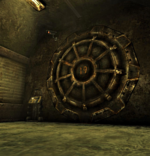
Before the war, the company constructed vaults, sold spaces to citizens, and prepared for their use in research test environments.[13][14][15] Equipment in the vaults, such as water chips, were faulty and prone to failure.[16] Shipping errors switched water chips and GECK deliveries.[17] Vault-Tec advertised vaults in newly annexed Canada.[18] The company also developed alternatives, such as the Series 1000 Shelter, allowing access for those too far from a full vault.[Pub 2] Employees received the Vault-Tec employee handbook, a publication that outlined everything about the company and its procedures, down to 2.25 minutes (135 seconds) time limit on bathroom breaks.[19][20] Their mascots were Vault Boy and Vault Girl.
A small contingent of vaults were designed to work properly as controls.[21] The other vaults featured a variety of scenarios, focused on researching how inhabitants would react and behave.[22][23] The Enclave were involved in the planning stages of vaults, describing it as "a social experiment on a grand scale" using "a unique set of circumstances designed to test the occupants."[24] Vault-Tec hired movie stars such as Cooper Howard to advertise the vaults.
Construction[edit]
Vaults featured super reactors, the Vault-Tec Assisted Targeting System, medical devices such as the organ extractor, Motion Sensors, and SimTek 5000 virtual reality pods.[25][26][27][Pub 3][28] New features were implemented, designed to improve the quality of life of a vault dweller, including SimuSun Lighting, Floorsuck Autocleaner Systems, Culinator 3000 Kitchen Systems, Entertainotron Rooms, and Eye-On-You Cameras.[29] Locations such as Vault 13 far exceeded its original budget.[Pub 4][30]
Preparation[edit]

Vault-Tec was authorized to carry out drills for citizens selected for inclusion in the vaults and operated its alert system. Alert drills were carried out at regular intervals to test admission protocols and members of the experimentation staff were expected to participate in the drills.[31] Compliance and secrecy were accomplished by way of threats and payments.[32][33][34] Vault-Tec authorized its private security to use lethal force during admission protocols.[35]
Initiatives[edit]

A large exposition at the Museum of Technology in the capital was designed to promote their shelters and explain their functionality, while prizes like the Pressed Vault Suit Award were also used to promote a positive image of the company.[22][36] The Vault-Tec: Among the Stars attraction at Nuka-World was funded and Vault-Tec bobbleheads were given as gifts to executives.[37]
Experiments[edit]
Some vaults had a unique set of circumstances designed to test the occupants, such as not having enough food synthesizers, only men, or opening after only six months.[38] Scientists at the Hawthorne Medical Laboratories, a Vault-Tec division, attempted to create hybrid humans in Vault 4 using radioactive resistant species, the result of which was the Gulper.[12]
Products[edit]
Structures[edit]
Technology[edit]
Items[edit]
Divisions[edit]


Locations[edit]
- Vaults
- Vault-Tec Headquarters, located in Vernon Square, Washington, D.C.
- Vault-Tec Regional HQ, located in Beacon Hill, Boston
- Vault-Tec: Among the Stars, an attraction at Nuka-World
- Vault-Tec University, located in Morgantown, West Virginia
- Vault-Tec Headquarters, located in Southern California
Notes[edit]
- Vault-Tec's phone number, 1-888-4-VAULTTEC, appears on the Vault-Tec Calendar in Sanctuary Hills.[39] Another number, 213-25-VAULT, is listed in a commercial for Vault 4 featuring movie star Cooper Howard.[40]
- The company is also referred to as Vault-Tek,[41][42][43] VaulTek,[44] Vaul Tek,[45] and Vault-Tech.[46]
- Vault experiments are mentioned in One Man, and a Crate of Puppets.[Pub 5]
- The "Vault-Tec Documentation Department" is mentioned in the Vault Dweller's Survival Guide and Fallout 4 Manual.[Pub 6][Pub 7]
Appearances[edit]
Vault-Tec appears in all Fallout games and in the Fallout Television Series.
Behind the Scenes[edit]
- The vault experiment was an idea created by Tim Cain during the initial stages of Fallout 2 development.[Doc 1][Doc 2][Doc 3]
- The Vault-Tec building seen in the Fallout 2 intro is a still from the film Dick Tracy.
- Outside of the Fallout series, the Vault-Tec logo also appeared in the 2016 reboot of Doom (published by Bethesda Softworks) on certain doors in the UAC facility on Mars. Vault-Tec is also mentioned in RAGE.[47]
- A location referred to as Vault-Tec headquarters is mentioned in the Fallout Bible 3 and rulebook to Fallout: The Roleplaying Game.[Pub 2][Dev 1]
 Vault-Tec Labs were mentioned in an unused terminal entry in Fallout 3.[48]
- In his unofficial pen-and-paper Fallout RPG, Joshua Sawyer said the following about Vault-Tec:[49]

Vaul-Tec was the most successful of the companies to make private survival vaults before the Great War. Prior to privatization, the creation of vaults was first a local (commonwealth) responsibility, then a federal responsibility. As with so many things near the end, however, the governments could never agree on how to handle the vault issue. Post-privatization, Vaul-Tec and a few other companies manufactured vaults for private citizens and for communities.
Gallery[edit]


.webp)


.png)


References[edit]
|


- ↑ Vault Dweller's Survival Guide inner cover: "NOTICE.––This document contains information affecting the national defense of the United States within the meaning of the New Amended Espionage Act, 50 U.S.C., 31 and 32. Its transmission or the revelation of its contents in any manner to an unauthorized person is prohibited by the law."
- ↑ 2.0 2.1 Fallout: The Roleplaying Game Rulebook p.250: "After a demo vault was opened to the public in Los Angeles, near the Vault-Tec headquarters, public enthusiasm helped fund the junk bond drive that funded the rest of construction. It was a ray of hope in a profoundly dark time. Those too far from a full vault could buy a Series 1000 shelter, a one-level subterranean mini-vault priced more reasonably for a small corporation or medium-sized community."
- ↑ Vault Dweller's Survival Guide p.2—1: "SIMTEK OPERATIONS: The Vault-Tec Research Group has determined that after a long period of security, many Vault-Dwellers will feel “uncomfortable” with the idea of returning to the outside world. The SimTek 5000 will provide a safe and reassuring return to life on the outside world. This chapter will give you a brief walk-through of the operation of the SimTek 5000."
- ↑ Vault Dweller's Survival Guide p.1—1-1—2: "Important Vault statistics
- ↑ One Man, and a Crate of Puppets, panel 1: "The Vault Experiments were never designed to rescue the people that lived inside them. They were a vast social experiment designed to study pre-selected segments of the population."
- ↑ Fallout 4 Manual: "ISSUED BY VAULT-TEC DOCUMENTATION DEPARTMENT, APPARATUS DIVISION"
- ↑ Vault Dweller's Survival Guide: "ISSUED BY VAULT-TEC DOCUMENTATION DEPARTMENT, JANUARY, 2077"
- ↑ Fallout Bible 6, Life with the GECK: "The GECK builders had no idea what the post-nuclear world would be like, and they had no real way to anticipate it, despite their "thorough tests" (it's doubtful they gave it much thought, to be honest, considering how badly organized the Safehouse project alone was, not to mention the experimental nature of the Vaults) - still, it seems as if the seeds present in the GECK were viable for Vault 8."
- ↑ Fallout Bible 0: "2077 October 23 Great War: Bombs are launched; who struck first is unknown... and it is not even known if the bombs came from China or America. Air raid sirens sound, but very few people go into Vaults, thinking it is a false alarm. The Vaults are sealed."
- ↑ Fallout Bible 0: "2063 August The construction of most Vaults completed, except for Vault 13, whose construction finally gets off the ground... heralding a development cycle that seems plagued with problems. Drills begin in the other cities with completed Vaults, but the increasing frequency of the drills has a "cry wolf" effect, and the turnouts for drills trickle off as the years go on."
- ↑ Chris Taylor: "The Master was in the Vault-Tec private Vault. This was the demonstration model built for the federal government, it was also very close to the Vault-Tec headquarters."
(Chris Taylor on vault13.net -Archived)
- Vault-Tec Corporation
- Fallout 76 mentioned-only organizations
- Fallout 4 mentioned-only organizations
- Creation Club referenced organizations
- Fallout: New Vegas mentioned-only organizations
- Fallout 2 mentioned-only organizations
- Fallout mentioned-only organizations
- Pre-War Businesses
- Slogan
- Doomsday Preppers
- Pre-War Businesses Research and Development
- Pre-War Businesses Energy