

SUBSCRIBE TO OUR FREE NEWSLETTER
Daily news & progressive opinion—funded by the people, not the corporations—delivered straight to your inbox.
5
#000000
#FFFFFF
To donate by check, phone, or other method, see our More Ways to Give page.


My house sits beside the road. Every day, I watch people approach the gate not knowing what they will find. Will it be open? Closed? Will there be a checkpoint? Will they be delayed for minutes, hours, or forced to turn back altogether?
For many families, the first question of the morning is no longer about work, school schedules, or the weather. It is simple: "Is the gate open today?"
No child should become so familiar with a barrier that it earns a permanent place in his imagination.
Entire WhatsApp groups have emerged around that question alone. Residents exchange updates throughout the day. Someone reports that traffic is moving. Another warns of delays. A third shares a photo showing the road blocked.
These groups were not created to discuss politics. They exist because people need to know whether they can get to work, attend university classes, reach medical appointments, or visit relatives.
The gate has become a permanent presence in people's minds. When it closes completely, the scene changes instantly.
The drivers park their cars along the roadside and continue on foot. Students hurry toward schools and universities. Workers walk to avoid losing a day's wages. People carrying groceries, bags, or small children cross the distance that vehicles can no longer cover.
In the evening, many return the same way—tired, frustrated, and uncertain whether they will find the road open when it is time to go home.
Sometimes people ask permission to leave their cars near our house because they do not know when they will be able to retrieve them. On more than one occasion, I have watched strangers park, shoulder their belongings, and continue their journey on foot because there was no other option.
The visible inconvenience is easy to describe. The invisible burden is harder to measure.
What does it mean to organize your life around uncertainty? What happens when a routine trip to work, school, or a medical appointment becomes a daily calculation involving alternate routes, unexpected delays, and the possibility that the road ahead may suddenly close?
Over time, uncertainty settles into people's lives. It affects productivity, family plans, social commitments, and mental well-being. Conversations become dominated by road conditions and access restrictions. Schedules remain tentative. Even celebrations, weddings, and family gatherings are planned with the possibility of disruption in mind.
The impact extends far beyond transportation. It reshapes the way people think. And perhaps nowhere is that impact more visible than in the way children absorb the world around them. My son is 8 years old. Over the past months, he has drawn the gate more than 30 times. No one asked him to do so. No teacher assigned it. Yet the yellow gate keeps appearing in his drawings. Sometimes it is closed. Sometimes cars are waiting in front of it. Sometimes people are walking around it. Occasionally, there are figures standing nearby, watching.
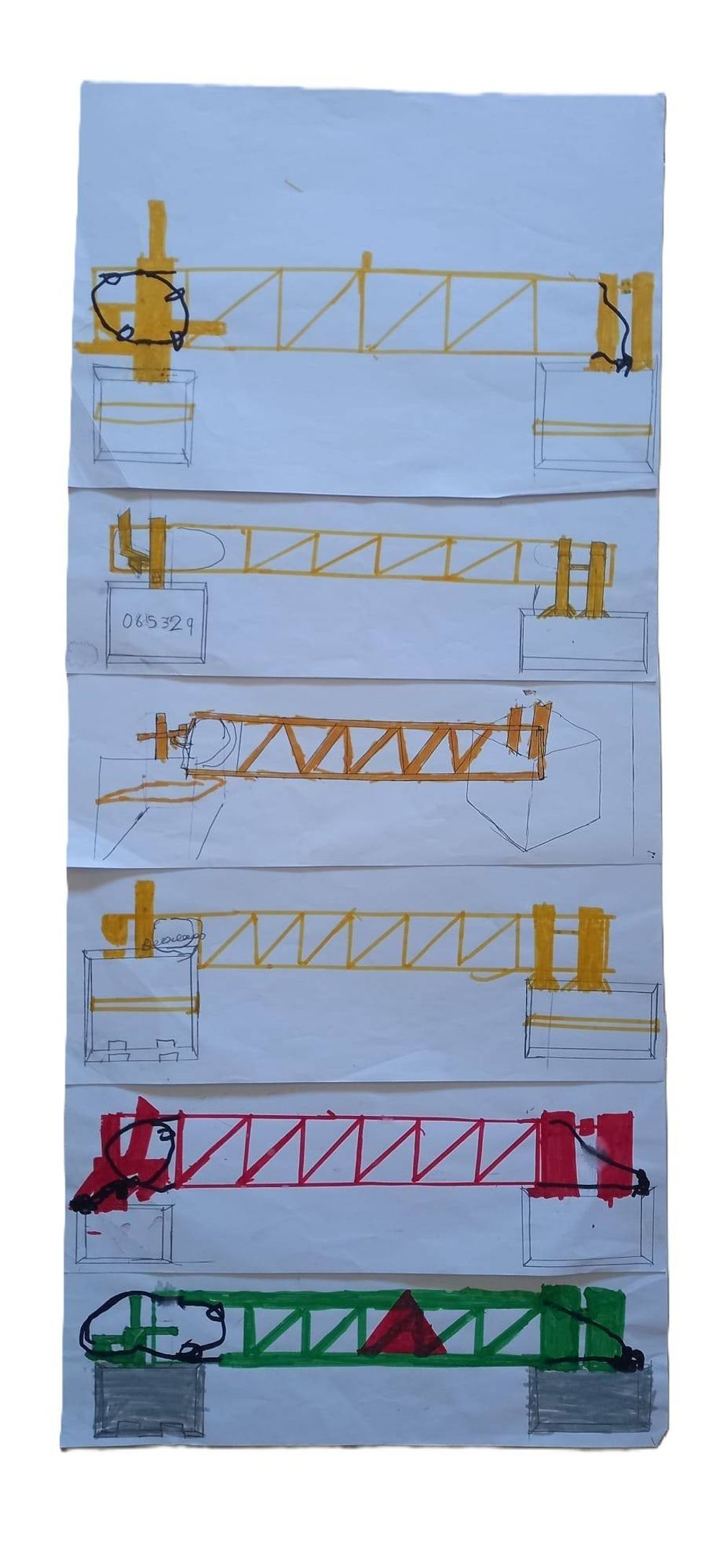 Some of the drawings done by Mahmoud Ibrahim's son are shown.
At first, I barely noticed. Children draw what they see. But as the drawings accumulated, I began to pay attention. The same image returned again and again. A gate. A road. Waiting.
Children are supposed to fill their notebooks with football fields, superheroes, animals, friends, dreams, and imaginary adventures. Yet among my son's drawings, the gate had secured a permanent place. That realization stayed with me.
The true cost of restrictions is often discussed in terms of economics, mobility, or security. Those discussions matter. But there is another cost that receives far less attention: the amount of mental space occupied by obstacles that become part of everyday life.
When adults constantly discuss whether a road is open or closed, children listen. When plans are interrupted repeatedly, children notice. When uncertainty becomes normal, children absorb it as part of their understanding of how the world works.
The gate outside my window is made of metal. Yet its influence reaches far beyond the road it controls. It enters conversations around dinner tables. It dominates community WhatsApp groups. It influences work schedules, school attendance, and family visits. And, in my son's case, it appears repeatedly on sheets of paper scattered around our home.
Recently, I gathered several of his drawings and laid them side by side. There it was again: the yellow gate. In one picture it was closed. In another it stood across the road while cars waited. In a third, people walked around it.
I found myself asking a simple question: What would my son be drawing if the gate were not there? I do not know the answer. But I do know that no child should become so familiar with a barrier that it earns a permanent place in his imagination.
That is why I am writing this.
Not simply about a gate on a road near Bethlehem, but about how uncertainty seeps into daily life, settles into communities, and quietly shapes the memories of a generation growing up in its shadow.

The GMO said Thursday that at least 173,514 others—including more than 44,500 children—have been wounded, and 9,500 Palestinians are still missing and presumed dead and buried beneath the rubble of bombed-out buildings in the coastal strip, more than 90% of which has been destroyed and 80% of which is under Israeli control, according to officials.
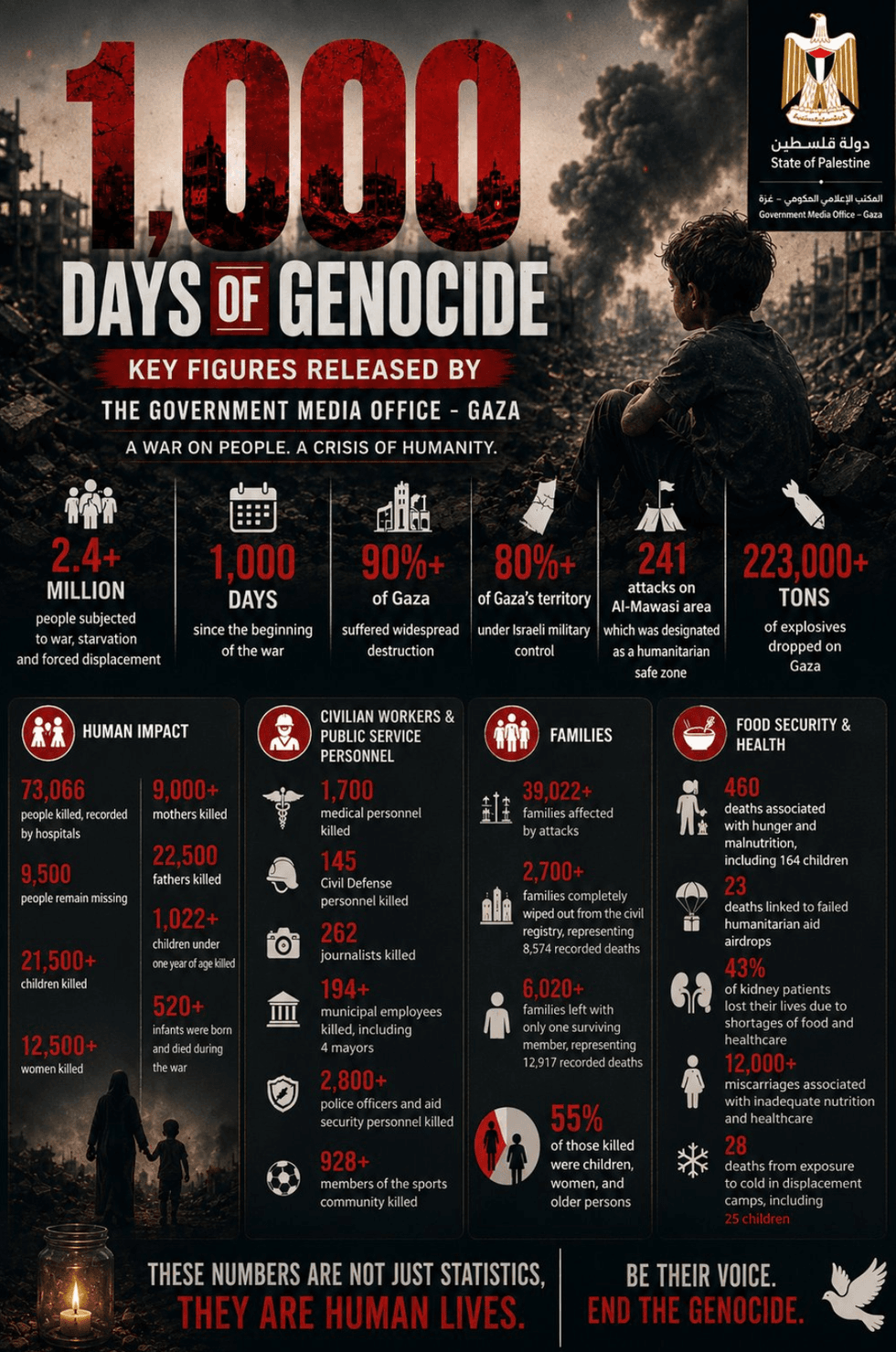 (Source: Gaza Government Media Office)
More than 11,000 Gazan children have suffered what the United Nations Children's Fund (UNICEF) called "life-changing injuries," including as many as 4,000 amputations, many of them performed without anesthesia.
“Every day for the past 1,000 days, the world has failed 1 million children in Gaza by not intervening to stop the killing and maiming of children," Ahmad Ahendawi, regional director at the charity Save the Children, said Thursday. "As their young, fragile bodies were blown to bits and pieces by bombs and missiles, the world sold those same weapons to the government of Israel [and]... continued trade agreements with the government of Israel."
Early in the war, UNICEF called Gaza “the world’s most dangerous place to be a child.”
Classified Israel Defense Forces (IDF) data leaked last August suggested that 5 in 6 Palestinians, or 83%, killed during the war's first 19 months were civilians. Experts attribute the high civilian death toll to Israel's use of artificial intelligence in target selection, its dropping of 1,000- and 2,000-pound bombs—many of them supplied by the US—in densely populated urban zones, and relaxed rules of engagement allowing for an unlimited number of noncombatant casualties in airstrikes targeting a single Hamas operative, no matter how low-ranking.
Last month, a United Nations commission of inquiry found that 30% of those killed by Israel in Gaza have been minors, and that “the deliberate targeting of children is one of the key elements establishing genocidal intent of the Israeli authorities and security forces to destroy the Palestinian group, in whole or in part, in Gaza."
The commission, which separately concluded that Israel is committing genocide in Gaza, used language consistent with Article II of the Genocide Convention, the international treaty against which Israel's actions are being weighed by the International Court of Justice in The Hague. In December 2023, South Africa filed a genocide case against Israel at the ICJ that is now formally backed by around 20 nations.
IDF troops have admitted to witnessing alleged war crimes, including indiscriminate murder of women and children. Doctors and other international volunteers who worked in Gaza's besieged hospitals during the genocide have reported the apparently deliberate targeting of Palestinian civilians, including children shot in the head and chest by Israeli snipers.
Palestinian survivors and witnesses have also accused IDF troops of summarily executing women and children.
“Every day for the past 1,000 days, the world has failed 1 million children in Gaza."
The new GMO figures note 460 deaths from malnutrition—164 of them children—and 28 Palestinians, mostly children, who perished from hypothermia in camps housing many of the approximately 2 million people forcibly displaced by the war.
According to figures published last month by UNICEF, more than 1,000 Palestinians, including at least 265 children, have been killed by Israeli bombs and bullets since the October 2025 ceasefire took effect. UNICEF called the purported truce a "cruel and deadly illusion."
All this in retaliation for the Hamas-led attack in which approximately 1,200 Israelis and foreign nationals were killed—some by so-called “friendly fire” and under the fratricidal Hannibal Directive—and 251 others abducted.
In the aftermath of the deadliest attack on Israel in its 75-year history, Israeli Prime Minister Benjamin Netanyahu—who is wanted by the International Criminal Court (ICC) in The Hague for alleged war crimes and crimes against humanity in Gaza, including murder and forced starvation—exhorted Israelis to "remember what Amalek has done to you."
According to the Hebrew Bible, the nation of Amalek was an ancient archenemy of the Israelites whose total extermination—"man and woman, infant and suckling"—was commanded by the Abrahamic deity figure God.
Numerous Israeli leaders made similarly genocidal statements, including Israeli President Isaac Herzog, who asserted that there are no innocent people in Gaza, former Defense Minister Yoav Gallant—who is also wanted by the ICC for ordering the "complete siege" of Gaza blamed for fueling deadly famine and disease—and the influential far-right politician Moshe Feiglin.
"Every child in Gaza is the enemy," Feiglin said last year. "We need to occupy Gaza and settle it, and not a single Gazan child will be left there."
According to the new GMO figures, 39,022 families in Gaza have suffered Israeli massacres, with more than 2,700 families entirely wiped out and another 6,020 left with only a single surviving member. More than 58,800 children have been orphaned, including 2,700 who lost both parents, while 26,370 women are now widows.
In 2024, Save the Children published a report detailing how Israel's onslaught has caused the "complete psychological destruction" of Gazan children. A subsequent study found that nearly all children in the embattled Palestinian enclave believed that their deaths were imminent—and nearly half of them said they wanted to die.
“We could die at any moment. I hope the war stops for us,” a 14-year-old girl identified as Amani told Save the Children in a report published Thursday.
“I hope the war stops so that I can continue my education in Gaza and live my rights as a human like any girl in other countries," she added. "I would like to live with love, peace, and an easy life."