What is EDI Compliance? How to Become EDI Compliant

Aaron Keeports

In this article, we'll cover:
- What is EDI compliance?
- What are the worst EDI compliance issues?
- Why is EDI compliance important?
- What are EDI chargebacks?
- Types of chargebacks
- 10 proven techniques for EDI compliance
- Get EDI compliant
Strong trading partner relationships have always been essential to business success. In today’s digital supply chains, those relationships increasingly depend on how well companies can meet EDI compliance requirements across every partner, workflow, and transaction.
EDI (Electronic Data Interchange) compliance is no longer just about exchanging a few documents correctly. It is about protecting revenue, reducing penalties, onboarding partners faster, and ensuring clean, compliant data flows into your business systems from every source, including traditional EDI connections and browser-based Web EDI portals.
As part of a broader supply chain orchestration strategy, EDI compliance helps businesses coordinate execution across partners, systems, and workflows so issues can be identified and resolved before they disrupt orders, shipments, or cash flow.
What Is EDI Compliance? What Does Being EDI Compliant Mean?
EDI compliance mandates are rules set by individual retailers and trading partners to standardize how they communicate with their supplier network. Each partner’s requirements are unique, based on the EDI transactions they use—such as purchase orders, acknowledgments, shipping notices, and invoices—and how quickly and accurately they expect to receive them.
By bringing more partners into a standardized digital process, retailers can reduce manual work, improve data accuracy, and make their supply chains more efficient. That includes not only fully integrated EDI partners, but also suppliers that need a simpler, browser-based way to participate through Web EDI.
For suppliers, meeting these requirements is critical. If you don’t comply, you could face:
- Costly chargebacks.
- Delays in payment.
- Negative impacts on vendor performance scores, which could strain your relationship with the retailer.
Bottom line: Non-compliance can lead to missed SLAs, financial penalties, delayed payments, lower vendor scorecard performance, strained business relationships, and fewer future business opportunities.
EDI compliance software is essential because many organizations require their partners to exchange documents electronically and meet strict performance standards, including retail giants like Walmart, Target, Costco, and Amazon.
In that sense, EDI compliance is not just a document exchange requirement. It is a foundational part of supply chain orchestration, helping businesses synchronize partner activity and keep execution aligned across the supply chain.
What are the Worst EDI Compliance Issues?
Many major companies have requirements for EDI trading partner setup and maintenance, both of which are important in keeping compliant.
EDI compliance can be tricky because each retailer has its own set of rules, and these rules can even change depending on how products are delivered (like directly to a store versus drop-shipped to a customer).
Suppliers often run into the following compliance challenges:
- The advance shipping notice (EDI 856) is incorrect, incomplete, or not sent on time.
- EDI invoices (whether the ) are rejected because they're incorrect or inaccurate.
Suppliers fail to send a purchase order acknowledgements (EDI 855) within the required timeframe.
- Functional Acknowledgements (EDI 997) fail to send.

Common Compliance Requirements
Here you can see Walmart's "Getting Started with EDI Implementation Guide," which helps companies become compliant and trade EDI with Walmart.
In the document, Walmart lays out 4 EDI compliance requirements for all partners
- The ability to exchange the basic EDI document set
- The timeline for EDI data testing
- Connection requirements
- Functional acknowledgment expectations
First, the basic EDI documents required by Walmart are:
- 810 Invoice
- 821 Claim
- 816 Address Listing
- 820 Remittance
- 850 Purchase Order
- 864 Text Message [for invoice errors]
- 997 Acknowledgment
Second, as far as the acceptable timeline for EDI testing, Walmart dictates that the period in which a vendor must prove that they are capable of transmitting all of the basic documents can take no longer than 6 weeks.
If testing takes longer than six weeks, the supplier may be removed from EDI testing for non-compliance.
→ Getting Started with EDI: Implementation Guide, Page 8
Third, to trade EDI with Walmart, vendors must maintain a consistent AS2 connection. This means that a business must not go offline or experience any disruption in its communication with Walmart.
Since AS2 is the sole means of connecting to Walmart and the method by which EDI documents are exchanged, a drop in connectivity can negatively affect a trading partner's relationship with the giant.
Fourth, the EDI trading partner MUST send EDI 997 functional acknowledgments no more than 24 hours from when Walmart purchase orders were placed in their partner mailbox.
In practice, true EDI compliance means supporting both highly integrated enterprise requirements and simpler web-based participation models so every relevant partner can operate within a compliant process.
Why Is EDI Compliance Important?
With virtually all major trading partners requiring suppliers to be EDI compliant, the importance of building and maintaining compliance cannot be overstated, especially given its direct impact on margins, operational efficiency, and long-term customer relationships.
At its most basic level, EDI compliance means your business can exchange required documents accurately and on time according to each trading partner’s standards.
Solid, trust-based relationships built on being EDI capable foster confidence and business growth. EDI implementation issues are not only frustrating, but they can also be costly. And that cost of being non-compliant comes in the form of EDI chargebacks.
True compliance is not just about the top tier of integrated partners. It is about extending compliant participation across your entire supply chain, including suppliers that rely on simple web portals instead of full EDI integrations.
What are EDI Chargebacks?
EDI chargebacks are financial penalties for non-compliance with your trading partner requirements. Trading partners issue EDI chargebacks because of vendor non-compliance with agreed-upon elements of the Service Level Agreement (SLA). Because vendor non-compliance disrupts operations and creates additional expenses for the trading partner, the customer offsets those additional costs by issuing EDI chargebacks to the vendor.
In the simplest terms, EDI chargebacks hit you because you caused mistakes that disrupted a customer's business operations and cost them money. If you're late with a delivery, packages are incorrectly labeled, or a shipment is damaged or incomplete, expect to receive an EDI chargeback.
Due to frequency of changes in routing guides, the complexity of managing dozens or hundreds of individual chargebacks, and the internal, cross-functional team effort required to combat EDI chargebacks, eliminating them entirely is often a tall order. Continue reading below to understand the different types of chargebacks and why they are assessed in the first place.
Types of Chargebacks
EDI chargebacks can take many forms. The EDI 856 ASN (Advanced Shipping Notice) is no doubt one sort of EDI document transaction that most people reading this are familiar with.
The ASN is far and away the riskiest transaction for chargebacks.
Its primary purpose is to provide tracking and packing information ahead of delivery. As seen above, Walmart explicitly mentions the timely sending of ASNs as a key component of EDI compliance.
Some of the most common elements included in an ASN are the purchase order number, ship notice number, and the location where the product will be shipped.
Beyond ASN errors, some other common reasons that B2B customers might execute an EDI chargeback to a vendor include:
- Using the wrong carrier
- Shipments arrive too early or late
- Key specs are missed (failure to meet proper packaging specifications, for example)
- Orders aren't filled at the appropriate rate
- Something's delivered to the wrong location
- Incomplete or incorrect paperwork
See the graphic below for some example chargebacks Amazon extracts from non-compliant partners:
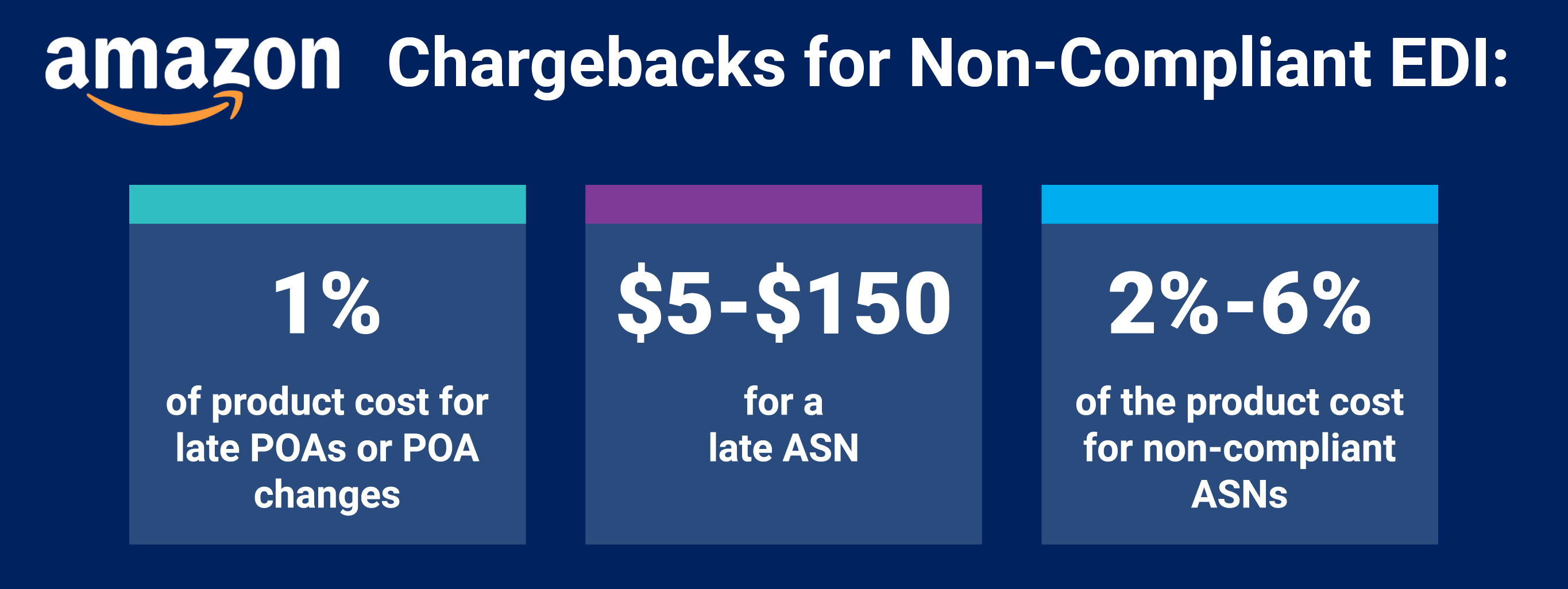
Top 3 Types of Amazon Vendor Chargebacks:
- ASN Chargebacks: When using Fulfillment-by-Amazon (FBA), vendors must promptly send the Advanced Shipment Notification (ASN) to Amazon upon order receipt. It is crucial to adhere to the ASN protocol and meet the specified timeframe outlined by Amazon. Failure to comply or errors in shipping information will result in automatic chargebacks.
- Routing Request Chargebacks: Upon receiving orders from Amazon, suppliers or vendors must accurately encode and submit routing requests within the shipping window. These requests enable Amazon to determine the shipping destination for the products. Failure to fulfill this requirement will lead to chargebacks.
- Delivery Chargebacks: Timely delivery is essential. If orders are not delivered within the designated schedule, the products must be returned to Amazon. Failing to do so will result in order cancellation and financial penalties.
Learn more about EDI orchestration with Amazon with our blog. Additionally, explore EDI compliance with Amazon in a virtual tour of our EDI integration platform.
EDI Compliance Solution: Amazon
While every customer-supplier agreement is different, to offset unexpected expenses, EDI chargebacks levied by companies can range from hundreds to literally thousands of dollars per violation, adding up to huge - and avoidable -- revenue losses on an annual basis.
While the consequences of non-compliance are clear, the bigger question is why so many companies still struggle to stay compliant. Recent survey data highlights several supply chain challenges that directly impact compliance:
Recent survey data highlights that 94% of businesses will experience regulation changes and/or enter new markets. As those requirements evolve, companies often need to adapt how they manage data exchange, compliance standards, and partner onboarding.

These are not just operational headaches. They are some of the same root causes behind EDI non-compliance, missed SLAs, shipping penalties, and chargebacks. Each delayed transaction, incorrect document, or visibility gap can show up as lost margin, lost trust, and missed opportunities.
The takeaway is clear: reducing manual work, improving data quality, and investing in technology that standardizes participation across integrated EDI, APIs, and Web EDI portals are essential steps toward protecting revenue and maintaining strong trading partner relationships. In a broader sense, they are also key to supply chain orchestration, ensuring businesses can move from visibility into coordinated action before issues escalate.
10 Proven Techniques for EDI Compliance
A successful EDI compliance strategy utilizes cutting-edge technology, clear communication, streamlined internal processes, and an ongoing commitment to development. Essential steps include:
1) Understanding Your Customers
Go through any vendor onboarding instructions and documentation provided by trading partners. Trading partners periodically revise their vendor guidelines, so it’s crucial to keep abreast of any updates to remain in adherence. Thus minimizing missed SLAs, costly fines, and negative vendor scorecards.
See how Alleghany Health Network cut supplier onboarding times by 50% using Cleo's Web EDI Portal.
2) Attaining Adaptability
Creating cross-disciplinary teams allows businesses to better adapt and cater to customer demands. Incorporating key team members from various departments ensures a comprehensive understanding of company operations, processes, offerings, and skill sets that lead to greater innovation and success.
3) Incorporating Compliance Standards from the Start
To mitigate the risk of EDI compliance errors, weave compliance checks into daily operations rather than treating them as a final step in order fulfillment. This helps identify and correct issues earlier, before they turn into penalties or failed transactions. Ensure operational processes are designed with compliance in mind and that systems such as ERP, WMS, TMS, EDI, APIs, and Web EDI portals are set up to support those standards from the start.
4) Continuously Improving Business Processes
View evolving EDI guidelines as a chance to assess and improve operational efficiencies. This can turn a business cost into a business opportunity that improves processes. Encourage teams to actively contribute ideas, as individuals involved in daily operations frequently offer valuable feedback that can lead to meaningful improvements.
5) Establishing Performance Benchmarks
Develop key performance indicators (KPIs) for essential supply chain operations to identify areas of weakness. Leveraging an EDI compliance platform with strong visibility and analytics makes it easier to pinpoint underperformance, track SLA risk, and make informed decisions before issues turn into penalties.
6) Gaining Insights from Industry Pioneers
Optimize supply chain efficiencies by learning from trading partners. Adjustments to trading partner requirements often aim to maintain their competitiveness in dynamic markets, allowing businesses to leverage these insights for their own advantage.
7) Using Technology That Suits Your Needs
Many organizations are hindered by cumbersome, fragmented technology systems that require significant time and resources to manage. Prioritize EDI and compliance solutions that can support your full trading partner ecosystem, including integrated EDI, APIs, and browser-based Web EDI participation. Check out the top Web EDI providers here.
8) Seeking Knowledge
Trading partners often provide workshops on vendor compliance which can significantly boost compliance ratings, while simultaneously demonstrating a company’s dedication to the partnership. These sessions may also provide a sneak peek into forthcoming compliance updates, allowing businesses to better prepare for impending changes.
9) Communicating Regularly
Regularly connect with trading partners to stay aligned with their requirements, strategies, operations, etc. This approach not only supports EDI compliance but also fosters a stronger business relationship that may lead to more business loyalty.
10) Empowering Your Sales Force
It is essential for sales professionals to grasp the significance of the operational improvements achieved via compliance initiatives. This enables them to effectively highlight the benefits in their sales pitches. Consider hosting training sessions led by those who have a direct understanding of a company’s processes to give the sales team an invaluable perspective that can be used to attract potential customers.
EDI Compliance with Web EDI
Here is how Cleo Web EDI simplifies EDI compliance and helps businesses reduce the risk of costly chargebacks.
With Web EDI, companies do not need on-premise software or deep in-house EDI expertise to meet trading partner requirements. Instead, users access a secure, cloud-based portal through a standard web browser, making it easier to exchange EDI documents with trading partners. So you can comply with any of your trading partners evolving requirements, without the big investment.
Below is the homepage of Cleo’s Web EDI Portal, featuring an intuitive interface designed to simplify day-to-day document management, that works much like your email's inbox.

Below are screenshots of a common EDI order-to-cash transaction flow using Cleo Web EDI, including the initial purchase order, purchase order acknowledgment, advanced ship notice, and invoice.
Purchase Orders (EDI 850) can be received directly in the Web EDI portal from the retailer.

Purchase Order Acknowledgments (EDI 855) can then be generated and sent in response to confirm receipt and acceptance of the order.

Advanced Shipping Notices (EDI 856) can be submitted through the portal to provide the retailer with required shipment details.

Invoices (EDI 810) can also be created and transmitted to the retailer in the format and timeframe required by that trading partner.

By helping manage document mapping, validation, and trading partner requirements behind the scenes, the Web EDI Portal reduces the burden on internal teams and helps lower the risk of missed deadlines, formatting issues, and other errors that can lead to chargebacks.
Finding the Right Technology
The right EDI compliance solution should do more than help you exchange documents. It should help you extend compliant participation across your entire supply chain, onboard partners faster, improve data quality, and give your team visibility into every transaction. More importantly, it should help close the execution gap between seeing an issue and resolving it, which is a core part of effective supply chain orchestration.
With Cleo's Web EDI Portal, businesses can:
Support broader partner participation across EDI, APIs, and Web EDI portals
Rapidly onboard new trading partners without lengthy integration projects
Reduce manual re-keying with PO-flip workflows and guided document creation
Improve data integrity with built-in business rules and source-level guardrails
Gain visibility into transactions through a unified dashboard
Identify and resolve issues before they turn into penalties, shipping errors, or chargebacks
Support supply chain orchestration with unified visibility and faster issue resolution across partner workflows
Cleo's Web EDI Portal is especially valuable for small to midsize suppliers, long-tail partners, and other teams that need a simpler way to meet retailer requirements without the cost and overhead of a full in-house EDI environment.The right Web EDI solution gives you peace of mind knowing your business can stay compliant across every trading partner, while also supporting your customers’ evolving needs.
Jason Smith, Manager at Uncle Bob’s Butter Country says, “My small family-owned company has partnered with Cleo since 2021, ever since we started selling our product to national retailers. Cleo's Web EDI Portal is a hassle-free, inexpensive way to get on the same platform as the huge companies. We can receive purchase orders and send invoices with a click, and accommodate other necessary communications. There are other vendors out there that do the same thing, of course, but the reason why we stay with Cleo is their amazing customer service from both the account management and tech teams. We can get a real person on the phone when we need it, and they have always been helpful and efficient. The low cost and remarkable customer care makes them the best value in EDI.” Learn more with the Uncle Bob's Butter Country case study.
Next Steps
If you are looking for a simpler way to achieve EDI compliance across more of your supply chain, Cleo's Web EDI Portal can help.
By making it easier for integrated and non-EDI partners alike to participate in a standardized digital process, the Web EDI Portal helps reduce manual work, protect margins, and improve performance across the order-to-cash cycle. It also strengthens supply chain orchestration by bringing more partner activity into a connected, visible, and actionable workflow.
Contact our team at sales@cleo.com to learn more about pricing, see the platform in action, and explore how Cleo can help you modernize EDI compliance.

Book a live demo


