Blog
Best EDI Software & Integration Providers of 2026
The Comprehensive Global Directory

Choosing the right EDI and B2B integration provider is no longer just about exchanging documents. It is about how effectively your business can operate across a complex partner ecosystem.
As supply chains grow more interconnected, many platforms still focus on moving data between systems, but fall short when it comes to coordinating the workflows and processes that depend on that data.
Many organizations are already feeling this gap in practice.
“With Cleo Integration Cloud, the ability to provide access to the EDI process to multiple teams is invaluable.”

Traditional EDI environments often limit visibility to a small group of specialists, making it harder for operations, customer service, and supply chain teams to respond quickly when issues arise.
At the same time, manual processes and reactive troubleshooting continue to slow teams down.
This shift in expectations is redefining what businesses need from their integration platforms.
It is no longer enough to simply move data from point A to point B. Modern organizations require systems that can coordinate across partners, trigger actions in real time, and provide visibility into both transactions and the processes behind them.
This guide compares the leading EDI and B2B integration providers in 2026 based on what actually matters in today’s environment:
Technical capability across formats and protocols
Depth of ERP and system integration
Flexibility to support real-world complexity
Ability to operate across multi-enterprise ecosystems
Because the real question is no longer “Can this platform handle EDI?”
It is:
“Can this platform support how our business actually operates?”
The State of EDI in 2026
EDI is no longer just about exchanging documents. It is about enabling reliable execution across increasingly complex, multi-enterprise supply chains.
As businesses scale across more partners, systems, and regions, traditional integration approaches are starting to show their limits. Platforms built primarily for data transfer often struggle to support the coordination, visibility, and responsiveness modern operations require.
This shift is driving a new standard for integration, one that goes beyond connectivity to support real-time processes, decision-making, and partner collaboration at scale.
“With Cleo Integration Cloud, the ability to provide access to the EDI process to multiple teams is invaluable.” (G2 Review)
The Shift from EDI to Ecosystem Integration Platforms (EIP)
Traditional EDI platforms were built to move documents between trading partners. That model worked when supply chains were simpler and interactions were mostly linear.
In 2026, that approach is no longer enough.
Modern businesses operate across a network of suppliers, logistics providers, retailers, and internal systems. Data does not just need to move. It needs to trigger actions, update systems in real time, and keep processes aligned across multiple stakeholders.
This is where Ecosystem Integration Platforms (EIP) come in.
“Cleo Integration Cloud is very flexible… the integration is more visible and user-friendly and adapts to new technologies.” (G2 Review)
EIP solutions expand beyond document exchange by:
Supporting multiple integration types, including EDI, APIs, and file-based workflows
Connecting directly into ERP and business systems
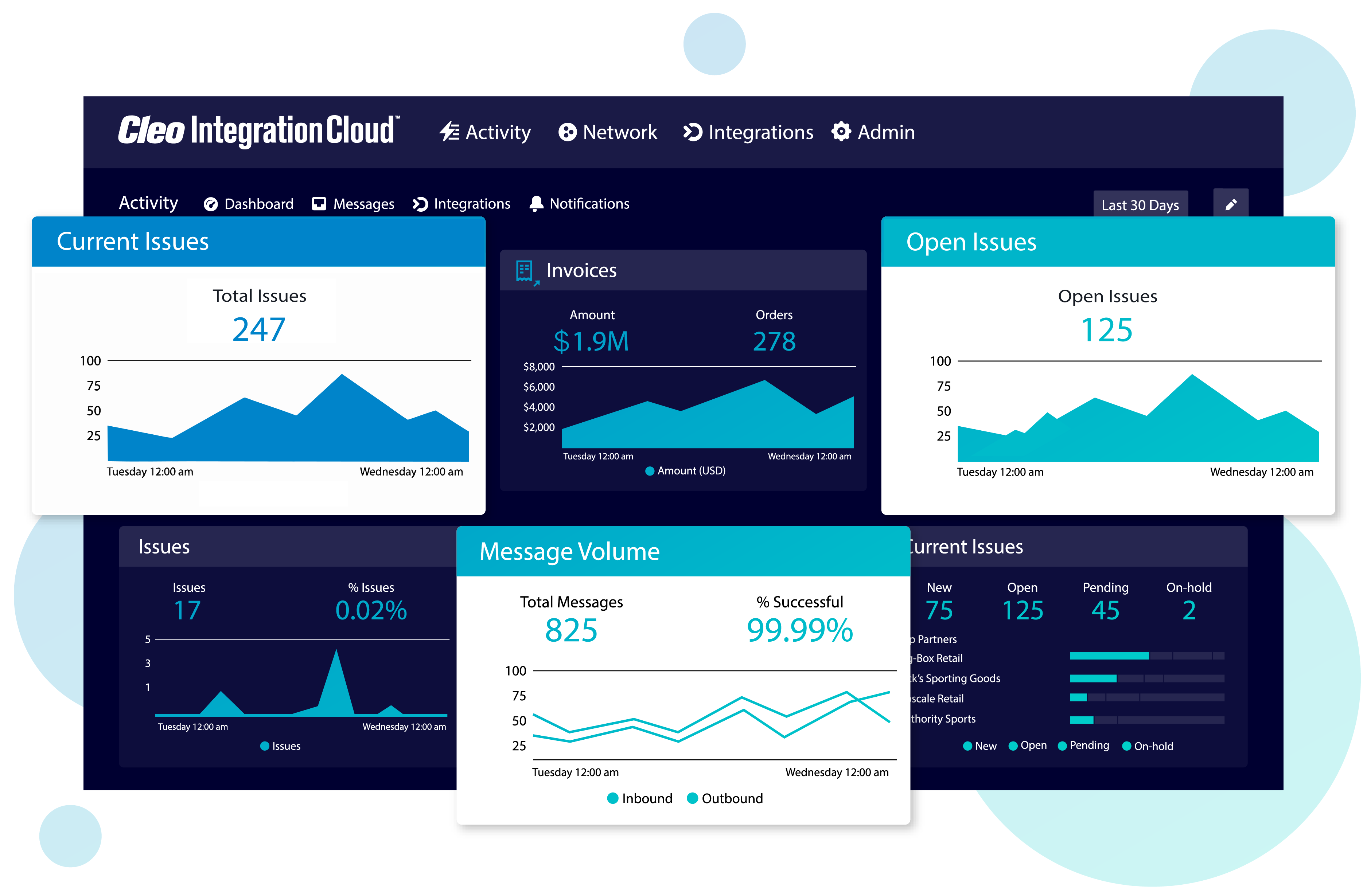
Enabling real-time visibility into transactions and processes
Coordinating workflows across partners
The result is a shift from isolated integrations to connected, multi-enterprise operations where data plays an active role in execution.
With Cleo, Century Supply Chain Solutions drove a 300% increase in transaction volume while reducing support tickets by 50%, read the case study.
The AI/EDI Integration Benchmark
Evaluating EDI providers today requires more than checking protocol support or partner connectivity.
Organizations are increasingly measuring platforms based on how much manual effort they eliminate and how quickly they can respond to issues.
Key evaluation factors include:
Automated Mapping
How easily can data transformations be configured and maintained without heavy developer involvement?
SLA Resolution Time
How quickly can errors or delays be identified and resolved before they impact operations?
ERP Integration Depth
Does the platform integrate directly with core systems like SAP, NetSuite, or Microsoft Dynamics, or does it rely on custom middleware?
These benchmarks reflect a broader shift toward platforms that not only connect systems, but also reduce operational friction and improve responsiveness across the supply chain.
“More than 98% of our B2B transactions are running through Cleo Integration Cloud, and we can see everything that’s going on.”

API-First vs. API-Hybrid Approaches
API-first platforms have gained traction by offering faster onboarding and simplified connectivity, especially for standardized use cases.
For organizations working primarily with structured X12 transactions, this approach can reduce initial integration timelines.
However, most real-world environments are not limited to a single format or protocol.
Businesses often need to support:
Multiple EDI standards such as X12 and EDIFACT
Non-EDI formats like XML, JSON, and CSV
File transfers including PDFs, images, and bulk data
Legacy communication protocols alongside modern APIs
API-hybrid platforms address this complexity by combining APIs, EDI, and file-based integration within a single environment.
This allows organizations to support both modern and legacy requirements without introducing additional tools, custom code, or fragmented workflows.
How EDI & Integration Providers Are Categorized
Not all EDI and B2B integration providers serve the same purpose.
While many platforms appear similar at a high level, they are typically designed for very different use cases, operating models, and levels of complexity. Understanding these differences is key to selecting the right solution.
To make this directory easier to navigate, providers are grouped into three categories based on their primary capabilities and typical deployment scenarios.
Tier 1: Enterprise Integration Platforms (The “Power Players”)
Includes: Cleo, OpenText, IBM Sterling, Boomi
These platforms are built for organizations managing high transaction volumes and complex integration requirements across multiple systems and partners.
They are typically characterized by:
Support for any-to-any data transformation across formats and protocols
Deep integration with ERP systems such as SAP, Oracle, and NetSuite
The ability to handle global standards and multi-region operations
Centralized control over integrations and data flows
Tier 1 platforms are best suited for companies that require scalability, flexibility, and tight alignment between integration and core business processes.
Tier 2: Modern Cloud-Native & API-First Providers
Includes: Orderful, Stedi, Mulesoft
These providers focus on developer-centric integration models and prioritize speed and flexibility for modern application environments.
They are commonly used for:
Rapid onboarding of standardized transactions, particularly X12 and JSON
API-driven integration workflows
Lightweight infrastructure with minimal setup requirements
While effective for targeted use cases, these platforms are generally more limited when it comes to supporting diverse data formats, legacy systems, and broader operational requirements across the supply chain.
Tier 3: Managed Service & Retail-Focused Networks
Includes: SPS Commerce, TrueCommerce
These providers emphasize outsourced integration and pre-built trading partner networks, especially within retail and supplier ecosystems.
They are typically chosen by organizations that want:
Simplified onboarding through existing partner networks
Assistance with retailer compliance requirements
Reduced internal resource involvement
Fully managed integration services
This model can reduce upfront effort, but often introduces tradeoffs in flexibility, visibility, and control over how integrations are configured and maintained.
“With Cleo, we don’t have the whole team tied up working EDI issues anymore… they spend their time on more meaningful projects.”

How the Leading EDI & B2B Integration Providers Compare
While many platforms fall into similar categories at a high level, their differences become much clearer when evaluated side by side. The following comparisons break down how leading providers perform across real-world requirements, from onboarding speed to long-term scalability and operational control.
1) Orderful vs. Cleo: Fast Onboarding vs. Complete Orchestration
Choosing between modern integration providers often comes down to a tradeoff between speed of onboarding and long-term completeness.
Orderful is positioned around fast, API-driven onboarding, while Cleo is built to support broader integration requirements across complex, multi-partner environments. The difference becomes more apparent as integration needs move beyond standardized use cases.
The “9-Day” Reality Check
Orderful promotes rapid onboarding, often citing timelines as short as nine days to get started with EDI through its API-first approach.
For organizations working with standardized X12 transactions and minimal customization, this can be achievable.
However, most real-world integrations introduce complexity that extends beyond those conditions.
“It was taking eight weeks to set up a new customer. Now we can do it in less than three days.” Todd Baughman VP Of Technology, Giltner. Read the case study.
Common requirements include:
Custom XML or JSON schemas
Partner-specific mapping logic
Multiple protocols and file-based workflows
As soon as these variables enter the picture, onboarding timelines are no longer defined by API speed alone. Additional development, testing, and exception handling are often required, which can significantly extend implementation effort.
This is where the gap between a narrowly scoped integration approach and a more complete platform begins to surface.
Where API-First Approaches Break Down
API-first platforms can simplify initial connectivity, but they tend to introduce limitations as integration requirements expand.
“We don’t have the whole team tied up working EDI issues anymore… they spend their time on more meaningful projects.” (Verst Logistics Case Study)
The MFT Gap
Most enterprises still rely on file-based exchanges such as PDFs, CSVs, and images alongside EDI transactions. Without native managed file transfer capabilities, these workflows often require additional tools or disconnected processes.
The Custom Code Trap
Orderful’s API-first model shifts much of the integration responsibility to internal development teams. Supporting ERP-specific logic, exception handling, and partner-specific requirements often requires custom wrapper code, increasing long-term maintenance overhead.
The Global Compliance Wall
Orderful is primarily focused on North American X12. Expanding into international standards such as EDIFACT, VDA, or TRADACOMS can introduce additional complexity and may require supplemental solutions.
The Verdict: Point Solution vs. Platform
Orderful can be effective for organizations prioritizing fast onboarding within a narrow, standardized scope.
But as integration needs expand across formats, partners, and systems, its limitations become more pronounced.
Cleo takes a different approach by enabling supply chain orchestration, allowing organizations to manage not just how data moves, but how processes are executed across their entire ecosystem.
The distinction is not just about onboarding speed. It is about whether the platform can support the full lifecycle of integration as complexity grows.
2) SPS Commerce: The "Black Box" Network
SPS Commerce is one of the most widely used providers in the retail EDI space, particularly among suppliers that need to meet retailer compliance requirements quickly.
Its model is built around a large, pre-established trading partner network and a fully managed service approach. For companies looking to offload integration responsibilities, this can simplify initial onboarding.
Strengths
Extensive Retail Network
SPS Commerce offers access to a large network of retail trading partners, which can reduce the effort required to establish connections with major retailers.
Managed Compliance Support
Its service model is designed to handle retailer-specific requirements on behalf of the customer, helping ensure compliance without deep internal involvement.
Lower Internal Ownership
Organizations with limited technical resources may benefit from outsourcing day-to-day integration management and support.
Shortcomings
Limited Visibility into Integrations
Because mappings and transformation logic are managed behind the scenes, customers often have limited insight into how their data is processed. This lack of transparency can make troubleshooting slower and more dependent on external support.
Restricted Control Over Changes
Even relatively small updates to mappings, workflows, or partner requirements may require submitting support tickets. This can introduce delays when businesses need to respond quickly to operational changes.
Cost Structure That Scales with Volume
Pricing models tied to document or transaction volume can become increasingly expensive as businesses grow, making long-term costs harder to predict.
Designed for Compliance, Not Operational Flexibility
The platform is primarily optimized for meeting retailer requirements, not for managing broader integration needs across logistics providers, warehouses, e-commerce platforms, or non-EDI workflows. As complexity increases, this can create gaps that require additional tools or workarounds.
Key Takeaway
SPS Commerce can be effective for companies focused on retailer compliance and outsourced integration. However, its managed, network-driven model can introduce limitations in visibility, control, and flexibility, particularly for organizations that need to adapt quickly or support more complex, multi-channel operations.
3) TrueCommerce: The "Plug-in" Legacy
TrueCommerce is often used by mid-market companies that need basic EDI connectivity tied to ERP systems such as NetSuite or Acumatica. Its appeal is straightforward: it enables companies to connect core order-to-cash transactions without implementing a more comprehensive integration platform. For organizations with relatively static requirements, this can be sufficient in the short term.
Strengths
ERP-Centered EDI Connectivity
TrueCommerce is commonly selected by companies that want EDI transactions integrated directly into their ERP systems without building a broader integration layer.
Retail and Supplier Compliance Support It can support standard compliance workflows and common transaction sets required by trading partners.
Accessible Starting Point for Simpler Use Cases For businesses with limited complexity, it provides a relatively straightforward way to get EDI up and running.
Shortcomings
Narrow Scope That Limits Scalability
TrueCommerce is primarily designed around ERP-driven EDI workflows. As businesses expand into multi-channel operations involving 3PLs, warehouses, e-commerce platforms, and non-EDI partners, the platform can quickly become a limiting factor rather than a scalable foundation.
Fragmented Integration Approach
Supporting APIs, file transfers, and partner-specific requirements often requires additional tools or workarounds, making it harder to manage integrations in a unified way as complexity increases.
Legacy Add-On Architecture
TrueCommerce often functions more like an ERP extension than a standalone integration platform. This can create constraints for organizations trying to standardize integration across multiple systems without relying on disconnected components.
Limited Agility for Modern Operations
Businesses that need to adapt quickly to changing partner requirements or evolving fulfillment models may find the platform less responsive than solutions designed for broader, multi-system coordination.
Key Takeaway
TrueCommerce can work for companies with straightforward, ERP-centered EDI needs. But as integration requirements grow beyond basic compliance into multi-channel fulfillment and partner ecosystems, its plug-in approach can become a constraint that limits flexibility, scalability, and long-term efficiency.
4) Stedi: The "Developer-Only" Toolbox
Stedi is a modern, API-first EDI platform designed primarily for engineering teams. Often compared to developer-first tools like Stripe, it focuses on providing clean APIs and infrastructure for building EDI workflows programmatically. This makes it a natural fit for organizations with strong internal development resources.
Strengths
Modern API-First Design
Stedi offers a clean, developer-friendly approach to EDI, with well-structured APIs that enable teams to build custom integrations from the ground up.
Flexibility for Custom Builds
Engineering teams have full control over how integrations are designed, allowing for highly tailored workflows when needed.
Lightweight Infrastructure
For organizations that prefer to assemble their own integration stack, Stedi provides the core components without requiring a heavy platform.
Shortcomings
Heavy Dependence on Engineering Resources
Stedi is built for developers, which means most implementations require ongoing involvement from software engineering teams. This can increase both cost and complexity, especially for organizations that want business users to manage integrations.
Lack of Out-of-the-Box Business Functionality
While Stedi provides the underlying APIs, it does not offer the same level of pre-built workflows, dashboards, or operational tooling. Teams are responsible for building and maintaining much of the surrounding business logic themselves.
Increased Maintenance Over Time
Because integrations are largely custom-built, ongoing updates, exception handling, and partner-specific requirements often need to be managed internally. This can create a growing maintenance burden as integration complexity increases.
Not Designed for Broader Operational Coordination
Stedi’s focus on APIs and infrastructure makes it well suited for building connections, but less suited for managing end-to-end processes across multiple partners, systems, and workflows without additional layers of tooling.
Key Takeaway
Stedi can be a strong fit for engineering-led teams that want full control over how integrations are built and managed. However, for organizations looking for a more complete solution that includes built-in workflows, visibility, and operational support, a developer-only approach can shift too much responsibility onto internal teams and create long-term scalability challenges.
5) OpenText (GXS): The "Legacy Giant"
OpenText remains one of the most established names in EDI and B2B integration, particularly among large enterprises that have been using legacy infrastructure for years. Its scale and longevity have made it a default choice for many Fortune 500 organizations. But in many cases, that position reflects historical entrenchment more than modern fit.
Strengths
Enterprise Scale
OpenText can support large transaction volumes and complex global trading environments, which is why it remains common in large enterprises.
Legacy Continuity
For organizations deeply invested in older systems and long-standing processes, OpenText can provide a path of least resistance by preserving the status quo.
Established Market Presence
Its long history in the market gives it broad name recognition and a large installed base across industries.
Shortcomings
Slow to Implement and Slow to Change
OpenText is often associated with long onboarding cycles, lengthy implementation timelines, and slower change management. For companies that need to add partners quickly or adapt to shifting business requirements, that pace can become a serious operational drag.
Built on Layered Legacy Technology
Rather than feeling like a unified modern platform, OpenText often feels like a collection of older technologies brought together over time. That can make the experience more fragmented, more complex to manage, and less adaptable than cloud-native alternatives.
High Cost of Complexity
Large enterprises may tolerate this overhead, but for many organizations, OpenText’s complexity translates into higher service costs, longer project cycles, and more internal friction than the platform is worth.
Poor Fit for Agile Operations
Businesses trying to move faster, modernize workflows, or support more dynamic partner ecosystems may find OpenText fundamentally misaligned with those goals. Stability is its strength, but agility is not.
Key Takeaway
OpenText may still work for large organizations that are comfortable operating within legacy-heavy environments. But for companies that want faster onboarding, easier change management, and a platform built for modern integration demands, it can feel less like a strategic advantage and more like infrastructure they have outgrown.
6) IBM Sterling: The "Complex Heavyweight"
IBM Sterling has long been associated with high-security, high-volume B2B integration, particularly in enterprises with demanding compliance, file transfer, and transaction requirements. Its reputation is built on power and depth. But that power often comes with a level of complexity that many organizations find difficult, expensive, and time-consuming to manage.
Strengths
Enterprise-Grade Scale and Security
IBM Sterling is designed to support large transaction volumes and highly regulated environments, which is why it remains a known name in enterprise integration.
Strong MFT and B2B Heritage
Its long history in managed file transfer and B2B integration makes it relevant for organizations with strict security and governance requirements.
Fit for Highly Specialized Environments
For enterprises with dedicated specialists and deeply established IBM ecosystems, Sterling can support demanding operational requirements.
Shortcomings
High Expertise Burden
IBM Sterling is not known for simplicity. In many environments, it requires specialized knowledge to implement, manage, and maintain effectively. That creates an expertise tax that increases both cost and dependency on niche resources.
Operationally Heavy
Sterling’s power often comes at the expense of usability. Routine changes, onboarding, and troubleshooting can become slower and more cumbersome than they should be, especially for teams that need agility rather than heavyweight administration.
Legacy Architecture Friction
IBM’s integration foundation is deeply rooted in older middleware models. Even as it expands its SaaS positioning, the platform is still often associated with the operational baggage of its on-premise past.
Not Built for the Modern IT Generalist
Many organizations no longer want integration platforms that require a small group of specialists just to keep things running. Sterling can be a poor fit for teams that need broader accessibility, easier management, and faster day-to-day execution.
Key Takeaway
IBM Sterling remains a powerful option for enterprises willing to absorb the cost and complexity that come with heavyweight infrastructure. But for organizations trying to modernize, simplify operations, and reduce reliance on specialized expertise, that model can feel less like enterprise strength and more like enterprise drag.
Head-to-Head Comparison Matrix
For buyers comparing EDI and B2B integration providers, the biggest differences often come down to architecture, operational fit, and what happens as complexity grows. While several vendors can support specific use cases well, their limitations become more noticeable when businesses need greater visibility, flexibility, and scalability.
“Cleo Integration Cloud provides a centralized platform that makes managing integrations much easier across teams.”
FAQs
What is the difference between EDI and modern integration platforms?
Traditional EDI focuses on exchanging standardized business documents between trading partners. Modern integration platforms go further by supporting multiple data formats, protocols, and systems, enabling organizations to manage more complex, multi-partner environments. Platforms like Cleo extend this further by enabling supply chain orchestration, allowing businesses to coordinate not just data exchange, but the workflows and processes that depend on that data.
What should businesses look for in an EDI provider in 2026?
Key factors include:
Flexibility across data formats and protocols
Depth of ERP integration
Visibility into transactions and workflows
Ability to scale across partners and regions
Solutions that unify EDI, APIs, and file-based integrations in a single platform tend to provide greater long-term flexibility compared to more narrowly focused tools.
Are API-first EDI platforms enough for most businesses?
API-first platforms can work well for standardized use cases, particularly when working with structured formats like X12. However, many organizations also need to support non-EDI formats, file transfers, and partner-specific requirements. In these cases, platforms designed to handle multiple integration types in one environment can reduce the need for additional tools or custom development.
Why does visibility matter in EDI and B2B integration?
Limited visibility can make it difficult to identify and resolve issues quickly, especially when working across multiple partners and systems. Platforms that provide end-to-end visibility into both transactions and workflows allow businesses to detect disruptions earlier and take action before they impact operations.
How do pricing models vary across EDI providers?
Pricing models can differ significantly. Some providers charge per document or transaction, which can become unpredictable as volumes grow. Others offer more scalable models based on usage or throughput. Evaluating how pricing aligns with growth is important, particularly for organizations planning to expand their partner ecosystem over time.
Why Cleo Stands Out
Across the providers in this directory, most platforms are designed to solve a specific part of the integration challenge.
Some focus on API-based connectivity. Others prioritize managed services or legacy infrastructure. While these approaches can work for narrower use cases, they often introduce tradeoffs as integration complexity increases.
Cleo takes a more complete approach.
Instead of focusing only on how data moves between systems, Cleo enables supply chain orchestration, allowing organizations to coordinate data, workflows, and processes across their entire partner ecosystem.
This includes:
Supporting any-to-any integration across EDI, APIs, file transfers, and non-EDI data
Providing native connectivity to ERP systems like SAP, NetSuite, and Microsoft Dynamics
Delivering end-to-end visibility across transactions and operational workflows
Enabling teams to manage integrations through a combination of self-service tools and responsive support
The result is a platform designed not just for connectivity, but for execution, helping businesses reduce friction, respond faster, and scale more effectively as their ecosystem grows.

Choosing the Right Platform
The EDI and B2B integration landscape in 2026 is defined less by connectivity alone and more by how well platforms support the realities of modern, multi-partner operations.
While many providers can handle specific use cases, whether that is API-based onboarding, retail compliance, or legacy infrastructure, their limitations tend to surface as integration requirements expand across systems, formats, and workflows.
For organizations evaluating their options, the key is to look beyond initial implementation and consider how well a platform can support long-term scalability, visibility, and operational control.
This is where the gap between point solutions and more comprehensive platforms becomes clear.
Solutions that unify multiple integration approaches and provide visibility across processes are better positioned to help businesses adapt, respond, and grow as their ecosystems evolve.
Cleo is designed with this broader challenge in mind, enabling supply chain orchestration that connects data, systems, and workflows into a coordinated, end-to-end execution layer.
As integration becomes more central to business performance, choosing a platform that supports not just connectivity, but execution, will ultimately determine how effectively organizations can scale and compete.
Questions about modern B2B integration? Reach out to the Cleo team at sales@cleo.com, request a demo, or explore our content hub for additional resources.

Modernize Your EDI
Go beyond basic EDI with real-time visibility, automation, and orchestration.
Cleo Case Studies: Turning EDI Into a Competitive Advantage
See how modern integration drives visibility, automation, and better decision-making.
-

How One Company Automated 98% of Its EDI Transactions
See how Duraflame gained full visibility and streamlined operations with Cleo Integration Cloud.
Read Case Study -

From Manual EDI to Fully Automated Operations
Learn how Verst Logistics eliminated bottlenecks and freed teams to focus on growth.
Read Case Study -
How Brother Streamlined Global EDI Operations
See how Brother improved visibility, reduced errors, and scaled integrations across its global supply chain with Cleo.
Read Case Study


